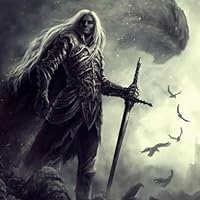
In the time before the Earth was round, the Demon Lords of Darkness sowed magic and misery, beauty and terror across the lands. This 3-in-1 volume
Night's Master. He was Azhrarn, the Demon Lord of Night, and in his Underearth palace he reigned amid his own most glorious creations. Yet always he returned to the surface world to wreak his spells, destroying human love with scarce a thought - until a new force tried to gain control above. And Azhrarn, who had preyed upon mortals for so long, now had to fight to preserve them.
Death's Master. When Uhlume, Lord of Death, made a bargain with an earthly queen, he opened the way to a future challenge to his own rule over all things mortal. For Azhrarn, Night's Master, had also been taking a hand in human affairs, and when the magic of two Demon Lords crossed, not even a Lord of Darkness could predict the final consequences!
Delusion's Master. He was Chuz, Lord of Madness, and he alone would defy Azhrarn's might. If Azhrarn chose to make a woman into a god, Chuz would play a game of his own design with Demon and mortal alike; a game that would result in life, death, and an ages-long conflict between Demon Lords.
Tanith Lee was a British writer of science fiction, horror, and fantasy. She was the author of 77 novels, 14 collections, and almost 300 short stories. She also wrote four radio plays broadcast by the BBC and two scripts for the UK, science fiction, cult television series "Blake's 7." Before becoming a full time writer, Lee worked as a file clerk, an assistant librarian, a shop assistant, and a waitress.
Her first short story, "Eustace," was published in 1968, and her first novel (for children) The Dragon Hoard was published in 1971.
Her career took off in 1975 with the acceptance by Daw Books USA of her adult fantasy epic The Birthgrave for publication as a mass-market paperback, and Lee has since maintained a prolific output in popular genre writing.
Lee twice won the World Fantasy Award: once in 1983 for best short fiction for “The Gorgon” and again in 1984 for best short fiction for “Elle Est Trois (La Mort).” She has been a Guest of Honour at numerous science fiction and fantasy conventions including the Boskone XVIII in Boston, USA in 1981, the 1984 World Fantasy Convention in Ottawa, Canada, and Orbital 2008 the British National Science Fiction convention (Eastercon) held in London, England in March 2008. In 2009 she was awarded the prestigious title of Grand Master of Horror.
Lee was the daughter of two ballroom dancers, Bernard and Hylda Lee. Despite a persistent rumour, she was not the daughter of the actor Bernard Lee who played "M" in the James Bond series of films of the 1960s.
Tanith Lee married author and artist John Kaiine in 1992.
A classic that deserves to stand the test of time. Lee takes old things -- old myth forms, old storytelling forms, etc. -- and makes them fresh again for modern eyes. My only frustration with these tales is that the form, which jumps from one character's tale to another, makes it hard to stay focused on any one of them, and sometimes I really wanted to. (I have the same frustration with Cat Valente's "The Orphan's Tale" books, which use the same format in an even more modernist reimagining -- also recommended.) It's clear that the problem is me, not the writing... but nevertheless I liked but did not love these tales, hence four instead of five stars. Still, for people who like this storytelling form, this is a near-perfect fusion of old and new.
Così epico, così sensuale, così meravigliosamente fantasy. Che scrittura Tanith Lee e che personaggi.
I primi tre libri del "Ciclo della Terra Piatta", ci presentano una moltitudine di personaggi divini, umani e demoniaci, il male e il bene si mescolano tanto da confonderci e da farci dubitare della stessa distinzione. Tre sono i sovrani che ci vengono presentati in questa raccolta: Uhlume, il Sovrano della Morte, Chuz, il Sovrano del Miraggio e Azhrarn, il protagonista indiscusso, Sovrano della Notte. Il primo libro sembra essere più che un romanzo, una raccolta di racconti, tutti volti a evidenziare e portare alla luce il personaggio di Azhrarn, il filo conduttore che li lega uno all'altro. E così scopriamo chi è il Signore delle Tenebre, bellissimo e terribile, capace di grandi passioni e grandi vendette ("Quello che un demone desiderava, e poi perdeva, lo distruggeva"), immortale e invincibile, con un unico punto debole: gli uomini. Nel momento in cui si passa ai due romanzi successivi, ci si aspetta di abbandonare la figura di Azhrarn e di passare ai successivi due sovrani. Sarà così, ma solo in parte, continuerà a giocare comunque un ruolo fondamentale. E Uhlume, così ligio al dovere e apparentemente privo di emozioni, e Chuz, la pazzia fatta demone ("Andava raramente dove non era voluto, dove la follia non era davvero arrivata prima di lui"), si troveranno a dover fare i conti con il Signore della Notte. E, come ci viene detto, una guerra tra Sovrani non era mai stata portata avanti e loro stessi ne avevano paura. Non ci sono però solo i demoni, ma anche uomini e donne, di grandi valori e reietti della società, fortunati e sfortunati, che subiscono e a volte provano ad affrontare il potere dei Sovrani, senza i quali i romanzi perderebbero il loro significato. Anche gli dei sono presenti, anche se più a margine e non sono esattamente quello che ci si aspetta. O forse si?
È stato un viaggio bellissimo e fantastico. Inoltre, l'edizione cartacea della Oscar Vault è veramente un piacere per gli occhi.
Spero tantissimo nella traduzione dei due volumi successivi.
The Flat Earth series is high fantasy fiction at its best. The personifications of evil, death, and madness interweave their stories set in a medieval flat earth afloat in darkness and chaos. This book contains Night's Master, Death's Master, and Delusion's Master.
Wildly inventive mythological storytelling at it's best. Love the use of language it's rich texture and complex plots I knew nothing about Tanith Lee or her work, I was just pursing my friends reading lists and I just thought the title looked interesting, knowing nothing more than that I ordered the book and was surprised to find it was over 700 pages. (So incurious was my initial attraction that I hadn't even looked up how long it was or what reviews it had) I almost didn't read it as a result. I've often stated that I have a hundred pages rule, if the book doesn't grab me by then I set it down and start something else) Well it takes awhile to get into it but I'm glad I did and by the end of the first book, (this is a combination of three books) I was hooked. So the story of Azhram was pretty good, the second one Uhlume kind of slowed down and the last one Chuz was alright, there was one part of the story which left me confused because I was expecting something amazing when Azhram and Dunizel first meet, all I can think is that that story is being held back for the next book. (which I plan to read) Yes very intelligent book I enjoyed it.
The short stories flow into one another nicely from character to the next character covering hundreds of years. I was impressed with the imagination and was pulled along...but
The sex in the stories, while not erotic, became overwhelming in scope. From m/m to demons getting it on with talking insects/reptiles to rape, f/f, bestiality, necrophilia, hermaphrodite relationships that result in a lot of confusion, seduction, and ending with an anal pregnancy. I may have forgot some, albeit gladly.
Misery, hate, unhappiness. Was there just two begrudging happy endings in all those hundreds of pages? I guess this is for those that like feeling despair after reading.
il sovrano delle tenebre 4.5/5 il sovrano della morte 4.75/5 il sovrano del miraggio 4/5 ci ho messo quasi quattro mesi a finire questo omnibus, ma ne è valsa la pena. la scrittura di tanith lee è molto particolare, quasi "mistica", e la sua immaginazione davvero vasta e vivace. sono felice di aver finalmente letto un'opera di questa autrice di culto, ma vorrei che la mondadori non facesse la solita giocata di mollare le traduzioni a metà. probabilmente mi toccherà recuperare il resto della serie in inglese.
This is an omnibus of 3 books in the series. I've only finished the first book so far, so this review is only based on that.
Night's Master- 5 stars Night's Master, the first book, is made up of a series of interconnected stories all related, directly or indirectly, to Azhrarn, the Demon Lord who rules the Underearth. These are really dark, adult fantasy tales that deal with themes of love, lust, greed, etc. The characters that populate Tanith Lee's world aren't necessarily likeable-- which actually, is refreshing and makes me enjoy the book more. So often writers try hard to create characters that we like and can root for, but I like the fact that Tanith Lee seems to just write characters that do what they want, and what makes sense for them, rather than trying to write them to be appealing to readers. Would I want to be friends with her characters? No, I'd probably run away if I ever met most of them, but they are fascinating to read about, and I find them very human, embodying so many relateable and recognizable emotions, obsessions, lusts, flaws... I find a little of myself in them.
The world building of the Flat Earth is pretty ambiguous. It is a world of exotic magic and mystery. Lee doesn't spend too much time developing it, but it doesn't take away from her stories at all. The mystery is part of its charm. I do love the little glimpse we get of the world above-- the gods who created this world are now bored with it, living in the book's version of "heaven", apathetic to the existence of human beings. So naturally, that leaves the demons who find entertainment in meddling in human affairs.
Majestic and dark and brooding and fun! Lee's odd style of macabre and eldrich description if similar to Lovecraft's, but much more entertaining, with her straightforward and deceptively simple storytelling.
I enjoyed this book, but it was hard to get through. It is essentially a book of short stories, but every short story impacts the others. It was very interesting, overall. Basically fairy tales from a demon's point of view. As you might expect, it was rather dark.
This is actually three books in the series in one. It opens with a bizarre m/m erotica scene with the prince of demons and some poor human and goes sideways from there. Each chapter is a depressing and sad story of demons meddling in the lives of humans back "when the earth was flat" meaning a really, really long time ago when gods and demons still existed. The plots are weirdly strung together in a very loose fashion. The characters rarely deserve the poor treatment they get and their lives (almost) never end well. I wanted to give up on this hot mess but I felt like i'd miss out on something enlightening. Or something. Spoiler alert: I wouldn't have missed a thing. And I didn't even finish the last part. It was just more sad, depressing chapters that don't end well for anyone except the demons. And they don't even care. Nor do the gods who pointedly have given up on humanity. 2/5 stars. And that's generous.
Il Sovrano delle tenebre 4 ⭐ Il Sovrano della morte 5 ⭐ Il Sovrano del miraggio 3 ⭐
All'edizione posso dare solo meno di una stella, visto che Mondadori, che purtroppo ha quasi il monopolio del fantasy in questo povero Paese, è ben felice di sfruttare una saga tradotta a metà per pubblicare un tomo da vendere a trenta euro. Era così difficile fare lo sforzo di tradurre tutta la serie della terra piatta? No, non era difficile, ma è fin troppo facile fare le cose fatte male e venderle perché hanno belle copertine.
Veramente affascinante, scritto in maniera suggestiva che ricorda effettivamente lo stile de Le Mille e una Notte, nella grande varietà di personaggi e come da un unico filo conduttore diverse storie e vicende si intrecciano fra loro
Tanith Lee is such an underrated author. Even with the strangest stories her gorgeous prose shines through. Her dark fantasy is unmatched. I’m so in love with her writing style - it feels like reading poetry.
Lyrical and mythic dark fantasy world somewhere between Arabian Nights and Brother's Grimm. Morally ambiguous demons, uncaring gods, and humanity in all its shades from splendid to sordid. Lush and sensual to severe and heartbreaking. The moral of this story is one a good many moralists would need well served to consider. Several LGBTQ characters.
This is one of the books that made me fall in love with Tanith Lee. I guess Lord Chuz would understand. I love the way she portrays each of the Lords of Darkness as as starting out as a pure form of itself - Azhrarn IS Wickedness, Uhulume brings death by simply existing, and Chuz makes no sense. And yet, each is ultimately undone by his own nature. Azhrarn finds it in himself to show compassion, Uhulume gives his sovereignty to another, and Chuz is caught in his own net. I found myself particularly drawn to the female characters in the book. I've always had a special place in my heart for Zorayas. I know - she's a baddie, but look how she GOT that way. Narasen, tricked and betrayed, refuses to stop 'Queening it' even after death. Jasrin, betrayed by love finds her only solace in the madness that makes her believe in her philandering husband.
I re-read my favorite Tanith Lee books at least once a year. There's something about her style of writing that makes reading her books so visual. She can really make you see, feel and hear the Flat Earth. As usual, she plays with beauty and ugliness, love and death, sexuality and sterility. She's always a study in contrasts.
This entire review has been hidden because of spoilers.
I would give this book a million stars if I could! Tanith Lee can not be beat for fantasy. Lord Azhrarn is simply one of the most amazing characters ever created. He is the Prince of Demons, as full of evil and shadows as the night, but his evil is subtle, seductive, and beautiful. The pain he inflicts is a pleasure, mortals his toys to play with, break, grow tired of and forget. The other Lords of Darkness have their charms, but you will find yourself waiting as if for a lover for the reappearance of Azhrarn. In Death's Master and Delusion's Master he shows us he is worthy of our adoration, but as is his way he is folded up in his cape as eagle's wings, and once again gone with a sparkling flash of his night colored eyes. If you have never read Tanith Lee before BUY THIS BOOK! It has mature subject matter, but that didn't stop me from reading it when I was 15 and falling completely in love with Night! All three of these books are sort of connected. Night's Daughter is the sequel, but centers more on Azhrarn's daughter, but he is in it enough to make it nearly as gorgeous.
Being a storyteller I'm always on the lookout for different/odd tales (really tired of all the personal narrative stuff and standard stories). Wow!! Tanith Lee takes very familiar archetypes and twists the stories until they are just about almost familiar but with darker plots.
I'm already telling original stories based on some of the characters. Here's the beginning of one of them (just to be sure I'm probably going to have to rename the character)
Azhrarn, Lord of Demons, Prince of Nightmares, was in love. He raised his darkened eyes and peered through narrow crystal windows out onto the world of men . . .
Of course with storytelling, you don't freeze the words on pages. You elaborate, polishing here, deleting there - as the telling requires.
'Night's Master' - 4* - a collection of linked myth tales about the darkest of demon lords and his manipulation games with humanity, the first in this series reads more like a vintage mythology book than a plot-driven fantasy novel, and that's a wonderful thing. vain kings, wicked sorceresses, blind seers, and lovers of all stripes have their lives cracked and shaped by their collisions with Azhrarn's power. by the end, little pieces of story that were dropped in the beginning get picked back up and placed into a satisfying conclusion that's all about the subtle delicacy of her writing craft. Lee's lushly dreamy language was already well-honed, despite this being one of her earlier books.
While reading this I kept thinking, only Tanith Lee could write like this. I don't know how she does it: Her Flat Earth is so vast, yet in these three novels, which aren't long, she immerses you so deeply. From the vantage point she gives you, her characters' lives are short but you are attached to them in that short time. How can her world be so engaging yet so all-encompassing? The only answer is the obvious one: She's goddess as well as an author, for how else can she give this extra meaning to the omniscient narrator?