Jump to ratings and reviews
Rate this book

For Beginners

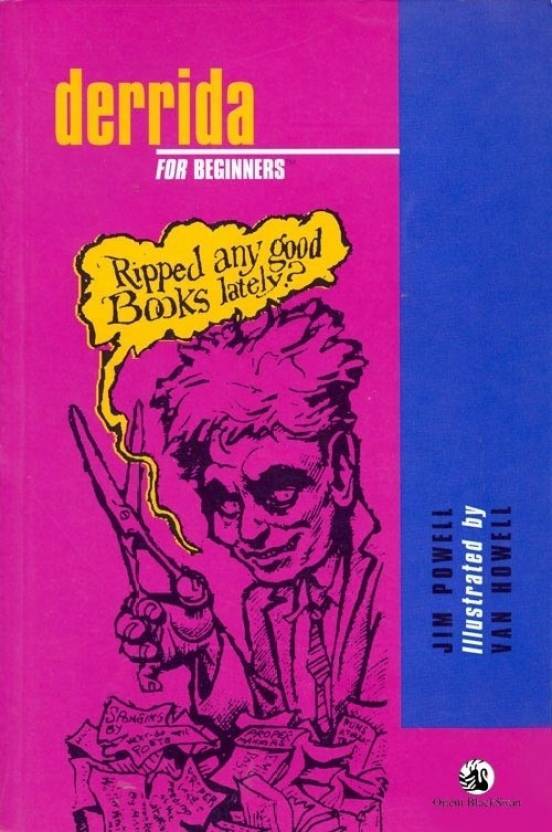
Derrida for Beginners

Rate this book
The documentary comic books of the for beginners series deal with complex and serious subjects they attempt to intimidate and uncomplicated the great ideas and work of great thinkers the movements and concepts dealt with are placed in their historical, political and intellectual contexts the books are painstakingly researched, humorously written and enlivened with classic comic-strip illustrations, photographs, paintings, etc the range of subjects covered is truly vast and varied - malcom x and the new age guru castenanda, shakespeare and foucault, jewish holocaust and arab and israel, structuralism and biology

197 pages, Unknown Binding

First published January 1, 1982

52 people are currently reading
395 people want to read

About the author

James N. Powell

14 books1,195 followers

~ New York Times

Most people think they use language to communicate. But language is insidious; it determines the way we think. Modern philosophers say we live in a universe limited by our language. Ludwig Wittgenstein even said we were ''bewitched.'' James Powell goes a little further. He examines the symbols of language the way a biologist examines cells. By inquiring into the nature of symbols themselves, he hopes to show the transcendental capacity of language not for mere communication but for ''communion.'' He assures us that the universe is a silent partner in a dialogue that goes on all the time and that throughout history certain images and techniques of meditation have led consciousness to break through the limitations of language.

Mr. Powell argues that we tend to underestimate the volatility of symbols. In world politics, we can easily see the danger of a breakdown in communication. When one world of meaning has no reality for the other, dialogue stops, sometimes violently. If the breakdown is taken as a failure in communication, in which each side sees the other as willfully irrational, the result is explosive. If, however, the failure is seen as a collision of symbol systems, each of which has absolute internal reality, then dialogue may be pursued with a different understanding. 'The Tao of Symbols is Mr. Powell's attempt to bring occupants of different worlds together (Buddhist and Moslem, scientist and sage) and to suggest the basis for a new kind of dialogue.


Some Suggestions for Interreligious Dialog


In addition to his published works, Jim Powell collaborated with Imogen Cunningham on a photographically illustrated translation of the verse of St. John of the Cross. James Powell: As a boy, James’s chores included keeping coyotes out of the chickens, riding fence, branding, milking, and harvesting. Since then, his jobs have changed quite a bit. He cut line for Smokey on many western wildfires–working winters surveying and building trails, while gradually awakening to Chumash and Vedic wisdom of fire ecology.

James has also taught meditation around the world, including to Michael Jackson's Neverland staff, Beach Boy Mike Love’s family, and Lithuanian-born archeologist Marija Gimbutas. The California meditation center he chaired for ten years provided ongoing instruction for over ten thousand Santa Barbarans. What’s more, he was Ayurvedic consultant to Deepak Chopra and Arianna Huffington at the Center for Perfect Health–which he co-founded–with Deepak's lectures drawing audiences of over 1,000. He collaborated with Group f/64 photographer Imogen Cunningham on a photographically interpreted book of his translations of the verse of Spanish mystic San Juan de la Cruz. The project was under consideration at various publishing houses when Imogen passed away.


Prologues to What Is Possible

1.

There was an ease of mind that was like being alone in a boat at sea,

A boat carried forward by waves resembling the bright backs of rowers,

Gripping their oars, as if they were sure of the way to their destination,

Bending over and pulling themselves erect on the wooden handles,

Wet with water and sparkling in the one-ness of their motion.


The boat was built of stones that had lost their weight and being

no longer heavy

Had left in them only a brilliance, of unaccustomed origin,

So that he that stood up in the boat leaning and looking before him

Did not pass like someone voyaging out of and beyond the familiar.

He belonged to the far-foreign departure of his vessel and was part of it,

Part of the speculum of fire on its

Ratings & Reviews

What do you think?
Rate this book

Friends & Following

Create a free account to discover what your friends think of this book!

Community Reviews

5 stars
91 (23%)
4 stars
158 (40%)
3 stars
118 (29%)
2 stars
23 (5%)
1 star
4 (1%)
Displaying 1 - 29 of 48 reviews
Profile Image for Fergus, Weaver of Autistic Webs.
1,270 reviews18.3k followers
March 22, 2025
For a woebegone wastrel as I was in the My-Way-or-the-highway, Push-Comes-to-shove 1980's - that endlessly reiterative and Circuitous Power Maze of the Me-Generation - this little salvo of a primer WOKE ME UP.

And Suddenly, I was ONTO this recondite man’s thought.

I SAW THROUGH the concept of the Trace - that monolithic apparition of the supposed inviolable solidity of the Dark Other of Pax Americana.

Derrida changed my world.

Made it straightforward.

AND gave it DIRECTION.

You’ll begin to UNDERSTAND HIM if you read it - and you’ll see that understanding HIM is just the tip of the modern iceberg.

But then, like Dr. Seuss says, “oh, the Places You’ll Go!”

It was the beginning of MY OWN PERSONAL WAY OUT OF AMERICA'S FINAL ANSWER TO POSTMODERNISM, the Male Ego.

It can do that for you, too...

Especially if you’re flummoxed In your search for take-away truth in this constant Disneyesque media barrage -

That makes us perpetually “distracted from distraction BY distraction.”

WHY are we always prey to distraction? Where is the Peace we knew as kids? Well, Derrida says, the secret is in the Traces of evil in our mind. To see through them is to see through our distractions - caused by real roadblocks in our mind.

These roadblocks are unpleasant Traces of the Other. And the Other is any person who has caused us grief in our lives in the past or present. When a Trace is activated, it causes stress - which comes from related thoughts falling in our heads like dominoes.

Some tones or inflections of a friend's voice will take us back to chthonic memory fragments from our distant past.

The Truth, as a wise-guy wag once ironically said, is Within!

And Derrida knows for sure “what’s bin did & what’s bin hid" by our mental machinery.

He’s not easy to read at the best of times, though, and this Easy-Reading Illustrated Summary of his main drift’ll get you up & running and SET YOU OFF ON THE RIGHT PATH!

Highly recommended.

A MUST-READ if you want to understand this new panacea to the garbage-in-garbage-out media mindset.

FIVE Easy-to-Grasp Stars.
Profile Image for Sam Hunter.
51 reviews
May 28, 2012
If you are afraid to read this book because you don't want people to see you reading a "for beginners" book publicly, think about it this way; anybody who doesn't know who Derrida is won't care, and anybody who does know who Derrida is will appreciate any attempt to figure out what the heck he was saying. I'm a big fan of post-structuralism and the writings of Derrida, and I picked up this book for some light reading- but it is definitely not light reading. This is a tough book that you need to devote some time to, because nothing Derrida ever wrote or said was simple in any way. I feel a lot more confident using the work of Derrida with the help of this commentary, and I'll definitely recommend it to future students and classmates.
Profile Image for Adriana Scarpin.
1,733 reviews
May 21, 2016
Estou até vendo eu misturar (propositalmente) Derrida com Lacan na prática clínica. Rá!
No mais esse livrinho é bem interessante e um dos melhores como introdução ao pensamento de Derrida, porque essa série pode ser para principiantes e cheios de figuras, mas nenhum deles pega leve na conceituação teórica.
41 reviews4 followers
May 1, 2007
Another great entry for this series. If you've ever heard the word/process/concept of "deconstruction" then you've been reading/listening to someone influenced by Derrida. He was a prolific writer so this introductory book focuses on his initial development of deconstruction and explains how deconstruction works. The gist of deconstruction is that no text is univocal and, thus, all texts are open to multiple interpretations. Deconstruction usually happens in the form of identifying and interpreting binary oppositions within the text. A binary opposition is something like male-female, mind-body, presence-absence, subject-object, etc. If you have any interest in doing or learning about textual criticism, this is a good place to start.
Profile Image for Katia N.
710 reviews1,108 followers
February 28, 2019
I picked this up as i am currently watching Yale's course on "Introduction to the Theory of Literature" with brilliant Paul Fry. I find it very informative and entertaining. There is a book accompanying the course Introduction to Theory of Literature.

He set to read infamous Derrida's Jacques Derrida's Structure, Sign, and Play in the Discourse of Human Science which I've read a few times before I've got anything out of it. But then I found the essay and his way to write fascinating and intellectually stimulating. So decided to explore a bit more and I've read this well written, not very serious introduction. It walks through major Derrida's works in an easy-digestible way. I am charmed by Derrida.
Profile Image for Benoit Lelièvre.
Author 6 books186 followers
June 27, 2016
Jacques Derrida is kind of a collective frustration for most intellectual people (such as myself) and I have made my mission to get at least a basic understanding of his philosophy. DERRIDA FOR BEGINNERS isn't exactly a one stop shop (Jim Powell wrote other volumes on the canonical French thinker), but it's a pretty darn great starting point. Powell gives historical and cultural insight on how post-structuralism came to be and how Jacques Derrida came to occupy such an important place in that movement.

That gave the reader an engaging canvas to answer the questions : why is Derrida important and why Derrida does the things he does. I now have a basic understanding of what: decentering text in the Western Occidental tradition means and why it's important to us here and now. I've always been a very bricks and mortar guys (unlike Derrida) and Jim Powell cleverly makes the bridge between such an abstract and difficult thinker's philosophy and the here and the now (Hegel would roll his eyes at that sentence). If you're one of these crazy people like me who enjoy the process of decoding philosophical though, the books of Jim Powell are pretty amazing at it. Consider me hooked. I will not stop here.
61 reviews3 followers
September 15, 2016
Don't let the comic book aspect of this fool you. This is actually pretty dense, yet it only touches on the general idea behind Derrida's deconstruction. I do feel, though, that I can finally read something from Derrida and not be completely lost, and I can also start forming some opinion on whether or not I agree with his claims, but, still, I'm not absolutely clear on what Derrida actually wanted to accomplish through his complete inversion and evisceration of Western philosophy - even after reading this book. If you want something that will provide some comfort for stepping into deconstruction, then this is a pretty good start, but, ultimately, you'll just have to read Derrida straight up to get a fuller understanding of his philosophy. Godspeed, moon cat.
Profile Image for David.
42 reviews2 followers
September 16, 2007
This book is fun. Very easy to read, lots of cartoons!

And very insightful into the life of a conflicted, brilliant man. Insightful into his difficult-to-grasp writings as well.

Highly recommended to anyone living in the U.S. (or the West altogether) born between 1930 and the date you read this post.
Profile Image for R L.
8 reviews
Read
July 13, 2018
Embarassed I read this but not embarrassed enough to skip out on the reading goal progress
Profile Image for Adam.
997 reviews241 followers
November 30, 2014
Derrida is at the heart of the post-modern movement in philosophy and it seemed valuable to get some idea of what his ideas were. In Powell's lucid and clever presentation, it becomes clear that he did advance a preponderance of pomo premises in both philosophy and literature, but also why his works are notoriously abstruse and stymying. Throughout the book, I kept thinking "yes, that's a core tenet of my worldview and something that makes a lot of sense, but why did he ever choose to explain it like *that*?"

Much of Derrida's early career developed his arguments by critiquing some pretty low hanging philosophical fruit. The core tenet of deconstructionism, that there is no grounding center of meaning, is defined against dichotomies that are so absurd as to seem strawmen (Christian v. pagan? seriously?) A lot of this surely stems from hindsight - it seems obvious that man v. woman is a false dichotomy now, but that's perhaps only because I've grown up in a world in which Derrida is old-hat. Still, the idea that the philosophy community would have taken these dichotomies seriously at face value at any time within the last hundred years seems unlikely. It's neat to see Derrida premise this discussion in social power hierarchies, following Marx in making philosophy cognizant of its material and cultural contexts. But the invocation of cultural context makes the dichotomy concept seem even more absurdly simplistic. I guess it's just meant to simplify the concept for explanatory purposes?

Next he hits Saussure, who had the poor sense to label writing as 'evil' in a book he wrote to be published. Saussure provides the idea that both symbols and concepts exist in a network of difference from each other, rather than through referents to real objects. Derrida simply removes the obvious fallacy from Saussure's conclusions to derive the postmodern idea that languages are independent systems that can never firmly anchor themselves to things-in-themselves.

If Saussure's ideas about writing are embarrassing, Rousseau's concepts are unmentionable. Yet Derrida saw fit to take the time to undermine his authenticity myth bullshit. He seemingly uses Rousseau as a kind of caricature of Romanticism that he applies to Levi-Strauss and from there, we infer, to the entire scientific enterprise. Despite all its attempts at objectivity and provisionality, scientists are still beholden to the desire to ground their findings in some Absolute Reality. But Powell doesn't give the impression Derrida spent much time thinking about philosophy of science, unfortunately – that is one of the most interesting applications of postmodern thought for me. He even bothers to critique Plato, of all people.

Derrida apparently had a flair for wordplay, and many of his middle period works are more examples than explanations of his ideas (even more so than his early works). This playful writing is probably even more difficult to parse than jargon-laden technical philosophy, in its own way. Anyway, one of these works, The Double Session, exhibits the idea that Masamune Shirow dubbed the “Stand Alone Complex” - a series of imitations without original referent. What hadn't occurred to me before (and the book never made this connection) is that this is a mirror of Derrida's ideas about language, that like concepts and words in a language, every component of a culture is defined by its difference from the rest in a chain that refers only to other components, not to reality itself. Reality as we know is just a social construct built on references to previous socially constructed realities. Wheeeeeeeee

Derrida's next work is seemingly his most arcane, a metatextual commentary that blows apart lines between text and commentary and previous texts. This sounds like a perfect nightmare to read, but it also seems to embody the same thesis Barthes presents lucidly in Death of the Author: the work exists both on its own and as a separate text including its relationships with every set of commentary, context, author bio, and references that a reader chooses to associate with it.

I love Derrida's concept of Hauntology, a contrast to Ontology, mostly because his fun is so accessible (very fresh and spooky skeletons). The neat thing about this is that it applies the play of meaning of deconstructionism to social zeitgeists and concepts. Deconstruction's first examples concern simultaneous interpretations from different perspectives (dominant and marginalized), adroitly analogized to the Rubin Vase – both a face and a vase are there, and the point of deconstruction is to be able to freely shift back and forth between the two, acknowledging that neither is more justified by the image itself. Hauntology makes this plural and temporal: historical ideas about reality are ghosts, interpretations that exist for a moment and are superseded by new ones in a ceaseless evolutionary process. It's a neat phrasing of a neat idea that gracefully explains postmodernism's fixation with things becoming passe.

I'm quite glad to have read this and get a much better sense of where some of these key postmodern ideas came from in their early development. Derrida seems extremely clever and fun and probably very funny depending on your sense of humor. But his works are evidently obsessed with their own originality, fixated on elaborate rhetorical word games, and extremely averse to clear statements of their own theses. Powell gave me everything I need to know about Derrida, at least for now.
Profile Image for Bradd Saunders.
63 reviews6 followers
Read
July 27, 2021
A book like this might seem silly on the face of it. To take something as esoteric as Derrida’s “philosophy” and reduce it to a book of clever pictures, questions and answers girded with easy-to-digest statements might, on the face of it, seem foolhardy. But as Einstein once said, “If you can’t say it simply you don’t understand it well enough.” Any thought process that can’t ultimately be reduced to something somewhat simple probably doesn’t have what it takes to work. Given that, this book is a good place to start for people who care to know something about deconstruction but don’t want to go to the trouble of trying to decipher it. It’s quite possible that Derrida would have loved it.

What might be the most telling part of the book is the short biography of Derrida in the beginning. A Jew living in an intensely prejudiced Algeria, he lived his early life as someone persecuted and marginalized, an outsider because he and his family did not represent the mainstream of Algerian power and culture.

This experience probably did more to shape him and his thought than anything he would have read in a book. To maintain that every culturally accepted truth is replete, finally, with a subjective and ultimately arbitrary bias is a way of saying that the people in charge and their way of thinking are no better than they people they ostracize or condemn.

And of course Derrida was right, at least right enough to have created something revolutionary. Every idea that needs a word to be recognized as an idea can be shown to have a hidden “marginalized” truth of its own that exists in contradiction to it. Derrida said that the attempt to center anything in some kind of fixed way results only in a process of binary opposites, like a snake continually devouring itself in an endless process of creation and destruction.

His ideas turned the academic world on its head and helped pave the way for the marginalized in various societies to make a case for their own way of thinking, introducing a text-based cult of even-handedness that permeates almost everything in Western culture today. Deconstruction did not create political correctness, but political correctness would not be possible without it. And yet it is also not possible within it.

That’s because deconstruction has difficulty with morality, the idea that there are things that are not beyond good and evil, actions and thoughts with real and tangible effects that hurt people in ways that are beyond any effort to deconstruct them. The best example of this is in the problem of Paul de Man, a deconstructionist colleague of Derrida who was ultimately found to have been a Nazi journalist during World War ll in Belgium. In an effort to defend de Man, Derrida did what he could to deconstruct the many articles he wrote in support of Nazi ideology, but the attempt itself only served to discredit his school of thought.

It’s hard to imagine that Derrida’s thought could have been possible without Einstein and relativity, or quantum mechanics and the uncertainty principle, discoveries which prove that the world itself, at its most fundamental level, resists the fixed and permanent and exists only as an interplay of probabilities arising in momentary “differences.”

This book is cogent and effective and shows that as a tool deconstruction is liberating, but as a belief, it’s a noose.
Profile Image for Avery.
35 reviews3 followers
October 31, 2018
A strong introduction to Derrida's thought. Even in this very simplified and accessible form, his work is pretty mind-bending and at times hard to grasp, but it's equally thought-provoking and fascinating. The book does a good job of laying out the core concepts of his philosophy, its background, and the often dramatic objections to it. I haven't read any primary texts from Derrida yet - I read this to get some baseline knowledge to make it easier when I move onto his actual writing - so I can't say how well it truly represents his ideas, but it seems pretty well-executed. Deconstruction is a useful lens for viewing just about anything through, and something worth thinking about in an increasingly stratified world. Don't be scared off by the "For Beginners" title, this is a good intro to an important and controversial modern philosopher.
Profile Image for Michael P..
Author 3 books74 followers
December 7, 2010
If you believe that when you say, “The fire truck is red,” you get to determine that red refers to the color and anyone who insists you mean, “The fire truck is socialist,” is wrong, you will not like Derrida. He insists that the socialist option is valid. While speaking and writing are not the same, Derrida insists they are as opposite as poison and cure. Derrida was certainly wrong. A lot. Based on his latter speeches, I believe he was a fraud. He fooled thousands of people. This book does a fair job explaining some of the things he claimed to believe.
Profile Image for Caleb Greenwood.
41 reviews4 followers
July 14, 2017
I read through this a year ago without an awareness of the mammoth Derrida was. Now as I dive into post- modernism, this was an invaluable primer.

As with most books in this serious, For Beginners offers a great survey of material. Although surface level due to its brevity (and I don't think I fully completed the Derrida book), it proves its importance in that you'll understand the whole picture when getting into deeper works.

Even if you don't feel competent reading Derrida himself, this overview is important for post-modern discussion.
Profile Image for Niral.
212 reviews5 followers
Read
February 24, 2012
Have to give this book some love for even attempting to explain in clear prose (and poke fun at) notoriously abstruse, academic knowledge. It's what every grad student is thinking: why can't they just say what they mean minus the jargon and lofty, circular language? Being new to Derrida, I can't say whether this book adequately represents the man's ideas. Still, a spirited effort is a spirited effort.
Profile Image for Ant.
674 reviews6 followers
May 25, 2018
A lovely introduction to a very complex thinker. It gives a nice insight into the playful nature of Derrida's deconstruction. Not to say that Derrida wasn't serious about his work, more that he didn't seem to feel the nihilism that some have felt by drawing different conclusions from his work.

I will admit to watching a few lectures as well to help get my head round the concepts. These also reinforced the views in the book - which made me feel that the author had a handle on subject matter.
33 reviews1 follower
Read
February 4, 2008
As with any intro book to a complicated thinker/topic, there are points that I think are covered well, and places where I think important information is missing. As an introduction, it serves its function well enough. But my own understanding of Derrida is colored by interpretations not represented here.
Profile Image for Michael.
20 reviews
June 11, 2008
Let's start with the obvious: Derrida is complex. Very complex. Even a lighthearted comic book presentation can't overcome that, but it's a fun way to try to understand the basics of his philosophies. If you love the minutia of language and meaning then exploring Derrida's ideas is a good way to gain perspective on how humans communicate.
Profile Image for Lia Lowenthal.
42 reviews6 followers
March 20, 2009
i'm kind of embarrassed to admitting reading this, but who cares. i found it in JB's library, and it had a lot of wear on the spine, so i think he liked it too... in any case, i've read derrida before, but i feel i needed some preparation before i hit up 'truth in painting.' it's pretty concise. it's goofy, but it's very thorough. thumbs up.
Profile Image for Elizabeth.
20 reviews10 followers
April 23, 2011
what a delightful romp through philosophy with all the cartoon characters and the silliness and jokes along the way. What a fun way to dip one's toes into any subject at all in this series. I am much smarter now and can discuss deconstruction as well as anyone. I'm a big fan of these books. They are a joy to read. Looking now to read the "Philosophers for Beginners" now.
Profile Image for Beth.
80 reviews7 followers
January 29, 2008
Still digesting this one. I really love the way that Derrida thinks, even if I don't understand half of it ;o)
Profile Image for Sally.
333 reviews16 followers
Want to read
September 19, 2008
What kind of magic would it take to get the CSU library to stock this book?
Profile Image for Ahimaaz R.
60 reviews5 followers
December 14, 2010
A real decent intro to Derrida makes me really want to read a Derrida for real
Profile Image for Holly Raymond.
321 reviews41 followers
December 25, 2012
This was a pretty good little comic book about Derrida to read on the river banks in Manayunk.
Profile Image for Kunjila Mascillamani.
123 reviews18 followers
June 18, 2015
Meaning is fascist.
Don't understand why most philosophers are obsessed with translating all of it to hymen. Such an insignificant entity.
Derrida rocks.
Displaying 1 - 29 of 48 reviews

Can't find what you're looking for?

Get help and learn more about the design.