

What do you think?
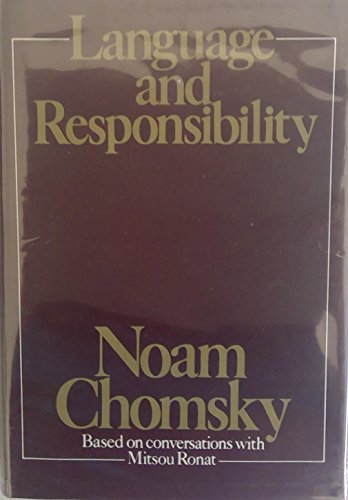
Language and Responsibility: Based on Conversations with Mitsou Ronat
From back cover:
America's foremost linguist and perhaps its most controversial political critic brings together both sides of his life and work in this wide-ranging, informal, and highly acces sible work. Published in the form of dialogues with Mitsou Ronat, Language and Responsibility begins with the themes Noam Chomsky first made so famous in "The Responsibility of Intellectuals" and ends with a remarkably informative, easily understandable exploration of key issues in modern linguistics. Along the way, Chomsky presents a self portrait of his political, moral, and linguistic thinking. He deepens his analysis of American intellectuals, vividly depicting the bankruptcy of American social science; and he offers an illuminating assessment of the American peace movement, Watergate, American foreign policy, Russian dissident intellectuals, a host of other current political issues.
Turning aside from the general ideological beliefs of American intellectuals, Chomsky provides an invaluable introduction to the history of generative grammar. He unveils the controversies that have shaped and structured the under standing of language for the last thirty-five years, and portrays the political social consequences that flow from the behaviorist assumptions so influential in the study of contemporary Society.
America's foremost linguist and perhaps its most controversial political critic brings together both sides of his life and work in this wide-ranging, informal, and highly acces sible work. Published in the form of dialogues with Mitsou Ronat, Language and Responsibility begins with the themes Noam Chomsky first made so famous in "The Responsibility of Intellectuals" and ends with a remarkably informative, easily understandable exploration of key issues in modern linguistics. Along the way, Chomsky presents a self portrait of his political, moral, and linguistic thinking. He deepens his analysis of American intellectuals, vividly depicting the bankruptcy of American social science; and he offers an illuminating assessment of the American peace movement, Watergate, American foreign policy, Russian dissident intellectuals, a host of other current political issues.
Turning aside from the general ideological beliefs of American intellectuals, Chomsky provides an invaluable introduction to the history of generative grammar. He unveils the controversies that have shaped and structured the under standing of language for the last thirty-five years, and portrays the political social consequences that flow from the behaviorist assumptions so influential in the study of contemporary Society.
212 pages, Hardcover
First published January 1, 1977
About the author
Noam Chomsky
1,011 books17.5k followersAvram Noam Chomsky is an American professor and public intellectual known for his work in linguistics, political activism, and social criticism. Sometimes called "the father of modern linguistics", Chomsky is also a major figure in analytic philosophy and one of the founders of the field of cognitive science. He is a laureate professor of linguistics at the University of Arizona and an institute professor emeritus at the Massachusetts Institute of Technology (MIT). Among the most cited living authors, Chomsky has written more than 150 books on topics such as linguistics, war, and politics. In addition to his work in linguistics, since the 1960s Chomsky has been an influential voice on the American left as a consistent critic of U.S. foreign policy, contemporary capitalism, and corporate influence on political institutions and the media.
Born to Ashkenazi Jewish immigrants (his father was William Chomsky) in Philadelphia, Chomsky developed an early interest in anarchism from alternative bookstores in New York City. He studied at the University of Pennsylvania. During his postgraduate work in the Harvard Society of Fellows, Chomsky developed the theory of transformational grammar for which he earned his doctorate in 1955. That year he began teaching at MIT, and in 1957 emerged as a significant figure in linguistics with his landmark work Syntactic Structures, which played a major role in remodeling the study of language. From 1958 to 1959 Chomsky was a National Science Foundation fellow at the Institute for Advanced Study. He created or co-created the universal grammar theory, the generative grammar theory, the Chomsky hierarchy, and the minimalist program. Chomsky also played a pivotal role in the decline of linguistic behaviorism, and was particularly critical of the work of B.F. Skinner.
An outspoken opponent of U.S. involvement in the Vietnam War, which he saw as an act of American imperialism, in 1967 Chomsky rose to national attention for his anti-war essay "The Responsibility of Intellectuals". Becoming associated with the New Left, he was arrested multiple times for his activism and placed on President Richard M. Nixon's list of political opponents. While expanding his work in linguistics over subsequent decades, he also became involved in the linguistics wars. In collaboration with Edward S. Herman, Chomsky later articulated the propaganda model of media criticism in Manufacturing Consent, and worked to expose the Indonesian occupation of East Timor. His defense of unconditional freedom of speech, including that of Holocaust denial, generated significant controversy in the Faurisson affair of the 1980s. Chomsky's commentary on the Cambodian genocide and the Bosnian genocide also generated controversy. Since retiring from active teaching at MIT, he has continued his vocal political activism, including opposing the 2003 invasion of Iraq and supporting the Occupy movement. An anti-Zionist, Chomsky considers Israel's treatment of Palestinians to be worse than South African–style apartheid, and criticizes U.S. support for Israel.
Chomsky is widely recognized as having helped to spark the cognitive revolution in the human sciences, contributing to the development of a new cognitivistic framework for the study of language and the mind. Chomsky remains a leading critic of U.S. foreign policy, contemporary capitalism, U.S. involvement and Israel's role in the Israeli–Palestinian conflict, and mass media. Chomsky and his ideas are highly influential in the anti-capitalist and anti-imperialist movements. Since 2017, he has been Agnese Helms Haury Chair in the Agnese Nelms Haury Program in Environment and Social Justice at the University of Arizona.
Born to Ashkenazi Jewish immigrants (his father was William Chomsky) in Philadelphia, Chomsky developed an early interest in anarchism from alternative bookstores in New York City. He studied at the University of Pennsylvania. During his postgraduate work in the Harvard Society of Fellows, Chomsky developed the theory of transformational grammar for which he earned his doctorate in 1955. That year he began teaching at MIT, and in 1957 emerged as a significant figure in linguistics with his landmark work Syntactic Structures, which played a major role in remodeling the study of language. From 1958 to 1959 Chomsky was a National Science Foundation fellow at the Institute for Advanced Study. He created or co-created the universal grammar theory, the generative grammar theory, the Chomsky hierarchy, and the minimalist program. Chomsky also played a pivotal role in the decline of linguistic behaviorism, and was particularly critical of the work of B.F. Skinner.
An outspoken opponent of U.S. involvement in the Vietnam War, which he saw as an act of American imperialism, in 1967 Chomsky rose to national attention for his anti-war essay "The Responsibility of Intellectuals". Becoming associated with the New Left, he was arrested multiple times for his activism and placed on President Richard M. Nixon's list of political opponents. While expanding his work in linguistics over subsequent decades, he also became involved in the linguistics wars. In collaboration with Edward S. Herman, Chomsky later articulated the propaganda model of media criticism in Manufacturing Consent, and worked to expose the Indonesian occupation of East Timor. His defense of unconditional freedom of speech, including that of Holocaust denial, generated significant controversy in the Faurisson affair of the 1980s. Chomsky's commentary on the Cambodian genocide and the Bosnian genocide also generated controversy. Since retiring from active teaching at MIT, he has continued his vocal political activism, including opposing the 2003 invasion of Iraq and supporting the Occupy movement. An anti-Zionist, Chomsky considers Israel's treatment of Palestinians to be worse than South African–style apartheid, and criticizes U.S. support for Israel.
Chomsky is widely recognized as having helped to spark the cognitive revolution in the human sciences, contributing to the development of a new cognitivistic framework for the study of language and the mind. Chomsky remains a leading critic of U.S. foreign policy, contemporary capitalism, U.S. involvement and Israel's role in the Israeli–Palestinian conflict, and mass media. Chomsky and his ideas are highly influential in the anti-capitalist and anti-imperialist movements. Since 2017, he has been Agnese Helms Haury Chair in the Agnese Nelms Haury Program in Environment and Social Justice at the University of Arizona.
Ratings & Reviews
Friends & Following
Create a free account to discover what your friends think of this book!
Community Reviews
Displaying 1 - 9 of 9 reviews

December 31, 2010
Language and Responsibility is delightful because it is a quick excursion that reaps huge rewards. The book is conversational Chomsky, without the formality of his lectures, but with chapters more or less exploring a single theme and variations as the intelligence of Chomsky and Ronat meander through the puzzles of language — that humans acquire them with ease, even in 'dire' circumstances; social issues around ideology; and media distortions of 'the truth'.
What particularly caught my fancy right now is his examination of 'so-called' empiricism. He argues that to an alarming extent today's scholars, in particular those in the U.S.A., have forsaken 'proper' empirical scholarship for the siren's call of a capitalist ideology that has all but eliminated free debate and argument outside of a very narrow range of 'respected' acceptability.
After starting the book in the middle, I have moved to reading it from front to cover. I'm currently on my second reading of the chapter "Linguistic and the Human Sciences."
See egajd books - read and almost read for additional thoughts and citations.
This is an excellent read!
What particularly caught my fancy right now is his examination of 'so-called' empiricism. He argues that to an alarming extent today's scholars, in particular those in the U.S.A., have forsaken 'proper' empirical scholarship for the siren's call of a capitalist ideology that has all but eliminated free debate and argument outside of a very narrow range of 'respected' acceptability.
After starting the book in the middle, I have moved to reading it from front to cover. I'm currently on my second reading of the chapter "Linguistic and the Human Sciences."
See egajd books - read and almost read for additional thoughts and citations.
This is an excellent read!

July 13, 2016
This is an interesting little book that sums up Chomsky's views on politics, philosophy, and linguistics. The format is quite unique since we're dealing here with an edited transcript of an interview with Chomsky, where Chomsky himself also acts as the editor! For the most part, this works. The tone remains consistently conversational while Chomsky's discussion of philosophical issues that arise from his linguistic inquiry does not lose any of its sophistication. Take the relation between semantics and truth, for example. Chomsky argues that empirical inquiry on meaning does not need to assume such a relation, on the grounds that the truth-condition of a given proposition is quite often context-dependent. He gives an example of the proposition 'the temperature is falling' and asks whether it's true or not. The answer is that the proposition may be true if the person who utters it has in mind recent time-spans, but false if one considers the effect of global warming. Obviously, this example has immense implications for mainstream philosophy of language where the significance of truth to the study of meaning is quite often taken for granted. Another interesting issue is Chomsky's conception of language, a conception that forms the philosophical foundation of his more technical, scientific work. Chomsky takes public languages like Chinese, or English to be vague, geopolitical notions which one cannot properly (or, perhaps, interestingly) theorise about. His notion of language is something quite abstract, namely a component or faculty of the mind which constantly interacts with other cognitive systems. The purpose of the linguist is to correctly identify this abstract structure and explain its properties. Thus, linguistics is a proper part of psychology and the field's sociological, or historical connotations become irrelevant.
The book gets a bit heavy-going towards the end where Chomsky's specific theories are discussed in greater detail. I suspect that much of the content here is quite outdated as well (for example, Chomsky's recent work seems to suggest a breakthrough in semantics where a rigorous, internalist program is now being pursued). However, there's much historical info here explicitly detailing Chomsky's intellectual development, and that can still be of interest. Moreover, Chomsky's radical political views which take about a chapter are quite intriguing and well thought-out.
The book gets a bit heavy-going towards the end where Chomsky's specific theories are discussed in greater detail. I suspect that much of the content here is quite outdated as well (for example, Chomsky's recent work seems to suggest a breakthrough in semantics where a rigorous, internalist program is now being pursued). However, there's much historical info here explicitly detailing Chomsky's intellectual development, and that can still be of interest. Moreover, Chomsky's radical political views which take about a chapter are quite intriguing and well thought-out.

September 5, 2026
Im Gespräch mit Mitsou Ronat analysiert Noam Chomsky sprachliche Themen wie die 'generative Grammatik' als auch die Verbindung von Macht und Sprache. Ich liebe Chomskys direkte Art, zu der hin und wieder auch konfrontative Seitenhiebe gehören.
Hier ein paar Beispiel:
Hintergrundinfo: Er diskutiert den Unterschied der Vorgehensweisen zwischen Geistes- und Naturwissenschaften.
"Nun ja, in Wirklichkeit wurde der Begriff »Grad von Grammatizität« zur selben Zeit entwickelt wie der Begriff »Grammatizität«, innerhalb der Theorie der generativen Grammatik, das heißt in den frühen 50ern. Ein Kapitel in LS LT ist dieser Frage gewidmet, und ich beziehe mich in Syntactic Structures ebenfalls darauf. Wichtiger ist aber, wieder einmal den Unterschied zwischen der Einstellung der Naturwissenschaften auf der einen Seite und einer, die häufig in den Sozialwissenschaften oder den »Geisteswissenschaften« auf der anderen Seite anzutreffen ist. Die letzteren, denen der intellektuelle Anteil der Naturwissenschaften fehlt, haben in einem hohen Maße mit Persönlichkeiten anstatt mit Ideen zu tun. In der Wissenschaft ist es selbstverständlich, daß Begriffe sich wandeln; das besagt einfach nur, daß man etwas zu lernen hofft. Dies ist schließlich keine Theologie. Man gibt keine Erklärungen ab, die man bis ans Ende seines Lebens unverändert beibehalten muß. Im Gegensatz dazu werden in den Sozialwissenschaften oder in geisteswissenschaftlichen Studiengebieten die Positionen häufig personalisiert. Hat man einmal eine Stellungnahme bezogen, dann muß man sie verteidigen, gleichgültig, was passiert. Die Positionen der einen oder anderen Schule werden mit Individuen identifiziert. Es wird zur Ehrensache, nicht zu wechseln, das heißt, nichts zu lernen. In der Linguistik ist das sehr augenfällig: Man wird bezichtigt, sich selbst zu widerlegen, wenn man seine Position modifiziert. Ich habe solche Kritik häufig gelesen, und ich finde sie schwer verständlich.
Wenn man sich bemüht, die Wahrheit zu entdecken, ob man nun allein oder in einer Gruppe arbeitet, dann ist es evident, daß man häufig seine Ansicht wandelt – jedesmal wenn eine Ausgabe einer ernsthaften Zeitung erscheint. Wenn es einen realen Fortschritt gibt, dann sind diese Veränderungen bedeutsam. Man fängt an, in einer anderen Weise zu denken. Die ersten Ansätze müssen in andere, bessere Ansätze verwandelt werden." (S.195)
"Wenn Theorien und die Begriffe, die in ihnen auftreten, persönlich werden, dann wird danach gesucht, »wer« sich irrt; aber das ist nicht die richtige Denkweise. Jener »wer« mag im Kontext seiner oder ihrer eigenen Zeit recht gehabt haben, unrecht im Kontext einer reicheren Theorie und wird sich vielleicht wieder als richtig erweisen. Das ist in Ordnung. Mehr noch, es ist nichts Falsches daran, sich auf falschem Wege zu befinden. Der Fortschritt basiert auf interessanten Ideen, die sich im allgemeinen als falsch erwiesen – entweder als unvollständig, mißdeutet oder als vollständig falsch.
M. R.: In den Geisteswissenschaften verbringen gewisse Professoren im wesentlichen ihre Zeit damit, ihre Doktorarbeit zu lehren.
N. C.: Jeder, der im Alter von fünfzig lehrt, was er im Alter von fünfundzwanzig gelehrt hat, sollte besser einen anderen Beruf suchen. Wenn innerhalb von fünfundzwanzig Jahren nichts geschehen ist, das einem beweist, daß die eigenen Vorstellungen falsch waren, dann bedeutet das, daß man sich nicht in einem lebendigen Gebiet befindet sondern vielleicht zu einer religiösen Sekte gehört." (S.197)
"M. R.: In diesem Punkt ist die strukturalistische Linguistik irreführend, ebenso wie die Weise, in der sie gelehrt wird. Was verlangen die Professoren von Studenten? Eine vorfabrizierte Methode anzuwenden. Man ist dazu verurteilt zu wiederholen, was bereits nachgewiesen wurde. Meine persönliche Begeisterung für die Linguistik entstand weitgehend in dem Augenblick, als ich begriff, daß sie Mittel bot, innerhalb der »Geisteswissenschaft« intellektuelle und kreative Arbeit zu leisten. Statt dessen wurde von Studenten in literarischen Fächern und in den Human- und Sozialwissenschaften verlangt, ohne Reflektion Methoden anzuwenden …
Sicherlich, die intellektuelle Kreativität, die der generativen Grammatik inhärent ist, basiert auch auf Regeln, aber das sind explizite Regeln, die man angreifen oder verändern kann.
N. C.: Mehr noch, wenn sich ein Gebiet immer noch auf dem Niveau befindet, auf dem prozedurale Methoden angewandt werden können, dann befindet es sich in der Tat auf einem sehr primitiven Niveau. Eine rein deskriptive Ebene, sagen wir wie die babylonische Astronomie, oder noch nicht einmal das. Es gibt in einem Fachgebiet, das einen realen intellektuellen Inhalt hat, keine »Methoden« in diesem Sinne. Das Ziel ist, die Wahrheit zu finden. Wie man das anfängt, weiß keiner. Es gibt keine Prozeduren, die im voraus zur Entdeckung von wissenschaftlicher Wahrheit festgelegt werden können. Man kann keinen kreativen Physiker oder Biologen schulen, indem man ihm sagt: »Hier sind die Methoden, wende sie auf einen neuen Organismus an.« Das mag der Weg sein, um einen Laboratoriumstechniker zu schulen, aber nicht einen Wissenschaftler. Man tut das, wenn man nicht weiß, wie man sinnvolle Arbeit für Studenten finden soll. Es ist ein Eingeständnis des Versagens.
Was man von einem Wissenschaftler erwartet, ist, daß er neue Prinzipien, neue Theorien, sogar neue Methoden der Verifizierung entdeckt … Das wird nicht geschehen, wenn man eine festgelegte Prozedur lernt. Dasselbe gilt für die Linguistik heute. Es ist unmöglich, jemandem die Prozedur zu erklären, die er anwenden muß, um die generative Grammatik irgendeiner Sprache zu finden." (S.198)
Kurz bevor ich kommendes Zitat laß, hatte ich mit einem Freund ein Gespräch zur, ich nenne es mal zur "reinlichen Sprache." Im Verlaufe unseres Gesprächs verwendete ich einen Ausdruck, der fanden wir dann, nicht "Duden-Deutsch" entspräche. "Meistens immer" - was bedeutete das nur? Dieser Sprachfehler lenke ab. Das Ziel sollte sein, sich richtig und duden-konform auszudrücken.
"M. R.: Ich glaube, es ist für Labov sehr wichtig zu zeigen, daß die Sprache des Ghettos ihre eigene Grammatik hat, die sich nicht als eine Sammlung von Fehlern oder Verstößen gegen das Standardenglisch definieren läßt…
N. C.: … Aber wer würde das bezweifeln? Ein Linguist könnte das unmöglich bezweifeln.
M. R.: Also gut, weil die Linguisten wissen, daß dies ein linguistisches Prinzip ist. Aber Labov wendet sich in erster Linie an Lehrer, Pädagogen, die im allgemeinen nicht die Berechtigung der gesprochenen Sprache anerkennen und die daneben die ideologische Aufgabe haben, jenen ein Minderwertigkeitsgefühl einzufößen, die nicht den Standarddialekt sprechen.
N. C.: Er tut auf der Ebene der Erziehungspraxis etwas sehr Nützliches, wenn er versucht, die Vorurteile der Gesellschaft im allgemeinen zu bekämpfen – und das ist sehr gut. Aber auf linguistischer Ebene ist diese Angelegenheit evident und banal. Der Steinzeitmensch sprach, so weit wir wissen, eine Sprache, die unserer ähnlich ist. Es ist offenkundig, daß die Sprache der Ghettos vom selben Rang ist wie die Sprache der Vororte." (S.84)
Hier ein paar Beispiel:
Hintergrundinfo: Er diskutiert den Unterschied der Vorgehensweisen zwischen Geistes- und Naturwissenschaften.
"Nun ja, in Wirklichkeit wurde der Begriff »Grad von Grammatizität« zur selben Zeit entwickelt wie der Begriff »Grammatizität«, innerhalb der Theorie der generativen Grammatik, das heißt in den frühen 50ern. Ein Kapitel in LS LT ist dieser Frage gewidmet, und ich beziehe mich in Syntactic Structures ebenfalls darauf. Wichtiger ist aber, wieder einmal den Unterschied zwischen der Einstellung der Naturwissenschaften auf der einen Seite und einer, die häufig in den Sozialwissenschaften oder den »Geisteswissenschaften« auf der anderen Seite anzutreffen ist. Die letzteren, denen der intellektuelle Anteil der Naturwissenschaften fehlt, haben in einem hohen Maße mit Persönlichkeiten anstatt mit Ideen zu tun. In der Wissenschaft ist es selbstverständlich, daß Begriffe sich wandeln; das besagt einfach nur, daß man etwas zu lernen hofft. Dies ist schließlich keine Theologie. Man gibt keine Erklärungen ab, die man bis ans Ende seines Lebens unverändert beibehalten muß. Im Gegensatz dazu werden in den Sozialwissenschaften oder in geisteswissenschaftlichen Studiengebieten die Positionen häufig personalisiert. Hat man einmal eine Stellungnahme bezogen, dann muß man sie verteidigen, gleichgültig, was passiert. Die Positionen der einen oder anderen Schule werden mit Individuen identifiziert. Es wird zur Ehrensache, nicht zu wechseln, das heißt, nichts zu lernen. In der Linguistik ist das sehr augenfällig: Man wird bezichtigt, sich selbst zu widerlegen, wenn man seine Position modifiziert. Ich habe solche Kritik häufig gelesen, und ich finde sie schwer verständlich.
Wenn man sich bemüht, die Wahrheit zu entdecken, ob man nun allein oder in einer Gruppe arbeitet, dann ist es evident, daß man häufig seine Ansicht wandelt – jedesmal wenn eine Ausgabe einer ernsthaften Zeitung erscheint. Wenn es einen realen Fortschritt gibt, dann sind diese Veränderungen bedeutsam. Man fängt an, in einer anderen Weise zu denken. Die ersten Ansätze müssen in andere, bessere Ansätze verwandelt werden." (S.195)
"Wenn Theorien und die Begriffe, die in ihnen auftreten, persönlich werden, dann wird danach gesucht, »wer« sich irrt; aber das ist nicht die richtige Denkweise. Jener »wer« mag im Kontext seiner oder ihrer eigenen Zeit recht gehabt haben, unrecht im Kontext einer reicheren Theorie und wird sich vielleicht wieder als richtig erweisen. Das ist in Ordnung. Mehr noch, es ist nichts Falsches daran, sich auf falschem Wege zu befinden. Der Fortschritt basiert auf interessanten Ideen, die sich im allgemeinen als falsch erwiesen – entweder als unvollständig, mißdeutet oder als vollständig falsch.
M. R.: In den Geisteswissenschaften verbringen gewisse Professoren im wesentlichen ihre Zeit damit, ihre Doktorarbeit zu lehren.
N. C.: Jeder, der im Alter von fünfzig lehrt, was er im Alter von fünfundzwanzig gelehrt hat, sollte besser einen anderen Beruf suchen. Wenn innerhalb von fünfundzwanzig Jahren nichts geschehen ist, das einem beweist, daß die eigenen Vorstellungen falsch waren, dann bedeutet das, daß man sich nicht in einem lebendigen Gebiet befindet sondern vielleicht zu einer religiösen Sekte gehört." (S.197)
"M. R.: In diesem Punkt ist die strukturalistische Linguistik irreführend, ebenso wie die Weise, in der sie gelehrt wird. Was verlangen die Professoren von Studenten? Eine vorfabrizierte Methode anzuwenden. Man ist dazu verurteilt zu wiederholen, was bereits nachgewiesen wurde. Meine persönliche Begeisterung für die Linguistik entstand weitgehend in dem Augenblick, als ich begriff, daß sie Mittel bot, innerhalb der »Geisteswissenschaft« intellektuelle und kreative Arbeit zu leisten. Statt dessen wurde von Studenten in literarischen Fächern und in den Human- und Sozialwissenschaften verlangt, ohne Reflektion Methoden anzuwenden …
Sicherlich, die intellektuelle Kreativität, die der generativen Grammatik inhärent ist, basiert auch auf Regeln, aber das sind explizite Regeln, die man angreifen oder verändern kann.
N. C.: Mehr noch, wenn sich ein Gebiet immer noch auf dem Niveau befindet, auf dem prozedurale Methoden angewandt werden können, dann befindet es sich in der Tat auf einem sehr primitiven Niveau. Eine rein deskriptive Ebene, sagen wir wie die babylonische Astronomie, oder noch nicht einmal das. Es gibt in einem Fachgebiet, das einen realen intellektuellen Inhalt hat, keine »Methoden« in diesem Sinne. Das Ziel ist, die Wahrheit zu finden. Wie man das anfängt, weiß keiner. Es gibt keine Prozeduren, die im voraus zur Entdeckung von wissenschaftlicher Wahrheit festgelegt werden können. Man kann keinen kreativen Physiker oder Biologen schulen, indem man ihm sagt: »Hier sind die Methoden, wende sie auf einen neuen Organismus an.« Das mag der Weg sein, um einen Laboratoriumstechniker zu schulen, aber nicht einen Wissenschaftler. Man tut das, wenn man nicht weiß, wie man sinnvolle Arbeit für Studenten finden soll. Es ist ein Eingeständnis des Versagens.
Was man von einem Wissenschaftler erwartet, ist, daß er neue Prinzipien, neue Theorien, sogar neue Methoden der Verifizierung entdeckt … Das wird nicht geschehen, wenn man eine festgelegte Prozedur lernt. Dasselbe gilt für die Linguistik heute. Es ist unmöglich, jemandem die Prozedur zu erklären, die er anwenden muß, um die generative Grammatik irgendeiner Sprache zu finden." (S.198)
Kurz bevor ich kommendes Zitat laß, hatte ich mit einem Freund ein Gespräch zur, ich nenne es mal zur "reinlichen Sprache." Im Verlaufe unseres Gesprächs verwendete ich einen Ausdruck, der fanden wir dann, nicht "Duden-Deutsch" entspräche. "Meistens immer" - was bedeutete das nur? Dieser Sprachfehler lenke ab. Das Ziel sollte sein, sich richtig und duden-konform auszudrücken.
"M. R.: Ich glaube, es ist für Labov sehr wichtig zu zeigen, daß die Sprache des Ghettos ihre eigene Grammatik hat, die sich nicht als eine Sammlung von Fehlern oder Verstößen gegen das Standardenglisch definieren läßt…
N. C.: … Aber wer würde das bezweifeln? Ein Linguist könnte das unmöglich bezweifeln.
M. R.: Also gut, weil die Linguisten wissen, daß dies ein linguistisches Prinzip ist. Aber Labov wendet sich in erster Linie an Lehrer, Pädagogen, die im allgemeinen nicht die Berechtigung der gesprochenen Sprache anerkennen und die daneben die ideologische Aufgabe haben, jenen ein Minderwertigkeitsgefühl einzufößen, die nicht den Standarddialekt sprechen.
N. C.: Er tut auf der Ebene der Erziehungspraxis etwas sehr Nützliches, wenn er versucht, die Vorurteile der Gesellschaft im allgemeinen zu bekämpfen – und das ist sehr gut. Aber auf linguistischer Ebene ist diese Angelegenheit evident und banal. Der Steinzeitmensch sprach, so weit wir wissen, eine Sprache, die unserer ähnlich ist. Es ist offenkundig, daß die Sprache der Ghettos vom selben Rang ist wie die Sprache der Vororte." (S.84)

December 8, 2020
Considered one of Chomsky's more accessible works, in reading this you will get a good grasp of the basic tenets of Universal Grammar, as well as a solid understanding of his political philosophy.
Chomsky's explanation as to how exactly the government's ability to censor and manipulate through the "free press" is very compelling, and he illustrates this point extremely well through some heartwrenching and shocking examples. If you're struggling to understand the power of the media, the first few chapters of this book should be prescribed reading.
Though it may be considered one of his most "accessible" books, to someone looking to start diving into Chomsky's work (like myself), you may find yourself needing to reread paragraphs multiple times and take time to really digest and process what it is Chomsky is trying to say (a large part of it seems to be dominated by his justification for his approaches). Not a bad introduction, but I doubt it'll make scintillating reading to anyone that is not at least aware of, or is intrigued by Chomsky's thinking.
Chomsky's explanation as to how exactly the government's ability to censor and manipulate through the "free press" is very compelling, and he illustrates this point extremely well through some heartwrenching and shocking examples. If you're struggling to understand the power of the media, the first few chapters of this book should be prescribed reading.
Though it may be considered one of his most "accessible" books, to someone looking to start diving into Chomsky's work (like myself), you may find yourself needing to reread paragraphs multiple times and take time to really digest and process what it is Chomsky is trying to say (a large part of it seems to be dominated by his justification for his approaches). Not a bad introduction, but I doubt it'll make scintillating reading to anyone that is not at least aware of, or is intrigued by Chomsky's thinking.

May 29, 2024
Interesting insights into the story of Chomsky’s theories on language.
Beware: this is an interview transcribed from the 1970s.
Not much mention of what his theories are. He also has chosen to include a rather lengthy part on politics at the beginning which was exactly what I was trying to avoid when choosing this book.
Beware: this is an interview transcribed from the 1970s.
Not much mention of what his theories are. He also has chosen to include a rather lengthy part on politics at the beginning which was exactly what I was trying to avoid when choosing this book.
May 3, 2020
a bit too academic for me, with a breakdown of Chomsky's theory of generative grammar, though his thoughts on ideology and academia still are worth reading
his outrage at the lack of media attention towards COINTELPRO, though i'm sure contextually justified, seems a bit scapegoating tackling other matters. Interestingly he dismisses Watergate and doesn't see the big deal. Yet Watergate was surely a turning point for further distrust in politicians and the political elite we have today. And further it cemented the conflict of media vs. politicians.
his outrage at the lack of media attention towards COINTELPRO, though i'm sure contextually justified, seems a bit scapegoating tackling other matters. Interestingly he dismisses Watergate and doesn't see the big deal. Yet Watergate was surely a turning point for further distrust in politicians and the political elite we have today. And further it cemented the conflict of media vs. politicians.

November 9, 2008
pick it up every now and then. read maybe 2/3 of it. dense but approachable. if you are interested in linguistics, chomsky's views on humanity, or philosophy you should read this. there is a reason apart from his political analysis that he is widely considered one of the greatest minds in human history.
January 16, 2022
A very decent, comprehensible and brief introduction of sorts to Chomskyan thought. The interlocutor is obviously an admirer of Chomsky's, which is sometimes appropriate to move the discussion along, but sometimes rather frustrating. At least at some points it would have been nice to see some push-back, especially on the linguistics (I admit this criticism is mostly based on me adhering to a different school of linguistics). I found the introductory chapters on politics and philosophy highly interesting and sharp! On the other hand, the speculation on the underlying ideology of empiricism was utterly incomprehensible to me (Chomsky, to his credit, admits that this section is indeed speculative). All in all, however, definitely a worthwhile read.

February 7, 2016
I recently watched Manufacturing Consent--the film about Chomsky--and became interested, once again, in his writings on linguistics, philosophy, and the technical nature of his generative grammar.
Finding this book was very helpful. I was really happy that it was (based on conversations) written in an interview style and the interviewer knew something about the technical nature of Chomsky's work. Ronat asked probing questions and restated answers to make sure there was comprehension.
The conversations were also helpful in breaking down Chomsky's theories and work while allowing him to expound upon the technical aspects which I was curious about.
It does get abstract and having some background in linguistics would have been a definite help, but not necessarily required. The technical aspects and some of the theory still escape me but I also felt that I was able to keep up, in a sense.
Very appreciative of the book and the flow from philosophy and politics into linguistics, which was most of the book. It was good, though somewhat inaccessible.
Finding this book was very helpful. I was really happy that it was (based on conversations) written in an interview style and the interviewer knew something about the technical nature of Chomsky's work. Ronat asked probing questions and restated answers to make sure there was comprehension.
The conversations were also helpful in breaking down Chomsky's theories and work while allowing him to expound upon the technical aspects which I was curious about.
It does get abstract and having some background in linguistics would have been a definite help, but not necessarily required. The technical aspects and some of the theory still escape me but I also felt that I was able to keep up, in a sense.
Very appreciative of the book and the flow from philosophy and politics into linguistics, which was most of the book. It was good, though somewhat inaccessible.
Displaying 1 - 9 of 9 reviews