A compassionate, sweeping history of the transformation in American attitudes toward animals by the best-selling authors of Rabid
Over just a few decades at the end of the nineteenth century, the United States underwent a moral revolution on behalf of animals. Before the Civil War, animals' suffering had rarely been discussed; horses pulling carriages and carts were routinely beaten in public view, and dogs were pitted against each other for entertainment and gambling. But in 1866, a group of activists began a dramatic campaign to change the nation’s laws and norms, and by the century’s end, most Americans had adopted a very different way of thinking and feeling about the animals in their midst.
In Our Kindred Creatures, Bill Wasik, editorial director of The New York Times Magazine , and veterinarian Monica Murphy offer a fascinating history of this crusade and the battles it sparked in American life. On the side of reform were such leaders as George Angell, the inspirational head of Massachusetts’s animal-welfare society and the American publisher of the novel Black Beauty ; Henry Bergh, founder of the American Society for the Prevention of Cruelty to Animals; Caroline White of Philadelphia, who fought against medical experiments that used live animals; and many more, including some of the nation’s earliest veterinarians and conservationists. Caught in the movement’s crosshairs were transformational figures in their own animal impresarios such as P. T. Barnum, industrial meat barons such as Philip D. Armour, and the nation’s rising medical establishment, all of whom put forward their own, very different sets of modern norms about how animals should be treated.
In recounting this remarkable period of moral transition—which, by the turn of the twentieth century, would give birth to the attitudes we hold toward animals today—Wasik and Murphy challenge us to consider the obligations we still have to all our kindred creatures.
Bill Wasik is the editorial director of the New York Times Magazine. With his wife, the veterinarian Monica Murphy, he has co-written two books: "Our Kindred Creatures: How Americans Came to Feel the Way They Do About Animals" (Knopf, 2024) and "Rabid: A Cultural History of the World's Most Diabolical Virus" (Viking, 2012).
Wasik is also the author of "And Then There's This: How Stories Live and Die in Viral Culture" (Viking, 2009) and the editor of "Submersion Journalism: Reporting in the Radical First Person from Harper's Magazine" (New Press, 2008).
Highly informative but difficult to read as an animal lover (more on this below). 🐈🐤🐎🥰
"It took thirty years to get there—from 1866, when New York killed stray dogs by drowning them in an East River tank, to 1896, when the ASPCA, in its brand-new shelters in Manhattan and Brooklyn, euthanized the unclaimed animals in humane chambers..."
Our Kindred Creatures centers on thirty years of American history, highlighting our evolving relationship with animals and the people who fought for their rights as activists. This includes George Angell, Caroline Earle White, Henry Bergh, Emily Warren Appleton, and others.
Animals discussed include passenger pigeons, pigs, bison, dogs, horses (I loved the chapter on Black Beauty), elephants, sea turtles, and more.
Information is well organized, and it's clear that the book is thoroughly researched. Our Kindred Creatures is a hefty read akin to David Quammen's work, so if you enjoy Quammen's books, this could be a good fit for you.
PLEASE NOTE: If you love animals, this may prove a difficult read.Be prepared to read about animals being worked to death, hanged and beaten to death, drowned, killed in fires, held captive for their lifetime in cages too small to turn around in, boiled alive, and more.
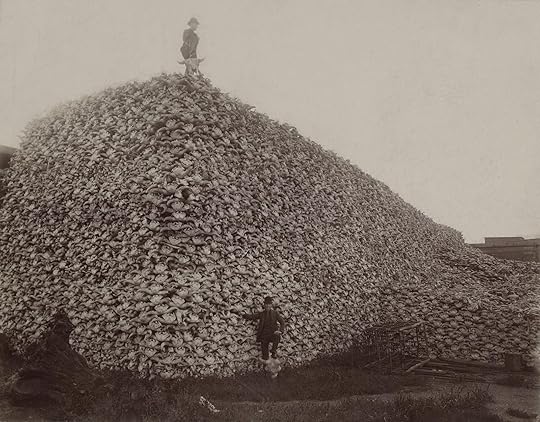
Also, the chapter on bison and Indigenous people raised some concern*. Wasik & Murphy write that before the arrival of white colonizers, bison populations were already declining because they were being hunted by Indigenous people. "Instead of sharing communally in the spoils of summer hunts, thriftily making use of every bison bit, Indians increasingly traded the results of their kills with whites for manufactured goods: steel arrowheads and knives; riding equipment and rifles; clothing, blankets, sugar, wheat flour, and whisky." No mention is made as to whether Indigenous people communally shared the items they acquired from trading with whites. Why frame the narrative this way?
On the other hand, Wasik & Murphy do share Colonol Richard Dodge's instruction to "Kill every buffalo you can" because "Every buffalo dead is an Indian gone". And they later attribute the bison's plummeting population numbers to professional white hunters who slaughtered bison full-time for profit.
I thought for sure the historical photo of white settlers standing atop a mound of bison skulls would be in the book, but it wasn't.
*NOTE: the chapter is titled "Every Buffalo Dead" but concerns the declining population of American bison. This is likely due to the fact that early settlers mistook the bison for buffalo and incorrectly referred to them as such.
It's painful to read about so much violence against animals, but these horrifying stories serve to emphasize that change was needed. We've come a long way since since the 1860s, but as Wasik & Murphy aptly point out at the end of their book, we still have a long way to go toward liberating our animal companions.
My heartfelt thanks to the kind people at Knopf for sending me a gorgeous finished copy of this book.
--
ORIGINAL POST 👇
Ooooh! New book coming from Bill Wasik & Monica Murphy. 📙👀
As an ardent animal lover, I knew I had to read this book, which covers the relatively recent history of animal advocacy in the United States.
Going into the book, I knew it was a recent history, but I don’t think it truly registered just how recent. Sometimes you think something as deeply ingrained into your own beliefs would have been around a while. Also, I have to mention, as an animal lover, it was very hard to read and listen to some truly necessary parts of the book. In order to make it to advocacy and valuing the treatment and welfare of animals, you have to go to the dark parts, too. I had to remind myself of that often.
Overall, Our Kindred Creatures is as important and well-researched as a book of this magnitude should be. It’s well-written, highly readable, and absolutely fascinating. While we have a long way to go with animal treatment, in my opinion, I’m beyond grateful to be living in a time where animals are more valued than they once were. I’m also grateful that my parents allowed me to have an animal menagerie where I loved - and continue to love - them all just as I would any family member. I learn something new from them every day, and I know my life has been shaped and enriched by them in more ways than I can enumerate.
A history of the animal rights movement from 1868 to the early 1900s. While I think this book has value, I like "A Traitor to his Species" about Henry Bergh was the better read.
Not my best review but I would recommend this book if you want to know more about animal treatment in this time. It's not for the squeamish or those who can't handle brutal details.
The authors, Bill Wasik and Monica Murphy, want their book, Our Kindred Creatures, to make the case that the decades from 1866 to 1896 “saw the birth of the modern attitudes toward the animals in their midst.” (p. 360) The book succeeds in its mission well. Wasik and Murphy explain the nascent social justice movement for animals (anti-cruelty, humane society, animal welfare, animal rights et al) in the USA and how it began in the United Kingdom. Anyone looking to broaden their understanding of animal advocacy and human-animal relations would be advised to read this book.
The reader is guided through an insightful understanding of how animals were viewed and treated in the latter half of the nineteenth century in the USA. It’s only in the Afterword that Wasik and Murphy relate the past to the present and reflect upon the future for the moral and legal status of animals.
From sea turtles killed for soup to horses pulling wagons loaded with goods and people through Manhattan streets. From the mass murder of pigeons and buffalos to dog fights in bars and performing elephants in circuses. From Chicago’s Packingtown disassembling untold thousands of cows to a dog cemetery in Westchester County, New York. From animals in research laboratories to drowning caged unwanted dogs in New York’s harbour. The authors take the reader through a succession of topics. These and many more animal issues are ably explored and described. Often, I feel overwhelmed with information and drowning in emotion when I read books cataloguing animal cruelty. But not with this large book (400 + pages including endnotes). Its fine construction of relatively short and similar-length chapters and its clear and concise writing style make it a manageable read. Each chapter is an informative stand-alone introduction to its subject.
The authors describe the emergence of the US animal movement with descriptions of its founders and leaders of organisations. This includes Henry Bergh, founder of the ASPCA in New York; George Angell, founder of the Massachusetts SPCA; and Caroline Earle White, founder of the Pennsylvania SPCA, which only men were allowed to lead. Consequently, White founded the PSPCA’s Women’s Branch which she could direct. The more I learn about these leaders the more I admire them for their innovative work, tenacity, and leadership. Today’s generation of animal advocates may complain about their challenges and, if you do, imagine the challenges Bergh et al had 150 years ago. While we’re increasingly dependent upon the Internet, they relied upon organising adults into societies and children into kindness clubs and publishing such landmark novels as Black Beauty and inspirational newspapers and motivational magazines. No TV. No radio. No mobiles. No WWW. No Facebook. Given how much easier it is with today’s technology, I often wonder why we don’t make more progress for animals than we do.
Bergh focused mostly but not exclusively on animal cruelty interventions and prosecutions. Men (for it was mostly men) beat horses and dogs in the streets, Bergh arrested them and brought them to court. Angel invested in ambitious public educational projects. White’s interests were in campaigning against animals in laboratories at the time when the modern scientific method came to the fore. They all decided to compromise some of their actions and positions at some point. Some can be understood, given the time and circumstances. But some went too far. According to Wasik and Murphy, the Chicago meatpackers co-opted the Illinois Humane Society. (p. 306) The stockyards were notorious for animal cruelty, even with the stockyards open to public tours. Circus impresario and serial animal abuser, P T Barnum, was invited to serve as a director of the Connecticut SPCA. Barnum and Berg compromised on the former’s treatment of elephants in circuses. I know from my research for the biography of Topsy the Elephant that the ASPCA didn’t oppose her murder in 1903. (Bergh died in 1888.) The ASPCA was concerned with making sure it wasn’t a public spectacle. Her owners got around this by charging more than 1,000 people a small admission fee to attend.
This book is a fine description of the treatment of animals during this period, the development of anti-cruelty and humane societies and their activities, and public attitudes. But I regret Wasik and Murphy didn’t devote more of their attention to the development of ideas and ethical theories about the moral and legal status of animals of this time. The philosopher Peter Singer is mentioned but they inaccurately cite him as the “thinker who has done more than any other to advance the idea of animal rights” (p. 365) Singer, a utilitarian, is not a rights-based philosopher.
Further, there’s a brief discussion of the concept, which Singer writes about, of the expanding circle and the need to include animals. The philosopher Dale Jamieson is also briefly considered by the authors as the “most profound thinker” on this topic (p. 368). I’ve never been convinced of the expanding circle as a viable moral construct. Any line, circular or otherwise, always means there’s someone outside not being included inside. Further, it’s not simply a question of whether you’re inside the circle or not. There’s also the space, the interrelationships between and among those in the circle, and anyone else outside of it. While I’m sympathetic to Tom Regan’s “subjects of a life” as those who have rights, we are more than individuals. We are communities of various kinds. Indeed, we are communities of communities. But Wasik and Murphy get my approval when they state in the context of current moral challenges, “The new type of goodness we need today has to explode [emphasis in original] the [expanded] circle, in a sense.” (p. 368) I don’t take the verb explode to be literal but a way to convey a sense of “we’re all in this together.” No line should separate any of us. If it does, it must be erased.
Finally, there’s a chapter dedicated to the veterinary profession and its development, which includes the formation of the New York College of Veterinary Surgeons and the American Veterinary Association. One of the authors (Murphy) is a veterinarian. I have a love-hate relationship with veterinarians. Some veterinarians license animal cruelty, particularly in the animal industrial complex. While others are truly compassionate people. I’m troubled by the book’s dedication: “America’s veterinarians—past, present, and future”. Why not “Tireless and fearless champions for animals across the world”? Or, better still, why not “The animals”?
Imagine it is 1866 and you are strolling the streets of New York City.
The first thing you might notice are the hundreds upon hundreds of horses pulling people in packed trolleys up and down the streets and avenues, the closest thing at the time to subway cars. You may find yourself suddenly surrounded not only by people, but by herds of cows and pigs and sheep as they are led to the slaughterhouses that dot Manhattan. If you head north to the affluent stretch of Fifth Avenue you may pass society’s elite as they parade their pure-bred dogs (the latest fashion statement at the time). If you look closely you will see birds, or the remnants of them, decorating women’s hats. Feathers from ostrich, heron, egrets, even the Carolina parakeet (a bird well on its way to extinction).
You may also witness a curious scene: A man standing on his stopped carriage in the middle of an avenue, holding up traffic, as he upbraids a passing carriage driver for whipping his horse. If you had seen this man, whose name was Henry Bergh, you would have witnessed the earliest manifestations of the American animal rights movement.
In Our Kindred Creatures: How Americans Came to Feel the Way They Do about Animals authors Bill Wasik and Monica Murphy take us back to the second half of the 19th century, when the animal rights movement sprung to life and quickly spread across the United States.
You’ll first meet Henry Bergh, a man born into wealth with a burning desire to attack “cruelism” wherever he saw it. He would not hesitate to confront anyone abusing a horse or any animal, stopping traffic in New York City if needed. But he was also a savvy tactician, working with politicians and other leaders to push through laws that his newfound organization, the Association for the Prevention of Cruelty to Animals, would eagerly enforce. The ASPCA, inspired by and modeled after England’s Royal Society for the Prevention of Cruelty to Animals was soon replicated across other cities. By 1871 there were more than a dozen organizations, from Boston to St. Louis to San Francisco.
Up until this point in American history, animals had no rights, no protections and, as the book documents, no veterinarians. It was common to see carriage drivers abusing their horses. Dog fighting and bear baiting matches were popular forms of entertainment as well as bullfights. But standing up to them was Bergh and his growing army of animal protection soldiers.
Up north in Boston we meet George Angell, the founder of the Massachusetts SPCA and equally driven to bring about change though on a much larger scale. While Bergh was arresting animal abusers across New York City, Angell was looking for ways to build a nationwide movement of enlightened Americans.
What Angell wanted, what he believed was possible, was nothing less than a moral revolution in America, one carried along by human emotion in rebellion against suffering of all forms. “Some of our friends most deeply interested in animal-protection societies are frequently charged with being sentimental,” he wrote … “To protect the weak, bind up the broken-hearted, defend the defenseless, raise the downtrodden, give liberty to the enslaves, — these are all sentiments.”
While reading this book I was reminded of a Brigid Brophy quote from her essay published in The Sunday Times in 1965. She wrote: “Whenever people say, ‘We mustn’t be sentimental,’ you can take it they are about to do something cruel.”
But Angell embraced sentimentalism and smartly used it to his advantage.
He founded a magazine called Our Dumb Animals, which, despite the name, was one of the most progressive animal rights magazines one could read, expanding to a circulation of 75,000 in 1890. Angell worked with schools to inspire children into becoming animal protectors. And he published (stole, actually) the novel Black Beauty, which had been published years earlier in England to much success. Angell had been hoping to find the equivalent of an Uncle Tom’s Cabin for the animal rights movement. By pricing the book at just 20 cents a copy, he indeed created a bestseller — selling nearly 400,000 copies in its first year. Sadly, author Anna Sewell never lived to see her novel become so successful.
In Philadelphia, we meet Caroline White, who founded the American Anti-Vivisection Society, a group that fought against the doctors and surgeons who thought nothing of operating of non-sedated animals. The legacy of animal testing is with us today and is no less contentious.
We head east to Chicago where we witness the rise of animal industries — mass-production slaughterhouses that raised animal cruelty to a level we have yet to reckon with today. But back then, the mass production of killing was viewed with awe the way one might view the mass production of automobiles.
The Chicago historian Dominic Pacyga — whose notes that local schoolchildren were taken to the slaughterhouses for decades, as recently as the 1950s — has described the purpose of this spectacle as “the presentation of the modern,” reflecting the rising attitude that brought hundreds of thousands of people to witness the miracles of the World’s Fair and the savagery of the meat industry nearby: the knowledge of what so-called progress looked like, but also a desensitization to its less salubrious side, and to the idea that some level of violence might be necessary for its continuance.
The slaughterhouses that emerged during Industrial Revolution and were bigger and, in many ways, far crueler than anything that came before. And despite the efforts of so many activists over the past 150 years, it is frustrating to see so few changes for the better. The authors note that despite the amazing progress we have seen in protections for some animal species (dogs, cats, endangered species) there are some species deemed unworthy of protection even today:
As of this writing, America is home to roughly 99 million cattle and 74 million pigs: populations that exceed those of dogs and cats … It’s not that they’re less intelligent, or less capable of suffering. It’s not that we owe them any less; our patterns of consumption lead to their existence and their treatment. We simply don’t care enough about them — at least not yet.
To right a wrong, one must first see a wrong. In the 1860s, a handful of Americans awoke to the plight of animals and gave rise to the animal rights movement, a movement that has accomplished so much and still has so far to go. We are overdue for a second awakening.
This enlightening, engaging and occasionally shocking book is a must read and a testament to the empathetic and fearless Americans who did so much for “Our Dumb Animals.” You will finish this book inspired to pick up where our animal activist ancestors left off.
NOTE: This review first appeared on EcoLitBooks.com.
I adored Our Kindred Creatures. It was eye opening on how we look at animals in this country and I appreciated the overview of the history of animal treatment and how it has changed, shaped, and morphed into a much more humane, compassionate view of how we should treat our creature friends.
Our Kindred Creatures is an in-depth study of animals and the humans that interact with them. It is clear that civilization has come a long way in the treatment of animals. There are many players in the game that made that change possible, which is detailed in the book. Also, the changes in science and technology which have enabled us to change our relationship with domestic and wild animals.
The writing flows well and is very engaging. There were some grotesque descriptions of vivisection, beatings, etc. that are difficult to read. But otherwise, it is incredibly informative and a fascinating study of the topic.
Our Kindred Creatures is a non fiction about the history of the treatment of animals. This was a very engaging book and kept me wanting to come back to the book.
Everyone knows I’m a crazy cat lady, so it’s nice to read about other people who are as compassionate towards animals as I am. I recommend this book for all animal lovers.
Thank you to Knopf and NetGalley for the advanced reader editions, in exchange for my honest opinions.
really interesting look at how animals were treated when they were more prominent in our lives. crazy to read about stories of animal abuse being justified throughout the moral awakening of the late 19th century
Very informative book but took me awhile to get through because of the graphic descriptions. But after restarting and rereading it…it’s such a great piece that discusses the historic treatment of animals and the modern animal welfare implications. I will definitely recommend this book to anyone interested in animal welfare history 🐮
For me, this book was less about how Americans came to feel the way they do about animals, and more about a history of the ASPCA. The book doesn't lay a foundation for exactly what they posit is the American consensus about animals in the past or in the present. I do appreciate the history of social activism and how it laid the groundwork for women's suffrage, a point that is cited in other books I have read this year. While the vignette on Black Beauty was interesting, it is only one author and one story, does it truly represent the views of American Society? I also appreciate the descriptions of American life that include details about animals that could be evidence for what our attitudes about animals were/are. However, for all the history offered, I don't feel I walked away with what I was expecting given the title. Do Americans belong to the mindset of social activists in the ASPCA?
We met Kara in a parking lot. He had been transported by volunteers from Missouri. Kara had spent nine years as a puppy mill breeder. He reeked of urine. His coat was thin and bare on the legs. He was weak. Still, after all he had been through, he looked at us and wagged his tail in greeting.
We brought him home, washed him, cleaned his kennel crate, got fresh beeding, fed him, and locked him in the crate for the night. The next morning, we found he had peed in his bedding. We took him outside, fed him, washed him up again. But before we could lock him up again he ran and found our Suki’s bed and snuggled in with her.
Suki had spent seven years in as a puppy mill breeder. She was still fearful and slept behind the bed headboard, which we had pulled from the wall to give her room. Suki stared at us, shocked by the intruder.
Kara was a foster dog and we weren’t supposed to provide vet services, but he was too ill to ignore. We learned that he had kidney failure and needed a special diet. That he had suffered a broken leg that was never treated. He had lost the tips of his ears to frostbite and the fur on his legs because he had allergies and chewed on them. His teeth were worn to nubbins.
Over the summer, Kara learned how to be a pet. He grew healthy enough to run away, even trying to climb the chain link fence. When we first let Kara out before bedtime, he would go under a bush and make a bed. We had to drag him out and bring him inside to his shared bed with Suki. He taught Suki how to chase and run and play, bringing her out of her shell. The two became inseparable.
By fall his kidney failure was worse. We did all we could, but finally let had to him go. We were heartbroken. He had been a character, a trouble maker, but his joy and love was infectious. Suki sulked for days after his loss.
We brought home another mill breeder. Kamikaze was riddled with health issues. Her hips were bad and she hopped instead of running. She had constant digestion issues. She had cysts between her toes from standing on wire cage floors. But she was spunky, curious, and playful from the start. When she became blind, Suki helped her find the door and water bowl.
What we learned about puppy mills was heartbreaking. They breed dogs for the greatest profit. The animal’s health is not considered, mental or physical, and the puppies often have health issues and defects. Our Kamikaze’s rescue group makes sure that all health issues are resolved before adoption. Suki’s foster family kept dogs considered unadoptable due to physical or mental issues. Suki had be returned by one family. We worked hard to help her overcome her fears.
And these mills are not illegal in most states. In our state of Michigan, a few cities have banned mill dog sales and legislation to prevent sales of mill dogs in pet stores has been introduced.
If we allow man’s best friend to be treated like a chicken in a cage, how do we treat chickens in cages?
Our Kindred Creatures is the history of a moral transformation, how society came to recognize the cruelty in how we treat our ‘dumb’ animals, with the hope that we will continue to implement protections as we become aware of the unseen cruelty behind the products we buy.
Between 1866 and 1896, the first crusaders organized animal protection groups and pushed for laws to prevent cruelty. These forgotten crusaders raised awareness of how horses were treated, the over-hunting of animals for sport or fashion, unneeded medical experiments, the abuse of circus animals, inhumane slaughterhouse practices, and the use of animals in deadly sports.
Civilization has come a long way since 1866 when Henry Bergh realized that cruelty to animals anethised humans to cruelty to each other. He began by challenging those who beat their horse on the streets. Today’s cruelty is behind the scenes, easy to ignore. But it exists, in puppy mills and factory farms. If we were aware of the suffering behind every glass of milk or pork chop we eat, it would quell our appetite. Additionally, the animals grown for consumption greatly impacts the climate crisis. And, the climate crisis and habitat destruction threatens wildlife.
This is a disturbing read, and unsettling. Chapters cover the slaughter of the buffalo, and the hunting of birds for fashionable hats, and the continuing controversy between medical science and antivivisectionists.
But it is also inspiring. We learn of the dedication of reformers who instituted the organizations to enforce animal protection laws and groups and publications that taught children kindness to animals.
I loved reading the story of Black Beauty, serialized in an American magazine, “Our Dumb Animals.” Told in the first person by Black Beauty, the novel follows his life from pleasant early years through the various owners and jobs he performs. He meets horses who tell of the pain of tail docking and rein checking, all for fashion. Anna Sewell had spent years writing the novel while suffering from ill health. She never lived to see her novel’s success. The book went on to be a bestseller.
It can be easy to be pessimistic about humans’ capacity for moral transformation. Social scientist often find, in interview with individual subjects, that no amount of reason and evidence will unsettle their instincts about right and wrong, even when those instincts manifestly result in prejudice or hatred toward others.
[…]Yet on large timescales…we know that moral change does happen, often at profound scale and remarkable speed.
from Our Kindred Creatures
Bergh’s idea that insensitivity to cruelty to animals fosters insensitivity to human beings can still be seen today in how we cage farm animals and how we have caged illegal immigrants.
Wow! Should be required reading. Hard to read at times but not knowing is comfortable ignorance. We do better when we know better. Our kindred creatures are such a gift to our lives. ✌️❤️🐾🐣🐘
“NORMALIZED ANIMAL CRUELTY IN THE NINETEENTH CENTURY”
Mr. Wasik and Ms. Murphy address a pivotal 30-year period in American history where people’s perspectives shifted about animals. They cover the years 1866-1896. Animals began to be seen as more than just objects. It begins by explaining how the Animal Society for the Prevention of Cruelty to Animals (ASPACA) was influenced by the movement’s creation in Europe as well as the earlier conditions that caused people to become more aware of animals’ plights. ‘Our Kindred Creatures’ is a clear-eyed historical presentation. It includes a few disturbing photos and illustrations.
The first page made my stomach hurt. The treatment of giant sea turtles being captured, shipped and turned into turtle soup is the stuff of nightmares. Humans’ treatment of various animals is vividly explained. The book begins by covering New York City’s 1800’s life where the stench, excrement, chaos, cruelty, and neglect were simply part of daily living. It was indicative of all urban sites. The streets, alleys and whatnot were crawling with horses, oxen, chickens, pigs, stray dogs and cats and goats. Rotting animal corpses littered the city. Their methods of animal control were barbaric. Animal blood sports were common and vivisection (dissecting animals while the creature was alive) was standard in medical schools. The ASPACA’s founder, Henry Bergh, spearheaded assaults on eliminating or reducing animal cruelty in the state.
Many elements of ‘Our Kindred Creatures’ are emotionally difficult to read. The cruelty and neglect we have inflicted on animals are countless, much of it for human entertainment. The authors describe the charlatan (the 1800s’ Trump) P.T. Barnum’s abuse of so many exotic animals for public consumption that it made me a little dizzy from anger while reading it. The book, however, does point out the nascent anti-cruelty measures that were taken during the period examined. Key, influential, animal anti-cruelty leaders are highlighted.
The book explains the 30-year period as the birth of the first animal shelters, veterinary schools and hospitals, and the specialization of animal care that went beyond any schmo off the streets claiming to be a veterinarian. More compassionate means of euthanasia were invented. It also covers the industrialization of meat processing including transportation of the animals, and the invention of meatpacking, slaughtering machines, as well as refrigeration rooms. The creation of Chicago’s Union Stock Yards, a massive enterprise, separated livestock from interactions with human society and helped people ignore the inhumane butchery. Today, this hellish industrialized system is still very much used and keeps the public insulated from the horror of how meat winds up on your plate. These large facilities guard with vengeance what is occurring in these purgatories and aggressively and legally attack anyone that gets a peek behind their curtain. In the late 1800s, the meat industry took a different approach by giving popular tours of animals being slaughtered and dismembered. Studies have shown that inflicting mass slaughter or watching it done for extended periods of time desensitizes a person to its cruelty and can easily transfer to inflicting cruelty on humans. The book also explains the planned eradication of buffalo, the tortured lives of circus elephants, the creation of a rabies vaccine, animal experimentation, and the popular novel ‘Black Beauty’s long-term impact on people’s perceptions on the treatment of animals or, at least, horses. Pet cemeteries and zoos are briefly reviewed.
Granted, I already have a low opinion of the human condition when regarding the treatment of animals. We have a haphazard, illogical approach towards what creatures are worthy of our respect and which ones we exploit. We go well beyond using them as an important food source, most of it is unjustifiable and unnecessary cruelty. Humans have driven many species to extinction, all of them were also unnecessary acts but got in the way of greed. While reading ‘Our Kindred Creatures’ does explain the positive steps many humans have taken toward animals and shows humans’ selected benevolence towards them, Mr. Wasik’s and Ms. Murphy’s excellent, well-balanced and informative book did not change my attitude that humans can often be major shits. It’s a very disturbing, fair, level-headed, and thought-provoking read.
I added this book to my list after hearing the authors, Billy Wasik and Monica Murphy, on The Hen House podcast. I was particularly drawn in by the talk about the three elements that drew Horses to being less exploited and visible in human society: Disease, Literature and Technology.
Reading the book, I have learned so much about the historic use of animals and it's consequential fight to end mistreatment. While I'm from England, I found it incredibly informative to see how it paralleled with our history here. How closely these two countries follow and emulated one another. I learned some incredibly saddening facts about how we have treated animals throughout history. The dog fighting and pens of lost dogs. The beluga whales and circus elephants. There were some moments I shed a tear for the abused and murdered, particularly the thousands of the vivisection chapters.
The book introduces us to several influencial figures, as we follow a thematic timeline across key cultural elements that have forced animals into our world: Science, Fashion, Entertainment, Education, Diet, over 17 chapters. Henry Bergh and George Angell are the prominent faces although other names appeared throughout for more brief stories. Interestingly, the book repeatedly highlighted how women were strongly represented within the movements, yet I couldn't help but feel like I got to know the likes of Caroline Earle White far less than the others. Even the section on wearing birds in women's fashion was so heavily focused on men rather than the women which was in contrast to the previous book I'd read on the topic, Mrs Pankhursts Purple Feather. Nevertheless, these figures were incredibly influencial and I will always welcome more animal rights activists to be celebrated for their work.
I found the read quite slow for the majority of chapters, yet I did feel that some chapters were more enjoyable to me than others based on my interests of colonialism and use of animals for entertainment and education. The Barnum chapters as well as Every Buffalo Dead and The Zoophilists, were chapters that particularly caught my attention. Murphy is a Vet, which you can see within the book as it regularly returns to the vivisection and vet stories throughout the book and clearly demonstrates their influence on our feelings towards animal. This isn't a bad thing! I think it brought a focus that maybe is often overlooked, and shows the care that we have for animals through the horse hospitals and treatment of pets in life and death. It also highlighted the nuanced discussions around testing on animals which can obviously bring much controversy and arguments in the medical field, where ones life may save many but will be done without their consent.
While I would have enjoyed more discussion from the authors perspective to compare the behaviours of the time to now (which the afterwords does introduce a little more), I really enjoyed being able to make some connections myself. Bergh's relationship with Barnum for example demonstrates the complex and hypocritical decisions that often animal rights activists find themselves having to make when building friendships and relationships. Being torn between being a friend who people are comfortable to spend time with and have conversations with them on their terms, holding guilt as you see things you disagree with, or becoming someone who isn't even welcome in circles to have conversations because you cannot hold your passion and frustration in.
The main message of this work is noted in the introduction title: A New Type of Goodness. We watch our activists strive in many ways to bring this new type of goodness to their society. Each person had their own idea for how it could work. Bergh captures the children's mind with societies (Band of Mercy) and storytelling, while others choose religious messaging, lawmaking and regular media outlets to encourage discussion. Clearly we continue to search for the right answer to the question: how can we get people to action this new type of goodness. This book demonstrates hope that we will continue to find those answers. As the final afterword notes, so much has been achieved and we can continue to make changes and find new ways of reaching people to make that difference in their lives: "Just as our powers of imagination were capable of such a leap in 1866, they are capable of the more difficult leap we face today. It is time, once again, to put them to work" (pg372).
I want to end with my favourite quote from George Thorndike Angell (1884) "To protect the weak, bind up the broken-hearted, defend the defenceless, raise the downtrodden, give liberty to the enslaved, - these are all sentiments". A reminder that amongst all the battles fought and solutions explored - it was empathy and emotion for those who were suffering that helped us make change.
This entire review has been hidden because of spoilers.
"... animals’ inability to testify to their desires, fears, and knowledge made it possible for many to put the question of their suffering entirely out of mind, given their seemingly preordained place in the natural order as mere possessions to be worked and consumed."
Our pets and the animals we live with and see in the community are sacred. We give them love and care as if they were our children. John Wick would kill for them. This wasn't always the case. Animals were viewed as work animals. Soulless, unfeeling, and only to be commanded.
The start of the American Society to Prevent Cruelty to Animals (ASPCA) had its roots in the anti-slavery movement. Humans should not be treated so cruelly, and neither should animals. We find the individuals lobbying to change the law and often restoring and enforcing it themselves. They also go toe to toe with Barnum and Bailey Circus (a fighter that stretched even into modern times( it was the book Black Beauty that changed so many hearts and minds.
The book does a thorough job of documenting the movement and its impacts. It is hard to imagine a time when we were not fascinated and enamored by our pets, but the book does an excellent job of showing the contrast. A society that treats even the smallest creatures kindles is a society that flourishes.
Favorite Passage:
Judeo-Christian tradition—the founding texts of which offer few prescriptions against cruelty to animals, even as they make ringing statements of human “dominion” over the natural world—could travel through their daily lives without giving much thought to how domestic animals in their overwhelmingly agrarian societies were treated. Few Europeans truly believed, as the French philosopher René Descartes theorized in the early seventeenth century, that animals should be classed as soulless machines—that, in the summation of one of Descartes’s disciples, Nicolas Malebranche, animals “eat without pleasure, cry without pain, grow without knowing it; they desire nothing, fear nothing, know nothing.” And yet animals’ inability to testify to their desires, fears, and knowledge made it possible for many to put the question of their suffering entirely out of mind, given their seemingly preordained place in the natural order as mere possessions to be worked and consumed.
“Unlike human victims of injustice, animals suffer but cannot speak of it, and neither can their families speak up on their behalf. For that reason, any movement on behalf of animals must hinge on a collective leap of imagination, on the power of narrative.”
This was a fascinating book about how Americans’ perspective on animals has evolved. Today, it’s unconscionable to allow someone to beat a horse in the middle of the road, lock zoo animals in too-small cages, and slaughter millions of birds for their feathers to be used in ladies’ hats. This book traces shifts in mindsets as a result of animal advocates’ efforts.
As someone who stopped eating animals after I realized the extent of the suffering I was contributing to, I found parts of this book really horrifying. The depictions of suffering and the stories of animals needlessly tortured and killed for a variety of reasons (entertainment, sport, convenience, fashion, fear, etc.) made me really upset. But the authors upon readers to consider that there’s still plenty of work to be done.
The book ends this way: “…we might use our own reservoirs of pet love- the deep adoration we feel for the animals were privileged to live with- as well-springs from which to love, and to aid, all those distant, unseen animals we know only as abstractions. Such animals include the sows in “gestation cages” and all the other food animals mired in feedlot existences that, while stopping well short of illegal cruelty, can hardly be regarded as happy lives, as well as the wildlife species threatened by habitat destruction and climate change, so numerous and far-flung that we may never learn the full list of species snuffed out. Any new type of goodness takes a new kind of mental discipline, an insistence that we decide everyday actions that once seemed innocuous- whether flogging a horse or ordering a hamburger- as intolerable acts of cruelty, because they will result in the suffering of sentient creatures.”
Haven’t finished, barely started, but already finding concepts worth recording.
1 — “Arising along with corporate capitalism was, perhaps, the most dispiriting mode of thinking about animals, one that reconceived them as just another industrial input, a disposable source of meat, milk, eggs, hides, and more, to be raised and killed at unimaginable scale with no compunction. In Chicago, Philip D. Armour and other meat barons spent these three decades inventing …the systems to do exactly that.” (page 12).
2 — “To see [animal suffering] as worthy [is] first and foremost an act of imagination. So it’s perhaps not surprising that resistance to animal suffering began… first in literary minds…(page 20)
3 — I had read a biography of Henry Bergh that left me full of admiration for him. This book tells some less-palatable stories. Chief among these is Bergh’s refusal to criticize PT Barnum for acquiring and exhibiting Jumbo, an elephant. (At least until Jumbo was hit by a train and smashed into smithereens.) What WAS the deal between these two? We will never know. We CAN say that Bergh dropped the ball on the Jumbo issue — a significant error.
4 — The authors point out that 21st century Americans typically live at a vast remove from the sources of their meat and dairy, in contrast to those of the 19th century, many more of whom were farmers. It is certainly true that Americans today don’t understand “farm” animals. But I think that many people don’t understand their pets either. I am disappointed that Monica Murphy, a vet, did not address this.
5 — Of the two men featured, I liked George Angell way more than Henry Bergh. But I did want to know what happened to the ASPCA after his death. And what about the Bands of Mercy, which had half a million child members at its peak? I wanted to know way more about this initiative.
6 — Thanks to (my guess) Bill Wasik for his deep research, his evocative details, his lean and muscular prose. These qualities made for an excellent book.
A book with very interesting and well-told stories, but without historical context. The authors focus on the founding of SPCA-esque organizations in the late 19th century primarily through biography chapters that are loosely tied together. The real story probably is not about biographies, but about popular culture. societal attitudes, and government efforts of the time and how its attitudes were formed and changed, however that is never addressed by the authors as they are too busy telling stories of individuals. There is nothing really wrong with the book, but it could have been an excellent history book if the authors had taken a different approach.
The book spent more time investigating the nascent beginnings of the animal rights movement in the United States than I realized it would-- I went into this expecting to read about the science behind animal intelligence/interactions with humanity for the last 10k years or so/ what modern science can tell us about our interconnectedness, and that wasn't really what I got.
HOWEVER, I still found the history VERY enlightening and it definitely fills in a few gaps I had, wondering to myself about some of the philosophy influencing modern America's attitude towards cosseting pets above caring for people (my words, not the authors'.)
About the start up in the US of the ASPCA - American Society for the Prevention of Cruelty to Animals, and how the leaders pushed to have the public realize that animals suffered and felt pain when used and abused. This included horses that pulled streetcars, wagons, and sleds, circus animals and other entertainment venues that displayed animals, vivisection for medical study and slaughter houses where pigs were deeped into boiling water while still alive. Veterinary doctors came about to care for the animals that eventually had a place in our homes and hearts.
The writing was good but seemed a little redundant at times, especially in the second half of the book.
The rights of animals and humans are so interconnected. Really goes back to none of us are free until we're all free but I also did appreciate that the authors said at the end that there should be a hierarchy of species and the call to action to help your human neighbors because I think that's something that people definitely forget oftentimes. I feel like this book really made me want to study Indigenous beliefs surrounding animal-human relationships because this is just post-colonial America (which it is very much advertised to be!) and I think it's hard to see the full picture of how we came to be as we are today and could be better in the future without that perspective.
I’m not sure the title is quite accurate—it really doesn’t have much to say about how Americans have come to feel the way we do, unless “how” means the path. And part of the book’s strength is that it reveals there is no American way of feeling about animals. It these are quibbles. The book is full of fascinating facts and narratives about the development of zoos and museums and societies designed to protect animals. And it shows the often contradictory designs/effects of some efforts—like the conservation societies that want to conserve animals so they can kill them.
On the whole I enjoyed this book and it was interesting to learn about the origins of animal protection societies and the people who were instrumental in their creation. I was hoping this book would delve more into the problems of today, particularly in the Southern US where "christian" ideology leads to the lack of spaying/neutering and the continuous abandonment of pets, the extremely high rates of euthanasia of dogs and cats, perfectly adoptable animals. It's disgusting to see the lack of caring and how animals, particularly in the south, are treated as disposable by so many people.
History of animal rights activism. Not what I was looking for. I've been curious how our thinking has changed from agrarianism (where people were intimately familiar with animals, and animals were technology) to industrialism (where most people no longer interact with animals, but they are dealt with in massive number in slaughterhouses and dairies). How this led to hunting becoming a hobby, pets to become children, and horses to become collectors items all while something as similar as a cow is treated drastically different, ethically and legally.
I found the history very interesting, though the authors' opinions and framing sometimes jarred me, and I was lukewarm on their conclusion.
That said, I'd eagerly read a follow-up, especially focused on how the advent of film and television affected attitudes towards animals. (Bambi and Dumbo were especially brought to mind, naturally.)
Speaking of elephants, I was surprised that the book didn't mention Jumbo's final fate as the mascot of Tufts University, something I've always found astonishingly uncomfortable!