

What do you think?

Wagner: The Terrible Man and His Truthful Art
How is it possible for a seriously flawed human being to produce art that is good, true, and beautiful? Why is the art of Richard Wagner, a very imperfect man, important and even indispensable to us? In this volume, Father Owen Lee ventures an answer to those questions by way of a figure in Sophocles – the hero Philoctetes. Gifted by his god with a bow that would always shoot true to the mark and indispensable to his fellow Greeks, he was marked by the same god with an odious wound that made him hateful and hated. Sophocles' powerful insight is that those blessed by the gods and indispensable to men are visited as well with great vulnerability and suffering. The Terrible Man and His Truthful Art traces some of Wagner's extraordinary influence for good and ill on a century of art and politics – on Eliot and Proust as well as on Adolf Hitler – and discusses in detail Wagner's Tannhouser , the work in which the composer first dramatised the Faustian struggle of a creative artist in whom 'two souls dwell.' In the course of this penetrating study, Father Lee argues that Wagner's ambivalent art is indispensable to us, life-enhancing and ultimately healing.
96 pages, Paperback
First published August 30, 1999
Ratings & Reviews
Friends & Following
Create a free account to discover what your friends think of this book!
Community Reviews
Displaying 1 - 10 of 10 reviews

February 28, 2024
The connection between art & morality is one that has engendered countless philosophical positions and also caused writers as diverse as Plato & Tolstoy to make rather doctrinaire statements. Can an unethical, seemingly unprincipled artist like the composer Richard Wagner be considered a force for good? This is a question posed by the late M. Owen Lee in his anthology of 3 lectures, given in Toronto 25 years ago.
Wagner: The Terrible Man and his Truthful Art represents a slim volume that responds to the question of whether it is possible for a "seriously flawed human being to produce art that is good, true & beautiful". In short, M. Owen Lee's conclusion is that the music of Richard Wagner, a most imperfect man, is not just important but even indispensable.
The 1st chapter of the book discusses the duality of what the author considers a divine spark inevitably encased in a human, very flawed body, with "all of Wagner's mature works concerned with the healing of man's archetypal wound, the draining away of evil & the bringing together of good within us." Thus, the story of Wagner's last opera, Parsifal, portrays "the integration of conflicting forces within the human psyche."

Owen Lee tells us that while Wagner was antisemitic, exceedingly self-indulgent, often cruel & vindictive, failed to pay his debts, faithless to his friends & his wives, "he had one mistress to whom he was faithful until the day of his death: Music."
Bernard Levin of the London Times is quoted: "Wagner is dangerous"...
The final section of Wagner: The Terrible Man and his Truthful Art concerns itself with the lessons held within an early Wagner composition, Tannhäuser, quoting Rilke (as Owen Lee did in an earlier work): Du musst dein Leben ändern, or "you must change your life". For Fr. Owen Lee, Wagner's compositions constitute Verwanglungsmusik, transformational music! "God speaks to us through works of art".
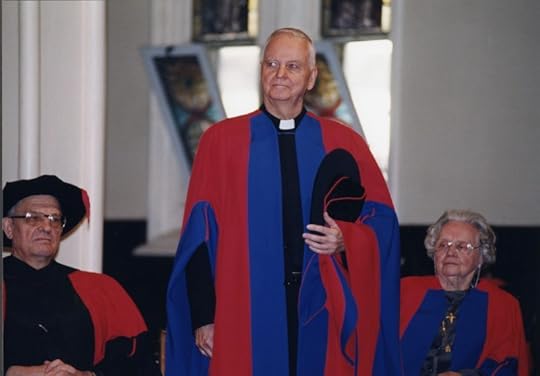
M. Owen Lee was for many years a commentator at the Metropolitan Opera's Saturday afternoon broadcasts. He was a Roman-Catholic priest of the Basilian Order, originally a French group dedicated to St. Basil, that began in 1822 just after the Reign of Terror, later establishing a branch in Toronto. Fr. Owen Lee had a PhD in Classics & taught at the Univ. of Toronto for many years. Much of his writing is steeped in classical literature & Jungian psychology.
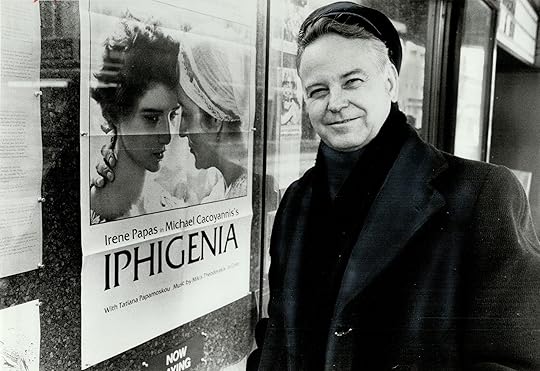
*Among the 3 images within my review are: the 1st & 3rd of M. Owen Lee, while the middle image is of composer Richard Wagner.
Wagner: The Terrible Man and his Truthful Art represents a slim volume that responds to the question of whether it is possible for a "seriously flawed human being to produce art that is good, true & beautiful". In short, M. Owen Lee's conclusion is that the music of Richard Wagner, a most imperfect man, is not just important but even indispensable.
The 1st chapter of the book discusses the duality of what the author considers a divine spark inevitably encased in a human, very flawed body, with "all of Wagner's mature works concerned with the healing of man's archetypal wound, the draining away of evil & the bringing together of good within us." Thus, the story of Wagner's last opera, Parsifal, portrays "the integration of conflicting forces within the human psyche."
Owen Lee tells us that while Wagner was antisemitic, exceedingly self-indulgent, often cruel & vindictive, failed to pay his debts, faithless to his friends & his wives, "he had one mistress to whom he was faithful until the day of his death: Music."
Bernard Levin of the London Times is quoted: "Wagner is dangerous"...
for no other composer goes down into such dark & forbidden chasms, nor up to such blinding brightness, liberating passions high & low, tearing bandages off unhealing wounds. Go to Wagner's Ring Cycle and at the end of the week, you have had the equivalent of a year in a psychiatrist's chair.The 2nd section examines Richard Wagner's influence, alluding to the writings of Joseph Conrad, Willa Cather, E.M. Forster, Virginia Woolf & James Joyce, with the last reference suggesting that in following the pilgrimage of Stephen Dedalus & Leopold Bloom through Dublin streets, the reader is following a quest mapped out in Homer's Odyssey but it is also "a quest in which meanings accrue through a hundred recurrent leitmotifs, a la Wagner".
The final section of Wagner: The Terrible Man and his Truthful Art concerns itself with the lessons held within an early Wagner composition, Tannhäuser, quoting Rilke (as Owen Lee did in an earlier work): Du musst dein Leben ändern, or "you must change your life". For Fr. Owen Lee, Wagner's compositions constitute Verwanglungsmusik, transformational music! "God speaks to us through works of art".
M. Owen Lee was for many years a commentator at the Metropolitan Opera's Saturday afternoon broadcasts. He was a Roman-Catholic priest of the Basilian Order, originally a French group dedicated to St. Basil, that began in 1822 just after the Reign of Terror, later establishing a branch in Toronto. Fr. Owen Lee had a PhD in Classics & taught at the Univ. of Toronto for many years. Much of his writing is steeped in classical literature & Jungian psychology.
*Among the 3 images within my review are: the 1st & 3rd of M. Owen Lee, while the middle image is of composer Richard Wagner.

April 23, 2013
Richard Wagner is a profoundly ambivalent figure - an historical and cultural giant (for good and for ill), a hugely unpleasant human being and, simultaneously, the author of some of the most beautiful, most deeply moving music the world has ever known. How can we resolve this contradiction? Renowned Wagnerian (also Catholic priest and classics scholar) M. Owen Lee uses the myth of Philoctetes, the wounded archer of Greek myth, as an explanatory framework for understanding Wagner in all his complexity. The author's intimate knowledge of Wagner's life and work shine in this short but insightful volume, helping his readers understand with lucid prose how the very qualities that make someone an infuriating human being can be the very same that make them a great artist. Highly recommended as a companion piece to his similarly concise, similarly brilliant Wagner's Ring - Turning the Sky Around.
December 15, 2021
To be honest, I’ve occasionally - on rare occasions throughout my life - been drawn to Wagner’s music, but have never really spent much time with it outside of a marathon Ring Cycle listen in college. This book pretty much jumped off a shelf into my hands at a used book store and I’m glad it did.
The author obviously knows his subject and conveys it well, offering insights beyond what would normally be accessible. Perhaps the best review I can give is that I’ve added several of Wagner’s operas to my “must listen” list.
The author obviously knows his subject and conveys it well, offering insights beyond what would normally be accessible. Perhaps the best review I can give is that I’ve added several of Wagner’s operas to my “must listen” list.

September 26, 2014
I've hitherto avoided Lee's books because of my aversion to Jung. This small collection of lectures, as it turns out, is really quite good: Jungian dogma is minimized, and Lee proves both knowledgable and entertaining.
In discussing Wagner as a person he falls neither into the hero-worshipping nor hysterically denunciatory camps (he ingeniously likens him to Philoctetes––damaged, difficult, and indispensable). He correctly sees Wagner as central to much of twentieth-century art, although he probably goes a little too far in trying to find traces of Wagner in Proust. He has some interesting things to say about Wagner's use of the Greek tragedians, and touches on the importance of eastern mysticism on his thought. These are lectures, and Lee does not go into great depth, but the book is a good introduction to the subject, and a useful corrective to some of the popular misconceptions about Wagner and his creations.
But the book's biggest plus, for me, is an extended examination of Tannhauser, once the most popular Wagner opera, and today the most unjustly neglected. The whole of the third lecture is given over to this, and alone would make the book valuable.
In discussing Wagner as a person he falls neither into the hero-worshipping nor hysterically denunciatory camps (he ingeniously likens him to Philoctetes––damaged, difficult, and indispensable). He correctly sees Wagner as central to much of twentieth-century art, although he probably goes a little too far in trying to find traces of Wagner in Proust. He has some interesting things to say about Wagner's use of the Greek tragedians, and touches on the importance of eastern mysticism on his thought. These are lectures, and Lee does not go into great depth, but the book is a good introduction to the subject, and a useful corrective to some of the popular misconceptions about Wagner and his creations.
But the book's biggest plus, for me, is an extended examination of Tannhauser, once the most popular Wagner opera, and today the most unjustly neglected. The whole of the third lecture is given over to this, and alone would make the book valuable.

April 10, 2022
Useful for understanding the need to separate art from the artist.
"Wagner himself wondered whether, if he had not given himself over wholly to his art, he might have become a good man. He chose instead to give us Tristan and Die Meistersinger."
Wagner read and re-read the Philoctetes in admiration. Edmund Wilson on Sophocles' play: "The victim of a malodorous disease which renders him abhorrent to society and periodically degrades him and makes him helpless is also the master of a superhuman art which everybody has to respect and which the normal man finds he needs.... It is in the nature of things--of this world where the divine and the human fuse--that [one] cannot have the irresistible weapon without its loathsome owner."
"Wagner himself wondered whether, if he had not given himself over wholly to his art, he might have become a good man. He chose instead to give us Tristan and Die Meistersinger."
Wagner read and re-read the Philoctetes in admiration. Edmund Wilson on Sophocles' play: "The victim of a malodorous disease which renders him abhorrent to society and periodically degrades him and makes him helpless is also the master of a superhuman art which everybody has to respect and which the normal man finds he needs.... It is in the nature of things--of this world where the divine and the human fuse--that [one] cannot have the irresistible weapon without its loathsome owner."

August 7, 2022
Another great set of lectures by Father Lee. I do wish that Lee had gone into a bit more detail on Hitler’s affinity for Wagner. Lee is by no means an uncritical apologist for Wagner but I do think his defense would have held more weight if more details Wagner’s legacy had been recounted. That said, the third lecture on Tannhauser (my own and Father Lee’s first experience with Wagner) is hands down the best I’ve read. He shows how that opera reveals Wagner as a man torn psychologically apart by the rapidly changing world of the 19th century. I always recommend Tannhauser as the best introduction to Wagner and I think I will start recommending this book as a good starting point as well!

April 10, 2025
Cringey title aside: Solid. A Christian voice reckoning with the force of Wagner. Brevity wins, and though the last third draws into a more narrow focus, the book deals generally—and well—with the indomitable composer.
January 26, 2012
One of Richard Wagner's most eloquent spokesmen. I will always remember one of Father Lee's concluding statements from this book, specifically about the composer's early opera, "Tannhauser": "Tannhauser is not, then, a dramatization of the victory of sacred over profane, of spirit over flesh, of Christianity over paganism. It is a celebration of a synthesis of those opposites, the healing of a soul torn between two worlds."

July 17, 2013
Having dealt with the Ring Cycle in another book, M. Owen Lee examines Tannhauser an earlier opera, for insight into this complicated musical genius. His thesis is that in all his operas, perhaps especially Tanhauser, Wagner has been working out his personal conflicts and reconciling opposing values. It is a synthesis of the spiritual and the carnal appetites. If you are a Wagner fan, this is a worthwhile read.

Displaying 1 - 10 of 10 reviews