

What do you think?
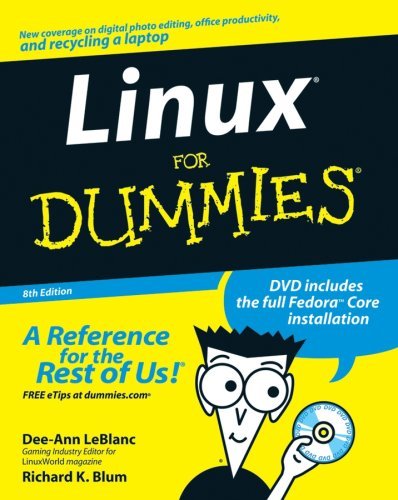
Linux for Dummies
CD-ROM/DVD and other supplementary materials are not included as part of eBook file.
432 pages, Paperback
First published May 29, 2007
Ratings & Reviews
Friends & Following
Create a free account to discover what your friends think of this book!
Community Reviews
Displaying 1 - 9 of 9 reviews

March 17, 2019
I was setting up linux os on my machine and spent some time to make my hand wet on it. I got this book and i knew it was really an old edition like more than ten years. Though the contents were still old but i still find some of them useful.. i should have bought a newer ones.
The basic setup and installation are still the same on the book, the rest are already outdated.
The basic setup and installation are still the same on the book, the rest are already outdated.
April 3, 2022
It gave me a good start on Linux. Covering all the basics.
This entire review has been hidden because of spoilers.

November 26, 2021
I've just started Linux for Dummies (Richard Blum, 10th edition, 2020). It seems like exactly what I wanted. It is funny and easy to read, yet seems comprehensive - it covers all six options for running Linux on a PC. It has whole sections on desktop environments and covers xfce, Gnome, KDE Plasma, Mate, Cinnamon etc. I immediately feel like this will explain a lot more than the book I reviewed recently (Linux in Easy Steps by Mike McGrath, 2021, 7th edition).
So far: I highly recommend Linux for Dummies to new Linux users!
Later: I'm near the end now. It is still good and covers a lot. There are a fair few typos - all minor, though I'm surprised no one proofreads the whole book before publication. I also got quite lost in later sections. The content is good, it just doesn't explain enough. For example, pp363-4 cover creating a script file. But it doesn't tell you where to save it. Then it assumed you haven't already put it in a folder with other commands, and tells you to enter a relative path of ./ - but of course, that won't work unless you saved the script into a specific folder, which the book doesn't mention. Then it points out you won't have permissions to run the file, without explaining why Linux would not let me run a file I created. Pp367-8 include a script, and says the echo line exists to "output a blank line", yet the example output doesn't have any blank lines, leaving a beginner scratching their head. Small things, but easily fixed with more careful consideration of a new user trying to follow complex instructions.
So far: I highly recommend Linux for Dummies to new Linux users!
Later: I'm near the end now. It is still good and covers a lot. There are a fair few typos - all minor, though I'm surprised no one proofreads the whole book before publication. I also got quite lost in later sections. The content is good, it just doesn't explain enough. For example, pp363-4 cover creating a script file. But it doesn't tell you where to save it. Then it assumed you haven't already put it in a folder with other commands, and tells you to enter a relative path of ./ - but of course, that won't work unless you saved the script into a specific folder, which the book doesn't mention. Then it points out you won't have permissions to run the file, without explaining why Linux would not let me run a file I created. Pp367-8 include a script, and says the echo line exists to "output a blank line", yet the example output doesn't have any blank lines, leaving a beginner scratching their head. Small things, but easily fixed with more careful consideration of a new user trying to follow complex instructions.

May 25, 2016
Bonne référence sur comment installer des systèmes sur Linux et des logiciel alternative essentielles. Des nombreux exemples sont donnés pour Ubuntu et Fedora. Il y a des commentaires sur les autres systèmes en bref. Plusieurs façons de les installer sont proposées. Le commun de partitionner du disque dure. Ou utiliser Wubi : installer Ubuntu comme l’application de Windows. Ça permet de l'avoir deux systèmes, mais les fichiers de Ubuntu sont visibles sur Windows c’est moins sécurisé. Ou créer une machine virtuelle que je vais tenter. Sur les exemples il y a des Google gadgets qui sont, par exemple, calendrier, gmail, gmaps…Le Shell est très utile. Il permet de lancer des logiciels tout de suite, choisir la priorité de processus, voir la hiérarchie des processus actifs...

August 2, 2010
Eh. Not particularly well-written, in my opinion. Could have used a lot more in terms of helping the user with everyday tasks rather than trying to shove everything up to and including CLI system administration in such a short book. It's okay, but not the first book I would hand someone to learn Linux.

November 26, 2007
Not helpful. This is for people uninitiated in Ubuntu. I suppose my main gripe is that I need something on a more intermediate level than neophyte.

April 11, 2011
*[ Ok, it is the first time I ever read a book about linux, mostly I used GUI and read manuals for the little knowledge I have, it was about time to start with some shell.- ]
November 7, 2015
Geeignet für uns Laien.

August 19, 2007
Was the more useful of the first two Linux books I read
Displaying 1 - 9 of 9 reviews