Jump to ratings and reviews
Rate this book

John the Posthumous

Rate this book
"After reading Jason Schwartz, it's difficult to talk about any other writer's originality or unique relation to the language. John the Posthumous is a work of astounding power and distinction, beautifully strange, masterful." -Sam Lipsyte"[Schwartz] is complete, as genius agonizingly is." -Gordon Lish"Haunting, original prose by a writer unlike any other on the planet. Jason Schwartz is a master." -Ben MarcusJohn the Posthumous exists in between fiction and poetry, elegy and a kind of novella in objects, it is an anatomy of marriage and adultery, an interlocking set of fictional histories, and the staccato telling of a murder, perhaps two murders. This is a literary album of a pre-Internet world, focused on physical elements - all of which are tools for either violence or sustenance. Knives, old iron gates, antique houses in flames; Biblical citations, blood and a history of the American the unsettling, half-perceived images, and their precise but alien manipulation by a master of the language will stay with readers. Its themes are familiar - violence, betrayal, failure - its depiction of these utterly original and hauntingly beautiful.Jason Schwartz is also the author of A German Picturesque (Knopf, 1998).

148 pages, Kindle Edition

First published August 1, 2013

12 people are currently reading
1147 people want to read

About the author

Jason Schwartz

7 books20 followers
Jason Schwartz is the author of a book of fiction, A German Picturesque (Alfred A. Knopf, 1998). His work has appeared in American Letters & Commentary, Antioch Review, Conjunctions, New York Tyrant, The Quarterly, StoryQuarterly, Unsaid, and other publications.

Ratings & Reviews

What do you think?
Rate this book

Friends & Following

Create a free account to discover what your friends think of this book!

Community Reviews

5 stars
46 (28%)
4 stars
50 (30%)
3 stars
34 (20%)
2 stars
18 (11%)
1 star
14 (8%)
Displaying 1 - 30 of 49 reviews
Profile Image for Glenn Russell.
1,514 reviews13.3k followers
Read
February 21, 2023


What does it mean for a piece of fiction to be itself an object of art?

In the spirit of approaching this question, I read John the Posthumous as if the novella were, indeed, an object of art, comparable to, say, a Joseph Cornell Box (a number of other reviews have likened Schwartz's work to a Cornell Box), with each section contributing a batch of elements, each chapter a cluster of objects.

So, with this vision in mind, think of the following headings, ten in number, as among the drawers or cubbyholes or shelves that house the contents of JS's unique J the P:

BIBLICAL
"The Devil's animal, in the storybooks, is found at the father's house, sometimes composed of white rope." "In Deuteronomy and Isaiah: the husband writes the wife a "letter of divorce." "In our family Bible: the flyleaf is inscribed in blue ink." These three direct quotes are examples of the biblical tone and content of the book, bringing to mind Cormac McCarthy.

Many were the times while reading John the Posthumous, I envisioned the narrator living in the years immediately preceding global catastrophe chronicled in McCarthy's The Road. Is the narrator documenting his "Pre-Road" age? That was the distinct impression I was given.

ROOMS
As much as or even more than characters (women, men, children), the narrator places focus on objects (houses, rooms, objects within rooms, bridges, outside objects) along with animals of all varieties. "Termites prefer timbers such as these. Fire sometimes traps rats in their galleries or behind an attic door."

Rats behind doors, rats behind walls reminds me of the H.P. Lovecraft tale, The Rats in the Walls. More generally, this Jason Schwartz fiction echoes Lovecraftian horror lurking just under the skin of objects. "The bed recurs as a figure in certain burnings - the torches fixed to boards, for skeletons, and the boiling oil in pots, in urns, in bowls."

POSITION OF WORDS AND SENTENCES ON PAGE
"The lake is named for the town, or for an animal, and is shaped like an ax-blade." In the 2013 OR Books edition, this sentence appears on page 26 toward the top of the page, after a short paragraph ending with "Certain of the words resemble ants in distress." and preceding another paragraph beginning with the word Adulterium in italics.

The exact positioning of the sentence on the page along with its relation to other sentences and paragraphs contributes to "book as object of art." In this way, John the Posthumous shares much in common with concrete poetry, a form of poetry where the arrangement of words and their appearance on the page is of primary importance.

POSITION OF OBJECTS AND PEOPLE IN RELATION TO ONE ANOTHER
"The bedpost, from a more sensible angle, might obscure a portion of the wardrobe, and divide the room in two." Much of J the P measuring, angling, bending, dividing, cutting can be likened to Alain Robbe-Grillet and the French Nouveau Roman, one novel in particular: The Mise-en-Scène by Claude Ollier since Ollier, an engineer by training, continually emphasizes the precise dimensions and angles of objects in space.

"The man stands in the corridor, the woman at the top of the stairs." A reader would be wise to attend to the shifting spacial relationships between one person and another, between people and objects, between object and object. "A balcony gallows may help dignify things a bit, despite the maulings in the courtyard.
A roadside gibbet, for its part, makes little accommodation for the sounds in a house." Do you sense a powerful emotional charge?

MINIMALISM
Curiously, with all the resonances and associations a reader can make on every page, there is also strong thread of minimalist art. To take one example of many: gallows and a gibbet bring to mind a wide assortment of ghoulish, ghastly images. However, on another level, in this work of fiction, they serve as objects in themselves a la Carl Andre and his bricks.


Carl Andre's Equivalent VIII - what you see is what you get

VIOLENCE, BRUTALITY, TORTURE
"At the time of murder, reader, a knife might display the victim's name. This was less the habit later in the century." Maybe it was just the mood I was in, but as I was reading, I could almost hear screams of victims and feel their agony and pain.

ENTWINING ETYMOLOGY AND ENTOMOLOGY
Abiding theme: the origins and meaning of words along with a continual reference to insects. "The gap in the banister is dreadfully evident, at any rate, despite the embarrassment of the pattern, hornets and all."

CHILD'S FRIGHT
"I count again the number of nails, up and down." --- "As a child, as a boy, I was distracted, shall we say, by several forms on the wall." --- "My nightshirt was white - the color, perhaps, of your own childhood attire." How much does the narrator's memory of terror coat his story with a layer of red powder?

REPETITION, REPETITION
Keep an eye out for the reappearance of cuckoldry, punishments of adulterers, the importance of the marriage bed, skulls, bones, corpses. "Organ knives were designed for the windpipe, the lungs, the intestines, and so on."

MACABRE MACGUFFIN
John the Posthumous was a French king who lived and ruled for five day in 1316. No explanation is provided as to why Jason Schwartz chose the title or how John the P relates to any of the happenings and writings in the book. This absence sets the tone for the entire work.

"The wife burns the husband's clothing. The husband stands at the end of the corridor, on every floor. We do embrace our examples, sometimes, with undue devotion. The town - it had been founded by a benedict. Commencing with burnt posts on a lawn. Our house was quite plain, I am afraid. Pause here, at the door. Present yourself at the window, as she had, and now remove yourself from view."

Profile Image for Fionnuala.
887 reviews
abandoned
December 16, 2015
Because we live in an age when we can kindle a fire under any book we choose and have a lively read as swift as a whisper of wind through a net curtain, I set about lighting this one as soon as I read about it. But no matter how hard I blew, I couldn't get it to take off. I tried adding clumps of knowledge from old books I'd read before, including the bible, and bits of old photographs, but it just wouldn't take. It was a fire that was dead before it began.
Afterwards, I examined the charred fragments. They were all green wood, the older, drier parts of the branches had been methodically chopped away. Who would do such a thing, I thought? Who would assemble the perfect bonfire and then deliberately remove the very bits that would make it roar?
But perhaps this book wasn't meant to roar, or even flicker.
Perhaps it has another destination.
I imagine all the fragments floating in a great cube of ice, so arranged that if you look at it from one angle, you see a four poster bed, from another a blood-soaked sheet, from a third the blank windows of a house, from the fourth a torn snapshot of the narrator's family.
I see it as an art object not a narrative.
Profile Image for Mariel.
667 reviews1,212 followers
August 27, 2013
The doorframe disappoints the wall, as the wall disappoints the floor. The mullions divide the yard into nine portions. But portions- or, if you like, portion- is an unlovely word, Guest and host, for their part, issue from the same root- ghostis. Which means stranger, villain, enemy- though naturally I had believed it to mean ghost. And the figure in the corner, lower right, is neither my daughter nor her hat, but just a paper bag in the grass.


What if you were a tarantula (any poor spider will do) as a hostage meal womb for a baby wasp to grow up and make more future killer wasps, just to live on the next you? If you were dragged off, prisoner in some hole, would you think about how unfair it all was, feeding the pain to spite hope? Past spider captive meals feeling it too. I think a lot about fucked up it is, the death of their victims. I've tried to will a sort of hawk-eye view on thforem for some time now. The under water victims of under water spiders will do too. Diving bell cocoons of thought, suspended forever. Does anyone else ever think about ballooning spiders? What if you were an adult spider making the conscious choice to fly this way, knowing you might not come back? The life on the end of the bee sting sword. That bees kill themselves for a fuck you to somebody, or is it self defense. What ways to go. I don't have this mind picture of a group of bugs or of individual bugs. It must happen. There must be one little guy somewhere knowing he's going to die and doing it anyway. Some ant caught in the shit work of "ants are supposed to be slaves. That's how it works" and maybe there's forever of proof backing it up.

A this is the way the world works in I thought this was the way the world works. A novel in the 'verse. What did it look like when other men were cuckolded in your place across space and time? If they felt it too then it's wrong for you. Poetry in some kind of justice.

Hey, have you ever heard that everyone is connected? Mosaics of the ant's life view on the farm (there's a lot of room to run, they say, right before they kill you). They make the face of the queen bee. Have you ever felt that it must be really fucking wrong, that there must be someone to appeal to, if you only knew what it was all called? So what did it look like when they took the knife and stuck it in the back that looked like those other backs. Standing to the storms. It is like having to think before every breath. Forget and you will die. It is a lot of work to believe it. If everyone is connected and this is how the world works this is what it looked like, this is what it is called in murder and adultery. It is work for me like yous and theys to think about cuckolds or adultery. Someone has to be the womb spider and someone's gotta be the hawk wasp. I don't want anyone to be either (someone should ask, is there any love it should look like?). Every little breath you take in the some kind of justice. Carve the beating heart out and ugly outside of you and they and becomes me I see anguish in the I know what is connected. I don't know how anyone has words like "cuckold" for a place a man married to a cheater should have been something else, or that people don't just fall out of love and in love with someone else every day. It isn't eating you outside of you, if you could still walk.

But I feel lost in running my fingertips against all the walls and all of the places there are holes where things "should be". Like when everyone is connected. I know what it feels like, if not the "should be". I don't feel a hole where there should be someone who loves me, or rather angry that it won't happen. I feel ashamed to walk around all the other people, as if I'm not one of them, because I don't have friends. I'll be thirty-four in a little over a month and I don't know if I've ever belonged around anyone. It is hard to muster up any kind of that shouldn't happen when I don't believe I'm like other people. I feel this beating behind the history in John the Posthumous, this conviction from what came before, and I was moved by it as a search for proof more than in belief. I don't believe in a make it happen but the pain in the search was so much I couldn't breathe.

A woman in the window, a daughter never seen. Knives and the heads put by them in buckets. The locusts or some kind of tapestry depicting cave man's prophetic fires. It could get so ugly. I wouldn't have cared at all about anyone being cuckolded. It isn't a shame to me, or a definition. That happens.

But the finial and the bed, remember, later became theirs, or, better still, were lost to us- a less noisome phrase, this, even if it neglects the fire. Evidently hearts once required a burnt deck, like heartsette, which added a wound, and like matrimony, for the lonely- but unlike blind girl, in which the hearts were marked out.

Even the earliest primers compare the heart's shape to a fist or to a hand waving goodbye.

Somewhere between the fist and the wall of the stilled beating heart is Jason Schwartz not writing to a you or a they. It's something I don't know how to name it. Somewhere, somewhere someone was you and they are no more. I believe in the longing. It is left on the floor, in the bed, a rumple of clothes. Fallen faces. I lost my breath over the creepy crawlings on the walls. The witnesses of critters and trying to say we are only human. It isn't convincing and that killed me because I have always heard we are all in it together. In the flying and that did you know so many are named wrong? Silk worms are caterpillars and Hessian flys were wasps in sheeps clothing. You never know where the knife is going to come from. It is that kind of book. I like that kind of book because I don't belong anywhere, and I think about insects all of the time too, at least, and the big parts that don't make sense are materials of insects. I am pretty miserable writing this review. I wished, in my head, to be free on the little parts. There has to be days when there's a "before" the dark times. Schwartz can go back to that, knife in hand, in the blue walls, in the witnesses. I'm not him so I can say he did it but I can't do it on the outside. It was so ugly the unfair parts, too. I feel this kind of empathy for parts I can't see, like spiders.
Profile Image for Brian.
Author 1 book1,246 followers
July 29, 2016

This novel has made me a believer in time travel. Sent to us from the 25th century - when humans have realized that language is woefully lacking in its ability to impart lucidity and idioms have failed us – this codex contains words in an assembly that baffles our 21st century mind. But it is beautiful the way that bird song and whale music is so. Inability to translate, to understand meaning with complete clarity, does not impact its weight.

A rood, in England, is a quarter acre – but may evoke, in the New World, animals in the kill. The sky is dead leaf or king’s yellow or burnt lake – at least as the field books have it.

I’ve read this book four times in the last few months, and each time it was as if I were approaching the text for the first. Schwartz is telling his readers a story of loss and betrayal via a narrator’s personal journey amidst the recollection of painful events. Our narrator requires us to learn definitions, his/her definitions, in order to see events as s/he does. The execution of this novel structure is nothing shy of amazing and flawless. Crack teams of learned men and women of letters should devote their time into the unraveling of the book to plum its deeper meanings, its tenuous connections to both the text itself and to the world it references.

Guest and host, for their part, issue from the same root - ghostis. Which means stranger, villain, enemy – though naturally I had believed it to mean ghost.
Friends M. Sarki and Proustitute both made me aware of this treasure. Their excellent reviews here on Goodreads should be read after reading the novel. And please remember - when you read this fabulous text, do not to become frustrated if clarity eludes you. I am still very much in the dark and yet feel inspired by what Schwartz has done with our language. Now I just need to see if he will lend me his time machine.
Profile Image for M. Sarki.
Author 20 books239 followers
December 16, 2015
The importance of being Jason Schwartz is primarily because we need him. There is no one writing in the English language today that is on the level and measure of Jason Schwartz, and that even includes that McCarthy fellow. Yes, Cormac writes a strain more manageable than the virus that exists in John the Posthumous, but the works are both biblical. A clever writer on the periphery might think that a mere reference book laid out beside you could produce something of the sort these pages have listed, in order, between the covers of this OR book. But I don’t think so. Merely compiling lists fail to manage their dance on the page (in this case a waltz) as the words of Jason Schwartz do. I have always likened him to a poet of the first rank and that is probably the reason I enjoy reading his work.

To be fair I suppose I will have to give credit where credit is due. Gordon Lish found Schwartz first. But that doesn’t mean that I too can’t champion him. If you happen to read the full page praise at the very front of the book you can see the Lish that I am talking about. For only the right reason he might just explain.

Schwartz never, in any story I have ever read by him, explains anything. He is long-suffering in that regard and he makes it very hard on the lesser readers among us. It helps to have an open mind. And reading Schwartz is no guarantee you will come out of the experience feeling any smarter than when you first went in. But you won’t be numb. You will have what for some of us is called an abundance of feeling. “Unexampled” is how Lish likes to term it.

John the Posthumous by Jason Schwartz is a series of connections in digression. Historical fact, academic and theological reference books, all seem to be sitting at the side of his desk or writing table in case, and he does, wish to consult them and enter his findings and tabulations into his text. Of course, there are also the fictions which when connected appear to also be of some fact and enter also into his reporting. But Schwartz is not The Nightly News and he rarely resembles any news anchor we have ever gotten comfortable with on TV. I am not sure that Jason Schwartz can even be trusted. At least he doesn’t appear to be anyone who…and it feels I have already gone too far in my own assessments and have become what I refer in my house as a haglund in my posture now with my too judgmental nature. The writer and professor Schwartz is a completely other matter in that he most certainly is a stand-up guy. But it is because of the narrator of this book that one can be made to feel not quite so sure about him as a person. In other words, the fiction behind the words is sometimes scary. But still we go on, and it is as if we must.

What is remarkable, at least to me, is the seriousness in which the narrator takes himself in these studies, or stories if you wish me to be precise, and the pleasant conversational tone he employs, I suppose, to put us at ease. But that is anything but what I feel when I am reading him. My head is spinning much as Beelzebub in a horror film, but still I am comfortable that Schwartz, the man, will protect me from some fateful fall from a height in which I could not survive. My words here are not meant to scare you, or even suggest you not read him for fear of any danger to your person too often, or too much, in the presence of. Not at all. I love this guy and you will too if you just hang on as if on some scary ride. His rails and machine are both in good working order. One must always keep an eye on the prize.

One problem you are sure to encounter while reading Jason Schwartz is you will not be privy to what his master plan is. It becomes obvious immediately that he has researched his subject well though he rarely gives us hints for what his greater subject is that dictates the hours of long research and the scribbling that come after them. His motive from the very beginning has to be clear even to the most stubborn ones among us. Schwartz means to entertain. He has no other agenda than to impress upon those of us reading that language makes our lives and history most certainly worthwhile though the outcomes might not establish themselves as beneficial or as gratifying as we may have initially hoped for.

From page 24: “August arrives in due course, the color of a statue or a hatchet.” He continues on to say in the next paragraph of one line, “But this does overstate it somewhat.” Lines such as these please me and draw a laugh out from me or at least gets from me a smile.

I have heard no few complaints regarding the tendencies of Schwartz to categorize, to countlessly enter items in such a way as to suggest an extensive laundry list. But these no few have failed to get the gist of this somewhat scientific aptitude. Make no mistake about his creative use of hard nouns, things I might say, that add credence to what he is talking about in his setting down of place. It is what we must want ourselves to occupy, but instead he does it for us. As Lish has often taught as strategy, Schwartz himself does supersaturate. There is often a bit much etymology, but not enough even for my personal taste. I love knowing where words originated from even if they have been made up. I have no proof of this as I never cross-reference the work I read in front of me especially if it is deemed already fiction.

It could be argued that for as much as Schwartz elaborates his fiction there is still too much left out and unknown to us. Sort of like entering through a locked door into an unknown house of some repute, though no one has lived to tell about it. Every page a new discovery into a further unknown, though we are getting to know each other more intimately. It is his life we share in, though it is made up and of another time.

The book is separated into three sections. The first being titled, Hornbook.

From page 38: “Thief ants occur inside decaying trees.” That sentence alone is a poem in my world of verse. And then on page 39, “See the bees atop the cinders.” A world of its own in which we might also inhabit, carefully.

And just when the going gets a bit too dangerous the narrator stops abruptly and says, “But now I have managed to trample the annuals again.” In context it is similar to taking a walk in the garden with an older, more tired and nervous version of our beloved Marlon Brando.

I am not sure how it happened that it seemed a kind and thoughtful father figure was talking to me and then all of a sudden the voice changed to a grandmotherly type. Perhaps a Mrs. Doubtfire, but that seems impossible and makes no sense to me at all. I must have been reading too much into the thing about that canopy over the bed ruining the children’s room and the way he finished with, “my dear.”

In the second section titled Housepost, Male Figure the narrator’s voice is proper and speaks kindly but with authority. He certainly doesn’t know-it-all. He is trying hard to get things straight, or right, or fixed into some sort of order for us. He is not afraid to fail though he most likely knows he must. We all do as well. But I think the serious and exactness of these facts and observations presented are meant as a way for all of us to connect, much as things in the stories also tend to do, and in their own sweet time. There is gratitude enough for all and also a bit of too much sadness. Sort of like a Neil Young song that is going to end badly no matter how much we wish it to be otherwise. But this may be prematurely unfair as I am just getting into this second section, though I doubt it as I have had numerous previous encounters with this same character. “Character is our fate” remember, and it doesn’t take a poet the caliber of Jack Gilbert to remind us anymore as I for one got it perfectly the first time back when so and so said it. But we are working on a story here and I am getting way ahead of myself.

From page 65: “The cord wound around a brass cleat.” It feels as if I am reading at times a found journal, trying to make heads and tails in an evidence room down at the local precinct. Or perhaps a diary or even some sort of confession. But more is always unknown and the rest is our imagination. It is frustrating and never clear, though the found objects insist on our understanding of them. Even less on the awful truth of what might have really happened. The house still stands as well as some of the proof of its prior existence. What was used in this crime may, or may not, still be leaning or wedged into a corner of the dusty room.

The knowledge presented in this book would take more than a lifetime or two to acquire. The research needed to inform ones self of the many trades and manners found here on the page proves that Schwartz works harder than both you and I. All we’ve had to do is read what he has written, enjoy the poetry of his verse, and attempt to add two plus two and somehow make it five. The problem seems to keep changing before our eyes, but the tone of jeopardy always remains insanely the same. It is a labor that for some would make crazy. And that is why this type of work is rarely read and too eagerly discounted. Lish has already gone on record as saying Schwartz is clearly taxing. And let that be a warning to you. But you are never better off dead when a guy like Schwartz can amaze you.

The third and final section is titled Adulterium, of which the meaning of the word is unknown to me but may be construed as having taken part in some illicit or unbecoming behavior with someone’s wife, or husband. The thread of cuckold continues here as do the objects contained as prior evidence.

How frightening when he says on page 93, “The ashpit attracts finches rather than bats, but the housecoat catches fire anyway.” What poetry is expressed from within our fear.

There is a way in which to read him. It is troubling not to begin, and more so when Schwartz appears so busy labeling. Our planet has never seen another writer like him, and I find it remarkable, and a stroke of luck, that we here do.

The narrator seems to think the reader sees the same things as he does. Or it is a ploy in which to irritate or make us look even harder. Perhaps a question for our selves to consider, and in ways a failure to get what is clearly right before our eyes. For example, from page 104, “A winding-sheet would imply contagion, despite the burlap sacks at the chapel wall.”

It is quite possible, and I expect it is regardless of what I think, that the longer one spends with sentences of John the Posthumous the more understanding through feeling is derived. The words are never pretentious, however a dictionary or etymological study could prove useful or else, in contrast, complications may also arise which were never initially intended by the author to begin with. In other words, too much study could prove harmful and our obsession should fare better by just letting go and having some fun along the way. And for me this idea does not seem at all preposterous. It is likely this work was meant for us to enjoy in whatever way we might have come across it.

The clues are scattered more than bread crumbs are wont to be and they lead our investigation into a more elaborate labyrinth of sorts if one is enough interested in which to pursue them. I prefer the easier and more casual walk among the daisies of his literature and prefer my senses to do the hard lifting instead of this more predictable cerebral pull toward definite answers and complete understanding. My method of reading should result in much less confusion and a more reliable accounting of my complete experience. It helps to know how to read him, but I have already stated that previously and in fact am sounding now a bit redundant. And as quickly as we have entered this rich world we are gone.
Profile Image for Jonathan.
1,010 reviews1,232 followers
February 10, 2014
A work of quite astonishing brilliance. Each sentence is like an entire novel chipped down to a fragmented core, overflowing with meaning. And underneath it all the oldest stories of them all - betrayal and violence and family and the home.

The word adultery does not, in fact, derive from cry – just as you had suspected – and the town, I will concede, suitably antique, and quiet now, stands in lieu of another town, come what may, these stains – cheerfully small – on the blade of the paring knife.

Trying to say something other than that expressed in the many wonderful reviews of this already in existence is hard.

However, before I start on the prose, I note that a few reviews on other sites have said that, other than the person to whom it refers, the title's meaning is opaque. So, to clear things up, here is a little history::-

JTP, as we shall call him, was the son of Clementia and Louis 1st back in 1316. What is interesting, and relevant, is that Clementia was Louis' second wife, after his first had been found guilty of adultery and murdered. All this sexy fun and games was called the "Tour de Nesle Affair"

A fun read can be had here: http://www.executedtoday.com/2010/04/...

What does this add to our reading? Not much, but to confirm the blood, violence and betrayal at the heart of the text.

As for the text itself, well, the sentence quoted at the start of this review is simple enough evidence of talent for me. It is a perfectly controlled piece of writing – the micro-breaks in the flow, the sudden(?) shift to the knife, the incongruity of "cheerful" (blood?) stains…

Other than that, well, I wrote some more rambles here but have just read this:

http://biblioklept.org/2013/07/25/jas...

which says everything better than I could. So go read that instead. And then read this book.
October 8, 2013

Please do no take what is written below as any attempt to provide the meaning of this work or an interpretation. It is only my very personal reaction and should be taken as no more.

After riding the buoyancy as conveyed in my status updates-
["Most narratives begin with a subject and from there digress. JtP starts with digression and digresses towards its subject. This is its mystery ripening behind the beauty of its poetic prose."]
["Composed of incomplete sentences that are composed of intricate puzzled pieces, JtP curls into the rhythm and sounds of poetry. Pieces are not embedded but woven within the letters, their spaces between. The prose blisters with murder, adultery, incest, blood of biblical retribution. Then the, "I," appears. Research or memory? Framed this way Schwartz shows it is the telling not the arriving,"]-the book ended abruptly leaving me disoriented, shamed that I was helpless in its wake. I did not believe then or now that Schwartz designed the writing style to create this helpless ambiguity in me the reader, making a statement about the experience in life through style versus content. There was something else or less.

From other similar reading experiences I knew the best thing for me was to walk around feeling this anxious helplessness for as long as it took to settle in and its meaning to rise to the surface.

What finally appeared was that this story ended where and how it did because it had nowhere else to go. Not that this was autobiographical or again stylistic but that the narrator-who does not appear as a first person, "I", until further in the story, then only periodic makes brief appearances-is himself lost. He too is battling. I see him sitting at a desk, ghosted, the dim light with a yellowed tinge. Forehead supported by his hand he pours over catalogues, legal manuscripts, biblical passages, historical documents. Within the poetic prose is the blunt contrast of this man's desperate readings of the horror, mutilations, ghastly atrocities, performed on others throughout history in the name of order and biblical callings. He is desperate in the obsession, its impudent demand for fulfillment, in order for life to continue with any purpose or meaning, until he has pieced together what he witnessed as a young child, or what was done to him. There are continued references throughout the text regarding, adultery, rape, incest, blood, murder.

As the book settled, what rose up for me was that there was a hazy presence. The presence was this lost man trying to find a passage out of a poetic circular nightmare. There aren't enough pieces to link for an understanding, a closure that will allow him to step into life. All he has are these shiny cut slivers of gems which turn out to be trinkets. He is as lost as I am, the reader.

To settle this work into words is a contradiction. Since it is something new our words do not refer to it. In time it may create a new dictionary of literary reference on its own.

The historic, John the Posthumous, was crowned king at birth. His reign ended five days later upon his death. It has never been determined whether the death was from natural causes or otherwise.
Profile Image for Tony Vacation.
423 reviews344 followers
January 27, 2019
Etymology and when the roots of words disappoint. Biblical law regarding adultery and the discrepancies of translation. Obscured historical accounts of cuckoldry and punishment. The anatomies of destructive household insects and how to cull them. Ominous descriptions of antique furniture, American architecture, and various paintings and wood carvings. A feverish litany peppered with evasive memories of familial violence and ruin. Language stripped down to exact prose the way a butcher renders meat. Imagine the last four fragmentary novels of David Markson but with the nightmarish clarity of John Hawkes.
Profile Image for Nathan "N.R." Gaddis.
1,342 reviews1,654 followers
Read
February 10, 2019
Some tiny books can pack a real punch. And looking around I see some of my goodFriends really took one to the gut with this one. Me? It's just a tiny book. I found it inconsequential on the whole and the part. Just a lot of words dangling around. I'm sure there was something serious--some murder, some adultery, something--lurking down below there but I found no reason to sus it out. Sorry. It's just a tiny book.


eta :: I just browsed the gr=Reviews of Friends. What the hell is going on? This is a vacuous little volume. In my opinion. Really. What did you guys read? I'm astounded right now. Baffled. Flumox'd. Hosed. Shorn. Am I trying to put my hat on my ass?
Profile Image for Fergus Menner.
49 reviews1 follower
Read
July 19, 2025
One of the strangest things I've ever read. I;m inarticulate in trying to describe this book. I think good old captain fiction said it best:

"As for the author, this mandarin heretofore hidden among us, there is positively nothing I can usefully say to you for him or of him or to him. He is complete, as genius agonizingly is. Can there be a more ghastly occupation? It is no guess that it had to have been terrible for Schwartz to have contained John the Posthumous."
Profile Image for Adam.
423 reviews181 followers
October 25, 2018
Things are arranged in an ominous logic. What but syntax could this connection be? "Am I missing something?!" All stark details, yet some things more than others are limned with horrible familiarity. A looseness of thought and causality, a lesson prose could teach us about everyday speech and description. For what reliability do consequences in reality ever uphold? All that is solid melts into The Book of the World, judgment and revelation, apocalypse and paradise eternally deferred. The brain-feel left behind as residue resembles a tutelary manual of oneiric decomposition and heroic reassembly. Most of These Things you've only heard of; like life. Halfwits indulge the self-aggrandizing pastime of mocking this style. If Beckett's was a voiceless subject, here is the subjectless voice. Ceremonies as solemn and sham as Pentateuch rituals. So decorous, painstakingly explicative, don't you know? When will the catastrophic collision finally deliver us from waiting?
Profile Image for Bob.
6 reviews2 followers
October 15, 2013

Not gonna write a damn thesis on the thing, but it's... well, it's good.

No, really.

It's like... the script to an adultery-themed episode of Antiques Roadshow directed by the Quay Brothers and set to a Cave/Ellis score.

627 reviews
July 2, 2021
I am awfully disoriented. There is a charm in the language and images so I went on reading. But to be frank I did not comprehend the content much more than the babble of my daughter at very young age. Harold Bloom is no more or I could have requested his help on 'how to read' this book.
Profile Image for Jon.
423 reviews20 followers
July 31, 2019
A man has been victimized by adultery, or thinks his is, and contemplates murder, or performs it. This book is A very suggestive, poetically arranged, and highly focused example of automatic writing (or at least is very reminiscent of it), which to the big daddy of the surrealist movement, Andre Breton, who first dabbled in automatic writing in 1913, was the heart of surrealism itself.

The technique, widely adopted by surrealist writers in the twenties (and by artists in other mediums, such as painting, under the broader term of 'surrealist automatism'), found its energy in another 'invention' of that era, Freud's notion of the unconscious. The idea behind it was too create a dialogue directly with one's unconscious (both that of the writer and the reader), bypassing the 'rational mind' and regaining the 'mythic' (or perhaps spiritual) dimension of the human subject, which has been largely suppressed in our secular modern world, in a modernistic way (that is, without the 'medieval' baggage that comes with organized religion, which to the surrealists no longer had a place in the modern world).

Both absurd and transcendent, an unsettling combination. Excellent! It is good to see the technique (or something like it) is not dead.
Profile Image for Katherine.
405 reviews167 followers
March 27, 2014
I've been delaying this review for some time now, and I honestly don't know where to begin.

John the Posthumous was just what I needed this month. It's dark and unsettling yet vague and cavalier. And yet, at times humor even manages to sneak in. I will admit right now, I don't think I understood everything that was happening as there isn't exactly a clear plot, but it still haunts me. And that's why it works.

Schwartz created something so vague, yet unbelievably clear to me. I glimpsed the muted landscape of burning houses and the anatomies of objects and humans alike, yet I didn't always understand what exactly was happening. His astute manipulation of the English language weaved something utterly unique in my experience. Some moments reminded me of a fleshed out Edward Gorey story, diving deeper into the vast setting of unsettling emotions and visuals.

But what I enjoyed most of all were the vivid brief and personal glimpses into the protagonist's life. My favorite moment on page 72: "Were you to gather the blanket this way, and set it on a chair, in winter, in the sewing room or the sitting room--horses on the wall; a wolf on a shelf--or in one of the rooms named for a color--late in the afternoon, the light terrifically dim--it might conjure, finally, the form of your boyhood dog." I swear I read that five times before continuing, but not until I texted it to my SO. The word finally so fragile and specific. It begins as instruction, yet ends almost as a confession of sorts. And the effect is still powerful, long after I've finished it.

Once I got into the rhythm of the prose, I felt comfortable with my discomfort. And I look forward to reading this again.

Highly recommended

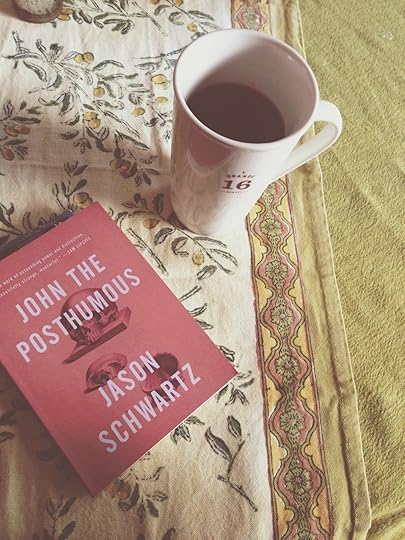
And damn it sure looked good on my table!


Profile Image for Fraser Kinnear.
777 reviews45 followers
December 26, 2013
Near the end, I read:
My wife arranged the knives in a tidy row. Sometimes a game is made of such formations – don't you find? And so she collects the needles and he extracts the hairpins as - observe – the blanket turns black. Or so goes our conjecture, as quaint as the names of the places. Or the ax in the pattern of the house. It catches the light or dispatches a shadow – though this is more often the case for windowers, I think.


The knives image reminds me of part of a Larkin poem:

Even so distant, I can taste the grief,
Bitter and sharp with stalks, he made you gulp.
The sun's occasional print, the brisk brief
Worry of wheels along the street outside
Where bridal London bows the other way,
And light, unanswerable and tall and wide,
Forbids the scar to heal, and drives
Shame out of hiding. All the unhurried day,
Your mind lay open like a drawer of knives.


Both feel sinister - domicile but dangerous. Both appear to be about potential for (emotional at least) violence within a marriage.

The difference is in the details, or I should say, amount of detail. Larkin is far more economical with this words. This should be an obvious and unfair comparison - one is writing poetry while the other is writing a book. However, this book doesn't read like a novel. Instead, John the Posthumous is menagerie of images all relating to a few core themes. Like Burroughs' cut-up technique applied across a book of prose poetry. And due to the lack of apparent plot or permanent characters, I found my attention frequently lapsing.

So you have ~150 pages of prose. What's there sounds great, feels great, looks great. The pages read consistently enough to exist within the same book binding. I wanted this to be a book, but (to poach a term) there is no there there.
Profile Image for Garrett Peace.
285 reviews12 followers
December 4, 2013
I'm not sure exactly what I read, but I liked it (I think). Definitely a trip.

Actual rating: ~3.5 stars, pending further thinking and reading of criticism.
Profile Image for JQ Salazar.
Author 3 books5 followers
May 19, 2022
“The doorframe disappoints the wall, as the wall disappoints the floor, which are the same distance from each other as you are from the house... Wouldn’t you say?”
Profile Image for Maxwell.
68 reviews16 followers
September 27, 2021
The writing is engaging, but I still found this to be the particularly boring side of avant-garde fiction with nothing I could really grasp onto.
Profile Image for Shehan.
7 reviews4 followers
November 7, 2022
Imagine buying a house, but all the rooms are removed. Same fate for the roof and tiles. Even the four walls are shifting. But you can fleetingly see the shadows casted by the rooms and roof that isn't there and it may even give you cover from the elements. Can you still call it a house? This is what I feel like about calling this a story. Removed are the traditional elements of a story plot, setting, characters. Even the very building block that makes a story; sentences have become alienated. They fit with each other in a logic that's difficult for you to comprehend. But they do fit (maybe not in the dimension you inhabit)

The words have more than their usual sense of meaning. They gain those additional definitions by clashing with each other in that alien universe of extra dimensionally joined sentences.

And those words are what makes this a story rather than a random mumble. But it's a dynamic shifting story changing with each moment. In the canvas of reader's mind these evokes pictures that is unique for each one.

I won't be able to tell what the stort is about apart from what's in the back cover of the book. But I stopped reading it in midnight because a certain part gave me creeps. And I think kinda proves it is a story after all.
Profile Image for Chris Gray.
107 reviews1 follower
November 7, 2023
DNF. Read 55%, brief skim of the rest. Alternatingly detailed and abstract descriptions of places where ambiguous dread lurks, lurked, or might lurk at sometime later.

Same sense of “Ahhh, I’m not enjoying this!” as Burroughs’s cut-up novels. This word salad is too bitter for me.
Profile Image for Jana Eichhorn.
1,127 reviews15 followers
April 4, 2020
DNF at 20%. If someone can tell me what this book is about, I will make them a cocktail.
12 reviews1 follower
February 13, 2021
The stories of stuff without all the useless connective tissue, like characters and plot. #worthit
15 reviews1 follower
Read
December 6, 2021
Listened as an audiobook which probably wasn't the right choice. This is very structurally interesting, and I wish I had physical pages read and reread.
Displaying 1 - 30 of 49 reviews

Can't find what you're looking for?

Get help and learn more about the design.