Former Army detective Kate Holland finally remembers what happened during her eleven hours as a POW in Afghanistan. She wishes she didn't.
Her PTSD raging, Kate's ready to turn in her badge with the Braxton PD, but she can't. The wife of a Muslim US Army soldier has been found stabbed and left to burn in a field, and Kate's boss has turned to her. Again.
Kate suspects an honor killing...until the wife of another soldier is found in the next town over, also stabbed and burned. When a third military wife is murdered, Kate uncovers a connection to a local doctor. But the doc is not all she appears to be. Worse, Kate's nightmares and her case have begun to clash. The fallout is deadly as Kate's lured back to where it all began.
This time, she might not make it home.
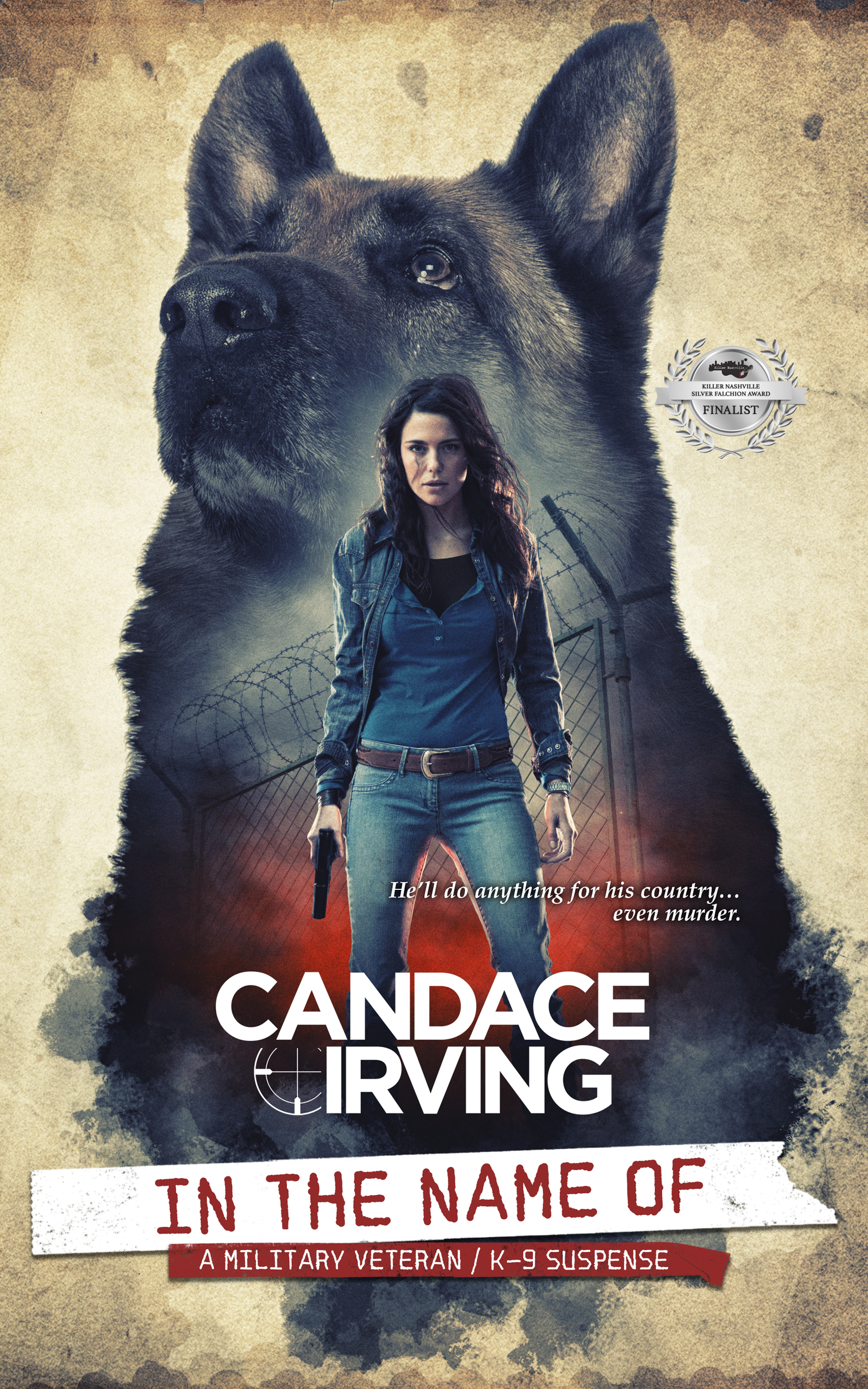
*In the Name Of is a 2022 Killer Nashville Silver Falchion Finalist for Best Investigator.
Written by a former US Navy Lt., In the Name Of is Book 2 in the Hidden Valor Military Psychological Suspense Series and features Ruger—Kate's 3 yr old German Shepherd.
Graphic crime scenes abound throughout the Hidden Valor books. If you like strong, female protagonists and seriously gritty, complex suspense that twists and turns all the way to The End—you'll love this latest installment in Candace Irving's military mystery/suspense series featuring Braxton Police Deputy Kate Holland and her self-appointed therapy dog.
A former US Navy Lt., CANDACE IRVING is the daughter of a librarian and a retired US Navy chief. Candace grew up in the Philippines, Germany, and all over the United States. Her senior year of high school, she enlisted in the US Army. Following basic training, she transferred to the Navy’s ROTC program at the University of Texas-Austin. While at UT, she spent a summer in Washington, DC, as a Congressional Intern. She also worked security for the UT Police. BA in Political Science in hand, Candace was commissioned as an ensign in the US Navy and sent to Surface Warfare Officer’s School to learn to drive warships. From there, she followed her father to sea.
Candace is married to her favorite soldier, a former US Army Combat Engineer. They live in the American Midwest, where the Army/Navy football game is avidly watched and argued over every year.
IN THE NAME OF: A Hidden Valor Military Veteran/K-9 Suspense (Hidden Valor Book #2) by Candace Irving is another edge-of-your-seat action suspense/mystery/police procedural mash-up featuring a small-town deputy who’s past as a former Army detective seems to continue to follow her. Both books, one and two have been great reads and with Kate’s continuing battle with PTSD and the overlap of important characters, I feel they are best read in order of release.
Deputy Kate Holland’s PTSD is taking over her life and even though she has started seeing a VA psychiatrist, she feels it is best to turn in her badge. Then she gets called to a horrific scene of a female with stab wounds and her burned body in a field. It brings back flashbacks from her attacked burning Humvee during her deployment. When a second body is found the same way in a neighboring town, Kate is reunited in her investigation with Deputy Aresh, who is still in the Army Reserve and helped in The Garbage Man case. Both believe these are “honor killings”. Both women are Muslim, and their husbands are Muslim Americans in the active services.
The women all seem tied to a doctor who claims no knowledge of either, but Kate knows she is lying. When a CIA operative warns them off the case, Kate and Aresh only dig deeper after a third murder, and Kate discovers that she must return to a place she swore never to return to.
I cannot say enough about this series. Kate is a complex, realistic, fully developed protagonist that makes me feel every emotion as I discover more and more of her story. She is a complex mix of fragile and yet strong. I enjoyed the scenes with Kate’s German Shepard, Ruger once again, even though he does not play a pivotal role in this plotline. It is also nice to see Kate take another chance on a “maybe” romance after so many men have let her down or betrayed her in the past. There are graphic descriptions of stabbed and burned women, but I never felt it was gratuitous. Kate’s PTSD is realistically portrayed, and the author does provide information on PTSD and the treatment regimen Kate is receiving in a postscript. The suspense plot in this story is intricately plotted and fast paced to lead Kate and Aresh in many different directions due to their own personal past experiences and it kept me guessing all the way to the climax. I am looking forward to reading the next book in this series.
I highly recommend this powerful and thrilling action suspense/mystery!
In the Name Of by Candace Irving has just about everything working for it. There is action, mystery, suspense, a little romance and a very concise look into what it can mean to someone battling with PTSD. It is very evident that she has done extensive research to develop characters struggling to exist with this debilitating condition, regardless of the traumatic event(s) that caused it. You get a real feel for the anguish that Kate, Arash, Seth and Lily are living with. The way Candace Irving describes the Cognitive Processing Therapy (CPT)that was developed by Dr. Resick to help those suffering from PTSD and how Kate is beginning to get some relief and new coping skills via CPT is very interesting. The descriptions of the horrible ‘honor killings’ followed by some cultures is very graphic, but clearly creates the visualizations the author wants you to have. Those alone build up the sympathy for the victims and the rationale why they must by stopped. The suspense in solving the killings makes you keep reading just to find out what happens next. I also enjoyed the interactions that tied Kate and Regan Chase together. Hopefully there will be much more of the two of them together in future books. Candace Irving has truly surpassed herself with this story. It is highly recommended and well worth the read. You will definitely enjoy In the Name Of.
This story is a follow-up to the Garbage Man book which was wonderful. Kate is still fighting her PTSD from being burned in an IED explosion and being a POW and her progress is further challenged when she lands a new case where women are being killed and set on fire. This story keeps you on the edge of your seat and the writing is so brilliant that you find yourself side by side with Kate and can almost smell the horrors of the crime scenes. There is a possible love interest that I am keeping my fingers crossed will progress in the next book. This is a wonderful story to read and I thoroughly encourage everyone to read this.
OMG! "In The Name Of " is a can't sleep, must read, best psychological thriller ever!
"In The Name Of", book2 of Candace Irving's A Hidden Valor Military Veteran/K-9 Suspense is one of those psychological thrillers that haunts you long after you finish reading the final sentence. For Military Veterans and first responders the story is so believable it could have come straight from personal duty logs. The reality of the plot of this novel adds to the reader's adrenaline rush, increased heart rate and breath holding, making it impossible to un-clench your fingers from around the book or kindle. Totally, lost within the tension Candice Irving's clever words create, I had a hard time returning to reality after I finished the final chapter. For several minutes I was stuck in the desert, afraid of every sound around me , forcing myself to practice every stress management technique I knew! To completely lose track of reality like that is to me the sign of an award winning Novel. And Candace Irving deserves to recieve a multitude of awards for "In the Name Of" !
As a military veteran and retired RN, married to a retired disabled Special Ops veteran, I especially appreciate the detailed journey through the recovery of the main character Kate Holland, Candace Irving provides in this novel. It gives me hope that CPT does help the mental trauma many of our veterans struggle with. Candace's research and sensitivity, shows through as Kate Holland continues to cope with her severe PTSD. There is a feeling as you read that if Kate Holland can deal maybe so can I. This is what good fiction should make you feel- hopeful, willing to hang on a bit longer, confident that you can suceed.
"In the Name Of" is as good as book 1, "Garbage Man" if not better. It is well worth the time and money to read It. I look forward from more on Kate Holland as time goes on. (A TV series might be a wonderful gift to your readers, Candice!)
This review applies to the first two books in this series. Irving deals with some interesting themes, but they make the character extremely limited and annoying. She builds her own walls and then slams her head against them, and that is hard to put up with as a reader. We all know people who do that, but I also find them hard to put up with as friends. I mean, eventually, you want those walls to come down and for them to deal with their issues. But sometimes it can be hard to hang in there and watch that head bruising over and over.
The character has many reasons for her patterns, such as a crappy childhood, PTSD, and her boots strap ethos (just another way of building arbitrary walls that can strain her options). We all have blind spots due to where we grew up and how we grew up, but it would be nice. If the character had a little more insight. The reason I’m spending any time at all on this review for a crime novel is that the experience of PTSD is realistically portrayed. And then the second book she does break down at least one wall and go to therapy, which does help her. So I liked how that was illustrated for others who may be building similar walls.
But by the end of the second book, you know that she’s never gonna break that silly mic drop pattern (or the overuse of italics, including identifying a speaker w their italicized name—if she tried it without them, she might see how silly they seem).
Also, given the title of the series, I expected the dog to be a K-9 police dog.
So I lost interest, including in what might’ve been a very compelling sequel in which the character’s childhood and its impact were more deeply examined. I don’t like being treated like a moron. Also both books illustrated a pattern, which is this disturbing need to identify compassion as pity (the terms are used interchangeably) and the repetitive pattern of betrayal trauma, which includes the bad guy [spoiler]
Kate Holland is smart, intuitive, courageous, and suffering from crippling PTSD, brought on by a hard and vicious father who constantly told her she wasn't good enough or smart enough to ever be in law enforcement and later, in the military, from being captured, tortured and humiliated down to her very soul. She's reached a point where she feels that she needs to resign as a deputy because nobody, including herself, can trust her judgment anymore. She has taken the huge step of seeing a therapist at the VA. He talks her into giving herself two more weeks of sessions with him before she resigns. Then comes the murder of a young woman, stabbed to death and set on fire. Kate has to stay on now to help solve this heinous murder. The department is down to just 3 or 4 officers, and Kate can't leave Lou in the lurch. She'll leave after the murder is solved. This is the second book I've read in this series, and I liked this one even better than the first. I liked that she'd made the decision to seek therapy, and I liked the new man in Kate's life. I really dislike a bunch of romance in my murders. The romance always seems to end up taking precedence over the murders (definitely not what I chose a murder mystery or psychological thriller for). In the case here, the romance is tasteful and brief, and it's believable. There's no huffing or smirking or heaving breasts; I think Kate Holland would find that distasteful anyhow. There's a lot of action and suspense. The only thing this book may have been short on is that there wasn't enough Ruger. I'll definitely go on to read the next book.
In The Name Of is the second installment in the Kate Holland Hidden Valor Military Psychological Suspense Series. Candace Irving's books are meticulously crafted and researched, well written, and full of suspense, keeping you guessing until the last page, and this is no exception. It tackles the subject of PTSD head-on, a sensitive subject prevalent among combat veterans, and often uncomfortable and misunderstood by civilians. Kate deals with her own PTSD while also trying to solve a series of murders as a Braxton Police Department detective. The wives of Muslim US Army soldiers are being killed and burned, looking suspiciously like honor killings, and Kate is pulled back to her days as an Army CID investigator in Afghanistan, her own issues forcing her to consider turning in her badge. The book thoroughly examines medical, cultural, and social issues, and teaches the underlying causes of PTSD and the treatments being used. It is well worth reading as a gripping mystery and is a stunning achievement for Ms. Irving.
Kate is a former Army CID agent now working for her hometown Police department. She is struggling with a severe case of PTSD and even considers leaving the force as she is not confident in herself and her abilities. With the new homicide cases, she has unique experiences and skills that are needed. These new murders appear to be honor killings but is there more at stake?
A well written suspense filled amazing book by Irving with scenes that will have you turning the pages eager to find out what happens next, who dies, who out maneuvers who. Gripping story dealing with past hurts, PTSD, and taking revenge to the ultimate level. This is a fast paced book that was hard to put down. Irving does a great job of getting the reader into the mind of her characters. We get a look at their thoughts, feelings, insecurities, and the reasoning behind their decisions. Irving's books are always a favorite of mine and I definitely recommend this book as well as any of her others.
I received a review copy of this book from the author. I am voluntarily leaving a review.
OMG! This Case Has It All! Intrigue, Mystery, Shock and More!
After reading Book#1of this series I wondered if Kate Holland could get through her PTSD and recover from the wounds of war, near-death and imprisonment. When you are good at what you do and committed to fighting injustice no matter where you find it you deeply feel it all. Kate has been beating up herself for her perceived failures in her previous case and its effectively neutered her in this one, so far. Those fears threaten to sabotage Kate's investigation of mysterious deaths that appear to be honor killings of wives of Muslim Military soldiers. Kate needs to dig deeply into some areas that will produce severe pain and flashbacks into her memories of her past and PTSD. Even when she's closing in Kate herself is shocked to see she's hasn't gotten it all right. But Kate is the consummate investigator and she course corrects for success. And Ruger gets a new buds, too.
I’m so in love with this series!! The twists and turns, the suspense and the characters make this story phenomenal!! I ordered the next book and can’t wait for it to come!!
Kate’s growth is so well done. From the prequel, where she didn’t want to live anymore because of the very severe PTSD and night terrors, to now where she’s working through it with a therapist and also working through her negative emotions from having a father that made her feel like she was never good enough….the process is written so realistically. Finding Ruger (her German Shepherd) and saving his life has actually saved hers many times over.
I will say that the murder victims are pretty gruesome and horrific. If that’s something you can’t deal with then you have been warned. But this is definitely a series I highly recommend if you like Mysteries/Suspense/Thrillers!!
This is the second book in the series, The Garbage Man was the first and the fact that I read both books in three days is a testament to how good they are. The subject matter, research and brilliant creative writing by the author is exceptional, pulling you into the story and despite sometimes being hard to read, keeps you turning the pages. The main character is tough and broken which makes the books even more believable and the plots deal with real issues that you may have avoided before but now cannot stop reading about. The support characters are also very well scripted but it’s the writing that makes these books so great. The author is telling you truths wrapped up in a story that brings you closer to understanding what hopefully most of us will never have to experience. It gives a whole new appreciation for the men and women that choose occupations to keep us safe. Thank-you all for your service both home and away! If you are looking for a mystery wrapped up in great writing, with plot changes that keep you wanting more…. Read these books, you will not be disappointed!
Book 2 was even better than book 1. Kate Holland is real, she’s strong and has the weakness many of us have. Ruger is a great dog, I think he needs some training so he can be part of Kates work. This book was fascinating not just to read, but I glad someone wrote about PTSD and what it can be like, how it keeps coming back. The public needs to learn more about it. Also, the inclusion of Iran and Afghanistan and their cultures was interesting, the good and bad parts. Maybe not an accurate study, but seeing good people as well as bad in both.
A marvellous thriller. Our heroine is desperately fighting her way through the PTSD caused by her time in the Army, helped by her wonderful dog. This last case she worked as a detective in her hometown only seemed to make matters worse. She's unsure about being fit enough to carry on. Hopefully, the town can go back to its normally quiet, peaceful ways. Will the murders she must solve now be the kill or cure she needs? The characters in this story are strong and multi layered. The canine hero has so much love to give. This is the second book in the series that I've read, and I will definitely be reading the next. I loved it.
Kate continues her battle with PTSD. A terrible murder occurs in her small town when they are short on deputies. This is only the beginning of what will happen, keep you guessing, and turning pages. In the middle of all this Kate finds herself attracted to someone also involved in solving the case. He even understands her PTSD. twists and turns but biggest one for me was at the end. I received an ARC and am so glad I did. The story was so good I skipped over a little profanity and kept reading. Hope you enjoy as much as I did.
Another total winner from Candance Irving! Kate's PTSD is still in residence from the Garbage Man. Her trials and tribulations with the PTSD, as well as ghastly murders happening around her keep her moving at a lively pace. The ending has a real twist that was unexpected. I am an ARC reader for Candance Irving because I just can't wait a moment longer than I have to to read her books! Irving is one of my favorite authors. Read this book and you'll know why! I highly, highly recommend her books!!!
This is the second volume of Candace Irving's saga of Deputy Kate Holland's investigations. I'm this one she agribusiness with her PTSD while dealing with her another series of slayings. The crime scenes adventuresome and her PTSD is constantly triggered until she finally deals with it. She is not yet while by the end of the book - but she' s gained a strong foothold.
Kudos to Ms. Irving for so the work.She put in researching not just PTSD but recovery. Well written and believable.
A great thriller, mystery and deep look into PTSD all in one with so many twists and turns you'll think you are on a rollercoaster! This book is extremely well researched, the characters are very real and believable. The book is really hard to put down. No spoilers, the plots starts with a body found in the yard of Kate's friend from high school and literally goes down hill from there. A must have.
Another outstanding story. First, I want to positively and heartily underscore author Irving's information on PTSD throughout this book and also her first book of the Kate Holland series. Second, let me simply agree with the overwhelming 4- and 5-star reviews from other readers. Ms. Irving is one of my favorite authors and I put her in with the likes of J.D. Robb, Michael Connelly and Robert Dugoni. Exceptional, meticulous writing.
A small town in Arkansas shouldn’t attract serial killers, yet Deputy Kate Holland is assigned to her second case involving one. This time the crime involves “honor” killings of Muslim women married to servicemen. The gruesome crime scenes trigger Kate’s PTSD, but she finally accepts the need for therapy to excise her demons while she tracks down the current monster threatening her hometown. A very engaging read but not for those with weak stomachs.
Broached Kate's PTSD and the therapy that she had so pointedly avoided for years. Understanding how PTSD manifests is useful for those who have relatives or friends who struggle with it.
The note at the end by Dr Resnick was helpful in understanding CPT therapy.
The twists in this story kept the plot riveting. I came to really like Kate and Lou, and, of course, Ruger.
This is an extremely well written story that deals very sympathetically with sometimes difficult subject matter. It moves forward at a rapid pace, but there's plenty of time and space for us to learns lots about the main characters that will doubtlessly be explored in the next book in the series. I found it very difficult to put this book down.
As gruesome as these stories are, I enjoy the Kate Hollan d stories. The murders are very difficult to solve and sometimes Kate is quite hampered by her PTS. These stories ,as gruesome as they are, bring to light the horrors that people suffer during an episode.
Great psychological thriller! Well-paced, gritty and suspenseful; an intricate plot backed up by superb character development. Candace Irving is a tremendously talented writer, and she is quickly becoming one of my favorite contemporary authors. I can't wait to read the next installment in her Hidden Valor series... and I hope to see more of Ruger!
I have been wanting to read Candace Irving's book for a while, finally picked it up and so glad I did. Just finished book 2 of Hidden Valor Military Veteran, also book 1. From beginning to the end the story kept me interested, full of suspense, intriguing. Onto book 3
No surprise here, the second book was better than the first. The author is able to keep a lot of details, balanced and included. But they all play a part in the story. There's no way that I would be able to pass up book 3. I've already started working on her other military series. I'm expecting great things.
This is the second book in the series and I'm well hooked. Murder, thriller, mystery, great characters, edge of seat suspense. I feel like I should have figured this one out and am so glad I didn't. There are no neat tidy bows with these characters and they are all wonderfully flawed. I love the research the author has done for each book as well.
The character development and storylines are fascinating and engrossing. While parts of the book are stressful, disturbing or horrifying reading, the focus is more on character reactions and interactions, and on the solving of the crime. I found this book nerve-wracking, yet satisfying and I’m looking forward to the third in the series.
Kate is a great character who is strong an complex. Lots of suspense as she works her cases and deals with PTSD. This author really seems to have a good understanding of this and even the hard work to overcome and work through it.. All while she's investigating crime scenes and working her cases and dealing with triggers. Loved it!
I love this series. A Great who done it series that keeps you guessing. Kate has been through Hell and is slowly getting better through strong determination. My only complaint is how long I have to wait for the next one😉