Dive into the biblical history that provides a clear, in-depth explanation of the origin, history, and significance of the Middle East conflict. Starting with Abraham, learn how he became the father of 3 religions, how his sons’ rivalry planted the roots for turmoil, and how the nations of Israel and Palestine continue this stalemate in current affairs.
The current conflict in the Middle East began long before the creation of the state of Israel in 1948. It originated when Abraham sinned, distorting God's promise that he and his heirs would make a great nation and inherit the land now called The Holy Land.
A historical and political account,?Seeds of Turmoil?clearly explains the biblical story of Abraham, Sarah, and Hagar and the ensuing sibling rivalry between Jacob and Esau, whose choices formed the world's three most influential Judaism, Christianity, and Islam.
This fascinating insight into the beginnings of the conflict also explains what about the land is so important today. In addition, Wright sheds light on the conflicting Jewish, Christian, and Islamic perspectives and answers the question, Does God play favorites?
A faith-based view on Middle Eastern relations, Seeds of Turmoil?provide the historical context for a modern understanding of how and why these current events take place.
This book is good for helping one to understand the people-groups that are associated with Biblical accounts of history and also for more clearly defining the long-term prejudices that tend to sustain unrest in the Middle East and elsewhere around the world. Unfortunately, this author’s opinions eventually culminate in these same sort of prejudicial conclusions. Fundamentalist indoctrination perpetuates the sort of hatreds that push us ever closer to outright war.
The Sins of Abraham & Sarah Lead to Sustained Discord
Perhaps inadvertently, this author reveals how much historical discord erupts out of the dysfunctional family life promulgated by Abraham and Sarah in 2,000 B.C. You will recall from the Biblical story that, despite God’s promise to give them a child, Abraham and Sarah became discouraged in their advanced age. So Sarah invited Abraham to have sex with her maid Hagar, to which Abraham readily complied! Can you imagine your wife inviting you to get it on with the maid? Fundamentalists may try to defend Abraham by saying this was more acceptable in his day and time but regardless, this action displayed a lack of faith in God’s promise. No matter how you slice it, having hot sex with Hagar was Abraham and Sarah’s attempt to take matters into their own hands instead of waiting on God. And this wasn’t the last time that Abraham and Sarah would reveal themselves as potential players. Later, out of fear, Abraham passes Sarah off as his sister, giving her to Abimelek, King of Gerar.
As a result of Abraham’s amorous antics with Hagar, she gave birth to his first son, Ishmael. Needless to say, the presence of Ishmael brought grief between Sarah and Hagar. Hagar eventually fled from Abraham, only to be confronted by an angel who told her to return. The Angel told Hagar that God would multiply her descendants through Ishmael, making from him a great nation.
The author emphasizes that this situation arose because Sarah was the temptress, Abraham the sinner, and Hagar essentially the victim. Hagar is identified as a victim because she was a slave, beholden to do as she was told. Later, Sarah gives birth to Abraham’s second son Isaac. Again, family dysfunction arises when Sarah insists that Hagar be driven away. The Genesis account of this describes God’s rescue of Hagar and Ishmael in the desert, where God again makes the promise that Ishmael will become a great nation. Ishmael was about 16 years old when he was expelled, even after having likely grown up as Abraham’s elder son.
Can you imagine the injustice Ishmael must have felt at being kicked out of his father’s household! Is it any wonder that Ishmael’s life and prodigy would become fueled by this resentment over how he and his mother were treated so unjustly? Ishmael’s descendants (the Arabs) would pick up on this resentment and inherit this sustained anger. The author asserts this feud ensues even today, as from Ishmael came the Arabs and from Isaac came the Jews.
The Basis for Conflict
The author points out that the heirs of Ishmael ultimately settled east of Egypt in what is now the Arabian Peninsula and eventually became known as Arabs. The author states that in 570 AD a descendant of Ismael, named Mohammad, founded Islam as a result of experiencing visions. After the fall of the western portion of the Roman Empire (in 476 AD), a vacuum ensued during which Muslim conquest (in 638 AD) resulted in Muslim control of Jerusalem and the Temple Mount.
As Arabs had lived in the land for more than 1300 years, you can imagine how outraged they were when the United Nations adopted a resolution in 1947 calling for a Jewish State. Five Arab nations then immediately declared war on Israel but were defeated. Later, in 1967, the Egyptians and Syrians were again defeated by Israel in less than a week, during which time the Israelis claimed Gaza, the Sinai Peninsula, the Golan Heights, the West Bank, and the Temple Mount in Jerusalem. Eventually, the Israelis returned most of the Sinai Peninsula and parts of the West Bank, but refused to return Jerusalem. Nevertheless, out of apparent fear of retaliation from the Arabs, the Jews have not removed the Dome of the Rock that has sat upon the temple mount for over 1300 years.
Islam believes that Allah gave them the land that is modern-day Israel and they consider Israel’s presence in the land an outrageous humiliation. The Jews, of course, see this as the land bequeathed to them by God in the scriptures, even though they were eventually scattered from it by God to the four corners of the earth.
The Un-Importance of Birthright: Ishmael & Isaac
By essentially categorizing millions of descendants by the characteristics of Ishmael and Isaac, this author succeeds in elaborating the sort of narrow-minded fundamentalism that continues to exacerbate much conflict on the world stage. This author emphasizes that Isaac was born of a free woman, while Ishmael was born of a slave woman, but neglects to draw the comparison that the Jews themselves, like Hagar, were slaves in Egypt. The author repeatedly mentions that the seed of Abraham through Sarah would be used by God to build a great nation, a covenant people (the Jews), but the reality is that the Jews have been scattered across the earth and badly persecuted, apparently failing to keep their end of the bargain. Even today, the Jews seem to be clinging to nation status only precariously.
The author points out that Isaac was born through a promise and Ishmael through the flesh, but neglects to mention that the lineage of Jesus Himself is Biblically reported to extend from the adulterous affair of David and Bathsheba. The reality is that the birth lineage of Jesus really lacks applicability if Jesus was immaculately conceived! Either Jesus was of the seed of Joseph or He wasn’t! If He wasn’t, which he can’t be if He was immaculately conceived, then physical birthright is of no consequence and spiritual birthright is what matters. This is confirmed further by the fact that no physical lineage is reported after Jesus. Jesus ends this issue of physical birthright and establishes that anyone may be spiritually reborn. The messages of scripture emphasize that it is this spiritual heritage that is most important, not any sort of physical heritage or birthright.
Neither the descendants of Isaac (Jews) or Ishmael (Arabs) today predominantly believe Jesus to be the messiah. Rather, it is the recipients of the spiritual birthright (Christians), not physical, that have birthed the spirit of Jesus within. Nothing could be more indicative of this than the fact that physical lineage ends with Jesus and becomes fully spiritual thenceforth.
Familial Sin & Mideast Turmoil: Jacob and Esau
Isaac and his wife had twins, one named Esau and the other Jacob. Esau came out of the womb first and hairy, but Jacob stole Esau’s birthright by bribing him with a dish of porridge. Later, Rebekah assists Jacob in stealing Esau’s blessing by helping Jacob pretend to be Esau. Rebekah shows great deception and a blatant lack of respect for her husband by deceiving him in this manner; and Jacob shows himself to be an outright liar. We see clearly in scripture that Jacob gains benefit through lies and treachery.
And even after helping Jacob deceive his father, Rebekah keeps on lying and scheming, sending Jacob away to find a wife in order to keep him from being killed by Esau. Outwitted, Esau leaves home and finds a wife among the heirs of Ishmael, eventually becoming heirs to the Edomites.
The sins of Abraham’s family against his first-born are the catalyst for Mideast turmoil. First we see the failure to accept Ishmael into Abraham’s family and now we see that Esau is beset by trickery and scheming. It seems less that God despises the descendants of Ishmael and Esau and more that sinful rejection has dispelled them into a riff that has never been reconciled.
The trickster Jacob finally meets his match in his Uncle Laban. Quickly falling in love with Laban’s beautiful daughter (Rachel), Jacob secures the right to marry her in exchange for 7 years of service to Laban. However, Laban secretly sends his plainer daughter Leah into the darkness to consummate the marriage; and thus gains another 7 years of service out of Jacob by tricking him into marrying both of his daughters. Who can believe the way this family treats one another? We see here an exhibition of the evil of Machiavellianism long before the time of Machiavelli. It is an evil that still plagues many of us today: the belief that the employment of cunning, duplicity, lies, and scheming are justified to get ahead in life.
Finally, on Jacob’s return he has to pass through Edom and again encounters his brother Esau. Remarkably, in an amazing act of kindness and reconciliation, Jacob bows before Esau, who in response embraces Jacob warmly. Esau shows himself to be incredibly gracious and forgiving. Through Esau’s forgiveness, we get the sense that Jacob experiences God’s grace and forgiveness. Yet, more than 400 years later, when the Israelites are moving from Egypt, on their way to the promised land, the Edomites won’t allow them to pass through their land. It is interesting to note that the Israelites respond by turning away from Edom and do not engage them (Numbers Chapter 20). However, as the Bible relates, the Israelites do go on to conduct mass genocide against certain of the people-groups inhabiting the land at that time.
The Edomite heirs of Esau today make up the modern country of Jordan, which was among the five Arab nations that declared war against the new Israeli state in 1948. Later, in the 1967 war, Israel seized the temple mount from Jordan, along with East Jerusalem and the West Bank. To the Jordanians, the sons of Jacob (Israel) were stealing from them again. However, we should note, that over time, Jordan has become one of the more progressive Muslim regimes to work favorably with Israel.
Historical conflicts with other Arab Kingdoms
No ancient kingdom compares in longevity to Egypt and we know of course that the Israelis were slaves in Egypt for quite some time. Another powerful kingdom was the Assyrians, who were situated in what is now northern Iraq and Syria.
Babylon eliminated the Assyrians in 610 BC and became situated in what is now southern Iraq. The great ruler of Babylon was Nebuchadnezzar, whom Saddam Hussein idolized. Nebuchadnezzar conquered Jerusalem in 597 BC, deporting many of the Jews to Babylon. After numerous Jewish rebellions, Nebuchadnezzar eventually leveled Jerusalem as well as the great temple built by Solomon 400 years earlier.
Persia overthrew Babylon in 539 BC. Iran is the modern day name for the ancient kingdom of Persia. Iranians are Muslim Persians. Iranians are not Arabic, only Muslim. An Arab means a person is from Arabia. Conversely, a Muslim is a person who practices the religion of Islam.
When Iraq and Iran went to war in the 1980’s, it was Arabs against Persians. When the Persian king Cyrus overthrew Babylon he allowed the Jews to return to their homeland. Additionally, Cyrus returned valuable articles of the temple that Nebuchadnezzar had plundered. Opposition to rebuilding the temple came from Edomites and Arabs, but the successor of Cyrus, Darius the Great, saw that the work continued. Even later, the Persian King, Artaxerxes, allowed Nehemiah to leave and rebuild the wall around Jerusalem.
More Recent Conflicts
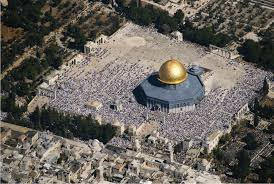
The Romans destroyed the Jewish temple in 70 AD. Later, the Muslims completed the Dome of the Rock upon the temple site in 691 AD and it has existed in this place for over 1300 years!
Dome of the rock sitting on the Temple Mount
When Muslims completed the Dome of the Rock, they believed it showed the superiority of Islam, which continued to progress. In the 8th Century, Muslims conquered Spain and Portugal; and even continued into France. The French turned back the Muslims in 732. The Crusades were staged by Christianity from 1095 to 1291 in an attempt to take the Holy Land back from Islam, but Islam retained control. In 1453 the Turks (the Ottoman Empire) conquered Constantinople, which had been the eastern headquarters of Christianity.
However, in 1492, Spain was able to throw off eight centuries of Islamic rule. With this Spanish victory, Christian Europe took the momentum and Europe moved into the Renaissance. The Muslim Ottomans (Turkey) joined Germany in WWI (1914) but were defeated. The victor’s stripped Turkey of its Arabic provinces and divided the spoils. Out of this, France got Syria and Lebanon, while Britain got Palestine and Jordan. Suddenly new nations like Iraq appeared with Churchill boasting that: “The British Empire is the world’s greatest Muslim power.”
In 1917, appalling the Muslim World, Britain issued the Balfour Declaration calling for a national homeland for the Jews in Palestine. Then, after WWII, in 1948, amid the world’s horror over the holocaust, the United Nations approved a national homeland for the Jews. Five Arab nations immediately declared war on Israel to no avail.
In the 1950’s Nasser rose to power in Egypt, with a Pan-Arabic nationalistic dream. In 1956, the Egyptian army began taking up positions south of Israel and signed agreements with Syria and Jordan that made Nasser leader of their forces. Nasser stated: “Egypt has decided to dispatch her heroes, the disciples of Pharaoh and the sons of Islam and they will cleanse the land of Palestine. We demand vengeance and vengeance is Israel’s death … our hatred is very strong. “ However, before his words could settle, Israel launched a preemptive attack that destroyed the Arab forces.
Again, in 1967, Egypt gathered forces with Syria and another preemptive strike by Israel destroyed them, with Israel capturing the Sinai, Golan Heights, much of the West Bank, all of Jerusalem, and the temple mount. Yet, even though it has been unsuccessful in destroying Israel, Islam has dominated in Syria, Palestine, Egypt, and North Africa. Some of these places were once Christian strongholds.
The conflict between Christians and Muslims continues today in places like Sudan, in mid-Africa. Islam is also rapidly growing in Europe today through immigration and high birth rates. In fact, Islam is growing so rapidly that within this century Muslims could become the majority people group in some European nations.
And modern Muslim people clearly remain bitter against Israel and intent upon world domination. The author quotes Muhammad as saying: “I was ordered to fight all men until they say, ‘There is no god but Allah’.” He quotes Ayatolla Khomeini saying: “We will export our revolution throughout the world … until the calls, ‘There is no god but Allah and Muhammad is the messenger of Allah’ are echoed all over the world.” He quotes Osama bin Laden’s comment about 9/11: “I was ordered to fight the people until they say: ‘there is no god but Allah’.” He quotes Mahmoud Ahmadinejad, the former president of Iran: “Israel is a disgraceful blot that should be wiped off the face of the earth.”
This author is adamant that what the world is facing from Islam is nothing less than it has faced from the attempted world domination of Marxism and Nazism.
Conclusion
The tendency to categorize people is wrong, especially by a single ancient ancestor. So much time has passed. All people are unique. Yet, all people are capable of coming to know the peace Jesus revealed to us: Arabs, Jews, Christians, Edomites, and all people groups. Physical lineage is not what matters. Spiritual lineage does matter.
Jesus persists in spirit even though He was sacrificed physically. As stated in Luke 9:27, Jesus has been returning and returns even now, bringing revelations of His kingdom into our sprits and birthing into us the royalty of Sonship. It is a devilish lie and a horrible misunderstanding of scripture that attempts to convert the second coming of Christ into a predestined physical war. The Kingdom is here already, awaiting our reception of it. He is here already.
Fundamentalists must see that the great power wielded by Jesus is love. The perception of Jesus returning as a murdering warrior is sacrilege. We must pray for peace, not just for Christians, but for the descendants of Ishmael as well. Matthew 22:37-39 directs us to be at peace with all men. We don’t do this by occupying their land and conducting war against them.
If you believe in war, war will eventually come to fruition. We must learn to believe in peace and reconciliation. Jesus said, “You have heard that it was said, ‘You shall love your neighbor and hate your enemy.’ But I say to you, love your enemies and pray for those who persecute you. (Matthew 5:43-44) Understanding this is to receive the spirit of Jesus.
The tension and hostility in the Middle East will continue until Jesus comes again into the hearts and minds and spirits of people such that they may similarly come to detest violence and stop believing the deviltry that they are predestined to conflict. The tragic thing is that both Christian and Islamic fundamentalists believe in war. They may tell you they abhor violence, but deep down they believe in the ultimate predestined war between Islam and Christianity. Indeed, that war has already been going on, through the crusades, through western occupation of the Mideast, etc. And that war will continue so long as the adherents of these two religions believe in war more fervently than they believe in the peace offered by Jesus Christ.
War ensues from nationalistic idolatry that deviltry has instilled in both people groups. Until war is rejected in favor of the peace that Jesus prescribed, discord will continue. The expectation that Jesus will return violently is a lie. Jesus proclaimed and demonstrated nonviolence. Jesus returns in love. Even now, let the love of Jesus return within your heart, such that you may exhibit the Kingdom in the here and now.
The wholesale relegation of whole classes of people as forever bad is classic fundamentalism that contradicts Jesus and the two great commissions. Fundamentalists simply fail to accept the new covenant that Jesus brought and, quite frankly, fail to fully accept Jesus and the love of Jesus. Instead they choose to wallow in mythical nonsense. The author himself says it well:
“Many today refuse what God offers to everyone – His amazing grace, which is true for heirs of Isaac and Ishmael, Esau and Jacob, and all mankind. Everyone who receives His grace begins a transformation that changes a heart of bitterness and revenge into a heart of grace that forgives those who killed their brothers and loves those who are their enemies. For those who do this in the Middle East, the conflict ends – one life at a time.”
As Esau demonstrated upon meeting Jacob on his return from the home of Laban, the seeds of turmoil are transformed into the seeds of love, forgiveness, and peace. This is the invasion of the Prince of Peace; this is His return; let Him return, even now.
A fantastic historical perspective on the Middle East. I read this in preparation of making a trip to the Holy Land and felt like the Biblical history of the region prepared me well for an understanding of what and why that small piece of land is fought over so strongly. Further, seeing the history played out from stories as old as Genesis strengthened my faith.
Seedsof Turmoil: The Biblical Roots of the Inevitable Crisis in the Middle East by Bryant Wright was a tough book to read. It wasn't that long and didn't use big words, but for the first 70 or so pages it repeated the same story again and again. For me it was a story I was already familar with. Abraham and Sarah did not trust God, yet again. She sent him to Hagar, Hagar bore Abraham a son, Ishmael, later Sarah bore Abraham the rightful heir --let the infighting begin.
After that story, the book began to take off. But honestly, if I had not had to finish this book to write a review, I probably would never have finished it. I never would have gotten to the parts of the story I did not already know. I had heard of Esau and Jacob, but I did not really know the whole story. I knew of Jacob's sons and the tribes of Israel and of course the story of Joseph, but again the fine details presented in a slightly different way were educational.
I found the geographical descriptions of the area enlightening. I also found it fascinating to consider Iran's role in Israel's plight. I've always had trouble identifying their "dog in the fight". Why have they cared about Israel so much, especially Mahmoud Ahmadinejad?
This book helped me indentify their dog. It was like a lightbulb went off and I could say "Ohhhh I see." I still don't understand why he [Ahmadinejad] insists upon acting like a crazy little man, every chance he has at the world stage, but I get why he's angry now.
I also finally understand the difference between the Shiites and Sunis. I've always wondered what makes a Muslim one or the other. I am sure in this age I could have just googled that, but I never did.
I know that Jewish people have been and continue to be attacked and demeaned for their religion and ethnicity. I've never lived in a world where that was acceptable so I got a little annoyed at the author's recurrent warning against Jew bashing. I suppose there are some people who call themselves Christian who might need to hear that warning, frequently.
I did take the author's advice and re-read Jonah. He was right it was funny.
All in all I found the book interesting, if the author writes a new version, I would suggest telling the Abraham/Sarah/Hagar story once and giving the different points of view as some kind of supplemental chapters at the end.
Disclosure of Material Connection: I received this book free from the publisher through the BookSneeze.com book review bloggers program. I was not required to write a positive review. The opinions I have expressed are my own. I am disclosing this in accordance with the Federal Trade Commission’s 16 CFR, Part 255 : “Guides Concerning the Use of Endorsements and Testimonials in Advertising.”
Seeds of Turmoil. The Biblical Roots of the Inevitable Crisis in the Middle East, by Bryant Wright. Disclaimer-I spent a Summer 2000 in Ramallah, teaching English in the refugee camps, worshiping in a small Palestinian Baptist church and playing basketball at the community center. After requesting this book from Book Sneeze (where I get free books from Thomas Nelson publisher for reviewing them on my blog), I started to regret it and knew that it would just make me angry. But in some ways, I was pleasantly surprised; Wright gave a very balanced, fair report on how Arabs must feel about this injustice and their current plight in the Middle East. He also says that Christ came for all, Jew and Gentile, and that salvation is available to all through him. But it wasn’t all great. The beginning of the book could have been called a very slow and repetitive walk through the Genesis story of Abraham and his family; which is where he gets the biblical basis for the current conflict. Then he gives three different perspectives and finished with three burning questions: Does God play favorites-Yes; Is God unfair-No; Is the Middle East conflict God’s fault?-No. I am glad he included these but for many it doesn’t clear up everything. My (probably until eternity) remaining questions: 1. Okay Abraham sinned and messed stuff up but WHY did the consequence of Ishmael have to be thousands of years of conflict? 2. The Pharisees of Jesus’ day got what the Messiah was going to look like all wrong and rejected Christ. Is it possible that the current Evangelical thought about the modern secular nation-state of Israel being what God has planned for the end days be all wrong too? I pray for peace and know that God had the most amazing plan for the Jews by bringing Jesus through them and still has a plan for them in the end. I would love to see a solution in the land but also know that it most likely won’t happen until Christ comes again. I know that Jesus said in Matthew that the end will come not after some political things happen but when the gospel of the kingdom is preached to all people. I, however unlike Wright, don’t get all warm and fuzzy about what a wonderful place Israel is and how going there makes you love Israelis, I guess it was because I didn’t have Jewish Holy Land tour guides there to meet my every evangelical need, instead I had to deal with check points and airport security and listen to the stories of people who still wear their house key around their neck even though it has been lived in by someone who stole it from them in 1948. Overall the book is good for the easy to understand way he presented the Bible knowledge, the fair treatment of all perspectives, and the emphasis of Jesus’ salvation, but I don’t agree with the end thought of blindly supporting a state that often acts very ungodly.
I’ve told the Bible stories of Moses, Abraham, Sarah & Hagar, Ishmael & Isaac, Jacob & Esau and the Israelites’ exodus to God’s promised land countless times to my children. I,too, have known and read those Bible stories since I was a child but I have not been able to connect them to what is currently happening in the Middle East. It was only after reading Seeds of Turmoil – The Biblical Roots of the Inevitable Crisis in the Middle East by Bryant Wright that I understood the connection.
Part 1 traces the roots of the Middle East conflict to the one major decision that Abraham and Sarah made to try to ‘help’ God in giving them a child. Through Sarah’s maidservant Hagar, Ishmael was born. Then after many years, God’s covenant child through Sarah, Isaac, was born. Bryant Wright wrote clearly why this became the root of the conflict. The he goes on to explain how Isaac’s heirs, Jacob and Esau’s conflict, grew from that seed of sin that came from Abraham and Sarah. The author then clearly explains the history of the following generations connecting it to the current crisis we see in the Middle East.
Part 2 of the book explains the Jewish, Islamic and Christian perspective. These last three chapters gives voice to each of these group’s perspectives and gives reasons for why they act that way. The book ends with the author’s final thoughts – three important questions that will help us more to understand God.
MY THOUGHTS:
Having had the opportunity in the past to do an in-depth study on the Old Testament, I was very excited to read Seeds of Turmoil – The Biblical Roots of the Inevitable Crisis in the Middle East by Bryant Wright. The book did not disappoint me because everything was explained so clearly. The author also provided maps to help in understanding history. Though there were a few pages when it started to become cumbersome, it also quickly picked up when I read the three different perspectives.
I believe that this is a book that every Christian has to read so that we can see and understand how God works. Especially the last part of the book where the author answers three important questions about God. Bryant Wright did a great job in pointing out how the sin of unbelief can affect all of us in the years to come. I can’t say enough good things about this book. I am highly recommending Seeds of Turmoil – The Biblical Roots of the Inevitable Crisis in the Middle East by Bryant Wright. Disclosure of Material Connection: I received this book free from the publisher through the BookSneeze®.com book review bloggers program. I was not required to write a positive review. The opinions I have expressed are my own. I am disclosing this in accordance with the Federal Trade Commission’s 16 CFR, Part 255 : “Guides Concerning the Use of Endorsements and Testimonials in Advertising.”
This book was not at all what I originally expected, and the main reason is because it was written by a Christian pastor. Initially, I was a bit disconcerted with his literal interpretations of the word of God and God’s motives, but as the book progressed, I found I was actually learning about the intriguing history of the conflict in the Middle East. Wright uses Old and New Testament scripture to demonstrate God’s purpose for his chosen people beginning with Abraham, then Isaac, Jacob and Moses. He illustrates how one bad decision (Abraham conceiving Ishmael through Hagar, thus disbelieving God’s promise to deliver him a son through Sarah) created conflict between various tribes/nations/races (the children of Ishmael against the children of Isaac, and eventually descendents of Esau versus those of Jacob). This conflict continued throughout the centuries and various periods in that region, i.e. Babylonian domination, the rise of Islam, etc. I also gained a better understanding of the lineage of various cultures who call the Middle East their home (I was not aware that Iranians are actually Persians, not Arabs). Wright then gives a brief background of the rise of Islam and its general theology. I think he effectively demonstrates why Muhammad is “…the most influential false prophet in the history of man.” Though I myself am not religious, I can appreciate the basic tenets of this book, one being that there are special ties between Christians and Jews because the Jews provided the Christians with their savior, Jesus. Another theory that is addressed is that history repeats itself to fulfill God’s will and to insure the survival of Israel and His Chosen People. While I could agree with Wright that throughout history, Israel has managed to survive against all odds, I did find him a bit “preachy.” I do not share his belief in the second coming as prophesized in scripture, or that tension in the Middle East will continue until that time, but I can agree with the idea that conflict will continue indefinitely based on much of the evidence Wright presented. I was going to give this book 3 stars, but because it really gave me a lot to think about and I could immediately think of about a dozen people I would recommend this to, it deserves 4 stars for exceeding my expectations.
I received a complimentary copy of this book from the Amazon Vine program.
Finally a book on the Middle East conflict which rocks the entire world and hits the news headlines every day. As the name suggests, a biblical treat to the subject is intended; and, Bryant Wright succeeds to a certain extent in this objective. Aiming to provide a detailed account of the origin of this conflict, Bryant begins from the story of Abraham and Sarah and then rides seamlessly. Seeds of Turmoil is high on biblical perspective and low on historical perspective. In other words, it is high on intent but low on content. Hence, it cannot be claimed as a masterpiece of scholarly research on Middle East. Rather, I think any Bible believing Christians will be able to enjoy this work.
This book is a good embarking place for any believer who wants to have the basic knowledge on the Middle East conflict. True, 1CSeeds of Turmoil" contains certain repetitive information and delves into sermonizing tone in certain places (as Bryant himself is a pastor and a preacher).
Bryant concludes by saying that when the Lord returns, there will be peace in the Middle East. His personal prejudice for Israel was evident throughout the book. Objective treatment of history has taken a back seat as Bryant interprets the 18Word 19 in some fluky style. He tells what he wants to tell rather that what it is.
When it is told that the biblical roots contribute to the Middle East conflict, I believe it is immature to assert that they are the one and only reason. I feel that the readers will find it difficult to get a holistic/comprehensive picture on the subject through such treatment.
Overall, this book is strictly for Bible believing Christians alone. It is a good work but may not be the great one. Language is lucid and easy to comprehend. I give it three and a half out of five stars.
Please note that I received this book from the publisher Thomas Nelson through its book review bloggers program Book Sneeze in exchange for an honest review.
I received this book to review, and was rather excited to read it; this is a very relevant and important topic. I am always looking to gain more knowledge and understanding about the Middle East. It is such a beautiful region, but so fraught with turmoil and tragedy. The first part of the book is basically a re-telling of the story of Abraham and Sarah. This is a good primer for those who are unfamiliar with this story or the bible. For those that are familiar with Genesis, this might feel a little redundant and repetitive.
Although this book is defninitely "pro-Isreal", I appreciated that he tried to be as unbiased as possible, and show both "sides" of the story, so to speak. Often only one side is portrayed as "just" or 'good", and the other as just evil/bad. This dehumanizes an entire peoples who are also suffering, feeling, thinking, living; they have families and fears just like all of us. The basic premise is that conflict is inevitable, and Isreal are the chosen ones.
I like the descriptions of the regions and how he gives different perspectives. He poses three questions: Does God play favorites, Is God unfair, and Is the Middle East conflict God’s fault?. These are good questions to add, because I am sure many people think about them in one way or another. I would've like to see him develope some of the topics a bit more, shorten the beginning part about Abraham, and go more into detail with the later parts of the book. He definitely present a lot of great knowledge, and as I mention, I appreciate a fair view (if one can use such a term as "fair" in this circumstance). I also like how he makes the scripture applicable, and easy to understand and contextualize. He also gives some information on the rise of Islam, lineages, and some of the additional biblical context I didn't know.
It would be neat if he included some "solutions" or ideas on how to better the situation
Have you ever considered the reasons why there is so much hate and mistrust in the Middle East? Bryant Wright, author of "Seeds of Turmoil", sets out to enlighten the reader of the whys and wherefores of these conflicts. The "Seeds of Turmoil", takes the reader on a journey of the Bible to find out who is involved.
As it is soon realized, we find in Genisis, that Abram and his wife Sarai along with Sarai's Egyptian maid, Hagar, had two sons. The first born, was Ishmael, the son of Abram and Hagar, as at that time, Sarai, was barren. As the Scriptures tell, God had promised Abram and Sarai, that they would have children, or at least a son, who would become a great nation. At a very advanced age, Abram and Sarai, did have that son, Esau. I won't go into detail, here, but these two boys were polar opposites. And from these two as well as from their parents, trouble was been brewing in the Middle East ever since. What I have found amazing, is that the author, takes the Scriptures to explain in easy to understand as well as intelligent format, just how the Middle East became such a ground of turmoil. It's no wonder there is so much conflict. Most of the story of Abram, or Abraham as he was later named by God, can be found in the Book of Genesis. Wright, also delves into the histories and points from all sides of the issues. He does not function purely on his knowledge of the Bible, but utilizes other sources of information to glean his book, "Seeds of Turmoil". Thank you Bryant Wright for doing your homework, while researching the information and then wrighting it in such a spectacular way. "Seeds of Turmoil" is bound to make the Christian Best Sellers List.
Each of us have probably at some point in our lives wondered just how things would turn out if we had made different choices. In this book on the conflict in the Middle East, Bryant Wright points to a specific time in history as the deciding moment that started it all.
This topic is so interesting and I have been drawn to different books in the last several years hoping to find a somewhat clear interpretation of the origins of all that is the Middle East crisis. This book absolutely satisfied my craving for that knowledge. Wright gives a thorough biblical background, adds in important historical facts to help the reader further understand the political importance and then ties all this together with modern day what-if examples. I found his writing style pleasant and entertaining, while at the same time authoritative and informative.
What did I like about this book? I would have to say that the most enjoyable aspect of this book is that I didn't feel like I had to be either a bible scholar or a history professor to understand the concepts presented in this book. His modern day examples of situations helped me understand the conflict in a way that I never would have otherwise. The biblical facts were presented with such insight that I learned something new with almost every page turn. The end of the book contains a timeline, glossary, and a study and discussion guide. The guidance that is given is helpful and relevant. The discussion questions are thoughtful and inspiring.
Would I recommend this book to others? Absolutely! This is an awesome book.
This book shares information about how biblical accounts have lead to the current problems in the Middle East, just as the title says. Unknowingly, I began this book with a bias. I expected to gain some insight, something new regarding the biblical roots of the conflict in the Middle East. Perhaps something from hermeneutical study. I had a hard time finishing this book because it felt like sitting through a very basic sermon from a guest pastor on a topic i was more familiar with than I realized. The tone in this book is also distracting. Take for example the following excerpt: "Travel was not easy in those days. The roads were bad, and there were no convenience stores with restrooms like today. . . Wells often served as the service stations of ancient times. They were a place to water the camels - the SUVs of ancient Israel." Talk about spelling things out for you. If you are very unfamiliar with the story of Abraham and the beginnings of Israel, then sure go ahead and try this book. But if you have studied The Bible and still want to read this book, enter with low expectations.
I received this book free from the publisher through the BookSneeze®.com book review bloggers program. I was not required to write a positive review. The opinions I have expressed are my own. I am disclosing this in accordance with the Federal Trade Commission’s 16 CFR, Part 255 : “Guides Concerning the Use of Endorsements and Testimonials in Advertising.”
I was really looking forward to reading this book when I received it before Christmas. I think the historical roots of the conflict in the middle east are very important to understand what’s going on today, but I don’t have any great knowledge of it, or so I thought. I started reading this book, and got to thinking maybe I know more about it than I thought. I read through the first half or so of the book, waiting to learn something new. Didn’t happen. Kept reading; still nothing that I hadn’t already heard.
What I did find was a lot of conjecture about how this person or that person would have been feeling or thinking, but it a sarcastic kind of way. I have to say, I did not appreciate the author’s dry sense of humor. I felt that it didn’t fit the story and didn’t do justice to the characters that he was discussing. The book went through the biblical stories in the book of Genesis, but did not provide any depth or insight that I had not heard other places.
Conclusion: Read this book if you really truly know nothing about the biblical history of the conflict in the middle east (i.e. the story of Ishmael and Isaac). Otherwise, don’t waste your time.
Disclosure of Material Connection: I received this book free from Thomas Nelson Publishers as part of their BookSneeze.com book review bloggers program. I was not required to write a positive review. The opinions I have expressed are my own. I am disclosing this in accordance with the Federal Trade Commission’s 16 CFR, Part 255 : “Guides Concerning the Use of Endorsements and Testimonials in Advertising.”
Seeds of Turmoil The Biblical roots of the inevitable crisis in the Middle East By Bryant Wright Published by Thomas Nelson I found this to be a most interesting book which takes the reader on a journey through biblical history which he starts the book with the story of Abraham. Abraham was actually the father of 3 of the most influential faiths; Judaism, Christianity and Islam. This is where and when the problems in the Middle East began and what has caused them to continue and escalate for thousands of years. After reading this book, the reader will come away with a deeper understanding of the history of the Middle East along with a broader sense of the current situation that we are facing in the world today. The last chapters in the book are very insightful, the Jewish perspective, the Islamic perspective and then the Christian perspective. I personally would suggest to the reader to highlight, take notes as you read so that you can really get the most of what you are reading. I didn’t have a whole lot of biblical knowledge and even so the book was very informative and easy to follow. There are also study notes for each chapter in the back. I also appreciated the glossary as it was quite helpful for me as I went along. The final thoughts and three burning questions are still going through my mind and I am still going over the timeline that Bryant Wright also included in the book. Prior to reading this book, my only knowledge of the Middle East situation was of the political type and this book has opened my eyes. Very glad I read this book!
Despite high praise from both a Food Network critic and a professional golfer, Wright's book on the complexities of the Middle-Eastern conflict is often racist, occasionally sexist, and uninformed on both biblical and current events. Relevant topics Wright covers in his historical survey include, but are not limited to, his discussions on how silly women can be (pg 9), how stupid men are (pg 8, 9), how little Muslims have "contributed to humanity as well as science, the arts, and business" based on how few Nobel prizes Muslims have achieved (pg 125), and how this entire conflict could have been avoided if only the Palestinians had never existed (pg1-173). Wright displays little to no concept of the perspectives of actual Palestinians and Muslims regarding this conflict, nor does he understand the role of land and inheritance within New Testament material. For Wright, the aims and goals of Islamic extremists are representative of all Muslims. Readers looking for a survey of the conflict from the perspective of those involved would spend their time better with Tolan's The Lemon Tree. Readers interested in Muslim contributions to humanity, science, the arts, and business are encouraged to read almost any history of Islam ever written. Readers interested in the conflict from a Christian perspective would do better to consult the New Testament gospels, epistles, and especially the book of Hebrews, particularly chapter 8. N.T. Wright's recent study on "the land" within Paul and the Faithfulness of God also offers some helpful insights within a New Testament framework.
Seeds of Turmoil by Bryant Wright Thomas Nelson, 2010 173 pages Non-fiction; Christian 3/5 stars
Source: Received for review via Booksneeze
Summary: Wright argues a. that the roots of the conflict in the Middle East are inevitable and b. in favor of Israel.
Thoughts: I requested to review this because I don't know much about this conflict and I wanted to see a Christian perspective. Now this certainly has a lot of Scripture references; in fact it tells the story of Abraham, Sarah, and Hagar repeatedly in the first part. That is where the conflict comes from. Abraham and Sarah were supposed to have a child who would be the covenant child from God (Isaac). Instead he sins with Hagar, fathering Ishmael the father of Muslims and planting the seeds of conflict.
He also argues that God promised the land of Israel (and actually even more territory) to the Jewish people making it theirs and that all Bible-believing Christians should support Israel. I feel like I don't know enough about this to decide where I stand but that was at least somewhat convincing.
Overall: Too repetitive and not fully tied together in a cohesive convincing way.
The theme of the novel is the roots of the Middle East crisis from a biblical point of view. It shows how it all started back in bible time. It started with Abraham and his two sons, Ishmael and Isaac. Abraham's first wife Sarah due to being barren, told her husband to conceive through her hand maiden Hagar. This was the practical way it was done in these times so the family name would not die out.
Ishmael is the father of the Arabs and Isaac is the father of Israel. The conflict between the two boys started at a young age. At age 13 Ismael and his mother were sent away by Sarah and Abraham due to Sarah's jealousy of the oldest son.
The conflicts started and snowballed to present time.
I received this book for free in exchange for 2 reviews.
I recommended Bryan Wright's Seeds of Turmoil to a friend and he was not dissappointed and gave the book a 5 star rating. The book begins with the story of Abraham, clearly describing why the turmoil in the middle east began and how the historical events had a dominoe effect on what is currently happening today in the Middle East. Although not scholarly, Wright's facts are consise and written clearly. He weaves in the effects of how sin creates conflict, a lesson we can apply to our everyday actions.
For those who want to learn more about Abraham and why the conflict in the Middle East has risen, I would highly recommend this book.
Very good outline of the history behind the middle east, and the biblical and muslim explanation for the constant uprising that is occuring there. It is very eye opening to what is going on and what will continue to occur in that region.