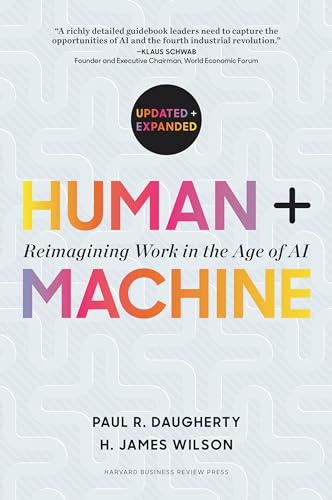
AI—including Generative AI—is radically transforming business. Are you ready? Accenture technology leaders Paul Daugherty and Jim Wilson provide crucial insights and advice to meet the challenge.
Look around you. Artificial intelligence is no longer just a futuristic notion. It's here right now—in software that senses what we need, supply chains that "think" in real time, and now Generative AI, like ChatGPT, that is radically reshaping work and productivity. Twenty-first-century pioneer companies are already using AI to innovate and grow fast. The bottom line is Businesses that understand how to harness AI can surge ahead. Those that neglect it will fall behind. Which side are you on?
In this new, updated, and expanded edition of Human + Machine, Accenture technology leaders Paul R. Daugherty and H. James (Jim) Wilson show that the essence of the AI paradigm shift is the transformation of all business processes within an organization—whether related to breakthrough innovation, everyday customer service, or personal productivity habits. As humans and smart machines collaborate ever more closely, work processes become more fluid and adaptive, enabling companies to change them on the fly—or completely reimagine them. The bottom line is that AI is changing all the rules of how companies operate.
Based on the authors' experience and research with 1,500 organizations, the book reveals how companies are using the new rules of AI to leap ahead on innovation and profitability and what you can do to achieve similar results. It describes six entirely new types of hybrid human + machine roles that every company must develop, and it includes a "leader's guide" with the five crucial principles required to become an AI-fueled business.
Human + Machine provides the missing and much-needed management playbook for success in the new age of AI.
“Człowiek i AI” to książka, której nie poleciłabym osobom chcącym zrozumieć, czym właściwie jest AI, jak działa albo jak zacząć korzystać z niej na co dzień - czy to w pracy, czy w innych codziennych zadaniach. Osoby te nie znajdą tu odpowiedzi na swoje pytania, a prawdopodobnie porzucą czytanie już po wstępie, ponieważ język książki jest wymagający i miejscami dość techniczny.
Za to zdecydowanie docenią ją osoby, które myślą o AI w skali organizacyjnej. Managerowie, liderzy, właściciele firm czy osoby odpowiedzialne za wdrażanie rozwiązań AI w dużych przedsiębiorstwach znajdą tu sporo inspirujących case studies — od koncernów wydobywczych i motoryzacyjnych, przez firmy farmaceutyczne, po centra obsługi klienta, fabryki i działy R&D.
Autorzy pokazują, od jakich kroków można zacząć wdrażanie AI. Podkreślają, że konieczne jest stworzenie nowych procesów biznesowych oraz odpowiednie przygotowanie danych, pracowników i całej organizacji na nowy sposób działania. Aby zwiększyć prawdopodobieństwo sukcesu, proces wdrożeniowy, powinien opierać się na formule MELDS (Mindset, Experimentation, Leadership, Digital Core, Skills).
W książce poruszony jest również temat powstawania nowych zawodów oraz - moim zdaniem - nieco zbyt optymistycznie przedstawione możliwości przekwalifikowywania pracowników do nowych obowiązków wynikających z wdrażania sztucznej inteligencji. Na plus należy jednak zaliczyć to, że autorzy wyraźnie zaznaczają, iż AI, oprócz licznych korzyści, niesie ze sobą także zagrożenia, na które należy zwrócić szczególną uwagę przy implementacji rozwiązań AI w każdym rodzaju biznesu.
I have selected this book as Stevo's Business Book of the Week for the week of 9/15, as it stands heads above other recently published books on this topic.
Although this updated and expanded edition is billed as only having an extra chapter that is an understatement of its value since there have been a lot of updates, making it the best AI book (I've read) that came out 2024. When the original version came out it made my top 3 books of the year and the update builds on and adapts to the advent of GenAI like chatGPT but with the same conclusion, we need to optimize for people by seeing how to employ AI in the best ways for us. Although there are now references to Responsible AI, the book didn't get a 5/5 because there was a lack of case studies on what has gone wrong alongside what has gone right. Check out my 2024 AI reviews for 2 books on that topic to get the right balance and to see behind just the business implications of AI. ps if you have a subscription to O'Reilly like my employer, you can read or listen for free. Otherwise buy this book since all profits are going to fund education into fusion (AI) skills.