
What do you think?
Rate this book


160 pages, Paperback
First published April 1, 2003


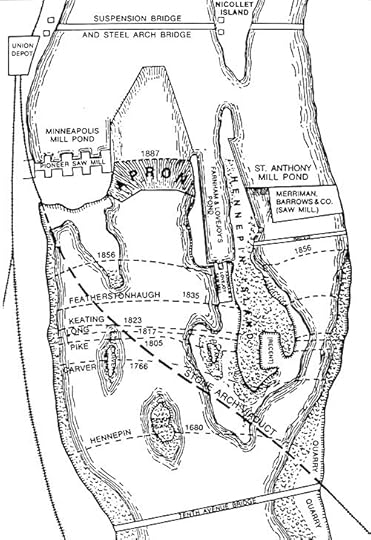 "A diagram showing the recession of the falls between 1680 and 1887"
The instability of the falls explains why steps had to be taken to stabilize it ("Building an Apron", pp.70-71, 73), if the city was going to continue to use the water as a source of power, first for "Sawdust Town", then for "Mill City", then for hydropower running rapid transit (pp.88-9, with streetcars all the way to Stillwater, 48 miles away, powered by the falls), and eventually for navigation of the upper Mississippi. "The water power of Lowell is a baby compared to ours." (p.72). The book addresses the history prior to the much later tourist moniker of the "City of Lakes", that goes well together with the state's name, Minnesota signifying water-country.
Glossy paperback edition, with 100 black & white plates (including many reproductions of early photography), plus 1 color plate on the back cover (an advertisement for Chas.A.Pillsbury & Co., "merchant millers", Minneapolis, USA). Oddly, some of the printed pages are much fainter than others, at least in my copy-- If it was a conscious decision of the printing house ('printed in Hong Kong'!), it was an annoying one: the faded, old-timey pages are much harder to read. With an index provided, but with some obvious entries missing, such as for the U.S. Army Corps of Engineers (infra plate p.71: "in 1954 a permanent concrete apron was erected"; p.128, plate p.129), for the Boyden Turbine water wheel (p.107), for the Glacial River Warren (p.8), not even for Union Depot (p.82).


