

What do you think?
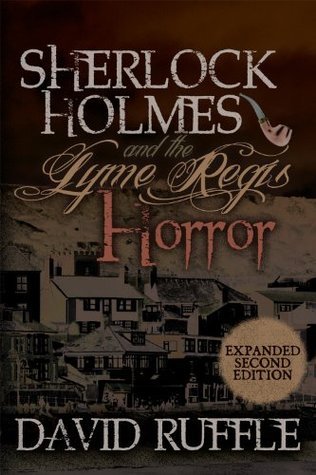
Sherlock Holmes and Lyme Regis #1
Sherlock Holmes and the Lyme Regis Horror
The year is 1896. Doctor Watson is invited to the Dorsetshire coast by an old friend. To Watson's surprise he manages to persuade his good friend, Mr Sherlock Holmes to accompany him. This hitherto unknown tale of Watson's involves romancing, dancing, occasional glasses of cider, but the holiday turns into a nightmare as the two old friends encounter an unimaginable evil which threatens their very souls. Can they triumph? - Fully revised and expanded 2nd edition.
245 pages, Kindle Edition
First published April 15, 2010
About the author
David Ruffle
28 books284 followersDavid Ruffle was born in Northamptonshire in the UK at an early age in 1956,yes..a long time ago. The school years passed by in a blur, or was he the blur ? He managed to extricate himself from the education system at 15 years of age and embarked on the adventure of life.
Eventually, said adventure took him to Dorset and the beautiful town of Lyme Regis in July of 2004.He felt immediately at home here and surprised himself by starting to write...first, poetry and later ghost stories. All the time he felt that Lyme Regis would be a perfect place for Sherlock Holmes and Dr Watson to have an adventure, any kind of adventure ! And so...Sherlock Holmes and the Lyme Regis Horror was born. The story continues.
David is now with the MX publishing team and further titles have appeared; Sherlock Holmes and The Lyme Regis Legacy, Tales From The Stranger's Room (as contributor and editor),and Holmes and Watson: End Peace. A children's illustrated book, Sherlock Holmes and the Missing Snowman (with illustrations by Rikey Austin, another Lyme Regis resident and hugely talented to boot)saw the light of day in November 2012. Two weeks later the third and final part of the Sherlock Holmes/Lyme Regis trilogy appeared: Sherlock Holmes and the Lyme Regis Trials. Also in the offing is an outing to Scarborough for Holmes and Watson, a proposed tale of thievery, murder and cricket!(A collaboration).Meanwhile, he is still to be found in Lyme Regis, working away and drinking the odd cider, diet permitting. The Abyss: A Journey With Jack The Ripper is set to be published in December 2013.
On a whim he decided to try his hand at comedy resulting in A Twist of Lyme and Another Twist of Lyme. These were published in 2014 along with the final book in the trilogy, A Further Twist of Lyme. New for 2015 will be, Holmes and Watson: An American Adventure. 2016 will see the publication of Holmes and Watson: An Evening in Baker Street followed by The Gondolier and the Russian Countess, a Holmes and Watson adventure set in 1902 Venice. And with any luck, Sherlock Holmes and the Scarborough Affair should surface by the end of the year!
Eventually, said adventure took him to Dorset and the beautiful town of Lyme Regis in July of 2004.He felt immediately at home here and surprised himself by starting to write...first, poetry and later ghost stories. All the time he felt that Lyme Regis would be a perfect place for Sherlock Holmes and Dr Watson to have an adventure, any kind of adventure ! And so...Sherlock Holmes and the Lyme Regis Horror was born. The story continues.
David is now with the MX publishing team and further titles have appeared; Sherlock Holmes and The Lyme Regis Legacy, Tales From The Stranger's Room (as contributor and editor),and Holmes and Watson: End Peace. A children's illustrated book, Sherlock Holmes and the Missing Snowman (with illustrations by Rikey Austin, another Lyme Regis resident and hugely talented to boot)saw the light of day in November 2012. Two weeks later the third and final part of the Sherlock Holmes/Lyme Regis trilogy appeared: Sherlock Holmes and the Lyme Regis Trials. Also in the offing is an outing to Scarborough for Holmes and Watson, a proposed tale of thievery, murder and cricket!(A collaboration).Meanwhile, he is still to be found in Lyme Regis, working away and drinking the odd cider, diet permitting. The Abyss: A Journey With Jack The Ripper is set to be published in December 2013.
On a whim he decided to try his hand at comedy resulting in A Twist of Lyme and Another Twist of Lyme. These were published in 2014 along with the final book in the trilogy, A Further Twist of Lyme. New for 2015 will be, Holmes and Watson: An American Adventure. 2016 will see the publication of Holmes and Watson: An Evening in Baker Street followed by The Gondolier and the Russian Countess, a Holmes and Watson adventure set in 1902 Venice. And with any luck, Sherlock Holmes and the Scarborough Affair should surface by the end of the year!
Ratings & Reviews
Friends & Following
Create a free account to discover what your friends think of this book!
Community Reviews
Displaying 1 - 15 of 15 reviews
August 22, 2012
This book is divided between a novella (The Lyme Regis Horror) and several short stories. First, the novella:
Ruffle knows Holmes and Watson very well; canon devotees will find plenty of insider references and familiar-sounding (though not verbatim) phrases. The Watsonian voice is decently done and witty; Ruffle stays in his narrator’s head the entire time. Holmes is mellower than he is often portrayed; he also seems to know more about Jane Austen than one would suspect of a man who sneers at softer emotions. On another interesting note, Holmes (using his impossible/improbable line of reasoning) is convinced early on that the culprit in the first story is supernatural, while the two physicians take some convincing. I never felt, however, that either Holmes or Watson was veering out of character.
One of Ruffle’s great strengths is his ear for dialogue; it rarely rings false, and is often quite funny such as when Watson informs Mrs. Jacobs that his writing is not for children, or the Inspector advises everyone not to “quibble with small details.” If a little too much time is spent delineating incidents in local history which don’t relate to the plot, it can be forgiven; Watson does like travel guides.
When it’s time to bring the suspense, Ruffle delivers as well. The atmosphere changes perceptibly when Sarah Jacobs opens the door to the Count. The following confrontation is electrifying, and reminds the reader that Holmes is truly master of the “and the horse you came in on” speech. The feeling of dread continues as Holmes, Watson, and Jacobs ready themselves for battle; they don’t know whether or not they’re coming back, and neither do we. In fact, as they walk towards the manor in dark of early morning, Ruffle’s description is so skillful, the chills are palpable.
Ruffle’s ability as a writer is, finally, evident in his deceptively simple denouement. In it, he takes up a thread I had thought dangling and superfluous, using it to pull the physical and emotional parts of the story together. I won’t divulge any more except to say that, as a writer, I admired the skill with which he accomplished this, and found myself thinking about it all day.
“The Trumper Affiar” (previously published as an e-pub on Amazon) is a solid story, written along more traditional lines than “Horror.” Ruffle provides accurate historical details, both in the setting and characters (actual cricket players), and his end notes are a nice touch for history aficionados. Holmes and Watson are also nicely in character and we’re treated to some nice running jokes as Watson continually bores the Great Detective (and occasionally the reader) with lengthy explications of cricket matches, and Holmes finds that the doctor’s novelistic touches have given him some unexpected anonymity. The story is not as atmospheric as “Horror,” but Ruffle performs a very nice sleight-of-hand in concealing the villain, the denouement is darker for its realism, and the ending is quite poignant.
Ruffle takes us back to the supernatural in “The Mystery of Loch Ness” and “The Runes Affair.” In the former, a gruesome death forces the reader to apply Holmes’ famous maxim, “that when you have eliminated the impossible, whatever remains, however improbable, must be the truth.” In “The Runes Affair,” three highly nervous paranormal researchers ask Holmes to help them fend off what seems to be an evil author’s attempt to exact vengeance for poor reviews and rejection slips through supernatural means. Holmes and Watson take on the case to assuage the mens’ fears and meet with unexpected results; one has to wonder whether they might have been manipulated into unwittingly carrying out revenge themselves.
Other stories have a supernatural bent as well. Set in more modern times (the 1930′s and the recent past, respectively), “Forever 1895″ and “A Lyme Ghost Story” suggest that Holmes dislikes partiers and inappropriate over night guests, but has a soft spot for pastiche writers. “Timeless in Lyme” is not about phantoms…at least from one perspective. In each of these pieces, Ruffle mixes past and present with the deft touch essential for a satisfying ghost tale.
Christmas is another favorite topic. In “Christmas at Baker Street,” Holmes explains to Watson the very best reasons for refusing a knighthood. He exposes even more of his heart in the incredibly charming “Henrietta’s Problem,” giving credence to Jeremy Brett’s view that “Holmes loved children.” My personal favorite in this collection, however, is “Christmas with Holmes,” which has an aging Holmes and Watson spending the holiday together in Sussex in 1916. The end scene is beautiful and while I realized, upon a third reading, that it could have a darker interpretation, I’ll go with my first, sad-but-fitting one. Ruffle ends the book with a lovely poem dedicated to his son, Duncan.
So, my final conclusion? Sherlock Holmes and the Lyme Regis Horror is a well-written collection with “the charm of variety,” deserving of a place on your bookshelf or in your e-reader. I look forward to reading more of Ruffle’s work.
Ruffle knows Holmes and Watson very well; canon devotees will find plenty of insider references and familiar-sounding (though not verbatim) phrases. The Watsonian voice is decently done and witty; Ruffle stays in his narrator’s head the entire time. Holmes is mellower than he is often portrayed; he also seems to know more about Jane Austen than one would suspect of a man who sneers at softer emotions. On another interesting note, Holmes (using his impossible/improbable line of reasoning) is convinced early on that the culprit in the first story is supernatural, while the two physicians take some convincing. I never felt, however, that either Holmes or Watson was veering out of character.
One of Ruffle’s great strengths is his ear for dialogue; it rarely rings false, and is often quite funny such as when Watson informs Mrs. Jacobs that his writing is not for children, or the Inspector advises everyone not to “quibble with small details.” If a little too much time is spent delineating incidents in local history which don’t relate to the plot, it can be forgiven; Watson does like travel guides.
When it’s time to bring the suspense, Ruffle delivers as well. The atmosphere changes perceptibly when Sarah Jacobs opens the door to the Count. The following confrontation is electrifying, and reminds the reader that Holmes is truly master of the “and the horse you came in on” speech. The feeling of dread continues as Holmes, Watson, and Jacobs ready themselves for battle; they don’t know whether or not they’re coming back, and neither do we. In fact, as they walk towards the manor in dark of early morning, Ruffle’s description is so skillful, the chills are palpable.
Ruffle’s ability as a writer is, finally, evident in his deceptively simple denouement. In it, he takes up a thread I had thought dangling and superfluous, using it to pull the physical and emotional parts of the story together. I won’t divulge any more except to say that, as a writer, I admired the skill with which he accomplished this, and found myself thinking about it all day.
“The Trumper Affiar” (previously published as an e-pub on Amazon) is a solid story, written along more traditional lines than “Horror.” Ruffle provides accurate historical details, both in the setting and characters (actual cricket players), and his end notes are a nice touch for history aficionados. Holmes and Watson are also nicely in character and we’re treated to some nice running jokes as Watson continually bores the Great Detective (and occasionally the reader) with lengthy explications of cricket matches, and Holmes finds that the doctor’s novelistic touches have given him some unexpected anonymity. The story is not as atmospheric as “Horror,” but Ruffle performs a very nice sleight-of-hand in concealing the villain, the denouement is darker for its realism, and the ending is quite poignant.
Ruffle takes us back to the supernatural in “The Mystery of Loch Ness” and “The Runes Affair.” In the former, a gruesome death forces the reader to apply Holmes’ famous maxim, “that when you have eliminated the impossible, whatever remains, however improbable, must be the truth.” In “The Runes Affair,” three highly nervous paranormal researchers ask Holmes to help them fend off what seems to be an evil author’s attempt to exact vengeance for poor reviews and rejection slips through supernatural means. Holmes and Watson take on the case to assuage the mens’ fears and meet with unexpected results; one has to wonder whether they might have been manipulated into unwittingly carrying out revenge themselves.
Other stories have a supernatural bent as well. Set in more modern times (the 1930′s and the recent past, respectively), “Forever 1895″ and “A Lyme Ghost Story” suggest that Holmes dislikes partiers and inappropriate over night guests, but has a soft spot for pastiche writers. “Timeless in Lyme” is not about phantoms…at least from one perspective. In each of these pieces, Ruffle mixes past and present with the deft touch essential for a satisfying ghost tale.
Christmas is another favorite topic. In “Christmas at Baker Street,” Holmes explains to Watson the very best reasons for refusing a knighthood. He exposes even more of his heart in the incredibly charming “Henrietta’s Problem,” giving credence to Jeremy Brett’s view that “Holmes loved children.” My personal favorite in this collection, however, is “Christmas with Holmes,” which has an aging Holmes and Watson spending the holiday together in Sussex in 1916. The end scene is beautiful and while I realized, upon a third reading, that it could have a darker interpretation, I’ll go with my first, sad-but-fitting one. Ruffle ends the book with a lovely poem dedicated to his son, Duncan.
So, my final conclusion? Sherlock Holmes and the Lyme Regis Horror is a well-written collection with “the charm of variety,” deserving of a place on your bookshelf or in your e-reader. I look forward to reading more of Ruffle’s work.

August 10, 2013
Sherlock Holmes and the Lyme Regis Horror is a collection of Sherlock Holmes pastiches penned by David Ruffle.
I read a lot of Sherlock Holmes books, some good, some bad. This one is definitely in the 'good' category. The majority of the stories stray away from the confines of the Canon, and run along more of a supernatural style. Normally I prefer Sherlock Holmes pastiches that have the more traditional set up, but the author did his job very well and my interest in the stories didn’t wane for a moment.
The majority of the collection is comprised by a novella which goes by the same title as that of the book. 'The Lyme Regis Horror' is an exceptional piece of work, a story which builds up at a steady pace and the interplay between Doctor Watson and Mrs. Heidler very well handled.
The rest of the book is made up of short stories and vignettes, for me the pick of these is ‘The Trumper Affair’, a short story that mirrors Conan Doyle’s style of storytelling very well. In fact it’s the kind of story I could imagine Conan Doyle himself writing. All in all, it’s a very good book, well researched and well written – I’d recommend it to all Holmes enthusiasts.
I read a lot of Sherlock Holmes books, some good, some bad. This one is definitely in the 'good' category. The majority of the stories stray away from the confines of the Canon, and run along more of a supernatural style. Normally I prefer Sherlock Holmes pastiches that have the more traditional set up, but the author did his job very well and my interest in the stories didn’t wane for a moment.
The majority of the collection is comprised by a novella which goes by the same title as that of the book. 'The Lyme Regis Horror' is an exceptional piece of work, a story which builds up at a steady pace and the interplay between Doctor Watson and Mrs. Heidler very well handled.
The rest of the book is made up of short stories and vignettes, for me the pick of these is ‘The Trumper Affair’, a short story that mirrors Conan Doyle’s style of storytelling very well. In fact it’s the kind of story I could imagine Conan Doyle himself writing. All in all, it’s a very good book, well researched and well written – I’d recommend it to all Holmes enthusiasts.

November 7, 2012
Sherlock Holmes and the Lyme Regis Horror. I read the first story in this compilation with great enjoyment; it has a strong plot, well-drawn minor characters and above all a believable relationship between the two main protagonists, Holmes and Watson. I very much like the fact that Watson is given time to develop not only an affection for the town of Lyme Regis (which the author clearly shares), but a sensitively-portrayed love interest. For me, although Holmes deploys his intellect and other resources to solve the case, it is Watson who is at the sharp end when push comes to shove.
In my view the next best story is a charming evocation of cricket in one of its several golden ages. Stalwart men with names like Trumper, Darling and Tomlinson uphold the spirit of the game against a bounder intent on mischief. The other stories and vignettes are icing on the cake. I thoroughly recommend this anthology.
In my view the next best story is a charming evocation of cricket in one of its several golden ages. Stalwart men with names like Trumper, Darling and Tomlinson uphold the spirit of the game against a bounder intent on mischief. The other stories and vignettes are icing on the cake. I thoroughly recommend this anthology.

August 12, 2013
Sherlock Holmes and The Lyme Regis Horror by David Ruffle is a brilliantly written and captivating tale that takes the reader on a new, exciting but dark and dangerous journey that has suspense, mystery, love and an overwhelming sense of evil. Told through the eyes of a charming and captivating Dr Watson, David has captured perfectly the eccentric genius that is Holmes and given an enlightening insight into the friendship and relationship of the two protagonists as they are drawn into an intriguing but evil chain of events.
David’s fabulous descriptive detail of the lanes and byways, buildings, sights, sound and atmosphere obviously come from his knowledge of, and affection for, the area and coupled with the interesting historical facts are certainly an added bonus.
Several shorter, all just as engaging, tales complete this thrilling read. I am very much looking forward to reading more.
David’s fabulous descriptive detail of the lanes and byways, buildings, sights, sound and atmosphere obviously come from his knowledge of, and affection for, the area and coupled with the interesting historical facts are certainly an added bonus.
Several shorter, all just as engaging, tales complete this thrilling read. I am very much looking forward to reading more.

March 29, 2013
Good god: poor grammar, dozens of printing errors, and completely non-canonical. I've read better fan fiction.

May 22, 2024
This is entertaining and feels like Homes and Watson yet some things jar, such as homes repeatedly calling Watson “my boy”, the overdone canonical references in the beginning of the main story, and Watson repeatedly badgering Holmes to like sports—revenge for calling him “my boy”? Also, too much detail about cricket in the second story though basing it in real players is neat.
The very short stories are clever, amusing and touching. While Holmes is harsher and too sentimental vis-à-vis the original, overall, this book captures style of Doyle and the main story uses the setting of Lyme Regis well, though not as well as the author’s second book, “Sherlock Holmes and the Lyme Regis Legacy”. The main story is suspenseful but I’m not sure what I think of the little twist in the denouement.
The very short stories are clever, amusing and touching. While Holmes is harsher and too sentimental vis-à-vis the original, overall, this book captures style of Doyle and the main story uses the setting of Lyme Regis well, though not as well as the author’s second book, “Sherlock Holmes and the Lyme Regis Legacy”. The main story is suspenseful but I’m not sure what I think of the little twist in the denouement.
July 15, 2022
Loving Lyme Regis and Sherlock Holmes I so wanted to love this book, in fact I brought all three Lyme books in anticipation. I didn’t hate it, but it was Dracula in Lyme Regis, unoriginal and predictable story, I guess as both characters are out of copyright you can get away with it…. Disappointing, hoping the next two aren’t moby dick in Lyme and Frankenstein in Lyme….. only give it two stars for the Lyme Regis setting which made me smile when road and place names I know so well were mentioned. Sorry x
March 6, 2024
This offering from David Ruffle was not as effective as either "Holmes and Watson End Peace" nor "Sherlock Holmes Tales from the Stranger's Room". I felt this was just a rehash of Bram Stoker's "Dracula" but instead of Whitby this one is set in Lyme Regis and features Sherlock Holmes and Dr John Watson. Please remember - no ghosts need apply !
The only redeeming feature of the volume were the short stories at the end, namely "S.H. & the Budget Problem", "Forever 1895", "A Lyme Ghost Story" & "Timeless in Lyme"
The only redeeming feature of the volume were the short stories at the end, namely "S.H. & the Budget Problem", "Forever 1895", "A Lyme Ghost Story" & "Timeless in Lyme"

May 9, 2024
A collection of Sherlock Homes’ stories ; starting with the longest story: “The Lime Regis Horror” with was great, even though several of the shorter stories were delightful. A real treat was the M. R. James story that Homes looks into.
September 28, 2012
This book is an anthology that consists of a short novel, a novella, nine short stories/fragments and a poem, all related, more or less, to Lyme Regis. This is the second edition and it contains additional material to the first edition as well as a number of editing changes.
The main story violates Holmes’ dictum, that “no ghosts need apply.” If that is overlooked, what is left is a lively and engaging tale about a picturesque village and time. The Watson telling the tale is one of the most engaging I have met. He has the loyalty, the manners and the honesty all Sherlockians have come to revere along with a knowing twinkle in his eye. Holmes is Holmes, a bit older than we are accustomed to, but with the keen eye and lack of pretense, inhibition or tact we all associate with him. The other characterizations in the story are well-done, producing sharp images and clear impressions.
The basic premise of the tale has a supernatural element that is alien to the Canon, with no scientific justification. It requires a ‘willing suspension of disbelief’ and it strained my reserves of such disbelief. However, if we can gloss over and forget Doyle’s descent into Spiritualism, we can surely forgive The Master a reaction to events that reach beyond the science of his time and place. It is evident that Holmes reacts reasonably and effectively to the circumstances he faces. The question is whether those circumstances could ever occur. “Further deponent sayeth not.”
The novella, “The Trumper Affair,” is engaging and well-written. Holmes solves a minor mystery and Watson’s love of Cricket is fully indulged. A number of ‘turn of the Century’ Cricket personalities are featured and the Twentieth Century British Empire is introduced.
The new collection of short pieces is expanded and ‘punched up’ a bit, but it remains incomplete and fragmentary. The items included are all emotional and interesting, but most are only glimpses of Holmes and Watson or of their lasting impressions. Time wanders in and out of the narratives and impressions are more important than details.
The results of reading this book are a desire to visit Lyme Regis and a hope to see more of this comforting Watson, who is just what one always felt Watson should be.
Re-reviewed by: Philip K. Jones, August, 2012.
Published in “Doctor Watson’s Formulary,” [#21, 09/2012]
The main story violates Holmes’ dictum, that “no ghosts need apply.” If that is overlooked, what is left is a lively and engaging tale about a picturesque village and time. The Watson telling the tale is one of the most engaging I have met. He has the loyalty, the manners and the honesty all Sherlockians have come to revere along with a knowing twinkle in his eye. Holmes is Holmes, a bit older than we are accustomed to, but with the keen eye and lack of pretense, inhibition or tact we all associate with him. The other characterizations in the story are well-done, producing sharp images and clear impressions.
The basic premise of the tale has a supernatural element that is alien to the Canon, with no scientific justification. It requires a ‘willing suspension of disbelief’ and it strained my reserves of such disbelief. However, if we can gloss over and forget Doyle’s descent into Spiritualism, we can surely forgive The Master a reaction to events that reach beyond the science of his time and place. It is evident that Holmes reacts reasonably and effectively to the circumstances he faces. The question is whether those circumstances could ever occur. “Further deponent sayeth not.”
The novella, “The Trumper Affair,” is engaging and well-written. Holmes solves a minor mystery and Watson’s love of Cricket is fully indulged. A number of ‘turn of the Century’ Cricket personalities are featured and the Twentieth Century British Empire is introduced.
The new collection of short pieces is expanded and ‘punched up’ a bit, but it remains incomplete and fragmentary. The items included are all emotional and interesting, but most are only glimpses of Holmes and Watson or of their lasting impressions. Time wanders in and out of the narratives and impressions are more important than details.
The results of reading this book are a desire to visit Lyme Regis and a hope to see more of this comforting Watson, who is just what one always felt Watson should be.
Re-reviewed by: Philip K. Jones, August, 2012.
Published in “Doctor Watson’s Formulary,” [#21, 09/2012]

December 21, 2016
An encounter with a certain Count…
My thanks go out to Steve and Timi at MX Books for my reading copy!
May, 1896. Doctor Watson has been invited to Lyme Regis, a coastal town in West Dorset, England by a friend from his university days. To his delight and surprise, Sherlock Holmes agrees to accompany him.
Upon arrival, Doctor Godfrey Jacobs reveals that this is more than a friendly visit. There is a dark mystery in this sleepy little town, and Jacobs hopes that Holmes can solve it.
It began when a schooner was blown into the harbor on a freak storm. When the locals went to check on it, it was found to have no one on board. There are three long crates floating in the water. These are salvaged, and the men return to shore. The ship vanishes in the night without flotsam or jetsam remaining.
The crates contain only dirt. They are claimed by a Transylvanian Nobleman by name of Count Orlana. (Cue spooky music. I am certain the reader can deduce the story from this point on.)
There is enough original material and characters to stop this from being a total rip-off of the plot of Dracula, but it is close…
The expanded version includes eleven short stories. They vary in length, but I think they will be of interest to any Holmes aficionado. There is the trumpet player who is afraid of being kidnapped, a problem at Loch Ness, a possible haunting, and much more!
I give the book three and a half stars…
Quoth the Raven…
My thanks go out to Steve and Timi at MX Books for my reading copy!
May, 1896. Doctor Watson has been invited to Lyme Regis, a coastal town in West Dorset, England by a friend from his university days. To his delight and surprise, Sherlock Holmes agrees to accompany him.
Upon arrival, Doctor Godfrey Jacobs reveals that this is more than a friendly visit. There is a dark mystery in this sleepy little town, and Jacobs hopes that Holmes can solve it.
It began when a schooner was blown into the harbor on a freak storm. When the locals went to check on it, it was found to have no one on board. There are three long crates floating in the water. These are salvaged, and the men return to shore. The ship vanishes in the night without flotsam or jetsam remaining.
The crates contain only dirt. They are claimed by a Transylvanian Nobleman by name of Count Orlana. (Cue spooky music. I am certain the reader can deduce the story from this point on.)
There is enough original material and characters to stop this from being a total rip-off of the plot of Dracula, but it is close…
The expanded version includes eleven short stories. They vary in length, but I think they will be of interest to any Holmes aficionado. There is the trumpet player who is afraid of being kidnapped, a problem at Loch Ness, a possible haunting, and much more!
I give the book three and a half stars…
Quoth the Raven…

September 5, 2011
Ehh, just okay. It has some really cute stories at the end, but the main plot was boring, and I didn't feel like the characters were in danger or had a sense of urgency about the entire affair. Watson's romance is just as ill-conceived as it was in The Sign of Four-- moreso because the author relies very heavily on Mary Morstan for the character of the love interest.
Also, I've never been to Lyme Regis. From this, I get that it's apparently a great place to visit, but I felt alienated, like I was missing a joke that "townspeople" would have gotten, instead of transported to a fascinating locale.
Also, I've never been to Lyme Regis. From this, I get that it's apparently a great place to visit, but I felt alienated, like I was missing a joke that "townspeople" would have gotten, instead of transported to a fascinating locale.

May 8, 2013
This was a book about Sherlock Holmes and his adventures from the narrative of DR. Watson. The story takes place in a small costal town, on what should be a holiday. Then there is a murder, and the game is afoot. This has a supernatural tone to it, and I did not mind that at all. I found the book very interesting, and look forward to book 2 of this trilogy.

Read
November 19, 2012loved it

December 20, 2016
The book let Watson have his moment, but sadly in a story which read far too much like SH vsDracuka by Loren Estleman, a book written years earlier.Hard to recommend a clonish tale.
Displaying 1 - 15 of 15 reviews