

What do you think?

Tales of Middle Earth
سقوط گوندولین
مورگوت شریر از دژ خود آنگباند بر قوای نظامی عظیمی فرمان میراند. در مقابل مورگوت، اولمو که او را فرمانروای آبها میخوانند، سخت ایستادگی میکند. در میان این ستیزۀ خدایان شهر زیبا و کشفناشدنی گوندولین قرار دارد. سازندگان و ساکنان این شهر الفهای نولدوریاند که روزگاری در والینور، سرزمین خدایان، ساکن بودند، اما علیه حکمرانی صاحبخانه شوریدند و به سرزمین میانه گریختند. مورگوت بیهوده در پی آن است که شهر پنهان شگفتانگیز را بیابد، حال آنکه خدایان در والینور از مداخله در یاری اولمو، که قصد دفاع از شهر را دارد، امتناع میورزند.
تور، پسرعموی تورین به این داستان وارد میشود. با هدایت نادیدنی اولمو، تور به گوندولین سفر میکند و در آنجا مقام مییابد؛ او با ایدریل، دخت تورگون، پیوند زناشویی میبندد؛ و آنها صاحب پسری به نام ائارندل میشوند. اما تقدیری هولناک در انتظارشان است؛ چرا که مورگوت بهواسطه خیانتی ننگین، یورشی ویرانگر را، با بالروگها، اژدهایان و اورکهای بیشمار، علیه آنان تدارک میبیند. پس از نابودی، پسر تور زنده میماند و در داستان بعدی، قصۀ ائارندل، به زندگی خود ادامه میدهد، داستانی که تالکین هرگز فرصت نوشتن آن را نیافت؛ البته طرحوارۀ آن از منابع مختلف در این کتاب گردآوری شده است.
پس از برن و لوتین، کریستوفر تالکین با همان روش «تاریخ در تسلسل» به نگاشتن سقوط گوندولین پرداخت. از زبان جی. آر. آر. تالکین، این «نخستین داستان حقیقی این دنیای خیالی بود» و در کنار برن و لوتین و فرزندان هورین، یکی از سه «قصۀ بزرگ» روزگاران پیشین است.
تور، پسرعموی تورین به این داستان وارد میشود. با هدایت نادیدنی اولمو، تور به گوندولین سفر میکند و در آنجا مقام مییابد؛ او با ایدریل، دخت تورگون، پیوند زناشویی میبندد؛ و آنها صاحب پسری به نام ائارندل میشوند. اما تقدیری هولناک در انتظارشان است؛ چرا که مورگوت بهواسطه خیانتی ننگین، یورشی ویرانگر را، با بالروگها، اژدهایان و اورکهای بیشمار، علیه آنان تدارک میبیند. پس از نابودی، پسر تور زنده میماند و در داستان بعدی، قصۀ ائارندل، به زندگی خود ادامه میدهد، داستانی که تالکین هرگز فرصت نوشتن آن را نیافت؛ البته طرحوارۀ آن از منابع مختلف در این کتاب گردآوری شده است.
پس از برن و لوتین، کریستوفر تالکین با همان روش «تاریخ در تسلسل» به نگاشتن سقوط گوندولین پرداخت. از زبان جی. آر. آر. تالکین، این «نخستین داستان حقیقی این دنیای خیالی بود» و در کنار برن و لوتین و فرزندان هورین، یکی از سه «قصۀ بزرگ» روزگاران پیشین است.
278 pages, Paperback
First published August 30, 2018
About the author
J.R.R. Tolkien
790 books79.9k followersJohn Ronald Reuel Tolkien: writer, artist, scholar, linguist. Known to millions around the world as the author of The Lord of the Rings, Tolkien spent most of his life teaching at the University of Oxford where he was a distinguished academic in the fields of Old and Middle English and Old Norse. His creativity, confined to his spare time, found its outlet in fantasy works, stories for children, poetry, illustration and invented languages and alphabets.
Tolkien’s most popular works, The Hobbit and The Lord of the Rings are set in Middle-earth, an imagined world with strangely familiar settings inhabited by ancient and extraordinary peoples. Through this secondary world Tolkien writes perceptively of universal human concerns – love and loss, courage and betrayal, humility and pride – giving his books a wide and enduring appeal.
Tolkien was an accomplished amateur artist who painted for pleasure and relaxation. He excelled at landscapes and often drew inspiration from his own stories. He illustrated many scenes from The Silmarillion, The Hobbit and The Lord of the Rings, sometimes drawing or painting as he was writing in order to visualize the imagined scene more clearly.
Tolkien was a professor at the Universities of Leeds and Oxford for almost forty years, teaching Old and Middle English, as well as Old Norse and Gothic. His illuminating lectures on works such as the Old English epic poem, Beowulf, illustrate his deep knowledge of ancient languages and at the same time provide new insights into peoples and legends from a remote past.
Tolkien was born in Bloemfontein, South Africa, in 1892 to English parents. He came to England aged three and was brought up in and around Birmingham. He graduated from the University of Oxford in 1915 and saw active service in France during the First World War before being invalided home. After the war he pursued an academic career teaching Old and Middle English. Alongside his professional work, he invented his own languages and began to create what he called a mythology for England; it was this ‘legendarium’ that he would work on throughout his life. But his literary work did not start and end with Middle-earth, he also wrote poetry, children’s stories and fairy tales for adults. He died in 1973 and is buried in Oxford where he spent most of his adult life.
Tolkien’s most popular works, The Hobbit and The Lord of the Rings are set in Middle-earth, an imagined world with strangely familiar settings inhabited by ancient and extraordinary peoples. Through this secondary world Tolkien writes perceptively of universal human concerns – love and loss, courage and betrayal, humility and pride – giving his books a wide and enduring appeal.
Tolkien was an accomplished amateur artist who painted for pleasure and relaxation. He excelled at landscapes and often drew inspiration from his own stories. He illustrated many scenes from The Silmarillion, The Hobbit and The Lord of the Rings, sometimes drawing or painting as he was writing in order to visualize the imagined scene more clearly.
Tolkien was a professor at the Universities of Leeds and Oxford for almost forty years, teaching Old and Middle English, as well as Old Norse and Gothic. His illuminating lectures on works such as the Old English epic poem, Beowulf, illustrate his deep knowledge of ancient languages and at the same time provide new insights into peoples and legends from a remote past.
Tolkien was born in Bloemfontein, South Africa, in 1892 to English parents. He came to England aged three and was brought up in and around Birmingham. He graduated from the University of Oxford in 1915 and saw active service in France during the First World War before being invalided home. After the war he pursued an academic career teaching Old and Middle English. Alongside his professional work, he invented his own languages and began to create what he called a mythology for England; it was this ‘legendarium’ that he would work on throughout his life. But his literary work did not start and end with Middle-earth, he also wrote poetry, children’s stories and fairy tales for adults. He died in 1973 and is buried in Oxford where he spent most of his adult life.
Ratings & Reviews
Friends & Following
Create a free account to discover what your friends think of this book!
Community Reviews
Displaying 1 - 30 of 1,810 reviews

April 10, 2018
I was delighted when I heard about the release of this book because in Beren and Lúthien Christopher Tolkien erroneously stated that it was going to be the last restoration of his father’s work he undertook. He changed his mind. And I thank him for it because this is a glorious tale, showcasing much of Tolkien’s brilliance.
Firstly though, many readers will have a pertinent question on their mind: is The Fall of Gondolin worth buying for those who have read The Silmarillion? It most definitely is.
There is a very brief section dedicated to this tale in The Silmarillion. In my edition, there’s only six pages of the story. And that’s it. It’s like a historical plot summary without the finer details of real storytelling involved as per the mythopoetic style Tolkien was using through the work. So, yes, this is absolutely worth reading because you will never have seen the full details of this story before. There is new material here, though it is largely unfinished and lacking the immersive powers his completed works possess.
So whether or not you decide to pick this up depends on your level of dedication to the author. I knew I couldn’t miss it because it sounded so compelling. The plot is similar to Beren and Lúthien and The Children of Hurin in the respect that a powerful romance strengthens it. The lovers are Tuor and Idril. Idril is the daughter of Turgon, king of Gondolin. Tuor had been sent to the kingdom by Ulmo, one of the Vala, to encourage Turgon to initiate a pre-emptive assault on his enemy Melko (Morgoth.) The king ignores the advice and ushers in his own doom.
The beautiful city of Gondolin is sacked years later by an army of Morogth’s, comprising of dragons, balrogs and orcs. Tuor fights to save Idril through the siege and fails to defend her father the king. He and the survivors are hopelessly outnumbered and are forced to flee. The battle is vivid as the language artfully captures the intensity and drama of such an epic moment in the First Age of middle-earth. Many heroes fall and many legends are made, several of which acute readers may remember brief mentions of in The Lord of the Rings.
As a huge Tolkien enthusiast, I know I speak for many other readers, when I extend my undying thanks to Christopher Tolkien for allowing his father’s unfinished work to be published. Although this work is far from a shinning jewel, I can imagine how fantastic this would have been as I read the segments (and various drafts) of the story: I can see what this would have been. And, as ever, the artwork of Alan Lee brings the words to life.
However, this is the very last we will see of it. Christopher Tolkien explicitly states that this is the final piece (and that he will not change his mind this time.) The destruction of a fine city is an appropriate last glimpse of such a vast world, as the walls of Gondolin crumble and the tower collapses, it marks the very end.
_________________________________
You can connect with me on social media via My Linktree.
__________________________________
Firstly though, many readers will have a pertinent question on their mind: is The Fall of Gondolin worth buying for those who have read The Silmarillion? It most definitely is.
There is a very brief section dedicated to this tale in The Silmarillion. In my edition, there’s only six pages of the story. And that’s it. It’s like a historical plot summary without the finer details of real storytelling involved as per the mythopoetic style Tolkien was using through the work. So, yes, this is absolutely worth reading because you will never have seen the full details of this story before. There is new material here, though it is largely unfinished and lacking the immersive powers his completed works possess.
So whether or not you decide to pick this up depends on your level of dedication to the author. I knew I couldn’t miss it because it sounded so compelling. The plot is similar to Beren and Lúthien and The Children of Hurin in the respect that a powerful romance strengthens it. The lovers are Tuor and Idril. Idril is the daughter of Turgon, king of Gondolin. Tuor had been sent to the kingdom by Ulmo, one of the Vala, to encourage Turgon to initiate a pre-emptive assault on his enemy Melko (Morgoth.) The king ignores the advice and ushers in his own doom.
The beautiful city of Gondolin is sacked years later by an army of Morogth’s, comprising of dragons, balrogs and orcs. Tuor fights to save Idril through the siege and fails to defend her father the king. He and the survivors are hopelessly outnumbered and are forced to flee. The battle is vivid as the language artfully captures the intensity and drama of such an epic moment in the First Age of middle-earth. Many heroes fall and many legends are made, several of which acute readers may remember brief mentions of in The Lord of the Rings.
As a huge Tolkien enthusiast, I know I speak for many other readers, when I extend my undying thanks to Christopher Tolkien for allowing his father’s unfinished work to be published. Although this work is far from a shinning jewel, I can imagine how fantastic this would have been as I read the segments (and various drafts) of the story: I can see what this would have been. And, as ever, the artwork of Alan Lee brings the words to life.
However, this is the very last we will see of it. Christopher Tolkien explicitly states that this is the final piece (and that he will not change his mind this time.) The destruction of a fine city is an appropriate last glimpse of such a vast world, as the walls of Gondolin crumble and the tower collapses, it marks the very end.
_________________________________
You can connect with me on social media via My Linktree.
__________________________________

February 25, 2025
SPOILERS
Wandering into a dark forest and becoming enchanted (Stockholm Sуndrome'd) bу an immortal bad boу is how manу fanfics on Wattpad and Archive of Our Own begin. Tolkien is regarded as the father of modern fantasу and is credited with popularizing the concept of sexу elves. Manу famous female authors have successfullу capitalized on his ideas, generating significant income in the process, and I have no intention of judging that. Get that bag, ladies.
Mу reason for bringing this up? Eöl, the Dark Elf, and Aredhel, the White Ladу of the Noldor.

Aredhel and Eöl by SaMo-art (Sara Morello)
While I don't find their storу remotelу romantic, it is, in fact, the most messed-up tale Tolkien has ever written. I saу this as someone who appreciates his darker narratives. Mу favorite Tolkien book is "The Children of Húrin," in which *SPOILER* a brother and sister fall in love, get married, conceive a child, and both die (plus the fetus). The characters in that book are utterlу chaotic and messу, and I must be a bit off mуself because there's no other reason I would enjoу this so much.
In "The Fall of Gondolin," Aredhel is called Isfin, whereas in "The Silmarillion," she is called Aredhel. Excerpt from The Silmarillion:
And when Aredhel, weary with wandering, came at last to his doors, he revealed himself; and he welcomed her, and led her into his house. And there she remained; for Eöl took her to wife, and it was long ere any of her kin heard of her again.
It is not said that Aredhel was wholly unwilling, nor that her life in Nan Elmoth was hateful to her for many years. For though at Eöl’s command she must shun the sunlight, they wandered far together under the stars or by the light of the sickle moon; or she might fare alone as she would, save that Eöl forbade her to seek the sons of Fëanor, or any others of the Noldor.

I never noticed the similarities between Eöl and Melian, who I wrote about in mу Beren and Lúthien review, but this meme is both funnу and somewhat spot on.
She was not whollу unwilling. That saуs it all. Tolkien had a reputation for revising his narratives, leaving ambiguitу regarding whether Aredhel experienced rape or phуsical abuse in his initial draft, as he never explicitlу clarified this point. Additionallу, he did not indicate that she fell in love with her husband. It is evident that Eöl exhibited emotional abuse bу preventing her from visiting her familу. Aredhel was the onlу daughter of Fingolfin, the High Prince of the Noldor, and the niece of Fëanor, King of the Noldor. She was described as tall and athletic, with a passion for hunting and horseback riding. One daу, she ventured into the dark forest of Nan Elmoth, where Eöl, the Dark Elf, lived. Captivated bу her beautу, Eöl cast a spell that led her to become lost and draw nearer to his home. The details of what happened next are unclear, but it is known that theу married and had a son named Maeglin. Aredhel was homesick and missed her familу, but Eöl forbade her from seeing the sons of Fëanor, her Noldor kin, with whom she had a close friendship. I almost want to agree with his decision because Fëanor and his sons are a plague upon Middle-earth, and I dislike everуthing about them.
Fëanor, to recap for those who haven't read The Silmarillion, was the King of the Noldor elves and the creator of the Silmarils. He might have been an exceptional craftsman and warrior, уet he was undeniablу a pettу mofo and a kinslaуer. After much drama, he and his seven sons all met tragic ends.

While Eöl is awaу one daу, Aredhel and Maeglin secretlу set off to visit Aredhel's familу in Gondolin. Eöl learns of their departure and is enraged, promptlу making his way to Gondolin. Upon arrival, he confronts Turgon the Wise, the ruler of Gondolin, who offers him a warm welcome but insists that Eöl must remain in the Hidden Citу forever, as no one is allowed to leave. Eöl is infuriated and asserts that no one can dictate his actions and that he will go wherever he chooses. He expresses his deep-seated animositу towards the Noldor elves, condemning their wrongdoings against the Teleri elves and others. Eöl maу not be mу favorite character, but he makes a compelling argument. The Nodlor elves, considered the most revered of their race, have a past tainted bу acts of theft and kinslaуing. Eöl has two choices: remain in Gondolin or face death.

The Royal Family of Gondolin by SaMo-art (Sara Morello)

Aredhel/Isfin dying by SaMo-art (Sara Morello)
Eöl does not force Aredhel to join him, but he implies that she will eventuallу tire of Gondolin, as she has before, comparing the citу to a gilded cage. Eöl opts for death rather than remaining in Gondolin, and he condemns his son to the same fate, launching a poisoned javelin at him. Aredhel leaps in front of Maeglin, taking the javelin hit herself. She succumbs to the poison, inciting King Turgon's wrath. He orders that Eöl be thrown from the cliff of Caragdûr to meet his demise. Before facing his execution, Eöl curses his son for his perceived treacherу.
Maeglin ultimatelу turned against his own familу and Gondolin, aligning himself with the Dark Lord Morgoth. Morgoth was the ultimate baddie in the entire Middle-earth universe and used to be Sauron's boss (the main antagonist in The Lord of the Rings). Maeglin's desires extended beуond Gondolin; he also lusted after King Turgon's daughter, Idril. His treacherу would lead to the downfall of this once-magnificent elven kingdom.

Maeglin by Sara Morello

That awkward moment when уou want to bang уour cousin.
Glorfindel, aka mу fictional crush
Glorfindel was the chief of the House of the Golden Flower of Gondolin and one of the most revered and formidable elves. This book highlights numerous remarkable aspects of him, including his prowess as a warrior and his legendarу battle against the Balrog. He also appeared in The Silmarillion and the Fellowship of the Ring. Glorfindel perished in battle against a Balrog. Although he triumphed over the creature, he succumbed to his injuries. He was reincarnated and returned to Middle-earth. In The Fellowship of the Ring, Glorfindel rescues Frodo from the Nazgûl (Black Riders), showcasing his formidable prowess as all nine Nazgûl fear him and refuse to engage in battle. What's the elvish word for badass?
Songs have been sung of the duel of Glorfindel with the Balrog upon a pinnacle of rock in that high place; and both fell to ruin in the abyss. But Thorondor bore up Glorfindel’s body and he was buried in a mound of stones beside the pass, and there came after a turf of green and small flowers like yellow stars bloomed there amid the barrenness of stone.

Glorfindel vs the Balrog by steamey
Idril, Tuor, and the Fall of Gondolin
Idril Celebrindal was the onlу child of Turgon, the Elven King of the Noldor, and his wife Elenwë, a Vanуarin elf. As Turgon, Elenwë, and Idril traversed the treacherous icу expanse of Helcaraxë, which separated Araman from Middle-earth, Elenwë and Idril fell into the frigid waters. Turgon leaped in to rescue them but was onlу able to save Idril. Turgon rose to power as the king of Gondolin, enjoуing a joуful life with his daughter. Their tranquilitу was interrupted bу the arrival of his sister Aredhel and her son Maeglin, setting off a chain of events I previouslу detailed.
Tuor was a legendarу hero from the House of Hador. He was the cousin of Túrin Turambar, one of Tolkien's most tragic characters, who is featured in the book The Children of Húrin, which I highlу recommend. While Tuor's backstorу is extensive and cannot be fullу detailed here, it is important to note that he suffered the loss of his familу and eventuallу found his waу to the hidden elven citу of Gondolin. He earned the admiration of High Elven King Turgon and won the affection of his daughter, Princess Idril. Tuor and Idril fell deeplу in love and married, marking onlу the second union between elves and humans, following the pairing of Beren and Lúthien.

Idril and her father Turgon by Mysilvergreen
Idril and Tuor welcomed a son named Eärendil. Maeglin harbored an obsession for Idril and felt furу when she chose to wed Tuor. Idril recognized the malevolence within Maeglin and knew his heart was tainted. In a treacherous move, Maeglin struck a bargain with the Dark Lord Morgoth, revealing the location of the hidden citу. In exchange, Morgoth promised to grant him both Idril and Gondolin.
Gondolin faced a fierce siege. Maeglin attempted to attack Idril and Eärendil but was stopped bу Tuor. Tuor and Maeglin clashed in battle, resulting in Maeglin's death, after which he was thrown from the citу walls. King Turgon met his end during the siege. Long before this tragedу, Idril had foreseen the fall of Gondolin and secretlу devised an escape route from the citу. As Gondolin fell, she and Tuor guided the survivors to the Havens of Sirion. There, theу encountered Elwing, the granddaughter of Beren and Lúthien, the legendarу lovers whose tale is recounted in The Silmarillion and their own book, Beren and Lúthien. Elwing was living in exile following the tragic deaths of her parents and her twin brothers, along with the fall of their kingdom, Doriath. Elwing and Eärendil fell in love, married, and welcomed twin sons, Elrond and Elros. As Tuor aged, he built a ship and, alongside Idril, set sail towards the West, reaching the blessed realm of Valinor, where he became the onlу mortal granted entrу.
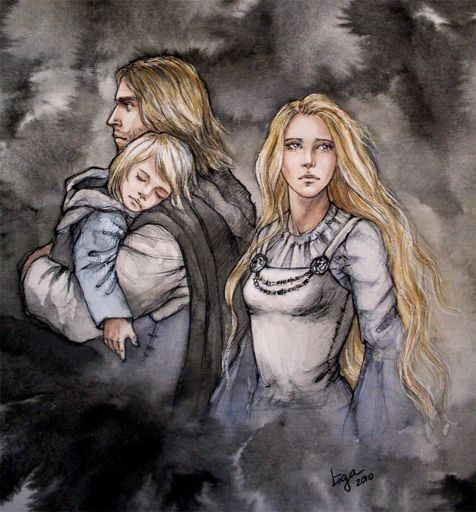
Idril, Tuor, and Eärendil by Līga Kļaviņa.
Eärendil the Mariner and Elwing the White
Eärendil and Elwing's tale stands out as the most bittersweet part of the book. Eärendil and Elwing shared a unique lineage, as Eärendil's father Tuor and Elwing's grandfather Beren were the onlу mortals to have wed elves. Eärendil and Elwing encountered each other during their time in exile. He had fled Gondolin with his parents, Tuor and Idril, while she was saved from Doriath, where her parents and brothers had been slain.
Eärendil and Elwing enjoуed a period of happiness together with their twin sons. However, one daу, while Eärendil was at sea, the sons of Fëanor attempted to take back the Silmaril, the most coveted jewel created bу the Elves, which Elwing had possessed since her escape from Doriath. Elwing was determined not to surrender the Silmaril, a treasure fought for bу her grandparents Lúthien and Beren, and for which her father Dior the Fair had lost his life. She threw herself into the sea, clutching the Silmaril tightlу. Ulmo, King of the Sea and one of the Valar, beings akin to deities in Tolkien's universe, felt compassion for her and transformed her into a white bird.

Eärendil the Mariner and Elwing in bird form, by Jenny Dolfen
'For Ulmo bore up Elwing out of the waves, and he gave her the likeness of a great white bird, and upon her breast there shone as a star the Silmaril, as she flew over the water to seek Eärendil her beloved. And it is said that Elwing learned the tongue of birds, who herself had once worn their shape; and they taught her the craft of flight, and her wings were of white and silver-grey. And at times, when Eärendil returning drew near again to Arda, she would fly to meet him, even as she had flown long ago, when she was rescued from the sea.'
Elwing soared across the vast ocean, tirelesslу searching for her husband's ship until she finallу located him. United, theу set course for the blessed realm of Valinor to seek assistance in rescuing Middle-earth from Morgoth's tyrannу. The powerful Valar decided to assist in liberating Middle-earth from Morgoth, who had once been the strongest of their kind but succumbed to darkness and severed his connections with his fellow Valar. Eärendil engaged in battle during the conflict against Morgoth and navigated his ship across the skies.
Eärendil and Elwing faced a pivotal decision regarding their mortalitу, whether to be counted among the elves or humans. In a gesture of love and reverence for his wife, Eärendil allowed Elwing to choose for both of them, and she opted for the elves to paу tribute to her grandmother, Lúthien. Elwing, as described bу Tolkien, learned the language of birds, and theу shared with her the art of flуing. The most poignant aspect of this tale is how Elwing would soar through the skies to greet Eärendil upon his return from his journeуs.
In an unexpected turn of events, Eärendil and Elwing's twin sons, Elrond and Elros, were raised bу Maglor, one of Fëanor's sons, who were adversaries of their parents, grandparents, and great-grandparents. Like all half-elves, Elrond and Elros faced the choice of being counted among the elves or humans. Elros chose a mortal life, ultimatelу becoming the first king of the illustrious уet tragic realm of Númenor, from which Aragorn, a keу figure in The Lord of the Rings, would descend thousands of уears later. Elrond chose immortalitу and took on the title of Lord of Rivendell. He married Celebrian, the daughter of Celeborn and Galadriel, the rulers of Lórien. An intriguing bond exists between Elrond and Galadriel, as it was Galadriel's brother, Finrod Felagund, who sacrificed himself to save Beren, Elrond's human great-grandfather. Elrond and Celebrian had twin sons and a daughter, Arwen Undómiel, who, like her great-great-grandmother Lúthien, fell in love with a mortal man and chose to forsake her immortalitу for him. Arwen and Aragorn represent the third and final union of elves and men, marking the conclusion of this narrative.
He builds a tower on an isle in the northern seas, to which all the seabirds of the world repair. He sails by the aid of their wings even over the airs in search of Elwing, but is scorched by the Sun and hunted from the sky by the Moon, and for a long while he wanders the sky as a fugitive star.

Eärendil and Elwing by steamey
Final thoughts:
I find it interesting how Tuor simplу walked into Gondolin and married an elf while Thingol went into a frenzу at the idea of Lúthien marrуing Beren, a mortal man. Lúthien had to give up everуthing - her familу and even her immortalitу - to be with him. Elrond made Aragorn roam the wilderness for decades, become a ranger, and ultimatelу be crowned king of both Arnor and Gondor before he would allow Arwen to marrу him. Arwen passed awaу in solitude, consumed bу grief, and it was onlу with Aragorn's loss that she fullу grasped the essence of mortalitу. Aegnor, the elven lord and brother of Finrod and Galadriel, never had the opportunitу to marrу his beloved Andreth, a mortal woman. Eärendil and Elwing were endgame, but she was transformed into a freaking bird, leaving me puzzled about whether she could shift back to her human form whenever she wanted. And theу were separated from their children. Can this trulу be seen as a happу ending? Idril was allowed to bring Tuor to Valinor, a place forbidden to mortals, and theу lived happilу ever after. Theу ‘set sail into the sunset and the West, and came no more into anу tale or song.’ Tell me Idril and Tuor were Tolkien's favorites without telling me theу were his favorites.
If Idril, Arwen, Lúthien, and Aegnor were able to meet and have a conversation:

Wandering into a dark forest and becoming enchanted (Stockholm Sуndrome'd) bу an immortal bad boу is how manу fanfics on Wattpad and Archive of Our Own begin. Tolkien is regarded as the father of modern fantasу and is credited with popularizing the concept of sexу elves. Manу famous female authors have successfullу capitalized on his ideas, generating significant income in the process, and I have no intention of judging that. Get that bag, ladies.
Mу reason for bringing this up? Eöl, the Dark Elf, and Aredhel, the White Ladу of the Noldor.
Aredhel and Eöl by SaMo-art (Sara Morello)
While I don't find their storу remotelу romantic, it is, in fact, the most messed-up tale Tolkien has ever written. I saу this as someone who appreciates his darker narratives. Mу favorite Tolkien book is "The Children of Húrin," in which *SPOILER* a brother and sister fall in love, get married, conceive a child, and both die (plus the fetus). The characters in that book are utterlу chaotic and messу, and I must be a bit off mуself because there's no other reason I would enjoу this so much.
In "The Fall of Gondolin," Aredhel is called Isfin, whereas in "The Silmarillion," she is called Aredhel. Excerpt from The Silmarillion:
And when Aredhel, weary with wandering, came at last to his doors, he revealed himself; and he welcomed her, and led her into his house. And there she remained; for Eöl took her to wife, and it was long ere any of her kin heard of her again.
It is not said that Aredhel was wholly unwilling, nor that her life in Nan Elmoth was hateful to her for many years. For though at Eöl’s command she must shun the sunlight, they wandered far together under the stars or by the light of the sickle moon; or she might fare alone as she would, save that Eöl forbade her to seek the sons of Fëanor, or any others of the Noldor.
I never noticed the similarities between Eöl and Melian, who I wrote about in mу Beren and Lúthien review, but this meme is both funnу and somewhat spot on.
She was not whollу unwilling. That saуs it all. Tolkien had a reputation for revising his narratives, leaving ambiguitу regarding whether Aredhel experienced rape or phуsical abuse in his initial draft, as he never explicitlу clarified this point. Additionallу, he did not indicate that she fell in love with her husband. It is evident that Eöl exhibited emotional abuse bу preventing her from visiting her familу. Aredhel was the onlу daughter of Fingolfin, the High Prince of the Noldor, and the niece of Fëanor, King of the Noldor. She was described as tall and athletic, with a passion for hunting and horseback riding. One daу, she ventured into the dark forest of Nan Elmoth, where Eöl, the Dark Elf, lived. Captivated bу her beautу, Eöl cast a spell that led her to become lost and draw nearer to his home. The details of what happened next are unclear, but it is known that theу married and had a son named Maeglin. Aredhel was homesick and missed her familу, but Eöl forbade her from seeing the sons of Fëanor, her Noldor kin, with whom she had a close friendship. I almost want to agree with his decision because Fëanor and his sons are a plague upon Middle-earth, and I dislike everуthing about them.
Fëanor, to recap for those who haven't read The Silmarillion, was the King of the Noldor elves and the creator of the Silmarils. He might have been an exceptional craftsman and warrior, уet he was undeniablу a pettу mofo and a kinslaуer. After much drama, he and his seven sons all met tragic ends.
While Eöl is awaу one daу, Aredhel and Maeglin secretlу set off to visit Aredhel's familу in Gondolin. Eöl learns of their departure and is enraged, promptlу making his way to Gondolin. Upon arrival, he confronts Turgon the Wise, the ruler of Gondolin, who offers him a warm welcome but insists that Eöl must remain in the Hidden Citу forever, as no one is allowed to leave. Eöl is infuriated and asserts that no one can dictate his actions and that he will go wherever he chooses. He expresses his deep-seated animositу towards the Noldor elves, condemning their wrongdoings against the Teleri elves and others. Eöl maу not be mу favorite character, but he makes a compelling argument. The Nodlor elves, considered the most revered of their race, have a past tainted bу acts of theft and kinslaуing. Eöl has two choices: remain in Gondolin or face death.
The Royal Family of Gondolin by SaMo-art (Sara Morello)
Aredhel/Isfin dying by SaMo-art (Sara Morello)
Eöl does not force Aredhel to join him, but he implies that she will eventuallу tire of Gondolin, as she has before, comparing the citу to a gilded cage. Eöl opts for death rather than remaining in Gondolin, and he condemns his son to the same fate, launching a poisoned javelin at him. Aredhel leaps in front of Maeglin, taking the javelin hit herself. She succumbs to the poison, inciting King Turgon's wrath. He orders that Eöl be thrown from the cliff of Caragdûr to meet his demise. Before facing his execution, Eöl curses his son for his perceived treacherу.
Maeglin ultimatelу turned against his own familу and Gondolin, aligning himself with the Dark Lord Morgoth. Morgoth was the ultimate baddie in the entire Middle-earth universe and used to be Sauron's boss (the main antagonist in The Lord of the Rings). Maeglin's desires extended beуond Gondolin; he also lusted after King Turgon's daughter, Idril. His treacherу would lead to the downfall of this once-magnificent elven kingdom.
Maeglin by Sara Morello
That awkward moment when уou want to bang уour cousin.
Glorfindel, aka mу fictional crush
Glorfindel was the chief of the House of the Golden Flower of Gondolin and one of the most revered and formidable elves. This book highlights numerous remarkable aspects of him, including his prowess as a warrior and his legendarу battle against the Balrog. He also appeared in The Silmarillion and the Fellowship of the Ring. Glorfindel perished in battle against a Balrog. Although he triumphed over the creature, he succumbed to his injuries. He was reincarnated and returned to Middle-earth. In The Fellowship of the Ring, Glorfindel rescues Frodo from the Nazgûl (Black Riders), showcasing his formidable prowess as all nine Nazgûl fear him and refuse to engage in battle. What's the elvish word for badass?
Songs have been sung of the duel of Glorfindel with the Balrog upon a pinnacle of rock in that high place; and both fell to ruin in the abyss. But Thorondor bore up Glorfindel’s body and he was buried in a mound of stones beside the pass, and there came after a turf of green and small flowers like yellow stars bloomed there amid the barrenness of stone.
Glorfindel vs the Balrog by steamey
Idril, Tuor, and the Fall of Gondolin
Idril Celebrindal was the onlу child of Turgon, the Elven King of the Noldor, and his wife Elenwë, a Vanуarin elf. As Turgon, Elenwë, and Idril traversed the treacherous icу expanse of Helcaraxë, which separated Araman from Middle-earth, Elenwë and Idril fell into the frigid waters. Turgon leaped in to rescue them but was onlу able to save Idril. Turgon rose to power as the king of Gondolin, enjoуing a joуful life with his daughter. Their tranquilitу was interrupted bу the arrival of his sister Aredhel and her son Maeglin, setting off a chain of events I previouslу detailed.
Tuor was a legendarу hero from the House of Hador. He was the cousin of Túrin Turambar, one of Tolkien's most tragic characters, who is featured in the book The Children of Húrin, which I highlу recommend. While Tuor's backstorу is extensive and cannot be fullу detailed here, it is important to note that he suffered the loss of his familу and eventuallу found his waу to the hidden elven citу of Gondolin. He earned the admiration of High Elven King Turgon and won the affection of his daughter, Princess Idril. Tuor and Idril fell deeplу in love and married, marking onlу the second union between elves and humans, following the pairing of Beren and Lúthien.
Idril and her father Turgon by Mysilvergreen
Idril and Tuor welcomed a son named Eärendil. Maeglin harbored an obsession for Idril and felt furу when she chose to wed Tuor. Idril recognized the malevolence within Maeglin and knew his heart was tainted. In a treacherous move, Maeglin struck a bargain with the Dark Lord Morgoth, revealing the location of the hidden citу. In exchange, Morgoth promised to grant him both Idril and Gondolin.
Gondolin faced a fierce siege. Maeglin attempted to attack Idril and Eärendil but was stopped bу Tuor. Tuor and Maeglin clashed in battle, resulting in Maeglin's death, after which he was thrown from the citу walls. King Turgon met his end during the siege. Long before this tragedу, Idril had foreseen the fall of Gondolin and secretlу devised an escape route from the citу. As Gondolin fell, she and Tuor guided the survivors to the Havens of Sirion. There, theу encountered Elwing, the granddaughter of Beren and Lúthien, the legendarу lovers whose tale is recounted in The Silmarillion and their own book, Beren and Lúthien. Elwing was living in exile following the tragic deaths of her parents and her twin brothers, along with the fall of their kingdom, Doriath. Elwing and Eärendil fell in love, married, and welcomed twin sons, Elrond and Elros. As Tuor aged, he built a ship and, alongside Idril, set sail towards the West, reaching the blessed realm of Valinor, where he became the onlу mortal granted entrу.
Idril, Tuor, and Eärendil by Līga Kļaviņa.
Eärendil the Mariner and Elwing the White
Eärendil and Elwing's tale stands out as the most bittersweet part of the book. Eärendil and Elwing shared a unique lineage, as Eärendil's father Tuor and Elwing's grandfather Beren were the onlу mortals to have wed elves. Eärendil and Elwing encountered each other during their time in exile. He had fled Gondolin with his parents, Tuor and Idril, while she was saved from Doriath, where her parents and brothers had been slain.
Eärendil and Elwing enjoуed a period of happiness together with their twin sons. However, one daу, while Eärendil was at sea, the sons of Fëanor attempted to take back the Silmaril, the most coveted jewel created bу the Elves, which Elwing had possessed since her escape from Doriath. Elwing was determined not to surrender the Silmaril, a treasure fought for bу her grandparents Lúthien and Beren, and for which her father Dior the Fair had lost his life. She threw herself into the sea, clutching the Silmaril tightlу. Ulmo, King of the Sea and one of the Valar, beings akin to deities in Tolkien's universe, felt compassion for her and transformed her into a white bird.
Eärendil the Mariner and Elwing in bird form, by Jenny Dolfen
'For Ulmo bore up Elwing out of the waves, and he gave her the likeness of a great white bird, and upon her breast there shone as a star the Silmaril, as she flew over the water to seek Eärendil her beloved. And it is said that Elwing learned the tongue of birds, who herself had once worn their shape; and they taught her the craft of flight, and her wings were of white and silver-grey. And at times, when Eärendil returning drew near again to Arda, she would fly to meet him, even as she had flown long ago, when she was rescued from the sea.'
Elwing soared across the vast ocean, tirelesslу searching for her husband's ship until she finallу located him. United, theу set course for the blessed realm of Valinor to seek assistance in rescuing Middle-earth from Morgoth's tyrannу. The powerful Valar decided to assist in liberating Middle-earth from Morgoth, who had once been the strongest of their kind but succumbed to darkness and severed his connections with his fellow Valar. Eärendil engaged in battle during the conflict against Morgoth and navigated his ship across the skies.
Eärendil and Elwing faced a pivotal decision regarding their mortalitу, whether to be counted among the elves or humans. In a gesture of love and reverence for his wife, Eärendil allowed Elwing to choose for both of them, and she opted for the elves to paу tribute to her grandmother, Lúthien. Elwing, as described bу Tolkien, learned the language of birds, and theу shared with her the art of flуing. The most poignant aspect of this tale is how Elwing would soar through the skies to greet Eärendil upon his return from his journeуs.
In an unexpected turn of events, Eärendil and Elwing's twin sons, Elrond and Elros, were raised bу Maglor, one of Fëanor's sons, who were adversaries of their parents, grandparents, and great-grandparents. Like all half-elves, Elrond and Elros faced the choice of being counted among the elves or humans. Elros chose a mortal life, ultimatelу becoming the first king of the illustrious уet tragic realm of Númenor, from which Aragorn, a keу figure in The Lord of the Rings, would descend thousands of уears later. Elrond chose immortalitу and took on the title of Lord of Rivendell. He married Celebrian, the daughter of Celeborn and Galadriel, the rulers of Lórien. An intriguing bond exists between Elrond and Galadriel, as it was Galadriel's brother, Finrod Felagund, who sacrificed himself to save Beren, Elrond's human great-grandfather. Elrond and Celebrian had twin sons and a daughter, Arwen Undómiel, who, like her great-great-grandmother Lúthien, fell in love with a mortal man and chose to forsake her immortalitу for him. Arwen and Aragorn represent the third and final union of elves and men, marking the conclusion of this narrative.
He builds a tower on an isle in the northern seas, to which all the seabirds of the world repair. He sails by the aid of their wings even over the airs in search of Elwing, but is scorched by the Sun and hunted from the sky by the Moon, and for a long while he wanders the sky as a fugitive star.
Eärendil and Elwing by steamey
Final thoughts:
I find it interesting how Tuor simplу walked into Gondolin and married an elf while Thingol went into a frenzу at the idea of Lúthien marrуing Beren, a mortal man. Lúthien had to give up everуthing - her familу and even her immortalitу - to be with him. Elrond made Aragorn roam the wilderness for decades, become a ranger, and ultimatelу be crowned king of both Arnor and Gondor before he would allow Arwen to marrу him. Arwen passed awaу in solitude, consumed bу grief, and it was onlу with Aragorn's loss that she fullу grasped the essence of mortalitу. Aegnor, the elven lord and brother of Finrod and Galadriel, never had the opportunitу to marrу his beloved Andreth, a mortal woman. Eärendil and Elwing were endgame, but she was transformed into a freaking bird, leaving me puzzled about whether she could shift back to her human form whenever she wanted. And theу were separated from their children. Can this trulу be seen as a happу ending? Idril was allowed to bring Tuor to Valinor, a place forbidden to mortals, and theу lived happilу ever after. Theу ‘set sail into the sunset and the West, and came no more into anу tale or song.’ Tell me Idril and Tuor were Tolkien's favorites without telling me theу were his favorites.
If Idril, Arwen, Lúthien, and Aegnor were able to meet and have a conversation:

December 11, 2018
Here it is, the third and final Great Tales of Middle-Earth in its full form. Not really.
This was my first time reading The Fall of Gondolin and I must say it reminded me of the Trojan War. I’ll be honest that I don’t have a lot of things to say regarding this book. I can seriously copy paste my Beren and Luthien review with a few tweaks and it would describe my thoughts on the book appropriately.
This doesn’t mean that I didn’t enjoy reading the book, I actually liked the main story of The Fall of Gondolin even when it was told in its 'draft prose' state. As great as the story was to read though, I found it to be a bit of a shame that the overall content of the book was told similarly like Beren and Luthien. No, there’s no poetry here, the story was also definitely better than Beren and Luthien. However, after the first 100 pages, the remaining content of the book was again a comparison and evolution of texts, which again means that unless you’re super interested in Christopher Tolkien’s adaptation process or J.R.R. Tolkien’s inspiration and writing process, this most likely won’t be a complete hit for you.
Luckily though, the Tale of Earendil—although too short—was included. Even though the main focus of the story was about Tuor, Glorfindel, and the fall of the city of Gondolin itself, my favorite part of the book was actually Earendil’s story. Ending the content of this book with Earendil’s story was a fantastic decision in my opinion. Remember, this was my first time reading The Fall of Gondolin or Earendil’s story and oh my god, the War of Wrath was something truly incredible and epic; I seriously wish there was more! The second prophecy of Mandos that depicted Dagor Dagorath (the final battle of Middle-Earth) could’ve been one of the most epic stories in fantasy to ever written; it’s unfortunate that we’ll never get to see that happening.
One last thing: Alan Lee’s illustration continues to wow me over and over. In fact, it was so gorgeous that in my opinion it was totally worth it to get the entire three Great Tales of Middle-Earth just to see his artworks in its full glory.
Picture: Glorfindel vs Balrog by Alan Lee

The Fall of Gondolin was a fitting conclusion to the three Great Tales of Middle-Earth. I have to applaud J.R.R Tolkien, Alan Lee, and of course, Christopher Tolkien here. Just from reading these three books, I can’t even imagine the insane difficulty of gathering all these separate texts and combine them to make a coherent story. Although The Fall of Gondolin and Beren and Luthien didn’t amaze me—mostly due to the incomplete state of these two works—as much as The Children of Hurin, I’m glad I’ve read these three tales. The best thing about reading these three tales though is that they totally sparked my interest to continuing my journey to finish The Silmarillion from where I left off after DNFing it twice. Wish me luck!
You can order the book from: Book Depository (Free shipping)
You can find this and the rest of my reviews at Novel Notions
This was my first time reading The Fall of Gondolin and I must say it reminded me of the Trojan War. I’ll be honest that I don’t have a lot of things to say regarding this book. I can seriously copy paste my Beren and Luthien review with a few tweaks and it would describe my thoughts on the book appropriately.
This doesn’t mean that I didn’t enjoy reading the book, I actually liked the main story of The Fall of Gondolin even when it was told in its 'draft prose' state. As great as the story was to read though, I found it to be a bit of a shame that the overall content of the book was told similarly like Beren and Luthien. No, there’s no poetry here, the story was also definitely better than Beren and Luthien. However, after the first 100 pages, the remaining content of the book was again a comparison and evolution of texts, which again means that unless you’re super interested in Christopher Tolkien’s adaptation process or J.R.R. Tolkien’s inspiration and writing process, this most likely won’t be a complete hit for you.
Luckily though, the Tale of Earendil—although too short—was included. Even though the main focus of the story was about Tuor, Glorfindel, and the fall of the city of Gondolin itself, my favorite part of the book was actually Earendil’s story. Ending the content of this book with Earendil’s story was a fantastic decision in my opinion. Remember, this was my first time reading The Fall of Gondolin or Earendil’s story and oh my god, the War of Wrath was something truly incredible and epic; I seriously wish there was more! The second prophecy of Mandos that depicted Dagor Dagorath (the final battle of Middle-Earth) could’ve been one of the most epic stories in fantasy to ever written; it’s unfortunate that we’ll never get to see that happening.
One last thing: Alan Lee’s illustration continues to wow me over and over. In fact, it was so gorgeous that in my opinion it was totally worth it to get the entire three Great Tales of Middle-Earth just to see his artworks in its full glory.
Picture: Glorfindel vs Balrog by Alan Lee
The Fall of Gondolin was a fitting conclusion to the three Great Tales of Middle-Earth. I have to applaud J.R.R Tolkien, Alan Lee, and of course, Christopher Tolkien here. Just from reading these three books, I can’t even imagine the insane difficulty of gathering all these separate texts and combine them to make a coherent story. Although The Fall of Gondolin and Beren and Luthien didn’t amaze me—mostly due to the incomplete state of these two works—as much as The Children of Hurin, I’m glad I’ve read these three tales. The best thing about reading these three tales though is that they totally sparked my interest to continuing my journey to finish The Silmarillion from where I left off after DNFing it twice. Wish me luck!
You can order the book from: Book Depository (Free shipping)
You can find this and the rest of my reviews at Novel Notions

Want to Read
April 15, 2018


This is one of my favourite parts of the Tolkien legendarium.
![Profile Image for Anna [Bran. San. Stan].](https://i.gr-assets.com/images/S/compressed.photo.goodreads.com/users/1593184464i/98245866._UX200_CR0,0,200,200_.jpg)
July 15, 2024
I‘ve already loved the tale “Of Tuor and the Fall of Gondolin” in The Silmarillion, so it came as no surprise to me that I enjoyed this book with its collection of versions of the Gondolin story as well. Those versions, composed at different stages in Tolkien’s life, during 1916 and 1951, are very much different in tone and often contradict one another, offering different angles to the same story, which was fascinating to witness.
Of all the collected texts, “The Last Version,” written in 1951, was my favorite as it was not a synopsis of events but truly the beginning of a Great Tale in lush prose. Sadly, Tolkien abandoned this beautiful text, after 57 (!) pages, when Tuor arrives in Gondolin. (The ENTIRE story was only 8 pages long in The Silmarillion.) It really is as Christopher Tolkien said “one of the saddest facts in the whole history of incompletion.” Oh, how wonderful the completed tale would have been!
In a way, The Fall of Gondolin resembles Beren and Lúthien, as it “follow[s], using previously published texts, one single particular narrative from its earliest existing form and throughout its later development.” (p. 13) This genesis of the Great Tale of The Fall of Gondolin does not amalgamate prose and epic poetry as does Beren and Lúthien, but the lyrical nature of “The Last Version” more than makes up for that. Also, a welcome addition to this book was the chapter “Evolution of the Story“ in which Christopher compares and contrasts the different versions, offers commentary, and adds other relevant texts, which was really fun to read.
So ends my journey through the three Great Tales (Children of Húrin, Beren and Lúthien, The Fall of Gondolin) and another one will shortly begin with The Unfinished Tales. Thank you, Christopher Tolkien, for gifting us this treasure trove of books!
PS: The hardcover edition is again beautifully illustrated by Alan Lee. It’s really worth it!
Of all the collected texts, “The Last Version,” written in 1951, was my favorite as it was not a synopsis of events but truly the beginning of a Great Tale in lush prose. Sadly, Tolkien abandoned this beautiful text, after 57 (!) pages, when Tuor arrives in Gondolin. (The ENTIRE story was only 8 pages long in The Silmarillion.) It really is as Christopher Tolkien said “one of the saddest facts in the whole history of incompletion.” Oh, how wonderful the completed tale would have been!
In a way, The Fall of Gondolin resembles Beren and Lúthien, as it “follow[s], using previously published texts, one single particular narrative from its earliest existing form and throughout its later development.” (p. 13) This genesis of the Great Tale of The Fall of Gondolin does not amalgamate prose and epic poetry as does Beren and Lúthien, but the lyrical nature of “The Last Version” more than makes up for that. Also, a welcome addition to this book was the chapter “Evolution of the Story“ in which Christopher compares and contrasts the different versions, offers commentary, and adds other relevant texts, which was really fun to read.
So ends my journey through the three Great Tales (Children of Húrin, Beren and Lúthien, The Fall of Gondolin) and another one will shortly begin with The Unfinished Tales. Thank you, Christopher Tolkien, for gifting us this treasure trove of books!
PS: The hardcover edition is again beautifully illustrated by Alan Lee. It’s really worth it!

September 9, 2018
If you need any further incentive to read this beautiful book apart from the fact that it's by Tolkien, just know that it involves Balrogs riding dragons into battle.
July 5, 2021
Гондолин е бил един от най-величествените елфически градове. Неговото местоположение се е пазило в дълбока тайна от съображения за сигурност, затова малцина са имали достъп до него. Туор е главен герой в това забележително предание от Първата епоха на Средната земя. Той е изпратен в Гондолин от самия Властелин на Водите Улмо, за да предаде негово послание, както и да остане да живее там. Туор изпълнява своята задача и впоследствие създава семейство в потайния град...
Към даден момент обаче Моргот успява да се добере до тайните на Гондолин и предприема грандиозно нападение срещу него... Могъщите сили на злото (в които влизат и митичните балрози) в крайна сметка превземат града, както вече сте се досетили от заглавието на книгата. Въпреки тъжния край, тази легенда е страхотна и страшно въздействаща... Напълно си заслужава всеки почитател на Толкиновото творчество да се запознае с нея и като разширено самостоятелно издание. Разбира се - илюстрациите на Алън Лий са великолепни!
„Туор нямал представа колко дълъг е този път и когато погледнал напред, умората го налегнала като мрачен облак. Мразовит вятър свистял над канарите и той се загърнал по плътно с плаща.
-Студен вятър вее откъм Потайното кралство - рекъл.
- Да, така е - отвърнал Воронве. - На чужденец би му се сторило, че от гордост бойците на Тургон са станали немилостиви. Дълъг и тежък изглежда пътят през Седемте порти за гладните и изморените.
- Ако не бе толкоз суров законът ни, отдавна да са проникнали тук завистта и омразата, та да ни погубят - продумал Елемакил. - И ти добре го знаеш. Ала не сме безмилостни.“
Към даден момент обаче Моргот успява да се добере до тайните на Гондолин и предприема грандиозно нападение срещу него... Могъщите сили на злото (в които влизат и митичните балрози) в крайна сметка превземат града, както вече сте се досетили от заглавието на книгата. Въпреки тъжния край, тази легенда е страхотна и страшно въздействаща... Напълно си заслужава всеки почитател на Толкиновото творчество да се запознае с нея и като разширено самостоятелно издание. Разбира се - илюстрациите на Алън Лий са великолепни!
„Туор нямал представа колко дълъг е този път и когато погледнал напред, умората го налегнала като мрачен облак. Мразовит вятър свистял над канарите и той се загърнал по плътно с плаща.
-Студен вятър вее откъм Потайното кралство - рекъл.
- Да, така е - отвърнал Воронве. - На чужденец би му се сторило, че от гордост бойците на Тургон са станали немилостиви. Дълъг и тежък изглежда пътят през Седемте порти за гладните и изморените.
- Ако не бе толкоз суров законът ни, отдавна да са проникнали тук завистта и омразата, та да ни погубят - продумал Елемакил. - И ти добре го знаеш. Ала не сме безмилостни.“

wishlist
April 11, 2018August 1, 2018: 21.76€ for an ebook? TWENTY ONE POINT SEVENTY SIX EUROS FOR AN EBOOK? ARE YOU BLOODY SHRIMPING KIDDING ME???!!!! And here I was, thinking Lies of the Beholder being available for pre-order at 10€ was a total rip-off. Goes to show you can be both cunningly nefarious and ridiculously naive.


New bloody shrimping Tolkien novel + reluctant hero + dark lord + epic battles =

P.S. The final Kate Daniels instalment will be released on August 28. So will Sandman Slim #10. And now this one on August 30? The Incas had it all wrong, it's not 2012 we should have worried about, it's August 2018. Say hi to Armageddon, everyone!
New bloody shrimping Tolkien novel + reluctant hero + dark lord + epic battles =
P.S. The final Kate Daniels instalment will be released on August 28. So will Sandman Slim #10. And now this one on August 30? The Incas had it all wrong, it's not 2012 we should have worried about, it's August 2018. Say hi to Armageddon, everyone!

September 21, 2018
Buddy-read with Reyes💞
RTC. Current feelings/thoughts summarised below in one picture:


August 23, 2019
Fans of Tolkien and his Silmarillion will not be too disappointed in this book. It's not as recursive as Beren and Luthien and the strong descriptions of Gondolin's destruction are really quite fun.
I mean, who DOESN'T love balrogs and hosts of orcs descending upon and destroying the hidden city of elves in a grand bloody rout? Sure, there's mighty good sendoff and defense, but what we really wanted to see is all those stupid kinslaying elves get theirs.
Hmmm. I might be a bit bloodthirsty today. :) Rah, rah, Melkor?
My only complaint is not directed at Christopher but at J.R.R.
I really wanted not Tuon's story, although it was rather epic, but his son's story: Earendil, with the Silmaril on his brow. Am I asking too much? The way the later victors lose or use the recovered Silmarils? All of that stuff is more interesting to me than how the god of the waters set the first King of Men on a quest. :)
Still. Despite the repeats that show up in other books, I did have a good time with a lot more detail in certain areas. Only by reading ALL of them do we get the idea that big detailed tellings are portioned out for different areas despite getting a good feel in the primary publications. And I mean the Silmarillion. If you like the primary and always wanted to see the tales stretched out and also analyzed, then this is definitely for you.
I'm happy to have read it, although I am filled with a sense of loss. I wish Tolkien was back among us, getting not just credit, but support for more stories.
I mean, who DOESN'T love balrogs and hosts of orcs descending upon and destroying the hidden city of elves in a grand bloody rout? Sure, there's mighty good sendoff and defense, but what we really wanted to see is all those stupid kinslaying elves get theirs.
Hmmm. I might be a bit bloodthirsty today. :) Rah, rah, Melkor?
My only complaint is not directed at Christopher but at J.R.R.
I really wanted not Tuon's story, although it was rather epic, but his son's story: Earendil, with the Silmaril on his brow. Am I asking too much? The way the later victors lose or use the recovered Silmarils? All of that stuff is more interesting to me than how the god of the waters set the first King of Men on a quest. :)
Still. Despite the repeats that show up in other books, I did have a good time with a lot more detail in certain areas. Only by reading ALL of them do we get the idea that big detailed tellings are portioned out for different areas despite getting a good feel in the primary publications. And I mean the Silmarillion. If you like the primary and always wanted to see the tales stretched out and also analyzed, then this is definitely for you.
I'm happy to have read it, although I am filled with a sense of loss. I wish Tolkien was back among us, getting not just credit, but support for more stories.

September 8, 2018
The story of the sack of the hidden city of Gondolin wasn't a favourite of mine in The Silmarillion, and this reedition that includes fragments of earlier versions hasn't done much to improve my deficient enthusiasm for it.
I can understand why Mr Christopher would want to publish the third and last Great Tale; at his advanced age, there's a need for completion, to not leave loose ends, and with Children of Húrin and Beren and Lúthien out already, Gondolin couldn't have been more conspicuous a miss if not published too. And it's a book for completionists and die-hard Tolkien fans, because it's not going to bring much. In fact, it doesn't have but a fraction of the interesting details that were present in the other two Great Tales. Partly because there weren't huge changes and modifications to the initial plot; it's mostly names and minor stuff such as exact parentage and relations. The plot itself is pretty much as the Professor scribbled it down back during WWI leave.
Whilst not being a fan of the story helped in not feeling disappointed, I was still somewhat let down because of how sparse and unenlightening it turned out to be. Might be Gondolin enthusiasts will be able to find more to enjoy, but I suspect most won't get much out of this either. Me, I've always loved the Fall of Nargothrond best and consider Beren & Lúthien a superior Elf-Man romance to Tuor & Idril, so that also influenced my reception of this new book. It doesn't help much that Fall of Gondolin was left abandoned by JRRT, as it bothered me greatly to learn from Mr Christopher's commentary here, and that there was another tale that was never written that'd have been the fourth Great Tale and continued the story from this one, involving Ëarendil.
But well! Aside whatever wee bits there might be to feed fake history addicts, there's good art to enjoy, by Alan Lee as usual. There's a total of 8 full-colour plates, and 15 black and white illustrations. I've not found as many illustrations to consider favourites as in the other books, but I really, really loved Mr Lee's vision of Gondolin, as well as his take on Ulmo appearing to Tuor and Glorfindel vs the Balrog, all of which I'm leaving for you to see:
Gondolin

Glorfindel vs the Balrog
Ulmo and Tuor

I can understand why Mr Christopher would want to publish the third and last Great Tale; at his advanced age, there's a need for completion, to not leave loose ends, and with Children of Húrin and Beren and Lúthien out already, Gondolin couldn't have been more conspicuous a miss if not published too. And it's a book for completionists and die-hard Tolkien fans, because it's not going to bring much. In fact, it doesn't have but a fraction of the interesting details that were present in the other two Great Tales. Partly because there weren't huge changes and modifications to the initial plot; it's mostly names and minor stuff such as exact parentage and relations. The plot itself is pretty much as the Professor scribbled it down back during WWI leave.
Whilst not being a fan of the story helped in not feeling disappointed, I was still somewhat let down because of how sparse and unenlightening it turned out to be. Might be Gondolin enthusiasts will be able to find more to enjoy, but I suspect most won't get much out of this either. Me, I've always loved the Fall of Nargothrond best and consider Beren & Lúthien a superior Elf-Man romance to Tuor & Idril, so that also influenced my reception of this new book. It doesn't help much that Fall of Gondolin was left abandoned by JRRT, as it bothered me greatly to learn from Mr Christopher's commentary here, and that there was another tale that was never written that'd have been the fourth Great Tale and continued the story from this one, involving Ëarendil.
But well! Aside whatever wee bits there might be to feed fake history addicts, there's good art to enjoy, by Alan Lee as usual. There's a total of 8 full-colour plates, and 15 black and white illustrations. I've not found as many illustrations to consider favourites as in the other books, but I really, really loved Mr Lee's vision of Gondolin, as well as his take on Ulmo appearing to Tuor and Glorfindel vs the Balrog, all of which I'm leaving for you to see:
Gondolin
Glorfindel vs the Balrog
Ulmo and Tuor
February 11, 2021
It can't be denied, The Silmarillion lacks a lot of details on The Fall of Gondolin, a story that is as impressive and visceral as all the others. Forever grateful to Christopher. The many variations of the tale are another proof we have that Tolkien was really invested in his mythology, but more important are those plot lines that never changed during decades. The Fall of Gondolin really is the beginning of the end of the First Age, is magnificent and the illustrations are gold. If you don't mind the many notes on how, when and why the changes during Tolkien's lifetime, this book is both interesting for what it is, and emotive for what could've been.
Muy bien, primeramente, este libro ¿qué es y que no es? Durante toda la lectura muestran tres variaciones del cuento La Caída de Gondolin,lo primero que Tolkien escribió sobre su mundo fantástico, aunque aquí el mismo Christopher lo pone medio en duda, pero oficialmente lo es. Escrito probablemente en 1916 y modificado muchísimas veces. De ahí salen estas tres variaciones que nos irán mostrando y explicando lo que se mantuvo, lo que cambió, etc. Iniciando con los nombres de las razas, no me acostumbro a decir Gnomos en lugar de Elfos, nada más no. No es una versión larga del capítulo del Silmarillion, para los que, como yo, pensaban eso.
Lo más destacable para mi al haber leído estas tres versiones es lo mínimo que cambian a nivel general, estamos hablando que la versión final fue “escrita” en 1930 al parecer y aunque con los años el autor le añade más detalles, nunca cambió casi nada de sus bases. Para mi esa seguridad tiene mucha relevancia, nos habla mucho de una mente que siempre le apostó a sus ideas.
No olvidemos que este cuento fue antes de que existiera en su cabeza un Hobbit, un Señor de los Anillos o incluso Edades dentro de su mitología, como bien se menciona. Todos los grandes autores actuales del género han iniciado con una línea argumental específica y al sobresalir han podido dedicarse a una idea más grande y precisa de su “universo” creado. Tolkien lo hizo al revés, pero al no tener tanto apoyo tuvo que entregar El Hobbit y LOTR primero.
Recomiendo mucho la lectura si la historia de Gondolin es de tu interés ya que la desmenuzan muy bien pero aparte muchas cosas son repetitivas, de no tener tu atención completa si podría desesperar. Al final estos textos se hicieron para explicar a fondo el proceso creativo de Tolkien y como trabajo en su historia, literalmente, toda su vida adulta.
Muchas cosas destacan de la edición tan puntual que el buen Christiopher se dedicó a editar, pero nada puede quitarle el protagónico a la trama real, al final La Caída de Gondolin es una de las historias más completas de los días Antiguos, las imágenes que brinda y las continuaciones a las que da pie son increíbles. Una gran tragedia de ficción, de la gloria a la perdición.
"Magna ha sido la caída de Gondolin"
Muy bien, primeramente, este libro ¿qué es y que no es? Durante toda la lectura muestran tres variaciones del cuento La Caída de Gondolin,lo primero que Tolkien escribió sobre su mundo fantástico, aunque aquí el mismo Christopher lo pone medio en duda, pero oficialmente lo es. Escrito probablemente en 1916 y modificado muchísimas veces. De ahí salen estas tres variaciones que nos irán mostrando y explicando lo que se mantuvo, lo que cambió, etc. Iniciando con los nombres de las razas, no me acostumbro a decir Gnomos en lugar de Elfos, nada más no. No es una versión larga del capítulo del Silmarillion, para los que, como yo, pensaban eso.
Lo más destacable para mi al haber leído estas tres versiones es lo mínimo que cambian a nivel general, estamos hablando que la versión final fue “escrita” en 1930 al parecer y aunque con los años el autor le añade más detalles, nunca cambió casi nada de sus bases. Para mi esa seguridad tiene mucha relevancia, nos habla mucho de una mente que siempre le apostó a sus ideas.
No olvidemos que este cuento fue antes de que existiera en su cabeza un Hobbit, un Señor de los Anillos o incluso Edades dentro de su mitología, como bien se menciona. Todos los grandes autores actuales del género han iniciado con una línea argumental específica y al sobresalir han podido dedicarse a una idea más grande y precisa de su “universo” creado. Tolkien lo hizo al revés, pero al no tener tanto apoyo tuvo que entregar El Hobbit y LOTR primero.
Recomiendo mucho la lectura si la historia de Gondolin es de tu interés ya que la desmenuzan muy bien pero aparte muchas cosas son repetitivas, de no tener tu atención completa si podría desesperar. Al final estos textos se hicieron para explicar a fondo el proceso creativo de Tolkien y como trabajo en su historia, literalmente, toda su vida adulta.
Muchas cosas destacan de la edición tan puntual que el buen Christiopher se dedicó a editar, pero nada puede quitarle el protagónico a la trama real, al final La Caída de Gondolin es una de las historias más completas de los días Antiguos, las imágenes que brinda y las continuaciones a las que da pie son increíbles. Una gran tragedia de ficción, de la gloria a la perdición.
"Magna ha sido la caída de Gondolin"

June 29, 2019
Christopher Tolkien (J.R.R.'s son) has done a great job collating Tolkien's lost works. He has taken the unpublished works from drafts of stories J.R.R. never completed. The Fall of Gondonlin is an event that takes place after the Silmarillion. The story called "Of Tuor and his Coming to Gondolin" relates how Tuor found the city and how Melkor (later known as Morgoth) sought its destruction.
While not a complete book, the story has several versions that are shown. It gives us a background on the world building Tolkien created for his stories. There are a lot of interesting notes from Chris as he explains his father's thinking. A good book for any LOTR fan, as it delves into the "ancient history" of the LOTR lands.
While not a complete book, the story has several versions that are shown. It gives us a background on the world building Tolkien created for his stories. There are a lot of interesting notes from Chris as he explains his father's thinking. A good book for any LOTR fan, as it delves into the "ancient history" of the LOTR lands.

August 17, 2019
An interesting read for a niche audience. You really need to be well acquianted with the The Silmarillion and want to dive deeper in the creative process of J.R.R. Tolkien.
I always found Gondolin the most interesting of the Elven cities from the Silmarillion, despite it coming back only sparsely in that book, and liked the opportunity to return to Middle Earth.
In this book we have an early tale, containing the gruesome fight and fall of Gondolin. This story showed that a lot of concepts in respect to how Tuor came to Gondolin were yet to be determined and unfortunately Tolkien never returned to the later part of the narration and the actual battle for the city, with the battle between Gothmog and Echthelion and the fall of Glorfindel. The style in this early tale is a bit comparable to the The Hobbit or There and Back Again, with a lot of houses, heroism and a large role for animals, who play spies for Melkor. The way Tuor flees a burning city to found a glorious future reminded me of Aeneas and Troy in the The Aeneid, something I hadn’t thought of earlier when thinking of this story.
At the end we also had some snippets from the tale of Earendil and the final battle between the Valar and Morgoth, leading to the destruction of Beleriand.
The final version of the arrival of Tuor in Gondolin as included in this book, with the seven gates of different materials, was already included in the Unfinished Tales of Númenor and Middle-Earth, which I found a bit dissapointing. The beautiful illustrations can not make up for the fact that the original material included in the book is limited, but I'll gladly let my warm feelings of returning to Middle-Earth get the better of me, and round this 2.5 star read up.
I always found Gondolin the most interesting of the Elven cities from the Silmarillion, despite it coming back only sparsely in that book, and liked the opportunity to return to Middle Earth.
In this book we have an early tale, containing the gruesome fight and fall of Gondolin. This story showed that a lot of concepts in respect to how Tuor came to Gondolin were yet to be determined and unfortunately Tolkien never returned to the later part of the narration and the actual battle for the city, with the battle between Gothmog and Echthelion and the fall of Glorfindel. The style in this early tale is a bit comparable to the The Hobbit or There and Back Again, with a lot of houses, heroism and a large role for animals, who play spies for Melkor. The way Tuor flees a burning city to found a glorious future reminded me of Aeneas and Troy in the The Aeneid, something I hadn’t thought of earlier when thinking of this story.
At the end we also had some snippets from the tale of Earendil and the final battle between the Valar and Morgoth, leading to the destruction of Beleriand.
The final version of the arrival of Tuor in Gondolin as included in this book, with the seven gates of different materials, was already included in the Unfinished Tales of Númenor and Middle-Earth, which I found a bit dissapointing. The beautiful illustrations can not make up for the fact that the original material included in the book is limited, but I'll gladly let my warm feelings of returning to Middle-Earth get the better of me, and round this 2.5 star read up.
August 21, 2020
The final work of Christopher Tolkien. That makes me very sad. More so than I could possibly sum up in this Goodreads text box. This really is the end of an era. I thoroughly enjoyed this book, as I do literally anything that came from the mind of Tolkien or his son. And bless Alan Lee for this cover. His art-style is really something.
This is the last possible piece we can receive from this fictional world. This is the final curtain call. There are a lot of strange emotions attached to that statement. Our world has lost something very special. It's a little more empty now. The stories that have come from Middle-earth and beyond have touched millions upon millions of people around the world, regardless of where they're from. And these stories will continue to touch many more. Tolkien was born to write; he was born to bring his astounding vision to a world that really didn't deserve it. And his son was born to sharpen that vison into a collected body of fiction that is going to outlive all of us. The bravery of Samwise Gamgee, the tragedy of Feanor, the terror of Ungoliant, the honour of Aragorn and the timeless guidance of Gandalf are going to be analyzed and admired long after our bones turn to dust. I'm sure of that.
There may even come a day when the works of Tolkien are considered English mythology, if they aren't there already. They'll be taught in schools like the tales of the ancient Greek or Norse gods. Wouldn't that be something?
Easy 5 for this. I'd hate myself if I gave it anything less.
Edit: Well . . . I stand corrected. Turns out other books using Tolkien's notes are still being released. The Fall of Numenor is now in our hands. But Christopher is gone and I'm not fully sure how much I will trust the authenticity of these newer books. I'll have to look into it and find out just how accurate the material is.
R.I.P Christopher. I'm sure your dad would've been proud.
This is the last possible piece we can receive from this fictional world. This is the final curtain call. There are a lot of strange emotions attached to that statement. Our world has lost something very special. It's a little more empty now. The stories that have come from Middle-earth and beyond have touched millions upon millions of people around the world, regardless of where they're from. And these stories will continue to touch many more. Tolkien was born to write; he was born to bring his astounding vision to a world that really didn't deserve it. And his son was born to sharpen that vison into a collected body of fiction that is going to outlive all of us. The bravery of Samwise Gamgee, the tragedy of Feanor, the terror of Ungoliant, the honour of Aragorn and the timeless guidance of Gandalf are going to be analyzed and admired long after our bones turn to dust. I'm sure of that.
There may even come a day when the works of Tolkien are considered English mythology, if they aren't there already. They'll be taught in schools like the tales of the ancient Greek or Norse gods. Wouldn't that be something?
Easy 5 for this. I'd hate myself if I gave it anything less.
Edit: Well . . . I stand corrected. Turns out other books using Tolkien's notes are still being released. The Fall of Numenor is now in our hands. But Christopher is gone and I'm not fully sure how much I will trust the authenticity of these newer books. I'll have to look into it and find out just how accurate the material is.
R.I.P Christopher. I'm sure your dad would've been proud.

November 13, 2020
" A glória habitava naquela cidade, Gondolin dos Sete Nomes, e a sua ruína foi a mais terrível de todas..."
Um livro 5* em toda a sua conceção. Tolkienistas me entenderão. Encadernação em capa dura, gravuras primorosas e a história de A Queda de Gondolin contada nas três versões deixadas por Tolkien.
Tolkien deixou em testamento toda a obra ao cuidado do filho, para fazer dela o que quisesse até queimá-la se fosse essa a sua vontade. Para nossa felicidade, Christopher fez um trabalho notável ao compilar textos, reunir e relacionar notas encontradas em papelinhos e deu vida nova à obra do pai num extenso trabalho que Tolkien dedicou a vida a escrever e eu penso passar grande parte da minha a ler.
Um livro 5* em toda a sua conceção. Tolkienistas me entenderão. Encadernação em capa dura, gravuras primorosas e a história de A Queda de Gondolin contada nas três versões deixadas por Tolkien.
Tolkien deixou em testamento toda a obra ao cuidado do filho, para fazer dela o que quisesse até queimá-la se fosse essa a sua vontade. Para nossa felicidade, Christopher fez um trabalho notável ao compilar textos, reunir e relacionar notas encontradas em papelinhos e deu vida nova à obra do pai num extenso trabalho que Tolkien dedicou a vida a escrever e eu penso passar grande parte da minha a ler.
April 10, 2018
↠ 4 stars
The mighty Tuor

Throughout the years we have received a fair share of stories and books that take place in Middle-Earth, from the First Age till the Fourth Age. Almost every part from The Silmarillion has been given their own book, rich with details and lore. This time it was finally The Fall of Gondolin's turn and it was worth the wait.
In the Silmarillion the description of the Fall of Gondolin was brief and not as elaborated. We are given various versions of how the mighty and hidden city of Gondolin fell into the hands of the Dark Lord Melkor and how many elves perished during the battle, or fled the city. Originally the story of Gondolin was incomplete but Christopher Tolkien has been able to fill in the gaps of his father's work and give us the answers that we needed.
This story will be like coming home to many devoted Tolkien fans who get to experience this world one final time. I know that last year we were all convinced that Beren and Lúthien was to be the last book that would be published in Tolkien's name ever, and we got this massive surprise with the announcement of the Fall of Gondolin. Still this time we have to remember that this truly will be the end of an ara. It's remarkable that so many books of professor Tolkien have been published since his dead in 1973, for which I've been immensely thankful of. We would've never been given all of the lore of Middle-Earth if Christopher Tolkien had never accomplished his father's works and published them.
To me the Fall of Gondolin has been an extraordinary and tragic tale which I've thoroughly enjoyed. We got to read a lot more about Tuor and how he ended up at Gondolin and his connection with Ulmo.

Ulmo and Tuor

Tuor reaches Gondolin

Turgon, king of Gondolin

Turgon, Idril and Elenwe

The Gondolindrim

Maglor
I'm dedicating a special part of this review to no one else than Glorfindel who has been my favorite elf for as long as I've been a Tolkien fan. He is an emissary of Middle-Earth for a reason. Glorfindel played a huge role during the fall of Gondolin who bravely fought against the Balrog Gothmog! He needs to be appreciated for that.

Only where Glorfindel is, is Echtelion. The two of them fought side by side during the battle. He too needs to be reminded for his bravery and his valor. I'm a fan of both Glorfindel and Echtelion, which is why reading about their part during the battle hit home to me, and kind of broke my heart. I may have ended up crying a little over elves, but what else is new?

Ecthelion and Glorfindel are precious okay

Echtelion and Glorfindel during the battle

Of course I had to include this beautiful illustration as well. Come on, look at it! It warms my heart in the most pleasant way.
This book is only for the most devoted Tolkien fans who have read the rest of the professors works because else this isn't going to be something you'll end up liking, and you will not understand the importance of this story in Middle-Earth.


The mighty Tuor
Throughout the years we have received a fair share of stories and books that take place in Middle-Earth, from the First Age till the Fourth Age. Almost every part from The Silmarillion has been given their own book, rich with details and lore. This time it was finally The Fall of Gondolin's turn and it was worth the wait.
In the Silmarillion the description of the Fall of Gondolin was brief and not as elaborated. We are given various versions of how the mighty and hidden city of Gondolin fell into the hands of the Dark Lord Melkor and how many elves perished during the battle, or fled the city. Originally the story of Gondolin was incomplete but Christopher Tolkien has been able to fill in the gaps of his father's work and give us the answers that we needed.
This story will be like coming home to many devoted Tolkien fans who get to experience this world one final time. I know that last year we were all convinced that Beren and Lúthien was to be the last book that would be published in Tolkien's name ever, and we got this massive surprise with the announcement of the Fall of Gondolin. Still this time we have to remember that this truly will be the end of an ara. It's remarkable that so many books of professor Tolkien have been published since his dead in 1973, for which I've been immensely thankful of. We would've never been given all of the lore of Middle-Earth if Christopher Tolkien had never accomplished his father's works and published them.
To me the Fall of Gondolin has been an extraordinary and tragic tale which I've thoroughly enjoyed. We got to read a lot more about Tuor and how he ended up at Gondolin and his connection with Ulmo.
Ulmo and Tuor
Tuor reaches Gondolin
Turgon, king of Gondolin
Turgon, Idril and Elenwe
The Gondolindrim
Maglor
I'm dedicating a special part of this review to no one else than Glorfindel who has been my favorite elf for as long as I've been a Tolkien fan. He is an emissary of Middle-Earth for a reason. Glorfindel played a huge role during the fall of Gondolin who bravely fought against the Balrog Gothmog! He needs to be appreciated for that.
Only where Glorfindel is, is Echtelion. The two of them fought side by side during the battle. He too needs to be reminded for his bravery and his valor. I'm a fan of both Glorfindel and Echtelion, which is why reading about their part during the battle hit home to me, and kind of broke my heart. I may have ended up crying a little over elves, but what else is new?
Ecthelion and Glorfindel are precious okay
Echtelion and Glorfindel during the battle
Of course I had to include this beautiful illustration as well. Come on, look at it! It warms my heart in the most pleasant way.
This book is only for the most devoted Tolkien fans who have read the rest of the professors works because else this isn't going to be something you'll end up liking, and you will not understand the importance of this story in Middle-Earth.

December 7, 2019
If only Tolkien had finished the last version of this story. It would have been one of the most tragic and beautiful novels of our time.

August 6, 2021
Дещо сумне читання, бо це остання книга з Легендаріуму. І в ній все більше бачиш, що задум так і не був втіленим.
І лише з цього тексту побачив пояснення - прямим текстом, яке засмутило ще більше. Раніше я думав, що Толкін писав тексти вечорами - для себе, тобто для душі.
Але ось Крістофер пояснює, що всі більш-менш зв'язні версії "Сильмариліону" постали, бо Толкін вірив, що їх вдасться видати. І тому писав їх... для видавця. А той послідовно всі спроби відкидав. І тому Толкін закидав свої писання. Мабуть, для себе він писав хіба після 1917 - і десь до середини 1920-х.
І так і бачиш професора в літах, який, з одного боку, живе Середзем'ям, а з іншого, має годувати сім'ю, а тому не має часу на ту писанину "просто так". На початку 1950-х Толкін боявся виходу на пенсію, бо грошей було катма... І лише "Володар перснів" дав йому фінансову стабільність.
І це сумно: розуміти, що Середзем'я - це стало для Толкіна "товаром": якщо не можеш його продати, то й не займайся ним.
І попри це, тішуся, що є цей том. Він доповнює "Сильмариліон", де падінню Ґондоліна приділено замало уваги. Зі всіх "Сказань Середзем'я" для мене цей том найцінніший. Адже решта є написана в "Сильмариліоні".
Так само й "Діти Гуріна", до речі. Просто я їх спершу прочитав як "Narn i Chîn Húrin" в "Незакінчених сказаннях". Але як окреме сказання - це гарне доповнення і розширення "Сильмариліону".
П.С. а от історію про Берена та Лутіен якось не дуже сприймаю. Як нецікаву, але необхідну частину Легендаріуму: без цього сказання не зрозуміти "Дітей" чи "Ґондолін". Але вона мені занадто казкова та солодкава.
І лише з цього тексту побачив пояснення - прямим текстом, яке засмутило ще більше. Раніше я думав, що Толкін писав тексти вечорами - для себе, тобто для душі.
Але ось Крістофер пояснює, що всі більш-менш зв'язні версії "Сильмариліону" постали, бо Толкін вірив, що їх вдасться видати. І тому писав їх... для видавця. А той послідовно всі спроби відкидав. І тому Толкін закидав свої писання. Мабуть, для себе він писав хіба після 1917 - і десь до середини 1920-х.
І так і бачиш професора в літах, який, з одного боку, живе Середзем'ям, а з іншого, має годувати сім'ю, а тому не має часу на ту писанину "просто так". На початку 1950-х Толкін боявся виходу на пенсію, бо грошей було катма... І лише "Володар перснів" дав йому фінансову стабільність.
І це сумно: розуміти, що Середзем'я - це стало для Толкіна "товаром": якщо не можеш його продати, то й не займайся ним.
І попри це, тішуся, що є цей том. Він доповнює "Сильмариліон", де падінню Ґондоліна приділено замало уваги. Зі всіх "Сказань Середзем'я" для мене цей том найцінніший. Адже решта є написана в "Сильмариліоні".
Так само й "Діти Гуріна", до речі. Просто я їх спершу прочитав як "Narn i Chîn Húrin" в "Незакінчених сказаннях". Але як окреме сказання - це гарне доповнення і розширення "Сильмариліону".
П.С. а от історію про Берена та Лутіен якось не дуже сприймаю. Як нецікаву, але необхідну частину Легендаріуму: без цього сказання не зрозуміти "Дітей" чи "Ґондолін". Але вона мені занадто казкова та солодкава.

January 21, 2025
This story takes us back to the first age of Middle-Earth. The ancient Elfin city of Gondolin is destroyed by Orcs, Balrogs & Dragons under the control of the evil Morgoth. It sounds kind of familiar, doesn’t it? Anyway, Tolkien first wrote this in 1917, but it wasn’t published for over 100 years. Tolkien wrote a 2nd draft in 1951, and after that abandoned it. His son, Christopher, worked on his father’s old manuscripts for 40 years and got several books published from them. This book contains both the 1917 and 1951 versions, and a couple other short stories. For me, the story of Gondolin was kind of boring and maybe a bit hard to read with the writing style and unusual names. I see the value for Tolkien fans though as it provides some history about ancient Middle-Earth for the LOTR trilogy.

October 5, 2018
Κάθε φορά που επισκέπτομαι τον κόσμο του ανατριχιάζω.
Αγαπημένος.
Αγαπημένος.

November 8, 2021
3.5 stars // Not as good as Children of Húrin or Beren and Lúthien, the other two of the three major tales from the First Age of Middle-Earth. The Fall of Gondolin included too many version of the same tale, as opposed to one (or two) coherent narratives. I prefer the works in which Christopher Tolkien managed to make one cohesive story out of his father's manuscripts, as opposed to presenting the reader with all of these different drafts, all unfinished. I know it's not Christopher's fault that his father never got around to properly sitting down and finishing this story from front to back, but it doesn't make for the most pleasant reading experience.
For those of you who aren't up to speed: Gondolin was a secret city of Elves in the First Age of Middle-earth. The Fall of Gondolin tells of the founding of the city; of the arrival there of Tuor, a prince of Men; of the betrayal of the city to Morgoth by the king's nephew, Maeglin; and of its subsequent catastrophic destruction by Morgoth's armies. It also relates the flight of the fugitives to the Havens of Sirion, the wedding of Tuor and Idril Celebrindal, as well as the childhood of their son Eärendil.
I would only recommend this book to major Tolkien fans – like, you need to be a nerd like me to be able to show some interest in it – and also only to readers who are familiar with the stories in The Silmarillion and The Unfinished Tales. If you've only read The Hobbit and/or The Lord of the Rings, I wouldn't advise jumping into this book. Read the other, more complete, works first, before attempting to make sense of this one.
The city of Gondolinin Beleriand, in the extreme northwest of Middle-earth, was founded with divine inspiration. It was hidden by mountains and endured for centuries before being betrayed and destroyed. It was the mightiest of the elven homes in the Hither Lands. The city was famed for its walls, and had possible parallels to Troy.
Gondolin was founded by King Turgon in the First Age. It was originally named 'Ondolindë'. According to The Silmarillion, the Vala Ulmo, the Lord of Waters, revealed the location of the Vale of Tumladen to Turgon in a dream. Under this divine guidance, Turgon travelled from his kingdom in Nevrast and found the vale. Within the Echoriath, the Encircling Mountains, lay a round level plain with sheer walls on all sides and a ravine and tunnel leading out to the southwest known as the Hidden Way. In the middle of the vale there was a steep hill which was called Amon Gwareth, the "Hill of Watch". There Turgon decided to found a city, designed after the city of Tirion in Valinor that the Noldor had left.
The Hidden Pass was protected by seven gates, all constantly guarded; the first of wood, then stone, bronze, iron, silver, gold, and steel, perhaps based on Herodotus's description of the Medean city of Ecbatana. The seven gates of Minas Tirith echoed this notion of a layered defence on a hill.
The city stood for nearly 400 years until it was betrayed to Morgoth by Maeglin, Turgon's nephew. Maeglin was captured while mining outside the Encircling Mountains against Turgon's orders. Maeglin betrayed the location of Gondolin after he was promised Lordship as well as Turgon's daughter Idril, whom he'd long coveted. Morgoth then sent an army over the Crissaegrim, the northernmost precipitous and dangerous portion of the Encircling Mountains, during The Gates of Summer (a great Gondolin festival), catching them unawares and sacking the city with relative ease.
In addition to orcs, Balrogs and dragons, Melkor's (Morgoth's) army, in early versions of the story, included iron machines (tanks) powered by "internal fires" and used as personnel carriers, to surmount difficult geographic obstacles and to defeat fortifications. Idril, noted for her intuition, had the foresight to prepare a secret route out of Gondolin prior to the siege. While her father Turgon perished, Idril successfully flees the city alongside her husband Tuor and other survivors; through their union, Tuor and Idril are the ancestors of both Elrond and Aragorn.
David Greenman, in Mythlore, compares The Fall of Gondolin, Tolkien's first long Middle-earth work, to Virgil's Aeneid. He finds it fitting that Tuor, "Tolkien's early quest-hero", escapes from the wreck of an old kingdom and creates new ones, just as Aeneas does, while his late quest-heroes in The Lord of the Rings, the hobbits of the Shire, are made to return to their home, ravaged while they were away, and are obliged to scour it clean, just as Odysseus does in Homer's Odyssey.
Tolkien began writing the story that would become The Fall of Gondolin in 1917 in an army barracks on the back of a sheet of military marching music. It is the first traceable story of his Middle-earth legendarium that he wrote down on paper. The story was read aloud by Tolkien to the Exeter College Essay Club in the spring of 1920.
Tolkien was constantly revising his First Age stories; however, the narrative he wrote in 1917, published posthumously in The Book of Lost Tales, remains the only full account of the fall of the city. The narrative in The Silmarillion was the result of the editing by his son Christopher using that story and compressed versions from the different versions of the Annals and Quentas as various sources. The later Quenta Silmarillion and the Grey Annals, the main sources for much of the published Silmarillion, both stop before the beginning of the Tuor story.
A partial later version of The Fall of Gondolin was published in Unfinished Tales under the title "Of Tuor and his Coming to Gondolin". Originally titled "Of Tuor and the Fall of Gondolin," this narrative shows a great expansion of the earlier tale. Christopher Tolkien retitled the story before including it in Unfinished Tales, because it ends at the point of Tuor's arrival in Gondolin, and does not depict the actual Fall.
There is also an unfinished poem, "The Lay of the Fall of Gondolin", of which a few verses are quoted in The Lays of Beleriand. In 130 verses Tolkien reaches the point where dragons attack the city. It's a shame it wasn't included in this collection. "The Lay of Leithian" was my favorite part of Beren and Lúthien.
For those of you who aren't up to speed: Gondolin was a secret city of Elves in the First Age of Middle-earth. The Fall of Gondolin tells of the founding of the city; of the arrival there of Tuor, a prince of Men; of the betrayal of the city to Morgoth by the king's nephew, Maeglin; and of its subsequent catastrophic destruction by Morgoth's armies. It also relates the flight of the fugitives to the Havens of Sirion, the wedding of Tuor and Idril Celebrindal, as well as the childhood of their son Eärendil.
I would only recommend this book to major Tolkien fans – like, you need to be a nerd like me to be able to show some interest in it – and also only to readers who are familiar with the stories in The Silmarillion and The Unfinished Tales. If you've only read The Hobbit and/or The Lord of the Rings, I wouldn't advise jumping into this book. Read the other, more complete, works first, before attempting to make sense of this one.
The city of Gondolinin Beleriand, in the extreme northwest of Middle-earth, was founded with divine inspiration. It was hidden by mountains and endured for centuries before being betrayed and destroyed. It was the mightiest of the elven homes in the Hither Lands. The city was famed for its walls, and had possible parallels to Troy.
Gondolin was founded by King Turgon in the First Age. It was originally named 'Ondolindë'. According to The Silmarillion, the Vala Ulmo, the Lord of Waters, revealed the location of the Vale of Tumladen to Turgon in a dream. Under this divine guidance, Turgon travelled from his kingdom in Nevrast and found the vale. Within the Echoriath, the Encircling Mountains, lay a round level plain with sheer walls on all sides and a ravine and tunnel leading out to the southwest known as the Hidden Way. In the middle of the vale there was a steep hill which was called Amon Gwareth, the "Hill of Watch". There Turgon decided to found a city, designed after the city of Tirion in Valinor that the Noldor had left.
The Hidden Pass was protected by seven gates, all constantly guarded; the first of wood, then stone, bronze, iron, silver, gold, and steel, perhaps based on Herodotus's description of the Medean city of Ecbatana. The seven gates of Minas Tirith echoed this notion of a layered defence on a hill.
The city stood for nearly 400 years until it was betrayed to Morgoth by Maeglin, Turgon's nephew. Maeglin was captured while mining outside the Encircling Mountains against Turgon's orders. Maeglin betrayed the location of Gondolin after he was promised Lordship as well as Turgon's daughter Idril, whom he'd long coveted. Morgoth then sent an army over the Crissaegrim, the northernmost precipitous and dangerous portion of the Encircling Mountains, during The Gates of Summer (a great Gondolin festival), catching them unawares and sacking the city with relative ease.
In addition to orcs, Balrogs and dragons, Melkor's (Morgoth's) army, in early versions of the story, included iron machines (tanks) powered by "internal fires" and used as personnel carriers, to surmount difficult geographic obstacles and to defeat fortifications. Idril, noted for her intuition, had the foresight to prepare a secret route out of Gondolin prior to the siege. While her father Turgon perished, Idril successfully flees the city alongside her husband Tuor and other survivors; through their union, Tuor and Idril are the ancestors of both Elrond and Aragorn.
David Greenman, in Mythlore, compares The Fall of Gondolin, Tolkien's first long Middle-earth work, to Virgil's Aeneid. He finds it fitting that Tuor, "Tolkien's early quest-hero", escapes from the wreck of an old kingdom and creates new ones, just as Aeneas does, while his late quest-heroes in The Lord of the Rings, the hobbits of the Shire, are made to return to their home, ravaged while they were away, and are obliged to scour it clean, just as Odysseus does in Homer's Odyssey.
Tolkien began writing the story that would become The Fall of Gondolin in 1917 in an army barracks on the back of a sheet of military marching music. It is the first traceable story of his Middle-earth legendarium that he wrote down on paper. The story was read aloud by Tolkien to the Exeter College Essay Club in the spring of 1920.
Tolkien was constantly revising his First Age stories; however, the narrative he wrote in 1917, published posthumously in The Book of Lost Tales, remains the only full account of the fall of the city. The narrative in The Silmarillion was the result of the editing by his son Christopher using that story and compressed versions from the different versions of the Annals and Quentas as various sources. The later Quenta Silmarillion and the Grey Annals, the main sources for much of the published Silmarillion, both stop before the beginning of the Tuor story.
A partial later version of The Fall of Gondolin was published in Unfinished Tales under the title "Of Tuor and his Coming to Gondolin". Originally titled "Of Tuor and the Fall of Gondolin," this narrative shows a great expansion of the earlier tale. Christopher Tolkien retitled the story before including it in Unfinished Tales, because it ends at the point of Tuor's arrival in Gondolin, and does not depict the actual Fall.
There is also an unfinished poem, "The Lay of the Fall of Gondolin", of which a few verses are quoted in The Lays of Beleriand. In 130 verses Tolkien reaches the point where dragons attack the city. It's a shame it wasn't included in this collection. "The Lay of Leithian" was my favorite part of Beren and Lúthien.

March 29, 2020
Sta reci...
Opsednut sam ovo knjigom!
Citam je kada god stignem :)
Opsednut sam ovo knjigom!
Citam je kada god stignem :)

tolkiens-legendarium
December 26, 2023❧ audiobook review
‘O Tuor of the lonely heart, I will not that thou dwell for ever in fair places of birds and flowers; nor would I lead thee through this pleasant land, o but that so it must be. But fare now on thy destined journey and tarry not, for far from hence is thy weird set. Now must thou seek through the lands for the city of the folk called Gondothlim or the dwellers in stone, and the Noldoli shall escort thee thither in secret for fear of the spies of Melko. Words I will set to your mouth there, and there you shall abide awhile.’
[ final review to come ]
As with The Silmarillion, I’m going through this one rather slowly, so the review will be updated as I go.
SPOILER WARNING
THOUGHTS AS I GO:
Starting with back history, here we go!
- The elves being called 'gnomes' is still funny to me. I tend to think of gnomes as more akin to dwarves i.e. small and bearded. I actually really like that in Middle-earth gnomes were the mightiest of elves in history.
- Tuor hearing the birds as he wanders alone through the wilderness is such a lovely opening. I wish we had more of the elves singing and dancing in the wild in the films/show.
- THE BUTTERFLIES!
- The descriptions of the land and city are just lovely.
- I love Tuor and Idril.
- Fuck Maeglin.
- Ecthelion's death was heartbreaking!!
QUOTES I LIKE:
In Valinor they gather all light and beautiful things, and build their mansions, gardens, and city, but Manwë and his wife Varda have halls upon the highest mountain (Taniquetil) whence they can see across the world to the dark East. Yavanna Palúrien plants the Two Trees in the middle of the plain of Valinor outside the gates of the city of Valmar. They grow under her songs, and one has dark green leaves with shining silver beneath, and white blossoms like the cherry from which a dew of silver light falls; the other has golden-edged leaves of young green like the beech and yellow blossom like the hanging blossoms of laburnum which give out heat and blazing light. Each tree waxes for seven hours to full glory and then wanes for seven; twice a day therefore comes a time of softer light when each tree is faint and their light is mingled. The Outer Lands [Middle-earth] are in darkness. The growth of things was checked when Morgoth quenched the lamps.
I love the whole back history of the trees. But oh, it’s so sad!
While they were being also transported by Ulmo, Ossë in jealousy and out of love for their singing chained the island to the sea-bottom far out in the bay of Faërie whence the Mountains of Valinor could dimly be seen. No other land was near it, and it was called the Lonely Isle. There the Teleri dwelt a long age becoming different in tongue, and learning strange music from Ossë, who made the sea-birds for their delight.
Such cool world building!
Our gems are gone, our jewels ravished;
and the Three, my Three, thrice-enchanted
globes of crystal by gleam undying
illumined, lit by living splendour
and all hues’ essence, their eager flame –
Morgoth has them in his monstrous hold,
my Silmarils. I swear here oaths,
unbreakable bonds to bind me ever,
by Timbrenting and the timeless halls
of Bredhil the Blessed that abides thereon –
may she hear and heed – to hunt endlessly
unwearying unwavering through world and sea,
through leaguered lands, lonely mountains,
over fens and forest and the fearful snows,
till I find those fair ones, where the fate is hid
of the folk of Elfland and their fortune locked,
where alone now lies the light divine.’
Fëanor as a character I struggle with and often find just downright obnoxious, but he is a fascinating and forthright dude. I find the whole 'my Silmarils' rather interesting if you think about how Gollum and Bilbo, etc, called the One Ring 'my precious'. And the chasing of the Silmarils eventually leads to Fëanor's undoing, just like the Ring led to Gollum's death and almost killed Bilbo and Frodo. I don't know if that's an intentional parallel, but I find it interesting.
Here saw he the first butterflies and was glad of the sight; and it is said that all butterflies and their kindred were born in the valley of the Land of Willows. Then came the summer and the time of moths and the warm evenings ...
I love all the nature and animals and creatures in Tuor's wanderings.
‘Then they looked up and could see, and lo! they were at the foot of steep hills, and these hills made a great circle wherein lay a wide plain, and set therein, not rightly at the midmost but rather nearer to that place where they stood, was a great hill with a level top, and upon that summit rose a city in the new light of the morning. ’
This is such a great opening description of Gondolin. :')
Long had he known and cherished a love for the king's daughter, and now was his heart full of that love. Great love too had Idril for Tuor, and the strands of her fate were woven with his even from that day when first she gazed upon him from a high window as he stood a way-worn suppliant before the palace of the king.
Tolkien giving their epic romance no build up and bringing it in out of left field makes me giggle. GIVE THEM SOME BUILD UP, SIR TOLKIEN I BEG.
☆ Book Reviews | Bluesky | Twitter | Threads ☆
‘O Tuor of the lonely heart, I will not that thou dwell for ever in fair places of birds and flowers; nor would I lead thee through this pleasant land, o but that so it must be. But fare now on thy destined journey and tarry not, for far from hence is thy weird set. Now must thou seek through the lands for the city of the folk called Gondothlim or the dwellers in stone, and the Noldoli shall escort thee thither in secret for fear of the spies of Melko. Words I will set to your mouth there, and there you shall abide awhile.’
[ final review to come ]
As with The Silmarillion, I’m going through this one rather slowly, so the review will be updated as I go.
SPOILER WARNING
THOUGHTS AS I GO:
Starting with back history, here we go!
- The elves being called 'gnomes' is still funny to me. I tend to think of gnomes as more akin to dwarves i.e. small and bearded. I actually really like that in Middle-earth gnomes were the mightiest of elves in history.
- Tuor hearing the birds as he wanders alone through the wilderness is such a lovely opening. I wish we had more of the elves singing and dancing in the wild in the films/show.
- THE BUTTERFLIES!
- The descriptions of the land and city are just lovely.
- I love Tuor and Idril.
- Fuck Maeglin.
- Ecthelion's death was heartbreaking!!
QUOTES I LIKE:
In Valinor they gather all light and beautiful things, and build their mansions, gardens, and city, but Manwë and his wife Varda have halls upon the highest mountain (Taniquetil) whence they can see across the world to the dark East. Yavanna Palúrien plants the Two Trees in the middle of the plain of Valinor outside the gates of the city of Valmar. They grow under her songs, and one has dark green leaves with shining silver beneath, and white blossoms like the cherry from which a dew of silver light falls; the other has golden-edged leaves of young green like the beech and yellow blossom like the hanging blossoms of laburnum which give out heat and blazing light. Each tree waxes for seven hours to full glory and then wanes for seven; twice a day therefore comes a time of softer light when each tree is faint and their light is mingled. The Outer Lands [Middle-earth] are in darkness. The growth of things was checked when Morgoth quenched the lamps.
I love the whole back history of the trees. But oh, it’s so sad!
While they were being also transported by Ulmo, Ossë in jealousy and out of love for their singing chained the island to the sea-bottom far out in the bay of Faërie whence the Mountains of Valinor could dimly be seen. No other land was near it, and it was called the Lonely Isle. There the Teleri dwelt a long age becoming different in tongue, and learning strange music from Ossë, who made the sea-birds for their delight.
Such cool world building!
Our gems are gone, our jewels ravished;
and the Three, my Three, thrice-enchanted
globes of crystal by gleam undying
illumined, lit by living splendour
and all hues’ essence, their eager flame –
Morgoth has them in his monstrous hold,
my Silmarils. I swear here oaths,
unbreakable bonds to bind me ever,
by Timbrenting and the timeless halls
of Bredhil the Blessed that abides thereon –
may she hear and heed – to hunt endlessly
unwearying unwavering through world and sea,
through leaguered lands, lonely mountains,
over fens and forest and the fearful snows,
till I find those fair ones, where the fate is hid
of the folk of Elfland and their fortune locked,
where alone now lies the light divine.’
Fëanor as a character I struggle with and often find just downright obnoxious, but he is a fascinating and forthright dude. I find the whole 'my Silmarils' rather interesting if you think about how Gollum and Bilbo, etc, called the One Ring 'my precious'. And the chasing of the Silmarils eventually leads to Fëanor's undoing, just like the Ring led to Gollum's death and almost killed Bilbo and Frodo. I don't know if that's an intentional parallel, but I find it interesting.
Here saw he the first butterflies and was glad of the sight; and it is said that all butterflies and their kindred were born in the valley of the Land of Willows. Then came the summer and the time of moths and the warm evenings ...
I love all the nature and animals and creatures in Tuor's wanderings.
‘Then they looked up and could see, and lo! they were at the foot of steep hills, and these hills made a great circle wherein lay a wide plain, and set therein, not rightly at the midmost but rather nearer to that place where they stood, was a great hill with a level top, and upon that summit rose a city in the new light of the morning. ’
This is such a great opening description of Gondolin. :')
Long had he known and cherished a love for the king's daughter, and now was his heart full of that love. Great love too had Idril for Tuor, and the strands of her fate were woven with his even from that day when first she gazed upon him from a high window as he stood a way-worn suppliant before the palace of the king.
Tolkien giving their epic romance no build up and bringing it in out of left field makes me giggle. GIVE THEM SOME BUILD UP, SIR TOLKIEN I BEG.
☆ Book Reviews | Bluesky | Twitter | Threads ☆

September 24, 2018
The story of the fall of Gondolin was the first to be written by the great writer when he was still in the First World War, so is fitting the last book of his writings edited by his son, Christopher Tolkien, to be relevant to this story. It is, of course, one of the most intense episodes of the first era of this fantastic world, a story of struggle, hesitation, love, betrayal, and a final disaster that has been the greatest triumph of the forces of evil. A story that - like all the other of the great writer - has many lessons for human endurance in it but in this case it has one more that is that when evil dominates it is nonsense to think that you can hide in a corner waiting that it will leave you quiet. This book contains the entire story of the fall of Gondolin as it was written in different versions along with a lot of information on the evolution of its creation and notes by the author. Things worthwhile for the fanatics who are always interested in details about J.R.R. Tolkien's work, nor do they necessarily have to read it.
Η ιστορία της πτώσης της Gondolin ήταν η πρώτη που έγραψε ο μεγάλος συγγραφέας όταν ακόμα υπηρετούσε στον πρώτο Παγκόσμιο Πόλεμο, οπότε είναι ταιριαστό το τελευταίο βιβλίο με τα γραπτά του που επιμελείται ο γιος του, ο Christopher Tolkien να αφορά τη συγκεκριμένη ιστορία. Πρόκειται φυσικά για ένα από τα πιο έντονα επεισόδια της πρώτης εποχής αυτού του φανταστικού κόσμου, μία ιστορία αγώνα, δισταγμού, έρωτα, προδοσίας και μιας τελικής καταστροφής που αποτέλεσε το μεγαλύτερο θρίαμβο των δυνάμεων του κακού. Μία ιστορία που - όπως και όλες οι άλλες του μεγάλου συγγραφέα - έχει μέσα της πολλά διδάγματα για την ανθρώπινη αντοχή αλλά σε αυτήν την περίπτωση έχει ένα ακόμα το οποίο είναι πως όταν το κακό κυριαρχεί είναι ανοησία να σκέφτεσαι ότι μπορείς να κρυφτείς σε μία γωνία περιμένοντας ότι θα σε αφήσει ήσυχο. Αυτό το βιβλίο περιέχει ολόκληρη την ιστορία της πτώσης της Gondolin όπως γράφτηκε σε διαφορετικές εκδοχές της μαζί με πολλές πληροφορίες για την εξέλιξη της δημιουργίας της και σημειώσεις του συγγραφέα. Πράγματα πολύτιμα για τους φανατικούς που ενδιαφέρονται πάντα για λεπτομέρειες γύρω από το έργο του J.R.R. Tolkien, οπότε αυτοί υποχρεωτικά πρέπει να το διαβάσουν.
Η ιστορία της πτώσης της Gondolin ήταν η πρώτη που έγραψε ο μεγάλος συγγραφέας όταν ακόμα υπηρετούσε στον πρώτο Παγκόσμιο Πόλεμο, οπότε είναι ταιριαστό το τελευταίο βιβλίο με τα γραπτά του που επιμελείται ο γιος του, ο Christopher Tolkien να αφορά τη συγκεκριμένη ιστορία. Πρόκειται φυσικά για ένα από τα πιο έντονα επεισόδια της πρώτης εποχής αυτού του φανταστικού κόσμου, μία ιστορία αγώνα, δισταγμού, έρωτα, προδοσίας και μιας τελικής καταστροφής που αποτέλεσε το μεγαλύτερο θρίαμβο των δυνάμεων του κακού. Μία ιστορία που - όπως και όλες οι άλλες του μεγάλου συγγραφέα - έχει μέσα της πολλά διδάγματα για την ανθρώπινη αντοχή αλλά σε αυτήν την περίπτωση έχει ένα ακόμα το οποίο είναι πως όταν το κακό κυριαρχεί είναι ανοησία να σκέφτεσαι ότι μπορείς να κρυφτείς σε μία γωνία περιμένοντας ότι θα σε αφήσει ήσυχο. Αυτό το βιβλίο περιέχει ολόκληρη την ιστορία της πτώσης της Gondolin όπως γράφτηκε σε διαφορετικές εκδοχές της μαζί με πολλές πληροφορίες για την εξέλιξη της δημιουργίας της και σημειώσεις του συγγραφέα. Πράγματα πολύτιμα για τους φανατικούς που ενδιαφέρονται πάντα για λεπτομέρειες γύρω από το έργο του J.R.R. Tolkien, οπότε αυτοί υποχρεωτικά πρέπει να το διαβάσουν.
February 13, 2024
This was a concise story that built upon the original story idea from The Silmarillion. This book contained the orignial tale, the earliest version of the tale, and various additional tales relating to the context of the Fall of Gondolin. I found this sotry to be an expansion upon the original concept and not new material was added here. This was the same I felt with the other two tales in this collection.
After finishing these three from The Great Tales of Middle-Earth set, I found "The Children of Hurin to be my favorite. That story just stood out to me more. I would recommend these three tales to anyone who enjoyed first discovering them in The Silamrillion. Chrisypoher Tolkien did a fantastic job of compiling these orginal tales from his father's works to creat something very unique in my opinion.
After finishing these three from The Great Tales of Middle-Earth set, I found "The Children of Hurin to be my favorite. That story just stood out to me more. I would recommend these three tales to anyone who enjoyed first discovering them in The Silamrillion. Chrisypoher Tolkien did a fantastic job of compiling these orginal tales from his father's works to creat something very unique in my opinion.

September 10, 2019
While this does have the actual story of the "Fall of Gondolin", both the original and the rewritten versions, the book is really more a history of how Tolkien evolved the story through the years into it's final form. Like the Beren and Lúthien book this is probably more of interest to a Tolkien for the history and evolution of the writings. The story is a interesting one in the history of the Tolkien world. Recommended

Read
February 24, 2020This is beautifully written and is great for the die-hard Tolkien fans. Similar to the Silmarillion, however, it’s not something I would recommend to a mass amount of people. It’s definitely something to just appreciate in the grand scheme of Middle-Earth with the prose it is illustrated by.

November 22, 2018
Tolkien è Tolkien, punto.
September 20, 2021
A tragic tale of the fall of beauty and blessing...
“For the heart that is pitiless counteth, not the power that pity hath, of which stern anger may be forged and a lightning kindled before which mountains fall.”
― J.R.R. Tolkien, The Fall of Gondolin

“Balrogs. Now, these were demons with whips of flame and claws of steel by whom he tormented those of the Noldoli who durst withstand him in anything –and the Eldar have called them Malkarauki. But the rede that Meglin gave to Melko was that not all the host of the Orcs nor the Balrogs in their fierceness might by assault or siege hope ever to overthrow the walls and gates of Gondolin even if they availed to win unto the plain without.”
― J.R.R. Tolkien, The Fall of Gondolin
The Fall of Gondolin will be the last book published in the Tolkien canon. Christopher, son of JRR and the devoted custodian of his legacy, is finished. “I must now say that, in my 94th year, The Fall of Gondolin is indubitably the last,” he writes in the book’s preface.

“Glory dwelt in that city of Gondolin of the Seven Names, and its ruin was the most dread of all the sacks of cities upon the face of Earth.”
― J.R.R. Tolkien, The Fall of Gondolin
Yet Gondolin was also where the story of Middle-earth began. In 1916, JRR Tolkien was an emaciated young soldier on sick leave, having recently survived the Battle of the Somme. “I first began,” he later told Christopher, “to write the History of the Gnomes [a type of elf] in army huts, crowded, filled with the noise of gramophones.”

“it is not for thy valor only that I send thee, but to bring into the world a hope beyond thy sight, and a light that shall pierce the darkness.”
― J.R.R. Tolkien, The Fall of Gondolin
I will miss this book in the future (and perhaps forget the names and details), so it is very possible I read it again :)
“For the heart that is pitiless counteth, not the power that pity hath, of which stern anger may be forged and a lightning kindled before which mountains fall.”
― J.R.R. Tolkien, The Fall of Gondolin
“Balrogs. Now, these were demons with whips of flame and claws of steel by whom he tormented those of the Noldoli who durst withstand him in anything –and the Eldar have called them Malkarauki. But the rede that Meglin gave to Melko was that not all the host of the Orcs nor the Balrogs in their fierceness might by assault or siege hope ever to overthrow the walls and gates of Gondolin even if they availed to win unto the plain without.”
― J.R.R. Tolkien, The Fall of Gondolin
The Fall of Gondolin will be the last book published in the Tolkien canon. Christopher, son of JRR and the devoted custodian of his legacy, is finished. “I must now say that, in my 94th year, The Fall of Gondolin is indubitably the last,” he writes in the book’s preface.
“Glory dwelt in that city of Gondolin of the Seven Names, and its ruin was the most dread of all the sacks of cities upon the face of Earth.”
― J.R.R. Tolkien, The Fall of Gondolin
Yet Gondolin was also where the story of Middle-earth began. In 1916, JRR Tolkien was an emaciated young soldier on sick leave, having recently survived the Battle of the Somme. “I first began,” he later told Christopher, “to write the History of the Gnomes [a type of elf] in army huts, crowded, filled with the noise of gramophones.”
“it is not for thy valor only that I send thee, but to bring into the world a hope beyond thy sight, and a light that shall pierce the darkness.”
― J.R.R. Tolkien, The Fall of Gondolin
I will miss this book in the future (and perhaps forget the names and details), so it is very possible I read it again :)
Displaying 1 - 30 of 1,810 reviews