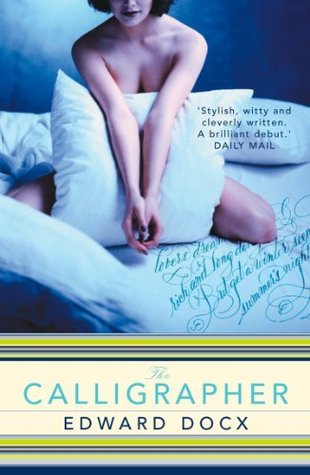
A gripping story of modern-day love and old-fashioned revenge. He is not quite as clever as he thinks he is. She is smarter than she seems.
Jasper thinks that he has found the perfect life. A world-class calligrapher and a serial seducer, he is happily transcribing the immortal songs and sonnets of John Donne for his wealthy patron. But when a shameless infidelity catches up with him, things begin to unravel. Worse still, one afternoon the perfect woman turns up beneath his studio window and he realises that he will have to abandon everything to win her.
Brilliantly written, stylish and very funny, ‘The Calligrapher’ is about the difference between men and women, about deception and honesty, and the timeless pursuit of love.
Edward Docx was born in 1972 in the north of England. He grew up in Cheshire and London. After school, he went to Christ’s College, Cambridge, where he read English Literature and was Junior Common Room President.
He began his professional writing career working on the national newspapers. In 2003, his first novel, The Calligrapher, was published to widespread acclaim. It was selected by the San Francisco Chronicle and the San Jose Mercury News as a Best Book of the Year and is now translated into eight languages.
In 2007, his second novel, Pravda (entitled Self Help in the UK), was published; it was long-listed for the Man Booker and went on to win The Geoffrey Faber Prize. In 2003 and then again in 2007, Docx travelled in South America as part of the research for his third novel which is scheduled for 2010.
Edward Docx lives in London. He is a full time writer.
In general I hate the word pretentious--it usually just functions as shorthand for "something I didn't understand". It's an easy cop-out, a way of not-really-getting a book while managing to blame it on the author.
But this book is *hella* pretentious. Prose is stilted, characters are overrealised. Subplots are abandoned in favor of pseudo-profound inner monologues. It just reeks of a coddled, from-private-school-straight-to-top-notch-university yuppie reaching for something grand and deep...and not really succeeding whatsoever.
'But that, I think, is what love is: an knowable risk taken in the darkness during unsettled weather'
Jasper is a modern-day calligrapher working on a commission to reproduce a selection of John Donne's Songs and Sonnets ... but when he meets Madeleine, has this contemporary rake-about-town met his ultimate nemesis?
This is a wonderfully witty, sly, sharp and clever updating of Donne's poetry, reproduced in a novel alive with literary self-consciousness (in a good way). Jasper, our modern-day Don Juan, remains sympathetic, and his voice is vibrant and eloquent, occasionally even lyrical, as he shuttles between hedonism (oysters, wild salmon, Cristal champagne) and contemporary critique (reality TV), between a careless and exuberant sensuality, and obsession with the enigmatic Madeleine.
Docx is an excellent reader of Donne, alive to the complexities of the shifting narrative voice and avoiding all those tired biographical fallacies that so often get attached to poetry, especially love poetry. Instead, the plot models itself on the ambiguities and spaces that exist in Donne's verse, on the contradictions and complications, the forward movements and the reversals, culminating in a revelation that leads us, as Donne so often does, back in circular fashion to the beginning.
So I would say this is one of the best novels I have read about poetry, about Donne, and about the interactions between literature and life: all done with a light touch that disguises an acute understanding. And it's also a love story set in contemporary London which is acute and engaging, always knowing, and lit with both light and darkness. Oh, and it's clever - very clever.
Jei šį romaną būčiau skaičiusi iki kokių 35 metų, man jis gal ir neblogai būtų suskambėjęs.
Bet dabar... Ištiko nemenka kankynė, nes knygoje gvildenamos 29 metų lovelaso problemos nelabai jaudino. Vis laužiau smegenis, kuo čia užsiimti, kad tik nereikėtų versti "Kaligrafo" puslapių. Net romano pabaigoje mandriai užraityti detektyviniai siužeto vingiai nereabilitavo knygos.
Tiesa, pagrindinio veikėjo profesija - kaligrafas ir anglų poeto Džono Dono poezijos intarpai suteikė knygai solidumo.
Taigi, summa summarum - vidutiniškas romanas su žiupsneliu pretenzijų į literatūrinį olimpą.
I like THE CALLIGRAPHER, savoring John Donne's poetry along with Docx's novel. Docx gathered the strains of literary and artistic culture and the libertines who give free rein to sexual and imaginative inclinations. The thirty metaphysical, love poems of Donne in SONGS AND SONNETS as Docx recreates and interprets them, made me appreciate this poet more through the device of forming a chapter for each of the love poems. Docx sets the stage for this pastiche before Chapter 1 opens by telling us the tale of Titivillus the Devil and the medieval scriptorium's monks. The book's chapters themselves can be read without acquaintance with Donne or the Renaissance. The entertaining, contemporary plot depicts the romantic ups and downs of an artist and the helpful concern of his friends. The ending, set at an art exhibition, alludes to the fogginess of Donne's meaning in his metaphysical poems. There, the reader gets an explanation from the poems' calligrapher that rivals listening to a precocious grad in an English seminar. Poetry as a genre tends towards obscurity, and this romping novel reinvigorates the four-hundred-year-old SONGS AND SONNETS with meaning to moderns, as if Donne is mirrored in contemporary lives of this twentieth-first century.
I'm surprised more people don't enjoy this book. I've loaned it to a few of my friends who were nonplussed. However, my husband and I thought it was absolutely marvelous. It's a recommendation from Book Lust II from the section entitled "Dick Lit"- the male version of chick lit. Anyways I loved this book so much I wanted to reread it again as soon as I finished. The plot itself is your average cliqued romantic comedy...but the writing is simply divine. I would describe it as a "delicious" book. This isn't the best paragraph, by any means, but it was one of my favorites so I'll leave you with a sample:
"When it comes to drinking I'm a commitment kind of guy. Cocaine, Ecstacy, weed, even cigarettes- I can take them or leave them- a few one-night stands here or there, a fling, an affair, a dalliance ...nothing serious. But with drinking it is love: it's for richer , for poorer, in sickness and in health, till death do us part. And a guy who starts out with a Talisker followed by a Moscow Mule may have been around the block a few times, but at least he knows the first kiss still matters."
Beautifully written. Self-consciously so. Much of this book reads like the author's exercise in using lovely words to form scintillating descriptions of...things, and scenery, and philosophy. But the core of the book turned me off. The protagonist and his love are both--I could use lovely words here, but why bother? they're both jerks. I didn't care if the romance worked out. There's a "twist" at the ending that shouldn't have surprised anyone, least of all the protagonist. It's one of those books where any mystery in the plot hinges on every character knowing every other character. As though there are only six people in all of London. I did want to know more about the grandmother. Mr. Docx, if you write a book about her, the piercingly intelligent 78-year-old keeper of documents, I will gladly read it. But these young folks are tiresome.
there is a certain kind of book that, when you are done, you hug it and want to immediately start reading it again and you want to buy copies for all your friends and you feel sort of bad for people who haven't read it yet. this is one of those books. go read this book right now and see what this author does with language. the words become textures and you want to say them out loud.
he eats words for breakfast... and poops out foie gras.
____
i'm only on page 204, but so far this book is gorgeous. i adore the language.
"Summer and winter are the world's new superpowers, oppressing spring and autumn and running them as miniature puppet states."
I like calligraphy and this book caught my eye In my local library discard bin so thought I would give it a try. I was pleasantly suprised at the this new writers language and prose although he used recalcitrant a few too many times for my liking, and I guessed the ending. It was entertaining and informative read. Looking forward to more from this author.
This is a great undiscovered novel! That I highly recommend. It is the story of a lovable young philanderer Jasper in modern London. He is handsome, intelligent, talented and completely ruthless when it comes to his dealings with women. However, he meets his match in the gorgeous mysterious Madeline. This is a love story, a mystery and a beautifully wrought literary novel. Jasper is a professional calligrapher currently commissioned to do a series of John Donnes Songs and Sonnets. The book intelligently compares and contrasts the lives of the poet and the calligrapher for a witty, ironic effect.
Along the way, one learns the biography of Donne, the history of the art of calligraphy, and much about the the culture of modern day London. A special treat in the book (and why it is used in college classrooms) are the expertly interwoven explications of Donne's poetry. Lit Crit in gold foil papers.
The book has wonderful eccentric characters and an amazingly constructed plot, which is sure to suprise and delight all readers. It will catch you off guard when you least expect it.
What a fun read. Depicts the life of Jasper, a Londoner who is quite the lady's man and in the opening portion of the novel is depicted as cheating on his long term girlfriend Lucy with a quick fling, thus ending that relationship. Jasper is the calligrapher of the title and there is an element of prologue that depicts how he came about this unusual career. His most recent custom order is the reproduction of a series of poems by John Donne and this provides a backdrop to the central plot which is the new relationship Jasper takes up with a recently acquired neighbor, Madeline. I personally found portions of the novel dedicted to reciting of the poems a bit strained but others might like this addtion of the novel. There is great rapport between Jasper and his buddy William, as well as his local convenience store owner Roy which is witty and humorous, full of fun dialogue. This is contrasted with the details of the relationship Jasper pursues with Madeline which superficially appears to be nothing out of the ordinary but eventually reveals itself as something quite different. All is ultimately revealed by the novel's end in a satisfactory manner, if not mildly unsettling.
Wasn't that impressed, really. It seemed padded, and this may have been its biggest problem. Although the author's voice was fluent and his descriptions had the ring of honesty that zips you right into the narrator's nervous system, many of the scenes dragged because they seemed to have little purpose. Everyday life, holidays and so on just went on too long without a pulse of development - even a tiny one. This meant I started to find the constant references to Donne poems were a contrived gimmick, instead of illuminating (excuse the pun). And of course I felt the most punchy writing was in the economical lines of the poems. Granted, it's a tall order to try to best John Donne, but a pacier story would have stood up better. I won't give the end away in case you're curious to read it, but I will say that the twist in the last paragraph really irritated me. It was hard to believe and looked as though it had been put in either because an editor wanted a flashy ending or because the author edited the book in two different moods. But I'm curious to check out the author's other work. So I guess he can't have offended me too much...
This was an unusual novel. I suppose it's a romance but it was far deeper and darker than romances usually are. The main character (Jasper) was a calligrapher and during the book he was being paid to create a set of John Donne's poems. Edward Docx used the poetry to explore some of the aspects of Jasper's attitudes to women and love or to comment on the story line. But Docx balanced this with humour so it didn't get too heavy. I liked the writing style too. This was one of my favourite sentences in the book about a night club:'Situated in a fashionably dismal Soho back-alley it is silted up most days of the week with the detritus of humanity - fabulously talentless men and women who ooze and slime through the half-light in a ceasless search for the dwindling plankton of each other's personalities.'If you think that's amusing you'll enjoy the author's writing style. If you think its an annoying wordy way of saying something quite straight-forward you'll proably want to read something else.
Having read Pravda before his debut, I decided I needed to see where this brilliant man started.
I've learned a few things: 1. Edward Docx must be working through issues with monogamy. 2. Humor mixed with beautiful language gets me hot. 3. Docx is a genius. 4. I relate more than I want to with almost every character in this book.
Honestly, I can't do this book justice with my words, so here are a few of his:
"He does not believe in God or mankind, but he visits churches whenever he is abroad and runs a music charity for tramps."
"So most evenings I sit alone in the mess of my new flat, reading self-esteem manuals and staring tearfully into the middle distance with a bottle of wine listening to 'All By Myself'."
"...and an attempt at a bilingual game of pornographic forfeit Scrabble, which I very happily lost."
I was disappointed with novel this in comparison to Pravda because I found the characters or the plot tedious. I'm just not that into self-absorbed, pseudo-intellectual English men and painfully constructed "I see dead people" plot twists.
No question Docx is a great writer. However, as far as I was concerned he may as well been describing laundry day--and describing it beautifully. I could find funny, curious scatological and even sexy things about my laundry enough to entertain me and to make me think about something in a new way. If I'm not paying attention, my beautifully described laundry can stun me when whites turn pink and even pleasantly surprise me when I remove a stain. Even so, I just want the permanent press cycle to finish and to get on with my life. Unfortunately, that is what I felt about the Calligrapher.
An unexpectedly quick read. This book definitely won`t appeal to everyone. The main character is kind of a self-centered jerk, the female lead is obviously toying with him in an equally self-centered way, and we know from the promo blurb that the end is just going to hurt for our lead, Jasper. If the prose/characters hadn`t been so interesting, waiting for the other shoe to drop could have been excruciating.
I`m a little dissatisfied with how quick the ending was, but this will probably be one of the paperbacks I end up holding on to. Worth a shot to see if it resonates with you. If not, don`t worry about finishing it.
Clever, well-written, and fun to read. Jasper Jackson is the calligrapher, working on a sequence of thirty love poems by John Donne for a wealthy client. Jasper is also a jerk, though from his point of view, he's just someone who loves women. The book begins with him cheating on his long-time girlfriend Lucy, then getting caught and dumped. The rest of the book is the story of his comeuppance. Docx plays around a lot with language and the Donne poems; some readers will find the language excessive, and in places, the sentence were simply overwrought. I personally am not a Donne fan, so I probably missed the subtleties of the book, but it was nice to read something literary and literate.
Worth the read, but not as good as I'd hoped. Frankly, I expected it to be sexier. And I guessed the surprise ending pretty early on, and it's an awful lot to ask your readers to swallow. And the foreshadowing frustrated me--since he'd already told me it was going to go so badly wrong, I felt like I wanted him to just hurry up and get there already so I could stop anticipating. On the other hand, there are some fantastic passages, especially the really caustic send-ups of London stereotypes, and I enjoyed the literary analysis aspect, being a former English major.
I bought this book randomly at a bargain book sale in Downtown LA. It cost me about 10 cents, and I'd never heard of it before, so I wasn't really sure what to expect. Though I found myself engaged in the book, I didn't really find any of the characters likable. But as I kept reading, I found myself interested in what happened to them and at times rooting for them, despite my inability to relate to any of them. But overall, interesting story and a good read.
I heard from some other members of my book group that this book had a "twist" at the end. I found the twist completely predictable. I really love the idea of using a body of poetry as a frame for a story, and I had virtually no knowledge of Donne when I started the book, so I enjoyed that aspect of it. Really, though, it felt a lot like a screenplay for the next hit romantic comedy.
This is one of those books where the plot, setting, and characters all come together to form a story that capitivates you to the end, with it's twists and turns. The inclusion of lines from John Donne is icing on the cake. I've read The Calligrapher more than once -- and enjoy discovering new details each time.
A book about a womanizer with very nice penmanship.
Reviewers loved this book when it came out. They said it was well-written, funny and sexy. My review: boring, not funny, not enough sex. I thought about quitting many many times, and now that I'm done I regret that I made it to the end.
The plot isn't the strongpoint of this novel but it does have some great, observant and funny descriptions of London and Londoners, as other reviewers have noted. I thoroughly enjoyed it and although it wasn't mind-blowing it was entertaining.
Jasper the main character is a both a charmer and a playboy which makes me admire and dismiss him. Its a light read with some romance, some humor and some twists. Some insight into calligraphy and a touch of poetry, cant go wrong with that.
For literary and easy read junkies alike -- follows the love affair of a classically trained calligrapher with John Donne's beautiful poetry and a love story of his own -- this book WILL surprise you.
"The world is full of fuckers and there's nothing we can do."
""Though most of us somehow remember that bullets and car crashes kill in real life,we take the romance myth to heart, we forget to suspend our disbelief."
A clever, funny, insightful book. The main character is hopelessly upper class, trying to live in a middle class world and I changed my mind constantly as to whether I loved or hated him. Completely engrossing.
John Donnes love poems interwoven as threads through marvellous plot of bad boy finding redemption through love and loss. Also felt like an exhilarating study of Donne's poetry (which I find difficult) and Docx as guide and tutor was an added bonus.
excellent reading finally, an "open ending" in the fashion of the last century European cinema. love the way he is selling the unsaleable: poetry in the 21st century for people like me, who barely sit to read fiction, not to mention poetry.