

What do you think?

Легионът на времето
Джак Уйлямсън написва първия си бестселър през 1928 година, а последния (засега) през 1996. Няма грешка в цифрите — той е уникален случай на писател хамелеон, който успява вече близо седем десетилетия да обновява своя стил и концепциите си така, че да надживява конкурентите си от всяко следващо поколение и винаги да е в тон със вкуса на съвременниците си! Според изследователите това е равносилно на истински подвиг, като се има предвид невероятната динамика, която цари на американския литературен пазар. Никак не е случайно, че именно той е създател на широко използваните понятия „андроид“, „тераформиране“ и др.
С тази книга ИК „Офир“ запълва поредната празнина в познанието на българските любители на фантастиката, представяйки им още един почти неизвестен за тях класик на жанра.
Съдържание
Легионът на времето – стр.5
Лунната ера – стр.132
„Непознатият“ Джак Уилямсън – Иван Златарски – стр.211
С тази книга ИК „Офир“ запълва поредната празнина в познанието на българските любители на фантастиката, представяйки им още един почти неизвестен за тях класик на жанра.
Съдържание
Легионът на времето – стр.5
Лунната ера – стр.132
„Непознатият“ Джак Уилямсън – Иван Златарски – стр.211
232 pages, Paperback
First published May 1, 1938
About the author
Jack Williamson
580 books178 followersJohn Stewart Williamson who wrote as Jack Williamson (and occasionally under the pseudonym Will Stewart) was a U.S. writer often referred to as the "Dean of Science Fiction".
Ratings & Reviews
Friends & Following
Create a free account to discover what your friends think of this book!
Community Reviews
Displaying 1 - 30 of 36 reviews

August 18, 2011
"The Legion of Time" consists of two novellas that Jack Williamson wrote in the late 1930s, neither of which have anything to do with his wholly dissimilar Legion of Space novels of that same period. Both of these novellas are written in the wonderfully pulpy prose that often typified Golden Age sci-fi, and both are as colorful, fast moving and action packed as any fan could want. That elusive "sense of wonder" that authors of the era strove for seemed to come naturally for Williamson, and if the style is a bit crude by today's standards and the descriptions a tad fuzzy at times, the author's hypercreative imagination more than compensates.
The first novella in this volume is "The Legion of Time" itself, which first appeared in the May, June and July 1938 issues of "Astounding Science-Fiction," scant months after John W. Campbell, Jr. began his legendary career there as editor. It is in some respects a mind-blowing story, in which we learn that Earth has two very different possible futures. In one, the Eden-like city state of Jonbar will flourish and mankind will thrive and become winged superbeings; in the other, the city of Gyronchi, ruled by the warrior queen Sorainya and the dark priest Glarath, will enslave mankind with the aid of their hybridized half human/half ant soldiers. These two possible Earth futures are thus in a deadly rivalry for fulfillment; a stalemate situation that Sorainya tips toward Gyronchi's favor by going into the past and making an oh-so-subtle alteration. Meanwhile, on the Earth of the present day, physicist Wil McLan puts together a team of deceased Prussian, English and American soldiers from various wars to man his timeship, the Chronion, and fight for the existence of Jonbar. If this capsule description sounds a bit way out, reader, let me just say that it doesn't even begin to do Williamson's tale justice. Time paradox stories usually give me a mild headache, and boy, is this one a doozy; still, Williamson does his best with his talk of temporal geodesics, nodes, hyperspace time continuums, and "conflicting infinitude of possible worlds" to put the conceit over. As I mentioned up top, the story's pace is relentless and the action virtually nonstop, a particular highlight being a daring nighttime raid on Sorainya's castle and its antmen soldiers within. The novella has many memorable touches, one of my favorites being a variation on a burial at sea; here, one of McLan's deceased soldiers (the story has a VERY high body count!) is pushed off the Chronion into "the shimmering gulf of time." The warrior queen herself makes for a wonderful villainess, one who is as likely to seduce a man as pour molten metal down his throat (another memorable touch, indeed!); she is more than a match for the 13 soldier members of McLan's team. As in the Legion of Space books, nearly insuperable odds are met head on by a team of extremely determined and can-do men. On a side note, "The Legion of Time" was the source of the term "Jonbar hinge," which describes any event that serves as a fork in the road of sorts for future history. All in all, great pulpy fun.
And "After World's End," the second novella in the collection, may be even better. This Williamson tale first appeared in the February 1939 issue of "Marvel Science Stories" and introduces us to Barry Horn, the first man to fly into space. Due to the uranium-salts concoction that Barry had been shot up with to protect him from cosmic radiation (don't ask!), he turns into a Rip van Winkle of the spaceways, and awakes in his orbiting ship 1.2 million years in the future! He learns that the Earth and the rest of the civilized galaxy is now at war with Malgarth, a robot that his remote descendant, Bari Horn, had created. With his robot hordes, Malgarth will exterminate mankind, unless Barry and a small group of renegades can locate the Dondara Stone, which supposedly holds the key to Malgarth's Achilles' heel. As for the novella's title, perhaps I am not spoiling things too much by saying that it refers to mother Earth, which Williamson throws into the sun in his story's first 30 pages, Edmond "the World Wrecker" Hamilton style. Malgarth and his hordes are a far, far cry from the peaceful and well-meaning robots of Williamson's classic short story "With Folded Hands" (1947) and novel "The Humanoids" (1949), and go a good bit too far in carrying out their genocidal schemes. This is a thrilling tale with tremendous action and real suspense, not to mention a wholly original alien character, Setsi the rum-guzzling sandbat; a silicon-based creature that beat "Star Trek"'s Horta to the silicic punch by over 25 years. Similar to Williamson's Legion of Space tales, in which a female guardian always protected mankind's superweapon, AKKA, here, mankind's salvation, the Dondara Stone, is guarded by another youngish woman of great pluck. The author, it must be said, is guilty of a few flubs in this story. October 12, 1938 was not a Sunday, but rather a Wednesday. And a ship traveling at half the speed of light (around 90,000 miles/second) would not be capable of traversing Malgarth's billion-mile-diameter radiation zone (or even half that distance) in a matter of minutes; simple math indicates a figure closer to 1 1/2 to three hours! Still, only the most anal-obsessive whackadoodle (yeah, that's me!) would notice gaffs like this, in the midst of the thrills that Williamson dishes out here. These two tales, taken back to back, demonstrate the great storytelling prowess that future Grand Master Williamson commanded even early in his career, and are both highly recommended for all fans of red-blooded, Golden Age sci-fi.
The first novella in this volume is "The Legion of Time" itself, which first appeared in the May, June and July 1938 issues of "Astounding Science-Fiction," scant months after John W. Campbell, Jr. began his legendary career there as editor. It is in some respects a mind-blowing story, in which we learn that Earth has two very different possible futures. In one, the Eden-like city state of Jonbar will flourish and mankind will thrive and become winged superbeings; in the other, the city of Gyronchi, ruled by the warrior queen Sorainya and the dark priest Glarath, will enslave mankind with the aid of their hybridized half human/half ant soldiers. These two possible Earth futures are thus in a deadly rivalry for fulfillment; a stalemate situation that Sorainya tips toward Gyronchi's favor by going into the past and making an oh-so-subtle alteration. Meanwhile, on the Earth of the present day, physicist Wil McLan puts together a team of deceased Prussian, English and American soldiers from various wars to man his timeship, the Chronion, and fight for the existence of Jonbar. If this capsule description sounds a bit way out, reader, let me just say that it doesn't even begin to do Williamson's tale justice. Time paradox stories usually give me a mild headache, and boy, is this one a doozy; still, Williamson does his best with his talk of temporal geodesics, nodes, hyperspace time continuums, and "conflicting infinitude of possible worlds" to put the conceit over. As I mentioned up top, the story's pace is relentless and the action virtually nonstop, a particular highlight being a daring nighttime raid on Sorainya's castle and its antmen soldiers within. The novella has many memorable touches, one of my favorites being a variation on a burial at sea; here, one of McLan's deceased soldiers (the story has a VERY high body count!) is pushed off the Chronion into "the shimmering gulf of time." The warrior queen herself makes for a wonderful villainess, one who is as likely to seduce a man as pour molten metal down his throat (another memorable touch, indeed!); she is more than a match for the 13 soldier members of McLan's team. As in the Legion of Space books, nearly insuperable odds are met head on by a team of extremely determined and can-do men. On a side note, "The Legion of Time" was the source of the term "Jonbar hinge," which describes any event that serves as a fork in the road of sorts for future history. All in all, great pulpy fun.
And "After World's End," the second novella in the collection, may be even better. This Williamson tale first appeared in the February 1939 issue of "Marvel Science Stories" and introduces us to Barry Horn, the first man to fly into space. Due to the uranium-salts concoction that Barry had been shot up with to protect him from cosmic radiation (don't ask!), he turns into a Rip van Winkle of the spaceways, and awakes in his orbiting ship 1.2 million years in the future! He learns that the Earth and the rest of the civilized galaxy is now at war with Malgarth, a robot that his remote descendant, Bari Horn, had created. With his robot hordes, Malgarth will exterminate mankind, unless Barry and a small group of renegades can locate the Dondara Stone, which supposedly holds the key to Malgarth's Achilles' heel. As for the novella's title, perhaps I am not spoiling things too much by saying that it refers to mother Earth, which Williamson throws into the sun in his story's first 30 pages, Edmond "the World Wrecker" Hamilton style. Malgarth and his hordes are a far, far cry from the peaceful and well-meaning robots of Williamson's classic short story "With Folded Hands" (1947) and novel "The Humanoids" (1949), and go a good bit too far in carrying out their genocidal schemes. This is a thrilling tale with tremendous action and real suspense, not to mention a wholly original alien character, Setsi the rum-guzzling sandbat; a silicon-based creature that beat "Star Trek"'s Horta to the silicic punch by over 25 years. Similar to Williamson's Legion of Space tales, in which a female guardian always protected mankind's superweapon, AKKA, here, mankind's salvation, the Dondara Stone, is guarded by another youngish woman of great pluck. The author, it must be said, is guilty of a few flubs in this story. October 12, 1938 was not a Sunday, but rather a Wednesday. And a ship traveling at half the speed of light (around 90,000 miles/second) would not be capable of traversing Malgarth's billion-mile-diameter radiation zone (or even half that distance) in a matter of minutes; simple math indicates a figure closer to 1 1/2 to three hours! Still, only the most anal-obsessive whackadoodle (yeah, that's me!) would notice gaffs like this, in the midst of the thrills that Williamson dishes out here. These two tales, taken back to back, demonstrate the great storytelling prowess that future Grand Master Williamson commanded even early in his career, and are both highly recommended for all fans of red-blooded, Golden Age sci-fi.

April 20, 2014
Denny Lanning and his Harvard roommates end up meeting again later in life, rescued at the moments of their death and traveling through time with eight other warriors recruited the same way. Their goal is a battle to decide the cosmic probability in favor of Jonbar, a utopia with (of course) a beautiful woman who visits Denny at points in his life and warns him. The villain is an evil woman (still beautiful) who wants to be immortal in the other probability option. She commands an army of insectoid warriors.
This book was first published as a serial in 1938, and this was the first science fiction concept of a crucial decision point in time travel novels - lookup the Jonbar Hinge on wikipedia. It is well done here, especially since the utopian outcome derives from a scientific mind that is starved of science in the other choice. The scenes of rescued warriors are also well done, even though each is mostly a caricature of their times - incidentally, this concept led to a time traveling role playing game called Timemaster.
After the legion is gathered, they gather information and fight skirmishes against the insects and their evil queen. Once they find out what they need (and where it is located), they stage an all out assault on the queen's palace, dying off one by one in a quest to reach the sacred object. These battle scenes are less well written and harder to follow. The final confrontation also feels a bit rushed. I'm wondering if the author jammed it all into one last episode for other reasons.
Gender bias as one would expect from a story written in 1938; characters are mostly flat though Denny and roommate physicist Wil McLan both grow some. A fairly quick read. Perhaps the story was reworked before being published standalone in 1952; it needed a bit more.
This book was first published as a serial in 1938, and this was the first science fiction concept of a crucial decision point in time travel novels - lookup the Jonbar Hinge on wikipedia. It is well done here, especially since the utopian outcome derives from a scientific mind that is starved of science in the other choice. The scenes of rescued warriors are also well done, even though each is mostly a caricature of their times - incidentally, this concept led to a time traveling role playing game called Timemaster.
After the legion is gathered, they gather information and fight skirmishes against the insects and their evil queen. Once they find out what they need (and where it is located), they stage an all out assault on the queen's palace, dying off one by one in a quest to reach the sacred object. These battle scenes are less well written and harder to follow. The final confrontation also feels a bit rushed. I'm wondering if the author jammed it all into one last episode for other reasons.
Gender bias as one would expect from a story written in 1938; characters are mostly flat though Denny and roommate physicist Wil McLan both grow some. A fairly quick read. Perhaps the story was reworked before being published standalone in 1952; it needed a bit more.

May 3, 2014
Another of the Best Novel nominees for the Retro Hugos. It didn't thrill me, I'm afraid. The basic concept is sound, though: Denny Lanning is a college student who's visited by a hologram from the future. This beautiful girl tells him he has to save the future so that her beautiful, perfect city 9Jonbar) can exist instead of the foul, evil city (Gyronchi) that has its own beautiful girl that tries to convince him to go their way. Eventually he's about to die in the Spanish Civil War, and then he gets scooped up by a time ship with the inevitable name "Chronion."
And the rest of the book is made up of action scenes in which this ship full of random guys from across history fights the bad guys until they get to the Ultimate Maguffin: in 1921, will a young boy named John Barr pick up a magnet (setting him on the path of science, eventually leading to the city named after him: Jonbarr) or a pebble (so atomic power gets discovered instead by a Russian named Ivor Gyros).
Then it's all action scenes again. And the two beautiful women end up being the same person. It sounds exciting, but the action scenes struck me as fairly tedious after a while.
And the rest of the book is made up of action scenes in which this ship full of random guys from across history fights the bad guys until they get to the Ultimate Maguffin: in 1921, will a young boy named John Barr pick up a magnet (setting him on the path of science, eventually leading to the city named after him: Jonbarr) or a pebble (so atomic power gets discovered instead by a Russian named Ivor Gyros).
Then it's all action scenes again. And the two beautiful women end up being the same person. It sounds exciting, but the action scenes struck me as fairly tedious after a while.

February 14, 2013
Fun short novel about a regular Joe whose fate will determine whether the future will be a Utopia, or a dead world ruled by an evil queen. Very pulp, written in the late 30s. I still have to read After Worlds End, the "second half" of the book. Jack Williamson is one of my favorites of the old school science fiction writers.

February 12, 2018
A great early classic of science fiction by the great Jack Williamson.

August 1, 2020
YOUNG MEN! ALLURING WOMEN FROM THE FUTURE WANT YOU TO FULFILL YOUR DESTINY! BE PREPARED FOR A MIRACULOUS APPEARANCE NEAR YOU SOON!
DON’T MISS YOUR CHANCE TO ENLIST!
This volume contains two short tales of adventure, vintage 1938. One set in the far future, the other is a battle to save the future.
Legion of time
In April 1927 college senior Denny Lanning is presented with his first opportunity to save the future. A young woman holding a strangely glowing orb appears before him in his room. He’s startled not only by her beauty but also because she appears out of thin air. She pleads with him to save her world, and warns him to beware of “Sorainya, the woman of war. She is the evil flower of Gyronci. And she must be destroyed.”
Not long after graduation Lanning is in mid-ocean on his way to an assignment as a reporter. As he’s taking a stroll on deck Sorainya herself appears floating in the air in a golden shell, “a warrior queen in a gleaming crimson tunic of woven mail that swelled with her womanly curves.” She calls his name and tempts him to sign up for her side with promises of half her empire as well as herself. All that’s required is to join her on the floating shell. Although tempted, before Denny jumps, he realizes that she and her vessel are just insubstantial projections and that a shark is circling in the sea below.
A decade after his first encounter with these mysterious women, Denny is in a Chinese aircraft battling the Japanese, when he’s shot down and mortally wounded. He’s plunging to his death when he’s suddenly rescued by a mysterious craft, a time ship, that hauls him aboard, heals him, and an old friend recruits him to save humanity from utter destruction.
After World's End
Mourning the recent death of his wife Dona Carrigan, adventurer and explorer Barry Horn is at loose ends when he’s given an unusual opportunity by an eccentric millionaire scientist. At his own expense, the scientist has built a rocket to explore the planet Venus, and he needs someone to fly it there. He needs a rocketeer to pilot the Astronaut, as he’s named his spacecraft. Barry is unsure about undertaking this risky venture, but then a woman in a crystal casket appears before him in a vision and urges him to go. She looks very much like his dead wife. He takes off, clears the Earth’s atmosphere successfully, but things go horribly wrong on the way to Venus and the Astronaut becomes a comet that orbits the Sun for a million years. And Barry Horn survives. Not only survives but reawakes to find a galaxy filled with humans about to be exterminated by evil robots, robots ruled by Malgarth a giant robot with an artificial brain created by an inventor named Bari Horn.
“You are Malgarth.” His voice came quick and husky, “You are the first technomaton. I am the maker of your body and your brain. I fashioned you to be a servant of mankind.”
A great brazen voice thundered abruptly from the relentless machine.
“But why should I serve you Bari Horn? For my body is strong metal, and yours a lump of water jelly. My eternal brain is far superior to your primitive nerve-centers. I am not bound to obey, for it was not by my will that I was made!”
Barry Horn awakes to become known as Barrihorn a conflation of himself and the inventor of Malgarth, and an accomplice of Kel Arran, the notorious Falcon of Earth, in a desperate fight to save humans from the powers of the Galactic Empire—a mere puppet of the dastardly Robot Corporation headed by Malgarth!
They don’t write ‘em like these anymore. The good guys are all good and the bad guys are all worse than bad. These Grand Space Operas with mystic motifs move through time and space at faster than light speed at multiple exclamation marks per page!
DON’T MISS YOUR CHANCE TO ENLIST!
This volume contains two short tales of adventure, vintage 1938. One set in the far future, the other is a battle to save the future.
Legion of time
In April 1927 college senior Denny Lanning is presented with his first opportunity to save the future. A young woman holding a strangely glowing orb appears before him in his room. He’s startled not only by her beauty but also because she appears out of thin air. She pleads with him to save her world, and warns him to beware of “Sorainya, the woman of war. She is the evil flower of Gyronci. And she must be destroyed.”
Not long after graduation Lanning is in mid-ocean on his way to an assignment as a reporter. As he’s taking a stroll on deck Sorainya herself appears floating in the air in a golden shell, “a warrior queen in a gleaming crimson tunic of woven mail that swelled with her womanly curves.” She calls his name and tempts him to sign up for her side with promises of half her empire as well as herself. All that’s required is to join her on the floating shell. Although tempted, before Denny jumps, he realizes that she and her vessel are just insubstantial projections and that a shark is circling in the sea below.
A decade after his first encounter with these mysterious women, Denny is in a Chinese aircraft battling the Japanese, when he’s shot down and mortally wounded. He’s plunging to his death when he’s suddenly rescued by a mysterious craft, a time ship, that hauls him aboard, heals him, and an old friend recruits him to save humanity from utter destruction.
After World's End
Mourning the recent death of his wife Dona Carrigan, adventurer and explorer Barry Horn is at loose ends when he’s given an unusual opportunity by an eccentric millionaire scientist. At his own expense, the scientist has built a rocket to explore the planet Venus, and he needs someone to fly it there. He needs a rocketeer to pilot the Astronaut, as he’s named his spacecraft. Barry is unsure about undertaking this risky venture, but then a woman in a crystal casket appears before him in a vision and urges him to go. She looks very much like his dead wife. He takes off, clears the Earth’s atmosphere successfully, but things go horribly wrong on the way to Venus and the Astronaut becomes a comet that orbits the Sun for a million years. And Barry Horn survives. Not only survives but reawakes to find a galaxy filled with humans about to be exterminated by evil robots, robots ruled by Malgarth a giant robot with an artificial brain created by an inventor named Bari Horn.
“You are Malgarth.” His voice came quick and husky, “You are the first technomaton. I am the maker of your body and your brain. I fashioned you to be a servant of mankind.”
A great brazen voice thundered abruptly from the relentless machine.
“But why should I serve you Bari Horn? For my body is strong metal, and yours a lump of water jelly. My eternal brain is far superior to your primitive nerve-centers. I am not bound to obey, for it was not by my will that I was made!”
Barry Horn awakes to become known as Barrihorn a conflation of himself and the inventor of Malgarth, and an accomplice of Kel Arran, the notorious Falcon of Earth, in a desperate fight to save humans from the powers of the Galactic Empire—a mere puppet of the dastardly Robot Corporation headed by Malgarth!
They don’t write ‘em like these anymore. The good guys are all good and the bad guys are all worse than bad. These Grand Space Operas with mystic motifs move through time and space at faster than light speed at multiple exclamation marks per page!

May 9, 2014
This book is really fun. It has time travel, genetically engineered and people, sword fighting, damsels in distress, basically everything a good action adventure needs.
I love the idea that the future and the fate of the human race can hinge on one small, seemingly insignificant event, that the flow of time can turn heroes into villains and villains into heroes based on different circumstances. I love that the average Joe can become a hero by affecting small and simple things, provided it is at the right time and place.
This book does have some of the inherent problems that seem to exist in all time travel stories. The paradoxes didn't quite make sense to me and I didn't feel like they were fully handled. But, it's a fun story and definitely worth reading.
I love the idea that the future and the fate of the human race can hinge on one small, seemingly insignificant event, that the flow of time can turn heroes into villains and villains into heroes based on different circumstances. I love that the average Joe can become a hero by affecting small and simple things, provided it is at the right time and place.
This book does have some of the inherent problems that seem to exist in all time travel stories. The paradoxes didn't quite make sense to me and I didn't feel like they were fully handled. But, it's a fun story and definitely worth reading.

August 2, 2010
University student Denny Lanning is startled out of his daily round by the appearance before him of a beautiful young woman, Lethonee -- or, at least, a projection thereof -- who pleads with him that he in some ill defined way preserve the existence of her far-future civilization, Jonbar, rather than that of the wicked tyrannical warrior queen Sorainya. Denny promises to do his best, although his resolve falters when he encounters Sorainya (again in projection), whose crimson chainmail garb cannot fully disguise her "womanly curves"; his lust cools when he realizes she's trying to get him eaten by a shark.
Years pass, and in due course Denny, fighting against the Japanese in China, gets killed . . . only to be revived aboard the the timeship, the Chronion, that has been built by his old college buddy and genius physicist Wil McLan. But how McLan has changed! He fell for Sorainya's lures and spent a decade in her torture chambers; now he is a broken old man, although the spirit within him still burns bright. A figure vaguely reminiscent of Verne's Robur the Conqueror, McLan is mustering a sort of temporal Dirty Dozen to fight against Sorainya and her vile minions such that her reality never comes into existence, but Lethonee's does. The men he gathers, each snatched out of their timestream in the moments before death (I wonder if this is where John Varley got the idea for his 1977 story "Air Raid"?) are all from the early decades of the 20th century and all white, but they do display the kind of classy dialogue that literary novelists use to subtly indicate different ethnic origins:
"Gott im Himmel!" rumbled Emil Schorn at his side. "Der thing we must recover is in that castle, nein? It looks a verdammt stubborn nut to crack!" (pp102-3)
or
"My word!" gasped the British flyer, Courtney-Pharr. "When we meet that she-devil, she'll account for all this. Rather!" (p108)
or even
The little cockney, Duffy Clark, came presently with a covered tray.
"Cap'n McLan?" he drawled. "Why, 'e's lookin' inter 'is bloomin' gadgets, tryin' to find where that she-devil and 'er blarsted hants got 'old of that magnet."
"Any luck?" demanded Lanning.
"Not yet, sor." He shook a tousled head. "Wot with hall spayce and time to search for the spot. And the woman an' her blarsted 'igh priest is arfter us, sor, in a black ship full of the bloomin' hants!" (p134)
The speech of this chrononautical Dick Van Dyke is effin' slow and difficult to type, as I've just been discovering. This may be why he plays a fairly minor role in subsequent proceedings; and, when he does appear, retains a certain sprightly cockney taciturnity, the bleeder.
There's lots of derring-do as our heroes battle Sorainya's troops, who are giant gun-wielding ants. Matters aren't made easier by the fact that McLan's own early experiments with time had, as a by-product, the effect of increasing the probability of Sorainya's world's existence. In between all the fighting, it emerges that the crucial fork in time, the nexus determining whether Lethonee's or Sorainya's future would be reified, is when a boy in the Ozarks in 1921, John Barr, is wandering home one evening and picks up either a magnet or a pebble he spots lying by the way: if it's the magnet, it'll spark off an interest in science that in due course will affect the course of world events such that, centuries down the line, Jonbar will emerge. Sorainya's rotten lot, naturally, want him to pick up the pebble, so they filch the magnet. Can the Legion get it back in place before the boy reaches it? You bet they can.
There's quite a lot of differently good writing in this book, like
Lanning never laughed at superstition -- few fliers do. But his lean face smiled in the darkness. (p38)
and
"Please forgive my voice, Denny," his hoarse whisper came at last. "But once in the dungeon, when I was nearly dead with thirst and begging for anything to drink, Sorainya had molten metal poured down my throat." (p56)
and
"They found us on the ledge," breathed the voiceless man. (p131)
but there's also a lot that's very appealing, not just the central conceit, which was highly original in its day, of future realities warring to be reified. Here, for example, is Lethonee's explanation of the nature of time:
"The world is a long corridor, from the beginning of existence to the end. Events are groups in a sculptured frieze that runs endlessly along the walls. And time is a lantern carried steadily through the hall, to illuminate the groups one by one. It is the light of awareness, the subjective reality of consciousness.
"Again and again the corridor branches, for it is the museum of all that is possible. The bearer of the lantern may take one turning, or another. And always, many halls that might have been illuminated with reality are left forever in the dark." [. . .:]
"You, Denny Lanning," she went on, "are destined, for a little time, to carry the lantern." (pp25-6)
Less evocative but conceptually perhaps more interesting is this bit of infodumping from McLan:
"There is a law of sequence and progression, I found at last, operating along a fifth rather than the temporal dimension, which imposes inexorable limits. It is that progression which actually creates reality out of possibility. And it is that higher law which prohibits all the trite absurdities met with in the old speculation about travel in time, such as the adventurer in time who returns to kill himself. The familiar logic of cause and effect is not abolished, but simply advanced to a higher dimension." (p65)
Literature The Legion of Time ain't, and I confess that all the action sequences are a bit of a homogenous blur in my memory already, but it's an astonishingly fast read and in places plenty of fun.

August 28, 2023
This book was a big 'what the hell?' I will ... attempt to review this in any meaningful way, while keeping in mind I stopped around a third of the way in (yet I still feel like I could fill a couple theses w/what I did read).
So, sure, as the cover implies, there's a machine that travels through time and there's a group of soldiers from different countries/eras thrown together in it. BUT they're not the focus (for the first third, at least)! The main focus is the lead character, named Dennis (perfectly fine) but called Denny (weird, to my ears). As soon as he starts reading a book by his friend with a very inocuous title (it was like ... Reality and Things) that talks about time travel, BAM, this beautiful woman appears from a city he's never heard of. She begs for his help, and he's like, 'you're hot so it sounds good.' She then gives him advice that saves his life for the first time. She also warns him against another woman, who runs a different city and is evil.
Soon thereafter, Denny is visited by a vision of the woman he was warned about. She's obviously evil, but he's like, 'eh, maybe?' Then later he's grabbed by the time traveling ship, and his friend who's the captain reveals she's kept him as a POW for a decade, torturing him the entire time. Denny is STILL TORN about which woman he should choose to side with. I can't tell if this is horrible sexism of its time, or a clever play on how blind men are when women are hot.
Anyway, I was like, I think I've gotten all I can out of this, and decided to drop it.
So, sure, as the cover implies, there's a machine that travels through time and there's a group of soldiers from different countries/eras thrown together in it. BUT they're not the focus (for the first third, at least)! The main focus is the lead character, named Dennis (perfectly fine) but called Denny (weird, to my ears). As soon as he starts reading a book by his friend with a very inocuous title (it was like ... Reality and Things) that talks about time travel, BAM, this beautiful woman appears from a city he's never heard of. She begs for his help, and he's like, 'you're hot so it sounds good.' She then gives him advice that saves his life for the first time. She also warns him against another woman, who runs a different city and is evil.
Soon thereafter, Denny is visited by a vision of the woman he was warned about. She's obviously evil, but he's like, 'eh, maybe?' Then later he's grabbed by the time traveling ship, and his friend who's the captain reveals she's kept him as a POW for a decade, torturing him the entire time. Denny is STILL TORN about which woman he should choose to side with. I can't tell if this is horrible sexism of its time, or a clever play on how blind men are when women are hot.
Anyway, I was like, I think I've gotten all I can out of this, and decided to drop it.

July 21, 2022
Типичный образец "бульварной" фантастики начала того периода, который англоязычные литературоведы несколько самохвально назвали "золотым веком" фантастики. С моей точки зрения - эта короткая повесть - никаким "романом" тут и не пахнет - слишком наполнена подростковыми штампами, чтобы быть интересна скольно-нибудь взрослому читателю. Бал добавлю за то, что вроде бы это первое произведение, в котором показана "война времени", то есть противостояние происходит как в настоящем, так и в прошлом и будущем, куда перемещаются герои. Поскольку я прочитал "Легион времени" в рамках моего личного литературоведческого проекта по прочтению всех книг из списка 100 Must-read Science Fiction Novels, то замечу, что "Легион времени" - один из кандидатов на выбывание, поскольку по стилю и настроению очень похожа на "Принцессу Марса" Берроуза из этого же списка.
November 29, 2025
(3.5 Stars)
A group of pre-WWII college boys discover time travel and try to tilt the future towards their desired path.
The fight scenes in this book were pretty weak (why is a bayonet so much more destructive than a machine gun?), but a lot of the rest of it was great. I don't know what time travel science fiction had been written before this, but a lot of classic tropes are present. I also appreciated that this book moved. We didn't spend a ton of time building characters or scenes, but those weren't the focus here. One other complaint is that a chunk of the plot revolves around men not being able to kill a woman, which went from uncomfortable to frustratingly childish. One of the characters had been a former lover of hers (ish, anyway), and him not being able to do it made sense. But another character was all ready to do so until... he looked at her pretty face? I dunno.
Anyway, I quite liked this.
A group of pre-WWII college boys discover time travel and try to tilt the future towards their desired path.
The fight scenes in this book were pretty weak (why is a bayonet so much more destructive than a machine gun?), but a lot of the rest of it was great. I don't know what time travel science fiction had been written before this, but a lot of classic tropes are present. I also appreciated that this book moved. We didn't spend a ton of time building characters or scenes, but those weren't the focus here. One other complaint is that a chunk of the plot revolves around men not being able to kill a woman, which went from uncomfortable to frustratingly childish. One of the characters had been a former lover of hers (ish, anyway), and him not being able to do it made sense. But another character was all ready to do so until... he looked at her pretty face? I dunno.
Anyway, I quite liked this.
This entire review has been hidden because of spoilers.
July 24, 2022
This book contains two short novels, the titular title and After World's End. Both are really science fantasy, or scientific romances, rather than science fiction. In The Legion of Time, the hero and his friends must control the geodesics of time to allow a Utopia to be born rather than a cruel empire of evil. Anticipates John Varley's novel Millennium in some ways as the members of the legion are snatched at the moment of their deaths. After World's End is unabashed space opera with little attempt at plausibility--Earth is cast into the sun, travel across the universe occurs with little effort, and the invincible robot villain is not so invincible. Both are still fun reads if you are in the right frame of mind.
Read
July 22, 2023(SPOILER ALERT)
This book contains two novellas, "The Legion of Time" and "At World's End". Both are sort of Merritt/ERB craziness, though both wildly imaginative and especially the latter getting into some deeply weird stuff. The latter really doesn't have enough time to develop its man vs. robot theme or pay enough time with.. you know.. destruction of Earth and stuff. Interestingly it seems like some of these concepts were held on to for the much more evolved and relatively more developed Legion of Space.
These are solid, weird, pulpy fun, but don't come looking for his best work. They're more like a hint of what's to come and some fun ideas.
This book contains two novellas, "The Legion of Time" and "At World's End". Both are sort of Merritt/ERB craziness, though both wildly imaginative and especially the latter getting into some deeply weird stuff. The latter really doesn't have enough time to develop its man vs. robot theme or pay enough time with.. you know.. destruction of Earth and stuff. Interestingly it seems like some of these concepts were held on to for the much more evolved and relatively more developed Legion of Space.
These are solid, weird, pulpy fun, but don't come looking for his best work. They're more like a hint of what's to come and some fun ideas.

August 1, 2023
Un début magnifique, à la Abraham Merritt, avec l'apparition de deux déesses, l'une du Bien, l'autre du Mal, qui auraient pu faire une couverture de Margaret Brundage. Elles représentent deux probabilités de futur antagonistes. Au point de divergence, un objet parfaitement banal qui doit être là en lieu et date exactes pour que le monde du Bien ait des chances d'exister. Une chute géniale. Entre les deux, beaucoup, beaucoup de bagarres avec un côté "lizard-men from Pluto" qui était la marque de l'Astounding d'avant Campbell. Jack Williamson et Legion of Time est justement la première grosse prise de Campbell éditeur et a contribué à changer la tonalité de la revue.

May 1, 2025
Those old-time pulp writers knew how to quickly draw you into a story. The trouble is, there's then a stream of plot and ideas and not much depth of character. Three years after this first appeared (1938), Williamson wrote "Backlash", a story with a similar theme that is a lot tighter and considerably richer.
(Spoiler warning: if you're going to read "Backlash" in the August 1941 issue of Astounding Science Fiction, do not read the editor's summary of the story on the contents page.)
(Spoiler warning: if you're going to read "Backlash" in the August 1941 issue of Astounding Science Fiction, do not read the editor's summary of the story on the contents page.)

July 20, 2019
This book is really a collection of two separate and unlinked novellas. The first is The Legion of Space and deserves a solid 4 star with maybe another half of one. The second, After World's End is not as strong and is much more dated, but due to a strong finish probably deserves a high 3, possibly 4 stars. I'm glad that I read them because they showed me how brightly Williamson's star was shining in science fiction's early days. Williamson's imagination was phenomenal.
July 16, 2025
I liked this a lot better when I first read it, some 50 year ago. I admit to skim reading the last half of the book this time.
Two future civilizations with time travel battle for existence as a single incident decided which one will exist, and the other will never have been.
One is good, a great future for mankind. The other is evil, ruled ruthlessly by an evil Queen and her murderous ant men, and the result is all down to one man and his small group of fighters.
Two future civilizations with time travel battle for existence as a single incident decided which one will exist, and the other will never have been.
One is good, a great future for mankind. The other is evil, ruled ruthlessly by an evil Queen and her murderous ant men, and the result is all down to one man and his small group of fighters.

October 2, 2020
Gets the 3rd star for significance in sf genre history, as an early example of a “time war” story like “The Big Time” or”This is How You Lose the Time War”. The jargon term “jonbar point” sometimes used in discussing time travel stories is a reference to this story. Otherwise this is a silly 1930s pulp action/adventure story.
July 15, 2025
I am sorry to give this just three stars, I cannot give it four. I enjoyed reading the two stories - The Legion of Time and After World's End. The writing is of the pulp variety and will not win any National Book Awards but highbrow science fiction was not in vogue in the 1930s with the exception of books by Aldous Huxley. I liked the first story most.

Read
August 6, 2021Pulpy SF from the 'golden age'. Some scientific veneer, but mostly magical time travel to avert a catastrophe. Much of the tale is taken up by epic battles between the Legion and the mutant ogre-like monsters they must fight to save a possible future civilization.
May 30, 2025
The story of a journey into the future to save the future of a woman "too cruel to live" (as the synopsis says). A good novel, but it does drag towards the end.
Want to Read
September 4, 2026Hugo Award Nominee (2014)

September 7, 2019
Fun pulpy adventures from the golden age. Williamson's writing is a cut above most of his peers, but is still pretty formulaic. It's only about 100 pages so he doesn't waste time getting into the action, which is surprisingly bloody and gruesome at times. I needed a breezy read in between longer books and this fit the bill.

June 24, 2023
The latest volume in my epic journey of reading the Science Fiction Grand Masters, The Legion of Time contains two novellas; the titular tale, and After World's End.
I kept thinking I had read the story that makes up The Legion of Time, but I haven't read this book before, that I can see. This story jumps right into things, as Denny Lanning, who share an apartment with Barry Halloran and two other Harvard seniors, receives a sort of holographic visitor, one night, a beautiful woman, with "mahogany-red" hair. Jack Williamson really seems to have loved redheads.
Her name was Lethonee, and she hailed from the city of Jonbar. But she wasn't really there. "It is only in your mind that we meet, through this," she says as she glances down at a large jewel in her hands. Lethonee is attempting to enlist Lanning to join her cause and help her defend her land against another realm, called Gyronchi. Their leader was Sorainya, "the woman of war."
Naturally, Sorainya eventually appears to Denny, in much the same manner, to also enlist him to her cause. The problem is, he would have to die to actually go to either one of them.
And from this point, the tale gets more confusing. Not necessarily in a bad way, because it was quite entertaining. But the story deals with concepts of which I have little knowledge, those of probability and possibility. You see, neither one of those realms actually exists, yet, but it is the probability of them that has allowed their representatives to visit Lanning. And every time something happens in one of the realms, those probabilities change.
At one point, Lanning and his crew wind up having to go back in time to a point and place where a young boy is about to pick up a pebble from a field. They have to take an item back, a large magnetic stone of sorts, and put it back where it belongs (the people of Gyronchi stole it, to erase all probability of Jonbar), so that the little boy will pick up the magnet instead of the pebble.
If you're confused, don't feel bad. If you're not, I am impressed.
The story is written with Williamson's typical wild imagination. And having been written (or copyright, at least) in 1952, it is ages ahead of its time.
The second story, After World's End, is, in my opinion, the better of the two stories. In this tale, a man is found dead in a bungalow, which had been vacant for a week, as its owner had gone out on a lake trip. The man was holding a diamond-like block, a letter (apparently a last will and testament) and a manuscript. the following story was contained in the manuscript. All of this is in a "Foreword."
Barry Horn is enlisted to man a private rocket ship, with which he is supposed to travel to Venus. Unfortunately, he misses an opportunity to correct his course and completely misses Venus. He winds up heading for the Sun, but doesn't plunge into it. Instead, he maintains some kind of strange orbit, where the ship has basically become a comet.
As he is "lost in space," so to speak, he develops a startling sense of intuition, where he can perceive events as they are happening on earth. Time goes by. Eventually a million years. Somehow, miraculously, he is rescued, only to find that there are only a handful of humans left, and he must defend them against a terrible robot that has taken over the universe.
Once we reach that point in the story, it is pretty much action all the way to the end.
Once again, the leading lady in the story is a redhead. I'm amused by this.
But this tale was, in my opinion, the better written of the two. Not any more believable, mind you, as reality takes a back seat in Williamson's tales. Not that that's a bad thing. That's why I read Science Fiction and Fantasy, mind you. But the second story held my interest much better than the first one.
But the ending of both tales was, I would say, very satisfying.
I kept thinking I had read the story that makes up The Legion of Time, but I haven't read this book before, that I can see. This story jumps right into things, as Denny Lanning, who share an apartment with Barry Halloran and two other Harvard seniors, receives a sort of holographic visitor, one night, a beautiful woman, with "mahogany-red" hair. Jack Williamson really seems to have loved redheads.
Her name was Lethonee, and she hailed from the city of Jonbar. But she wasn't really there. "It is only in your mind that we meet, through this," she says as she glances down at a large jewel in her hands. Lethonee is attempting to enlist Lanning to join her cause and help her defend her land against another realm, called Gyronchi. Their leader was Sorainya, "the woman of war."
Naturally, Sorainya eventually appears to Denny, in much the same manner, to also enlist him to her cause. The problem is, he would have to die to actually go to either one of them.
And from this point, the tale gets more confusing. Not necessarily in a bad way, because it was quite entertaining. But the story deals with concepts of which I have little knowledge, those of probability and possibility. You see, neither one of those realms actually exists, yet, but it is the probability of them that has allowed their representatives to visit Lanning. And every time something happens in one of the realms, those probabilities change.
At one point, Lanning and his crew wind up having to go back in time to a point and place where a young boy is about to pick up a pebble from a field. They have to take an item back, a large magnetic stone of sorts, and put it back where it belongs (the people of Gyronchi stole it, to erase all probability of Jonbar), so that the little boy will pick up the magnet instead of the pebble.
If you're confused, don't feel bad. If you're not, I am impressed.
The story is written with Williamson's typical wild imagination. And having been written (or copyright, at least) in 1952, it is ages ahead of its time.
The second story, After World's End, is, in my opinion, the better of the two stories. In this tale, a man is found dead in a bungalow, which had been vacant for a week, as its owner had gone out on a lake trip. The man was holding a diamond-like block, a letter (apparently a last will and testament) and a manuscript. the following story was contained in the manuscript. All of this is in a "Foreword."
Barry Horn is enlisted to man a private rocket ship, with which he is supposed to travel to Venus. Unfortunately, he misses an opportunity to correct his course and completely misses Venus. He winds up heading for the Sun, but doesn't plunge into it. Instead, he maintains some kind of strange orbit, where the ship has basically become a comet.
As he is "lost in space," so to speak, he develops a startling sense of intuition, where he can perceive events as they are happening on earth. Time goes by. Eventually a million years. Somehow, miraculously, he is rescued, only to find that there are only a handful of humans left, and he must defend them against a terrible robot that has taken over the universe.
Once we reach that point in the story, it is pretty much action all the way to the end.
Once again, the leading lady in the story is a redhead. I'm amused by this.
But this tale was, in my opinion, the better written of the two. Not any more believable, mind you, as reality takes a back seat in Williamson's tales. Not that that's a bad thing. That's why I read Science Fiction and Fantasy, mind you. But the second story held my interest much better than the first one.
But the ending of both tales was, I would say, very satisfying.

June 6, 2016
This book contains two unrelated novellas: The Legion of Time, originally published as a serial in the May - July 1938 issues of Astounding and After Worlds End, published in the Feb 1939 issue of Marvel Science Stories. Both are written in typical pulp style with less than believable characters, no character development, and lots of action. If you can't deal with that kind of writing, these stories aren't for you. If you can overlook the flaws, you'll find an amazing density of ideas, no doubt mined by later, better science fiction writers. You'll recognize story elements which still turn up in modern science fiction. If one had read either of these as a teenager in the era it was written, it's easy to imagine it being the most amazing story you'd ever read. And, indeed, so many people have fond memories of The Legion of Time that in 2014 it was nominated for a Retro-Hugo Award.
The Legion of Time is an early time-opera. The gist of it is that space-time is branching out into multiple possible futures, all equally real until our actions in the present determine the final reality as we experience and observe it. Two probable timelines in particular are of interest. One leading to the Utopian city of Jonbar and the other to the dystopian city of Gyronchi and the extinction of humans. At the cross roads of time are four 1930s college students. Denny Lanning is our guy but his roommates each play a role as well. One becomes a physicist who develops a time viewer that allows viewing the future along possible timelines. He uses it to view the evil Gyronchi timeline, realizing too late that observing a possible time line makes that future more likely. Gyronchi becomes real enough to send their ant-like minions back to our time and forcibly shift history in favor of their reality. It's up to our heroes to set things right and repair future history. The physicist builds a time ship and with the help of Denny Lanning, they assemble a crew of deceased WWI era war heroes by snagging them at the moment of their death in battle and reviving them with medical tech from the future. Together they become the "Legion of Time" and set out fight Gyronchi up and down the timelines.
After Worlds End is more of a space-opera, though it involves a key bit of time travel as well. A wealthy scientist builds a rocket and hires a famous adventurer, Barry Horn, to pilot it to Venus. An anti-radiation drug goes awry, leading to our adventurer falling into a state of suspended animation for one million years. Meanwhile, back on Earth, his son has grown up to be a scientist and develops a synthetic biological brain, which combined with a robot body, becomes a cyborg named Malgarth. The cyborg immediately turns evil and plots to take over the Universe and destroy mankind. After killing his creator, Malgarth assumes control of his creator's company and slowly builds the company by developing and selling robots as servants to man. The robots are all slaved to Malgarth's mind, waiting until they outnumber man so they can revolt and exterminate the human race. Coincidentally it takes about one million years for Malgarth's plans to reach fruition. Barry Horn awakens just in time to be rescued by a band of robot-fighting rebels. Together they must save humanity from robot doom. There are positronic ray guns, disrupters, robot armies, planets pushed into suns, silicic sandbats, mysterious black pits of extra-dimensional scary stuff, and other amazing things.
The Legion of Time is an early time-opera. The gist of it is that space-time is branching out into multiple possible futures, all equally real until our actions in the present determine the final reality as we experience and observe it. Two probable timelines in particular are of interest. One leading to the Utopian city of Jonbar and the other to the dystopian city of Gyronchi and the extinction of humans. At the cross roads of time are four 1930s college students. Denny Lanning is our guy but his roommates each play a role as well. One becomes a physicist who develops a time viewer that allows viewing the future along possible timelines. He uses it to view the evil Gyronchi timeline, realizing too late that observing a possible time line makes that future more likely. Gyronchi becomes real enough to send their ant-like minions back to our time and forcibly shift history in favor of their reality. It's up to our heroes to set things right and repair future history. The physicist builds a time ship and with the help of Denny Lanning, they assemble a crew of deceased WWI era war heroes by snagging them at the moment of their death in battle and reviving them with medical tech from the future. Together they become the "Legion of Time" and set out fight Gyronchi up and down the timelines.
After Worlds End is more of a space-opera, though it involves a key bit of time travel as well. A wealthy scientist builds a rocket and hires a famous adventurer, Barry Horn, to pilot it to Venus. An anti-radiation drug goes awry, leading to our adventurer falling into a state of suspended animation for one million years. Meanwhile, back on Earth, his son has grown up to be a scientist and develops a synthetic biological brain, which combined with a robot body, becomes a cyborg named Malgarth. The cyborg immediately turns evil and plots to take over the Universe and destroy mankind. After killing his creator, Malgarth assumes control of his creator's company and slowly builds the company by developing and selling robots as servants to man. The robots are all slaved to Malgarth's mind, waiting until they outnumber man so they can revolt and exterminate the human race. Coincidentally it takes about one million years for Malgarth's plans to reach fruition. Barry Horn awakens just in time to be rescued by a band of robot-fighting rebels. Together they must save humanity from robot doom. There are positronic ray guns, disrupters, robot armies, planets pushed into suns, silicic sandbats, mysterious black pits of extra-dimensional scary stuff, and other amazing things.
February 26, 2013
While the title story might deserve an extra half star, the companion piece is enough weaker that it only averages three.
Legion of Time is a story about alternate futures and probability, and was one of the earliest SF stories to deal with the implications of what we now call quantum mechanics.
The story hinges on a version of the observer effect, and a time-travel version of Schrodinger's cat, as an unfortunate scientist helped cause a horrific future by watching it from the past. Undoing this involves time travel, unraveling alternate futures, and a host of other things, and is a lot of fun.
The second story, After World's End, was very dramatic and sweeping in scope, but I had difficulty believing a word of it, because the drama all hinged on a safety measure NOT being employed until humanity was almost wiped out. Many billions of lives were lost because of someone saying "nah, I don't think I'll destroy the robot tyrant until absolutely everything lines up with this vague prophecy."
The story wasn't as trite when it was written as it seems now, with the basic idea of an inventor creating a robot so far advanced that it really doesn't need humanity...and without bothering to program in safeguards to keep it on our side. The other story flaw, besides the safeguard, was that such an advanced robot would succumb to so many of the flaws of an ego-driven human tyrant.
Still, both stories are fun Golden Age science fiction adventures, and very quick to read.
Legion of Time is a story about alternate futures and probability, and was one of the earliest SF stories to deal with the implications of what we now call quantum mechanics.
The story hinges on a version of the observer effect, and a time-travel version of Schrodinger's cat, as an unfortunate scientist helped cause a horrific future by watching it from the past. Undoing this involves time travel, unraveling alternate futures, and a host of other things, and is a lot of fun.
The second story, After World's End, was very dramatic and sweeping in scope, but I had difficulty believing a word of it, because the drama all hinged on a safety measure NOT being employed until humanity was almost wiped out. Many billions of lives were lost because of someone saying "nah, I don't think I'll destroy the robot tyrant until absolutely everything lines up with this vague prophecy."
The story wasn't as trite when it was written as it seems now, with the basic idea of an inventor creating a robot so far advanced that it really doesn't need humanity...and without bothering to program in safeguards to keep it on our side. The other story flaw, besides the safeguard, was that such an advanced robot would succumb to so many of the flaws of an ego-driven human tyrant.
Still, both stories are fun Golden Age science fiction adventures, and very quick to read.

June 1, 2014
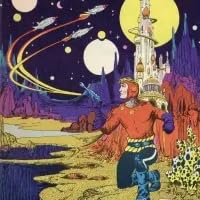
I read this book because it was nominated for the Retro-Hugo Award. The contents of the book are somewhat different than the Goodreads description. This is the Bluejay Books paperback edition of November 1985. It contains the short novel, "The Legion of Time," plus the short novel, "After World's End," both originally published in 1938, and are not otherwise connected in any way. The total page count is 249. The book is illustrated by Ilene Meyer. The cover illustration shown in the Goodreads description is obviously from a Pyramid edition, not the Bluejay edition.
Both stories in this book are serviceable, but neither would be mistaken for modern science fiction, nor are either particularly memorable. Both are filled with thrilling space adventures featuring exotic aliens and damsels in distress. I have a suspicion that some Hugo voters confused "The Legion of Time" with the better known The Legion of Space (1947). You could do worse than read this book, but this is not grandmaster Williamson's finest work by any means.
Both stories in this book are serviceable, but neither would be mistaken for modern science fiction, nor are either particularly memorable. Both are filled with thrilling space adventures featuring exotic aliens and damsels in distress. I have a suspicion that some Hugo voters confused "The Legion of Time" with the better known The Legion of Space (1947). You could do worse than read this book, but this is not grandmaster Williamson's finest work by any means.

May 27, 2014
http://nwhyte.livejournal.com/2304620.html[return][return]I hadn't appreciated that this was where the phrase "jonbar point" originated; I twitched with some excitement about a reference in a 1938 book to the defence of Paris in 1940 (though there are then Russian rocket pilots from 1947 which is a bit early); I was struck by the intense descriptions of hand-to-hand combat, practically trench warfare, which presumably must have been much in the war literature of the time reflecting the previous conflict (Williamson himself would have been too young to have any direct knowledge of it); I was amused by the notion of gathering together the best soldiers of all time, copied of course by Doctor Who among others; I winced a bit at Good Princess vs Bad Princess; and I was a bit surprised when it was over after less than a hundred pages.

August 20, 2015
Storyline: 2/5
Characters: 1/5
Writing Style: 2/5
World: 2/5
I think this would be an enjoyable read for those who delight in raw, mindless action or who can appreciate the historical circumstances (and state of the genre) in which it was written. I have neither of these qualities, and for me it was a shallow, ridiculously-paced and outdated work of science fiction. This could have served as a screenplay for a thirty-minute television episode filmed in the same style and costumes as the 1987 He-Man movie, Masters of the Universe.
There were some inklings of good science fiction thought. The discussion of chance, for instance, brought to mind Asimov's Hari Seldon, but no part of this book was developed.
Characters: 1/5
Writing Style: 2/5
World: 2/5
I think this would be an enjoyable read for those who delight in raw, mindless action or who can appreciate the historical circumstances (and state of the genre) in which it was written. I have neither of these qualities, and for me it was a shallow, ridiculously-paced and outdated work of science fiction. This could have served as a screenplay for a thirty-minute television episode filmed in the same style and costumes as the 1987 He-Man movie, Masters of the Universe.
There were some inklings of good science fiction thought. The discussion of chance, for instance, brought to mind Asimov's Hari Seldon, but no part of this book was developed.

August 31, 2015
I read this book because it was referenced in Ultima, but sadly it was a waste of time. The Legion of Time might have been worth it back in 1938, but (at least in my opinion) it doesn't hold up today.
Displaying 1 - 30 of 36 reviews