"Wait, are we talking about the same person?" Ever hear that when two or more people compare notes about a supposed "common" other who is unrecognizable to each.
In three sections, women in different countries and cultures describe Lafcadio at different spans of his life. Each depiction could not be more distinct from the other two. The constants are food and an Elizabeth character. Each section is actually the story about a woman than the man they had in common. He, the professional storyteller, is used as an instrument in the service of the women with the stories.
Truong's writing is beautiful and clever; and her imagined perspectives on Lafcadio sharp and witty. She performs, in writing, a kind of channeling, rich with the flaws of humanity and insights into its irony and contradictions. There's an affectionate acuity in Truong's writing. (And I often think about her book, Bitter in the Mouth, the only book I reread immediately after turning the last page on the first go. And thus, I anticipated this book and will eagerly wait for more from her.)
Several quotes:
...When my father was not an echo, he spoke in circles, a snake swallowing its tail.
At midmorning, the aromas , which hung like damp laundry over the street of villas, were the same as those coming from Kanella's kitchen. Onions and olive oil. The whole island by noon was a pan of sweet onions melting....
I was spare with my words when I was with Charles, as the fewer that I used, the better we understood each other.
....We understood one another. I understood them so well that I soon despised them both....
Believing a man doesn't mean making a fool of yourself. that was Aunt Sweetie talking. Molly taught me my kitchen skills but Aunt Sweetie taught me--or she tried to--what I would need to know in the other rooms of the house. She never married, and she told me that made her wiser than most women.
Religion, Pat had said to me and then I had repeated it to Charlotte, was for people who needed to believe that death was better than life. I was afraid to tell her what else Pat had said, but I did. Heaven is a good story, Mattie, and good stories get retold....
...Pat was a terrible storyteller, and I told him so. Pat looked up, his eye aglow. On the contrary, he said. He was a very good storyteller, as the listener wanted to know more, which was the point of storytelling.
When you've been taught that you are lesser, there was another way to empty yourself of anger, the stubborn kind, the kind closer to shame. It was cheaper than drink, but it cost those around you more. I didn't tell Pat about this other way. he came to it on his own.
...I don't know what Creole cooking is, but if these are colored folks, then I know a thing or two about what's on their tables. What I want to know is whether these were the dishes that they cooked in their own kitchens or whether these were dishes that they cooked in the kitchens of others. The two aren't the same. The first is what they hunger for, and the second is what their hunger make them do.
..."Facts are akin to fish bones," he said. "If what you want is to serve the flesh, then the bones can be discarded," he suggested.


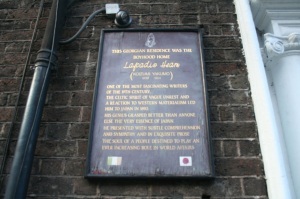 Commemorative plaque to Lafcadio Hearn, 48 Gardiner Street Lower, Dublin, Ireland. (Wikipedia)