The premise of this book was intriguing. And a little confusing. This was written by Jennifer Croft, the translator for some of Olga Tokarczuk’s work. I love Tokarczuk so I knew I had to get my hands on this. Plus, it kept eyeing me from its face-out on the bookshelf! Eight translators gather in Poland to translate the newest work, Grey Eminence, by fictional author Irena Rey. The very real, solid book by my side as I write this, The Extinction of Irena Rey, is told from the first-person point of view by Irena’s Spanish translator. That in turn is translated by “English”, one of Croft’s characters and the translator of that language in this novel – with footnotes, often snide ones at that! If this seems bonkers already, then you will have a sense of how I felt for the first half of the book. Until it finally fell into place for me, and I understood what author Jennifer Croft was doing.
“She was warmth, she was moisture, she was light, she was the adamant perfection of a million billion snowflakes in a split second’s descent, she was tender, she was eternal, and she was memory, she was love. She was everything we’d ever wanted, all anyone could want in the world.”
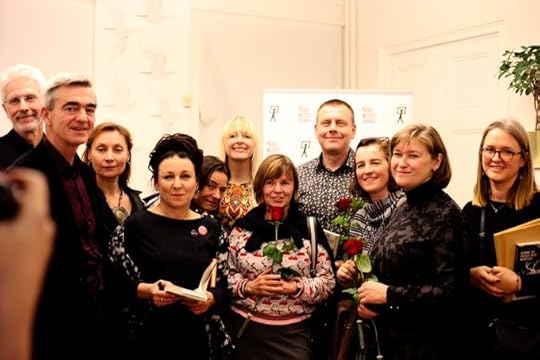
Irena’s translators are obsessed with her. They drop everything and isolate themselves in the Białowieża forest of Poland to do her bidding and translate her work. They even agree to not translate any other Polish author’s work to stay in Irena’s favor. Shortly after the eight arrive however, Irena disappears. The word shenanigans comes to mind! There’s plenty of mystery surrounding Irena’s whereabouts, but there’s also lots of arguing and loads of sexual tension, particularly as Irena has a new translator on board this year, “Swedish”.
“Swedish was new, handsome as a red deer, and we knew at first sight that he would be her favorite. Not only because of the prestige of his language, a conduit to her inevitable Nobel Prize, but also because of his saunter, his stance, that gratifying invitation in his hot blue eyes.”
There’s a lot of subtle humor humming just below the surface. Be sharp or you might miss it – admittedly, I did at times. I wasn’t always on my game while reading this book. Croft also focuses on the natural world, logging, historical artifacts and of course the art of language and translation. Oh, and there’s quite a lot about fungi within these pages as well. A bit of a coincidence once again. I’ve seemed to run into this topic accidentally more than once this year. Croft even goes so far as to cleverly tie this into the world of translation.
“In the end, what we do is mycelial. What we do as translators is stitch the world into a united and communicating whole.”
While extolling the value of translation one minute, Croft will then turn around and, through the voice of one of her translator characters, she will make a disparaging comment. This confused me initially, but then I realized what she was doing was putting forward not her own thoughts, but perhaps the thoughts of others regarding the world of translation. While defending their position of staying on at Irena’s home to translate her work during her absence, the translators believe it is their duty to protect “their author.” Take a look at this “footnote” provided by the English translator character in this book:
“The reference here is to the superstition among certain readers who believe translations necessarily adulterate their originals, and thereby ruin them. (I think I have shown irrefutably throughout this novel that a translation is often superior to its original, but of course this is for you to decide.)”
I’m not sure how to get across the feel of this book. It’s an odd one, really - but not in a bad way. The plot itself wasn’t all that propulsive, but I found some funny moments, a lot of clever thoughts surrounding translations, and some wonderful descriptions of the forest. If anything I’ve said sounds tempting, then you might be the right reader for this novel. If you’re thinking what the hell is Candi going on about, then you might want to give this a pass! Three stars for the story, four stars for the writing. That makes a 3.5 star book for me.
“I was gripped by an urge to inscribe our existence, the existence and significance of us as translators, how we mattered, and how we dissolved, which came to the same, like the horizon at sea.”