

What do you think?

Very Short Introductions #085
Modern Ireland: A Very Short Introduction
This is a book about the Irish Question, or more specifically about Irish Questions. The term has become something of a catch-all, a convenient way to encompass numerous issues and developments which pertain to the political, social, and economic history of modern Ireland. It is a question which refuses to go away, but it is also a question whose inconstant meaning is rarely anatomized and still less often denied. One of the main aims of this book is to explore the complicated and shifting nature of the Irish Question, and to assess what it has meant to various political minds and agendas. The book is arranged both thematically and chronologically; each of the eight chapters takes as its focus a particular period, and each period is discussed within the context of one or more questions which informed and shaped that particular period.
About the Series: Combining authority with wit, accessibility, and style, Very Short Introductions offer an introduction to some of life's most interesting topics. Written by experts for the newcomer, they demonstrate the finest contemporary thinking about the central problems and issues in hundreds of key topics, from philosophy to Freud, quantum theory to Islam
About the Series: Combining authority with wit, accessibility, and style, Very Short Introductions offer an introduction to some of life's most interesting topics. Written by experts for the newcomer, they demonstrate the finest contemporary thinking about the central problems and issues in hundreds of key topics, from philosophy to Freud, quantum theory to Islam
164 pages, Paperback
First published March 27, 2003
Ratings & Reviews
Friends & Following
Create a free account to discover what your friends think of this book!
Community Reviews
Displaying 1 - 30 of 37 reviews

January 20, 2013
The Irish are the only example I can think of where only 60 or so years ago they were suffering from the kind of British racism summed up in the famous landlady's sign :
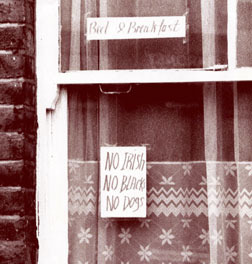
And now the situation has reversed so much that British people are constantly claiming they have Irish ancestry and they're naming their kids Ryan, Liam, Callum, Connor, Logan, Finlay, Finn, Aidan and Keiran or Erin, Aoife, Siobhan, Oonagh and Deirdra. It's like reverse-racism. Is that a thing? If it is, the Irish invented it.
Irish history is as painful to contemplate as their music is delightful to listen to, so I guess the only way to read a book like this is while De Dannan or My Bloody Valentine are blasting away in your earholes to balance things out a bit. (But not Clannad. Are you kidding?)
This book is what I needed as a brisk summary and filled in a lot of gaps but in many ways it was a bit crap really. Senia Paseta writes in historyspeak, a dreadful affliction of historians whereby they are compelled to extrude sentences like this
The prospects for Irish reunification were very faint indeed in the 1920s, but possibilities for fostering better relations between North and South did exist, especially through the initially promising Craig-Collins pacts of 1922. These came to very little.
Maybe I'm being harsh. Probably historians get fired if they introduce lively adjectives or recognisable human emotion into their careful, judicious, can I say fantastically boring language (unless their name is Niall Ferguson, when they write as if they're Hunter Thompson on his way to Las Vegas, wired, fried and barely under control).
Two and a half stars. Could do better. See me after class.
May 14, 2020
A dull, deplorably slanted history of modern Ireland.
Paseta's discussion of the Famine excuses the British government while failing to mention the Famine Roads or even the name of Trevelyan. Paseta flatly refuses to use the term "colonial" to describe Ireland's relation to Britain (5) and takes a forthrightly Malthusian view of Irish population growth before the Famine. She sneers at Irish nationalism and resistance to British rule: the Fenian Rising of 1867 was an "extravagant" episode "orchestrated and manipulated by the Fenians" (51); Parnell was a "cool, aloof, and opportunistic politician" (55); the 1848 rising she describes as "farcical" (31); the Easter Rising "carried on" an Irish political "tradition of disdain for a democratic mandate, popular support, and hope for success" (78-79); contemporary rhetoric of Irish unification is "simplistic" and "cheap" (137).
Such insistently negative language contrasts starkly with the calculatedly euphemistic language she adopts in discussing British policy in Ireland. On the Famine, she writes, "No 19th-century British government was prepared to throw limitless amounts of money at 'Irish problems,' but the Famine governments could not be accused of outright callous negligence," despite her own admission that the government had a "profound reluctance to upset the economic status quo" (35) of laissez-faire capitalism. She extenuates the forced evictions of peasant farmers: "Large-scale eviction was not endemic, though it did increase sharply during the Great Famine. It usually took place only when tenants repeatedly refused or were unable to pay their rent" (43-44). Of the Black and Tan atrocities, "woeful degree of indiscipline" (83) is her mealy-mouthed verdict.
Bias aside, the book is out of date. Brexit and the legalization of abortion in Ireland have left its discussion of Irish unification and of the influence of Catholic moral teaching on social policy badly in need of updating.
Paseta's discussion of the Famine excuses the British government while failing to mention the Famine Roads or even the name of Trevelyan. Paseta flatly refuses to use the term "colonial" to describe Ireland's relation to Britain (5) and takes a forthrightly Malthusian view of Irish population growth before the Famine. She sneers at Irish nationalism and resistance to British rule: the Fenian Rising of 1867 was an "extravagant" episode "orchestrated and manipulated by the Fenians" (51); Parnell was a "cool, aloof, and opportunistic politician" (55); the 1848 rising she describes as "farcical" (31); the Easter Rising "carried on" an Irish political "tradition of disdain for a democratic mandate, popular support, and hope for success" (78-79); contemporary rhetoric of Irish unification is "simplistic" and "cheap" (137).
Such insistently negative language contrasts starkly with the calculatedly euphemistic language she adopts in discussing British policy in Ireland. On the Famine, she writes, "No 19th-century British government was prepared to throw limitless amounts of money at 'Irish problems,' but the Famine governments could not be accused of outright callous negligence," despite her own admission that the government had a "profound reluctance to upset the economic status quo" (35) of laissez-faire capitalism. She extenuates the forced evictions of peasant farmers: "Large-scale eviction was not endemic, though it did increase sharply during the Great Famine. It usually took place only when tenants repeatedly refused or were unable to pay their rent" (43-44). Of the Black and Tan atrocities, "woeful degree of indiscipline" (83) is her mealy-mouthed verdict.
Bias aside, the book is out of date. Brexit and the legalization of abortion in Ireland have left its discussion of Irish unification and of the influence of Catholic moral teaching on social policy badly in need of updating.

November 23, 2015
As an American living in Ireland, I am used to getting a single (Republican) telling of Irish history. It was invigorating to read another bias. While the author is not British herself, my Irish friends insist that this version of events stinks of Unionist bias. Well, I suspect the truth lies somewhere in the middle. In any case, I enjoyed the history of the Catholic church's stranglehold on Irish society, and the formation of Ireland's political parties. Read with a skeptical mind.

August 20, 2023
I stopped reading this book on chapter 3.
The style is callous and the author is prone to blame the Irish people of things like the Great Hunger or the lack of industry while openly condoning the British government.
This is written from a colonialist mindset and like the VSI to capitalism it has an obvious Tory bias so I assume that’s the editorial line of the VSI collection.
The style is callous and the author is prone to blame the Irish people of things like the Great Hunger or the lack of industry while openly condoning the British government.
This is written from a colonialist mindset and like the VSI to capitalism it has an obvious Tory bias so I assume that’s the editorial line of the VSI collection.

November 7, 2013
While I like the idea of this series and find that this book does cover a lot of ground concisely, I got piqued by its insistent blame sharing. I guess coming from Oxford UP, I shouldn't be surprised, but Paseta refuses to find any group at fault as in this gem of a quote: "Large-scale eviction was not endemic, though it did increase sharply during the Great Famine. It usually took place only when tenants repeatedly refused or were unable to pay their rent." Oh, well, if that's how things "usually" went, I guess it's all good. Yuk!
August 7, 2024
Reads like a humanities grad student who thought they could write their research paper later but then forgot it til the night before and word count was way too high for just one all nighter.
Only explanation I have for why any author would praise the *moral* victory of being neutral on the issue on Nazi germany
Only explanation I have for why any author would praise the *moral* victory of being neutral on the issue on Nazi germany

December 7, 2025
I really like the Very Short Introduction books for making information so easy to digest. The writing in this one was rather distasteful however.
Eight chapters of “This does nothing for your cause” –Person Who Hates You & Your Cause.
The constant barrage of Shady AF Comebacks to any expression of dissatisfaction with Unionism whatsoever seemed a bit unnecessary. One quote I found particularly ridiculous: “what they perceived to be the wholesale Anglicisation of Ireland”. ?????? Later on that same page, the author describes the “Anglophobia” that comprised part of “the foundation” of early nationalist identity. No qualifier needed here though; while English influence was merely “perceived” by a self-victimising few, Anglophobia is as undisputed as it was uncalled for. Girl whatever
Eight chapters of “This does nothing for your cause” –Person Who Hates You & Your Cause.
The constant barrage of Shady AF Comebacks to any expression of dissatisfaction with Unionism whatsoever seemed a bit unnecessary. One quote I found particularly ridiculous: “what they perceived to be the wholesale Anglicisation of Ireland”. ?????? Later on that same page, the author describes the “Anglophobia” that comprised part of “the foundation” of early nationalist identity. No qualifier needed here though; while English influence was merely “perceived” by a self-victimising few, Anglophobia is as undisputed as it was uncalled for. Girl whatever

August 1, 2025
Quite frankly, one of the worst introductory books on Ireland available. Two major issues plague the book, the first being the language of the book. It's far too verbose, and clearly written by a historian, as it suffers from use of language unfamiliar to the common reader, among other issues. A huge no-no for a book advertised as an introduction to the subject matter at hand.
Secondly is the bias of the author as well. The book at times reads like a British apologist novel, often skimming/glossing over the various atrocities committed by the British against the Irish people, or opting to focus on the hard economic number impact and the like instead, overlooking the deep social impacts these atrocities had upon the Irish.
Overall one would be better off tackling a full fledged novel from the likes of James Joyce or thick volume of Irish history instead, if this is the option for an introduction to Modern Irish history.
Secondly is the bias of the author as well. The book at times reads like a British apologist novel, often skimming/glossing over the various atrocities committed by the British against the Irish people, or opting to focus on the hard economic number impact and the like instead, overlooking the deep social impacts these atrocities had upon the Irish.
Overall one would be better off tackling a full fledged novel from the likes of James Joyce or thick volume of Irish history instead, if this is the option for an introduction to Modern Irish history.

March 7, 2023
Tbh, it's a rather mediocre VSI. It's not written that well, especially the first half is kinda... boring. The second problem: It's outdated (published 2003).
Still, it covers a lot of different topics that are essential if you want to grasp modern ireland, mostly history (it seems paradoxical if you read the title of the book). Feminist history and "contemporary" issues, change in public opinion are also discussed.
I would not really recommend the book, it was an interesting read tho.
Still, it covers a lot of different topics that are essential if you want to grasp modern ireland, mostly history (it seems paradoxical if you read the title of the book). Feminist history and "contemporary" issues, change in public opinion are also discussed.
I would not really recommend the book, it was an interesting read tho.

October 12, 2021
Good, brief, to the point (no fluff), mainly a survey of the political history of Ireland from the 18th century to the present.

August 18, 2021
My interest in the subject was high which is probably the only reason I was able to finish the book. Not well organized, it starts the story in what I'd consider somewhere near the middle, stutters and stumbles through a chronological format, and is delivered in a stilted style that combines unusual vocabulary with quirky syntax.
It also frequently assumes the reader has insights that an 'introduction' should really not do, and tosses out bits of information out of context (e.g. someone named ''Dev'' appears out of nowhere and it took me a few minutes to realize that this was Eamon de Valera). It also does little to clear up the plethora of acronyms and Irish shorthand used in Irish political and social history; after a while I was almost more confused than when I started.
Admittedly, it only claims to be a very short introduction, but believe me, it reads much longer! I guess I'll have to spring for the more costly, and more thorough, options not available on Kindle ($33.00 plus shipping for Bartlett's ''Ireland: A History'' in paperback! Yikes!).
It also frequently assumes the reader has insights that an 'introduction' should really not do, and tosses out bits of information out of context (e.g. someone named ''Dev'' appears out of nowhere and it took me a few minutes to realize that this was Eamon de Valera). It also does little to clear up the plethora of acronyms and Irish shorthand used in Irish political and social history; after a while I was almost more confused than when I started.
Admittedly, it only claims to be a very short introduction, but believe me, it reads much longer! I guess I'll have to spring for the more costly, and more thorough, options not available on Kindle ($33.00 plus shipping for Bartlett's ''Ireland: A History'' in paperback! Yikes!).

March 3, 2019
3,5/5 stars. I read this mostly because I experienced my knowledge of post-1800 Ireland as quite patchy. Honestly though, after reading this, I can say that probably the only patchy period was post-1916. This book swiftly covers Irish history from the eighteenth century up to 2000. Though it is well-organised, and admirably neutral in many of the dichotomous parts of Irish history, I found its style rather hard-going. Would recommend if you want to learn more about Ireland!

November 24, 2024
honestly very wordy. felt a bit lost and bored at times. definitely not for beginners because there is so much information in such small book. normally i am a big of the series but this didnt hit the nail on the head for me as much as i would have liked.

June 8, 2024
This chronological listing of facts doesn't deliver enough analysis. When given, opinions can be unnecessarily controversial, e.g. claiming "the island of Ireland in reality consists of two Irelands" .[ no evidence, more than two, I'd say, still able to unite ] I'm asking for explanation not opinion or prediction. Supposedly "Famine governments could not be accused of outright callous negligence" but Trevelyan was negligent. She says Good Friday Agreement of 1998 is a "model for peace processes" with no proof how itt can be applied elsewhere, certainly not in the Middle East's opposing cultures.
Defintions should be made to explain concepts, not so much for minor organizations or their abbreviations. "Emancipation would benefit only a tiny section" makes unclear whether it means the right to vote. And the desciption of the Emancipation bill of 1829 seems the opposite Of emancipation in its effect. Even the 1801 Act of Union is named but not described. Union theme endures with Unionist belief, to join with UK, not to be confused with "Irish Unity" to consolidate the entire Irish island. The "decision to revolt at Easter 1916" doesn't explain who decided: IRB? Volunteers? I liked the explanation of "tradition of disdain for a democratic mandate, popular support, and hope of success" which helps explain the motivation as a "lost cause" something like US South after Civil War. "Partition" is the opposite of Irish unity, not the opposite of "1801 Union"
An editor should have called for a re-write to combine sections which repeat similar facts, like immediately contradint iitself as to whether French Revolution was "Catholic triumph" viewed by Catholics, or viewed by Protestants as "victory against the infidel Catholic Church".
Why is "alleged propensity of the Irish to marry young and to rear large families" only alleged when statistics would demonstrate it? The book hardly mentions role of Catholic Church in recommending this until aa late chapter on the late 20C Church. Cliched style uses flowery phrases like "ill afford", "halcyon days of solitary political hegemony" Using the word "beleaguered" is overused and vague. The word "anti-" is overused, I counted 36x used to mean the opposite of an active political position. Often she does not even explain the original position but just names the opposite team, a debate without facts.
While mostly chronological, the story suffers from overdoing lists of legislations, organizations, people are worthwhile but feel like prep for some test. Often these objects are unexplained while a reference would be helpful, particularly for this US reader. It's less an essay than a speaker's hints and reminders.
Many compound sentences use "but" so that the second part modifies or softens or contradicts the first part. This makes her arguments equivocal and longer. Sometimes the 2 parts seem to agree yet somehow opposes the first part. Organization is confusing when chapters sometimes apply to the entire Island, sometimes only to Ulster.
Interesting that UK leadership helped enfranchise Catholics which Irish protestants opposed. Their enmity was based on religion and class, not on allegiance to Britain.
The abstentionist role is interesting. Why doesn't it happen in US? The votes of minority party wouldn't make a legislative difference so might as well be absent. At least for issues when parties vote as a bloc. Would US public expect US politicians not to get away with such symbolic non-votes?
Defintions should be made to explain concepts, not so much for minor organizations or their abbreviations. "Emancipation would benefit only a tiny section" makes unclear whether it means the right to vote. And the desciption of the Emancipation bill of 1829 seems the opposite Of emancipation in its effect. Even the 1801 Act of Union is named but not described. Union theme endures with Unionist belief, to join with UK, not to be confused with "Irish Unity" to consolidate the entire Irish island. The "decision to revolt at Easter 1916" doesn't explain who decided: IRB? Volunteers? I liked the explanation of "tradition of disdain for a democratic mandate, popular support, and hope of success" which helps explain the motivation as a "lost cause" something like US South after Civil War. "Partition" is the opposite of Irish unity, not the opposite of "1801 Union"
An editor should have called for a re-write to combine sections which repeat similar facts, like immediately contradint iitself as to whether French Revolution was "Catholic triumph" viewed by Catholics, or viewed by Protestants as "victory against the infidel Catholic Church".
Why is "alleged propensity of the Irish to marry young and to rear large families" only alleged when statistics would demonstrate it? The book hardly mentions role of Catholic Church in recommending this until aa late chapter on the late 20C Church. Cliched style uses flowery phrases like "ill afford", "halcyon days of solitary political hegemony" Using the word "beleaguered" is overused and vague. The word "anti-" is overused, I counted 36x used to mean the opposite of an active political position. Often she does not even explain the original position but just names the opposite team, a debate without facts.
While mostly chronological, the story suffers from overdoing lists of legislations, organizations, people are worthwhile but feel like prep for some test. Often these objects are unexplained while a reference would be helpful, particularly for this US reader. It's less an essay than a speaker's hints and reminders.
Many compound sentences use "but" so that the second part modifies or softens or contradicts the first part. This makes her arguments equivocal and longer. Sometimes the 2 parts seem to agree yet somehow opposes the first part. Organization is confusing when chapters sometimes apply to the entire Island, sometimes only to Ulster.
Interesting that UK leadership helped enfranchise Catholics which Irish protestants opposed. Their enmity was based on religion and class, not on allegiance to Britain.
The abstentionist role is interesting. Why doesn't it happen in US? The votes of minority party wouldn't make a legislative difference so might as well be absent. At least for issues when parties vote as a bloc. Would US public expect US politicians not to get away with such symbolic non-votes?
September 14, 2025
Technically accurate, but it distorts the narrative around colonial resistance to a place that is barely recognizable. The discussion around any of the violent episodes of Irish history is distinctly lacking, and the excuses crafted for British negligence during the famine period are absurd. That said, some of the discussion around pre-famine politics is fascinating. Much more time should have been spent on the lead up to 1916, and particularly on the unique alliances forged among Irish factions in that period. De Valera’s wilderness years in the 1920’s could have used more attention, as could Cosgrave’s government. The Blueshifts weren’t focused on nearly enough, and the huge shift in IRA politics during the beginning of the Troubles is almost completely ignored. The shift from De Valera to Lemass is almost completely ignored. Obviously, the period on modern history is hilariously outdated. The European Union is still a mere economic community in this book, so anyone looking for commentary on modern Ireland should look elsewhere.
August 14, 2023
Senia Pašeta's "Modern Ireland: A Very Short Introduction" portrays the complex and multifaceted history of Ireland. The "modern" history spans from the late 19th century to the present day (the first edition was published in 2003). Readers are introduced to key events, figures, and movements that have shaped the two Irelands on this single island, including the path to independence, the separation of the Irish state from Northern Ireland, the Troubles, political struggles, and the country's economic and cultural evolution in the late 20th century. The book also delves into related topics such as religious affairs, the development of nationalism, and Ireland's identity in relation to Britain from the 1970s and within the broader European context.
The book, which addresses both newcomers and those familiar with Ireland, succeeds in condensing a vast and intricate history into a compact volume without sacrificing depth or nuance. It offers a holistic view of modern Ireland, starting with the Act of Union, progressing through the Catholic, land, and national questions, to the end of the union and the independence of the Irish Free State, which later became the Irish Republic. It also does not omit developments in Northern Ireland.
Certainly, a strength of the book is its balanced and objective approach when discussing contentious issues, leaving it to the readers to form their own opinions. Given the brevity of the book, it nevertheless highlights a rich and fair diversity of perspectives within Irish history and challenges any simplistic views. It remains debatable whether some topics are covered too briefly or if a more in-depth analysis is desired.
To summarise, the book provides a well-crafted and insightful overview of Ireland's recent history. It aids in understanding not only past developments but also contemporary society, politics, welfare, religion, education, economics, and other related topics. It serves as an excellent starting point for those looking to familiarise themselves with the subject.
The book, which addresses both newcomers and those familiar with Ireland, succeeds in condensing a vast and intricate history into a compact volume without sacrificing depth or nuance. It offers a holistic view of modern Ireland, starting with the Act of Union, progressing through the Catholic, land, and national questions, to the end of the union and the independence of the Irish Free State, which later became the Irish Republic. It also does not omit developments in Northern Ireland.
Certainly, a strength of the book is its balanced and objective approach when discussing contentious issues, leaving it to the readers to form their own opinions. Given the brevity of the book, it nevertheless highlights a rich and fair diversity of perspectives within Irish history and challenges any simplistic views. It remains debatable whether some topics are covered too briefly or if a more in-depth analysis is desired.
To summarise, the book provides a well-crafted and insightful overview of Ireland's recent history. It aids in understanding not only past developments but also contemporary society, politics, welfare, religion, education, economics, and other related topics. It serves as an excellent starting point for those looking to familiarise themselves with the subject.

July 29, 2025
A very narrow and rather sterile look into the history of 18th-20th century Ireland with an imperialist bias from a non-English author. The author diminishes the Great Famine to a 'natural' disease, and claims that whether the British government's relief measures were inadequate is a debatable question. Not to mention blaming the exodus of people on lack of opportunities and decent standards of living in Ireland. Could the lack of those be due to the 400-year long attempts to subjugate the country by means of not just war but also starvation? Just an idea.
Nevertheless, a good read to see the whitewashing perspective of the other camp.
Nevertheless, a good read to see the whitewashing perspective of the other camp.

December 9, 2020
Modern Ireland
A Very Short Introduction #85
Senia Paseta
It reads differently from another book in the series on the same topic Northern Ireland #82
It is more from the Unionist side and it adds a chapter on the Catholic Church and its influence on society.
I take them both as a short complementary read on Ireland, serve as a good introduction from both sides and more in-depth reading is needed to grasp the events.
A Very Short Introduction #85
Senia Paseta
It reads differently from another book in the series on the same topic Northern Ireland #82
It is more from the Unionist side and it adds a chapter on the Catholic Church and its influence on society.
I take them both as a short complementary read on Ireland, serve as a good introduction from both sides and more in-depth reading is needed to grasp the events.

August 20, 2023
If you know a fair bit about Irish history since 1801, you will probably find much here to quibble with, mostly generalisations for purposes of space. But, as this is a very short introduction, for the novice it does exactly what is sets out to do. It was, however, written in 2003 when the Celtic Tiger was roaring loudest. I doubt it would end on such a sunny note of economic and social progress now.

October 7, 2020
He interviews her ...
Q: Was there anything that surprised you in this book's historical content?
A: I don't know.
Q: Did you learn anything new and worth remembering?
A: The thing about Bono.
Q: Was there anything that surprised you in this book's historical content?
A: I don't know.
Q: Did you learn anything new and worth remembering?
A: The thing about Bono.

March 10, 2021
Chapter 1: The Act of Union
Chapter 2: The Catholic question
Chapter 3: Land questions
Chapter 4: National questions
Chapter 5: The end of the Union
Chapter 6: Independent Ireland
Chapter 7: Northern Ireland since 1922
Chapter 8: Modern Ireland
Chapter 2: The Catholic question
Chapter 3: Land questions
Chapter 4: National questions
Chapter 5: The end of the Union
Chapter 6: Independent Ireland
Chapter 7: Northern Ireland since 1922
Chapter 8: Modern Ireland
December 6, 2022
This was poorly edited and written in a verbose and unclear style. The author never decisively defines pivotal groups (unionists, pro Treaty, anti Treaty) before launching into multiple chapters about them. I read this to get a basic idea of Ireland's history but I feel like I'm still lost.

May 17, 2017
Excellent short introduction to the subject.

May 27, 2017
Not the most interesting read but not the worst either.
March 17, 2018
Easy-to-read, interesting, informative.

September 4, 2021
Great information.
However, this is the most boring read I've had this year.
If you're looking for an entertaining historical account, this is not it.
However, this is the most boring read I've had this year.
If you're looking for an entertaining historical account, this is not it.

June 1, 2026
Disappointing book in general, surprisingly dull and boring.
Maybe my expectations were high, but it is the worst book I read in Very Short introduction series, by far.
This books completely ignores any cultural and art subjects, mostly focusing on political history. Very skimmed coverage of economy too. Any descriptions of historical personalities and brief and dry.
Please don't waste your time reading this book and find another better book (I will certainly do too).
Maybe my expectations were high, but it is the worst book I read in Very Short introduction series, by far.
This books completely ignores any cultural and art subjects, mostly focusing on political history. Very skimmed coverage of economy too. Any descriptions of historical personalities and brief and dry.
Please don't waste your time reading this book and find another better book (I will certainly do too).

August 1, 2015
'A very short history of Ireland' is what it says on the tin and that is precisely this book offers. The era covered is 'modern Ireland' so does not go into Vikings and Gallic past but comprehensively touches upon all the milestones in the religious wars (Catholics vs Protestants / Anglicans) and the checkered history and relationship of this nation with England. Quite unbiased in its commentary so quite good as an introduction to Irish history and to try to make sense of (if violence can anytime be justified) of the troubled 70s and 80s, the IRA and Ulster Volunteer Force terrorist gangs etc. Concise (so definitely doesnot go deep in explaining issues) and updated upto the financial crisis - early 21st century. Recommended as the travel companion for those who want to get the sense of history of Ireland.

February 24, 2014
The low rating for this book is partly for the text itself, but more importantly, it applies to the Oxford A Very Short Introduction collection as a whole. These texts aren’t introductions, really. They may help to refresh your mind, but on the whole I find that they require a lot of previous knowledge (such as the names of all British Prime Ministers ever, as was the case with this book) that someone who is reading an Introduction may not always have. Intermediate steps between certain events also appear to be missing at times, making it difficult to understand how one thing followed from another. This particular book was informative, but also rather dry. Just maybe read the Wikipedia page first.

May 13, 2012
This is an interesting, mostly political history of Ireland from approximately 1800 to 1922, the years when Ireland was fighting for independence from Great Britain. For myself, I found it hit the sweet spot of assuming just enough but not too much background knowledge ... It seemed to cover the key figures, it moved along very quickly. Granted, this just gives you a sense of the high points of modern Irish history, but before I read this I didn't have a good grasp of even that. At various points, the author also checks in on well-being of everyday people, the status of women, and the country's connections to the Catholic Church.
Displaying 1 - 30 of 37 reviews