

What do you think?
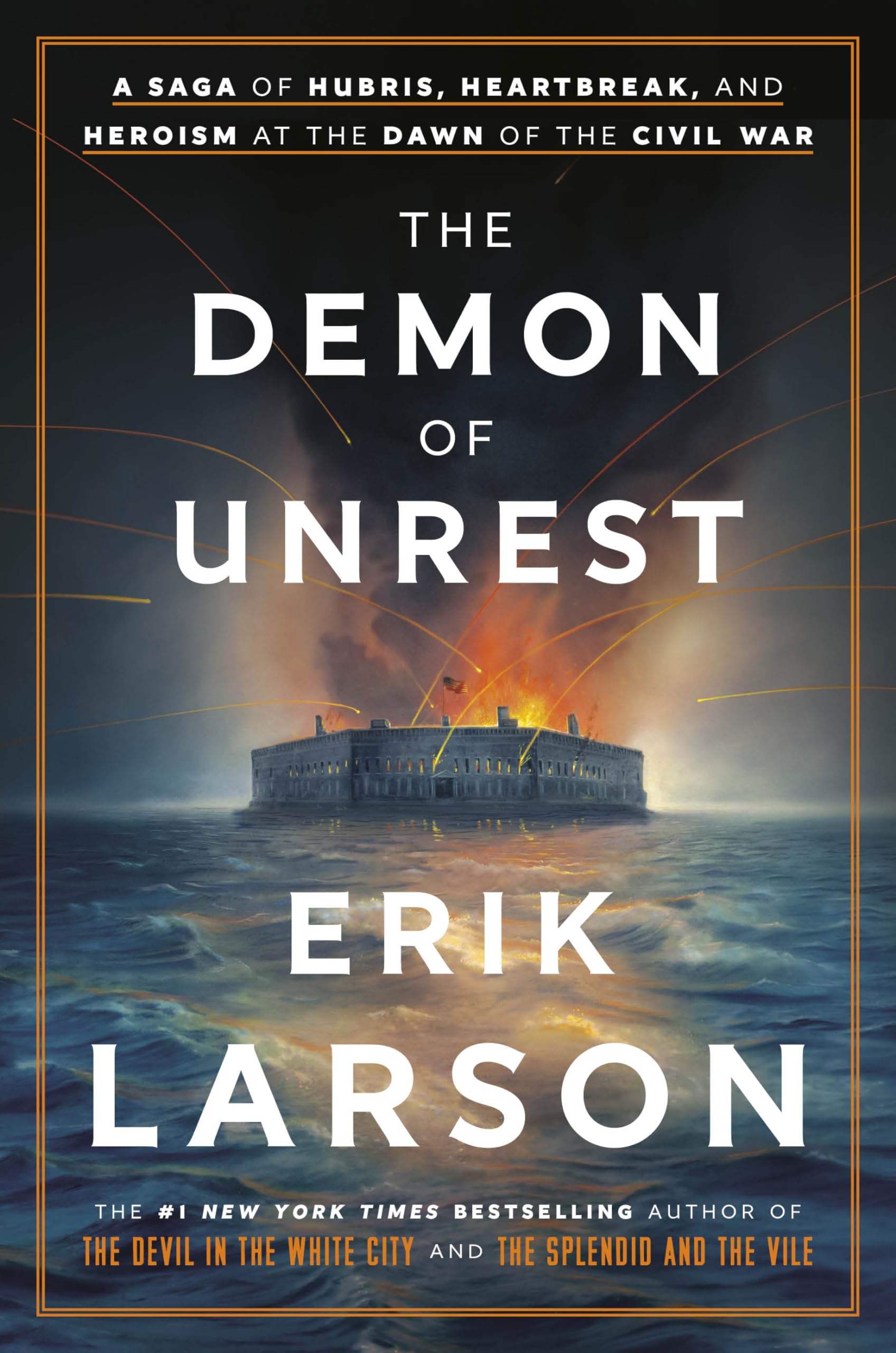
The Demon of Unrest: A Saga of Hubris, Heartbreak, and Heroism at the Dawn of the Civil War
Goodreads Choice Award
Nominee for Readers' Favorite History & Biography (2024)The #1 New York Times bestselling author of The Splendid and the Vile brings to life the pivotal five months between the election of Abraham Lincoln and the start of the Civil War—a slow-burning crisis that finally tore a deeply divided nation in two.
On November 6, 1860, Abraham Lincoln became the fluky victor in a tight race for president. The country was bitterly at odds; Southern extremists were moving ever closer to destroying the Union, with one state after another seceding and Lincoln powerless to stop them. Slavery fueled the conflict, but somehow the passions of North and South came to focus on a lonely federal fortress in Charleston Fort Sumter.
Master storyteller Erik Larson offers a gripping account of the chaotic months between Lincoln’s election and the Confederacy’s shelling of Sumter—a period marked by tragic errors and miscommunications, enflamed egos and craven ambitions, personal tragedies and betrayals. Lincoln himself wrote that the trials of these five months were “so great that, could I have anticipated them, I would not have believed it possible to survive them.”
At the heart of this suspense-filled narrative are Major Robert Anderson, Sumter’s commander and a former slave owner sympathetic to the South but loyal to the Union; Edmund Ruffin, a vain and bloodthirsty radical who stirs secessionist ardor at every opportunity; and Mary Boykin Chesnut, wife of a prominent planter, conflicted over both marriage and slavery and seeing parallels between both. In the middle of it all is the overwhelmed Lincoln, battling with his duplicitous Secretary of State, William Seward, as he tries desperately to avert a war that he fears is inevitable—one that will eventually kill 750,000 Americans.
Drawing on diaries, secret communiques, slave ledgers, and plantation records, Larson gives us a political horror story that captures the forces that led America to the brink—a dark reminder that we often don’t see a cataclysm coming until it’s too late.
On November 6, 1860, Abraham Lincoln became the fluky victor in a tight race for president. The country was bitterly at odds; Southern extremists were moving ever closer to destroying the Union, with one state after another seceding and Lincoln powerless to stop them. Slavery fueled the conflict, but somehow the passions of North and South came to focus on a lonely federal fortress in Charleston Fort Sumter.
Master storyteller Erik Larson offers a gripping account of the chaotic months between Lincoln’s election and the Confederacy’s shelling of Sumter—a period marked by tragic errors and miscommunications, enflamed egos and craven ambitions, personal tragedies and betrayals. Lincoln himself wrote that the trials of these five months were “so great that, could I have anticipated them, I would not have believed it possible to survive them.”
At the heart of this suspense-filled narrative are Major Robert Anderson, Sumter’s commander and a former slave owner sympathetic to the South but loyal to the Union; Edmund Ruffin, a vain and bloodthirsty radical who stirs secessionist ardor at every opportunity; and Mary Boykin Chesnut, wife of a prominent planter, conflicted over both marriage and slavery and seeing parallels between both. In the middle of it all is the overwhelmed Lincoln, battling with his duplicitous Secretary of State, William Seward, as he tries desperately to avert a war that he fears is inevitable—one that will eventually kill 750,000 Americans.
Drawing on diaries, secret communiques, slave ledgers, and plantation records, Larson gives us a political horror story that captures the forces that led America to the brink—a dark reminder that we often don’t see a cataclysm coming until it’s too late.
559 pages, Kindle Edition
First published April 30, 2024
About the author
Erik Larson
42 books71.2k followersErik Larson is the author of nine books and one audio-only novella. His latest book, The Demon of Unrest, is a non-fiction thriller about the five months between Lincoln’s election and the start of the Civil War. Six of his books became New York Times bestsellers. Two of these, The Splendid and the Vile: A Saga of Churchill, Family, and Defiance During the Blitz and Dead Wake: The Last Crossing of the Lusitania, both hit no. 1 on the list soon after launch. His chronicle of the Chicago World’s Fair of 1893, The Devil in the White City, was a finalist for the National Book Award, and won an Edgar Award for fact-crime writing. It lingered on various Times bestseller lists for the better part of a decade and is currently in development at Disney Studios. Erik’s In the Garden of Beasts, about how America’s first ambassador to Nazi Germany and his daughter experienced the rising terror of Hitler’s rule, is currently in development with StudioCanal and Playtone.
Erik’s first book of narrative nonfiction, Isaac’s Storm, about the giant hurricane that destroyed Galveston, Texas, in 1900, won the American Meteorology Society’s prestigious Louis J. Battan Author’s Award. The Washington Post called it the “Jaws of hurricane yarns.” Erik is particularly pleased to have won the Chicago Public Library Foundation’s 2016 Carl Sandburg Literary Award for Non-Fiction.
His audio novella, No One Goes Alone, while a work of fiction, is a ghost story based on real-life events and characters, including famed 19th-century psychologist William James. Erik refers to it as a ghost story with footnotes.
He graduated summa cum laude from the University of Pennsylvania, where he studied Russian history, language and culture; he received a masters in journalism from Columbia University. After a brief stint at the Bucks County Courier Times, Erik became a staff writer for The Wall Street Journal, and later a contributing writer for Time Magazine. His magazine stories have appeared in The New Yorker, The Atlantic Monthly, Harper’s, and other publications.
He has taught non-fiction writing at San Francisco State, the Johns Hopkins Writing Seminars, the University of Oregon, and the Chuckanut Writers Conference in Bellingham, Wash., and has spoken to audiences from coast to coast. A former resident of Seattle, he now lives in Manhattan with his wife, a neonatologist, who is also the author of the nonfiction memoir, Almost Home, which, as Erik puts it, “could make a stone cry.” They have three daughters in far-flung locations and professions. Their beloved dog Molly resides in an urn on a shelf overlooking Central Park, where they like to think she now spends most of her time.
Erik’s first book of narrative nonfiction, Isaac’s Storm, about the giant hurricane that destroyed Galveston, Texas, in 1900, won the American Meteorology Society’s prestigious Louis J. Battan Author’s Award. The Washington Post called it the “Jaws of hurricane yarns.” Erik is particularly pleased to have won the Chicago Public Library Foundation’s 2016 Carl Sandburg Literary Award for Non-Fiction.
His audio novella, No One Goes Alone, while a work of fiction, is a ghost story based on real-life events and characters, including famed 19th-century psychologist William James. Erik refers to it as a ghost story with footnotes.
He graduated summa cum laude from the University of Pennsylvania, where he studied Russian history, language and culture; he received a masters in journalism from Columbia University. After a brief stint at the Bucks County Courier Times, Erik became a staff writer for The Wall Street Journal, and later a contributing writer for Time Magazine. His magazine stories have appeared in The New Yorker, The Atlantic Monthly, Harper’s, and other publications.
He has taught non-fiction writing at San Francisco State, the Johns Hopkins Writing Seminars, the University of Oregon, and the Chuckanut Writers Conference in Bellingham, Wash., and has spoken to audiences from coast to coast. A former resident of Seattle, he now lives in Manhattan with his wife, a neonatologist, who is also the author of the nonfiction memoir, Almost Home, which, as Erik puts it, “could make a stone cry.” They have three daughters in far-flung locations and professions. Their beloved dog Molly resides in an urn on a shelf overlooking Central Park, where they like to think she now spends most of her time.
Ratings & Reviews
Friends & Following
Create a free account to discover what your friends think of this book!
Community Reviews
Displaying 1 - 30 of 6,952 reviews
February 26, 2024
Larson begins his new book by saying, “I was well into my research on the saga of Fort Sumter and the advent of the American Civil War when the events of January 6, 2021, took place.” This is, to my recollection, the only time he refers explicitly to that day in the book, but J6 — indeed, the entirety of the Trump years (in which we are still living) — is a presence on every page, not least when Larson describes the urgent concerns officials had that the electoral count to certify Lincoln's election would be disrupted, the certifications stolen or destroyed, and the capitol attacked by angry Americans.
As Larson demonstrated in his other books (bestsellers all), he has an eye for the telling detail and interesting character. “Demon of Unrest” takes these skills to a new level. It brings to vivid life the period between the election of Abraham Lincoln and the firing on Fort Sumter. Most readers will probably go in thinking they know the basics of the event: Lincoln got elected, South Carolina seceded from the Union, it fired on Fort Sumter, and the Civil War began. Larson shows how much more there is to the story. The broader picture is there, to be sure: the debates, threats over secession, how people and politicians reacted to it, key events, and so on. What truly distinguishes “Demon” is its focus on the day-to-day details: the letters, arguments, diary entries, conversations, etc., that participants and observers shared, the doubts they entertained or the outrage they nurtured, the ego, ambition, delusion, and frustration. In short, how real people reacted at every step of the way -- those who sought to prevent war, those who eagerly worked to provoke it, and those caught in the middle.
Each section of the book is introduced with an excerpt from the Code Duello, the rules governing how duels are to be conducted. It’s a fitting device, given how critical dueling and honor were in shaping Southern attitudes. Larson shows us time and again how badly the North and South understood each other, how vastly different their cultures were and the effect those differences played in how events unfolded. The importance of Honor was a particularly powerful force in shaping Southern thought. For them, Northern attitudes about slavery (which was central to both the South's economy and its culture) were not policy differences but attacks on their Honor.
Larson writes very early on, “At the heart of the story is a mystery that still confounds: How on earth did South Carolina, a primitive, scantily populated state in economic decline, become the fulcrum for America’s greatest tragedy?” Then he proceeds to provide an answer to the question. South Carolina had 110,000 more enslaved people than it did whites. Fear of a slave uprising was perpetually in the minds of its white citizens and had been for many decades. The raid on Harper’s Ferry by John Brown in 1859 brought made that fear burn white hot. Southerners were constantly on edge. Northern criticisms of slavery were seen to not only as attacks on their honor and values but also as feeding an existential threat. The result of all this: As one South Carolinian — James Petigru, a Unionist who ultimately voted for secession -- is said to have put it, “South Carolina is too small for a Republic, and too big for an insane asylum.”
Larson puts flesh on the bare bones of our historical imaging of that fraught time. There's Charleston, South Carolina, for example, site of Fort Sumter. In the minds of readers today, it’s likely no more than an historical place name. Or we envision as it is today, with palmettos and magnolias and magnificent oaks. The picture of antebellum Charleston Larson shows us is quite different: “As you walk the streets of Charleston,” he writes, “rows of greedy vultures, with sapient look, sit on the parapets of the houses, watching for offal.” The vultures were so valuable in cleaning filthy streets that they were protected by law: anyone caught killing one was subject to a ten-dollar fine. And then there were the slave markets — visible to the public at one time, hidden out of sight at another, then out in the open again. There are wealthy plantation owners and their slaves, hotheads, unionists, and free Blacks anxiously hurrying home as curfew neared.
Larson shares many telling glimpses into Southern culture of the time. The highest echelons of South Carolina saw themselves as aristocracy, chevaliers, paragons of elegance. As the drama surrounding Ft Sumter is playing out, a ball is held in Charleston. One attendee glowingly described the ball goers as “very select” and “none but the higher classes.” At least one other person who was there that night saw things differently: British author, Margaret Hunter Hall, found the event less than stellar. The gentlemen were “very second-rate,” she wrote in her book, The Aristocratic Journey. As for the women: “I never in my life saw so many ugly women gathered together.”
To explore how the secession crisis was experienced, Larson goes back and forth from Charleston and Ft. Sumter to Washington, following various individuals as they make their way through the growing tension and uncertainty. Up in Washington City (the U.S. capital’s formal name until it became the District of Columbia in 1871), a well-out-of-his-depth President Buchanan is procrastinating. “His great hope,” we read, “seemed to be by temporizing to avoid an issue before the 4th March.” He meets regularly with members of his Cabinet to talk about what to do — particularly as the threat to Fort Sumter grows larger — oblivious to the fact that while these discussion as being held, one member of his Cabinet is secretly trying to ship arms to the South and another is feeding Southern leaders information about what’s being suggested and planned.
Buchanan, in turns out, is not only feckless in dealing with the crisis, he’s also oblivious to its seriousness. Larson writes of a conversation Buchanan has with Georgia Senator Robert Toombs about Fort Sumter before any shots have been fired: ““But Mr. Toombs, why do you ask?” “Because Sir my State has a deep interest in the decision.” This perplexed Buchanan. “How your state—what is it to Georgia whether a fort in Charleston harbor is abandoned?” “Sir,” Toombs answered, “the cause of Charleston is the cause of the South.” “Good God Mr. Toombs, do you mean that I am in the midst of a revolution?” “Yes Sir—more than that—you have been there for a year and have not yet found it out.” “
Unsurprisingly, Major Robert Anderson, Sumter’s commander, is a prominent figure in the book. He is a Southerner himself but is ever mindful of his honor as an officer in the US Army. In a letter to a friend he writes, “Like yourself my sympathies are in the matter of the sectional controversy all with the South, but I must confess that I have lost all sympathy with the people who govern this state. They are resolved to cement their secession with blood.”
Awful though his split allegiances might be, they are made infinitely worse by the complete absence of instructions from his superiors in the chain of command. Should he be preparing for battle? Will there be reinforcements? Or should he surrender the fort? He receives contradictory answers from Washington — when he gets any answers at all, which is the usual case. As Larson writes of Anderson’s frustration, “He found it inconceivable that at so sensitive a moment, with war in the wind, the government would leave such a fateful decision to him.” In time, newly elected President Lincoln will order reinforcements be sent to Summit and Fort Pickens in Florida, but he inadvertently assigns the same ship to both locations at the same time.
The book is populated by a fascinating cast of individuals: among them are Presidents Buchanan and Lincoln (Lincoln was cautiously silent before he was sworn in and quickly overwhelmed after), the ever-ambitious William Seward, Jefferson Davis, Abner Doubleday (also stationed at Sumter), bloodthirsty secessionist Edmund Ruffin, Southern diarist Mary Boykin Chesnut, British journalist William Howard Russell, and many others. (Russell will be barred from visiting Army camps on both sides because of his reports on battles. It is from Russell too that we learn of the ubiquity of “chewing tobacco and its residues” in the country at that time. Spittoons were everywhere — really: everywhere! — but the floors were still covered with, well, exactly what you’d expect.)
Larson’s writing is, as ever, engaging and compulsively readable. We know, of course, what will happen at Sumter, but "Demon" enables us to watch events unfold on the ground, in Ft Sumter, in Charleston SC and Montgomery AL, Washington, Springfield IL, and elsewhere. Larson manages to make the story suspenseful. There are many things in the book I hadn’t known. None perhaps is as startling as the story of a (very) last ditch effort to avoid a civil war: a constitutional amendment proposed in the House by Rep. Thomas Corwin of Ohio and in the Senate by William Seward that guaranteed that Congress would not interfere with slavery where it currently existed… The House approved it by a vote of 133 to 65; the Senate likewise, 24 to 12. Lincoln later forwarded the proposed amendment, the original thirteenth, to all state governors… Only a few states would ultimately ratify the amendment before events made it irrelevant [by the attack on Ft. Sumter]. Known to future centuries as the Shadow or Ghost Amendment, it remained an active congressionally approved but unratified amendment into the twenty-first century, theoretically still open to a final vote by the states.
“Demon of Unrest” is full of such revelations, insights, and lively characters. I can say with complete confience that it will be a bestseller. And it will deserve to be.
My thanks to Crown Publishers and Edelweis+ for providing a digital ARC in return for an honest review.
As Larson demonstrated in his other books (bestsellers all), he has an eye for the telling detail and interesting character. “Demon of Unrest” takes these skills to a new level. It brings to vivid life the period between the election of Abraham Lincoln and the firing on Fort Sumter. Most readers will probably go in thinking they know the basics of the event: Lincoln got elected, South Carolina seceded from the Union, it fired on Fort Sumter, and the Civil War began. Larson shows how much more there is to the story. The broader picture is there, to be sure: the debates, threats over secession, how people and politicians reacted to it, key events, and so on. What truly distinguishes “Demon” is its focus on the day-to-day details: the letters, arguments, diary entries, conversations, etc., that participants and observers shared, the doubts they entertained or the outrage they nurtured, the ego, ambition, delusion, and frustration. In short, how real people reacted at every step of the way -- those who sought to prevent war, those who eagerly worked to provoke it, and those caught in the middle.
Each section of the book is introduced with an excerpt from the Code Duello, the rules governing how duels are to be conducted. It’s a fitting device, given how critical dueling and honor were in shaping Southern attitudes. Larson shows us time and again how badly the North and South understood each other, how vastly different their cultures were and the effect those differences played in how events unfolded. The importance of Honor was a particularly powerful force in shaping Southern thought. For them, Northern attitudes about slavery (which was central to both the South's economy and its culture) were not policy differences but attacks on their Honor.
Larson writes very early on, “At the heart of the story is a mystery that still confounds: How on earth did South Carolina, a primitive, scantily populated state in economic decline, become the fulcrum for America’s greatest tragedy?” Then he proceeds to provide an answer to the question. South Carolina had 110,000 more enslaved people than it did whites. Fear of a slave uprising was perpetually in the minds of its white citizens and had been for many decades. The raid on Harper’s Ferry by John Brown in 1859 brought made that fear burn white hot. Southerners were constantly on edge. Northern criticisms of slavery were seen to not only as attacks on their honor and values but also as feeding an existential threat. The result of all this: As one South Carolinian — James Petigru, a Unionist who ultimately voted for secession -- is said to have put it, “South Carolina is too small for a Republic, and too big for an insane asylum.”
Larson puts flesh on the bare bones of our historical imaging of that fraught time. There's Charleston, South Carolina, for example, site of Fort Sumter. In the minds of readers today, it’s likely no more than an historical place name. Or we envision as it is today, with palmettos and magnolias and magnificent oaks. The picture of antebellum Charleston Larson shows us is quite different: “As you walk the streets of Charleston,” he writes, “rows of greedy vultures, with sapient look, sit on the parapets of the houses, watching for offal.” The vultures were so valuable in cleaning filthy streets that they were protected by law: anyone caught killing one was subject to a ten-dollar fine. And then there were the slave markets — visible to the public at one time, hidden out of sight at another, then out in the open again. There are wealthy plantation owners and their slaves, hotheads, unionists, and free Blacks anxiously hurrying home as curfew neared.
Larson shares many telling glimpses into Southern culture of the time. The highest echelons of South Carolina saw themselves as aristocracy, chevaliers, paragons of elegance. As the drama surrounding Ft Sumter is playing out, a ball is held in Charleston. One attendee glowingly described the ball goers as “very select” and “none but the higher classes.” At least one other person who was there that night saw things differently: British author, Margaret Hunter Hall, found the event less than stellar. The gentlemen were “very second-rate,” she wrote in her book, The Aristocratic Journey. As for the women: “I never in my life saw so many ugly women gathered together.”
To explore how the secession crisis was experienced, Larson goes back and forth from Charleston and Ft. Sumter to Washington, following various individuals as they make their way through the growing tension and uncertainty. Up in Washington City (the U.S. capital’s formal name until it became the District of Columbia in 1871), a well-out-of-his-depth President Buchanan is procrastinating. “His great hope,” we read, “seemed to be by temporizing to avoid an issue before the 4th March.” He meets regularly with members of his Cabinet to talk about what to do — particularly as the threat to Fort Sumter grows larger — oblivious to the fact that while these discussion as being held, one member of his Cabinet is secretly trying to ship arms to the South and another is feeding Southern leaders information about what’s being suggested and planned.
Buchanan, in turns out, is not only feckless in dealing with the crisis, he’s also oblivious to its seriousness. Larson writes of a conversation Buchanan has with Georgia Senator Robert Toombs about Fort Sumter before any shots have been fired: ““But Mr. Toombs, why do you ask?” “Because Sir my State has a deep interest in the decision.” This perplexed Buchanan. “How your state—what is it to Georgia whether a fort in Charleston harbor is abandoned?” “Sir,” Toombs answered, “the cause of Charleston is the cause of the South.” “Good God Mr. Toombs, do you mean that I am in the midst of a revolution?” “Yes Sir—more than that—you have been there for a year and have not yet found it out.” “
Unsurprisingly, Major Robert Anderson, Sumter’s commander, is a prominent figure in the book. He is a Southerner himself but is ever mindful of his honor as an officer in the US Army. In a letter to a friend he writes, “Like yourself my sympathies are in the matter of the sectional controversy all with the South, but I must confess that I have lost all sympathy with the people who govern this state. They are resolved to cement their secession with blood.”
Awful though his split allegiances might be, they are made infinitely worse by the complete absence of instructions from his superiors in the chain of command. Should he be preparing for battle? Will there be reinforcements? Or should he surrender the fort? He receives contradictory answers from Washington — when he gets any answers at all, which is the usual case. As Larson writes of Anderson’s frustration, “He found it inconceivable that at so sensitive a moment, with war in the wind, the government would leave such a fateful decision to him.” In time, newly elected President Lincoln will order reinforcements be sent to Summit and Fort Pickens in Florida, but he inadvertently assigns the same ship to both locations at the same time.
The book is populated by a fascinating cast of individuals: among them are Presidents Buchanan and Lincoln (Lincoln was cautiously silent before he was sworn in and quickly overwhelmed after), the ever-ambitious William Seward, Jefferson Davis, Abner Doubleday (also stationed at Sumter), bloodthirsty secessionist Edmund Ruffin, Southern diarist Mary Boykin Chesnut, British journalist William Howard Russell, and many others. (Russell will be barred from visiting Army camps on both sides because of his reports on battles. It is from Russell too that we learn of the ubiquity of “chewing tobacco and its residues” in the country at that time. Spittoons were everywhere — really: everywhere! — but the floors were still covered with, well, exactly what you’d expect.)
Larson’s writing is, as ever, engaging and compulsively readable. We know, of course, what will happen at Sumter, but "Demon" enables us to watch events unfold on the ground, in Ft Sumter, in Charleston SC and Montgomery AL, Washington, Springfield IL, and elsewhere. Larson manages to make the story suspenseful. There are many things in the book I hadn’t known. None perhaps is as startling as the story of a (very) last ditch effort to avoid a civil war: a constitutional amendment proposed in the House by Rep. Thomas Corwin of Ohio and in the Senate by William Seward that guaranteed that Congress would not interfere with slavery where it currently existed… The House approved it by a vote of 133 to 65; the Senate likewise, 24 to 12. Lincoln later forwarded the proposed amendment, the original thirteenth, to all state governors… Only a few states would ultimately ratify the amendment before events made it irrelevant [by the attack on Ft. Sumter]. Known to future centuries as the Shadow or Ghost Amendment, it remained an active congressionally approved but unratified amendment into the twenty-first century, theoretically still open to a final vote by the states.
“Demon of Unrest” is full of such revelations, insights, and lively characters. I can say with complete confience that it will be a bestseller. And it will deserve to be.
My thanks to Crown Publishers and Edelweis+ for providing a digital ARC in return for an honest review.
![Profile Image for s.penkevich [hiatus-will return-miss you all].](https://i.gr-assets.com/images/S/compressed.photo.goodreads.com/users/1735525095i/6431467._UX200_CR0,11,200,200_.jpg)
Want to Read
February 2, 2024Eric Larson releasing a Lincoln Civil War history right before Father's Day in the US is a publishing slam dunk.
Bookstore jokes aside I’ve always been impressed how Larson is accessible for everyone (not just dads either) in really engaging ways to learn cool history. Just kind of a fan of him as a personality in publishing which I really appreciate as a librarian. He definitely can drive sales so also a fan of him as a bookstore employee too.
Bookstore jokes aside I’ve always been impressed how Larson is accessible for everyone (not just dads either) in really engaging ways to learn cool history. Just kind of a fan of him as a personality in publishing which I really appreciate as a librarian. He definitely can drive sales so also a fan of him as a bookstore employee too.

May 23, 2024
Larson excels at research and at rendering his research to the reader in a well-written and fascinating manner.
🔥 The South was eager for war. Too eager. Their own president, Jeff Davis, a veteran, warned them a conflict with the North would ravage the South. But both sides fumbled and bumbled their way into a war without considering the consequences - misunderstandings, misapprehensions, miscalculations paved the way. There was dancing in the streets of Charleston, South Carolina when Fort Sumter in their harbor surrendered to Confederate artillery and war was declared. There was no dancing 1863/1864 as Southern victories dwindled, Sherman cut a swath of destruction through Georgia as he marched his army to the sea, and the Confederacy began to collapse.
Above all things, Southerners believed they lived a righteous lifestyle, one blessed by the Bible, and detested Lincoln and abolitionists to the point of hatred. Secession began in earnest with Lincoln’s election. The war ended slavery but it would take another hundred years for that to begin to become a significant reality for millions of African-Americans.
As you might have guessed, Larson began this project after the attack on the US Capitol building January 6, 2021. He saw America breaking into factions due to acute political differences and wondered what parallels there might be between 1861 and 2024. There were plenty, unfortunately. This becomes readily apparent to the reader as they work their way through this rather intense book.
Highly recommended and highly readable.
🔥 The South was eager for war. Too eager. Their own president, Jeff Davis, a veteran, warned them a conflict with the North would ravage the South. But both sides fumbled and bumbled their way into a war without considering the consequences - misunderstandings, misapprehensions, miscalculations paved the way. There was dancing in the streets of Charleston, South Carolina when Fort Sumter in their harbor surrendered to Confederate artillery and war was declared. There was no dancing 1863/1864 as Southern victories dwindled, Sherman cut a swath of destruction through Georgia as he marched his army to the sea, and the Confederacy began to collapse.
Above all things, Southerners believed they lived a righteous lifestyle, one blessed by the Bible, and detested Lincoln and abolitionists to the point of hatred. Secession began in earnest with Lincoln’s election. The war ended slavery but it would take another hundred years for that to begin to become a significant reality for millions of African-Americans.
As you might have guessed, Larson began this project after the attack on the US Capitol building January 6, 2021. He saw America breaking into factions due to acute political differences and wondered what parallels there might be between 1861 and 2024. There were plenty, unfortunately. This becomes readily apparent to the reader as they work their way through this rather intense book.
Highly recommended and highly readable.
April 18, 2024
The author actually compares January 6 protest to Ft. Sumter. What an absolutely delusional comparison showing a stunning inability to compare and contrast like a 6th grader. Evidently protestors getting police escorts around the Capitol on January 6 is the same as the full military engagement of Ft. Sumter. Would have expected something more scholarly, but that was obviously too much to ask.
*** Will you be issuing a revised book noting Marxist democrats efforts to subvert the will of voters before and after a Trump victory, and how that kept grinding at you as a definitive moment of grave and treacherous national division? ***
*** Will you be issuing a revised book noting Marxist democrats efforts to subvert the will of voters before and after a Trump victory, and how that kept grinding at you as a definitive moment of grave and treacherous national division? ***

May 15, 2024
Seriously, the first sentence of the book read, "I was well into my research on the saga of Fort Sumter and the advent of the American Civil War when the events of January 6, 2021, took place. As I watched the Capitol assault unfold on camera, I had the eerie feeling that present and past had merged." HARD PASS! Disappointing assessment from one of my favorite authors. As a historian, I know that history is not fact, but rather written through the opinions and viewpoint of the historian, no matter how neutral they try to be. So I would be questioning everything he wrote in this book as though he was looking through the lens of comparing J6 with the Civil War. And yes, it unfolded as he was researching. But when this book was published, much more had been exposed and come to light. Why even mention it? Just write me a book about the Civil War and leave current day politics out of it.
p.s. I wondered why this book was just sitting on the "New Releases" shelf at the library and didn't have a hold list a mile long. Now I know why!
p.s. I wondered why this book was just sitting on the "New Releases" shelf at the library and didn't have a hold list a mile long. Now I know why!

May 22, 2024
5+++ stars!
And this is how it’s done!
I’ve never been a fan of most contemporary historical fiction. Why read fiction when the true story is riveting and rivals anything an author could imagine?
This book is the perfect example of narrative non-fiction at its finest.
Every word, every thought, every conversation is corroborated in the historical record, and Larson brings the characters to life for his readers. I was riveted from beginning to end, and felt I was living this time period alongside them.
Just as the author brought the events preceding WWII alive in his book, In The Garden of the Beasts, the author brings the events preceding the Civil War alive in this book.
I went into it thinking I knew the nuances and the history from the time prior to Lincoln’s election to the firing on Ft Sumter, the official beginning of the Civil War. I was wrong. My knowledge was incomplete.
What a treasure we have in Erik Larson. I can’t wait to see what he writes next.
* I received a digital review copy via NetGalley. It was also excellent on audio.
And this is how it’s done!
I’ve never been a fan of most contemporary historical fiction. Why read fiction when the true story is riveting and rivals anything an author could imagine?
This book is the perfect example of narrative non-fiction at its finest.
Every word, every thought, every conversation is corroborated in the historical record, and Larson brings the characters to life for his readers. I was riveted from beginning to end, and felt I was living this time period alongside them.
Just as the author brought the events preceding WWII alive in his book, In The Garden of the Beasts, the author brings the events preceding the Civil War alive in this book.
I went into it thinking I knew the nuances and the history from the time prior to Lincoln’s election to the firing on Ft Sumter, the official beginning of the Civil War. I was wrong. My knowledge was incomplete.
What a treasure we have in Erik Larson. I can’t wait to see what he writes next.
* I received a digital review copy via NetGalley. It was also excellent on audio.

July 13, 2024
“I invite you now to step into the past.”
I have always appreciated Larson for his storytelling. The non-fiction writer who writes as if it we were reading a suspense novel waiting for the climatic moment to occur. Only he isn’t writing a fiction novel, he is writing about truth in history – a time in the past that we get to live within the pages. We are just feeling it and experiencing it as if it were alive and real and happening to us in real time. Only it is history playing out for us, not a suspense novel.
Unfortunately, as the author begins writing this story, he finds himself in a conundrum as he compares the Civil War to January 6, 2021. He shares that he is “appalled” but also “riveted” by “today’s political discord, which incredibly has led some benighted Americans to whisper of secession and civil war.” Did those same people on January 6, 2021 really know what they were talking about when they spoke about what it was like during the Civil War?
As always, Larson’s research takes us there. This story covers a five-month period, the drama between Abraham Lincoln’s election in November 1860 and the attack and surrender of Fort Sumter in Charleston, South Carolina.
Larson has a way with his narrative that takes us directly to the past. Plopping us within the setting and making us feel present.
However, as thorough as his research is, this wasn’t his best book, for me. Even as I took my time reading it, in-between my other novels.
Black Americans and Abolitionists are hardly mentioned. You would think this would be important considering the time in history. Still, I recognize the author has chosen to limit his book to a five-month time period. And, the focus on Fort Sumter. Is that his excuse? But still, it seemed that a lot of past history characters are hardly fleshed out, and that has not been typical of the author in his past books. Obviously, I am conflicted here.
If anything, maybe this book will open the door for readers to be curious about the Civil War and want to explore other history books.
Also, there is undoubtedly good history to be read here, with sources, acknowledgments and a vast bibliography, notes and index that takes us to 565 total pages. And, no doubt a reminder that we need not want to repeat history again.
By the end of this book, we can’t help but question ourselves in today’s world, because that is where we live…
Are we indeed heading towards a civil war of differences politically that could lead to real bloodshed again?
I have always appreciated Larson for his storytelling. The non-fiction writer who writes as if it we were reading a suspense novel waiting for the climatic moment to occur. Only he isn’t writing a fiction novel, he is writing about truth in history – a time in the past that we get to live within the pages. We are just feeling it and experiencing it as if it were alive and real and happening to us in real time. Only it is history playing out for us, not a suspense novel.
Unfortunately, as the author begins writing this story, he finds himself in a conundrum as he compares the Civil War to January 6, 2021. He shares that he is “appalled” but also “riveted” by “today’s political discord, which incredibly has led some benighted Americans to whisper of secession and civil war.” Did those same people on January 6, 2021 really know what they were talking about when they spoke about what it was like during the Civil War?
As always, Larson’s research takes us there. This story covers a five-month period, the drama between Abraham Lincoln’s election in November 1860 and the attack and surrender of Fort Sumter in Charleston, South Carolina.
Larson has a way with his narrative that takes us directly to the past. Plopping us within the setting and making us feel present.
However, as thorough as his research is, this wasn’t his best book, for me. Even as I took my time reading it, in-between my other novels.
Black Americans and Abolitionists are hardly mentioned. You would think this would be important considering the time in history. Still, I recognize the author has chosen to limit his book to a five-month time period. And, the focus on Fort Sumter. Is that his excuse? But still, it seemed that a lot of past history characters are hardly fleshed out, and that has not been typical of the author in his past books. Obviously, I am conflicted here.
If anything, maybe this book will open the door for readers to be curious about the Civil War and want to explore other history books.
Also, there is undoubtedly good history to be read here, with sources, acknowledgments and a vast bibliography, notes and index that takes us to 565 total pages. And, no doubt a reminder that we need not want to repeat history again.
By the end of this book, we can’t help but question ourselves in today’s world, because that is where we live…
Are we indeed heading towards a civil war of differences politically that could lead to real bloodshed again?

June 2, 2024
Here is the short version of the lead up to the Civil War. Driven by greed and bigotry, the rich plantation owners of the South were creeping towards separation from the United States. From its beginning, the United States had accommodated, compromised, and twisted itself into knots to appease the Southern states, but that wasn’t enough for them. They demanded total capitulation. They were finally driven over the edge by the fear that the election of Abraham Lincoln would end the reign of their business plan that depended on a pool of unpaid labor. The fact that Lincoln had no such plan didn’t get through to them, so some entitled idiots in South Carolina declared themselves free of the union of states and decided to attack Fort Sumter. The southerners got their fort, and four years of war. That is what happens when you give sway to the very worst of human nature.
This book details the long (extensively researched) build up to the attack on Fort Sumter. It covers only 5 months, but they were extremely tense and eventful months. President James Buchanan dithered and basically did nothing while the southerners plotted. Lincoln faced threats of assassination and was thrown into a crisis even before his inauguration. Major Robert Anderson managed to secretly smuggle his troops to Fort Sumter (that was actually exciting as well as clever). There is a lot of political maneuvering.
The book relies on written records for everything. These people were committed diary keepers. There is a lot of detail about biographies, personalities, physical characteristics and ailments. That could have been tedious to read, but I didn’t mind it. The book did not feel long, and 25% of it contains the bibliography and notes. I loved Will Patton’s narration of the audio book.
I received a free copy of this book from the publisher.
This book details the long (extensively researched) build up to the attack on Fort Sumter. It covers only 5 months, but they were extremely tense and eventful months. President James Buchanan dithered and basically did nothing while the southerners plotted. Lincoln faced threats of assassination and was thrown into a crisis even before his inauguration. Major Robert Anderson managed to secretly smuggle his troops to Fort Sumter (that was actually exciting as well as clever). There is a lot of political maneuvering.
The book relies on written records for everything. These people were committed diary keepers. There is a lot of detail about biographies, personalities, physical characteristics and ailments. That could have been tedious to read, but I didn’t mind it. The book did not feel long, and 25% of it contains the bibliography and notes. I loved Will Patton’s narration of the audio book.
I received a free copy of this book from the publisher.

August 20, 2024
There are so many excellent review of this book that I don't feel I can add much to what already has been written. I have read all of Larson's works and have been fascinated by all of them, with the exception of In the Garden of Beasts: Love, Terror, and an American Family in Hitler's Berlin which didn't particularly appeal to me.
In this beautifully written history of the time leading up to the shelling of Fort Sumter on April 12, 1861, the author provides some little known information (or at least to me) of the political machinations and rumors that were boiling beneath the surface. We follow Abraham Lincoln as he takes office as the President and must face the disintegration of the United States. As states began to secede from the Union to form the Confederacy, he struggled to, at least, keep the upper South in the Union by stating that those states who already had slavery could continue to do so as could those who had seceded. As we know, that was not acceptable and more states seceded.
Fort Sumter, located in the Charleston,SC harbor, became the center of attention as it was a federal facility and SC wanted to turned over to the Confederacy. This is the major thrust of this history as we meet both Federal and Confederate leaders,"fire breathers" and back stabbers involved openly or secretly in the negotiations which were doomed to fail.
I can't begin to touch on all the information contained in this revealing history which ends with the shelling of Fort Sumter and a war that killed 750,000. Larson has written a classic book and I highly recommend it.
In this beautifully written history of the time leading up to the shelling of Fort Sumter on April 12, 1861, the author provides some little known information (or at least to me) of the political machinations and rumors that were boiling beneath the surface. We follow Abraham Lincoln as he takes office as the President and must face the disintegration of the United States. As states began to secede from the Union to form the Confederacy, he struggled to, at least, keep the upper South in the Union by stating that those states who already had slavery could continue to do so as could those who had seceded. As we know, that was not acceptable and more states seceded.
Fort Sumter, located in the Charleston,SC harbor, became the center of attention as it was a federal facility and SC wanted to turned over to the Confederacy. This is the major thrust of this history as we meet both Federal and Confederate leaders,"fire breathers" and back stabbers involved openly or secretly in the negotiations which were doomed to fail.
I can't begin to touch on all the information contained in this revealing history which ends with the shelling of Fort Sumter and a war that killed 750,000. Larson has written a classic book and I highly recommend it.

June 5, 2024
Hear me correctly: I love Erik Larson. He’s one of my favorite authors. But I think some of his greatest strengths turned into weaknesses in this particular book. The fascinating story of what led up to the attack at Fort Sumter got lost at times in what felt like a bit of self-indulgence on Larson’s part. Do we need to know who Mary Chestnut had dinner with throughout the lead up? Absolutely not. Did that advance the narrative at all? Not one time.
The American Civil War is a powerful and intriguing era of our nation’s history. Combining that with one of my favorite non-fiction authors was a tantalizing prospect for me. Unfortunately, this one just didn’t really hit the mark for me.
I don’t want to completely blame Mary Chestnut, but I think it was mostly because of Mary Chestnut - and other figures of similarly unhelpful and uninteresting connection to the events the Fort Sumter attack.
The American Civil War is a powerful and intriguing era of our nation’s history. Combining that with one of my favorite non-fiction authors was a tantalizing prospect for me. Unfortunately, this one just didn’t really hit the mark for me.
I don’t want to completely blame Mary Chestnut, but I think it was mostly because of Mary Chestnut - and other figures of similarly unhelpful and uninteresting connection to the events the Fort Sumter attack.

August 27, 2024
Erik Larson succeeds in making the past come vividly to life by using telegrams, personal letters, diaries, military records, news articles, and weaving them together like a master craftsman.
This book delves into the five months between Abraham Lincoln’s election and the outbreak of the Civil War. Larson captures the tension, miscommunications, and tragic errors that defined this critical period in American history.
The book centers on key figures such as Major Robert Anderson, a conflicted Union commander at Fort Sumter; Edmund Ruffin, a fervent secessionist; and Mary Boykin Chesnut, whose personal struggles mirror the larger national crisis. Through their eyes, Larson portrays the deep divisions, inflamed passions, and political maneuvering that led to the inevitable conflict.
Powerful storytelling
Historical political horror
Fragile national unity
Thought provoking
Even though this was a very long book, I felt the urgency and dread of those five months. Lincoln’s struggles with his own cabinet, particularly William Seward, showed the overwhelming challenges faced by Lincoln, desperate to hold the Union together.
The United States feels more divided than ever, it almost feels like this is Larson’s warning to us all.
This book delves into the five months between Abraham Lincoln’s election and the outbreak of the Civil War. Larson captures the tension, miscommunications, and tragic errors that defined this critical period in American history.
The book centers on key figures such as Major Robert Anderson, a conflicted Union commander at Fort Sumter; Edmund Ruffin, a fervent secessionist; and Mary Boykin Chesnut, whose personal struggles mirror the larger national crisis. Through their eyes, Larson portrays the deep divisions, inflamed passions, and political maneuvering that led to the inevitable conflict.
Powerful storytelling
Historical political horror
Fragile national unity
Thought provoking
Even though this was a very long book, I felt the urgency and dread of those five months. Lincoln’s struggles with his own cabinet, particularly William Seward, showed the overwhelming challenges faced by Lincoln, desperate to hold the Union together.
The United States feels more divided than ever, it almost feels like this is Larson’s warning to us all.
May 15, 2024
I have always loved Erik Larson’s books. However this was the first one that disappointed me. Too much detail. It droned on and on exploring every minuscule detail of the attack on Fort Sumter. It was ponderous trying to slog through it so I stopped. I fast forwarded to the Epilogue and that is why I gave it 2 stars. 🙁

May 11, 2026
The first Erik Larson book I read, I rated it 5 stars, The Splendid and the Vile: A Saga of Churchill, Family, and Defiance During the Blitz. The second Larson book I read was The Devil in the White City: Murder, Magic, and Madness at the Fair That Changed America and I rated it 3 stars. Unfortunately, The Demon of Unrest: A Saga of Hubris, Heartbreak, and Heroism at the Dawn of the Civil War is also a 3-star rating.
The introduction was interesting in attempting to blend current events with past history. As Larson was writing The Demon of Unrest: A Saga of Hubris, Heartbreak, and Heroism at the Dawn of the Civil War, the January 6, 2021, insurrection on the US White House Capitol was occurring.
I was fascinated and wanted to learn more about the tumultuous time period after Abraham Lincoln was elected and the journey into Civil War. The narration is by Will Patton, and he has received accolades for capturing the emotional undercurrents and southern drawl. For me, the narration pace felt slow, even when I increased the speed on the audio.
My review is an outlier, so I strongly encourage readers to read many reviews of The Demon of Unrest: A Saga of Hubris, Heartbreak, and Heroism at the Dawn of the Civil War.
The introduction was interesting in attempting to blend current events with past history. As Larson was writing The Demon of Unrest: A Saga of Hubris, Heartbreak, and Heroism at the Dawn of the Civil War, the January 6, 2021, insurrection on the US White House Capitol was occurring.
I was fascinated and wanted to learn more about the tumultuous time period after Abraham Lincoln was elected and the journey into Civil War. The narration is by Will Patton, and he has received accolades for capturing the emotional undercurrents and southern drawl. For me, the narration pace felt slow, even when I increased the speed on the audio.
My review is an outlier, so I strongly encourage readers to read many reviews of The Demon of Unrest: A Saga of Hubris, Heartbreak, and Heroism at the Dawn of the Civil War.

May 7, 2024
“My cup of bitterness is full and overflowing.”
Ditto, bro I tried.
Incredibly researched; felt like a lecture that I missed the first half of & spent the rest of class scribbling notes rather than retaining info.
Ditto, bro I tried.
Incredibly researched; felt like a lecture that I missed the first half of & spent the rest of class scribbling notes rather than retaining info.

May 27, 2024
”I was well into my research on the saga of Fort Sumter and the advent of the American Civil War when the events of January 6, 2021, took place. As I watched the Capitol assault unfold on camera, I had the eerie feeling that present and past had merged. It is unsettling that in 1861 two of the greatest moments of national dread centered on the certification of the Electoral College vote and the presidential inauguration.”—— Erik Larson, Dark Magic (A Note to Readers)
Erik Larson is a master storyteller and this masterful examination into the run-up before the Civil War and the six months between the election of Abraham Lincoln to the presidency, the inauguration in Washington, and the surrender of Fort Sumter. In the election of November 1860, the country was bitterly at odds with the Southern extremists moving closer to destroying the Union with one state after another electing to secede from the Union with Lincoln powerless to stop them. The Demon of Unrest focuses on Major Robert Anderson, the commander of the forts in Charleston Harbor as the passions of the North and the South came to focus on a lonely federal fortress in Charleston Harbor, that of Fort Sumpter.
At the heart of this riveting narrative was Major Anderson, the commander of Fort Sumpter. Anderson was a former slave owner and sympathetic to the South but loyal to the Union. Larson also focuses on a radical Edmund Ruffin stirring secessionist rhetoric,and Mary Chesnut, wife of a prominent planter and conflicted about both marriage and slavery, most importantly, she kept a diary. In the middle of it all was the overwhelmed Abraham Lincoln as he tries to avert a war that he fears is inevitable. As always, there is extensive research in this book as Larson utilizes diaries, secret communiques, slave ledgers and plantation records. It is the harrowing story of the nation’s forces that led America to the brink. One cannot read this book without seeing the harrowing and shocking similarities of the polarity in our nation today to the era of the Civil War.

Read
July 9, 2024I'm a big fan of Erik Larson's non-fiction. His research is impeccable and his books are usually gripping: a full court press of history, personality, conflict, and outcome that propels the reader through the book like a locomotive. I didn't feel that way about this book. While it's an amazingly granular look at what events and personalities led to the surrendering of Fort Sumter (beginning with Lincoln's election in 1860 and ending with Sumter's fall the following April (with a final jump in time to a postwar reclaiming of Sumter by the victorious union) its very granularity is what, for this reader, bogged the book down. I learned a great deal about specific individuals who were either observers or participants in the event in Charleston, South Carolina, and I also learned a great deal about governmental individuals who--prior to my reading of the book--I'd known by name only. And there are certainly characters of admirably nobility (most particularly Major Robert Anderson), despicable racism (James Henry Hammond) and scandalous treachery (Edmund Ruffin), the pace of the book begins to drag due to the sheer number of people and tangential events that the reader is exposed to. So, for this reader, The Demon of Unrest was a bit of a slog and for the first time in any book by Erik Larson, I looked several times to see how many pages were left to read. I hate to say this as I have loved all of his books until now. This one just didn't do it for me although that is not to say that it won't be an excellent read for students of the Civil War who want an in-depth look at the particular event that lit the conflagration that ultimately killed 750,000 people and lay waste to vast areas of the south.

July 5, 2024
The only reason I finished this book is because I’ve liked other books by Erik Larson. But I knew getting into it that I’d have trouble sticking with it. War strategy and war history bore me, as did this book. It’s also the third one I’ve read on the Civil War in recent years, and I keep hoping I’ll find the next one more captivating to read. Perhaps I should give up. Three stars on the strength of his overall portfolio, but really, on the merit of this book by itself, that would be closer to a 2.5.

May 5, 2024
Excellently researched and narrated, however my mind ✨wandered✨ a lot. Mary Chestnut would have been my mortal enemy if we had lived in the same time period. Chewing tobacco is disgusting today, however in 1861 it was downright revolting. Both Lincoln and Anderson needed a hug. 3.5

June 7, 2024
He lost me at the introduction with his comparison of January 6 to pre-Civil War South Carolina. Too topical...won't age well.

October 12, 2024
The last adjective I ever expected to use for a book by a talented popular historian about the start of the Civil War is "boring." And yet, that is my chief impression of The Demon of Unrest. The work chronicles the period between Lincoln's election in November, 1860 and the Union's surrender of Fort Sumter in April, 1861 and is predominantly concerned with the happenings at the fort. The story is told through various points of view that give a sense of the overall atmosphere during this time. However, there is rarely any real narrative flow. It seems like 85% of the book is about setting the scene and only 15% tells a story. I could not wait for it to end.

May 1, 2024
I listened to this one and I didn’t like the narrator. Great well researched book.

Read
March 17, 20253.5 Stars
In his latest non-fiction work The Demon of Unrest Erik Larson focuses on a very narrow slice of events that led up to the
American Civil War. He looks at the period from Lincoln's election as president in November 1860 to the surrender of Fort Sumter in April of 1861. He hones in on the stories of a handful of elite White men and the gossipy diary of Mary Chestnut, married to one of Charleston's leaders. This work augments, it does not supplant, other histories of the time leading up to the war.
Larson uses excerpts from The Code Duello to frame each section, paralleling the quotes and his text. His chapters are very short, 2 - 7 pages, so I never get bogged down in the copious details he includes.
In short, Larson believes that the North failed to understand how invested Southerners were in slavery and in the tales they told themselves to justify it. They also failed to understand Southern culture, love of state, and sense of honor, duty and loyalty to it and their way of life. The South overestimated the power and importance of their agricultural contributions to the economy of both the North and Britain. And they underestimated the willingness of Northerners to fight to preserve the Union.
One Southern orator prophetically warned: “What will you do with these people? Will you allow them to sit at your own table, marry your daughters, govern your States, sit in your halls of Congress and perhaps be president of the United States?”
Larson's work shines for me when he focuses on Major Robert Anderson, the Union army commander of Fort Sumter. Southerners build up their defenses all around the fort and eventually cut off the supplies. Formerly a slave owner with ties to the South, Anderson is portrayed as a man of honor loyal to the U.S. Army who is placed in a quagmire with little to no official rope to extract himself. If he fires the first shot, he will be responsible for starting civil war. If he surrenders the fort, he signals the federal government's acquiescence to dissolving the Union.
For a non-fiction historical work it's a relatively easy read. Just know that you're not getting a comprehensive saga despite the subtitle A Saga of Hubris, Heartbreak, and Heroism at the Dawn of the Civil War.
Publication 2024
In his latest non-fiction work The Demon of Unrest Erik Larson focuses on a very narrow slice of events that led up to the
American Civil War. He looks at the period from Lincoln's election as president in November 1860 to the surrender of Fort Sumter in April of 1861. He hones in on the stories of a handful of elite White men and the gossipy diary of Mary Chestnut, married to one of Charleston's leaders. This work augments, it does not supplant, other histories of the time leading up to the war.
Larson uses excerpts from The Code Duello to frame each section, paralleling the quotes and his text. His chapters are very short, 2 - 7 pages, so I never get bogged down in the copious details he includes.
In short, Larson believes that the North failed to understand how invested Southerners were in slavery and in the tales they told themselves to justify it. They also failed to understand Southern culture, love of state, and sense of honor, duty and loyalty to it and their way of life. The South overestimated the power and importance of their agricultural contributions to the economy of both the North and Britain. And they underestimated the willingness of Northerners to fight to preserve the Union.
One Southern orator prophetically warned: “What will you do with these people? Will you allow them to sit at your own table, marry your daughters, govern your States, sit in your halls of Congress and perhaps be president of the United States?”
Larson's work shines for me when he focuses on Major Robert Anderson, the Union army commander of Fort Sumter. Southerners build up their defenses all around the fort and eventually cut off the supplies. Formerly a slave owner with ties to the South, Anderson is portrayed as a man of honor loyal to the U.S. Army who is placed in a quagmire with little to no official rope to extract himself. If he fires the first shot, he will be responsible for starting civil war. If he surrenders the fort, he signals the federal government's acquiescence to dissolving the Union.
For a non-fiction historical work it's a relatively easy read. Just know that you're not getting a comprehensive saga despite the subtitle A Saga of Hubris, Heartbreak, and Heroism at the Dawn of the Civil War.
Publication 2024

May 17, 2024
As always Erik Larson has written a comprehensive and extremely well researched story of the tensions and unrest that led us into the Civil War.
Concentrating on the commander of Fort Sumter, Major Robert Anderson, a man torn between his belief in slavery but loyal to the United States and his new commander in chief, Abraham Lincoln, the details and missteps that led us into conflict that wrecked havoc upon our nation.
If we ever wonder how feelings can become inflamed and carried to the breaking point, one really needs to look around and see the havoc that is being wrought today. Even as Lincoln desperately tries to hold the union together the forces of people, the press, and language attributed to him and was never uttered, set our nation ablaze.
Seven hundred, fifty thousand men perished in this war, and its aftermath is still felt to this very day. A tragedy that might have been averted is the question. It always lingers in the minds of those left behind as well as the people of today.
Thank you to Erik Larson, Crown Publishing, and NetGalley for a copy of this book published in April.
Concentrating on the commander of Fort Sumter, Major Robert Anderson, a man torn between his belief in slavery but loyal to the United States and his new commander in chief, Abraham Lincoln, the details and missteps that led us into conflict that wrecked havoc upon our nation.
If we ever wonder how feelings can become inflamed and carried to the breaking point, one really needs to look around and see the havoc that is being wrought today. Even as Lincoln desperately tries to hold the union together the forces of people, the press, and language attributed to him and was never uttered, set our nation ablaze.
Seven hundred, fifty thousand men perished in this war, and its aftermath is still felt to this very day. A tragedy that might have been averted is the question. It always lingers in the minds of those left behind as well as the people of today.
Thank you to Erik Larson, Crown Publishing, and NetGalley for a copy of this book published in April.

June 12, 2024
This is one of those books that just pulls you right in. Larson has this amazing talent for making history feel like a grand adventure novel. Instead of just dumping a bunch of dates and events on you, he dives deep into the minds of the people who actually lived through these moments. It’s like you’re right there with them, experiencing everything firsthand.
One of the coolest things about this book is how Larson uses personal journals and diaries. It’s not a history lesson with dry dusty facts; it’s like you’re sitting down for a chat with someone who witnessed it all. His deeply intimate approach makes the story so much more engaging and real.
This book is packed with suspense, almost like a psychological thriller. And the crazy part is, it’s all true! Even though we know how things turn out in the end, Larson’s knack for detail and building tension keeps you on the edge of your seat. I found myself eagerly turning the pages, wanting to know what happened next.
Larson has this great habit of focusing on singular pivotal moments in history. His other books cover events like the sinking of the Lusitania, the Blitz of London, and the Chicago World's Fair. In this one, he zeroes in on the period leading up to the Civil War, especially the drama around Fort Sumter. I remember learning about Fort Sumter in school, but Larson brings it to life in a way that feels fresh and urgent.
What really stood out to me is how Larson captures the uncertainty and indecision of the moment. We often forget that the people back then didn’t know how things would turn out. When Abraham Lincoln took office in 1861, he didn’t know a brutal Civil War was on the horizon. He was trying to navigate all the passions and conflicts threatening to tear the country apart. Larson does an incredible job of showing just how high the stakes were and how the way forward was a bewildering maze of frightful choices.
The book introduces us to a bunch of fascinating characters, each with their own take on what’s happening. For example, take Mary Chesnut. She’s a socialite and the wife of a secessionist general. We get to see the events through her eyes as she listens to the shelling of Fort Sumter from the streets of Charleston. Her diary entries are filled with anxiety, anticipation, and even a giddy joy at the violence. They give us a real sense of what it was like to be a civilian caught in the middle of this conflict. For those of us looking back, Mary is a quaint historical figure, but Larson turns her into someone who might live next door to you. We see her uncertainty and the terrible choices she faces. All the paths forward were so daunting.
Then there’s Major Robert Anderson, the Union commander in charge of Fort Sumter. He’s faced with this impossible decision: does he start a war by defending the fort, or does he swallow his pride and surrender with hope of avoiding bloodshed? Larson brings Anderson’s internal struggle to life, showing just how much blowback a level-headed person gets when passions boil over.
We also get to hear from William Seward, Lincoln’s Secretary of State. He’s bitter about being passed over for the presidency, and his scheming and ambition add another layer of intrigue to the story. His personal diary entries reveal a man constantly plotting to increase his power within Lincoln’s administration.
And then there’s James Henry Hammond, a disgraced South Carolina politician desperate to redeem his reputation after a scandal involving an affair with underage girls who were his relatives. He sees the conflict as an opportunity to use the violence and hatred to regain his status and prove his worth. It brings a tragic edge to the political maneuvering of the time, highlighting how personal failings and ambitions were an ever-present part of these landmark historical events.
“The Demon of Unrest” is a fantastic read because it does such a deep dive into the real people who were both major participants and observers of these watershed moments. Larson’s ability to humanize history, combined with his talent for building suspense, makes this book a great read for most any literary taste. It’s a great reminder that history isn’t just a series of events but a tapestry of human experiences, dysfunctions, and emotions.
Erik Larson has once again proven his skill as both a historian and a storyteller. If only all history could be told in such a compelling way.
One of the coolest things about this book is how Larson uses personal journals and diaries. It’s not a history lesson with dry dusty facts; it’s like you’re sitting down for a chat with someone who witnessed it all. His deeply intimate approach makes the story so much more engaging and real.
This book is packed with suspense, almost like a psychological thriller. And the crazy part is, it’s all true! Even though we know how things turn out in the end, Larson’s knack for detail and building tension keeps you on the edge of your seat. I found myself eagerly turning the pages, wanting to know what happened next.
Larson has this great habit of focusing on singular pivotal moments in history. His other books cover events like the sinking of the Lusitania, the Blitz of London, and the Chicago World's Fair. In this one, he zeroes in on the period leading up to the Civil War, especially the drama around Fort Sumter. I remember learning about Fort Sumter in school, but Larson brings it to life in a way that feels fresh and urgent.
What really stood out to me is how Larson captures the uncertainty and indecision of the moment. We often forget that the people back then didn’t know how things would turn out. When Abraham Lincoln took office in 1861, he didn’t know a brutal Civil War was on the horizon. He was trying to navigate all the passions and conflicts threatening to tear the country apart. Larson does an incredible job of showing just how high the stakes were and how the way forward was a bewildering maze of frightful choices.
The book introduces us to a bunch of fascinating characters, each with their own take on what’s happening. For example, take Mary Chesnut. She’s a socialite and the wife of a secessionist general. We get to see the events through her eyes as she listens to the shelling of Fort Sumter from the streets of Charleston. Her diary entries are filled with anxiety, anticipation, and even a giddy joy at the violence. They give us a real sense of what it was like to be a civilian caught in the middle of this conflict. For those of us looking back, Mary is a quaint historical figure, but Larson turns her into someone who might live next door to you. We see her uncertainty and the terrible choices she faces. All the paths forward were so daunting.
Then there’s Major Robert Anderson, the Union commander in charge of Fort Sumter. He’s faced with this impossible decision: does he start a war by defending the fort, or does he swallow his pride and surrender with hope of avoiding bloodshed? Larson brings Anderson’s internal struggle to life, showing just how much blowback a level-headed person gets when passions boil over.
We also get to hear from William Seward, Lincoln’s Secretary of State. He’s bitter about being passed over for the presidency, and his scheming and ambition add another layer of intrigue to the story. His personal diary entries reveal a man constantly plotting to increase his power within Lincoln’s administration.
And then there’s James Henry Hammond, a disgraced South Carolina politician desperate to redeem his reputation after a scandal involving an affair with underage girls who were his relatives. He sees the conflict as an opportunity to use the violence and hatred to regain his status and prove his worth. It brings a tragic edge to the political maneuvering of the time, highlighting how personal failings and ambitions were an ever-present part of these landmark historical events.
“The Demon of Unrest” is a fantastic read because it does such a deep dive into the real people who were both major participants and observers of these watershed moments. Larson’s ability to humanize history, combined with his talent for building suspense, makes this book a great read for most any literary taste. It’s a great reminder that history isn’t just a series of events but a tapestry of human experiences, dysfunctions, and emotions.
Erik Larson has once again proven his skill as both a historian and a storyteller. If only all history could be told in such a compelling way.

May 6, 2024
Although he had begun his research during the pandemic, it was the similarities with January 6 that spurred Erik Larson to complete his investigation into the Civil War and most particularly the role that the attack on Fort Sumter played. Once again, he examines a large piece of history by examining the lives of the players behind it, and here the proponents of the Southern secession are given motivations and personalities of their own. Utilizing diaries and correspondence, he casts his historian's eye on those events, delineating ironies and making history come to life.
June 27, 2024
Happy Independence Day!

You might think you know it all about the Civil War, but Erik Larson returns to tell us all about the months leading up to and including Fort Sumter. You might also think this isn’t the more interesting looks at that time, but true to his style, the author moves it along quickly. The chapters are short and full of quotes, either from letters or news. He seems to know all the principal actors intimately, and Lincoln only takes a small role. It was fascinating to hear from Seward, Major Anderson, and especially Buchanan.
There was a center on Edmund Ruffin, the staunch secessionist who fired the first shot at Sumter. Larson also clues us into the private lives of many Confederates and their sympathizers, including Jefferson Davis, Mary Chestnut, and James Hammond, the Senator who coined the phrase "Cotton is king.” I had to pause here and there, reading their thoughts and circumstances as though they were regular people, since in the back of my mind they were pro-slavery and uttered horribly racist ideology. But, of course, they’re products of their time and society. Understanding how the South thought was instructive and interesting. And, to be sure, you see some of the policy that just didn’t work out (England didn’t rush to support the Confederacy, and withholding cotton didn’t do much to the economy). Hammond in particular comes off quite poorly, and Ruffin meets a gruesome end. See Gone with the Wind: just because you read about the South doesn’t make you a Confederate sympathizer, IMHO.
Then, of course, there’s Fort Sumter. That could’ve been a book right there. Larson covers everything: Anderson’s background, his daring maneuver to occupy the fort during Christmas 1860, the South Carolina build-up of guns in Charleston harbor, and just about every shot fired. We hear from officers in the fort, including Abner B. Doubleday (yes, THAT Doubleday, to whom the founding of baseball is wrongly attributed). It gets tense, emotional, desperate. I didn’t know much about this battle, but I got everything I wanted and more.
Larson yet again proves himself to be one of the best historians in the game. Go get it!

You might think you know it all about the Civil War, but Erik Larson returns to tell us all about the months leading up to and including Fort Sumter. You might also think this isn’t the more interesting looks at that time, but true to his style, the author moves it along quickly. The chapters are short and full of quotes, either from letters or news. He seems to know all the principal actors intimately, and Lincoln only takes a small role. It was fascinating to hear from Seward, Major Anderson, and especially Buchanan.
There was a center on Edmund Ruffin, the staunch secessionist who fired the first shot at Sumter. Larson also clues us into the private lives of many Confederates and their sympathizers, including Jefferson Davis, Mary Chestnut, and James Hammond, the Senator who coined the phrase "Cotton is king.” I had to pause here and there, reading their thoughts and circumstances as though they were regular people, since in the back of my mind they were pro-slavery and uttered horribly racist ideology. But, of course, they’re products of their time and society. Understanding how the South thought was instructive and interesting. And, to be sure, you see some of the policy that just didn’t work out (England didn’t rush to support the Confederacy, and withholding cotton didn’t do much to the economy). Hammond in particular comes off quite poorly, and Ruffin meets a gruesome end. See Gone with the Wind: just because you read about the South doesn’t make you a Confederate sympathizer, IMHO.
Then, of course, there’s Fort Sumter. That could’ve been a book right there. Larson covers everything: Anderson’s background, his daring maneuver to occupy the fort during Christmas 1860, the South Carolina build-up of guns in Charleston harbor, and just about every shot fired. We hear from officers in the fort, including Abner B. Doubleday (yes, THAT Doubleday, to whom the founding of baseball is wrongly attributed). It gets tense, emotional, desperate. I didn’t know much about this battle, but I got everything I wanted and more.
Larson yet again proves himself to be one of the best historians in the game. Go get it!
March 11, 2026
The beginning of the Civil War was at Charleston's Fort Sumter and this is the story of that event with a cast of characters brought alive by this narrative. Erik Larson uses historical accounts to create a book that reads like a great novel rather than a dull history textbook. The believers in the nobility of the Confederate cause will probably call it Yankee propaganda because Larson clearly points out that slavery was the catalyst for the Civil War. I tend to agree since many of Charleston, South Carolina's most prominent citizens were wealthy slave holders that had huge fortunes made from slave labor. These people feared that Northern abolitionists would take away their slaves and became the first state to secede from the United States. This was the reason for firing on Fort Sumter which led to the Civil War and it not about the honor of the South besmirked by the North.

September 24, 2025
We know how the story goes--Fort Sumter is fired upon, puts up a fight, and then surrenders- and the Civil War begins. But Larson gives us a lot of fascinating detail as we follow the crisis day-by-day, from Lincoln's election to the fall of Sumter.
5 STARS.
5 STARS.

August 4, 2024
Great idea for a book, and great execution from Erik Larson. The book covers the events leading up to the South's attack on Fort Sumter. In typical Larson style, he examines the events from multiple viewpoints: The Lincoln administration, the Confederate leaders, and the commanders and soldiers at Fort Sumter.
Reading a Larson book can get you a picture of things that you can't get from a traditional history book. It was interesting seeing how contemporary codes of "honor" were an important factor in how events played out. And how difficult it was to get accurate news, so confusion and misunderstandings were common. And there were little things, like how chewing tobacco was so common that establishments had spitoons inside (that weren't entirely effective at keeping things clean, as people's aim wasn't always great).
It was one of my favorite Larson books.
Reading a Larson book can get you a picture of things that you can't get from a traditional history book. It was interesting seeing how contemporary codes of "honor" were an important factor in how events played out. And how difficult it was to get accurate news, so confusion and misunderstandings were common. And there were little things, like how chewing tobacco was so common that establishments had spitoons inside (that weren't entirely effective at keeping things clean, as people's aim wasn't always great).
It was one of my favorite Larson books.

June 20, 2024
Erik Larson is an automatic read for me. He has become one of my favorite non-fiction authors, making past events come alive.
The Demon of Unrest covers the months between Lincoln's victory at the polls in 1860 and the first shot of the Civil War at Fort Sumter in Charleston in 1861. While Erik does a good job of highlighting players in this conflict you might have never heard of, I think he delves a little too deep in the minutiae of certain events. Some of the chapters felt like filler, with him going off on side adventures that didn't really add anything to the narrative.
I would still recommend this, though. You will learn stuff that will give you a greater appreciation of how precarious this nation was going into the 1860's.
The Demon of Unrest covers the months between Lincoln's victory at the polls in 1860 and the first shot of the Civil War at Fort Sumter in Charleston in 1861. While Erik does a good job of highlighting players in this conflict you might have never heard of, I think he delves a little too deep in the minutiae of certain events. Some of the chapters felt like filler, with him going off on side adventures that didn't really add anything to the narrative.
I would still recommend this, though. You will learn stuff that will give you a greater appreciation of how precarious this nation was going into the 1860's.
Displaying 1 - 30 of 6,952 reviews