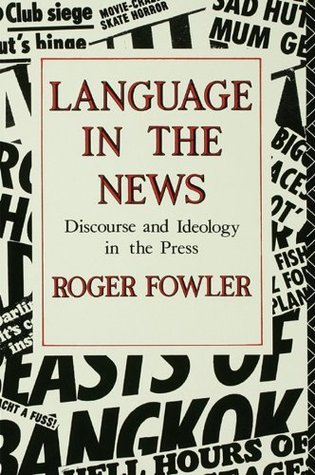
Newspaper coverage of world events is presented as the unbiased recording of `hard facts`. In an incisive study of both the quality and the popular press, Roger Fowler challenges this perception, arguing that news is a practice, a product of the social and political world on which it reports. Writing from the perspective of critical linguistics, Fowler examines the crucial role of language in mediating reality. Starting with a general account of news values and the processes of selection and transformation which go to make up the news, Fowler goes on to consider newspaper representations of gender, power, authority and law and order. He discusses stereotyping, terms of abuse and endearment, the editorial voice and the formation of consensus. Fowler's analysis takes in some of the major news stories of the Thatcher decade - the American bombing of Libya in 1986, the salmonella-in-eggs affair, the problems of the National Health Service and the controversy of youth and contraception.
A high three stars. Many of the concepts Fowler outlines are "obvious" (that women are referred to in the British press with diminutive and juvenile forms far more often than men, e.g.), they bear repeating (and, as Fowler points out, the very fact that it is "obvious" makes it important to state).
Mostly, I was impressed by how well so many of these discursive tendencies travel to the Japanese tabloids. (Well, not the linguistic parsing of headlines.) It made me reflect on what one might be able to consider a "universal" journalistic discourse, that probably reproduces and reinforces a value system that has its own history but has claims to universality in this day and age when "the world is flat."
Lukacs writes about journalists being those beings in the capitalist order doomed to be blind to the ideology they spout. B Anderson locates vernacular print journalism as a condition that enabled imagined national communities to emerge. So what of the "trashy" tabloid press today? More of the same or more of the different?
Very interesting. It seemed to me the author seemed slightly incapable of keeping his own political views out of the writing, but perhaps the era of the book and therefore the news discussed was a factor in this. Nevertheless, a good starting point for studying news articles a little more in-depth.
A very nice book that gives good clarification and provides systematic analytic framework on the relationship between ideology and language, between hidden political views and inclinations and their linguistic exhibited expressions. A manual for discourse analysts of written texts
The style in which this book is written is very conscientious and clear. This is a great introduction to critical linguistics as well as how to analyze news representation.