Man Alone takes place in a weekend. Beatrice has taken their daughters Elena and Fiona to the beach with friends. Phillip is left behind. In his ordered world, time moves to the rhythm of caring for others. But freedom disorients him. The house is different. Time is suddenly desirable. He has it, but it's still elusive. He still wants to organise time to save time, cook and freeze food to save time. Freed from time, Phillip moves between abstract thoughts: the meaning of a sublime moment, to observing a dripping tomato, caught at the beginning of recurring journey from experience to recollection in the future. He misses friendships. He goes into an alternate world. He wonders what happened to his school friend Johnson all those years ago? He tries to recreate the memories of Johnson as though he holds the key to something. He visits his mother who moved herself into a home for the aged. She has no answers about his childhood friend. She has begun to live an ever expanding present. He is left to find all the clues to who Johnson was through the imagination and memory.
An engaging first person narrative about being a father in the 21st century, questioning what it is to be male, the love of family and how to find an identity. The non-toxic version of masculinity; philosophical and engaging.
Nick Petroulias lived his entire life in Melbourne, Australia. He writes fiction with an interest in how we find ourselves caught in the domains of time, the natural world, and movements of human history.
Masterthief Press began in 1985 as the vehicle for the photomontage and artists books created by Melbourne artist and poet, Peter Lyssiotis. Masterthief has produced fine limited-edition books, works of poetry and collaborative texts between artists, photographers, architects, designers and writers. The work is held in collecting libraries and private collections in Europe, America and Australia.
In keeping with the tradition of bringing art and literature together, the cover of Man Alone features original artwork by young Melbourne artist, Scarlett Sykes-Hesterman. Future works of literature will continue to feature young local artists.
Masterthief is small, even for a small press. It will continue to produce, in slow motion, works that might otherwise never see publication, that hope to have a wider effect on the world than the size of their print run. All works will be author and artist generated.
Time, memory, and nostalgia, those were the themes of the last two books I read, and this book, chosen without knowing that it would be, was the perfect follow-up to Time Shelter and Lessons—though it treats their themes in an entirely different and much more economical way.
The author of Man Alone sets out as if to contain time by having his narrative cover a mere three days. But his narrator, Philip, a husband and father, alone at home over the course of a weekend, spends his alone time thinking about how he can stretch present time (make the most of his precious time alone), gain future time (make huge batches of sauces for the freezer), and regain past time (by examining his memories). Philip is so concerned with time that he even tries to stop it altogether by creating hiatus moments in his life. One such strategy he has used in the past is to deliberately miss his train to work after dropping his kids at school so that he can have a few moments of dead time between his obligations. The home-alone weekend presents the perfect opportunity for hours of such dead time—in spite of his ambitious plans for making sauces and in spite of the long list of things Philip's wife has asked him to do while she is away with their young daughters.
A lot of Philip's dead time is spent on the sofa thinking about the past, I feel like I'm browsing a second-hand store full of junk toys and furniture. He finds himself preoccupied in particular with a brief and golden time in childhood when he had a friend called Johnson. Johnson is a wonderful device on the author's part; he appears and disappears like quicksilver. Sometimes Philip has a clear picture of him and of the games they played, sometimes the picture is so fleeting, Philip is unsure if Johnson ever existed—and his mother, the only other witness to that time in his life, has told him she doesn't recall Johnson at all. Does a memory exist if no one else shares it? This book had me pausing frequently to indulge in my own bit of dead time as I tried to push open the doors of my memory hoping for glimpses of a few friends who briefly entered and exited my own childhood.
But the doors of memory are difficult to open as Philip and I both found out. Real doors open much more easily and they may cause the doors of memory to slam shut and the quicksilver shadows to slip from our grasp. ………………………………………………
This book chimed perfectly not only with Time Shelter and Lessons, but also with several other books I've read in the last few months. There was Max Frisch's Man in the Holocene about a man alone with his failing memory and his dwindling time, and the strategies he uses to cope with each. Then there was Jon Fosse's Septology, also about a man alone with his memories and his shifting relationship to time. I was reminded of that book a lot while I was reading Nick Petroulias's book because I was so implicated in both narratives while reading them that I found myself worrying about odd details in both protagonists' lives: would Fosse's Asle remember to feed his dog and put all the food he'd bought into the fridge before it spoiled; would Philip remember to turn down the heat under his huge pot of sauce before it boiled over or dried up completely, losing him present time spent cleaning up, and future time when he'd have to make it all over again. What a way to spend my own precious reading time! That said, I'm always happier reading about someone else's shopping or sauce making than actually doing my own.
Nick Petroulias is a goodreads friend, by the way, and I'm very glad to have read his truly beautiful book which I bought directly from Asterism Books.
Milan Kundera observed, "Most protagonists of great novels do not have children. Scarcely 1 percent of the world's population is childless, but at least 50 percent of the great literary characters are without children." Upon reflection, perhaps the primary reason authors write novels about women and men without children harks back to what the French novelist Pascal Garnier expressed through one of his male characters, who sees children as Nazis, ogres, vampires — sucking their parents' blood and wrecking adult lives. "They catch us in the prime of life and ruin our secret gardens with their red tricycles and bouncy balls that flatten everything like wrecking balls." Goodness, seen in this light, the rationale makes abundant sense: novelists can focus on the full bloom of their characters' inner lives, their adventures and challenges, their reflections and choices, since their fictional creations — their adult men and women—need not devote even a portion of their energy to children.
Nick Petroulias takes the opposite tack. The author's narrator/protagonist, Phillip, is a family man, living with his wife, Beatrice, and his two young daughters, Fiona & Elena. Ah, parenthood – one of the most formidable challenges in modern society, a society composed of nuclear families where parents, caring for their children, have taken on an all-consuming responsibility. "I no longer want the clutter of daily life that I've lived with for the past dozen years. I want the possibilities that solitude brings." Phillip's desire is not an uncommon lament of parents who come to fully appreciate the joys of solitude only after a life full to the brim with children. "How can so much maniacal energy flow from a creature that looks hand-drawn from a story by A.A. Milne?" So Phillip muses while dealing with Elena's floppy, lopsided sock. Anyone, like myself, who has had the experience of raising children will empathize with Phillip.
Man Alone is a compelling portrait of fatherhood where Phillip has a rare opportunity to actually spend an entire weekend alone since Beatrice will be taking the girls on a trip with her friend Rosemary and her two daughters. “I've wanted this weekend for a long time; to generate my own memories again.”
Now that he's alone, how will Phillip spend his time? What will he think about? "I have a theory about all this – that the pace of this family life leads me to forget who I am. The thoughts and events that constitute the entire impression of myself simply vanish." Phillip's reflections shed light on the sacrifices adults make on behalf of their children. Not only is one's identity set aside, but also a person's attention to their own needs is deferred as the needs of children consistently take precedence. In a word, one no longer thinks in terms of oneself.
Phillip thinks deeply about the nature of time, memory, and what constitutes his own personal identity, delving into his pre-father past, which extends as far back as childhood. To provide a more specific glimpse, here are a few snapshots:
Playing Games With Time - “Those few minutes of every day when something goes wrong – outside of my ability to correct it – allow me to play a sleight of hand with time, a game that has taken many years to master.” Phillip recognizes life will occasionally give him a break, will set him free. One such instance: after he drops the kids at school (always the perfect father) and before he arrives at work (always the perfect breadwinner), he might have to wait longer for the train (track problem, accident, weather, just missing his usual train). In those precious minutes, he has transcended roles and tasks and plans. For Phillip, time expands in the imagination. And, now, he has three whole days!
Reclaiming Personhood – Unlike the practice of meditation, where we're encouraged to let go of thoughts, Phillip takes a different approach. “I want to follow the path of one thought, freely associate images, themes, until the thought has its own form. I can be a memory.” Phillip's memory lands on a time when he was a schoolboy of thirteen and had a friend by the name of Johnson. And he's off. Houses, streets, trees, games, past feelings and imaginings – it all comes back. “There's this giant ledger of memories I've been allocate to choose from. Once we've entered such thoughts is forgetting impossible?”
Triggers – How do we measure our past? What events qualify as defining moments? Perhaps not surprisingly, Phillip proclaims, “I measure the passage of time through the girls.” There's a recollection of his conversation with Fiona while traveling to a specific cove when she asked him how old he would be when she is nine. His answer: forty. Fiona then asks how old he will be when she reaches certain ages in the more distant future, prompting Phillip to reflect on the effects of his past cigarette smoking on his lifespan. This, in turn, leads Phillip to contemplate his own death and his sense of self. “The movement of the line towards death is my identity.”
What I've noted above serves as a brief taste of what readers will encounter in Man Alone, a short novel (123 pages) about what truly matters in our lives when we find ourselves as parents (especially fathers) of small children. From the publisher's blurb: “The non-toxic version of masculinity; philosophical and engaging.” I can't think of a more apt description. Highly recommended.
Nick Petroulias has lived his entire life in Melbourne, Australia. Man Alone is his first novel
I had many plans in place. I put so many plans on hold that I lost track of them: people, books, movies, restaurants. Perhaps over the weekend I can order them in my head. An order of lost things. My head. That’s the only place I really want to stay in for the next three days. Alone. The weekend offers a set of possibilities.
This is Philip’s aspiration for the days his wife and two young daughters will spend away from him, on their beach holiday. He longs to be a ‘man alone’ after a long time of being a member of a clan. He longs for some ‘uncluttered’ days, for the ‘possibilities that solitude brings’. His love for his family is palpable throughout the book, but so is his craving to ‘generate his own memories again’, if only for the span of a weekend.
He reads ‘from his long list of unread classics’ and takes from Seneca’s work a single thought, ‘an equation by which to measure one’s life – that life is long if you know how to use it’. During his girls’ absence, he thinks, reminisces, meets with his childhood friend, tries to reconstruct the memory of another long-lost friend in an effort to recall something critical he has forgotten over the years. He’s pondering the thoughts and events that ‘make up the entire impression of himself’, all the while trying to put into context his reality, past and present, factual or imagined. His friend argues that the aim to find yourself is pointless, that you exist through your responsibilities, that ‘once you preoccupy yourself with yourself alone, you’ll end up looking backwards through an endless series of mirrors. And there you’ll endlessly obsess with your image’. So, our narrator spends a large part of his precious time making pasta sauce and chicken broth for future family meals, finding purpose and joy in the cooking ritual, the dissection of its minutiae and his fleeting thoughts. Throughout the book he never ceases to calculate the time spent on all those trivial activities that help sustain quotidian life. Time gained and time wasted. Too little time, never the right time.
What did Beatrice mean last Tuesday when she said, “we don’t have enough time”? Did she mean time for talking, time for travel, time for impromptu visits with friends, time for movies, time for fucking? The sauce might stick to the pot soon. …time for study, time for research, time for work, time for new experiences… I should go and check the sauce. …time for drinks after work, time for the kids, time for community work, time to help save the world... Beatrice will ask me: “What did you do while we were gone?” Which means, “how did you spend your time?”
Early on he admits that he’s the kind of storyteller who forgets “the dramatic turn of events, as if thoughts, actions, narratives, just flow without structure, method or an organizing principle”. Indeed, this is a stream of consciousness narration, a rumination on Time and Memory, a meditation on (and of) humble, everyday materials, a tender ode to parenthood and a gentle reminder of how a shared life compensates for all that is given up for its sake.
Nick Petroulias, the author of this novella, is a GR friend whose writing skill is evident in his reviews; I was happy to find the same quality in his fiction. But…was it fiction?? I don’t know much about his personal life, only that he lives with his family in Melbourne and he is of Greek origin. I’m guessing we’re in the same age group, which means that the frenzy of our child-rearing days is past us. Although his narrator has a different name, I suspect that most of the material is autobiographical. Many of his thoughts and his family’s rituals have been mine too, despite the distance in our lives’ geography. They reminded me of my own longing for ‘suspended time’ and that curious sense of incompletion when I was finally getting it. I smiled more than once in recognition of the mixture of elation and melancholia prevailing over this slim book.
Speaking of the book itself, I must comment on its physical beauty: Silky, heavy paper, elegant chapter layout, clean-cut, generously sized typography. I’m glad this book found me, since it’s not yet widely available in the market. Nick was kind enough to send me the link of Asterism Books, his publisher in the northern hemisphere and I’d be happy to share it with anyone interested, via GR messaging. It’s a book worth having and going back to, if only for that nostalgic place it transports its readers.
And this moment, this weekend, will be one of only a handful of moments through which I attempt to step outside the flow of time in which I live.
Aptly titled Man Alone, Nick Petroulias’ debut effort chronicles a weekend in the life of a man (Phillip) who's been married with children long enough to see a gulf form between his present domestic state and his former unmarried one.
This is not just any weekend, though. For the first time in a long time, wife Beatrice and daughters Fiona and Elena are off for a weekend beach vacation with another mom and her children. This means Phillip gets to fill his weekend as he wishes with time well spent.
But what is time well spent? Is it the same as it once was -- a time of carousing, loafing, reading, going out with friends? Or has it changed into something more practical, as in “buying time” for when the family returns by making enough spaghetti sauce to cover multiple future meals, thus easing the nightly crush of kids returning from school and parents returning from work?
Not a novel with a central conflict or plot seeking resolution, Man Alone is better described as a quiet, meditative piece. René Descartes had best move over, too, because his first and foremost precept “I think, therefore I am” is about to get a workout, as Phillip mixes the weekend occupations of Everyman with midnight cogitations of philosophers.
Of specific interest to Phillip is the concept of time. How do our memories stretch it, shrink it, eliminate it? To tackle this, Petroulias has his narrator return over and over to the niggling question of Johnson, a kid he knew briefly in grade school but struggles to recall. Phillip begins to question whether a person can even exist if he is forgotten. Like a tree falling in the wilderness, existence might depend on sound. Or defy it. Memory might also be like a ladder, each rung depending on the last time you thought of the memory.
As Phillip's foil, we have Daniel, a friend from high school days that he meets for a drinks at a local café. They are, unsurprisingly, drifting apart, and Daniel can’t help but rib his friend for thinking constantly of his wife and the girls when he has license to focus on himself. Or is it his former self? Or are the two – bachelor and married father – two personalities forever struggling with each other in the same body?
Overall this first-person narrative stops and smells the roses while musing over its thorns – quite leisurely in its pace, yet strangely compelling for it. A lot of Phillip’s observations on matters quotidian come across as aphoristic:
”And the coffee? The potential pleasure of the second cup comes with the release from the drug urgency of the first. The period before drinking the second is better than the one before. I’ve learned to appreciate the cessation of pleasure and the let–down of satisfaction.”
There’s also debate with his still-single friend over the direction his life (and its thought process) has taken. At one point, Daniel goes for the jugular: "You think that because you have kids, you have automatic access to great insights to the world, don’t you! You think that if you can’t arrange to see your friends, or have a life beyond your children and family, then that gives you the right to an endless stream of dead-end feelings looking for sympathy. Am I close? I think I am. You feel depressed. You even look depressed. You probably even want me to share your depression. You can’t get your act together because you have the best excuse in the world to do as you please – to leave life and play dead. To disappear up your own arse.”
To which Phillip wonders whether there’s any point in a riposte, though he does consider rejoinders, such as the fact that Daniel “will remain a child forever for not having children of his own.”
It’s a tough and familiar grind for men. Friendship, I mean. Especially when one marries and the other remains single, each wondering if the grass is greener. Meanwhile, there's the approach of Birnam Wood, seen by the reader like a piece of dramatic irony. Time. Memory. Death. Happiness. Finding a way. Sure there is a way, even while suspecting there might not be.
A lot of heavy things, in other words. Things that loom larger and louder when the house is suddenly empty and expectations and anticipation run into the realities of the human mind and its gloriously painful capacity to think (and therefore be).
Reading this unique work left me to wonder what I would do in a similar situation when my kids were young and still living at home. I mean, in such straights, Friday to Sunday looks HUGE. Alas, I think I often burned time just thinking about what to do with it. Making false starts. Ruminating on the past instead of creating the present. Or, perhaps better said, wondering if I can make like Dr. Frankenstein and bring the distant past back to life by hitting it with electric bolts of revelatory thought.
Thinking. It can be enticingly painful. This is one man's 3-day journey toward proving the point.
1. The book starts with lists. The wife of the narrator — a very ordered character — writes a list of “everything she aims to complete” before parting on an extended weekend holiday together with her two daughters and a friend of hers. The list also includes things to take on the holiday.
2. She also writes a list to her husband, the man left home alone for a few days, so that he will know what to do in her absence. Interestingly enough for me, his list is written on a sheet of paper torn from a calendar. I wonder — and I hope this is not too far-fetched! — if that piece of calendar isn’t the metonymy of literature’s history in its greatest albeit fragmented (torn) temporal span? I guess that the very first scriptures were lists and, closer to our time and culture, at the very beginning of known Western literature, more precisely in the Iliad, Homer made an ovational list of Greek battleships. That’s when list-making actually premiered, as far as we readers know. The span of time between these two works of literature (Homer’s and Petroulias’) is as immense as the contrast between the lists they contain: one is in hexameters, while the others, in this book, are all scribbled on pieces of paper for the use of a household; one is epic, enduring, proudly sung by generations of bards so as to cross all ages, and to this day we, so to say, inherit those battleships in written form, and in all languages. The lists of ‘man alone’ (title adequately written in small letters) pertain to the everyday life of a family, are made exclusively for the orientation of this family in its daily life; these lists are transmitted merely from wife to man, or vice versa, they hang for a while on a wall and are as disposable as the pages of the calendar they are written on, as ephemeral as the child drawings on these same pages, those made by one daughter or the other, because, I forgot to say, the calendar in question is a ‘school calendar’, handmade by the children.
3. The calendar is thus the book of the family, because all of its members put their lines in it, colourful or monochrome lines that sketch some of the forms and meanings of seasons and days, the plans and moods of parents and children. But it’s a book that — alas, like all books of its modest kind — literally flies off the wall. In time and place, this Australian author of Greek descent stands ‘alone’ on the opposite shore of Ancient Hellas with the prose of one man, his chores and reminiscences (his memory and internal time are the central scope of the narrative), his secret struggle for some solitude, a collaterally gained weekend, all this contrasting with, or reflecting in the negative (at least for this reader), the deeds of great warriors, the schemes of shrewd Ulysses, a grandiose work — The Iliad — (as opposed to the minute, everyday one of any parent) that has imposed itself upon the collective memory and founded Western literature.
4. We resonate with the lines of this book as with perceptions of our own “normality”. It’s surely very hard to write prose that enters and goes straight through the prosaic without becoming prosaic itself, subtly extracting a narrative flow from the everyday. Knausgaard does this at his best, Lee Klein too, and, as I now see, Nick Petroulias. They all somehow make normality fascinating, turning what in the hands of other mortals would be trivial life-logs into live page-turners.
5. Coming back to the torn piece of calendar: there’s a big break between the epic and the everyday, between making glorious ancient war and doing modern, modest chores. The break between contemporary prose and the classical epic. I will call this the “meta-time frame” of (my reading of) this book (“meta” is Greek…). The objective, history-of-literature, or comparative-literature time frame.
6. Somewhere within this large literary scale, a bit later in the book, the narrative turns Proustian in a very down-to-earth way. I will call this “the internal or personal time frame.” Here, coping with his weekend alone, in a break from busy family life, the narrator finds himself instinctively trying to find a distant childhood friend through memory, reminiscing about him in spirals of never-closing circles.
7. I had to interrupt making this list because my own wife sent me to the shop to buy what she forgot to buy earlier. I kept in mind the list she dictated to me: “pita, goma, lemons”. We had some tasty chicken wraps afterwards. I mention this because I know the author is a gourmand, and this is wonderfully reflected in the book.
8. Funny that the first chapter is titled Friday Begins on Thursday. I got three copies of the book on a Thursday in February. I gave one to a friend, and another one will hopefully soon get a place in my local public library. That first Friday, I wanted to start reading man alone, but unfortunately didn’t have the time. Last Friday I started reading it without thinking that it would be nice to start reading it on a Friday to synchronise (another Greek word) my reading schedule with the narrative and to make out of this a catchy point in my review. The weekend and the following week until this Friday, now when I finally read and write again about man alone, were very busy. I’m working around 65 hours per week lately. In the morning I produce thermostats — that’s my full-time job. I also took an extra job, temporarily, in the evening, at a sawmill.
9. Describe work at the sawmill. I can’t. As are the minute chores of man alone, my hard labour at the sawmill is so far away from ancient Hellenic heroism that it begins to resemble it, by contrast. The way I throw 20x20/570cm beams onto pallets makes me modestly think of the way Achilles threw the spear that killed Hector. I won’t make a list of beams and planks by size and by the kind of wood they were cut from. Full-size tree trunks come into the machine at one end, and I get, on a huge conveyor belt driven by chains, to manipulate the first cuts (the raw material of future constructions of all sorts, from fences to houses) by physical force (no cranes I can rely on) and the techniques that I acquired by studying the methods of Fane and Bobi — my super-strong and incredibly kind colleagues. There are ways of rotating, jerking, pulling, hinging (by using bodyweight) and throwing large beams by using momentum, ways of sandwiching planks before stacking them on the pallets, etc. One of my favourite methods is shaking planks into position, which, by a ridiculous analogy, I can call “The Shake-spear Method”...
10. Before and long after I started to master these methods, multiple muscles of my body got sore at various degrees, which allows me to classify them in the order of importance for the work I can perform thanks to them:
11. Probably the biceps deserve first place — they are almost constantly sore from the complex lifting with supination they are involved in. Naturally, they are closely assisted by the forearm muscles (abductors) and the deltoids.
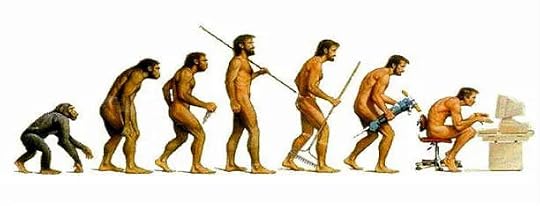
12. Next come the triceps and the latissimus dorsi, ex aequo — for all the horizontal and oblique pulling towards and along the body. Neither should the contribution of the trapezius and the rhomboids be ignored here — these are true weaklings for the typing creature at the end of this famous evolutionary diagram:
13. Very closely follow the pectoralis major, highly involved in pressing the beams onto the pallets and down on the side of the conveyor (in this the pecs are assisted by the lats and triceps).
14. The abdominal muscles — mainly the external obliques — play a key role in stabilising and smoothening most of my movements, especially the arm jerks combined with the concomitant twisting of my tormented torso.
15. The Gluteus Maximus (my butt), which I salute Roman style, is assisted in this wood-war campaign by his loyally hinging hamstrings.
16. Working-class heroism is far from, but strangely akin to, ancient heroism!
17. All the rest of the leg muscles get an honourable place, as I never made fewer than 20,000 steps on working days, the top being 23,689 (or 17.3 km) according to my old Garmin watch, which actually makes a gross underestimation in that it’s not even counting the (innumerable!) steps I make on the spot while manipulating the heavy material that brings sweat to my brow.
18. Because of my busy schedule lately I didn’t have the time to read most of the books that I borrowed from the library. I unfortunately had to give these back without reading or finishing them:
Vies minuscules — Pierre Michon
Necrópolis — Santiago Gamboa
Gli Esordi — Antonio Moresco
Vilhelms værelse — Tove Ditlevsen
Romans 1 et 2 (Voyage au bout de la nuit, Mort à crédit, D’un château l’autre, Nord etc.) — Louis-Ferdinand Céline
Proleterka, La paura del cielo — Fleur Jaeggy
Kødets ingeniører — Karl Ove Knausgård
My ample listening time at work compensates a bit for the lack of time I have to sit down to read books at home. During this intense labouring period I’ve relistened to:
Mes amis — Emmanuel Bove
L’amant — Marguerite Duras
Gehen — Thomas Bernhard
An audio anthology of Daniil Kharms’ prose in Russian
A volume of essays by Knausgaard in Danish
Du côté de chez Swann — Marcel Proust
Prosa — Franz Kafka
19. I have to take my time reading man alone, or rather grasp (carpe) the short, rare intervals of time that I have when alone and not too tired, intervals that often, fortunately, match the length of a chapter. The whole narrative is marked by time — as mentioned above — and is Proustian in a down-to-earth way.
20. To this regard, I’ll connect some quotes with margin notes:
21. “We need people around us to remember who we were, to help piece everything together for us. Without them, we cease to exist for long periods. [...] There is a danger that when you are alone no one can confirm who you are for that period. You have no alibi for your existence. No one can tell a story about you.”
22. “She [Beatrice, the wife going on her weekend off with the children] is in a hurry, but I want to slow things down now into a manageable flow of time in which each task exists of and for itself. I no longer want the clutter of daily life that I've lived with for the past dozen years. I want the possibilities that solitude brings.”
23. “As my theory has it, if this life keeps up, I will run out of time to maintain the idea of who I was and, by extension, who I am. And then I will have disappeared.”
25. “I want to follow the path of one thought, freely associate images, themes, until the thought has its own form. It can be a memory. Unlike meditation, distractions become my path. Instead of nirvana - I don’t want to go there I open thoughts like a series of endless doors.”
Other, overlong margin notes:
Time is gained in moments when the routine fails, or when he finds himself left outside it, by sheer chance.
He rationalizes time, both in the sense of pondering on it, and in determining its rations, assimilating and consuming them, even the leftovers of time:
“most mornings I probably brush my teeth for a few more strokes, sip my coffee that little bit more slowly, iron my shirt a little more thoroughly, fuss over the girls for a few more moments.”
26. If the parallels with the Iliad were not far-fetched enough, I should mention that even earlier in The Great Calendar of Literature, which has many blank squares and even misses some of the pages torn out and turned to dust by the wind of time, we can nevertheless inscribe with certainty the Epic of Gilgamesh on one of the first days of January, and man alone on one of the last days of December. Why did that cuneiform masterpiece come to mind? What’s with all this comparative-literature mood I’m in?
27. Both these books are, at their core, stories of friendship. Gilgamesh seeks to revive his friend. He goes to the end of the earth to cure him from death. The man alone character travels in his memory.
28. Gilgamesh — tyrant — a patriarch of his people — alone.
29. man alone — democratic family man (though the family is slightly matriarchal) — rarely alone.
30. Both have a quest which is ultimately deeply psychological, though the action (if one can call it that) is for one in the realm of fantasy, for the other in the inner realm of memory.
31. What does a man do when left alone? Now, take my suppositions cum grano salis, because I too was rarely left alone… but my guess is that many men would helplessly wait to be saved by a woman (or by another man, if that is the case), merely pretending to do something in the meantime. The manliest men would immediately seek to conquer and control, conquer a world for themselves, populated by those needed (affiliate with some of them, control the others). Very few men would create for themselves and others what always escapes conquering and control and is more genuine than that which can be conquered and controlled. Proust, for example, created his time “regained” (temps “retrouvé”, in fact). Remember the part about the madeleine? Actually, memories cannot be “gained”, conquered, or controlled; they are found, and they need our most fragile senses and the help of our creativity to come back to us.
32. Lists are probably the most hopelessly humane pieces of writing. They reflect a mess that they are seemingly putting into order, and they are, all of them, destined to be infinite and incomplete. They are a form of sketched projects or projections (either of a documented past, or into the future), less illusory than fully formulated plans (regardless of whether we are talking about a planned day in the life of a man alone or the Five-Year Economic Plan of the USSR).
I only recently learned about my Goodreads friend's debut novella, published in 2022. It’s a refreshing piece of “literary guy lit,” with a first-person protagonist who is neither drunk womanizer, nor alienated philosopher, nor confused loser, but first and foremost a parent and husband sprung free for a weekend from the overwhelming worlds of home and work. It's a naturalistic work that feels like a memoir, but not like one I've ever read.
Time and memory are the themes, and the book’s present tense is perfect for this: after all, memory is the present tense of the past (and yet usually handled in the past tense). Those who insist on show instead of tell won’t like the way Petroulias handles these themes. I liked it.
Unusually, this novella is only available (at least in the U.S.) in paperback, with smooth, thick stock that’s very readable.
Man Alone consists of the ruminations of a husband and father left alone for the weekend by his wife and daughters, who are heading out to a beach cabin. For the first time in years, Phillip is by himself. Man Alone can be read as a counterpart to novels by women, aching for time alone, for a room of their own, women whose sense of self has become lost among the identities of and duties owed to their children, jobs, and spouses. The “selflessness” of a caretaker is sometimes best understood literally:
"There’s a fear when facing a lull. Without the routine of the girls in the house, I move around the house like a fly caught in a repeating square flight path. I’m no longer energised by their absence."
Phillip takes on the caretaker role in his household, voluntarily so, in his case, being the partner with the job offering the more flexible schedule with the fewer demanding ours, doing the laundry, cooking, grocery shopping, and sheepherding of his daughters Elena and Fiona to school and their events, and doing what he can to make the life of his wife, Beatrice, easier. His vision of the future, while house-husbanding, extends no further than the outfits Elena and Fiona will need for school tomorrow morning or predicting when the freezer will need to be refilled. He enjoys the responsibilities and thinks of almost nothing else.
While the narrator looks forward to maximizing his time alone, his promised 48 hours solo—maybe 72 if his wife decides to spend an extra day—it takes 20% of the novel’s length to get the girls out the door, and most of his thoughts are about them rather than his plans. He also spends a great deal of his time (up to the book’s halfway mark, at least) jarring food for future family meals. So much for alone time!
Phillip exhibits introspective qualities akin to those found in Nicholson Baker’s early books, such as Room Temperature and Mezzanine, when mulling over daily minutiae. But although Phillip’s daughters are still in elementary school, often the narrative tone is of a man older than presented here—say early middle age, mid-30s to early 40s—more akin to the contemplative musing of characters novels by Sam Savage (The Way of the Dog, Glass, It Will End with Us), where the reflections are products of six decades or so of experiences and the thoughts serve more as a summing up than a way forward: Phillip often talks of “last times”: “Is this the last time I saw my childhood friend? Is this the last time I experienced X, smelt Y,” etc.
Phillip’s thoughts about Johnson, a near-anonymously named kid from elementary school Phillip has obsessed about over the years for reasons he can’t determine—the mystery itself concerns him as much as the cipher Johnson. Phillip cannot recall of what their friendship consisted, when or why the kid’s family moved. He has dim recollections of what Johnson wore, and his memory suggests that Johnson lived in a different neighborhood, which would have required parental permission from Phillip’s mother to visit, which Phillip is almost certain he did. His mother remembers nothing of Johnson, nor does Phillip’s old friend Daniel, whom Phillip hasn’t seen in years and with whom he’s promised to meet up with during his sacred solo time.
Seeing Daniel isn’t the joyous meet-up Phillip had hoped it might be. Have their mutual interests thinned over the years, replaced by divergent paths, duties, and goals? Is the friendship tenuous? Has each of them evolved and changed so much that only memories hold them together any longer?
Author Nick Petroulias, through his character Phillip, seems to suggest that our sense of self is based to a great degree on who we owe allegiances to, the conditions in which our loves and likes of others flourish, and the ways in which our desires to express our affections by the giving of ourselves. Perhaps our sense of self is strongest when we think of ourselves least.
Earlier today it took me a long time to realise that my body and mind were already moving into a different direction to the day before. A planet's orbit is affected by the gravitational forces of the sun and other bodies around it so that it moves in relation to others. With the others gone, the course of my orbit has shifted. There must be a name for what I'm experiencing.
That time I got over the overnight ferry at Devonport my body stayed in motion for several hours because of the effect of the sea. That effect has an expression: I hadn't regained my land legs. But there's no name for this other experience. This is the first full day I've spent apart from the others to feel the divergence from them as a bodily sensation.
Phillip's life triggered one of my biggest existential terrors, parenthood, that is. The triviality and repetition of the family routine can be rather exhausting, I reckon. Nothing much happens but at the same time everything happens, things to be forgotten, all the dinners that have to be prepared, the lists of all the daily chores, the broken toys to be mended, the struggle of puting socks to a rebelious four year old... These are problems of no great significance-supposedly- yet how many people are adequately aware and prepared for the family microcosm?
But there's something else that terrifies me, this dilusion of one's existence, a reduction that is necessary in order to achieve the sense of togetherness that defines the familial bond, this is something I've experienced from the perspective of a daughter... and then I turned 18 years old and happily broke free. Motherhood would have made me stick my head inside an oven, eventually, I'm the living example of why some people shouldn't be forced to procreate.
Oh well... Back in the 1950s the world population was 2.5 billion. Nowadays it's 7.3 billion. I think it should be OK for people who don't want to make a family to be allowed to do so. But there's still pressure and in many cultures is still deemed unacceptable for women to remain single. The ticking clock or the social norms, what difference does it make. How many women (and men) rush to fulfill a role they are not ready or even made for?
But Phillip is nothing of the sort. And this book is neither a thriller nor a comedy, it's the quiet meditation of a father, a caring, disoriented but loving papa, who gets to spend a weekend alone at home , while Beatrice, his wife, and their two daughters, Elena and Fiona, go for a short vacation. A man alone.
Men are not usually depicted as such and it's so refreshing to read something that defies the stereotypes in a wholesome and non militant manner. He is very conscious about his fatherhood despite his somnambulistic automation and day-to-day repetition which is a prerequisite for the stability of his family life. At first I was worried that his temporary halt of his daily routine would lead to some kind of a disaster, that he would realise how trapped and unhappy he is and snap or that a huge catastrophe might occur and destroy his peaceful and tidy life. But no. This is not a book about regrets or second thoughts.
Good parenting lacks the polished insta-perfection or exaggeration for comedic purposes or petty drama. It's a human interaction that requires balance and stability, a structure to form long lasting relationships that evolve and develop.
You see, Phillip, grew up as a neglected child but not as an unloved one. It just so happened that his parents were poor and had to work long hours. So he was pretty much a child alone. And he suffers from a childhood memory gap. That can be rather haunting, this inability to remember the past correctly and have no one to record or retrieve your memories for you.
I don't know much about Nick Petroulias outside the things he chose to share inside the Goodreads book review community, a respectful, caring, accepting individual, avid reader. I bought three copies of his book with my own coin, one for me, one for my friend Pirjo that will soon travel to Finland and the third one I will try to donate it to a Greek library- I so hope the Central Municipal Library of the City of Athens, the one near the Larissa metro station, will accept it. If they catalog it I will come back with an update to share the link. I don't want this book to end up lost and forgotten. Parenthood in Greece is still heavily influenced by the patriarchal doctrine that requires for men to be the breadwinner and quite uninvolved and for women to be the main child carers. Well things change and it's always good to have books that provide an alternative worldview.
Ένα αγαπημένο απόσπασμα μεταφρασμένο στα ελληνικά:
Λίγο πριν το ξημέρωμα ένα συνειδητό όνειρο εισέρχεται στον ύπνο μου, ένα όνειρο που έρχεται και φεύγει σε διάφορες εποχές της ζωής μου. Μέσα στο όνειρο κάμποσοι πίθηκοι, στο μέγεθός μου αλλά πιο μεγαλόσωμοι- τα όνειρα μπορούν να προκαλέσουν τέτοιες στρεβλώσεις- με κυνηγούν μέσα σε έναν περιτειχισμένο κήπο με μονοπάτια από πέτρινες πλάκες και παρτέρια με πλούσια καταπράσινη βλάστηση. Με το πέρασμα του χρόνου κατάφερα να φτιάξω χάρτες με τις τοποθεσίες των μονοπατιών και σχέδια των παρτεριών. Μπόρεσα να αναγνωρίσω κάμποσα από τα φυτά που εμφανίζονται, κολοκάσια, κορδυλίνες, μονστέρες καθώς και διάφορα άλλα φοινικοειδή δέντρα και φτέρες των οποίων τα ονόματα δεν έχω ανακαλύψει ακόμα- και δεν είναι μόνο τα ονόματα των φυτών αλλά κι εκείνο της πέτρας, ένα είδος βασάλτη - τραχύ και γκρίζου σαν εκείνον από τον οποίο είναι φτιαγμένα τα παλιά κτίρια και τα κράσπεδα των πεζοδρομίων. Κάθε φορά που βλέπω το όνειρο καταφέρνω να αναγνωρίσω και κάτι νέο, ένα καινούριο στοιχείο. Και με το πέρασμα του χρόνου προχωράει και η ανακατασκευή του τοπίου. Φροντίζω να κρατώ σημειώσεις και σχέδια προκειμένου να τα έχω ως οδηγό την επόμενη φορά που θα δωτο όνειρο αν και το σκηνικό παραμένει πάντα το ίδιο. Κατέληξα να είμαι ο επιμελητής του ονείρου. Όπως τα κορίτσια παίζουν με ένα κουκλόσπιτο μετακινώντας τα έπιπλα και τους ενοίκους. Το όνειρο μου έρχεται αβίαστα ωστόσο είμαι πεπεισμένος πως πρέπει να έχω κάνει τις απαραίτητες προετοιμασίες. Ωστόσο δεν νομίζω πως κατάφερα ποτέ να αλλάξω την πορεία του ονείρου μέσω κάποιας συνειδητής παρέμβασης.
Το όνειρο πάντα εκτυλίσσεται μέσα σε ένα απαλό γκρίζο φως που μοιάζει με δύση ή αυγή. Τρέχω μέσα στους λαβύρινθους του κήπου και οι πίθηκοι στο κατόπι μου. Κάθε φορά φτάνω σε ένα σημείο όπου νιώθω πως τους έχω ξεφύγει αρκετά ώστε να νιώσω ασφαλής αλλά τελικά κάνω λάθος και παγιδεύομαι. Σε αυτό ακριβώς το σημείο ξυπνάω. Ίσως να γνωρίζω πως μπορώ να ξυπνήσω βρισκόμενος σε μία κατάσταση μεταξύ πραγματικότητας και φαντασίας. Εκεί μπορώ να επικοινωνήσω και με τα δύο. Κατά τη διάρκεια ορισμένων σκηνών μέσα στο όνειρο χτες το βράδυ θυμάμαι να λέω στον εαυτό μου: Αν ακούσω το κελάηδημα των πουλιών, θα έχω αργήσει να γεμίσω το αμάξι ώστε να φύγουν νωρίς.
Έχω εξασκηθεί στο περιγράφω το όνειρο στην εντέλεια. Κάπως έτσι κατέληξε να είναι τμήμα της ιστορίας της ζωής μου. Χωρίς τέτοια γεγονότα θα εξαφανιζόμουν. Αυτός είναι ένας φόβος που επιταχύνεται με το πέρασμα του χρόνου. Το πέρασμα του χρόνου πρέπει να προσδιορίζεται από γεγονότα. Οπότε το όνειρο γίνεται η αρχειακή καταγραφή αυτού του χρόνου. Το όνειρο είναι αλληλένδετο με την ιστορία ενός αγοριού που ήξερα από το σχολείο όταν ήμουν σε ηλικία περίπου επτά ετών. Ένα αγόρι που το έλεγαν Τζόνσον. Να τι έχω καταφέρει να αναθυμηθώ από αυτόν: Το όνομά του και κάποιες σκόρπιες λεπτομέρειες που έρχονται και φεύγουν. Παραμένει ως μια συστάδα από ακανόνιστες, ανεπιβεβαίωτες σκέψεις. Κι απομένω με το βάσανο μιας αδιάκοπης αναπόλησης. Όπως έχω εγώ αναμνήσεις από εκείνα τα πρώιμα χρόνια σχετικά με εκείνον, ίσως κι εκείνος να έχει διατηρήσει κάποιες αναμνήσεις από εμένα: Απόδειξη πως υπήρξαμε, πως γνωριστήκαμε και πως κάποια περιστατικά συνέβησαν στα αλήθεια. Αλλά ακόμη κι ο Τζόνσον εξαφανίζεται μέσα στις λεπτομέρειες της τωρινής μου ζωής. Καθώς επαναλαμβάνω το όνομά του, ξαναβλέπω το μεγάλο χαρωπό του πρόσωπο μπροστά στον φακό της μηχανής την ημέρα που τραβήξαμε τη σχολική φωτογραφία. Φανταστειτε την πιο χαρούμενη φάτσα που είδατε ποτέ σας. Αυτό ακριβώς είναι το πρόσωπό του. Αυτή η εικόνα αναζωογονεί για λίγο τις σκέψεις μου κι έπειτα εξαφανίζεται. Μια αιφνίδια δόση ντοπαμίνης, που διαρκεί όσο και η ανάμνησή του. Μέσα στο πέρασμα των χρόνων παραμένει θολός. Σαν παζλ καμωμένο από ένα και μοναδικό κομμάτι.
Αν ήμουν στη θέση του ήρωα, θα εγκατέλειπα ευχαρίστως τα πάντα, χωρίς δεύτερη σκέψη, για να ξαναβρώ τον χαμένο κρίκο της παιδικής μου ηλικίας.
Being a parent gives one plenty of occasion, but rarely the opportunity, to think about time, how we experience it, and its effect on memory. These are the things that occupy the narrator of this thoughtful book, for whom time is so regimented and guided by routines that when a long weekend alone presents itself, his sense of time seems to simultaneously expand and contract. There is the planning of all that could be done with the time, to enjoy it and to buy more time in the future. There is also the fleeting sensation of time slipping away -- the countdown of time until the family returns. I see a version of myself in the narrator and passed a good bit of time following his reflections.
One thing that stood out for me in this book were the constant and varied reminders of time. Because it is so much a part of our daily experience of the world, it is easy to see markers of time all around us. For the narrator, time is not simply measured in days, hours, or minutes. It is measured in lifetimes, the passage of daylight, a sauce thickening, the decay of a garden, the ticking of a clock. There are also individually-relative markers of time like the time spent in anticipation of an event, the delay between an imagined event and the news of it reaching the narrator, even the Doppler sound of car tires moving closer to and away from the driveway has a temporal aspect.
All these potential temporal markers structure the experience and perception of time differently. For some experiences of time, we may remember many details, resulting in a high fidelity recollection. For other experiences, time may be compressed into a few notable or functionally summative events: we went out, I made dinner, I went to work.
Another aspect of the book that I liked was the reflection on parallel experiences of time belonging to our children, our spouses, our friends, our parents, and total strangers. Maybe even time belonging to places and things. I imagined these experiences of time metaphorically, as vectors with direction and speed that cut through the other vectors. At any given moment of intersection between vectors, our experiences may mediate one another. If the angle of intersection is shallow enough, our time may, more or less, run in parallel with someone’s or something’s time (for a time), mutually mediating, setting into routines that form deep channels of habit that, even when those strands of time do diverge, the shared mediational experience leaves a palimpsest, like the way the terrain flows around a building that used to be there or a road follows an old wagon trail, making unusual turns that would have made sense to the mule-team driver who used that path hundreds of years prior. And those strands of time that we meet at a steeper angle, they may have a glancing effect: leaving fleeting and potentially untrustworthy memories like the “Johnson” our narrator remembers only by last name and a Miller t-shirt. And the lines that we meet perpendicularly are those who may leave no trace at all: the chance encounters with people we will never see again.