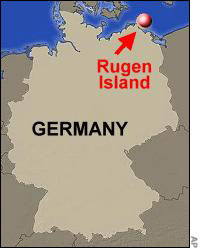
"Every one who has been to school and still remembers what he was taught there, knows that Rügen is the biggest island Germany possesses, and that it lies in the Baltic Sea off the coast of Pomerania. Round this island I wished to walk this summer, but no one would walk with me. It is the perfect way of moving if you want to see into the life of things. It is the one way of freedom. If you go to a place on anything but your own feet you are taken there too fast, and miss a thousand delicate joys that were waiting for you by the wayside."
The Adventures of Elizabeth in Rügen by Elizabeth von Arnim
Elizabeth von Arnim (31 August 1866 – 9 February 1941), born Mary Annette Beauchamp, was an English novelist. Born in Australia, she married a German aristocrat, and her earliest works are set in Germany. Her first marriage made her Countess von Arnim-Schlagenthin and her second Elizabeth Russell, Countess Russell. After her first husband's death, she had a three-year affair with the writer H. G. Wells, then later married Frank Russell, elder brother of the Nobel prize-winner and philosopher Bertrand Russell. She was a cousin of the New Zealand-born writer Katherine Mansfield. Though known in early life as May, her first book introduced her to readers as Elizabeth, which she eventually became to friends and finally to family. Her writings are ascribed to Elizabeth von Arnim. She used the pseudonym Alice Cholmondeley for only one novel, Christine, published in 1917.
Elizabeth von Arnim, born Mary Annette Beauchamp, was an English novelist. Born in Australia, she married a German aristocrat, and her earliest works are set in Germany. Her first marriage made her Countess von Arnim-Schlagenthin and her second Elizabeth Russell, Countess Russell. After her first husband's death, she had a three-year affair with the writer H.G. Wells, then later married Earl Russell, elder brother of the Nobel prize-winner and philosopher Bertrand Russell. She was a cousin of the New Zealand-born writer Katherine Mansfield. Though known in early life as May, her first book introduced her to readers as Elizabeth, which she eventually became to friends and finally to family. Her writings are ascribed to Elizabeth von Arnim. She used the pseudonym Alice Cholmondeley for only one novel, Christine, published in 1917.
I am on an Elizabeth von Arnim kick. Five novels read and something like 12 to go. What got me started was ‘Vera’ and that was an incredibly good book and then I read “The Enchanted April.” After that I was hooked and off to the races with ‘The Caravaners’ and then ‘Elizabeth and Her German Garden’ and then ‘Expiation’. They were all different enough from each other to stimulate, but I am beginning to see some stylistic elements in her novels that are trademarks of hers.
To wit, here the protagonist’s coachman, August, has left his coach with Elizabeth in it behind, while he rides his horse (this is circa 1900) up front (unaware the coach car has been disengaged) for an hour or so before he realizes things are mighty quiet back there (I guess he prefers to stare ahead for prolonged durations). He finally realizes he has left Elizabeth and her maid Gertrud in the dust and he hysterically rides back to fetch them. And so there is this exchange between him and a small crowd of villagers who have gathered I guess to provide aid and comfort to Elizabeth. • ‘Finally,’ continued August, not to be stopped in his excited account, ‘finally by the mercy of Providence the map used by the gracious one fell out’—I knew it would—‘as a peasant was passing. He called to me, he pointed to the road, I pulled up, I turned round, and what did I see? What I then saw I shall never—no, never forget—no, not if my life should continue to be a hundred.’ He put his hand on his heart and gasped. The crowd waited breathless. ‘I turned around,’ continued August, ‘and I saw nothing.’ • ‘But you said you would never forget what you saw,’ objected a dissatisfied-looking man. • August: ‘Never, never shall I forget it.’ • Man: ‘Yet you saw nothing at all.’ • August: ‘Nothing, nothing. Never will I forget it.’ • Man: ‘If you saw nothing you cannot forget it’ persisted the dissatisfied man. • August: ‘I say I cannot—it is what I say.’ • Man: ‘It is impossible to forget that which has not been,’ called out the dissatisfied man as August passed him.
Which is reminiscent of the funny scene involving Wymess in the novel ‘Vera’. Wemyss is remonstrating against one of his maids. He sees that the piano cover is missing a button. He wants everything just so, exactly just so, and someone is to blame for the missing button. • “Look at the piano-leg,” said Wemyss. The parlourmaid, not knowing which leg, looked at all three so as to be safe. • “What do you see?” he asked. • The parlourmaid was reluctant to say. What she saw was piano legs, but she felt that wasn’t the right answer. • “What do you NOT see?” Wemyss asked, louder. • This was much more difficult, because there were so many things she didn’t see: her parents for instance.
Which is reminiscent of Mrs. Fischer in ‘The Enchanted April’ when she dislikes a mannerism of speaking of Mrs. Wilkins. “You see,” Mrs. Wilkins said—a silly trick that, which she mostly began her sentences; Mrs. Fischer each time wished to say “Pardon me—I do not see, I hear”—by why trouble?
In the present novel, the protagonist is rarely called by her name but from the title we know it is Elizabeth. Only once or twice is there mention that she has a husband and children. She is very well off, so one can imagine maids and governesses are taking care of the children. Elizabeth wants to take a fortnight to see Rügen, a picturesque island in northeast Germany located off the Pomeranian coast in the Baltic Sea. I had the 1904 edition and what was a nice bonus to the book was the inlaid 2-page, fold-out map at the beginning of the novel showing a drawing of Rügen and a red line drawn by Elizabeth on the drawing outlining her route taken during the 11-day trip. She runs into a cousin she has not seen in 10 years, Charlotte, and that makes for an entertaining part of the novel. Charlotte, 10 years earlier when she was 19 or 20 years old, ran off to get married to a 60-year old Professor who was well-known (and full of himself and interested in women younger than he). Anyway, in the course of the story we also run into that Professor now 70 (and Charlotte now 30) and another pompous windbag, Mrs. Harvey-Browne, a bishops’ wife.
Elizabeth von Arnim used the penname “Elizabeth” for most of her novels — in this one she used “by the author of Elizabeth and Her German Garden”, so I will use “Elizabeth”. Elizabeth had me laughing out loud or chuckling on more than one occasion, as she has had me doing with her other novels. I would give this a very solid 3 stars. If you were interested in dipping into her oeuvre, this is not a novel I would recommend starting off with. It is an amusing read, and I enjoyed it, but there were quite often long-winded descriptions of the flora of Rügen, which at least for me tended to be a bit much at times, as well as the lack of a plot. Still, those are minor points to me—this was quintessential Elizabeth and I enjoyed it overall. 🙂 For those newcomers to Elizabeth I would recommend any of these three novels: Vera, The Enchanted April, or the Caravaners.
Notes: • Chapter headings included the day of the trip and the starting off point and destination of the trip (e.g., The Third Day—From Lauterbach to Göhren). Another nice thing about the 1904 edition was that after the novel’s conclusion, there were synopses and brief reviews of four of her earlier works (Elizabeth and Her German Garden; the Benefactress; The Solitary Summer; and The April Baby’s Book of Tunes (sort of a sequel/companion piece to Elizabeth and Her German Garden). • Note: In Wikipedia we are told this novel like several of hers are semi-autobiographical in nature. So it is possible that this is the same Elizabeth as in “Elizabeth and Her German Garden” but I am not sure. Certainly von Arnim was very well off and at the time she had little children, as did the Elizabeth in this novel.
Reviews: • This is an excellent review! From a blogger: https://heavenali.wordpress.com/2016/... • If you subscribe to the NY Times (which I don’t) you can read a review of the book when it first came out! See the NY Times digital archives. Review is located in Section BR, Page 156, issue date of March 5, 1904, • From a blog site where one can download the book in several formats: http://girlebooks.com/blog/free-ebook...
This was an unexpectedly delightful feel-good read. I usually do not read these kind of books (tbh - I rarely read anything that is not Science Fiction or Fantasy), but I found it on the shelves of my late mother. And since Ruegen is a place I have very fond memories of I had to take a look.
At the beginning of the last century Elizabeth decides to travel around Ruegen with a waiting maid and a coachman. Her intention is to have a quiet journey to discover the lovely sights of the island in the Baltic Sea. The quiet part of the journey is soon thwarted for she can not get rid off the company of an English bishop's wife and her son, her cousin Charlotte, who's frustrated by her fruitless efforts to get to see to women's rights and later on the cousin's husband, an elderly professor whom said cousin tries to avoid cause he doesn't take her seriously.
All Elizabeth wants is solitude, all she gets is chaos. Her little adventures are told in a humorous way, her dialogues are witty and her inner monologues often self-deprecating. The author tells her story with a light handed ironical distance. Caught between emancipation and commitment to the established system she analyses herself and her environment with a sharp eye, never condenscending, always with understanding respect and sometimes with amiable naiveté.
I had such a pleasure reading her mishaps - most of which are completely harmless by nowadays standards - in her vivid prose, that I already bought more of her books for my evening feel-good times.
One cannot underestimate my love for Von Arnim's writing. Her fiction is good, but her autobiographical work is pure joy. In this kind of work she doesn't write about much of anything, but her spirit and intelligence shine in witty observations of daily life. Daily life it indeed was in her first two books, Elizabeth and Her German Garden and The Solitary Summer. In those she simply described her daily goings-on, mostly in her beloved garden in rural Pomerania. In The Solitary Summer she had a small premise at the outset, to have no visitors for a whole summer, and she succeeded charmingly. This time around Von Arnim gets bolder with her premise: to walk around Germany's largest island and popular tourist destination, Rugen.
She fails at her premise almost instantly as it was quite impossible for a woman at that time and her social standing to go walking alone. And since she couldn't convince any lady friends to be as excited about walking around Rugen as she was, she settled for riding her coach around Rugen with her maid, Gertrud. Stolid Gertrud provides an excellent foil for free-spirited Elizabeth, and belly laughs frequently follow many of their interactions. One of the first scenes is permanently nestled in my memory and makes me smile each time I remember it: Worrying about her horses while passing a motor car (not common at the time) and a loud brass band (probably more common than motor cars), Elizabeth and Gertrud jump out of the carriage and run to calm the horses. The horses--it turns out--didn't mind a bit, and they along with the driver kept trotting along oblivious to it all. Elizabeth and Gertrud are left in the dust, watching their comfy carriage fade away in the distance. Apparently it was unseemly for a carriage driver to turn around and look at his passengers, so it was some hours before he discovered the empty carriage and returned to fetch them.
This was scene one in Rugen after which Elizabeth, Gertrud and the driver continue village after village around the island. If not a practical travel guide, Von Arnim intended this book to contain at least useful tidbits of where to eat, where to stay, and where the best bathing spots are. She admits that she fails at this intention too, which is just as well since this information is of no use to us over 100 years later. Where Von Arnim excels is in her interactions with the people she meets and, more importantly, with nature. She makes parts of Rugen seem like paradise on earth. People she tries to avoid, but she is not successful. Coincidentally she runs into her cousin Charlotte who is a very earnest feminist with apparently no sense of humor. Charlotte is completely disgusted with Elizabeth's conforming existence of piddling in the garden and having babies. At the point she meets up with Elizabeth, Charlotte is on the run from her famous intellectual husband. I had to wonder if this cousin "Charlotte" was in actuality Von Arnim's real life cousin Katherine Mansfield--a quick look at Mansfield's biography makes this unlikely, but possible. Charlotte, her estranged husband, and a son and mother pair take over the narrative which gets quite interesting. This part of the book reminds me of Enchanted April in which Von Arnim weaved several realistic and interacting stories where again not much happens but all ends up intensely satisfying.
As is true when reading any Von Arnim work, you will find yourself wanting to read aloud parts of it to innocent bystanders. I will therefore leave you with a selection of the author's words that I think particularly defines her style and mood:
"Oh blessed state, when mere quiet weather, trees and grass, sea and clouds, can make you forget that life has anything in it but rapture, can make you drink in heaven with every breath! How long will it last, this joy of living, this splendid ecstasy of the soul? I am more afraid of losing this, of losing even a little of this, of having so much as the edge of its radiance dimmed, than of parting with any other earthly possession."
This is the lady equivalent of Starship Troopers: You can read a satiric commentary, or read a lovely and addicting travel narrative of Baltic resort life 100 years ago. Words are carefully, beautifully chosen (even the descriptions of scenery are interesting), and it's worth a look just to admire the casual precision of language and tone. Meanwhile, everyone in the book is so miserable. The women are furiously, silently frustrated with the social conventions that force them to do what they least want to; the men are oblivious and talk endlessly. It's a wildly fun read.
I was wanting to read this book after recently finding out it is the third of a series that does not need to be read together because each book stands on its own but having read Elizabeth's German Garden and Solitary Summer, and enjoying Elizabeth von Arnim's journal like style. Elizabeth has such a refreshing air about her that has me, enjoying all she says even though all the stories I have read of her including The Enchanted April are not story driven but people driven. You are driven forward by the conversations and actions of the people more than a plot. You are awakened to life, spirituality with regards to nature and purpose of it all. Her books have a loving of nature that one cannot help feel for nature more deeply and wanting to explore it deeps. I had never heard of the island Rugen before but I felt I traveled it in a way with her. When reading this kind of travel guide which in reality turns into a human interaction story, you are interested in how things turn out and once again can Elizabeth obtain that sought out solitary thoughtfulness which she loves to obtain when she commutes with nature but once again relatives or friends show up to bring that reality to restriction because of their want of constant attention. Humor is always present but being a natural one with regards to human beings. I find these stories interesting more so for when they were written pre world war 1, independence of women being very limited and yet always Elizabeth brings it forth in her writing and looking at both sides. I wonder what side she was really on?
I’ve been in a reading slump and von Arnim was just what I needed. Her quiet humor is fun to read. Since there’s essentially no plot, I can relax and enjoy her wonderful phrasing. This one was like listening to a close friend describe her recent vacation with all its funny little mishaps.
Rugen is the largest island Germany possesses. It is 32 miles long and 25 miles wide with a population today of 77,000 people. Although it is covered with farms and hotels today, it is rich with history from the Stone Age forward, since it was an important fortress in the Baltic Sea to regulate sea trade. It has been fought over since it was taken from a germanic tribe in 500 BCE by the Danish Prince Waldemar I. Later it was claimed by Pomerania then Sweden and later Russia. Elizabeth visits it in 1905 and sees it much as it is today, one of the most popular German vacation spots. Elizabeth goes from town to town with her maid in her carriage looking for an inn to spend the night. She likes the idea of turning her back on duties and exploring the world. She has three young daughters and an estate to take care of at home in Miltzow. She spends two weeks on Rugen describing each stop. Elizabeth enjoys the forests, the sea, and the landscape of each town. Here she describes sitting in the woods behind Binz: "...when mere quiet weather, trees, and grass, sea and clouds, can make you forget that life has anything in it but rapture, can make you drink in heaven with every breath! How long will it last, this joy of living..." Elizabeth writes with wisdom and at times seems modern. Recommended especially when visiting Rugen.
In 1901, the Countess von Arnim-Schlagenthin decides to go on a walking tour of Rugen, Germany's largest island off the Pomeranian coast. None of her friends want to go with her, so she decides to go alone, in a carriage instead of walking. She has an idea of writing a travel guide of the best inns on the island and best places to swim, etc. She accomplishes this (her gift of poetically describing nature's gifts is admirably suited to this task), but her tour of Rugen ends up being an adventure in every sense. She finds herself in the middle of a marital spat, having to think up a scheme to get the married couple back together and rid herself of their fighting, at the same time trying to avoid the company of a bishop's wife and her son who appear to be following her around the island. A delicious treat of lyrical beauty and witty observations by a unique voice that still brings delight to readers over 100 years later.
I wish I had loved this book more! Elizabeth von Arnim is one of my all-time favorite authors, but I'm learning that she has two types of books. And, sadly, I find the more "humorous" books less enjoyable and more irritating (probably because my sense of humor is very different from hers). The Adventures of Elizabeth in Rügen is similar to The Caravaners and Father in tone—I liked these three books least so far.
Both Elizabeth and Her German Garden and The Solitary Summer (my fav!!) are absolutely wonderful, but I struggled to get through this third book in the "memoir trilogy". Several parts were truly gorgeous in both description of nature and clever conversations (or musings), but I generally did not find myself looking forward to picking up where I left off. (It doesn't usually take me three weeks to finish an EVA book.)
If it wasn't for the handy, pull-out map of Rügen at the front of the book and the crisp, snappy ending, I think I would have given this book 2.5 stars. I'm not sure if I'll read this book again, but I have to admit that I learned a lot about this island in Germany and it looks like a beautiful place. I believe a movie of Elizabeth's Adventures in Rügen could be glorious and very funny. Unfortunately, reading about her trip fell a bit short of the mark for me.
My Favorite Parts: ❊ Second page where she’s describing Putbus! ❊ “…there is nothing so absolutely bracing for the soul as the frequent turning of one’s back on duties.” ❊ “And then Gertrud, after having kept quiet all day, would burst into activities at night, unpack the hold-all, produce pleasant things like slippers, see that my bed was as I like it, and end by tucking me up in it and going away on tiptoe with her customary quaint benediction…” ❊ The very end of The First Day where she’s describing the ducks on the water. ❊ “The native pillows are mere bags, in which feathers may have been once.” LOL ❊ In The Fifth Day chapter, the section where she is describing the little house on the sands. It starts with “Every hotel was full…” ❊ “Every morning comes the light and a fresh chance of doing better.” ❊ The very last page!!! Perfect!!
So many thanks to my friends Caro (@carosbookcase on IG) and Sabine (@sabines.literary. world on IG) for buddy reading this book with me. I'm really looking forward to hearing their thoughts and favorite parts of the story!
**I am not reading this in German however it is by far the best picture. The modern cover for the English version is this (WTF) ((hattip wandaful))
Available on Project Gutenberg: http://www.gutenberg.org/ebooks/33762 I shall read this on my laptop, a page at a time. Life is grand, thank you Wanda.
Opening: Every one who has been to school and still remembers what he was taught there, knows that Rügen is the biggest island Germany possesses, and that it lies in the Baltic Sea off the coast of Pomerania.
She finds a travel guide to Rügen that has this 'remarkable paragraph'
'Hearest thou the name Rügen, so doth a wondrous spell come over thee. Before thine eyes it rises as a dream of far-away, beauteous fairylands. Images and figures of long ago beckon thee across to the marvellous places where in grey prehistoric times they dwelt, and on which they have left the shadow of their presence. And in thee stirs a mighty desire to wander over the glorious, legend-surrounded island. Cord up, then, thy light bundle, take to heart Shylock's advice to put money in thy purse, and follow me without fear of the threatening sea-sickness which may overtake thee on the short crossing, for it has never yet done any one more harm than imposing on him a rapidly-passing discomfort.'
3* - Enchanted April 4* - Elizabeth and her German Garden - The Adventures of Elizabeth in Rügen TR - Vera (Wanda has found that this story is the basis for du Maurier's Rebecca so I am keen to have a looksee)
This entire review has been hidden because of spoilers.
A charming travelogue from the turn of the 20th century that launched me on a trip to Rugen with fellow fans of Elizabeth von Arnim. She was an astute observer of Germans taking their leisure on a beautiful Baltic Island.
Sadly cannot find the exact edition of this book by Gutenberg Project that I downloaded to my kindle for free. Both my husband and I read this book having seen it referred to in a walking program Wanderlust with Julia Bradbury and having relatives that vacation on Rugen annually. It distresses me that the book descriptions are often incorrect for the various editions. Elizabeth in 1904 was a lady before her times...she wanted to walk Rugen and experience it totally but could not get a woman friend to accompany her so off she goes with her driver, August and her MAID the wonderful character Gertrud, two horses to draw the carriage and off they go. Along the way she runs into various characters and situations and her cousin Charlotte. A somewhat frustrated early feminist attempting to spread the word of liberation to all females within her reach and avoid her aging doddering professor husband. The two British visitors to the Island, mother and son and Charlotte's Professor husband and Charlotte herself.... all seem to weave in and out of the story while everyone moves around the island meeting up here and there. The humor and wit of Elizabeth's descriptions of the frustrations large and small of NOT getting her solitude and her beautifully expressed joy of the nature in every respect make the book a true pleasure to read. I can well understand why her writing was and remains popular. We took note, with some pleasure, in the second series of Downton Abbey ..I think episode two wherein her famous book, Elizabeth and Her German Garden was made reference to. One has to try and put themselves back into another time in this world when such manners and customs were necessary and treasured. In many ways, I wish we could see more of these sensibilities today. A joy for a change of pace......
Il mio incontro con Elizabeth von Arnim è stato casuale, ma questo incontro casuale, che probabilmente non sarebbe mai avvenuto in maniera volontaria, ha fatto nascere un amore solido e duraturo.
Con Elizabeth a Rügen (questo il titolo dell’edizione italiana, pubblicata da Bollati Boringhieri) sono arrivata al settimo libro letto di questa autrice, e ne ho già altri pronti ad aspettarmi. I suoi libri in lingua originale sarebbero disponibili gratuitamente su Project Gutenberg se il sito non fosse stato oscurato in Italia, ma potete comunque trovarli su altri siti che offrono libri di pubblico dominio per il download gratuito.
Elizabeth decide di fare un viaggio sull’isola di Rügen, nel nord della Germania, un luogo molto amato dai turisti. Vorrebbe girarla a piedi, ma non trova amiche disposte ad accompagnarla e, per le convenzioni sociali dell’epoca, andare da sola sarebbe del tutto inaccettabile. Decide così di girarla in carrozza con il fido August e la domestica Gertrud. Il suo intento è quello di scrivere una sorta di guida turistica, ma ben presto il libro finisce per diventare qualcosa di completamente diverso, quando la donna incontra casualmente la cugina Charlotte, che non vedeva da dieci anni. Così alle descrizioni dell’isola, dei villaggi, dei paesaggi e delle locande, si intreccia quella delle avventure vissute insieme a Charlotte.
La massima aspirazione di Elizabeth (in questo come in altri libri dell’autrice) sarebbe quella di trascorrere del tempo in solitudine a godere delle bellezze del paesaggio e, sostanzialmente, a riposarsi dalle fatiche di moglie e madre. Purtroppo Charlotte decide di unirsi a lei e non la lascerà per un minuto. Elizabeth ha inoltre la sfortuna di incontrare una coppia di turisti inglesi composta da una signora, moglie di un vescovo anglicano, e suo figlio Brosy. I due inevitabilmente si attaccano a lei proprio come la cugina, ed ecco che l’agognata tranquillità va a farsi benedire.
Charlotte è un personaggio bizzarro per l’epoca: una donna tedesca che ha studiato a Oxford, un’intellettuale che ha sposato un famoso professore di quarant’anni più anziano, il quale però è più attratto dalla bellezza della giovane moglie che dalle sue capacità intellettive. Soffocata in un matrimonio rivelatosi il contrario di quello che sperava, Charlotte scopre il femminismo e diventa autrice di pamphlet in cui rivendica a gran voce l’emancipazione femminile, pur mostrando enormi contraddizioni nella vita quotidiana. Si trova a Rügen da sola dopo essere praticamente scappata dal marito, e decide così di accompagnare la cugina Elizabeth nel suo viaggio.
Come spesso accade nei libri di questa autrice, grande importanza rivestono le riflessioni argute di Elizabeth, donna che pur sembrando conformarsi alle aspettative della società tedesca dell’epoca, tuttavia risulta più emancipata di quanto si potrebbe pensare, tanto che appunto decide di intraprendere questo viaggio da sola, senza la sua famiglia. Elizabeth vuole tranquillità, vuole stare lontana dalle preoccupazioni quotidiane e godersi un viaggio per conto suo, ma dopo l’incontro con la cugina purtroppo non potrà più farlo.
Il libro è pervaso da una sottile ironia, da molta arguzia, ed è di fatto divertente e dispensatore di molti sorrisi. Molti dei libri di von Arnim sono così. L’umorismo di questa autrice è caratteristico e peculiare, ed è quello che rende tanto godibili i suoi libri, oltre alla supposta leggerezza che però quasi sempre nasconde riflessioni e problematiche più profonde.
I libri di von Arnim, perlomeno quelli che ho letto finora, non sono mai capolavori, ma sono piacevolissimi da leggere e come sempre li consiglio caldamente, anche se so che non tutti li apprezzano, perché purtroppo molti si fermano al piano superficiale e li trovano troppo leggeri. Un approccio che consiglio è quello di guardare oltre la leggerezza e cercare di leggere anche quello che l’autrice non esplicita del tutto; pur senza far diventare preponderante questo tipo di lettura, ma anzi continuando a godere della scrittura lieve di von Arnim.
Dopo Il giardino di Elizabeth e Un'estate da sola, Elizabeth cerca ancora una volta di allontanarsi dalla vita di società che è costretta a fare e che ha cercato di rifuggire occupandosi del giardino e trascorrendo un lungo periodo in campagna, da sola (o così sperava). Decide di esplorare così la vicina isola di Rügen, sul Mar Baltico, e di scrivere magari un diario di viaggio per dare consigli a chi la visiterà dopo di lei. Ma purtroppo, la compagnia di persone indesiderate perseguita Elizabeth ancora una volta. Prima incontra la cugina suffragista Charlotte, laureata a Oxford e in crisi col marito, il professor Nieberlein (un professorone di Oxford; un tipo che apparirà più avanti e che è meglio perdere che trovare), poi viene assillata dalla spocchiosa vedova di un vescovo inglese e da suo figlio, che stalkerano Charlotte perché vorrebbero conoscere il marito (a cui invece lei vorrebbe sfuggire); senonché, anche il professore fa la sua comparsa e si appiccica alla cuginetta tedesca, la povera Elizabeth. È tutto un giocare a rimpiattino, con equivoci, alberghi occupati, fantasmi, tentativi di evitarsi e di scappare via, tutti narrati dalla voce ironica di Elizabeth, l'alter ego della von Arnim, che, alla fine, di Rügen ai suoi lettori può dire ben poco, anche se bene o male riescono a "visitare" l'isola lo stesso seguendo le sue avventure.
Many authors despair of book signings; however, I enjoy not just meeting the readers of my rural romances, The Sovereign Series, but also the opportunity to browse vast shelves of books, old and new. At a recent book signing at Beyond-the-Sea in Lincolnville Beach, Nanette (the owner) had piled a few books other than my own on the small wooden table at which I sat. Naturally, I was curious to see what work was important enough to crowd me out and somewhat antagonistically I picked up a small gray and red paperback with a 1920's cover featuring the figure of a woman twirling next to the sea in a smart black travelling coat. I began reading The Adventures of Elizabeth in Rugen, and was so captivated by the opening line of her second paragraph: "Round this island (Rugen) I wished to walk this summer, but no one would walk with me," that I was almost irritated when a fan interrupted me, clutching one of my books to autograph.
How rare it seems these days when one discovers a new author! It is a luxury much like the discovery of a hidden garden or a new chocolatier. In fact, London's Daily Telegraph called this book a "delicious confection."
Mary Annette Beauchamp was an English writer born in Australia in 1866. Her family later emigrated back to England, and in 1891 she married Count Henning August von Arnim-Schlagenthin, a Prussian aristocrat, and thus became herself a Countess or "Grafin." The couple settled at Nassenheide, Pomerania, where the von Arnim's had their family estate, and Mary began to have babies and take up gardening as a vocation. When her husband was thrown in debtor's prison, von Arnim adopted the pen name "Elizabeth" and wrote the best-selling book, Elizabeth and her German Garden. The book was so popular it was reprinted 20 times during the first year of publication.
What makes von Arnim's semi-autobiographical writing so irresistible are her amazing powers of description combined with a charming wit. She describes not only the sea and the woods and the fields and the birds and the sky in minutest detail, but also the workings of the human heart, mind and soul with a precision laced with gentle irony. Her lovely ramblings make one want to be with her or have her with one, perhaps as a best friend. Indeed, there is a strain of loneliness that pervades her writing, which searches out and discovers that same unmentionable loneliness within our own souls.
In The Adventures of Elizabeth in Rugen, von Arnim sets out one week in summer to explore the island of Rugen in her coach and horses (ferried to the island by a nervous boatsman) accompanied by her faithful maid Gertrud (along for propriety's sake) knitting wordlessly and somewhat relentlessly. Von Arnim's support crew indulges every whim of her heart, stopping hither and thither in villages, by the wayside, in the woods, by the seashore ... every place a thing of beauty catches her eye. In delicious detail von Arnim describes the scents, sounds, tastes of her adventurous journey until you are filled with the urge to get out a map and track down the island of Rugen, feeling sure it must be the most wonderful place on earth even though you have never heard of it. (Apparently, Rugen was a common vacation place for the Prussians and Germans during the early 20th century, and please do not ask me the difference between the two, because I do not know, but von Arnim makes a distinction).
Little complications arise during von Arnim's travels, of course, from her inability to find suitable lodgings to her almost unavoidable encounter with her long-lost cousin Charlotte, a staunch bluestocking feminist, who is on the run from her elderly Professor husband. When Charlotte decides to join von Arnim, the trip hilariously becomes more about Charlotte's escaping than von Arnim enjoying her own vacation (escape) from her husband and children. Indeed, one of the most interesting and endearing aspects of von Arnim's character is that she seems unable to resist the demands and commands of the stronger characters within her orbit, such as her cousin, and her husband, whom she lovingly and ironically labels The Man of Wrath. Who of us doesn't hanker to have the courage to clearly label such indomitable characters in our own lives? Von Arnim's tongue-in-cheek tittle-tattle about these creatures whose influence she yields to is so delicious it's almost sinful.
As soon as I was home from my book signing, I went into my bedroom, shut the door, and didn't come out again until I had finished reading The Adventures of Elizabeth in Rugen. I have since proceeded to devour as many of von Arnim's books as I can find, including her celebrated Elizabeth and Her German Garden and the soulful A Solitary Summer. I was also pleasantly surprised to discover that von Arnim is the author of the inspiring book The Enchanted April, which has been adapted for Broadway as well as made into a wonderful motion picture.
I can't say enough about von Arnim's writing and tragic personal history (although her first marriage was unhappy, she married again after von Arnim died, only to be even more disappointed in love). I'm sorry we never had the opportunity to meet (she died in 1941 at the age of 74) because I feel sure that we would have been good friends, nay, the best of friends.
Delightful book of - and on - nothing. If the seaside can be defined as "nothing"!!!! What charmes me of von Arnim, is mainly her way of writing: I'd keep on reading her for ages!!!
The place itself is, I believe, beautiful. No place with so much sea and forest could help being beautiful.
he came back to Stubbenkammer.' 'Indeed? With his wife?' 'No; Charlotte was not with him.' 'Indeed?' Never was a more expressive Indeed.
A ‘Brummel”, I am reliably informed by Wiki, is a German word, adopted by Jerome K. Jerome for his comedic sequel, 3 Men on a Brummel (published 1900). The book defines a Brummel as: “describe[ing] a a journey, long or short, without an end; the only thing regulating it being the necessity of getting back within a given time to the point from which one started”. How much Elizabeth Von Arnim knew about Jerome K. Jerome or the degree to which she intended her book, The Adventures of Elizabeth in Rügen Kindle Edition(Original publication date: 1901) to be a brummel or it may have been that she intended this to be a legitimate travel book that happened to turn into a mildly comical adventure.
A final resolution would be a major act of academic research. The Elizabeth of this book seems to have a certain reverence for the academic and a mild humor about those so impassioned as to make this a serious effort.
Our Narrator, Elizabeth informs us that she is a married German woman with sufficient leisure time to report on her vacation travel around the Island of Rugen. Rugen is the largest of Germany’s Baltic Islands and to this day has some major summer tourist beaches. At this time, it was a more rustic place, the tourists, almost all German are there with squalling children and a reliable thirst for coffee and beer. Whatever hunger they may have we rarely read of our guide making much of the food.
Her goal is to ride along with her nearly feudally loyal maid, and her coachman, making regular observations of her experience. She is seeking mostly solitary pleasures in nature and the occasional chance to bathe “with the jellyfish”.
I found myself alternating between sharing her enthusiasm for nature and finding it cloyingly sweet. As such it was a relief that in a very amusing way she meet with, runs afoul of<?> her cousin. Her cousin is a fiery voice for the women’s movement. The kind whose cannot imagine a woman, who being propriety indoctrinated would not, burn with an enthusiasm to match hers. Elizabeth is not the type to burn for any like enthusiasm. We can count on her to allow family ties and a preference to be polite. She will accommodate her cousin, even as she seeks relief for this shrill presence.
Given that meeting your cousin is something of a coincidence, she is also befriended by an English family .This group is lead by the much impressed, with herself wife of a not present Anglican Bishop and her son, an intense young man with a burning to discuss the infinite. Elizabeth is equally disinterested in self important wives of Bishops, or intense discussion of the infinite. What has her bemused is that the intense thinkers have so little awareness that they at once miss the beauty of the country side and the passive indifference of their audience.
The comedy that insures is mild and friendly rather than arch. The party, parties she finds herself subjected to are never disparaged, in any terms. They are amusing and inconvenient, and mostly harmless.
Ms. Von Arnim is a fine writer and this is a brief relaxing book. Clearly not a stereotypical German book of deep anything, except an almost thwarted pleasure in the beauty of this island. The end, admittedly abrupt comes at about the right point. More would have been too much and for me this was enough of a mental Brummel.
The title character/narrator (might also be the author, don't know, don't care) is a wealthy English lady who married a German whatever and now regards herself as a "female Junker", and feels like traveling around the island of Rügen all alone, which means being driven in a carriage by a chauffeur and having her shoes buttoned by a maid. These are inferior beings of course (she sometimes seriously ponders the possible presence of inner life in her maid), not allowed to bother her. There are others, namely her rebellious feminist cousin, the cousin's unbelievably creepy "cute old German professor", and a wife of an English bishop, who have the rights to bother her, and she can't run away. Her distress at this horrible development is what the book is about. Disliked this book immensely. Wow. Talk about annoying. Sometimes there were glimpses of compassion, but mostly it was all about smug self-satisfaction of Elizabeth who simply could not understand how other people - especially those stupid, unreasonable women - could be dissatisfied with their lot in life. The feminist cousin was a sick, harried and unpleasant individual, the bishop's wife was a horrid snob and hypocrite, the men were more or less fussed over and forgiven for their little faults, being, dontcha know, men - and Elizabeth would rather talk to men. Way more valuable and interesting, men. There was also nature depicted in painstaking detail, with raptures and frills and lots of sugar. I had lots of irritating stuff highlighted, but I’m not feeling like quoting anything. Maybe when I'm in prison with nothing else to do. I liked the ending, and some of the more irritating passages which made me read on, hence 2 stars. But I must say that it's been a long time since I've been in a more unsympathetic company... I'm also reading "Little Women", and haven't decided which bunch of characters is worse as of yet, but Elizabeth in Rügen might take the cake. With rancid butter lol.
This was a rather short work by my dear old dead friend Elizabeth von Arnim. No, of course we weren't really friends, seeing as how she died eons ago before I was even a twinkle in my Pappy's eye. But if we had been contemporaries, I am sure we would have been the best of friends. Like Jane Austen, she is very intelligent and witty. Like Gaskell, she is very nice. Yeah, nice. She thinks snarky things, but is well bred enough to not speak it. She's nice. Anyway, this is tiny bit of travel literature. She was always traveling by herself, my Elizabeth is. Of course this time, much to my delight, she brought along her lovely and sturdy maid, Gertrud. Gertrud rocks. She knits when she can, is long-suffering and always able to whip of coffee and biscuits in any situation that may arise. So anyway, Elizabeth is traveling around Rugen and runs into some humerous charcters that interfere with her plans in the funniest ways. There is a bossy, know it all Bishop's wife and her charming son and a cousin of Elizabeth's who is super intellectual and into causes and such but is, much to the reader's entertainment, on the run from her old-man husband who the bishop's wife at first thinks is a homeless vagabond come begging. HEe heee. Elizabeth decides to reunite the two but is hampered in her noble efforts by monsoons (in Germany, yes), lack of suitable lodgings or transportation that will accommodate her uninvited traveling companions, and the interfering of the bishop's wife who decides to establish herself as a groupie to the cousin's husband, despite is horrid appearance, once she learns he is really a famous professor or something.
Von Arnim's nastiness knows no bounds. From disgust with the "help" to hatred for her female companions, this book is less about travel and more about von Arnim's sadistic side and absence of empathy.
The first turn-off is von Arnim's displeasure at her cousin's choices--choices which seemed to have arisen from disillusionment with her marriage and the loss of six very young children in succession. Cousin Charlotte is also a feminist and interested, perhaps single-mindedly, with the betterment of women and the improvement of their ability to be independent. But can we blame her? Hardly, given her background story. But von Arnim heaps on the blame.
The book turns horrifying when Charlotte's husband arrives. Charlotte has clearly been trying to escape him--she hates him, and probably for more than his condescending attitude and dismissal of her intelligence. He seems possessive and possibly abusive. And yet von Arnim, with glee, seeks to see them trapped on an island together, despite her cousin's tears and desperate attempts to lose him in his pursuit of her. Von Arnim is firmly on the professor's side, describing him in endearing terms, even when his actions and obsessive nature should have warned any woman--even in the early 20th century.
This book was chilling, von Arnim's evil delight in her cousin's plight and feigned wonderment her cousin's separation from her husband disturbing.
The Adventures of Elizabeth in Rügen is the third in a series of autobiographical novels by Elizabeth von Arnim which starts with her novel Elizabeth and her German Garden. The second novel The Solitary Summer I have yet to read, (or even possess) but I don’t think it really matters which order one reads these novels, they don’t follow on really in the conventional sense.
This beautifully written novel took me right away from the here and now, to another time and a place I must admit to not even having heard of. In that first and probably more famous novel, Elizabeth is content to stay in her home, delight in her garden, her children and poke gentle fun at her husband The Man of Wrath. In this novel, Elizabeth is a little older, a little more jaded perhaps, she needs a break from her home, and so we join her on a journey round an Island in the Baltic sea. Elizabeth von Arnim’s descriptions of Rügen are wonderful, and I am now keen to follow in the footsteps of Elizabeth one day and take a trip around Rügen myself.
Wie immer hervorragend! Ich bin mittlerweile ein kleiner Fan der Autorin. In diesem Reisebericht erzählt sie von ihrer Reise auf Rügen, von den Orten, die sich besucht, der Natur und den Menschen, die sie dort trifft. Dabei ist sie immer sehr treffend in ihren Beschreibungen und oftmals schonungslos ehrlich - auch, was sich selbst betrifft. Ihre Begeisterung für die Natur, für Ruhe und für das Alleinsein lassen bei mir die Sympathiepunkte steigen. Ebenso wie ihre Bereitschaft auch außerhalb gesellschaftlicher Normen zu agieren, sollten diese mal weniger passen. Manchmal möchte ich sie dagegen auch mal schütteln, z.B. wenn sie scheinbar nicht versteht, warum die Cousine so unglücklich in ihrer Ehe ist. Unterm Strich beweist die Autorin auch hier wieder, wie unabhängig und auch eigensinnig sie sein kann, in einer Welt voller Konventionen. Vor Vorurteilen und Privilegien ist jedoch auch sie nicht gefeit. Ein sehr gelungener, unterhalsamer Reisebericht, welcher Rügen attratktiv aussehen lässt und doch genug Handlung bietet, die mitreißt.
Si conclude così l'ideale trilogia con protagonista Elizabeth. In realtà questo terzo episodio è scollegato dai precedenti e non compaiono più la sua bella casa, il suo strepitoso e sterminato giardino, le sue tre figliolette e il marito, bensì soltanto lei in compagnia della sua cameriera e del suo cocchiere su un'isola del Baltico, Rügen appunto. Ovviamente questo viaggio di undici giorni vedrà apparire anche altri personaggi che daranno vita a delle scenette esilaranti. In tutta onestà questo tipo di storielle mi farebbe venire il latte alle ginocchia, ma non quando sono raccontate dalla penna meravigliosa della Von Arnim. Ho sottolineato tante frasi ironiche e mi sono divertita più volte a leggere le sue riflessioni scritte in maniera impeccabile. L'autrice possiede una padronanza del lessico che mi lascia ogni volta estasiata.
This is the story of Elizabeth travel records around Rugen, the largest German's island and a popular tourist destination.
During her walking's with her maid Gertrud, they met Elizabeth's cousin, Charlotte. According to some biographical data of the author, it seems that this character could have been her real cousin, Katherine Mansfield.
What can I say? It's Elizabeth, my favorite writer at present. This did not disappoint. Elizabeth's journey around the Island of Rugen with her maid and a bunch of reoccurring others. This may be autobiographical as she made this journey with her maid in real-life.
Whimsical little book which is hard to categorise - is it a travel book or a novel? It describes a short summer journey round an island in the Baltic, undertaken by the author (or perhaps a fictional version of her) with her two long-suffering servants. There is a map of the island, showing her route and the places where she stays. She travels from place to place at the height of the tourist season without having made any advance arrangements for accommodation. This leads to a number of experiences which do not meet her exacting standards for personal comfort, and a series of strange encounters, first with an earnest young Englishman, then with her own cousin who seems to be fleeing from her (much older) husband, then again with the Englishman and his dreadful mother, who are actually hoping to meet the cousin's husband, a famous professor. There follows a series of near-farcical scenes after the Professor himself appears looking for his wife, who gives him the slip again and sets everyone off in pursuit of each other. Some interesting observations in passing on the role of women and aspects of marriage - and of course some delightful descriptions of the island (and the difficulties of getting about by road in unsuitable vehicles, ca. 1904!).
This is the third and final "Elizabeth" book from which Elizabeth von Arnim took her pen name. I love Elizabeth and her German Garden the most, and then I think I like the sequels The Solitary Summer and The Adventures of Elizabeth in Rügen about equally -- not quite so well as the first book, but it was still lots and lots of fun!
Like in the previous two books, people and circumstances conspire to prevent Elizabeth from wholly and completely accomplishing her goal. But Elizabeth perseveres. She sometimes loses her natural good spirits just a little, but she recovers them before long. And her writing made me laugh aloud repeatedly, just as I hoped it would.
I liked the first part best, when it's just Elizabeth and Gertrud and the driver, and the only things that spoil Elizabeth's plans are things like hotels having no vacancies. Once she met up with her odd cousin Charlotte, things turned almost a little screwball here and there, with the mishaps and misunderstandings piling up a bit too quickly for my taste. Also, there were a lot fewer passages describing and appreciating the beauty of the world around her, which are something I absolutely love in von Arnim's books.
Overall, I'll totally read it again, but not as often as Elizabeth and Her German Garden.