The story follows brothers Snugglepot and Cuddlepie, and their adventures in the Australian bush. As well as many friends, along the way they encounter the wicked Banksia Men.
If the title Snugglepot and Cuddlepie makes you wince, then this is not for you. For as the saying goes, what you see is what you get. On the other hand, if you just went "Aww!" at the title and picture, or you have a yen for childhood nostalgia, or you have very young children at the moment, then this is a treat. Older children may sneer contemptuously, or they may secretly rather enjoy it if they like cute stories. It is an Australian classic.
May Gibbs was an Australian author, although she was born and studied Art in the UK. She is now famous for her invention of the "Gumnut babies" who first appeared in illustrations she made for another author, Ethel Turner, and then on postcards May Gibbs produced, which depicted gumnut babies in uniform to support Australia's role in World War One. She started writing stories about Gumnut babies and Gumblossom babies in 1916. Her most famous book about them, "Tales of Snugglepot and Cuddlepie, Their Adventure Wonderful" was written in 1918. She went on to write many more.
The books are heavily anthropomorphic tales set in the Australian bush, and the illustrations balance the text perfectly; they are equally important. Enthusiasts collect these beautiful watercolours on their own merit. Reprints of the book often have small black and white versions of these pictures, but these are very unsatisfactory and lose a lot of the appeal. The Complete Adventures of Snugglepot and Cuddlepie includes several colour plates, as well as line drawings, of the three books: "Snugglepot and Cuddlepie", "Little Ragged Blossom" and "Little Obelia", all of whom are "gumnut babies".
"Gumnut babies" are miniature cherubs, smaller than a kookaburra, and defenceless. They can easily be carried off by an owl, and live amongst the foliage of the bush, alongside other Nuts and Blossoms. All these little cherubs are cared for by by various wild animals, such as Mr. Blue-cap Wren, Mrs. Kookaburra, and the kindly Mr. Lizard, but are also in danger from characters such as the spotted cat, screaming Native Bears (koalas) or the greedy owl who think gumnut babies are little grubs. Other creatures they encounter will try to help, such as a lizard who has been captured by Mrs. Snake, and on being freed allows them to ride on his back. A kangaroo too is a helpful cabman on whom they can ride. A dog is a "monster", as is a human - potentially. But Snugglepot and Cuddlepie learn about humans when they watch one rescue a possum from a cruel trap. Mrs. Snake and Mrs. Ant are unknown quantities, acting as enemies protecting their young, when a gumnut baby inadvertently kills some of their babies, but neutral at other times. It is very much a young child's view of the world; experiences and lessons in trying to categorise "safe" and "unsafe", and the adventure of learning is what is described in these stories.
It is a charming and fun way to learn such lessons, as well as gentle reminders about good manners, "In the Bush everyone is polite when they are asked to be." The names are all very much of their time; "Lilly Pilly", "Mrs. Busy Blossom", "Lanky Legs" (a frog), The ultimate threat is there, in this case the "Banksia men" whom some Australian adults remember even today as giving them nightmares when they were little. The illustrations of the Banksia men are indeed scary for a young child. No cuteness here, just a hairy blob with a malevolent expression and long legs ending in clawed feet. These parts of the stories including the Banksia men are very akin to an imagined bogeyman. When we first meet one he is running away, carrying off a gumnut baby by the heels - a terrifying prospect.
Snugglepot and Cuddlepie, although not generally known outside Australia, is arguably that country's best-loved children's book. Its reputation in Australia compares with that of "Peter Pan" or "The Water Babies" in the UK, and it has the feel of both of these classics. The length of the text, the complexity of the language, plus the style and attitude of the narrator, are all similar. Although set in the Australian Bush, the influences are heavily European, not Aboriginal.
May Gibb died in Sydney in 1969, and the copyright from the designs and stories about all her Bush characters, plus the rest of her estate, were all left to three children's charities.
Not, you never said that Snugglepot and Cuddlepie was a sex-and-violence-infused philosophically-motivated Scandinavian-themed retelling of Genesis. WHY DID YOU LIE TO ME? ______________________
[Later the same day]
Well, I'm definitely building up a picture of what this book is like. I'm going to be soooo disappointed if it turns out that the Goodreads recommendations engine was just stringing me along.
Cuteness overload ! Gumnuts in a rugby scrum, Little Ragged Blossom riding a sea horse, this is one big hug of a children's book. The drawings of May Gibbs really make this, without which the story is a little "idiosyncratic" but I am sure children would make better sense of the plot. This is understandably an Australian classic and I am pleased to have finally read this.
*https://mrsbbookreviews.wordpress.com It is an absolute pleasure to be involved in showcasing the great work of one of Australia’s most treasured children’s book writers and illustrators, May Gibbs. As part of the celebrations to commemorate one hundred years since the work of May Gibbs was first published, a range of May Gibbs books have been remastered, in updated formats for audiences new and old to enjoy.
Here at Mrs B’s Book Reviews, I will be conducting my own promotion of May Gibbs, an Australian icon I have admired since a young girl, through a series of three book reviews. I am beginning my celebration of the work of May Gibbs, with a review one of my most precious stories from Gibbs that has stayed with me since a child, The Complete Adventures of Snugglepot and Cuddlepie. I discovered this book as a young girl growing up in Australia in the 1980’s and it is a story that has stayed with me my whole life. I always look fondly upon my reading adventures with the endearing Snugglepot and Cuddlepie. Now, as an adult and a mother to two young children, the magic in re-reading this text and sharing the journey with my own children has been a magical experience.
The edition I received for review from the May Gibbs brand of The Complete Adventures of Snugglepot and Cuddlepie, was re-formatted and released in 2007. The long lasting appeal of this defining piece of Australian children’s literature is evident, as this treasury has not been out of print since it was first released in 1918. Generation after generation of Australian children and their families have enjoyed taking a turn in the Australian bush with the sweet brothers, the gumnut babies, called Snugglepot and Cuddlepie. The adventures of this cute twosome are defined by the acquaintances the duo have with a range of native Australian animals, such as koalas, kangaroos and kookaburras. There is a high sense of adventure depicted in the text, as Snugglepot and Cuddlepie are faced with many perils during their adventures in the bush that the reader hopes they overcome. There is an overwhelming sense of danger for Snugglepot and Cuddlepie, as well as their animal friends, as they try to avoid the Bad Banksia Men, providing a good versus bad element to this very special text. When this classic Australian masterpiece reaches its end, readers will leave the story with an understanding of friendship in all its forms and love in their heart for these gentle creatures.
The Complete Adventures of Snugglepot and Cuddlepie 2007 edition comes with an added bonus. Two extra bush tales are included in this wonderful edition. The first of these sequels is titled, Little Ragged Blossom and More About Snugglepot and Cuddlepie. A trio, consisting of Little Ragged Blossom, plus Snugglepot and Cuddlepie, embark on an adventure together. They take a turn undersea and must face the wrath of both the feared Bad Banksia Men, along with some new ocean themed enemies. They also make new friends on their unforgettable journey and they reunite with dear old friends. This sequel is another testament to the power of companionship between the title characters in this text.
The second accompanying sequel to the main text is titled, Little Obelia and Further Adventures of Ragged Blossom Snugglepot & Cuddlepie. This particular adventure takes our favourite bush babies away from the bush, to the ocean for another thrilling adventure. Again, our loveable characters must battle the Bad Banksia Men and another nasty foe, Giant Octopus but they are assisted by their loyal friend, Mr Lizard. This is another fine tale from Gibbs that highlights the power of friendship. Each of these additional extra tales compliments the main feature narrative.
In this new edition of the famed work of May Gibbs, readers will be pleased to see an added bonus to the treasury. For adult readers of the text, such as myself, this was a most welcome surprise at the close of the book. The bonus material is a mini biography that highlights the background of author and illustrator May Gibbs. For this reader, who recently visited the home of the young May Gibbs in Harvey, Western Australia, this made for a fascinating read. Equally interesting was the publication journey of the May Gibb’s collection and the way in which Gibbs’ work was used as a tool for promotion in the dying days of World War I. Overall, this extra material enhanced my reading experience of this edition of The Complete Adventures of Snugglepot and Cuddlepie.
What makes The Complete Adventures of Snugglepot and Cuddle Pie, as well as all work produced by May Gibbs, is the way in which the stunning and quintessentially Australian artwork perfectly compliments the prose. If you are yet to discover the world of May Gibbs, I would suggest this edition of The Complete Adventures of Snugglepot and Cuddlepie is the best place to start your journey – you won’t look back!
*I wish to thank the May Gibbs brand for providing me with a free copy of this book for review purposes.
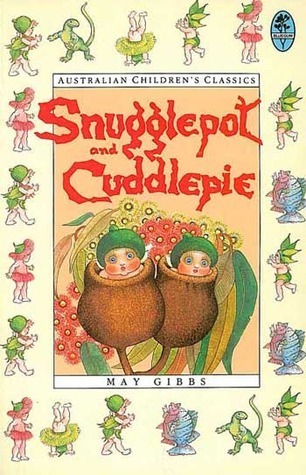
I’m not sure how well-known outside of Australia these stories – and art work, especially – are. Even if you didn’t read, or had read to you, the stories of the gumnut babies Snugglepot and Cuddlepie, their friends Ragged Blossom, and Mr Lizard, and those dastardly Banksia men, if you’re Aussie, you know the image of a gumnut baby well. These you can see on the cover here, whose dress and life is based on the gumnuts produced by the eucalyptus tree.
Taking an educated guess, I’d say the illustrator and author of these stories, May Gibbs, was trying to create a kind of Australian fairy in that very Victorian/Edwardian vision of what a fairy was (certainly not the darker Celtic Fae, but rather a kind of sweet creature who hopped from flower to flower). It would be an interesting question to explore – the creation of Australian folklore and tales in the absence of one that immigrant Australia could call its own. How indeed do the gumnut babies sit along side the Aboriginal Australian dreamtime legends and storytelling – not uncomfortably, but Gibbs was certainly, and not surprisingly, employing a more English tradition in her depiction of the Australian bush and Australian nature.
And I think that is good thing. Being blessed with a gift for illustration and wonderful detail (I don’t have a copy of the book on hand but I remember the pictures of both the Australian bush and under water scenes, with clever detail that uses the minutiae of nature in creative ways) though, Gibbs saved it from being merely twee and sweet and gave us something quite beautiful. For me personally, I think it gave a connection back to Australia (as a child, I was brought up in Jakarta) that I think was vital, for it only became a lived experience when was 9.
The stories themselves… I think there was something a little deeper in them than most of the other children’s books I read. There was adventure, but there was emotional connection, and fear, and friendship too. But really, I’d give these to someone just for Gibb’s lovely illustrations. :)
This book is the reason why I have so much love and respect for lizards and am still scared of Banksias. I have an irrational fear that they will come alive and render me deadibones!
This bind-up edition - part of Angus & Robertson's Australian Children's Classics series - contains three adventures that were originally published separately: Snugglepot and Cuddlepie in 1918, Little Ragged Blossom in 1920, and Little Obelia in 1934.
The first story follows the adventures of the eponymous Snuggelpot and Cuddlepie, two gumnut babies who set out to see one of the "bad" human beings. Making a friend of Mr. Lizard and an enemy of Mrs. Snake along the way, they eventually find themselves in Big Bad City (yep, that's right - NYC has nothing on that BBC), where the "nuts" and their friends must confront evil Mrs. Snake and her allies, the wicked Banskia men.
The villainous Banskia men are back in the second story, and up to no good - their scheming eventually lands Snugglepot and his friend Ragged Blossom at the bottom of the sea. Here they live for some time, taken in by the kind Ann Chovy, while Cuddlepie and Mr. Lizard struggle to discover what has become of them...
Evil never dies, gentle reader, and as you might suspect, not all of the bad Banskia men were "deadibones" after the adventures contained in Little Ragged Blossom. In this final chapter of the gumnut saga, Snugglepot, Cuddlepie and Little Ragged Blossom are lured back to the sea, but with the help of Little Obelia, the radiant princess of the sea, all turns out well...
I will confess that I had very low expectations going into this book... I am not a fan, generally speaking, of Victorian fairytale-fare, but decided to read this anyway, as part of a project on children's fantasy that I am currently working on. It also appealed to me because it was Australian, and I have long felt that the children's literature scene in the United States is too insular, British imports being a notable exception. This trend might be reversing itself post-Harry Potter, but it's too soon to say for sure...
The gumnut babies are like little "bush fairies," cutesy cherub-like creatures whose virtues are as predictable as their adventures are bland. The wicked Banskia men - who are villains because... well... apparently that's just what they are - make for some uninspiring foes. In short, I have a hard time imagining myself getting caught up in these stories, even when I was a very young child.
The only bright note to this volume, and the reason I awarded two stars instead of one, is the positive message it imparts about respecting the environment and being kind to animals. As Cuddlepie says when he sees a human rescue poor Mr. Possum from a leg-hold trap: "I wish that all Humans were kind to Bush creatures like that." This is a message that can probably be found however, in a children's book that can boast of other virtues...
Listening to Snugglepot and Cuddlepie narrated by a full cast was a wonderful and enchanting experience. As a child I had never heard of the May Gibb’s stories I grew up with mostly fairytales especially the Brothers Grimm fairytales and I loved them! The first I heard of Snugglepot and Cuddlepie and the Bad Banksia Men was when I listened to John Williamson sing about them in the early 90s, and not until now have I had a chance to listen to the delightful tale, my next step is to find and buy the book so I can enjoy looking at the beautiful illustrations. This story was an absolute joy to listen to.
‘The Big Bad Banksia Men are the villains of the Gumnut stories and are based on the appearance of aged Banksia "cones” – dark, hairy, knobbly, many-eyed creatures. They are always hatching wicked plots to capture the Nuts and Blossoms and Mr Lizard is their greatest enemy.’
My memories of this book are less about the story - which is all over the place and darned hard to follow sometimes - and ALL about the pictures. Gorgeous, detailed, parallel universe, Aussie bush, hand-drawn illustrations. May Gibbs was truly an artist.
Bum scrum. My favourite. You'll have to find a copy and go towards the end of the book (Little Obelia) to find it. Having seen a rugby scrum will explain better, but still ridiculously cute.
And yes, like many Aussie kids 'afore me, the Big Bad Banksia Men are the stuff of nightmares, and cute little bottoms cause for smirks. Having grown up with banksia trees, gum nut collections, lizards, snakes, kookaburras, kangas, koalas etc etc these pictures came to mind on all our little adventures to the bush. These plants are everywhere. The animals are much shyer.
As I mentioned, the story was never what enthralled me, it was the pictures, and I have read it again at 40+ with a wonder that I ever read the whole thing the first time. As a story it reminded me of what I wrote in high school on a Friday afternoon when the English teacher declared 'free form' and we all just wrote. Wrote anything. Anything that just popped into our heads. I even did a kind of octupussy garden/fishy dance thing one time that was just, well, weird. But you get my point. May Gibbs' story is very old fashioned in style, punctuation and language and would these days have been rejected I'm sure until it was more tightly written - or at least edited better.
I wish I could give this classic more 'stars' but alas I can't. Worth a visit none the less.
this is like my childhood in one book. It used to be a tradition that my mum would read me a book every night or a chapter of a book if it was a series or a novel. But when we started reading these it was like a whole new world opened up to me. The characters were mostly absolutely adorable with their little hats and the writing managed to reach out to younger readers/ listeners emotionally too. The pictures were incredibly lovely. All in all, I loved this series and the memories it holds for me.
Snugglepot and Cuddlepie are foster gum-nut brothers who live in the Australian bush. Together they set off on an adventure to find humans. Mr. Lizard accompanies them, and along the way they meet Ragged Blossom, who also join them. They meet many new friends, but find they must fight the wicked Mrs. Snake and the Bad Banksia Men.
Snugglepot and Cuddlepie is one of Australia's best-loved children's books. It was first published in 1941.
Is this a high quality work of literature? No. (Even though it is incredibly creative and an overall beautiful story.) My rating is mainly fuelled by nostalgia, but that's okay. This book has been and will continue to be a huge part of my life and something that I hold with great fondness in my heart.
Gibbs achieves much in these three little books. Her illustrations are lovely, her characters loveable, and the stories enjoyable—with elements of both fantasy and reality. But in addition, she showcases the wildlife downunder (both in the bush and under the sea)—at times, in rather creative ways—the Kangaroo cabs for one pop immediately to mind. The stories are written simply, yet have a certain amount of ‘wordplay’, in some instances reminiscent of Alice. And she conveys her message against being cruel to the environment and particularly animals effectively with a rather heartrending description of a trapped possum. But luckily for us, this is a children’s book, and things turn out well for all.
A lovely written and illustrated fairy story - so why read this book over others? Well what is special about this book is that it's an Australian application of the genre, which creates the interesting effect of being both very familiar and alien at the same time making it a real Australian fairy tale rather than a fairy tale told by an Australian. So for non Australians there's an element of novelty and for Australians there's the immersion and magic that can't be fully had in wholly European stories.
Also included a hastily cobbled together picture of the plant which inspired the Banksia Men.
I read this not too long ago and wondered what on earth happened. The language is a bit odd, and that prevented me from going further. It's a classic for a very good reason: the concept and idea, plus the illustrations are brilliant. I just wish the language was different.
This is an Aussie tale that is such a classic that it is still read in homes today. It is an exceptional story accompanied by exceptional art. Lots of love for the Aussie classics.
I don't think it's because I'm an adult. In the end, I've read quite some children's books I loved... Perhaps it's cos I lack the sense of nostalgia here? Either way, I thought "Australia's best-loved children's book" would blow my socks off, but it was hard to get into the story. I quite enjoyed Gibbs' writing style, though I felt like running around like a chicken without a head throughout the fist book "Snugglepot and Cuddlepie".
"Little Ragged Blossom" brought a breath of fresh air. Not only the illustrations brought me great joy. I really got the idea we were (finally) going and getting somewhere! The Banksia men surely helped a lot!
Needless to say, I had high hopes for the 3rd book! Unfortunately, no matter how cute "Little Obelia" was, it didn't do it for me. Especially a much anticipated climax stayed out... Oh Obelia, why did you leave empty-handed...?
This may be considered a children's classic, but I'd never heard of it before the book fell into my hands. Oh, how I wished I read this as a child! Reminds me a lot of the Water Babies by Charles Kingsley, which was a firm favourite when I was younger. This edition is beautiful, with some great illustrations. The author has a lovely sense of humour, which comes out in both the writing and the drawings, which you'll find something new in every time you look. Surprisingly enjoyable despite being way past the target audience!
Talk about fast-paced! No sooner had one problem resolved that another began! And, for a children’s book, there were an awful amount of murderous schemes! This is definitely a book of its time but I can see the charm of it and the way it would have captured the imagination of children when it was published. I’m glad to have read this piece of Australian history but I don’t think I’ll be recommending it for small children! I will, however, be magpieing the word “deadibones” and I will continue to refer to banksia seedpods as big bad banksia men until I am deadibones myself!
This volume has 3 books in 1, the first published in 1918 and the last in 1934. Apparently these are classics in Australia. I didn’t know anything about it but was taken with the illustrations and had to read it. Kai and I read this together. We thought it would be quick because it’s a children's book, but it actually took 2 months to complete. The adventures are very wacky and some lines are hilarious. First of all I should mention that all the characters are “Gumnut babies”, as in they are a species of miniature babies that live among the wildlife in the bush. They aren’t actually babies– they are shown smoking pipes and raising children, this is just a species where the fully grown look like babies. Snugglepot and Cuddlepie are brothers that are totally indistinguishable from one another. They decide they want to seek out humans to see them for themselves. They are very cute little babies but tbh they cut a swath of destruction everywhere they go and they don’t seem to be remorseful. They aren’t cruel and they aren’t seeking out harm and chaos, but it certainly seems to follow them. At one point they cause the crushing of all the eggs in a bird’s nest, and their solution is to replace the eggs with some lizard eggs. This is not going to be ok when they hatch, and now some Lizard family has lost their babies. This exemplifies their typical pattern of trying to fix a problem and creating a worse problem in its wake. The problem is that they tend to drag others into it, and the two of them are almost never the ones who face the consequences.
They meet a Blossom during their travels (boys are Nuts, girls are Blossoms in this world). Her name is “Ragged Blossom” bc she’s poor. Kindof a disrespectful name, and she’s a more fully formed character than the titular two, and yet doesn’t get any glory in the title! Ragged Blossom joins their group and they become a trio.
There was a villain named Mrs Snake, who gets violently vanquished, only for a new Mrs Snake to be introduced several chapters later! This made the second Mrs Snake a decidedly unformidable foe. Aside from those two, the main villains are the Banksia men. These guys are like the Minions in that they don’t have their own evil project, they just serve whichever evil master they can find.
Half of the book takes place under the sea and there’s this whole subplot with the Fish Folk and this Messianic baby named Little Obelia. Ragged Blossom is Little Obelia’s mother figure, which is funny to see because she is just a tiny baby who takes care of an even tinier baby. Little Obelia has a Renesmee situation going on, because she grows abnormally fast until she’s like God of the Fish Folk even though she was a baby quite recently. Ragged Blossom’s desire to nurture a child is overwhelming, so when they all get back up to the Bush she, Snugglepot, and Cuddlepie go to the “baby store” and purchase ALL of the orphans. There’s some problems here with the fact that the babies can be bought so easily. And while I have endless faith in Ragged Blossom’s abilities as a caretaker, I think Snugglepot and Cuddlepie might be dead weight even if generally well-meaning. I would like to read a volume of the queer family structure they’ve created with the two brothers, Ragged Blossom as a matriarch who neither of the brothers appear to have a romantic interest in, and 15 or so adopted children. They also “buy” the nurse who works at the orphanage to help out. I’m a little concerned about that terminology.
The two best things about this book are the gorgeous illustrations and the extremely funny slang terms. I’m not sure if this is a) Australian slang b) the way people in Australia talked 100 years ago or c) made up by May Gibbs. There will be a serious violent death, and a character will somberly remark that the deceased is “Deadibones”. When something is good they say “Good root!”. The illustrations show such a lush and imaginative world. Gibbs put so much detail into every image. The edition we have had a mix of full color inserts and black and white drawings.
I would like to know more about the class structure of Gumnut society. It is clearly very stratified. Ragged Blossom is obviously poor. There’s a scene where she wants to go to the movies. The theater is owned by Lilly Pilly’s rich father, and Lilly Pilly herself gets lots of attention for being rich. Ragged Blossom cant’ afford a ticket, so she rappels down through a hole in the ceiling of the theater, Lady Gaga superbowl style, and asks Snugglepot if he will swap spots with her so she can see the film. Why wouldn’t they just buy her a ticket so she doesn’t have to do all that?
More evidence for the class struggles in the bush comes when the crew gets to Big Bad, the main metropolitan center for Gumnuts. Upon arrival, they come across a strike. The crowd has signs stating their demands, which are “More Birthdays” “More Sunshine” “We want more clothes” “Gum Work” “More seeny? (illegible). The Gumnuts don’t really wear clothes beyond a leaf loincloth for Nuts and a grass skirt for Blossoms. Ragged Blossom has a scene where she goes to a clothing shop and is deeply uncomfortable being there. Do they want clothes or are being deprived of them? I was under the impression that clothes were not necessary, but this demand made me rethink.
Another thing is their relationship to other creatures. Some are viewed as equal intelligence as Gumnuts, and some are subjugated like animals. Kangaroos are somehow miniaturized, and they are used as Taxis or for racing. Seahorses serve a similar function in the underwater world. Snakes are always evil, which is a bit unfair.
I’m dying at the top comments for the top review of this book, because the recommendations for it include Knausgaard and the Marriage of Heaven and Hell by William Blake. One commenter, who also noticed the swath of destruction wrought by Snugglepot and Cuddlepie, discusses the “holocaust of everyday life”. Tbh I would have preferred less Snugglepot and Cuddlepie, and more Ragged Blossom and Little Obelia. Additionally, the villains were simply too evil and uncomplex, and having a second Mrs Snake was a bit silly. I like that it’s a kids book that doesn’t seem to exist purely to teach a moral lesson. It was great fun to read but I’m glad we are finally done!
The Complete Adventures of Snugglepot and Cuddlepie contains: The Tales of Snugglepot and Cuddlepie (first published in 1918) and its two sequels, Little Ragged Blossom (1920) and Little Obelia (1921). The tales follow the adventures of two gumnut babies & their friends and foes.
I have just read this for the first time. I don't know why, but it never crossed my path as a child, unlike The Magic Pudding, Blinky Bill & The Muddle-Headed Wombat. You'd think it would have been a natural inclusion in my reading material.
I did enjoy it, but I think I would have liked it better as a child, or even if I had read it as a child. For me it was just a nice story for kids, without the nostalgia. I think the pair of them needed a good paddling at the beginning, particularly for what they did to Mrs Fantail. I wonder why it was the Banksias' lot to be the bad guys? It was a very good adventure story for children.
I loved the illustrations! I agree with other reviewers that she was probably a better illustrator than storyteller. Some parts seem very haphazard & difficult to follow, but I don't suppose kids would mind.
I got this book secondhanded in Blok M and quite satisfied that (turns out) this actually is a "classic" and popular childhood story in Australia. I also love the cheeky names of our heroes, Snugglepot and Cuddlepie. Jadi pengen ndusel nggak siiih...
I found this not easy to read because not sure if it's because a. my English is getting worse or b. I am just stupid. But after some pages it is okay as long you're patient enough to give attention (got lost many times tho) because the pace is really quick and full of eponymous characters.
There are 3 stories of the adventures of Snugglepot, Cuddlepie, and friends. Pretty much intense... . . . . ... and frightening. Is it just me or what, because I was thrilled reading our hero fell down from the air and killed 300 ants accidentally. Or when Mr. Lizard burned the bad Banksia men. Seriously?
Anyhow, it's a nice new reading experience for me. Besides, it also has a cute illustration dengan bokong di mana-mana. If you come or in Australia, you can also visit the Nutcote, a house museum surrounded by pretty garden here
I found this in the thrift store and apparently it's a huge deal in australia, children still read it to this day (published in 1918) and may gibbs' illustrations (which I gather are half the point) are apparently all over the place, dishtowels, nursery decor, greeting cards and such. I'd never heard of it, it's one of those things that is knit into the national culture but doesn't really get exported, I suppose. enid blyton isn't really a thing in the US but is huge in the UK.
but the whole thing is, pardon the pun, nuts (the eponymous characters are "gum nuts" - from the eucalyptus tree, and there are also "flowers", the flowers of the same). they are like cherub-fairies, a sort of importing of english victorian fairies to australia, using all the unique flora and fauna there. one of their defining characteristics is bare bums, and the illustrations are chock full of the staring eyes and chubby naked bottoms of the gum nuts - the flowers sometimes have a frilly flower petal skirt. there's one picture titled "the football scrum" which is about 20 gumnut butts and legs, their heads and upper torsos all inside the huddle, some upside down. I don't even know what to think about that. I suppose it appeals to small children - I would give the age for this from 2-7.
there are three longish stories in this collection, which is about 200 pages long, with copious illustrations. I think in the original there are a lot of color illustrations, which I imagine would be a lot of the appeal, because they are often of big groups of gumnuts and flowers and assorted other creatures having a party or riding around in the city or getting aboard a ship or crossing a stream by walking across a lizard who stands there like a bridge. so, a lot of things to look at.
I read the first story and thought, ok, that was a bit unsettling. the gumnuts do things like fall into an anthill and crush three baby ants, which the ant nurse shrugs off because they have 300 of them, or agree to sit on a bird's nest for her but accidentally break both her eggs, whereupon mr. lizard says don't worry, I'll get you new eggs, and leaves lizard eggs in the nest - which he has kidnapped from a neighbor - instead. so, a bit rough on babies. mr. lizard is a character who is constantly running errands or carrying someone from place to place - he no sooner finishes one errand than he starts another. there are villains, banksia men (evidently the seed pods of an australian tree that look hairy and have mouthlike openings all over them) and mrs. snake. most people love snugglepot and cuddlepie instantly and will do anything for them, except the banksia men and mrs. snake, whose mission in life it is to kill them.
I think it's not until the second story that the word "deadibones" starts being thrown about for dead, which is, I have to admit, adorable. there's quite a lot of talk about death, people are forever being thought to be dead when they're just asleep or passed out. it's not all sunshine and rainbows, not by a long shot. it's not super moralistic - sometimes may gibbs puts something in about being kind to animals and never carrying any creature upside down, and there's an overall theme of loyalty and friendship and doing anything for your friends, but mostly it's action.
the second story I quite enjoyed. it was extremely fast-paced, there's an epic battle scene at the end with cuddlepie riding on an eagle and slinging stones, banksia men in boats, a banksia man on a clifftop about to throw snugglepot down a hole forever until mr. lizard springs into action and wrestles him. in the end the banksia men are deadibones - except not really, we find out in the third story. quite a lot of it also takes place under the sea, as all these flora cherub fairies initially think they might drown but they are actually fine under water and there's no trouble about breathing.
the third story was even more fast-paced, it was frenetic. typically the characters in each of these stories all separate and gibbs bounces back and forth between one and another, with months and months compressed into a paragraph or two. so ragged blossom is under the ocean with obelia, a sort of prophetess ocean queen, and one of the nut boys is with mr. lizard and the other is meant to be going to the dentist - there's some anti-dentist talk in there, enid blyton would never. shockingly, mr. lizard and snugglepie or cuddlepot or whoever was with him - neither of them has a distinct personality, they're just alike - smoke pipes together, in a rare break from the action. there's also a bit where a bunch of living banksias are piled up and apparently burned alive, which is a bit horrific. then one of the nuts goes under the ocean again and has to do this mystical quest to the "fish sauce shop" to rescue ragged blossom, who one minute was enjoying life with obelia and her fish friends and the next is declared to have been kidnapped and thrown into the deepest darkest ocean abyss.
so yeah, it's a lot. I wouldn't say gibbs is a great writer - she's better at drawing really - but she's definitely an energetic writer, and an imaginative writer. small children wouldn't notice anything amiss. but yeah, super weird. there's some cute dialogue and anytime it starts to get saccharine there's sure to be a snake or a banksia man or evil octopus along to mix things up. I'm glad I read it, it probably explains a lot about australians.