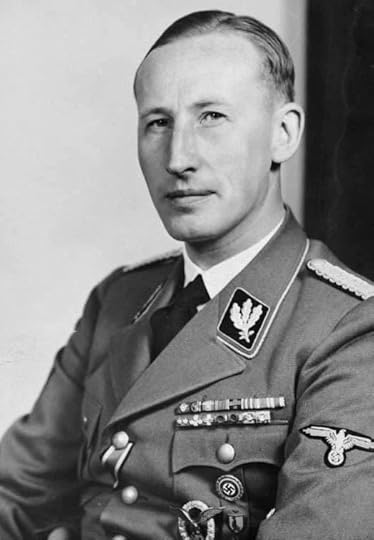
Robert Gerwarth’s Hitler’s Hangman: The Life of Heydrich, is arguably, to date, the most comprehensive biography of one of the cruelest leaders in the Nazi regime, Reinhard Heydrich. For those who recognize his name, it is most often in occurrence with his May 1942 assassination in Prague and the merciless retribution upon his death. He is also remembered for being one of the cruelest, most tyrannical Nazi leaders, whom was second only to Heinrich Himmler in the initial planning of the final solution (more on Himmler in a moment).
Although many prominent critics sing Gerwarth’s praises for ”explaining persuasively what motivated Heydrich to model himself into the perfect Nazi” (Richard Evans of Times Higher Education) and the Sunday Telegraph mentions how ”Gerwarth has gone digging in the sources to root Heydrich more firmly in the context that gave rise to some of the worst crimes of the modern age”, one can’t help but feel a slight disappointment at the conclusion of the book, which still does little to explain the mindset, events, and reasoning behind Heydrich’s rapid radicalization into Nazism.
It’s all the more frustrating because it would appear Gerwarth truly did utilize every source possible. He notes in the preface how he searched archives ”in Germany, Britain, the United States, Russia, Israel and the Czech Republic, which revealed many more sources on Heydrich’s life than are often assumed to exist.”
However, it’s obvious through the materials he did find that Heydrich was a very private individual in which personal records were scarce. Unlike his Nazi compatriots Goebbels and Himmler, he kept no diary, and most of his private correspondence only survived in fragments following the end of WWII.
What does become immediately obvious from the beginning of the book was that despite Heydrich’s macabre nickname and reputation for extraordinary cruelty, he remained a wholly unremarkable figure from his childhood, through his ascent in the Nazi Party, up until his death.
During childhood, he grew up amid relative prosperity, his parents owning a musical conservatory (with 400 pupils in 1911 at its record high enrollment). At age 4, a young Reinhard moved into a three-story home in an exclusive location. He vacationed with his family during the summer on the coast of the Baltic Sea, took up a wide range of sports (despite his very frail figure) and was among the mere 10% of privileged, elite males who went on to secondary schooling in the early 1900s (90% of German students in this time period finished their education after primary school).
His grades were above average, but despite his talents and abilities (or lack thereof), his ambitions and unrelenting desire for success remained a key element of his personality.
After being kicked out of the Marines for a behavioral issue (he was seeing another girl while reported to be engaged to one back home) he despaired at the thought of working a low-paying, low status job.
Fortunately for Heydrich, his soon-to-be-wife, Lina, and her parents, were huge early supporters of the Nazi Party. Lina and her family were very much driven by zealous ideology, while Heydrich was drawn in by much more practical considerations - well-paying, stable careers in this new Party’s bureaucracy - a chance to gain back what he thought he may have permanently lost after being discharged from the military.
The book continues on like this, speaking mostly of mundane, straightforward details concerning Heydrich’s engagement, marriage, and rapid ascent to the top of the party hierarchy - he was personally interviewed and hired by Heinrich Himmler, who would remain a lifelong friend and mentor (despite claims that the two were often at odds with one another).
The details provided are, of course, interesting - especially in the first chapter’s account of the assassination plot in Prague successfully carried out against him, as well as his meetings and proposals on how to resolve the “Jewish Problem” and his contributions to the Final Solution, which would be implemented in haste after the humiliating defeat in Stalingrad.
Conspicuously absent from these accounts were any attempts by the author to explain Heydrich’s motivations and increasing racial hatred, based on interpretation of available sources. While it was clear Heydrich was an opportunist, and had initially taken the job out of the power it would grant him, what is less clear is how it came to be so much more than simply a job for him.
In this, I wish Gerwarth had made more of an attempt to explain these frenzied shifts from seeing Nazism as an opportunity for career advancement, to viewing it as his entire life’s purpose, a cause he was willing to die for (which, of course, he did). By the end of the book I knew more about Reinhard Heydrich’s upbringing and career, but my questions as to how he justified so many of his actions went unanswered.
I’d still recommend reading this book for the all the important facts pertaining to Heydrich’s life. However, the reader needs to be aware they’ll have to draw their own conclusions on his mindset and reasoning, from limited information concerning his opinions and experiences.
It is mostly implied that out of his need to always maintain order and the image of a perfect and top employee/leader, he was willing to do unspeakable things which many other Party members shied away from. And no other real reason than that. This willingness of his to follow orders to a T is what made him uniquely important to Hitler.
Thus, the Czech citizens and nascent underground movement were right to worry about Hitler’s retribution if the assassination plan was to be carried out - the British were applying pressure to the Czech government-in-exile to call upon two volunteers to carry out this plan.
Their claim was that each Allied nation needed to do their part in fighting the Nazi occupation, and that Czechoslovakia had done very little to help in this effort. This was because the Czechs had ineffective military might, along with very small and disorganized resistance forces - which they knew would be wiped out entirely if this plan was successful.
Britain should have listened to the Czechs. Over a thousand civilians died as punishment for the death of Hitler and Himmler’s “beloved Heydrich”, the lovely little village town of Lidice being destroyed, entirely razed to the ground. Lidice forever. 🇨🇿
PS - My great-grandfather wrote a book on Lidice right after the horrific incident - I’m half Czech - called Lidice Forever, but I do not believe it was mass published. Also, it was very short in length - perhaps 90 pages? I do think if you look at my photos, you can see an editorial he wrote for the New York Times on the anniversary of the Lidice massacre and the importance of remembering the innocent victims.
Again, excuse any grammar mistakes or possible repetition … I cannot seem to write a brief review, and as I am writing quickly, there’s likely some mistakes. I do intend to look these reviews over later and make any needed corrections after they’re all posted.