Arrow in the Blue is the first volume of Arthur Koestler's autobiography. It covers the first 26 years of his life and ends with his joining the Communist Party in 1931, an event he felt to be second only in importance to his birth in shaping his destiny.
In the years before 1931, Arthur Koestler lived a tumultuous and varied existence. He was a member of the duelling fraternity at the University if Vienna; a collective farm worker in Galilee; a tramp and street vendor in Haifa; the editor of a weekly paper in Cairo; the foreign correspondent of the biggest continental newspaper chain in Paris and the Middle East; a science editor in Berlin; and a member of the North Pole expedition of the Graf Zeppelin.
Written with enormous zest, joie de vivre and frankness, Arrow in the Blue is a fascinating self-portrait of a remarkable young man at the heart of the events that shaped the twentieth century.
The second volume of Arthur Koestler's autobiography is The Invisible Writing.
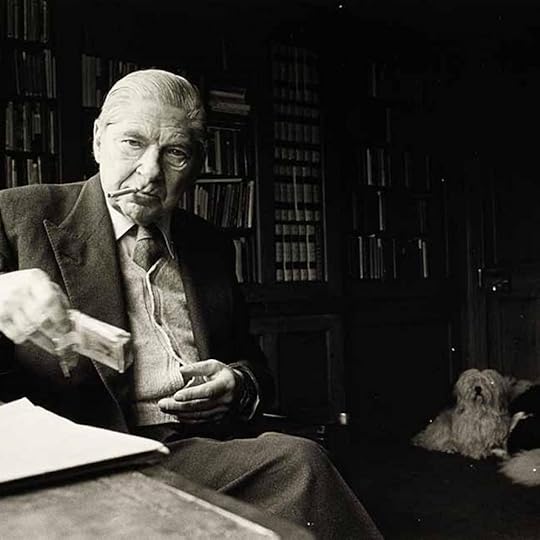
Arthur Koestler CBE [*Kösztler Artúr] was a prolific writer of essays, novels and autobiographies.
He was born into a Hungarian Jewish family in Budapest but, apart from his early school years, was educated in Austria. His early career was in journalism. In 1931 he joined the Communist Party of Germany but, disillusioned, he resigned from it in 1938 and in 1940 published a devastating anti-Communist novel, Darkness at Noon, which propelled him to instant international fame.
Over the next forty-three years he espoused many causes, wrote novels and biographies, and numerous essays. In 1968 he was awarded the prestigious and valuable Sonning Prize "For outstanding contribution to European culture", and in 1972 he was made a "Commander of the British Empire" (CBE).
In 1976 he was diagnosed with Parkinson's disease and three years later with leukaemia in its terminal stages. He committed suicide in 1983 in London.
Lehet úgy is olvasni, mint sima kalandos önéletrajzot – pontosabban fél önéletrajzot, mert Koestler 1930-ban egy brutális cliffhanger-rel elengedi olvasói kezét, mégpedig azon a ponton, ahol belép a kommunista pártba. Vagy ahogy ő megfogalmazza: épp mikor bezuhanna a krokodilokkal teli szakadékba. Mi meg rághatjuk a körmünket, hogy hú, most mi lesz. Így is működhet a szöveg, remek passzusok vannak benne például a '20-as évek pionír-Palesztinájáról, vagy épp a sarkvidéki Zeppelin-expedícióról. Igazi éles szemű, fanyar humorú beszámolók, Koestler jól lát a pályán, lehet neki hinni. Ugyanakkor a kalandra éhes olvasók alighanem nehezményezik majd, hogy néha mintha egyesben haladnánk a próza sztrádáján – mégpedig azért, mert Koestler, ha járt is világot eleget, azért elsősorban nem a világ érdekli, hanem a világban ő maga.
Tépelődő, moralizáló írás ez. Koestler feladatának érzi, hogy önmagát jó alaposan megpszichoanalizálja – nagyítóval végigmegy saját hibáin, tévedésein, frusztrációin, perverz precizitással időzve a hibák legnagyobbikán: a vágyon, hogy különböző ideológiákba kapaszkodjon. Ezen ideológiák egyike a cionizmus volt, a másik pedig, igen, a kommunizmus. A tan, ami az európai értelmiséget megfertőzte a '20-as, '30-as években. Mert bizony akkor úgy tűnt, a kommunizmus a jövő. Hisz amíg a kapitalizmus válságból válságba tántorgott, a szélsőjobboldal pedig nekiáll élve felfalni az agonizálni látszó demokráciát, addig a Szovjetunióban ötéves tervek indultak, gátak és erőművek nőttek ki gombaként a földből. Megfelelő távolságból nézve pedig ez az egész úgy hatott, mintha ők rakétával süvítenének feljebb, egyre feljebb, a csillagok közé, amíg mi bele vagyunk ragadva a posványba. A bolsevizmus gurui bejárták a Nyugatot, mézes dialektikával érveltek Marx mellett, a Koestler-féle igazságra éhezők pedig megestek szavaik hallatán. Nem szégyen az. Megbotlani. Ha az ember van elég bátor, hogy aztán elismerje, ha tévedett.
Pszichológiai értelemben a kötet legérdekesebb eleme talán az, ahogy Koestler megragadja és körülírja saját kettős személyiségét. Ennek a személyiségnek egyik elemét a „végtelenbe tartó nyílvessző” metaforájával lehet körülírni – ez a rész folyton kiáramolna a világba, egyesülni vágyik a mindenséggel, nyitott, szabadságra tör. Ugyanakkor van Koestlernek egy másik arca is, ami inkább egy befelé tartó spirálként ábrázolható, ami folyton saját belső lényegéről tesz fel kérdéseket, önmagába fordul, inaktív és moralista. Ezek ketten osztoznak Koestleren és egészítik ki egymást: amíg az első aspektus gondoskodik a cselekményről, addig a második folyamatosan elemzés alatt tartja ezt a cselekményt. Az első felel a tevékeny életért, a második garancia az (ön)kritikára.
Nem pszichológiai értelemben pedig a legerősebb – vagy még inkább: legriasztóbb – rész az, amikor Koestler berlini éveiről ír. A világválságot követő pár évről, amikor a náci párt félelmetes népszerűségre tett szert. Nem is azt éreztem megdöbbentően találónak, amit Koestler Hitlerről meg a brancsról mond. Hanem amit saját „osztályáról” – a tehetetlen értelmiségről. Azokról, akik nem akarták elhinni, mi következik. Akik rafinált módjait fejlesztették ki az önáltatásnak, csak azért, hogy ne kelljen szembenézniük azzal, ami rájuk vár. Sajnálatosan és félelmetesen aktuális mondatok.
Őszinteségre és pontosságra törekvő szöveg, olyan intellektus terméke, ami folyton saját korlátait kutatja. Óda a nyitott gondolkodáshoz egy olyan embertől, aki belekóstolt a zárt gondolati rendszerbe, hasfájást is kapott tőle, ezért tudja, milyen.
I would devide my life to before and after reading Koestler. Reading Koestler for the first time, just released, Koestler changed me to a totally different person. He was a man of a generation who witnessed final disaster of civil war in Spain and descending and demolishing of hope by communism in Soviet, while confronting the invasion of Fashism in Europe. He explained his generation’s pain and frustration as a most brave looser, not sophisticated but very simple. The best description of the time is when he says; The sun of the age of reason was setting down. Arrow in the Blue together with The Invisible Writing are kind of autobiography of first 35 years of Koestler's life.
Sometimes I think Koestler should be compulsory reading in mid-school, no later. What a better source for learning history. Koestler has lived many lives, with each life more interesting than most people. But that's not all. It's the way he investigates his political belief system with such a fine comb that it gives insights into the whole nature of dogma. And while in his case it was communism, I'm sure it's as relevant for capitalism, objectivism, xyz-ism. It's sad that Koestler wrote about it in a time when the intellectuals were looking towards left. But to think that this book has hardly any reviews on Amazon, hell, it's not even available in paperback, is not just shocking, it's sad. For there is so much in Koestler that's relevant to us today, as it was then, and as it would be tomorrow.
This one is the first part of his biography covering his early life, and leaves us at a critical juncture -- to be continued in Invisible Writing, the second part of the saga that is Koestler's extraordinary life -- full of events, more exciting than many Hollywood action films. It's truly an amazing book, that aught to be read by many many more.
The first volume of Koestler's autobiography covers the first 26 years of his life and culminates with his joining the Communist party in 1931.
This is a fascinating account of a most extraordinary life. From penniless lemonade seller in Palestine to editor of leading German newspapers and everything in between. Set against the background of the Weimar Republic and the rise of the Nazis, Koestler's account of his formative years is a curious mixture of diffidence and confidence, as befits one who suffered from chronic shyness.
Rich in fascinating descriptive touches and wild adventure, a Zeppelin flight to the North Pole for example, this volumes whets the reader's thirst for the remaining volumes.
Fascinating first hand account of his young adulthood in Central Europe and as an early Zionist in British mandate Palestine. Especially interesting is his analysis of how he became a communist and the closed intellectual loop that sucked him in. Of course at the time of writing he was looking back at the twin disasters of Stalinism and Nazism. Highly recommended for Koestler fans and those interested in a first hand account of the pre-war era in Central Europe.
This covers the first 26 years of Koestler's life 1905 to 1931 and he lived more in those 26 years than most people do in a life time. He comes across as taking life by the throat whenever it got too comfy. Always eager to forge out his own path. During those 1st 26 years we have some truely world changing events taking place. From his involvement with the very beginning of the Zionist movement to the joining of the communist party as the Nazi's took control of Germany. It can be a very funny book, Koestler is a great witty observer of life and himself, especially his poor Dad who was always being sucked in by crank inventor's none more so than a business man who tried to get him to invest in Radio-active toilet soap, although the odd thing was it was a great success owing to the fact that thankfully it wasnt radio-active and it was during WW1 when nobody had such luxuries.
One of his journalistic jobs took him to Iraq in the 1920's to interview King Feisal, in which the King stated "that central arabia is today more than ever a country of ignorant fanatics".
He is another creative person who loved solitude and understood the term oceanic feeling although he didnt write any books in this period the building blocks take shape throughout these formative years to which he himself states that he was emotionally immature. To sum up this book is a great historical journey through Koestler's early life and the changing events in the world of science, politics and culture and is a fascinating read throughout.
Koestler was one of the few authors who could boast of having had his books burned by the Nazis and the Soviets.
Lead one of the great lives of the twentieth century. He started as a young journalist, and part time communist spy, in the middle of the spanish civil war. His faith in the party began to crack soon after. This is the first volume of his autobiography, He played an important part in every ideological, and a few of the real, battles of the age.
he should be ranked with orianna falacci, whittaker chambers, george orwell, and merian cooper.
A vivid, frank, substantive and perceptive accounting of Koestler's youth and early manhood (1905-1931) in Budapest, Vienna, Palestine and Berlin, told with wit, style and humor. He takes us into the center of economic, political and social upheavals that marked and marred the early 20th century and continue to affect the 21st. His telling of his conversion to communism, which he later rejected, while necessarily less entertaining than his childhood anecdotes does give firsthand insight into how people turn to closed systems and absolutism when they find the complex real world lacking.
Koestler provides a very honest autobiography (part one), of an eventful life up to his joining the Communist Party of Germany at the end of 1931. He is a very good writer, intelligent, neurotic and not particularly amiable. He openly and effectively shares the cultural forces and angst of the first third of the 20th century in Europe and explains what led him to Communism. In part two he will explain his break.
The copy I've got hasn't been checked out of the library for 14 years, which is disheartening. As autobiography it wasn't brilliant, and I was expecting life-changing brilliance, but it was very very good. And the guy had an extraordinarily interesting life. The book is a page-turner simply on its value as memoir.
If one autobiography were chosen to represent the traumas, trials, and even laughter of the twentieth century, Arthur Koestler's 2-volume opus, ARROW IN THE BLUE, and its follow-up, THE INVISIBLE WRITING would win on the first ballot. Koestler is best remembered today for his novel of political fiction, DARKNESS AT NOON, and for being Arthur Koestler: Hungarian Jewish atheist, Communist, Zionist, newspaper correspondent, and anti-fascist turned anti-communist. This first volume of his memoirs shows that the 'arrow in the blue", the streak that marked his life, was skepticism paradoxically combined with a great zeal for his passion of the moment. One early vignette from ARROW illustrates the rebel cum believer Koestler. After receiving his degree in engineering from the University of Budapest Arthur argued with a friend who fervently believed all of life is dictated by determinism and free will our common illusion. Koestler whipped out his engineering degree, tore it up in front of his friend's face, and told him, "You see, I will my future". He could never practice engineering but had scored a philosophical point over an opponent and that meant more to Koestler than a career. Out of that opinionated exchange came his commitment to making his own rules, from politics to sex: Migrating to Israel and becoming one of the first members of a kibbutz (an accomplishment that oddly placed him in the same ranks as Noam Chomsky, though the two never met), loafing and begging in France (like Orwell), while partaking of its women ("I bet there isn't a single dress shop in France that was not paid for by a prostitute's earnings") and flying off to Germany, landing a job at a newspaper and in 1931, with the Nazis at full-strength, Joining the German Communist Party (KPD). The reader exis this first volume exhausted and at times exasperated with Koestler but never bored. Don't worry, folks, there's still plenty of Koestlerian helter-skelter for volume two, THE INVISIBLE WRITING, or "I Was a Communist espionage agent until I became a British secret agent".
As well as a portrait of the man himself, we get a colourful portrayal of the times in which he lived and operated, and this is in keeping with his accustomed blend of journalism and creative writing which makes him so readable.
Köstler`s position as a journalist of ability and reputation gave him a discerning view of political events of his time. He recounts some of his observations and experiences from this period including his attraction to communism and the rise of Nazism. Being a Jewish high-ranking journalist working in Berlin in the early 1930s gave him firsthand experience of the developing storm.
The book ends with an account of the Graf Zeppelin`s voyage to Northern climes on which Köstler was invited to report as a journalist.
The first volume of Arthur Koestler's autobiography covering 1905 to 1931. He led an interesting life and was fairly reflective on his ideas and perspectives throughout, so it makes a good read. He covers his father's house (which was an exciting place given his father's penchant for trying new technology), partaking in the Zionist movement in the 1920s, his attraction to communism, his falling out with communism, and his career in journalism which allowed him to branch out in various ideas. This is a more accessible work to understand his thought than "Janus: A Summing Up" which is excerpts from his various books, including more straightforward philosophy.
An easy read with some interesting self-observations and some good observations later in the book about life and relationships. However, one does get the strong sense that Koestler didn't really 'get people' and this lack of insight extends quite consistently to his own actions. Moreover, there was such a lack of detail, especially with regards to his relations and activities in many places; we get the biographical mile-stones but rarely get much sense of what it was like to live day to day as this man and thus why he felt the way he did.
"Colui le cui opinioni e convinzioni sono completamente libere da inconsce parzialità, scagli la prima pietra." (p. 108)
"Possiamo accrescere le nostre conoscenze, ma non possiamo ridurle; nessun chirurgo del cervello può ripristinare la verginità di un’illusione." (p. 288)
Not the most interesting self-biography, although it has some more engaging episodes. Imo Koestler goes into a very grandiose and self-important style of describing at length details that are not that interesting.
Couldn’t finish this book! It just didn’t click for me. And as my mother says, “Reading is for pleasure,” I decided to abandon this one. Don’t get me wrong, it is a highly intelectual and well-written book.
Rolig och annorlunda biografi, självrannsakande och skarpt skrivet. Och på detta ett spännande livshistoria, både idemässigt, historiskt och geografiskt
Niet zijn beste (vind ik) maar ik onthoud de uiterst memorabele hoofdstukken waar hij analytisch ingaat op het denkproces van iemand die zich tot het communisme laat bekeren.
Arthur Koestler vivió muy de cerca ciertos acontecimientos de nuestro siglo de tanta trascendencia histórica, política y social, que esta obra bien podría haberse extendido unos cientos de páginas más. "Flecha en el azul", abarca desde su nacimiento hasta el momento en que toma la decisión de ingresar en el partido comunista alemán. Koestler nos relata su infancia y adolescencia, y, lo que es más relevante, el despertar de sus sentimientos políticos, cuya solidez y compromiso tuvieron una importancia definitiva en su trayectoria vital. El primero de esos sentimientos fue un fervoroso sionismo que lo llevo a dejar sus estudios para intentar ingresar infructuosamente en un kibutz y dedicar su vida a trabajar la tierra en Palestina. Después de su breve estancia en la colonia judía -no superó el periodo de prueba por el que debían pasar todos los candidatos-, vivió sucesivamente en Haifa, Tel Aviv y Jerusalén, ejerciendo el periodismo, y ya de vuelta a Europa, en París y Berlín. Allí llegó a ocupar el cargo de director de la sección científica en uno de los diarios más respetados de Alemania hasta su ya mencionado ingreso en el partido comunista, no sin antes haber tomado parte, en calidad de ilustre informador, en una expedición internacional al Polo Norte, ni más ni menos que en un Zeppelin.
Koestler is the twentieth century in trousers. Most of the big scary events in European twentieth century history seemed to bumped up against Koestler. He was there, saw that, met him. This is the first part of his autobiography and I have just jumped into the second part - entitled Invisible Writing.
Quite compulsive reading and from a fascinating perspective. A personal tale that gives an insight into how the early 20th Century social and political currents appeared to one, politically aware mind. Funny, self-deprecating and inspirational.
Kniha so silnejšími a slabšími miestami, ale tie silné stoja zato.
Koho zaujíma, ako sa v Európe žilo cca od 1910 do 1930, táto kniha ho môže dosť uspokojiť. Keby si autor odpustil občasnú mizogýniu, bolo by to ešte lepšie.