

What do you think?

The Tunnel: Selected Poems
This prized collection of Russell Edson's prose poems, featuring his own favorites from seven prior collections, constitutes some of the most original American art of this century. This is the book of choice for both new and committed fans of this imaginative poet.
232 pages, Paperback
First published December 1, 1994
About the author
Russell Edson
50 books115 followersRussell Edson (December 12, 1928 – April 29, 2014) was an American poet, novelist, writer, and illustrator. He was the son of the cartoonist-screenwriter Gus Edson.
He studied art early in life and attended the Art Students League as a teenager. He began publishing poetry in the 1960s. His honors as a poet include a Guggenheim fellowship, a Whiting Award, and several fellowships from the National Endowment for the Arts.
Russell Edson was born in Connecticut in 1935 and lived there with his wife Frances. Edson, who jokingly has called himself "Little Mr. Prose Poem," is inarguably the foremost writer of prose poetry in America, having written exclusively in that form before it became fashionable. In a forthcoming study of the American prose poem, Michel Delville suggests that one of Edson's typical "recipes" for his prose poems involves a modern everyman who suddenly tumbles into an alternative reality in which he loses control over himself, sometimes to the point of being irremediably absorbed--both figuratively and literally--by his immediate and, most often, domestic everyday environment. . . . Constantly fusing and confusing the banal and the bizarre, Edson delights in having a seemingly innocuous situation undergo the most unlikely and uncanny metamorphoses. . . .
Reclusive by nature, Edson has still managed to publish eleven books of prose poems and one novel, The Song of Percival Peacock (available from Coffee House Press).
He studied art early in life and attended the Art Students League as a teenager. He began publishing poetry in the 1960s. His honors as a poet include a Guggenheim fellowship, a Whiting Award, and several fellowships from the National Endowment for the Arts.
Russell Edson was born in Connecticut in 1935 and lived there with his wife Frances. Edson, who jokingly has called himself "Little Mr. Prose Poem," is inarguably the foremost writer of prose poetry in America, having written exclusively in that form before it became fashionable. In a forthcoming study of the American prose poem, Michel Delville suggests that one of Edson's typical "recipes" for his prose poems involves a modern everyman who suddenly tumbles into an alternative reality in which he loses control over himself, sometimes to the point of being irremediably absorbed--both figuratively and literally--by his immediate and, most often, domestic everyday environment. . . . Constantly fusing and confusing the banal and the bizarre, Edson delights in having a seemingly innocuous situation undergo the most unlikely and uncanny metamorphoses. . . .
Reclusive by nature, Edson has still managed to publish eleven books of prose poems and one novel, The Song of Percival Peacock (available from Coffee House Press).
Ratings & Reviews
Friends & Following
Create a free account to discover what your friends think of this book!
Community Reviews
Displaying 1 - 30 of 58 reviews

March 24, 2015

I took my first writing course many years ago, back when I was in my late thirties. I was given conventional short stories and poems as models but nothing really clicked with me, that is, I knew I wanted to write but wasn’t really inspired by those conventional ways of writing.
Then one day whilst visiting a library in downtown Philadelphia, I came across an anthology called The Anti-Story - a collection of various stories that were reactions against conventional form. One type of anti-story was Against Length and featured the following piece by author Russell Edson:
FATHER, FATHER, WHAT HAVE YOU DONE?
A man straddling the apex of his roof cries, giddyup. The house rears up on its back porch and all its bricks fall apart and the house crashes to the ground.
His wife cries from the rubble, father, father, what have you done?
------
The experience of reading this short piece of fiction was so powerful it almost put me on my knees. I knew immediately that this was it – the type of writing for me.
I spent the next eight years writing Russell Edson-style micro-fiction. Most fortunately, editors of a number of little magazines were more than happy to publish my work. And each time I had one of my books of micro-fiction published, I sent a copy to Russell Edson as a way of saying "thank you." Russell was kind enough to, in turn, send a letter back to me each time, a letter in the form of a prose poem, that is!
Anyway, I mention this as a way of encouraging readers who ordinarily shy away from poetry to check out Russell Edson. Surreal, fanciful, bizarre, enigmatic. And The Tunnel, a collection from seven different Edson books, is a treasure.
Here are two poems from the collection:
A PERFORMANCE AT HOG THEATER
There was once a hog theater where hogs performed
as men, had men been hogs.
One hog said, I will be a hog in a field which has
found a mouse which is being eaten by the same hog
which is in the field and which has found the mouse,
which I am performing as my contribution to the
performer's art.
Oh let's just be hogs, cried an old hog.
And so the hogs streamed out of the theater crying,
only hogs, only hogs . . .
THE REASON WHY THE CLOSET-MAN IS NEVER SAD
This is the house of the closet-man. There are no rooms,
just hallways and closets.
Things happen in rooms. He does not like things to
happen . . . Closets, you take things out of closets,
you put things into closets, and nothing happens . . .
Why do you have such a strange house?
I am the closet-man, I am either going or coming, and I
am never sad.
But why do you have such a strange house?
I am never sad . .
------
Since I mentioned how Russell inspired me to write micro-fiction, here's one of mine I'd like to share:
OH HOW TIME FLIES
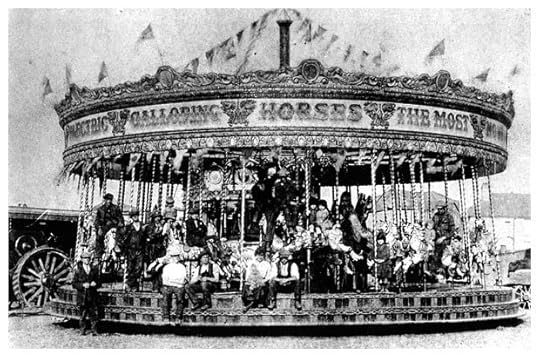
A girl wearing a ruffled pink dress and sneakers hops on a merry-go-round and mounts what she thinks is a horse but is actually a sewing machine. She stretches her legs until her toes barely touch the throat plate.
Perplexed, sensing something woefully wrong, she peers down at all the dials: buttonhole dial, stitch-width dial, stitch-control dial, stitch-pattern dial, reverse-stitch dial.
A bell rings and the merry-go-round goes round, lights flashing, organ music playing, horses and needle bobbing. Round and round she goes until her hands and legs swell with veins, her face puckers with wrinkles, and all her hair turns silvery gray.
![Profile Image for s.penkevich [hiatus-will return-miss you all].](https://i.gr-assets.com/images/S/compressed.photo.goodreads.com/users/1735525095i/6431467._UX200_CR0,11,200,200_.jpg)
December 7, 2014
‘The head is death with hair upon it. Also it is a vehicle upon which it is itself to ride through dream and suppertime.’
The Tunnel, the selected poems of Russell Edson (1935-2014), is the most refreshing collection of ‘poetry’ that I have encountered in a long time. To call it breathtaking would invoke the right ideas but would also miss the mark by miles—reading Edson is less like losing your breath in beauty and more like being given new lungs and a new atmosphere in which to breath. It is like seeing a strange and alien world that is also unmistakably your own and registering near-nonsense as the most fit method of discussing the abstractions of reality. It would be easy to recommend Edson’s work as a sadistic amalgamation of the elliptical surrealism and playfulness found in James Tate and Charles Simic, but Edson has a voice and style distinctly his own that more categorizes him alongside these wonderful poets rather than ‘of them’¹ Edson tends to defy classification, as is pointed out in the indespensible article about him published in The Believer by Sarah Manguso. One might refer to Edson as surreal prose poetry, yet in articles he scorned the usage of those signifiers. As to surrealism, Edson says ‘why do we have to be surrealists? Brenton didn’t invent our imagination.’² Edson also disliked the term ‘prose poem’ (though I am glad to see the prose poem talked about as an accepted idea; I recall a classroom with an overturned chair as I stood shouting at several of my peers who refused to accept prose poetry as anything other than scraps of writing that were of no benefit to literature. I lost the argument.) seeing it as too artificial a term for a subject matter that truly has no defined form: ‘the prose poem has yet to yield up a method.’ This is all a circoitus rambling that should sum itself up that Edson’s poetry is something to come to on its own terms, as to attempt to classify, cage and give shape to it would miss the ghostlike quality and ethereal, haunting beauty of the tiny tales he spins in each. They are like short fables, unsettling and elusive, managing to avoid direct discussion by residing in eternal metaphor to discuss the darker underbellies of existence and humanity. Apes, for example, make a frequent appearance, often as a symbol of the wild, untamed and uncivilized impulses in all of us, such as when a wife fornicates with an ape before bashing his brains out, shoving him in an over and serving him for dinner—a pretty ribbon tied carefully around his genitals. The imagery is bizarre, but not for the sake of the weird but for the sake of understanding the abstract through its own devices. Edson’s work may seem nonsensical, bizarre and so removed from the standards of anything we have taken comfort in, yet it registers on all the proper emotional and intellectual levels as if coming in sideways and overtaking us like a mist rather than a head-on assault of logical and comprehensible teachings. The Tunnel is a wild, untamed ride through a frighteningly wasteland of the real, where nothing is as it seems. It is a ride surely not to be missed.
4.5/5
¹Russell Edson and Charles Simic—my personal favorite poet—were in fact good friends. Simic published a wonderful eulogy of sorts for his friends Edson and Bill Knott in the New York Review of Books, in which he says of Edson ‘The real surprise comes when we realize that what we are reading is not the work of a jokester, but of a satirist and a serious thinker.’ This does well to summarize the playfulness found in Edson. In The Tunnel there are a few poems dedicated to James Tate and Simic (as well as William Carlos Williams, Donald Hall and more). The second poem to Simic is particularly intriguing:
²André Breton (1896-1966), often considered a founder of surrealism, was a French writer and poet most known for his Manifestoes of Surrealism.
A Journey Through Moonlight
In sleep when an old man’s body is no longer aware of its boundaries, and lies flattened by gravity like a mere wax in its bed...It drips down to the floor and moves there like a tear down a cheek...Under the back door into the silver meadow, like a pool of sperm, frosty under the moon, as if in his first nature, boneless and absurd.
The moon lifts him into its white field, a cloud shaped like an old man, porous with stars.
He floats through high dark branches, a corpse tangled in a tree on a river.
Sheep
They are in the house. They move like clouds over the floors.
They are in the bedrooms. They return from the cellar. They wander in the attic like balls of dust.
A man is sitting in the kitchen, his face in his hands. He is crying, his tears wetting through fingers.
The sheep baa and to him they gather, licking his hands for salt.
A ewe then sweetly offer herself in heat.
He turns her on her back, his face in the wool of her breast…
Killing the Ape
They were killing the ape with infinite care; not too much or it runs past dying and is born again.
Too little delivers a sick man covered with fur.
….Gently gently out of hell, the ape climbing out of the ape.
Antimatter
On the other side of a mirror there's an inverse world,
where the insane go sane; where bones climb out of the
earth and recede to the first slime of love.
And in the evening the sun is just rising.
Lovers cry because they are a day younger, and soon
childhood robs them of their pleasure.
In such a world there is much sadness which, of course,
is joy.
The Fall
There was a man who found two leaves and came indoors holding them out saying to his parents that he was a tree.
To which they said then go into the yard and do not grow in the living-room as your roots may ruin the carpet.
He said I was fooling I am not a tree and he dropped his leaves.
But his parents said look it is fall.

The Tunnel, the selected poems of Russell Edson (1935-2014), is the most refreshing collection of ‘poetry’ that I have encountered in a long time. To call it breathtaking would invoke the right ideas but would also miss the mark by miles—reading Edson is less like losing your breath in beauty and more like being given new lungs and a new atmosphere in which to breath. It is like seeing a strange and alien world that is also unmistakably your own and registering near-nonsense as the most fit method of discussing the abstractions of reality. It would be easy to recommend Edson’s work as a sadistic amalgamation of the elliptical surrealism and playfulness found in James Tate and Charles Simic, but Edson has a voice and style distinctly his own that more categorizes him alongside these wonderful poets rather than ‘of them’¹ Edson tends to defy classification, as is pointed out in the indespensible article about him published in The Believer by Sarah Manguso. One might refer to Edson as surreal prose poetry, yet in articles he scorned the usage of those signifiers. As to surrealism, Edson says ‘why do we have to be surrealists? Brenton didn’t invent our imagination.’² Edson also disliked the term ‘prose poem’ (though I am glad to see the prose poem talked about as an accepted idea; I recall a classroom with an overturned chair as I stood shouting at several of my peers who refused to accept prose poetry as anything other than scraps of writing that were of no benefit to literature. I lost the argument.) seeing it as too artificial a term for a subject matter that truly has no defined form: ‘the prose poem has yet to yield up a method.’ This is all a circoitus rambling that should sum itself up that Edson’s poetry is something to come to on its own terms, as to attempt to classify, cage and give shape to it would miss the ghostlike quality and ethereal, haunting beauty of the tiny tales he spins in each. They are like short fables, unsettling and elusive, managing to avoid direct discussion by residing in eternal metaphor to discuss the darker underbellies of existence and humanity. Apes, for example, make a frequent appearance, often as a symbol of the wild, untamed and uncivilized impulses in all of us, such as when a wife fornicates with an ape before bashing his brains out, shoving him in an over and serving him for dinner—a pretty ribbon tied carefully around his genitals. The imagery is bizarre, but not for the sake of the weird but for the sake of understanding the abstract through its own devices. Edson’s work may seem nonsensical, bizarre and so removed from the standards of anything we have taken comfort in, yet it registers on all the proper emotional and intellectual levels as if coming in sideways and overtaking us like a mist rather than a head-on assault of logical and comprehensible teachings. The Tunnel is a wild, untamed ride through a frighteningly wasteland of the real, where nothing is as it seems. It is a ride surely not to be missed.
4.5/5
¹Russell Edson and Charles Simic—my personal favorite poet—were in fact good friends. Simic published a wonderful eulogy of sorts for his friends Edson and Bill Knott in the New York Review of Books, in which he says of Edson ‘The real surprise comes when we realize that what we are reading is not the work of a jokester, but of a satirist and a serious thinker.’ This does well to summarize the playfulness found in Edson. In The Tunnel there are a few poems dedicated to James Tate and Simic (as well as William Carlos Williams, Donald Hall and more). The second poem to Simic is particularly intriguing:
With Sincerest RegretsThe work is humorous and dark, probing at the aspects of life that we must all accept as reality but do not discuss, the toilet working as a wonderful metaphor here. However, the real joy is in the line ‘In the book of the heart there is no mention made of plumbing, a line with all the humor, wit, cadence and near-distinctness of Simic’s writing that it made me want to flip through all his books as it seemed it must have come from him somewhere. It should also be noted that the closest resemblance to The Tunnel that I’ve read is Simic’s The World Doesn't End (which is, in fact, dedicates to Tate).
Like a monstrous snail a toilet slides into a living room on a track of wet, demanding to be loved.
It is impossible, and we tender our sincerest regrets. In the book of the heart there is no mention made of plumbing.
And though we have spent out intimacy many times with you, you belong to an unfortunate reference, which we would rather not embrace…
The toilet slides away on another track of wet…
²André Breton (1896-1966), often considered a founder of surrealism, was a French writer and poet most known for his Manifestoes of Surrealism.
A Journey Through Moonlight
In sleep when an old man’s body is no longer aware of its boundaries, and lies flattened by gravity like a mere wax in its bed...It drips down to the floor and moves there like a tear down a cheek...Under the back door into the silver meadow, like a pool of sperm, frosty under the moon, as if in his first nature, boneless and absurd.
The moon lifts him into its white field, a cloud shaped like an old man, porous with stars.
He floats through high dark branches, a corpse tangled in a tree on a river.
Sheep
They are in the house. They move like clouds over the floors.
They are in the bedrooms. They return from the cellar. They wander in the attic like balls of dust.
A man is sitting in the kitchen, his face in his hands. He is crying, his tears wetting through fingers.
The sheep baa and to him they gather, licking his hands for salt.
A ewe then sweetly offer herself in heat.
He turns her on her back, his face in the wool of her breast…
Killing the Ape
They were killing the ape with infinite care; not too much or it runs past dying and is born again.
Too little delivers a sick man covered with fur.
….Gently gently out of hell, the ape climbing out of the ape.
Antimatter
On the other side of a mirror there's an inverse world,
where the insane go sane; where bones climb out of the
earth and recede to the first slime of love.
And in the evening the sun is just rising.
Lovers cry because they are a day younger, and soon
childhood robs them of their pleasure.
In such a world there is much sadness which, of course,
is joy.
The Fall
There was a man who found two leaves and came indoors holding them out saying to his parents that he was a tree.
To which they said then go into the yard and do not grow in the living-room as your roots may ruin the carpet.
He said I was fooling I am not a tree and he dropped his leaves.
But his parents said look it is fall.

November 17, 2019
Much of Edson's imagery is ripe for fantastic fiction (in both meanings of the phrase), which is why I enjoyed his novel, Gulping's Recital, more (and I will surely read Edson's other novel too). His work is a(n) (anti-)world of the (in)sane, the (sur)real, the (non) sequitur, the (reptilian) (b)rain.
Here is but a brief taste:
"Once I changed a man into a child by removing certain bones. The result was less than life, yet, more than death; it was art . . ."
This would make a great opening to a novel: "On the other side of a mirror there's an inverse world, where the insane go sane; where bones climb out of the earth and recede to the first slime of love."
"When science is in the country a cow meows and the moon jumps from limb to limb through the trees like a silver ape."
"It was someone as viewed in a mirror, or was it you said it was someone viewing its someone who it is in a mirror where perhaps someone lives only."
"He that puts suicide into his left ear pretends it is wax. His mother says, but it's a bullet which you have shot yourself with."
Here is but a brief taste:
"Once I changed a man into a child by removing certain bones. The result was less than life, yet, more than death; it was art . . ."
This would make a great opening to a novel: "On the other side of a mirror there's an inverse world, where the insane go sane; where bones climb out of the earth and recede to the first slime of love."
"When science is in the country a cow meows and the moon jumps from limb to limb through the trees like a silver ape."
"It was someone as viewed in a mirror, or was it you said it was someone viewing its someone who it is in a mirror where perhaps someone lives only."
"He that puts suicide into his left ear pretends it is wax. His mother says, but it's a bullet which you have shot yourself with."

July 7, 2020
Funny em. A Man can be a man, or not-man, or anything, or swap roles that makes the man's head the man and not the man himself, or man's head thinking he is a man and not-man at the same time.
Welcome to the world of Russell Edson, where anything can be anything and nothing at the same time.
By the way, that is just one type of stuffs he wrote. And though one is tempted to easily brand them
as prose poems, it is very complicated than it seems.
To show this collection is a top class one, I will randomly open a page and share the story here
You
Out of nothing there comes a time called childhood, which is simply a
path leading through an archway called adolescence. A small town there,
past the arch called youth.
Soon, down the road, where one almost misses the life lived beyond
the flower, is a small shack labeled, you.
And it is here the future lives in the several postures of arm on windowsill, cheek on this; elbows on knees, face in the hands; sometimes
the head thrown back, eyes staring into the ceiling . . . This into nothing down the long day's arc . . .
That could have been just a coincidence that it turned out to be great, let me try once more to prove the writer's greatness.
Here you go:
The blank book
The book was blank, all the words had fallen out.
Her husband said, the book is blank.
His wife said, a funny thing happened to me on my way to the present
moment. I was shaking the book, to get all the typos out, and all of a
sudden all the words and punctuation fell out too. Maybe the whole
book was a typo?
And what did you do with the words? said her husband.
I made a package and mailed it to a fictitious address, she said.
But no one lives there. Don't you know, hardly anyone lives at fictitious addresses. There's barely enough reality there to provide even a
mailing address, he said.
That's why I sent them there. Words all mixed up can suddenly coalesce into rumors and malicious gossip, she said.
But don't these blank pages also present a dangerous invitation to
rumors and malicious gossip? Who knows what anyone might write in
his absent-mindedness? Who knows what chance might do with such a
dangerous invitation? he said.
Perhaps we shall have to send ourselves away to some fictitious address, she said.
Is it because words keep falling out of our mouths, words that could
easily start rumors and malicious gossip? he said.
It is because, somehow, we keep falling out of ourselves, like detached
shadows; shaking as if we could get all the typos out of our lives, she
said.
Well, at least, if this doesn't hurt reality, it does, in fact, give reality a
well earned rest.
I got inspired by his writing and tried my luck, the result is as follows:
Funny cow?
Joe Pesci was sitting in a bar in India.
Just across him sat a cow.
Pesci looked at it and smiled.
Half an hour passed and Pesci was feeling tipsy, called the cow and said, you have found yourself in a spot.
Cow mooed.
Pesci took that as a sign of its attention and approval.
Pesci went on, you see the guys here are taking you for fun. You are either a venerable object or an object of ridicule.
Cow mooed.
He smiled and continued.
These guys who you think are on your side are actually digging your grave.
The other side is obviously pulling your hair at every turn.
Cow mooed.
He inched forward and whispered with a serious face.
These won't stop unless you act.
Cow mooed again.
He thought it was curious to know more.
He continued on.
Another time someone makes fun of you or venerate you, just kick the butt of them!
Cow rose from its chair and kicked the face of Pesci.
Pesci on the floor writhing with pain and confusion. Perplexed, he asked "Funny how?"
Cow bowed and mooed again, and went out of the bar.
******** End of the story
Another great discovery for me and I have to thank Glenn Russell (is it any coincidence that he shares a part of his name with the writer?). Without his review I wouldn't have known this writer!
This collection is highly recommended!
Welcome to the world of Russell Edson, where anything can be anything and nothing at the same time.
By the way, that is just one type of stuffs he wrote. And though one is tempted to easily brand them
as prose poems, it is very complicated than it seems.
To show this collection is a top class one, I will randomly open a page and share the story here
You
Out of nothing there comes a time called childhood, which is simply a
path leading through an archway called adolescence. A small town there,
past the arch called youth.
Soon, down the road, where one almost misses the life lived beyond
the flower, is a small shack labeled, you.
And it is here the future lives in the several postures of arm on windowsill, cheek on this; elbows on knees, face in the hands; sometimes
the head thrown back, eyes staring into the ceiling . . . This into nothing down the long day's arc . . .
That could have been just a coincidence that it turned out to be great, let me try once more to prove the writer's greatness.
Here you go:
The blank book
The book was blank, all the words had fallen out.
Her husband said, the book is blank.
His wife said, a funny thing happened to me on my way to the present
moment. I was shaking the book, to get all the typos out, and all of a
sudden all the words and punctuation fell out too. Maybe the whole
book was a typo?
And what did you do with the words? said her husband.
I made a package and mailed it to a fictitious address, she said.
But no one lives there. Don't you know, hardly anyone lives at fictitious addresses. There's barely enough reality there to provide even a
mailing address, he said.
That's why I sent them there. Words all mixed up can suddenly coalesce into rumors and malicious gossip, she said.
But don't these blank pages also present a dangerous invitation to
rumors and malicious gossip? Who knows what anyone might write in
his absent-mindedness? Who knows what chance might do with such a
dangerous invitation? he said.
Perhaps we shall have to send ourselves away to some fictitious address, she said.
Is it because words keep falling out of our mouths, words that could
easily start rumors and malicious gossip? he said.
It is because, somehow, we keep falling out of ourselves, like detached
shadows; shaking as if we could get all the typos out of our lives, she
said.
Well, at least, if this doesn't hurt reality, it does, in fact, give reality a
well earned rest.
I got inspired by his writing and tried my luck, the result is as follows:
Funny cow?
Joe Pesci was sitting in a bar in India.
Just across him sat a cow.
Pesci looked at it and smiled.
Half an hour passed and Pesci was feeling tipsy, called the cow and said, you have found yourself in a spot.
Cow mooed.
Pesci took that as a sign of its attention and approval.
Pesci went on, you see the guys here are taking you for fun. You are either a venerable object or an object of ridicule.
Cow mooed.
He smiled and continued.
These guys who you think are on your side are actually digging your grave.
The other side is obviously pulling your hair at every turn.
Cow mooed.
He inched forward and whispered with a serious face.
These won't stop unless you act.
Cow mooed again.
He thought it was curious to know more.
He continued on.
Another time someone makes fun of you or venerate you, just kick the butt of them!
Cow rose from its chair and kicked the face of Pesci.
Pesci on the floor writhing with pain and confusion. Perplexed, he asked "Funny how?"
Cow bowed and mooed again, and went out of the bar.
******** End of the story
Another great discovery for me and I have to thank Glenn Russell (is it any coincidence that he shares a part of his name with the writer?). Without his review I wouldn't have known this writer!
This collection is highly recommended!

December 1, 2018
I have fallen for Russell Edson's strange prose poems. They are alternately amusing, absurd, ribald, surreal, poignant, and sublimely inscrutable. This is a book I will buy if one day I find it in a bookshop. I checked this book out from the library but I cannot read it to the end now. That would be akin to gorging on cake that is too rich. There are too many poems here to read before I haul my pile of books back to the library. I've been sampling for a couple of months now and it's time to take a break. But I will be back. In the meantime here are a couple of my favorites, because they are too good not to share:
The Difficulty With a Tree
A woman was fighting with a tree. The tree had come to rage at the woman's attack, breaking free from its earth it waddled at her with its great root feet.
Goddamn these sentiencies, roared the tree with birds shrieking in its branches.
Look out, you'll fall on me, you bastard, screamed the woman as she hit at the tree.
The tree whisked and whisked with its leafy branches.
The woman kicked and bit screaming, kill me kill me or I'll kill you!
Her husband seeing the commotion came running crying, what tree has lost patience?
The ax, the ax, damnfool, the ax, she screamed.
Oh no, roared the tree dragging its long roots rhythmically limping like a sea lion towards her husband.
But oughtn't we to talk about this? cried her husband.
But oughtn't we to talk about this, mimicked his wife.
But what is this all about? he cried.
When you see me killing something you should reason that it will want to kill me back, she screamed.
But before her husband could decide what next action to perform the tree had killed both the wife and her husband.
Before the woman died she screamed, now do you see?
He said, what . . . ? And then he died.
The Press of Night
At night when the strings are cut; the only string is an electric cord feeding an electric light.
. . . No, there is no other place.
The electric light presses on the window to keep out the night.
Memory is a string caught in some dark place, beyond even memory; a tangled kite string that will not let the kite rise, even as the metamorphic winds of life will not let it fall.
Thus falls the attention into itself; the lens of the attention withdrawing from the distance; lives in the foreground, having broken from extreme depth.
Chair and table become textures. The eyes grown tactile read the room as Braille. The attention flutters like a moth caught in a room; neither through the window nor into the head of the dreaded self . . .
All out there the night . . .

December 9, 2015
I am still dazzled by Russell Edson's capability to conceive alternative realities, apparently created simply by observing and twisting the most uneventful and trivial side of life. Usually governed by madness and absurdity, these parallel worlds end up being certainly much more eventful than what might be initially expected from the ordinary situations triggering the insanity. Concurrently, the surrealistic nuances of some of the events taking place in the poems provide the 'realms' envisaged by the author with an obscure hue, through which the remotest hidden corners of the human mind are explored in a way.
This statement may aspire to be truthful, though, only if we take for granted that it is 'poetry' how this author's production ought to be called, which is something definitely difficult to agree on. Personally, I do not mind how it is labelled whatsoever: however reassuring pigeonholing these texts may be, the truth is that trying to classify them according to their formal presentation is indeed not very far from splitting hairs. I consider there should not be a very strong urge to categorize Edson's literary work in this regard, because its charm is actually found on its content rather than on its form; the latter is not but a mere means facilitating the transmission of ideas located beyond the constraints of a book page. Anyway, as it will not be me that deny how appealing attempting to categorize these texts is, I suggest to opt, if a single label must be chosen, for the most common name they have been given: 'prose poetry'. To my mind, the hybridism of this tag does indeed reconcile the non-poetic formal structure of all the Edson’s texts with the no less conspicuous poetic tone that lies beneath some –or most– of them.
Leaving –superfluous– classifications aside, it is doubtlessly in the occurrences of Edson’s ‘prose poems’ where they reach their true dimension: a woman fighting tooth and nail against a tree, a father who suddenly happens to be an ox and lives as such at home, another woman who offers herself to be cooked... All the same, whereas some of them are directly built around either the mental derangement of the characters or around the apparent irrationality of the events, other texts –probably a minority within the collection, but not at all few in number– do contain a noticeable poetic essence that endows the compilation with a cosmic and ethereal touch, alien to the distorted routine character of the situations mentioned above. Nevertheless, even if we acknowledge the coexistence of two types of ‘ecosystems of ideas' within the selection, there will still be only one certainty: Russell Edson’s universes are literary ambrosia for the reader who is open-minded enough to expect what cannot be expected.
------------------------------------------------
Aún estoy asombrado por la capacidad de Russell Edson para concebir realidades alternativas, aparentemente creadas mediante la simple observación y posterior torsión del lado más aburrido y trivial de la vida. Normalmente gobernados por la demencia y la absurdez, estos mundos paralelos terminan siendo mucho más azarosos de lo que en un principio cabría esperar de las situaciones ordinarias que terminan desencadenando la locura. Al mismo tiempo, los matices surrealistas de algunos de los acontecimientos que tienen lugar en los poemas tintan de oscuro los ‘reinos’ imaginados por el autor, explorando así, en cierto sentido, los recovecos más recónditos de la mente humana.
Este comentario puede aspirar a ser cierto, no obstante, solo si damos por hecho que es ‘poesía’ el nombre que corresponde darle a la producción de este autor; algo en lo que es sin duda difícil ponerse de acuerdo. Personalmente, no me importa en absoluto cómo se la etiquete: por muy reconfortante que pueda resultar encasillar estos textos, lo cierto es que intentar clasificarlos atendiendo a su presentación formal no queda demasiado lejos de lo bizantino. Considero que no debería haber una necesidad demasiado grande de categorizar la obra literaria de Edson en este sentido, porque su encanto radica, de hecho, en su contenido más que en su forma; esta última no deja de ser un mero medio que facilita la transmisión de unas ideas ubicadas más allá de los límites de la página de un libro. En cualquier caso, como no seré yo quien niegue lo atrayente que resulta intentar categorizar estos textos, sugiero optar, si tenemos que quedarnos con una sola etiqueta, por el nombre más común que se les ha dado: ‘poesía en prosa’. Para mi gusto, el hibridismo de esta etiqueta concilia la estructura formal no poética que poseen los textos de Edson con el no menos notorio tono poético que subyace en algunos –o muchos– de ellos.
Clasificaciones –superfluas– al margen, es sin duda en los acontecimientos de los ‘poemas en prosa’ de Edson donde estos alcanzan su verdadera dimensión: una mujer que lucha encarnizadamente contra un árbol, un padre que resulta ser un buey y vive como tal en casa, otra mujer que se ofrece a sí misma para que la cocinen… Aun con todo, mientras que algunos están construidos directamente en torno al desequilibrio mental de los personajes o a la aparente irracionalidad de los sucesos, otros textos –probablemente una minoría en la colección, pero ni mucho menos pocos en número– sí que contienen una esencia poética definida que dota a la recopilación de un toque cósmico y etéreo, ajeno a la cotidianidad deformada de las situaciones mencionadas arriba. Aun con todo, incluso si reconocemos la coexistencia de dos tipos de ‘ecosistemas de ideas' dentro de la selección, seguirá habiendo una única certeza: los universos de Russell Edson son ambrosía literaria para el lector que sea lo suficientemente amplio de miras como para esperar lo inesperable.
This statement may aspire to be truthful, though, only if we take for granted that it is 'poetry' how this author's production ought to be called, which is something definitely difficult to agree on. Personally, I do not mind how it is labelled whatsoever: however reassuring pigeonholing these texts may be, the truth is that trying to classify them according to their formal presentation is indeed not very far from splitting hairs. I consider there should not be a very strong urge to categorize Edson's literary work in this regard, because its charm is actually found on its content rather than on its form; the latter is not but a mere means facilitating the transmission of ideas located beyond the constraints of a book page. Anyway, as it will not be me that deny how appealing attempting to categorize these texts is, I suggest to opt, if a single label must be chosen, for the most common name they have been given: 'prose poetry'. To my mind, the hybridism of this tag does indeed reconcile the non-poetic formal structure of all the Edson’s texts with the no less conspicuous poetic tone that lies beneath some –or most– of them.
Leaving –superfluous– classifications aside, it is doubtlessly in the occurrences of Edson’s ‘prose poems’ where they reach their true dimension: a woman fighting tooth and nail against a tree, a father who suddenly happens to be an ox and lives as such at home, another woman who offers herself to be cooked... All the same, whereas some of them are directly built around either the mental derangement of the characters or around the apparent irrationality of the events, other texts –probably a minority within the collection, but not at all few in number– do contain a noticeable poetic essence that endows the compilation with a cosmic and ethereal touch, alien to the distorted routine character of the situations mentioned above. Nevertheless, even if we acknowledge the coexistence of two types of ‘ecosystems of ideas' within the selection, there will still be only one certainty: Russell Edson’s universes are literary ambrosia for the reader who is open-minded enough to expect what cannot be expected.
------------------------------------------------
Aún estoy asombrado por la capacidad de Russell Edson para concebir realidades alternativas, aparentemente creadas mediante la simple observación y posterior torsión del lado más aburrido y trivial de la vida. Normalmente gobernados por la demencia y la absurdez, estos mundos paralelos terminan siendo mucho más azarosos de lo que en un principio cabría esperar de las situaciones ordinarias que terminan desencadenando la locura. Al mismo tiempo, los matices surrealistas de algunos de los acontecimientos que tienen lugar en los poemas tintan de oscuro los ‘reinos’ imaginados por el autor, explorando así, en cierto sentido, los recovecos más recónditos de la mente humana.
Este comentario puede aspirar a ser cierto, no obstante, solo si damos por hecho que es ‘poesía’ el nombre que corresponde darle a la producción de este autor; algo en lo que es sin duda difícil ponerse de acuerdo. Personalmente, no me importa en absoluto cómo se la etiquete: por muy reconfortante que pueda resultar encasillar estos textos, lo cierto es que intentar clasificarlos atendiendo a su presentación formal no queda demasiado lejos de lo bizantino. Considero que no debería haber una necesidad demasiado grande de categorizar la obra literaria de Edson en este sentido, porque su encanto radica, de hecho, en su contenido más que en su forma; esta última no deja de ser un mero medio que facilita la transmisión de unas ideas ubicadas más allá de los límites de la página de un libro. En cualquier caso, como no seré yo quien niegue lo atrayente que resulta intentar categorizar estos textos, sugiero optar, si tenemos que quedarnos con una sola etiqueta, por el nombre más común que se les ha dado: ‘poesía en prosa’. Para mi gusto, el hibridismo de esta etiqueta concilia la estructura formal no poética que poseen los textos de Edson con el no menos notorio tono poético que subyace en algunos –o muchos– de ellos.
Clasificaciones –superfluas– al margen, es sin duda en los acontecimientos de los ‘poemas en prosa’ de Edson donde estos alcanzan su verdadera dimensión: una mujer que lucha encarnizadamente contra un árbol, un padre que resulta ser un buey y vive como tal en casa, otra mujer que se ofrece a sí misma para que la cocinen… Aun con todo, mientras que algunos están construidos directamente en torno al desequilibrio mental de los personajes o a la aparente irracionalidad de los sucesos, otros textos –probablemente una minoría en la colección, pero ni mucho menos pocos en número– sí que contienen una esencia poética definida que dota a la recopilación de un toque cósmico y etéreo, ajeno a la cotidianidad deformada de las situaciones mencionadas arriba. Aun con todo, incluso si reconocemos la coexistencia de dos tipos de ‘ecosistemas de ideas' dentro de la selección, seguirá habiendo una única certeza: los universos de Russell Edson son ambrosía literaria para el lector que sea lo suficientemente amplio de miras como para esperar lo inesperable.

July 17, 2017
My friend Joey said to read this and I said I didn't want to. But I read the book after all. And they all lived happily ever after. Except Russell Edson probably because all writers suffer infinitely even if you love their book, ya feel me?

April 22, 2013
Apes, clouds, cows, people, they all have a story to tell. Who's to say anyone should understand it? As long as it makes sense in a nonsensical way; as long as it fits together; as long as its written by Russell Edson. This collection of about 20 years of poetic poems that read like narrative short-short stories, but are not prose because prose isn't poetry and this is poetry: condensed, original language that often feels as if it's missing a word, a sentence, even a paragraph, and yet is complete, sturdy like granite, and just as heavy. Funny, too. Humor is the stepchild of art, but here the disenfranchised are given the keys to the kingdom. When they open up the door we, as readers, are lucky to have a peek inside and see that things are more bizarre, wonderful and moving than truth.

Read
November 20, 2010Different poems. One I really liked...
The Fall
There was a man who found two leaves and came
indoors holding them out saying to his parents
that he was a tree.
To which they said then go into the yard and do
not grow in the living room as your roots may
ruin the carpet.
He said I was fooling I am not a tree and he
dropped his leaves.
But his parents said look it is fall.
The Fall
There was a man who found two leaves and came
indoors holding them out saying to his parents
that he was a tree.
To which they said then go into the yard and do
not grow in the living room as your roots may
ruin the carpet.
He said I was fooling I am not a tree and he
dropped his leaves.
But his parents said look it is fall.

August 21, 2014
Delightful, Kharms-esque, walking the fine line between flash fiction and prose poetry (and often, in my estimation, crossing it)... Perhaps overly fond of ellipses... Although perhaps those were fashionable in previous decades... I personally prefer sentences to do their own work, without the gooey weirdness of ellipses...

December 6, 2010
"The red mustache which you constantly refer to is the sign of office, /the change of gender, the self inflicted blow, the secondary hair of my my /manhood, the end of my menopause, the return to maidenhood, the /cerebral menses from my nose instead of my under part..., she said." -A Red Mustache
"This is the land of vibrating velvet. Eating itself. Forming itself. This is /the land of death. Endless. Absurd." -Little Dead Man
"What if once on the other side of the door there remains only the ur-/gency to use the door again?" -A Child Walking Out Of a Cow's Behind
"A man sleeps back into a /rock as it is better for a rock in a garden than a man inside himself trembling in red darkness." -The Man Rock
"Why to be alone. You are pretty are you not/you are as pretty as you /are not, or does that make sense. /You are not pretty, that is how you can be alone. And then you are /pretty like fungus and alga, you are no one without some one, in theory /alone." -Mr. Brain
"One tries to concentrate on the small effects which try to speak in a /quiet way, small scenes like the corner of a room arranging itself to /speak in symbol with its little table flanked by a meaningful shadow and /some small colonies of dust." -Signs
"The old man said to his wife, will you make him stop counting, be-/cause it's like having bugs crawling on everything. /I can't, because he do it in his head where I can't make him stop. He do /it like in secret, said the old woman." -One Two Three, One Two Three
"Dear horizontal place, I do not wish to be a rug. Do not pull at the dif-/ficult head, this teetering bulb of dread and dream..." -The Floor
"Do you see how the china is full of intestinal matter?" -Through Dream and Suppertime
"One feels that things are about to change. I have felt this all my life. It /is a readiness that robs every act of meaning, making every situation ob-/solete, putting the present into the past. /A man is a series of objects placed in a box, the sound of a train, /the sounds of his own liquids trickling through the intimate brooks of /his body, a certain number of bones, tree shadows that fall through the /flesh as nerve patterns, or blood vessels; pourings, exchanges, discon-/nections..." -The Dainty One
"The man thinks the monkey too good to waste, even if there is only /enough monkey to make one boot. /And so he has one boot made, and calls this his monkey-boot." -The Hemorrhoid Epidemic
"The stunt man keeps asking, now? as he flips and falls on his head." -Making a Movie
"The singing by the river turns out to be a radio plugging into the mouth /of a corpse. /In a nearby field a butterfly is being folded up by a preying mantis into /a small bright package." -How Things Will Be
"Do you believe in evolution, oh, thing of easy answers? /Do you believe Darwin was descended from a thing more jaw than /head?" -Darwin Descending
"This is the land of vibrating velvet. Eating itself. Forming itself. This is /the land of death. Endless. Absurd." -Little Dead Man
"What if once on the other side of the door there remains only the ur-/gency to use the door again?" -A Child Walking Out Of a Cow's Behind
"A man sleeps back into a /rock as it is better for a rock in a garden than a man inside himself trembling in red darkness." -The Man Rock
"Why to be alone. You are pretty are you not/you are as pretty as you /are not, or does that make sense. /You are not pretty, that is how you can be alone. And then you are /pretty like fungus and alga, you are no one without some one, in theory /alone." -Mr. Brain
"One tries to concentrate on the small effects which try to speak in a /quiet way, small scenes like the corner of a room arranging itself to /speak in symbol with its little table flanked by a meaningful shadow and /some small colonies of dust." -Signs
"The old man said to his wife, will you make him stop counting, be-/cause it's like having bugs crawling on everything. /I can't, because he do it in his head where I can't make him stop. He do /it like in secret, said the old woman." -One Two Three, One Two Three
"Dear horizontal place, I do not wish to be a rug. Do not pull at the dif-/ficult head, this teetering bulb of dread and dream..." -The Floor
"Do you see how the china is full of intestinal matter?" -Through Dream and Suppertime
"One feels that things are about to change. I have felt this all my life. It /is a readiness that robs every act of meaning, making every situation ob-/solete, putting the present into the past. /A man is a series of objects placed in a box, the sound of a train, /the sounds of his own liquids trickling through the intimate brooks of /his body, a certain number of bones, tree shadows that fall through the /flesh as nerve patterns, or blood vessels; pourings, exchanges, discon-/nections..." -The Dainty One
"The man thinks the monkey too good to waste, even if there is only /enough monkey to make one boot. /And so he has one boot made, and calls this his monkey-boot." -The Hemorrhoid Epidemic
"The stunt man keeps asking, now? as he flips and falls on his head." -Making a Movie
"The singing by the river turns out to be a radio plugging into the mouth /of a corpse. /In a nearby field a butterfly is being folded up by a preying mantis into /a small bright package." -How Things Will Be
"Do you believe in evolution, oh, thing of easy answers? /Do you believe Darwin was descended from a thing more jaw than /head?" -Darwin Descending

April 5, 2010
This book has an odd shape (8x8) and it juts out from my bookshelf, which is indicative of the irregular content within. Edson is an original, his prose poems operate on their own skewed internal logic, a grotesque/uncanny universe with pigeons the size of horses, electric monkeys, and women delivering toads out of their armpits...stuff a fourth grade kid might make up to gross out his kid sister. But I'm underselling Edson. His imagination is quite eclectic, and this is a collection of surprises, head scratchers and belly chuckles. Each "story" can be read in under a minute, and I think these bite-sized nuggets of absurdity must be good food for the psyche.

August 27, 2007
If Gary Larson was a poet . . .

October 16, 2007
Emily's mom loves this book and showed it to her as a kid.
I like to think about kids reading this.
I like to think about kids reading this.

May 29, 2025
A man opens a Russell Edson book. The letters have not been properly affixed to the pages. They spill into his legs. The letters are lost in the thick foliage of his thighs and shins.
Later, he notices the letters have formed primitive societies in his leg jungles. He tries to demand tribute from them for using his legs but they ignore his demands.
For revenge, the man takes Joseph Conrad's Heart of Darkness and pours entire paragraphs on himself to attack the letters.
Fifty years later, a lower case 'z' immigrates to the man's beard, where it receives a doctorate in post-colonial literature from the Chin University.
Later, he notices the letters have formed primitive societies in his leg jungles. He tries to demand tribute from them for using his legs but they ignore his demands.
For revenge, the man takes Joseph Conrad's Heart of Darkness and pours entire paragraphs on himself to attack the letters.
Fifty years later, a lower case 'z' immigrates to the man's beard, where it receives a doctorate in post-colonial literature from the Chin University.

January 30, 2019
Oh My God, I'll Never Get Home
A piece of a man had broken off in a road. He picked it up and put it in his pocket. As he stooped to pick up another piece he came apart at the waist. His bottom half was still standing. He walked over on his elbows and grabbed the seat of his pants and said, legs go home. But as they were going along his head fell off. His head yelled, legs stop. And then one of his knees came apart. But meanwhile his heart had dropped out of his trunk. As his head screamed, legs turn around, his tongue fell out. Oh my God, he thought, I'll never get home.
The Pattern
A woman had given birth to an old man.
He cried to have again been caught in the pattern. Oh well, he sighed as he took her breast to his mouth.
The woman is happy to have her baby, even if it is old. Probably it had got mislaid in the baby place, and when they found it and saw that it was a little too ripe, they said, well, it is good enough for this woman who is almost deserving of nothing.
She wonders if she is the only mother with a baby old enough to be her father.
The Death of an Angel
Being witless it said no prayer. Being pure it withered like a flower.
They could not tell its sex. It had neither anal or genital opening.
The autopsy revealed no viscera, neither flesh nor bone. It was stuffed with pages from old Bibles and cotton.
When they opened the skull it played Tales from the Vienna Woods; instead of brain they found a vagina and a penis, testicles and an anus, packed in sexual hair.
Ah, that's better! cried one of the doctors.
A piece of a man had broken off in a road. He picked it up and put it in his pocket. As he stooped to pick up another piece he came apart at the waist. His bottom half was still standing. He walked over on his elbows and grabbed the seat of his pants and said, legs go home. But as they were going along his head fell off. His head yelled, legs stop. And then one of his knees came apart. But meanwhile his heart had dropped out of his trunk. As his head screamed, legs turn around, his tongue fell out. Oh my God, he thought, I'll never get home.
The Pattern
A woman had given birth to an old man.
He cried to have again been caught in the pattern. Oh well, he sighed as he took her breast to his mouth.
The woman is happy to have her baby, even if it is old. Probably it had got mislaid in the baby place, and when they found it and saw that it was a little too ripe, they said, well, it is good enough for this woman who is almost deserving of nothing.
She wonders if she is the only mother with a baby old enough to be her father.
The Death of an Angel
Being witless it said no prayer. Being pure it withered like a flower.
They could not tell its sex. It had neither anal or genital opening.
The autopsy revealed no viscera, neither flesh nor bone. It was stuffed with pages from old Bibles and cotton.
When they opened the skull it played Tales from the Vienna Woods; instead of brain they found a vagina and a penis, testicles and an anus, packed in sexual hair.
Ah, that's better! cried one of the doctors.

March 5, 2008
Usually when reading a poet’s selected work, especially one spanning almost twenty years, it is rare to see much consistency in tone, subject matter and form. Instead, one can typically trace threads of influence throughout a career and observe how the poet has shifted through different phases. Russell Edson’s selected poems are the exception to this rule. Since his first volume was published in 1964, Edson has satirically skewered through the territory of human evolution, Freudian psychology and human logic, using the surrealist prose poem form first made famous by French poets such as Frances Pongé. However, because of this consistency, I found it difficult to maintain my attention through a collection this long, as once his “game” (so to speak) is figured out, only the poems that somehow expose or connect to actual human emotion, behavior or logic are engaging and therefore memorable. The other pieces read like funny or gross humor; once the punch line is revealed, they lose their potency. In spite of this, one never feels in the presence of a simple mind at work; the poems that are poignant are deeply so and the others are still impeccably constructed, with much attention paid to aural devices (most notably alliteration and repetition) and the juxtaposition of interesting, bizarre images. Because of this craft work, I found it valuable to read through the entire collection and see how well these elements can carry a poem.

February 1, 2008
so why have i not read russell edson before? shit! i adored the style of these poems, especially the early ones. "A Love Letter" is gorgeous. "Fire is Not a Nice Guest" is brilliant. i'd describe edson's work as what might happen if salvador dali wrote russian folktales. i admit that the poems towards the end didn't carry the same crackling energy for me, they felt a bit more tired, less of a universe-in-a-waterdrop. at his best, though, edson packs a lot of insight about human nature and about the relationships between people, things, time, space, animals, ideas, landscape, everything into something compact and readable.

October 24, 2007
If it were easier to find Russell's individual books, this collection might not be a five-star item. The work included here spans about thirty years and you will doubtless favor some given time period over another (personally, I'm less moved by the earlier pieces). You have to dig around a little for Edson's best poems (and you'll be surprised by the extent to which they resemble the middling ones) but the work is well worth it. Once you've found some favorites, read them aloud to a lover. You'll laugh all night (that's the point, right?).

September 23, 2009
I've been thinking of Edson since I started rereading Natalie Goldberg's "Writing Down the Bones" (-->see Lisapedia entry for "Desperate Writers Caught in Throes of MFA Program). Goldberg quotes an Edson poem about a toilet sliding into the living room, demanding to be loved. His pieces all have that kind of internal logic it's impossible to argue with. There has been undeniable intimacy with the commode; why is it so impossible to love it?
The toilet leaves, flushing with grief...
WHAT IS THERE NOT TO LOVE (about poetry like that)
?
The toilet leaves, flushing with grief...
WHAT IS THERE NOT TO LOVE (about poetry like that)
?

Read
September 13, 2007Completely absurd poems that get to the heart of mis/communication. E.g. The Fall
There was a man who found two leaves and came
indoors holding them out saying to his parents
that he was a tree.
To which they said then go into the yard and do
not grow in the living room as your roots may
ruin the carpet.
He said I was fooling I am not a tree and he
dropped his leaves.
But his parents said look it is fall.
There was a man who found two leaves and came
indoors holding them out saying to his parents
that he was a tree.
To which they said then go into the yard and do
not grow in the living room as your roots may
ruin the carpet.
He said I was fooling I am not a tree and he
dropped his leaves.
But his parents said look it is fall.

February 23, 2008
Claudia made me read this book. At first I really did not care for the strange, surreal, absurd poetry of Edson. But after awhile, when I let myself roll with the poems rather than trying to make them be logical or analytical, I started to really like Edson's work...seeing folklore, mythic, and other echoes of subconscious lyricism. Ultimately, I think I ended up "channeling" him in some of my own work. In any event, he is -- I think -- an acquired taste.

May 9, 2008
Weird. Gorgeous. Truly one of the most interesting and engaging books I've ever read. With internal and twisting logic that traipses all over surreal and back again, Edson is never dull and often completely shocking. I have never read anything quite like it.
Best enjoyed in small doses over a long period of time. I read one or two a night before bed and it was plenty. Granted, my dreams were a little whacked, but that's to be expected.
Best enjoyed in small doses over a long period of time. I read one or two a night before bed and it was plenty. Granted, my dreams were a little whacked, but that's to be expected.

June 28, 2008
I'm sorry, I'm mad about Edson. His imagination, originality and brass balls are mystically fantatical! My favorite is The Toy Maker. He speaks of wives who call up to the heavens at their husbands who took the easy way out--death. There are fires being pacified by keepers of the insane. Apes whose bodies fall apart because of faulty warranties. But oh the humor, the fun, the originality. How can you not like Russell? Hell, he's from Connecticut! He's got to be great!

October 19, 2011
I liked it a lot. It was more a series of nightmarish vignettes than typical poetry. The imagery is really vivid and the themes (primarily the boundary between person and animal/person and thing) are appropriately unsettling. If I were making a movie or TV show, and needed to reflect that a character was having disturbing dreams, then I could easily pick one of these poems at random, film it pretty much word for word, and it will be successful. A good choice for the end of October.

December 31, 2007
I was finally in the mood to read this one. Really liked it. Difficult to get into because of the bizarre grammar at the beginning. It's as if some of the prose poems were originally formatted like typical poems and the line breaks were deleted. As the book progressed, this went away. I didn't like the poems from the second collection that this book collected though.

May 1, 2008
People have been asking me for years if I've read Edson. Now I know why. His poems' wacky worlds sometimes seem to contain the secret histories of my own poems' landscapes. Over the seven different collections, Edson's prose poems continue to invite readers to think about things in new ways, stretching the imagination of everyday life. Often they tickle your tummy with their funny.

April 12, 2009
I have been re-reading this since going to Open Mic Poetry nights. What I like about Edson is his accessibility to the audience with a twist of the surreal to keep it entertaining and real.
I am most enamored with his poem "A Love Letter," in which he addresses the object of his affection with candor and humility.
I am most enamored with his poem "A Love Letter," in which he addresses the object of his affection with candor and humility.

August 24, 2014
How Russell Edson isn't a household name in poetry circles is beyond me. Deeply funny, dark & surreal, practically every single poem here is brilliant. My first few times reading him, I felt as if my brain was rewiring itself to keep up, to understand & to view the world in a new way. This is essential.

February 27, 2007
In truth Edson has written 25 mind-bogglingly good poems that everyone should read/double-take at. Then he has another 400 poems derivative of the other 25, but the tone is consistent, and he is the god-father of the prose poem.
Displaying 1 - 30 of 58 reviews