Jump to ratings and reviews
Rate this book

The Rooster's Wife

Rate this book
For the past 40 years, Russell Edson has been producing a body of work unique in its perspective and singular in its approach. He is, arguably, America’s most distinguished writer of prose poems. Here are contorted Darwinian narratives of apes and monkeys exhibiting absurdly human behavior, along with his usual menagerie of elephants, horses, chickens, roosters, dogs, mermaids and mice. Along with his trademark humor, The Rooster’s Wife finds Edson contemplating age, mortality and immortality as well. Of Memory and Distance It’s a scientific fact that anyone entering the distance will grow smaller as he proceeds. Eventually becoming so small he might only be found with a microscope, if indeed he is found at all.
But there is a vanishing point, where anyone having entered the distance must disappear entirely without hope of his ever returning, leaving only the memory of his ever having been.
But then there is fiction, so that one can never really be sure if one is remembering someone who vanished into the distance, or simply who had been made of paper and ink . . . Russell Edson has been called a surrealist comic genius, a magician of metaphor and imagination. He is all of these, and a philosophical poet whose zany expeditions into the twisted labyrinths of logic resemble Lewis Carroll’s adventures through the wonderlands of paradox and illusion. Perhaps that is why even people who do not read significant amounts of contemporary poetry can immediately appreciate the playful accessibility of Russell Edson’s writing. What he pulls out of the hat of the subconscious is always unpredictable, immediate and surprising. Russell Edson ’s books include The Very Thing That Happens (1964); The Childhood of an Equestrian (1973); The Selected Poems (1994); and The House of Sara Loo (Rain Taxi Chapbook Series, 2002). He lives in Darien, Connecticut.

88 pages, Paperback

First published April 1, 2005

7 people are currently reading
109 people want to read

About the author

Russell Edson

49 books113 followers
Russell Edson (December 12, 1928 – April 29, 2014) was an American poet, novelist, writer, and illustrator. He was the son of the cartoonist-screenwriter Gus Edson.

He studied art early in life and attended the Art Students League as a teenager. He began publishing poetry in the 1960s. His honors as a poet include a Guggenheim fellowship, a Whiting Award, and several fellowships from the National Endowment for the Arts.

Russell Edson was born in Connecticut in 1935 and lived there with his wife Frances. Edson, who jokingly has called himself "Little Mr. Prose Poem," is inarguably the foremost writer of prose poetry in America, having written exclusively in that form before it became fashionable. In a forthcoming study of the American prose poem, Michel Delville suggests that one of Edson's typical "recipes" for his prose poems involves a modern everyman who suddenly tumbles into an alternative reality in which he loses control over himself, sometimes to the point of being irremediably absorbed--both figuratively and literally--by his immediate and, most often, domestic everyday environment. . . . Constantly fusing and confusing the banal and the bizarre, Edson delights in having a seemingly innocuous situation undergo the most unlikely and uncanny metamorphoses. . . .

Reclusive by nature, Edson has still managed to publish eleven books of prose poems and one novel, The Song of Percival Peacock (available from Coffee House Press).

Ratings & Reviews

What do you think?
Rate this book

Friends & Following

Create a free account to discover what your friends think of this book!

Community Reviews

5 stars
72 (36%)
4 stars
79 (40%)
3 stars
34 (17%)
2 stars
10 (5%)
1 star
1 (<1%)
Displaying 1 - 23 of 23 reviews
Profile Image for Glenn Russell.
1,525 reviews13.4k followers
November 27, 2016

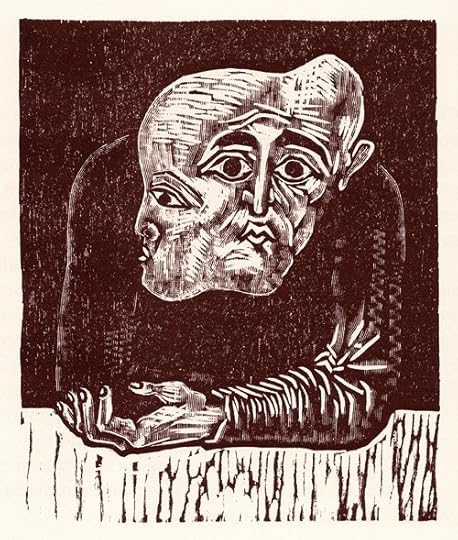
A Portrait in Ellipses - illustration by prose poet Russell Edson, 1935–2014

What many readers enjoy about poetry is the heartfelt connection with the world of the poet through language, sensations, feelings, perceptions and musings contained within the poem. Even someone like myself who doesn’t usually read that much poetry, the three poems below resonate:

The Red Wheelbarrow by William Carlos Williams

so much depends
upon

a red wheel
barrow

glazed with rain
water

beside the white
chickens.

How Poetry Comes to Me by Gary Snyder

It comes blundering over the
Boulders at night, it stays
Frightened outside the
Range of my campfire
I go to meet it at the
Edge of the light

Each Ecstatic Instant by Emily Dickinson

For each ecstatic instant
We must an anguish pay
In keen and quivering ratio
To the ecstasy.

For each beloved hour
Sharp pittances of years,
Bitter contested farthings
And coffers heaped with tears.

But what to make of the prose poems of Russell Edson, where the whole dynamic of poetry in the conventional sense is turned on its head? As Goodreads reviewer Nina observed, Edson uses his poems to play puppeteer with his characters, where men, women, animals, plant life and objects function as little more than dolls or “soulless stick figures against a blank backdrop.” And these bizarre Edson-esque happenings take place in an unnervingly chaotic, jumpy universe, a universe where interspecies sex, outlandish combinations and transformations along with outbreaks of random violence are all accepted as perfectly normal. It appears we are worlds away from the the poetry of William Carlos Williams, Gary Snyder and Emily Dickinson. Actually, more is at stake. As Charles Simic wrote in his New York Times Review of Russell Edson: "For many readers, calling something like this poetry is not just preposterous, but an insult against every poem they have ever loved."

So what does a Russell Edson prose poem look like? For those readers unacquainted, here is a sampling of four of his shorter pieces from this collection:

Fairytale
Behind every chicken is the story of a broken egg. And behind every broken egg is the story of a matron chicken. And behind every matron is another broken egg . . .

Out of the distance into the foreground they come, Hansels and Gretels dropping egg shells as they come . . .

The Elegant Simplification
An old man’s cane had broken a bone. Actually, a cane has only one bone. One of nature’s more elegant simplifications.
As the doctor prepared the splint he asked how the cane came to break its back.
My wife, said the old man. Her head is uncommonly hard . . .

Super Monkey
He was creating a super monkey by grafting pieces of a dead parrot to a morphine monkey.
When the monkey awoke he was covered with green feathers and had a beak. His first words were, Polly wants a cracker.
It’s historic! No monkey will ever have said this before!
And so super monkey will be given all the crackers super monkey can eat, until super monkey sickens of crackers and says, Polly wants a banana. Which will be another historic quotable!

Then he’ll begin work on super-duper monkey who, with proper grafting, will be able to sing like a canary . . .

The Tree
They have grafted pieces of an ape with pieces of a dog.
Then, what they have, wants to live in a tree.
No, what they have wants to lift its leg and piss on the tree . . .


Ouch! What in the world is going on with such poetry? As a dedicated lover of Russell Edson prose poems for the past thirty years, permit me to offer a few observations:

• Each piece tells a little story and the story is told in sentences rather than verse, thus a prose poem rather than a poem;

• We have entered the world of surrealism, the world where the umbrella meets the sewing machine on the operating table, the world where anything, no matter how bizarre, outlandish, weird, odd or strange, can take place and does take place;

• The combinations and happening are as clear as clear can be, in this way, these prose poems have much in common with the paintings of René Magritte;

• The imagination is touched in ways most fantastic – another magic gate to the worlds of hallucination, dream, visions and shamanism.

And how dedicated was Russell Edson to the prose poem? He wrote mostly prose poems – more than a dozen books of prose poems over a span of forty-five years. After reading my first Russell Edson poem years ago, I found my own writer’s voice and began writing prose poems for the next eight years. I’d like to share a couple:

Under the Desert Sun
Beyond the tuba of time and the trumpet of brass fittings, they spot a spiky green growth: a cactus with two bulbous swells toward the top – a female cactus, they reckon. Coming closer, they espy drops of dried blood on the sand a few inches from the green, spiky base. Ah, yes, it must be that time of month for the female plant.

By this tuba time, their own legs – green and spiky – can’t move. The sun, fiery ball, spins a child on the tip of its tongue.

The Adventures of Maurice Moonrat
A cartoonist keeps a caged moonrat in his studio. He had this creature, a variety of hedgehog, brought all the way from the Borneo so he could create the animated cartoon version with accuracy. The cartoonist carefully studies this foot-long moonrat with its small eyes and ears in a yellowish wedge-shaped head, its sharp, pointed nose bristling with long whiskers, its pointed teeth, its hairy, brown coat and long scaly tail. When he’s done, he names his cartoon character Maurice Moonrat.

The first episode will feature Maurice Moonrat and his sidekick, Lars, a dull-witted tomcat, bobsledding in the Olympics. The cartoonist wants as much realism as possible, so he talks his studio into sending him to Lake Placid to watch real bobsledders in action. Once at the bobsled run, however, he insists on strapping the moonrat to the front of the bobsled to gauge the rodent’s reaction. The perplexed bobsledders reluctantly agree.

After the run, at the bottom of the hill, the cartoonist unstraps his moonrat, who takes a few shaky steps and curls up in a shivering mass of fur. The bobsledders understand just how cruel and sadistic the cartoonist really is when he insists the moonrat be strapped to the bobsled for a second run. There’s a second run, all right, but it isn’t anything like the cartoonist expected.

By the time they’re all reassembled at the top of the hill, there’s the beginning of a conversion to animation. Maurice Moonrat and Lars are the bobsledders, wearing helmets and sleek uniforms, Maurice the driver, Lars the brakeman, and the cartoonist is tied to the back of the bobsled, to be dragged down the track behind them. Maurice and Lars push off, running at record speed and then hop in the bobsled as they start their decent. Maurice’s pointed teeth break into a wide grin when he hears a long, drawn-out scream from his creator.
Profile Image for Brian .
429 reviews5 followers
August 13, 2018
This was the weirdest sh** I’ve ever read in my life, and it was hilarious! I read through the first few poems and thought, Oh boy, one of those poets I don’t understand; what the heck is he talking about?

Until I read a few more to one that shocked me, and under the search for depth and meaning, the ludicrous humor broke something in my mind and I shifted into laughter. It’s the kind of laughter when you don’t know what else to do, “what-the-freak-was that” kind of laughter.

Then I understood. This strange looking man on the back cover pretends to be serious and deep but sneaks subtle humor into your mind that spins you like a push from a man hanging out a window of a passing vehicle.

Imagine sitting in a park with a close friend. You’re on a bench and a skinny guy in a trench walks by, turns to you both, opens his jacket and he’s wearing a one-piece women’s swimming suit with a huge rubber-ducky strapped to his crotch. He says in a high pitched, nasal voice, “Hi. She wanted me to piss on her cake, but I like vanilla and she likes chocolate. Have a good day Ralphie.” He closes the trench and walks away. You are shocked, look at your friend, and the shock subsides, your mind tries to settle, and you think, “what-the-freaking-heck-just-happened,” and all you can do to react is release laughter together. This is the kind of humor I get from Russel Edson, in this, my first exposure to his work.

Look at these first sentences of short poems:
“He was creating a super monkey by grafting pieces of a dead parrot to a morphine monkey” (Super Monkey).
“An old man is dressed in lingerie to amuse his cat” (The Cat).
“A woman had a bowel movement. An attending doctor smiled and said, Yours will be the first baby born without a belly button” (The Great Abstraction, or the Unfinished Story of Everything).
“A doctor, keeping to his promise to do no harm, keeps a spare old man with a white beard in his medical closet in case someone should choke to death on a tongue depressor” (To Do No Harm).
“Rocking the baby in her arms its head falls off and rolls to the corner of the room and begins to cry” (The Wet Diaper).

For someone who reads this review, I hope this poem may settle and you’ll “get it.” It took several poems before the brain-gears matched up for me:
.Things.
A woman said that she had been feeling rather thingy of late, and had, in fact, just had a thing.
Her husband said, What thing?
That thing, it came out of my body as suddenly as not, like some presumptuous stool.
That’s a baby, you silly thing.
Then is it to suckle at my thing?
Where else? You silly thing.
So the woman held the baby to her chest and said, Now the thing is attached to my thing. But I don’t know if the thing is suckling my thing, or my thing is suckling the thing.
Her husband said, It’s the thing suckling your thing, not your thing suckling the thing, you silly, silly thing….

I am learning about myself as I read literature. I love new, weird unique things. It opens to knowledge and understanding I’ve never experienced. I’m surprised to realize I like Russel Edson. Everything in me, reading at first said, this is too weird. But I must confess, I like this. It has that meatiness and resonance I like in literature and leaves me with something to think about, under the surface, a new understanding of humor and its link to sparks of confusion.

Thank you to my Goodreads friend for sending this to me. I’ve never experienced anything like this. It opened me up to a new kind of “knowing” – weird, fun, hilarious.
Profile Image for Jason.
158 reviews48 followers
March 1, 2009
What happens when an idiot opens his mind? Well, he’ll either say nothing or he’ll say something.

As in:

Super Monkey

He was creating a super monkey by grafting pieces of a dead parrot to a morphined monkey.
When the monkey awoke he was covered with green feathers and had a beak. His first words were, Polly wants a cracker.
It’s historic! No monkey will ever have said this before!
And so super monkey will be given all the crackers super monkey can eat, until super monkey sickens of crackers and says, Polly wants a banana. Which will be another historic quotable!

Then he’ll begin work on a superduper monkey who, with proper grafting, will be able to sing like a canary…


The thing about Edson’s creations is that they are stupid as hell, because he kills reason. If the point of literature is to bring out new points, to awaken the soul to the birth of ideas—Edson gives birth to retarded heads which spout out paltry idioms and eloquent mutterings.

But what’s that saying about monkeys on a typewriter?

Every once in a while, it’s primordial effluvium. Generations away from sparks and candor. It’s fucking insane, but it’s also fucking delightful. It is the nothingness that made life. It is the shit. Like that famous video of the cat making ominous music on the keyboard. Though it’s absurd, it touches the soul with some kind of accidental transcendental musing. And it works!

Most of his stories are populated with old men and old women, or children or talking animals or talking objects. Names are arbitrary. Identities are subdued. They are role-players, devices. He uses personification to excess. He allows absurd dialogue to draw towards irrelevant points. Or he will question systematic ideas like marriage and other typical life experiences by allowing their inane functionality to perform off-kilter, like in “Of Baskets and Eggs”:

There was a woman who had been advised not to put all her eggs in one basket: that it might just be that a dozen eggs require a dozen baskets.
Her father said, Please, you’re making me nervous.
Would you say that the advice is more figurative than nervous.
I’m undecided about the ratio of eggs to baskets in reference to the transference of same, say, from nest, A. to point, B.
From nest, A. to point, B.? Now I’m really nervous, said her father.
Nervous? What’s that?
Impulses without expression. Regret and anger battling through the system. Hatred compressed under a father’s patience, said her father.
But what’s that go to do with the question of baskets and eggs?


Or in “The Box”:

A man was opening and closing a box. Once it was opened he closed it. But again, closed, he would open it—Opened, he would close it—Closed, he would open it…
And he continued to open and close the box. Opening it and then closing it. Opening it and then closing it…
The constant motion made his mother nervous. She said, Will you stop doing that with the box?
Okay, I’ll just close it, he said.
But no sooner was it closed than he was opening it again.
I said stop doing that with the box, she cried.
Okay, Okay, I’ll just open it and leave it open, he said.
But no sooner was it opened than he was closing it again.
His father said, Why don’t you get married so you don’t have to be doing that with that box?
But I am married, this is my wife, said the man.
Congratulations, said his father, But why didn’t you tell us you were married?
Because I thought you might be a little disappointed that I didn’t marry the girl next-door, said the man.
But there’s no girl living next-door, said his father.
I know, that’s why I didn’t marry her. I hope you’re not disappointed.
Not at all, said his father, It’s just that that box is a little disappointing…


I can see Edson’s writing process. He begins with a random mention, some arbitrary clause that comes into his head, and then develops the thing. It starts as a statement containing objects. But where will it go?

The monkey is set to chomp on the typewriter and by the end, the “let’s see where this takes us…” inevitably has found the candy trail through the forest or becomes an exhausting deluge in indecipherable gibberish. It’s not his prose that we are reading, it’s his mind. The mind of a madman, confronting the status quo and clichés. He derides the necessary presumptions of Modern necessity by allowing the objects of Modernism (the happy housewife, kitchen appliances, the father with the pipe, the monkey with the pipe (straight from B.F. Skinner’s lab table)); he allows them to face off with no rules, with no objective, no morals, no impression—just stimulus, a Petri dish. If real life was entropy and our words were merely shooting guns, would we say anything in connection? Would it all be manipulated machines?

He gives these fake concepts faces and because they are so superficial they are almost blank. They are dolls. They walk into each other and they say one-dimensional phrases. When they cough, they choke on threads because they are puppets. And once in a while, one sputters out genius. Why? Because that is the paradox of nothingness. Once in a while a phenomenon is created out of blackholes; Edson runs his projector from the outskirts of the event horizon:

Let us consider the man who fried roses for his dinner, whose kitchen smelled like a burning rose garden; or the man who disguised himself as a moth and ate his overcoat, and for dessert served himself a chilled fedora…

A skeleton awakens and yawns in a grinning gape of teeth; stretching, its spine arching like a suspension bridge.
Sitting on a coffin it pulls flesh as if hip boots up the bones of its legs. Toe bones wriggling and twisting to fit themselves into the flesh of their feet. And then a long sleeved glove of flesh up one arm, and then the other.
And so with its torso, wrapping its ribs in a corset of flesh, fastened with the stub of an old umbilical cord.
Almost complete it hangs its genitals and puts on a mask.

In the street it passes unnoticed by other skeletons also wearing masks….


He plays with function, with inanimate fundamentals becoming mythologized, like in Barthes. While the situations are ridiculous, cartoonish and nonsensical, there is a notion of sadness. It is as if reality has been ripped from him and he is revealing the world as he sees it bare, stripped of intelligence and passion. You won’t find desperation in his work, but this riding mechanical anxiety. It is the same delirium that crashes computers. He is working from the insane notion that drives sane into sociopath, departure from love. Emotions do not necessarily exist, they are as fathomed as intelligence. Once you strip the world down to bare form it is nothing more than a play of objects; and when objects are allowed to play they can do anything. They can sit there for hours or they can collide to no effect. They can fuck and have babies or they can walk around in circles and nobody bothers them. They are, in effect, free. But it’s absolute freedom that kills the spirit, that proves, indeed, God is dead.

Although, that also depends on how far you want to go in thinking his cartoon is allegory. Maybe he just wants to say nothing. Sometimes the best way to say nothing is to just spit while you talk and laugh at the puns. Hey, I mean, Sex and the City is a hit-show after all.

The alternative is: this is just fodder, nonsense. A hamster wheel motorized by the Id. He brings the metaphor to life and lets it play around. He’s not trying to emphasize any point exhaustedly. It is writing without politics, Animation:

“The Restaurant”

A series of bangs, like backfires or gunshots…
It was a fat man exploding on the floor of the restaurant, writhing and jerking with bright flashes tearing through his clothes.
Obviously too many explosives. One spark arcing an imperfect nervous system, and a man can be destroyed by his own bowels.

Soon, after a few smoky belches and our encouraging nods, he was studying the menu again, and ordering the gunpowdered chicken with the nitroglycerin sauce.

After it was over, as well as it had to be, and the waiters had finished sweeping him up, I picked up a piece of intestine out of my glass and resumed my Molotov cocktail….


Anyway, it's worth a checking out. Even if you don't like it, it's art.
Profile Image for Leanna.
143 reviews
September 13, 2009
Seemed like Russell Edson "lite" to me. Trademarks are there--old people, Father, Mother, apes, genitals. All poems in his trademark prose poem style, often with ellipses. I dunno, most of the book seemed to rely on cheap or gross gags and puns. There are others poems of his I like much more than the ones in this book.

That said, "The Gas Heads" was pretty funny--about the word bubbles above the heads of Dick and Jane from the classic readers. Clever!
Profile Image for Robert Vaughan.
Author 9 books142 followers
January 17, 2016
A dear friend sent this slim volume of Edson to me, and I was grateful. In some ways, it does seem in style with Edson's quirky, and clever way of deconstruction, and the "gosh, I never saw that coming" shock technique. Abstractions. But also, this collection seems just slightly blasé in some way. Not his usual WOW! I am such a huge fan, though, and so grateful to Edson for opening me up as a writer.
Profile Image for Bill.
Author 3 books16 followers
September 26, 2015
Alla Prima word painting, slatherings of wet, dark strokes on wet, dark strokes directly to the canvas of life. It's a combination of Bosch, Goya, Bouguereau, Blake, and Durer. A hellish joyride through the droll, dank, mean universe of the everyday. This isn't poetry for pondering over too long; read it, get up slowly from your chair, and go make a cup of coffee.
Profile Image for Tricia.
51 reviews
June 7, 2008
quick fable worlds constructed smartly than melted like lego houses under magnifying glasses. great prosepoems, often scandalous. i would suggest reading it with beer-can chicken. i knew a lady who referred to this recipe as chicken up the butt. so there you go.
Profile Image for J.F..
7 reviews1 follower
November 1, 2007
Edson is a master of impossible scenarios, and making meaning of them... Reputed as the "most distinguished writer of American prose poems" (Bio blurb in Rooster's Wife), his poems are written almost like jokes, except with punch lines that are more profound than laughable. Take for instance "The Jack Story":

There was the Jack of the beanstalk story, and a Jack Sprat who could eat no fat. And there was Jack-in-the-box who used to spring out of a box for no reason at all. And Jack who broke his crown fetching water with a certain Jill. Not to forget little Jack Horner, or the Jack who jumped over a candlestick....

Theirs is a club of Jacks. Grown old they are all drunks. Jack Sprat's a bloated sot. Jack of the beanstalk has long ago drunk up all his beanstalk wealth. Jack who used to spring out of a box how lies at the bottom of it in his own vomit. Little Jack Horner just sits in a corner nursing a bottle of rye, saying, what a good boy am I. And the Jack who used to fetch water complains that he still misses Jill, and all the wondrous falling they used to do....

An issue of Believer magazine a couple of years ago lead me to pick up his selected poems, a collection of his work that spans three decades. And though I had some trouble getting into those, I completely enjoyed Rooster's Wife.
Profile Image for CX Dillhunt.
81 reviews
July 18, 2009
2005 Boa edition so thought I should read it; found it at Passtimes Books in Sister Bay; read it the afternoon I bought it, couldn't put it down; I've not trusted R.E. in the past, but this changed my mind--a more coherent collection, really made me laugh, cry & reread! Still a few pieces in each of the 3 sections that could have been left out all together & would have made the book even stronger.
Profile Image for MikeCro.
15 reviews1 follower
Read
September 20, 2007
If Salvador Dali did what he did with a pen and a paper...alright, if he did it with words instead of pictures...this would be it.
Profile Image for Otto.
85 reviews10 followers
April 8, 2019
Prose poetry that's like Dril before Twitter existed.
Profile Image for Beth Cato.
Author 132 books703 followers
September 3, 2019
What a trippy book. Edson’s prose poetry reads like a fever dream, each only paragraphs long, scenarios absolutely ludicrous. Some of the imagery is amusing and stunning, some bizarre, some revolting (several involve girls being groped). On a technical level, each work relies heavily on ellipses, which adds to the fever dream feel as one poems sloshes into the next. Overall I found the concept weird for my taste and I am unsure how to feel.
Profile Image for Brenda.
Author 3 books49 followers
June 7, 2010
Russell Edson is the Mad Hatter of Prosepoemland. Even as she skims the table of contents, the reader prepares herself for streaming punch lines or else riddles without answers. Titles such as “The Wet Diaper,“ “Monkey Gas,“ and “Portrait of a Wrinkly Old Man with Nasty Genitals” do not promise solemnity or sagacity. Or do they?

My favorites in the collection include:

“To Do No Harm”
in which a doctor “cooks a little girl to death with his x-ray machine,” then, “accidently"
slits "his own throat while shaving with his scalpel…” (39)

“At Sea”
in which two fishermen seek mermaid wives, hoping for daughters who will resemble
“Emily Dickinsons born with water wings; nice shut-in types who write poetry and
love their dads.” (41)

“Let Us Consider”
in which a crone wears " smoked cows’ tongues for shoes,” a man stir-fries "roses
for his dinner,“ and a young woman sets to "scraping her shadow off a wall…” (63)
Profile Image for Donna.
124 reviews14 followers
June 30, 2008
Compared to some of Russell Edson's other work, I thought this was a bit tamer and more accessible. Surreal and dream-like, I have come to enjoy Edson quite a bit and admire his ability to create his own folklore/mythology. As my poetry friends will tell you, he sometimes takes over my own work. A haunting voice that grows on you.
Profile Image for Danny Avila.
87 reviews5 followers
February 23, 2019
The feeling after reading one of Russell’s poems is as follows: I wonder what would incline someone to write such a thing, then I wonder what the point of the poem is, then I wonder what the point of anything is, then I laugh. Experiencing this cycle of feelings is really fun. Thanks Russell!
Profile Image for David.
922 reviews1 follower
December 12, 2009
More odd, hilarious, disturbing prose poems from Edson. Rather addictive.
Profile Image for Alvokun.
32 reviews3 followers
July 12, 2020
I would say this is one of Edson's best collections (and he has many and very good ones). Almost the entirety of a previous smaller book, The House of Sara Loo, is included here. At this point of his literary production, Edson absolutely knew how to build his prose poems and short stories. He even included some metapoetic texts, such as "Let Us Consider". I also believe this collection allows to exemplify the more or less distinct categories that can be applied to Edson's work: short story, prose poem and the so-called narrative prose poem. Although minor, these differences are indeed possible, and I believe The Rooster's Wife has a bit of the three of them. Great collection, in short.
28 reviews
July 19, 2022
Edson is always a delight! Definitely look up some of his poems before buying a book (they aren’t for everyone). Some of the most distinct and creative poetry I’ve read to date. “The Dark Waters” was especially good.
Profile Image for Sarah.
Author 15 books17 followers
October 15, 2019
"Didn't Adam even make love to a piece of himself and create a whole species."
Profile Image for Jack Rousseau.
199 reviews4 followers
January 17, 2022
Within a collection, Edson's prose poems are often connected by common themes or scenarios. In The Rooster's Wife, the most common of these themes/scenarios is birth...
A woman had a bowel movement. An attending doctor smiled and said, Yours will be the first baby born without a belly button.
Does that mean I've won a prize? said the woman.
I'm not sure, said the doctor.
Not sure? Then why did I bother? said the woman.
Because in the final accounting, dear lady, things happen in abstract rendezvous as fate and substance meet to tell the story of everything.
Does that mean I don't get a prize? said the woman.
I'm not sure.
When will you be sure?
When fate and substance meet, and the full story of everything has been written.
When will that be?
When fate and substance meet, and the full story of everything has been written.
And when will that be?
Hopefully any day now...
- "The Great Abstraction, or the Unfinished Story of Everything", pg. 31


There was a man who built himself something that looked like a womb. When he left it he'd say, I've just been born, spank me if you must, but please be kind.
And just before he entered it he would say, I'm just about to be conceived. I wonder who my daddy and mommy are.
- "The Womb", pg. 35


A woman had given birth to twin daughters, but used only one.
When her husband asked where the other one was, she said, There's only one.
But I thought I once saw two partially developed persons of the female persuasion exit the lower end of your torso.
That was when I was feeling excremental and lay down in expectation of an extraordinary bowel movement, but instead bore a partially developed person of the female persuasion.
But I thought I saw two partially developed persons of the female persuasion exit the lower end of your torso, said the husband.
Oh, that one, she's a spare in case I come again into expectations of an extraordinary bowel, but find my bowels unwilling; then would I tender the spare partially developed person of the female persuasion, and so remain within the index of those who bring forth upon the earth....
- "Of Those Who Bring Forth Upon the Earth", pg 47


After nine months a woman gives birth to a little girl's doll.
The doctor's a little disappointed about the baby not having an umbilical cord, which he takes special delight in cutting on newborns.
The mother and father decide to love it and take it home. The put a diaper on it and give it an empty baby bottle to nurse. And life is good.
This is what it's all about, says the husband.
What what's about? says the wife.
You and I, and the fruit of our loins....

But one day the baby begins to make a ticking sound. They call the bomb squad, and the baby is put in an explosive cage and taken to a deserted field, and blown up....
- "Baby", pg. 59


A woman had given birth to a small pink elephant.
She asked the doctor, Why an elephant and not a parrot?
Isn't your husband an elephant?
No, that's my grandpa Tusk. My husband's the parrot, the one in the cage. You met him when you came to look under my skirt. I said, Why are you looking under my skirt? You said you were trying to see if you could see the baby's head. Meanwhile my husband was emptying his bowels in a newspaper on the floor of his cage. Don't you remember?
No, my head was under your skirt looking for a head....
- "Looking for the Head", pg. 77


My favourite prose poem in the collection...
As a man watched, his wife buttered his hand.
He asked her why she was buttering his hand.
She said, I thought it was a piece of toast.

When she bit his hand he asked, Why are you biting my hand?
I thought it was a piece of toast.

When she bit his hand again he asked, But why are you still biting my hand?
Because I still think it's a piece of toast....
- "Breakfast Toast", pg.44
57 reviews3 followers
December 18, 2007
Russell Edson's the Godfather of prose poetry, WTF, I'm confused....
Displaying 1 - 23 of 23 reviews

Can't find what you're looking for?

Get help and learn more about the design.