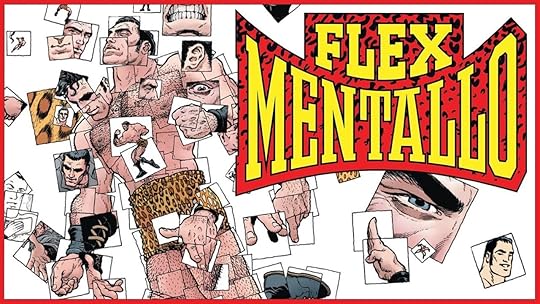
More than a review, this is my attempt to rationalize Grant Morrison's script of Flex Mentallo, so it's probably doomed to fail. This is not a resume of the plot of the comic page by page, but a post-construction I have dared to elaborate after reading the story three or four times, in different directions and from different angles. In my view, there is no other way to approach this work, due to the convoluted nature of the story.
Compared to Morrison's script, David Lynch's "Inland Empire" is plain linear storytelling.
I will try to put some order into this series by exploiting the obvious similarities of the "Flex Mentallo" story with the famous DC series titled "Crisis on Infinite Earths". In "Crisis..." there was a series of parallel universes (the DC multiverse) that were being devoured and destroyed one by one. Finally the DC superheros save the day and a new reality starts. Here, things happen a little different.
So, let's go. Spoilers abound (if the world "spoiler" means something in a morrisonian context):
Things start with a catastrophe menacing parallel universes. This multiplicity of universes, called the polyverse, is being destroyed by an evil force named "The Absolute". The superheroes of this polyverse ("The Legion of Legions") are failing to stop that evil force. As a consequence, the polyverse will disappear, and the Absolute will be the only reality from now on.
Before everything collapses, however, the superheroes develop a plan to at least save themselves (somehow) by self-mailing to a new kind of reality outside their doomed polyverse and within The Absolute. As part of the plan, two League members, Nanoman and Minimiss (how could someone not to love those names?), weaving through the spacetime of The Absolute, create a new world: the "real" universe, where we live. Now it seems that Legion members have some place to go. However, something went wrong. At the time of creation, parts of this new universe entered into a "quantum coma", neither alive or dead, like Schrödinger's cat. Superheroes arrive, but they are doomed to live in a strange state called "fictional", the place where all fictions live.
The Legion will not be able to actually become real until someone in the "real" reality will decide one way or the other, by virtue of a magic word that will break the quantum coma. However, that magic word seems to exist only in that fictional state, as the solution to a crossword in the hands of a misterious shazam-like retired superhero. Someone in reality should pronounce that word and bring the heroes into life.
Close to Sirius, Legion members are waiting for someone to remember them and bring them to reality. For that to happen, the barriers between fiction and reality must broke, and a child named Wally (Wallace Sage) seems to be the perfect person for the task. The heroes manifest to Wally at critical points in his life, like a possible child abuse experience. During that experience we see a green-caped guy (the leader of the Legion) holding Wally's hand and taking him to a tour of the fictional world ("Welcome to… Where you-get-your-ideas"). It seems that those God-like fictional characters not only created our reality, but they take care of it (providence). They sometimes "come" to our world to help us, to help people like Wally to cope with his life.
The green-caped hero shows Wally the fabric of our reality, and how they have been transmitting fictional ideas into this reality they created. Wally is told that he is the one that will be able to make them real again ("Don't be afraid: before it was a bomb, the bomb was an idea").
Wally, inspired by the Legion, draws comics and creates new characters like Flex Mentallo. As such, Flex lives in a fictionary world, just like the Legion, but with little contact with them. In Flex's fictionary world, the Legion is a legendary entity that few people was able to see, but sometimes they manifest themselves through epiphanies, drug induced hallucinations, appearance to space travellers, etc. It seems that in the fictionary world there are parallel universes, so Flex does not mix with the Legion (in the same way that Sherlock Holmes does not mix with the characters in, say, The Walking Dead), but connections are not forbidden…
However, as Wally grows up, he abandons his love of superheroes. That will lead Flex Mentallo's world to a near-collapse, an "End Is Near" status, very similar to the state of the world in Alan Moore's "Watchmen". But another character created by Wally, called The Fact, believes that the fictional world created by Wally deserves to be saved. The Fact is very special. He was "spread and twisted" through time and space by some psychic superpowers of the adolescent Wally, as a kind of punishment that now results in a blessing. The Fact is the only character that seems to be able to jump from reality to fiction, and to move between the different fictionary worlds. His multiplicity of appearances, at different times and locations, leads Flex to consider him a collective, named Faculty X.
The-Fact-Faculty-X considers Flex to be the only hero that is able to save the world and leaves him a lot of clues to that point towards a teleport tube. Flex believes that the teleport leads to the Legion HQ but that is actually an illusion created by The Fact. Actually, the teleport is the door to the place where the "villain" lives. This villain is a moonfaced character representing the adolescent Wallace, who now negates and despises the superhero world that he previously loved and created. This moonfaced character is the one that previously punished The Fact to live in-between worlds. He claims to be the controller of the "creative engines", like an impersonation of the child's creativity Wally used to have, while reading comics with the help of his old moonfaced lamp: "I made you, Flex. I made your whole sad, scabby little world to entertain myself with and now I'm going to destroy it". The forces of creativity have also the destructive counterpart, the power of destroying its previously created worlds.
Moonface menaces Flex with a piece of coal symbolizing "The Death of Flex Mentallo". With the help of Lt. Harry and The Hoaxer (Grant Morrison himself who, being the writer, has the last word about everything that goes on here), Flex confronts moonface. In the fight that ensues, Harry is forced to shot himself and the Hoaxer simulates to collapse (but, of course, it's a hoax; no one can defeat the writer!) but finally they take control of the situation. Harry comes to life again and Flex defeats Moonface.
Removing his mask, the moonface reveals his teenage Wallace Sage identity: a person who, like many of us at that age, wanted to "destroy" everything related to superheros ("pathetic fucking power fantasies for lonely wankers…"). But Wallace is aware that, by destroying them, he somehow will die during the process. Luckily, Flex feels sorry for moonface-teenage-Wallace and helps him. Old superheroes like Flex "would never let us down". In parallel, we see how a grown-up Wallace reminds his love of comics. The piece of coal representing Flex's death now has become a diamond.
Flex, Lt. Harry and the young Wallace look towards the Earth with hope. They know that "The Fact is out there somewhere" and will rescue them. The fiction world is saved, but they are still fiction. How is The Fact going to help?
Let's see. In parallel to the "main" plot, Morrison tells us the suicide attempt of the adult Wallace Sage. When Wally grows up, he became a rockstar named Wallace Sage. He is now on the verge of suicide and talking about his past, his love of comics, child experiences, hallucinations, etc. Wallace tells his story by phone to a member of the "samaritans" help group. At the end we see that it was The Fact (as a Faculty X member) the one who the adult Wallace was talking to. The Fact knows where Wallace is and gives him a (now solved) crossword sheet with the magic word that breaks the Nanoman-Minimiss quantum weave and activates the superhero world into ours, bringing the superheroes into reality.
Utterance of this "sha_z_m" word is probably a metaphor for expressing the will of bringing fiction to reality. In any case, Wallace pronounces the word. In the final scence, we see Wallace's girlfriend waking up. Grant Morrison (as the Hoaxer) briefly appears to tell us that "They're coming through" and, looking by the window, she contemplates this new, amazing world.
That's all, or maybe not. I surely left a lot of things without comment (that dreamy world, with that castle above it). This is not an easy read by any matters, but it's an amazing re-read or re-re-read. The list of topics covered by this comic masterpiece is overwhelming: Fiction, reality, many-worlds, adolescence, cosmogony, love-hate of comics, the power of the writer over their characters, comic history, we humans as characters created by someone else, drugs, suicide, religion, gnosticism (our world was created by a bunch of imperfect Gods), childhood, abuse, fiction as a way to cope with reality, superheroes and their deconstructed counterparts, naivety, dreams, going back to childhood, the writing experience, writer-character relationships, fiction as hallucination and the other way round, etc., etc. In a word, Morrison at his finest.