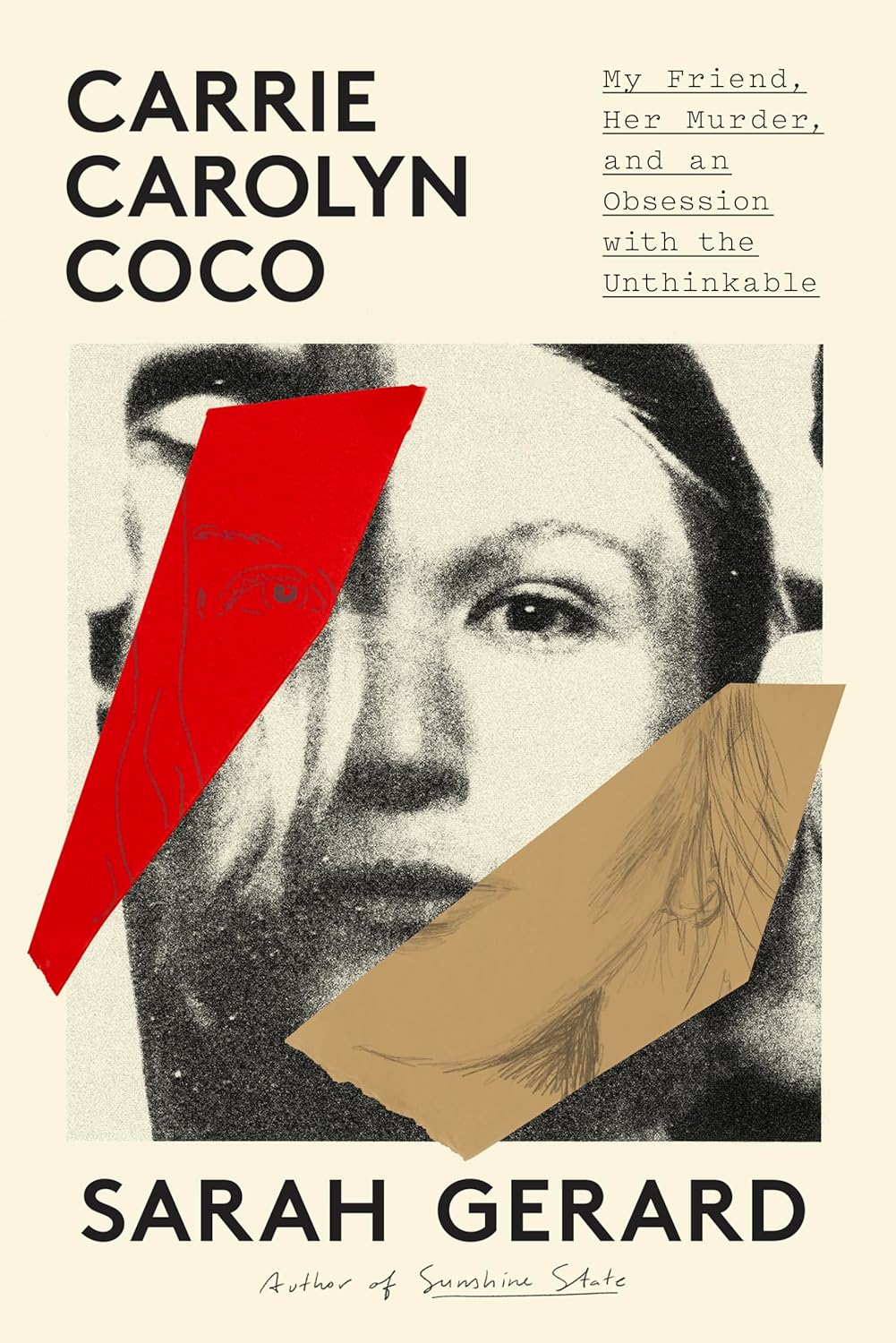
Acclaimed author Sarah Gerard turns her keen observational eye and cutting yet compassionate prose to the 2016 murder of her friend Carolyn Bush, examining the multi-faceted reasons for her death―personal and societal, avoidable and inevitable―with all the “insight and skill” ( Tampa Bay Times ) she brought to her lauded essay collection Sunshine State .
On the night of September 28, 2016, twenty-five-year-old Carolyn Bush was brutally stabbed to death in her New York City apartment by her roommate Render Stetson-Shanahan, leaving friends and family of both reeling. In life, Carolyn had been a gregarious, smart-mouthed aspiring poet, who had seemingly gotten along well with Render, a reserved art handler. Where had it gone so terribly wrong?
This is the question that has plagued acclaimed author Sarah Gerard and driven her obsessive pursuit to understand this horrifying tragedy. In Sarah’s exploration into Carolyn’s life and death, she spent thousands of hours interviewing her and Render’s friends and family, poring over court documents and news media, attending memorials for Carolyn, and Render’s trial, and reading obscure writings and internet posts from both parties. Even as she gleaned through this work a deeper understanding of Carolyn, her murderer, and the reasons for the crime, Sarah couldn’t help but turn her gaze to the greater forces that enabled it.
Sarah’s relentless instinct to follow a story and its characters to even their darkest ends makes this work at once a gripping work of true crime, a striking homage to Carolyn’s life, and an explosive excavation of a society in which murderous crimes committed by white men have become a disturbing norm.
Sarah Gerard is the author of the essay collection Sunshine State; the novel Binary Star, a finalist for the Los Angeles Times first fiction prize; and two chapbooks, most recently BFF. She teaches writing at Columbia University and for independent workshop series, including Catapult, Sackett Street, and Brooklyn Poets. Her short stories, essays, interviews, and criticism have appeared in The New York Times, Granta, The Baffler, Vice, BOMB Magazine, and other journals, as well as in anthologies. She writes a monthly column for Hazlitt and is currently at work on several books, including a novel about love and a nonfiction book about a murder.
First off, regardless of any other response to this book I may have had, I want to state unequivocally that what happened to Carolyn was obviously completely terrible and tragic. I feel for her family and close friends who were affected by this shocking and violent loss, and I cannot imagine the lasting impacts of such grief. Although I struggled with this book in some ways, the most important thing in my view is that the book was hopefully somehow helpful or healing to Carolyn’s family and close friends. What they think of this book is the only thing that really matters to me, and they are best equipped to judge it.
I usually don’t have a problem rating books. First of all, who am I anyway, and what does it really matter to the world what I think about a book? I’m not a high powered critic with the ability to impact anything. Second, I don’t ever agree with the idea that rating memoirs or autobiographical writing is not okay. It’s not “rating lives,” it’s expressing a personal response to the particular telling of a story, a book, a work of art someone chose to create and publish and sell, thus opening it up to others’ opinions. It’s fair to assess that product.
Nonetheless, I don’t feel comfortable rating this particular book.
In fact: This book made me uncomfortable in a number of ways.
First, I often struggle when someone tells the story, from a memoir/autobiography angle, of another person’s tragedy, trauma, or murder, but still inserts themself into that story. It is one thing if the storyteller was truly close to that person, was their best friend or parent or child or partner or sibling. It feels appropriate in such cases. But I’ve read a few books lately, including this one, where the storyteller was not very close to the subject at all. In this case, it feels appropriating rather than appropriate.
Second, as other reviews have observed, the book contains lots and lots of often repetitive detail about Carolyn’s gifts and talents as a person, as well as the types of leisure and social activities she engaged in as a teen and early 20-something creative student, writer, and artist in Florida and NYC. Carolyn clearly was a unique person who lived life vibrantly and was adored by many. However, I do think the repetition was a bit much. There are only so many times I can read about someone and her friends smoking and writing and debating about aesthetic philosophy and spiritualism. It does start to feel a bit insufferable and claustrophobic, like being trapped in the subway car with an art school field trip.
Also, although I hate to say this, the descriptions of Carolyn did seem to border a bit on manic pixie dreamgirl glorification/idealization and even hagiography. I guess this suits the “obsession” theme in the subtitle, but it felt somehow disrespectful and I feel a more nuanced and humanized portrait would have been of greater service to the subject and to other victims. After all, one doesn’t have to be an angel to be a human worthy of respect and dignity and life. Carolyn did not deserve to be a victim, but that doesn’t mean she had to be perfect. Repeatedly emphasizing things like Carolyn’s beauty and fashion sense - ad nauseam - unfortunately has the effect of suggesting that Carolyn’s death was all the more tragic because she was a pretty white girl.
Thirdly - and I have had to strike and rewrite this paragraph several times to avoid going on a rant - I was unsettled that the author seems to suggest conclusions about Carolyn’s killer that I do not think the author has the psychological/academic knowledge and qualifications or the sufficient information/evidence to make. Suffice it to say that she seems determined to portray him as just a rich bad guy who murdered Carolyn on a whim so that he could malinger in a long-term prison vacay as opposed to a person whose behavioral health problems influenced his behavior. OK, so the guy did an awful thing, and he experienced some privilege in life too, but it also seems pretty clear that ample signs of mental illness and disturbed, odd behavior were present with him for some time and factored into what happened, and I don’t see how the tragic situation is helped by denying that. Refusing to accept this reality doesn’t make the situation any better or bring the victim back. He doesn’t have to be full-on intentionally evil for this to be a tragedy; he can also be sick. Is not greater awareness of and empathy around mental health - for all - a goal worth working for and that could ultimately benefit everyone? Isn’t this ostensibly one of the purposes of this book?
(A word about drug-induced psychosis: I work in mental health and have seen this and similar phenomena happen frequently enough, including with substances that people often prefer to think about as innocuous or even fully beneficial. I think the killer has way more pervasive and concurrent mental health issues going on than that episode alone, but I don’t think it’s a total bullshit excuse even if it’s unpleasant to think about. Additionally, it’s interesting that the author omits discussion of how the killer’s father, a once-famous cartoonist for The New Yorker, was eventually arrested on serious and still-mysterious child pornography charges after this murder and died of organ failure while the case was pending and his son still in prison - more evidence that things were potentially quite amiss in the killer’s supposedly perfect, privileged life.)
And as for the tangential chapter on Bard College - yes, it seems pretty horrible and retrograde, as are many elite educational institutions, stay away from it, but I still don’t see how realistically they could have done anything to address the killer’s mental health or prevent this tragedy from occurring given that it was a number of years after his graduation and that he didn’t display violent behavior while at school.
(And, it appears Bard did give Carolyn many chances to finish her coursework when factors such as anxiety, depression, and perfectionism seem to have been impairing, but if she never completed any of her classes despite these additional chances, it makes sense as a consequence that they would eventually have to let her go.)
Overall, I think this was an interesting twist on true crime in its effort to emphasize the life rather than the death of the victim as well as the lives of those who loved and survive her. However, this effort was marred for me by bias and writing beyond one’s scope of expertise. The result is a confusing passion project in which the author’s connection to the subject never seems entirely clear.
A young woman was senselessly murdered by her roommate, and an acquaintance spent six years researching a book about her. When I saw the advance reader copy was available, I was intrigued enough to read it.
As someone who didn’t know Carolyn Bush, I can’t say this book by her “friend” does her any favors. Carolyn comes across as unbearably unlikable (for example, descriptions of her as punching people as hard as she could for fun, “she’s so intense” (p. 311), I’ve never liked anyone who is physically abusive to “friends” and thinks it’s funny) and incredibly pretentious. I mean, a lot of us are pretentious in our twenties, especially if we fancy ourselves writers, but although I think the author means the reader to find Carolyn as unique and incandescent, that’s not actually how she paints her.
If feels weird to be criticizing a book about a murdered young woman, but I’m criticizing the author, not the victim. I hope the author found the exercise cathartic. I honestly can’t guess what the author is trying to achieve with this book. The book’s subtitle is “My Friend, Her Murder, and an Obsession with the Unthinkable,” and the author is definitely obsessed.
Throughout the book, astrology is presented as fact, which it’s not. “On November 19, 1990, Carolyn Hilton Bush was born. The moon was a waxing crescent on its path to conjunct with Saturn. A Scorpio, Carolyn’s ruling planet was Pluto, but she was born in the third decan of the sign, so she was also blessed with the moon’s influence. Pluto gave her power and determination. The moon made her sensitive, nurturing, and compassionate. As a Scorpio, Carolyn was resilient and perceptive, daring and brave, creative and enterprising. She planned and strategized. She hated pretension.” (p. 113 of the advance reader copy) Nonsense like this made it hard for me to take the author seriously.
This book desperately, desperately needed an editor. There were so many times when I thought, what in the world does this have to do with the murder of Carolyn Bush? Parts are almost stream of consciousness, and the author seems to think that every single thing she came across while researching the book HAD to go in the book. Trust me, it didn’t. Sometimes I wondered what I was reading. The text is also repetitive, and jumps dizzyingly around in time.
The book also serves as a nonstop criticism of Bard College and its president. It might have been better to bundle all the criticisms together, making a case for the criticism, instead of sprinkling stories, some of which had nothing to do with Carolyn Bush, throughout the narrative. The murderer, Render Stetson-Shanahan, honestly comes across almost as an afterthought.
For me as a reader, the book fails as “a gripping work of true crime” and as a character study of Carolyn Hilton Bush. I suppose it works best at capturing a group of artists and writers in a specific place over a specific period of time. For the people who know and loved Carolyn Bush, I hope this book is illuminating and helpful. I wouldn’t recommend it to anyone who did not know Carolyn Bush.
I knew nothing about Carolyn Bush or Bard College before reading this book. I read an advance reader copy of Carrie Carolyn Coco.
In 2016 Carolyn Bush, 25, was stabbed to death by her roommate Render Stetson-Shanahan in their NYC apartment. Carolyn was the author’s friend and she seeks to determine what led to her death, reviewing court transcripts, media sources and interviews with friends and family to get answers. The author was warned against writing this book, with a friend claiming a book “will flatten her for easy consumption, turn her into entertainment, glamorize her murder.” The author admitted to being unsure about her own motivations, asking whether she had “…a thirst for justice? Fear for my own safety in a sexist culture? Grief…? Entertainment, fame or money? Fascination and curiosity with death? A desperate desire to know why?” She finally determines that her primary push is to fully know Carolyn.
Both Carolyn and Render attended Bard College, Carolyn flunked out. Bard….does not come off well. “They’re living like squatters, not putting the heat on, talking about literature like they understand it when they don’t, and then they have this super-fancy bottle of whiskey? This is rich kid shit.” This kind of seems to sum up everything about Bard students as portrayed in the book. Rich, pretentious kids, slumming. It’s very off putting.
But even worse than the students is the administration. The President of the school is the worst, just a skeeve. The College seems to offer almost nothing as far as mental health services. Oh, and the President and a number of other members of the Bard administration wrote letters of support of Render to the court. For the murderer.
As to getting to know Carolyn, well….she’s not the easiest person to love. A friend describes her, “I feel like she has kind of this reincarnation of Mina Loy. She definitely wanted to be. The kind of ‘swathed in fur, holding court in a smoky parlor talking about the firmament and the fixture of the stars.’ That’s the world she wanted to inhabit.” I really can’t with these people.
All that said, and despite the cast of thousands that made things a bit confusing at times, I really enjoyed this. Despite what maybe the author wanted this is definitely true crime, but with a fairly unique legal defense, an interesting victim and the loathsomeness of the whole Bard thing, it was, dare I say it, worth reading (I didn’t want to say entertaining because we are talking about the tragic death of a young woman.) Oh, I hope I’m not alone in wishing there was an explanation of the Wendy’s Subway name. Why is such a fancy think space named for two fast food outlets? Highly recommended.
Revolutionary for the genre, Carrie Carolyn Coco delves into the 2016 case of Carolyn Bush, who was brutally murdered by her roomate, Render.
Instead of examining the case through the details of the event, as well as the trial and information about the murderer, the reader spends almost the entirety of the novel with the victim. We grow up with her, hear from her friend group, learn of her passions and ambitions. She was a vibrant individual, only 25 at the time her life was taken, though many of those who loved her believed that her vibrancy wasn’t tied to her age.
When unspeakable things occur, such as what happened to Carolyn, it is the victim (as well as their loved ones) who suffer the most. It makes sense to me, then, that this book stepped away from the traditional true-crime-narrative. Rather than making this a salacious “who-done-it”, love and care was put into memorializing a person as complicated and lovely as someone you might know, too.
The author was a friend of Carolyn, and her pursuit of understanding why this happened to someone she cared so much for, reflects on every page. The story wrapped up reluctantly, in a way which felt like a friend, unable to let go of a final opportunity to spend time with someone she misses, very much. An intimate and clever novel.
“When Carolyn was 17 and I was 23—the summer we were inseparable—she first showed me her writing. It is the only time I remember ever being in genuine awe of someone, witnessing the magnitude of their talent, in real life.
Carolyn loved books even more than I did. She read voraciously. She was forever engaged in the pursuit of knowledge and creative practice. I was nearly seven years older than her but she was light years ahead of me. She was just born cool.
After she was murdered, I started having dreams about her. In the first one, I was waiting by an old rotary dial phone in some sun-drenched Florida room when finally a call came. Carolyn told me how she was sorry she hadn’t called sooner. That she’s been so busy. I asked what it was like, wherever she was. She laughed and said it was very much like it is here. That she had a job and had moved into her new house—and then of course she had to spend all her time decorating and settling in because she can never settle down until she’s settled in. “One thing is different,” she said. “Fewer men. Which makes sense, when you think about it.’ She laughed. ‘Souls are made mostly of female energy anyway.”
In the Spring of 2017, about six months after Carolyn died, Sarah Gerard messaged me on Facebook. She told me there was something she wanted to ask me. She said it was best to talk in person. We had first met about 10 years prior, when Sarah’s father had dragged her to an art tour of the Raymond James Financial Art Collection. As administrator for the Collection, I led the tour. In the years since, we’d both moved to New York from our hometown of St. Petersburg, Florida, and had crossed paths from time to time in the section of the Venn diagram where the art world overlaps with the literary. But we weren’t friends. I told her to meet me at Shade Bar on Sullivan Street, near my office at NYU. I had a feeling about what she wanted to ask me. I didn’t yet know how I felt about it.”
Carrie Carolyn Coco is about Carolyn Bush, who was murdered in 2016. The book is written by a friend, but I read 60% of this book and still do not understand how the author knows her. This book is not written in any coherent manner -- it is not chronological, as it begins with Carolyn's death, and it feels extremely random and stream of consciousness. The author went deep into Carolyn's history in a way that felt completely unnecessary. Honestly I was so lost and bored. I read other reviews, and it seems that the ending goes further into why Render murdered Carolyn. I tried, but I just could not get past the numerous deep dives into Carolyn's life in ways that did not matter to me.
It's sad, because this book is about a girl who tragically lost her life too soon. The author notes that she had been told not to write this book, and it seems to me that that would have been the better idea. This book feels like the author's healing process, and doesn't do much to serve Carolyn or her family.
Thank you to Zando and NetGalley for an ARC in exchange for an honest review!
Boy, where to start. First of all, this story was not the author's to tell. It felt like she took advantage of a really (really) distant friendship with the victim to insert herself into the tragedy and get a book deal. The author never interrogates why she needs to be the person to tell this story.
Second, if she was trying to make the victim (and her pretentious wannabe artist friends) come across as insufferable, she did a great job. If I were the victim's family or friends, I'd be pretty upset at how a near stranger depicted someone I cared for.
First, I do want to say that I think Sarah Gerard is an extraordinary writer. If not for her skill at the sentence-level (and the strength of the opening chapters), I probably would have given up on this book about halfway through because, once you get past the night of Carolyn's (baffling, senseless) murder, the narrative structure starts to meander. At times, it was so repetitive and chaotic that I skipped pages out of frustration, hoping the story would draw itself together again. But it kind of never does, and there are sooooo many off-topic deep dives into... the murderer's grandparents? and the (absolutely vile) scumbag Bard president? and the (also vile) culture at Bard? all of which has nothing to do with anything because the murder did not occur when the perpetrator or Carolyn were attending Bard College. It didn't even happen in the same city. Or coincide roughly with either of them having attended the college, at all (to my recollection; there is soooo much hopping back and forth through time that several dates/timestamps definitely slipped by me). I *think* Gerard's goal was to establish that the murderer (I refuse to use his name, fuck him), who comes from wealth, was enabled by sympathetic adults around him, most of whom were also very wealthy and had connections to Bard College, which itself has a history of covering up wrongdoings perpetrated by faculty/staff/students and outright ignoring what appears to be a massive mental health crisis that has pervaded the entire campus for decades, which eventually culminates in the murderer's "breakdown" and Carolyn's subsequent death. If so, that literally could have been accomplished through a handful of well placed details rather than the CHAPTERS upon chapters of information that the author provides. They all had the vibe of an essay your teacher would hand back to you with "off-topic!" scribbled all over the margins.
Also, I have to admit that I feel a bit misled by the subtitle of this book, which identifies Gerard as a friend of Carolyn's. In fact, they seem to have barely known each other (aside from inhabiting the same social/artistic circles in Brooklyn, and briefly working at the same bookstore), and it's revealed toward the end of the book that the last time Carolyn saw Gerard, Carolyn tried to draw her into an obvious pyramid scheme (lmao?????) then never spoke to her again after that. At best, it seems that the author and Carolyn were friendly acquaintances; nearly all of the revelatory details about her and her life were provided by closer friends and family. To my recollection, Gerard herself contributes very little except to say that Carolyn was super intellectual and artistic, which... is the gist of what everybody else has to say about her, anyway. Oh, and they also apparently grew up geographically close to each other and knew a lot of the same people? I kept waiting for the part where Gerard would turn the lens on herself, and try to interrogate WHY she felt like she had to write this book in the first place, or what gave her the right, etc. when there were sooo many other people (who are writers themselves!!!!) who knew Carolyn better and would perhaps be better positioned to write her story. But Gerard actually never questions this beyond a couple paragraphs. I found this disappointing and, frankly, confusing.
That being said, the strength of this book is in the depiction of Carolyn. I appreciated how Gerard never shied away from portraying her as a complex individual, instead deifying her just because she died young and tragically. I'm going to be honest... if I'd gone to college with Carolyn, I probably would've hated her. She comes across as insufferably pretentious and self-absorbed (same with her friends from the art collective, omfg), but then, aren't we kind of all that way at 24? So much true crime writing centers the victim as someone "whose smile lit up a room" or "was the life of the party" and I just love that Gerard put so much effort and work into accurately capturing who Carolyn WAS. I'm just not convinced that this was Gerard's story to tell, or that she had enough material to write a book-length work in the first place. The book would have been a lot stronger (not to mention more interesting, to me) if she'd dug into this deeper.
This entire review has been hidden because of spoilers.
Thank you NetGalley and Zando for the early access to Carrie Carolyn Coco, in exchange for a truthful review.
Deeply disturbing case, vividly rendered in places, but with frustrating repetition in others, and strange deviations.
This is a tough one to talk about. If it was fiction it would be open to criticism about the large number of unlikeable characters, but these are real people - and young people at that - who have suffered a loss, even if the reaction to that loss frequently feels a little narcissistic and performative.
I’m also not sure how I feel about the book having ‘my friend’ in the title, which implies a personal perspective filled with connection and insight, when the author states in the text they’d only just started to form a friendship when Carolyn was murdered. Then, when we discover the actual nature of their relationship, revealed in an email towards the end, the whole enterprise feels even stranger.
There’s an early moment where one of Carolyn’s friends talks about feeling uncomfortable about writing an essay about her after her death, when they hadn’t had very deep conversations when she was alive, and he was ‘nervous about claiming more than is my right to claim.’ This feels like one of the most revealing moments of the book, in a genre where exploitation of tragedy is always a risk.
As a document of our age, it feels genuinely essential - though I’m not sure if that was the actual intent. I might be wrong though! Truly, one of the weirdest non-fiction books I’ve read.
-she seems desperate to publicly shame the mother of the killer revealing every embarrassing event of her life even though she had nothing to do with the killing. Why ? Because she is not eager to see her mentally ill son locked up forever and publicly mourns, on Facebook, the incarceration of her son. What does Gerard hope to gain by hurting the mom by revealing embarrassing career and financial problems in the context of nonfiction. What does she hope to gain for wishing further harm upon the mentally ill killer, he’s locked up Sarah. Do you want to see him publicly executed?
I’m gonna need a second to formulate my thoughts and feelings about this…..I picked this up on a whim only for it to become one of those rarely engrossing books that seems to have the power to consume and haunt all of your thoughts and dialogues….I had to read and finish it in a little over 24 hours in order to breathe and exist again only to come an ending that wasn’t an ending at all—which has to obviously be the point….how else but to be ultimately left unsatisfied and unfulfilled by the endless rabbit holes within one of the ultimate themes that haunts and defines us: violence, its endless unanswered mysteries and hidden truths; the systems and cultures enabling and sustaining it, and the victims left demolished in its wake
this was just not a good book. after reading other reviews that have very similar opinions, i wouldn’t recommend this one. this was done in poor taste AND poorly written
I feel bad giving a book about a tragic and senseless murder of a young woman a low rating, but the book itself also made me feel bad: about the victim, about the killer, and about the author.
Bad as in: the way Gerard depicts Carolyn, supposedly in tribute to her, makes her seem insufferable. The endless discussions of her talent, while also showing a person who can't finish anything and is constantly borrowing money to continue to "be an artist"...as someone who lives in New York, this type is all too common and cannot help but provoke severe eye rolls from me, especially combined with all the astrology and other woo bullshit she gets into. (There is truly SO much astrology in this book!) Plus, at one point, an actual pyramid scheme. Carolyn absolutely did not deserve what happened to her, and that includes the way she's introduced to the world by her supposed friend.
Supposed as in: so despite the subtitle, it turns out Gerard barely knew her? It seems like they were acquaintances at best, people who ran in the same circles, but it becomes increasingly clear that Gerard says so little about their relationship because there wasn't much of one. Gerard's nominating of herself to tell this story, and to tell it in this way, then starts to feel highly suspect.
Suspect like: all the connections Gerard tries to draw between the senseless act that ended Carolyn's life, and sexism at Bard College, and the Me Too movement, and Jeffrey Epstein, and racism in Florida, and every other murder that ever happened in the area, and and and-- I think there probably are connections to be made in some of these cases, but not the way this book is structured, which is both highly repetitive and sloppy. Gerard doesn't seem to have an actual thesis or work toward making any real points: she essentially just lists things and quotes, at length, from trial transcripts and the statements of support written by the killer's friends and family. The way she treats this last type of material, in general, was really off-putting to me: she seems to be mocking them for still loving their friend or family member. What he did was absolutely horrific, but in a book featuring so many people who love to (mis)use therapy words, I'm shocked she couldn't summon even a little empathy for people whose only crime is loving someone deeply troubled. Were they just supposed to stop?
Someone should have stopped Gerard from telling this story, at least in this way. It does no one any favors.
Stunning writing from a native Floridian! While I've read her earlier fiction and her beautiful Florida history book Sunshine State, Sarah Gerard has fully bloomed with Carrie Carolyn Coco. Her writing cracks with David Grann-like electricity. I was shocked by what I learned about the culture at Bard College and the sham of which our judicial system can sometimes be.
Most importantly, a gorgeous tribute to a life snuffed out before her prime.
First off, I think that the murder that this book centers around was awful and tragic. Carolyn did not deserve what she went through and I wish all good things for her family. However, this book was not a respectful or well done telling of her story. After finishing the book, it seems clear to me that the author over stepped in writing it. From what the book portrays, the author was not very close with Carolyn and only knew her as a coworker and fellow Wendy’s Subway patron. This really rubbed me the wrong way seeing as though Carolyn was not a major influence in the authors life and she did not know her well enough to write a book on her life and murder. I just know that that there must be drama and gossip in the friend group about this because it comes off as very predatory. As though she is using Carolyn’s death to further her career.
Secondly, the writing was mediocre at best. Many things were introduced to the story that didn’t need to be there. This includes things like detailed explanations of Carolyn’s birth chart (which I have nothing against astrology but including it in the book not only seemed silly but also very random).
Thirdly, Carolyn is almost depicted as a manic pixie dream girl type of person, which honestly made depictions of her unbearable at times due to second hand embarrassment. I think that because this author only knew her vaguely, she wrote only the surface of Carolyn’s personality and made her seem very one dimensional (which obviously to people who actually knew her would not have been the case). This made Carolyn almost like a mythical creature whose death was tragic but also artistic. I don’t think that this was a good depiction of a real life woman.
Fourthly, I would be furious if I was the friends that were interviewed for this book because the author does a really good job at making them seem pretentious and unlikeable. The way they were written made me feel like if I were to meet them in real life, I would absolutely hate them. Of course this is probably not how they are in real life and is purely the fault of the author.
Lastly, I did like the deep dive into Bard. However I do believe it was unnecessary for the story and distracted from Carolyn’s life seeing as though she didn’t go there anymore. It almost seemed like a whole different book just stuck into the middle of this one to make it longer.
I would be curious to see what her loved ones really think of this book after it was published.
While I appreciated the focus on the victim, I did not love the obvious unwillingness to grapple seriously with the killer's mental health issues which are not limited to the drug-induced psychosis that was the cornerstone of his defense. We don't need to disappear the mental illness to make Render a largely unsympathetic figure.
i can see what she was trying to do in straying away from the sensationalization of true crime, but i think that she ended up falling into the same pit of it.
Carrie Carolyn Coco is described by its writer, Sarah Gerard, as being about the murder of her friend, and indeed the friend is murdered and there are some short chapters about the murderer’s hearings/trial which leave you exactly as well informed about his motive as you were before reading it. What it does discuss - in detail - is the interactions of a large group of her friends before and after the crime, people she met/knew in college (Bard) and/or as members of an informal association of would-be writers she co-founded. All are young, most are gig workers, and many are at least partially dependent on the financial support of upper middle class parents. All are talented (their appraisal), nutty (my appraisal), deeply disturbed by her death but remarkably non-judgmental about her killer. The bottom line insofar as I can discern it appears to be that the crime was sort of caused by marijuana use but mainly the fault of Bard College. True crime readers will likely be disappointed by Carrie Carolyn Coco; those who attended small liberal arts colleges might enjoy the book … although I did and I didn’t.
I'm feeling a bit conflicted about this book, which is about the murder of 25-year-old Carolyn Bush, a promising artist. As other reviews note, it's a stretch to call the author and Carolyn friends; I'm not sure if the publisher pushed to exaggerate their closeness, but it seems much more accurate to call them coworkers who became friendly acquaintances. As a result, it's not clear why Carolyn is the source of the author's obsession--and why she felt so compelled to write about her seems important in making sense of this book as a whole and grappling with some of the larger questions about mental health, justice, the carceral system, etc. That being said, this book's main triumph is keeping the focus on the victim, telling her life story, and giving space to her surviving loved ones to share their memories and their grief. While some details are graphic, this is not lurid or sensational. Despite its flaws, this story has been told with extreme care for Carolyn.
At 350 pages, this would have benefited from refining the focus. Other reviews describe how the chapters jump through time and subjects, which doesn't typically bother or confuse me. However, the structure felt haphazard. While at the line level, Gerard's writing is precise and cogent, there is a lot of repetitive information. It becomes tiring to hear--over and over again--just how brilliant and beautiful Carolyn is. A lot of the people in her orbit from Wendy's Subway come off as sounding pretentious/obnoxious. There's also a weird digression in Chapter 11 about racial tensions/policing in Saint Petersburg, Florida, that really feel like it has nothing to do with Carolyn. Even the epigraph for that chapter, from Michelle Alexander's the New Jim Crow, is a head-scratching choice given that this chapter focuses on Carolyn's childhood (and I think we get too much information about this time period, which, to be blunt, just wasn't that interesting).
I also really struggled with the material about Bard College. I hate to agree with Leon Botstein (who sounds like an absolute asshole), but Carolyn's murder DID happen years after both she and her killer had left the school and were living in New York City. The connection between the crime and Bard seems tenuous at best--other than the fact that many Bard employees wrote letters of support for the killer (which is worth mentioning and criticizing, but should not have dominated so much space).
The issues of sexual violence and administrative indifference also did not strike me as unique to Bard, yet the author doesn't seem to be using Bard as an example to engage in a discussion of these issues more broadly. The horrors at Bard are, unfortunately, identical to ones I've witnessed on every (public) college campus I've lived and worked at. Gerard clearly did a ton of research into issues at the school, but it takes up way too much space and feels like it should have become a separate piece. She argues that Carolyn suffered at Bard (I'm unsure why this would relate to her eventual murder) and that her killer's own mental health issues might have gone undetected and untreated because of his status as a wealthy student whose mother was a long-time Bard employee. I can see why this would be important to at least mention, but not why it takes up so much room in the manuscript.
Ultimately, the length and lack of focus kept this from being a truly great book, but I admire that the author refuses to let Carolyn be forgotten or have her story overshadowed by her killer.
I really struggled to write a review for this book, mostly because I was so deeply moved by it and I wanted to make sure I did justice to Sarah Gerard’s work. This nonfiction book focuses on the life of Carolyn Bush, a friend of Gerard’s who was murdered in 2016. I think true crime as a genre can often be exploitative, but it’s also a genre that has a strong pull, especially for female readers. The question of how to ethically approach it is a tricky one. I often encounter true crime stories that leave me feeling uncomfortable for how they treat someone’s death and devastation as entertainment. Carrie Carolyn Coco avoids this in focusing on Carolyn as a person, as well as detailing the fallout and grief among her loved ones. Gerard also offers some theories about the killer’s motives, deftly connecting ideas of class, misogyny, and privilege.
I see several complaints among reviewers that the book spends too much time on Carolyn’s life, exhaustively (and lovingly) cataloguing her childhood interests, her teenage preoccupations, and the conversations she had with her writing group and art school friends. It is true that it’s a lot of detail. It shifts the focus of the book from the crime to Carolyn herself, and demands that we see her as the interesting thing, not her death. I was also struck by a thought when reading it: what if every crime story spent this much time with the victim? I don’t think it’s necessarily possible to do so, but it serves as a reminder that the people lost were three dimensional, beloved, and that they deserve to be remembered for more than just their deaths.
Thanks to the publisher & NetGalley for a copy of the book.
Unfortunately I don’t know that this was a story that needed to be written, other than for the author and those close to her. It’s not unsolved, not especially sensational, I’m not trying to be cold- or heartless, but while grotesque and a very good example of how mental health falls to the wayside in America, it wasn’t riveting like you want a book of this genre to be.
Thank you to the publisher and to NetGalley for providing me with an advanced copy of this book in exchange for an honest review
This is such an impossible book to review. On one hand I want to recommend it, I think it’s compelling how the author takes the true crime genre and turned it on its head. Half of this book is a biography about the titular Carolyn and a beautiful tribute to who she was as a person. So often the victims get steam rolled in these kinds of books.
On the other hand, I can’t recommend this because soooo much of what the author implies about the perpetrator of the horrible murder is very…. strange. Bard college seems like a scary place… lol. At least the Bard college of this author’s imagination. Not that anything is ever actually unbiased, but this was so biased that I really have no way parsing the narrative she lays out. The author spends so much time castigating the murderer’s family for daring to continue to care about their son/brother. To the extend where she is literally recounting the mother’s facebook posts. It’s… certainly a choice.
My one star rating has nothing to do with the victim and the victim’s story. My rating has to do with the author Gerard. There were too many characters that were irrelevant to the story, the writing was so unorganized and out of focus. Often times, some chapters didn’t even contribute anything to the story. Overall, this book was boring and so unorganized. The author wasn’t even that close to the victim and kept inserting herself to the narrative (so cringe).
DNF 70%. This was a flabbergasting read. If any of my friends write a book about my senseless murder and make it about the insufferable art musings of Bard post-graduates, I am going to haunt the shit out of you.