A perfectly timed book for the educational resistance—those of us who believe in public schools
Culture wars have engulfed our schools. Extremist groups are seeking to ban books, limit what educators can teach, and threaten the very foundations of public education. What’s behind these efforts? Why are our schools suddenly so vulnerable? And how can the millions of Americans who love their public schools fight back? In this concise, hard-hitting guide, journalist Jennifer C. Berkshire and education scholar Jack Schneider answer these questions and chart a way forward.
The Education Wars explains the sudden obsession with race and gender in schools, as well as the ascendancy of book-banning efforts. It offers a clear analysis of school vouchers and the impact they’ll have on school finances. It deciphers the movement for “parents’ rights,” explaining the rights that students and taxpayers also have. And it reveals how the ostensible pursuit of “religious freedom” opens the door to discrimination against vulnerable children.
Berkshire and Schneider outline the core issues driving the education wars, offering essential information about issues, actors, and potential outcomes. In so doing, they lay out what is at stake for parents, teachers, and students and provide a road map for ensuring that public education survives this present assault.
A book that will enrage and enlighten the millions of citizens who believe in their public schools, here is a long-overdue handbook and guide to action.
10/1/2025 addendum: The title of this book is, sadly, apropos: The war against public education is on, and it's only going to get worse. My daughter went to her school library to check out a graphic novel that she has checked out several times in the past. ("The Girl From the Sea" by Molly Knox Ostertag, about a young girl who falls in love with a mermaid.) The librarian refused to check it out, citing a new Ohio law that now restricts children under a certain age from checking out books with certain themes, such as homosexuality or transgenderism. I don't really fault the librarian, whose hands are probably tied by these stupid new laws, many of which are flat-out unconstitutional, and her fear is based on political repercussions, further de-funding, and parental lawsuits. This war isn't being waged with guns and bombs. It's being waged with fear and misinformation. And the other side is winning. We must fight this. Fight censorship and book-banning. Support public education. Support libraries.
Public education is as American as you can get. That is to say that it is far from perfect, in serious need of reform, and has a troubled history, but isn't that America in a nutshell? Because public education is precisely the kind of democratic, egalitarian, and vital institutions that has contributed to our country's success, what do the ultra-conservative Right-wing Christian nationalists want to do about it? Abolish it, of course.
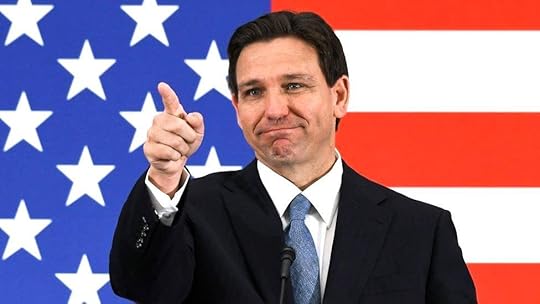
Florida Governor Ron Destankis, who is one of many advocates of diverting federal funds from public schools to charter and parochial/private schools. These politicians argue that they aren't against public education so much as they are for choice, but the consequences are the same: a serious financial blow to public schools, many of which would have to seriously reduce faculty and/or end up in state receivership.
If the latest attacks on public schools---part and parcel of the anti-pronoun, anti-LGBTQ+, anti-CRT, pro-book banning, pro-Christian nationalist campaign---has you scratching your head, you're not alone. With the advent of a second Trump term, anti-public school proponents have certainly gained some steam.
If public education is important to you, one needs to read "The Education Wars: A Citizen's Guide and Defense Manual" by Jennifer C. Berkshire and Jack Schneider. It's short (only 156 pages) and somewhat academic, but it covers a lot, from a brief history of public schools to the continuous battles that public education has fought against previous racist and anti-intellectual forces to the new wave of Trumpian nationalist attacks.
Berkshire/Schneider do offer hope. In many states where laws have already gone into effect that attack public schools, the backlash has been swift and fierce. It's also been across partisan lines. Apparently, a majority of people---Democrat, Republican, Independent---see the importance of public education, not just for local economies and the community but for their children as well. Studies have consistently shown that children in public schools do better, academically and socially, than children that attend charter schools and even some private schools.
[image error]
Many recent policies are facing a backlash that could make their way to the Supreme Court. Despite the current SCOTUS rightward-lean, there is still a strong precedent in many past education cases where the courts have favored the schools. More often than not, the best predictor for future outcomes is past outcomes.
Still, it's a scary time we're living in. Who knew that in 2025 we'd have to worry about ignorant soccer moms protesting transgender kids or prudish parents advocating state-wide book bans?
I think this will go down as one of the most important and timely books I read this year.
Every educator and parent and person who cares about our democracy should read it.
Why are state legislatures so concerned with the ten commandments, trans-athletes, and CRT? What’s really going on when states like Tennessee are passing school voucher laws?
This book answers those questions while giving a comprehensive history and analysis of how we got to this point in our country, and what will happen to public education if we don’t reverse course.
This quote is sticking with me for saying the quiet part out loud: “Scratch beneath the surface of our more recent school culture wars and you’ll find a common thread: the pace of social change. In the past, just as in the present, reactionary panics about what children were learning and about alleged undermining of parent rights were also a way of saying “slow down” to social progress, or to roll it back altogether.”
Thanks to The New Press and Netgalley for the ARC, can’t recommend this enough.
I spontaneously picked up this book off of a library display. I thought the topic was timely with private school vouchers recently appearing on the ballot, and my general interest in youth and education. It is a short, yet dense read on public v private, education as a public right v consumer good, and more. The message strongly emphasizes the need of public education, but I was expecting a more “middle of the road” viewpoint. The historical context and talk about democracy as a whole were my favorite parts.
“Schooling is what we do to ensure that we live in an educated, humane, and cohesive society—one that is able to reason collaboratively, even across disagreement, and decide collectively. It is how we pass on our shared values and principles, support and sustain culture, and forge a shared ethos.” (147)
This book isn’t just a salve for an educator’s wounded heart—but a prescription for meaningful improvement.
In this book, Berkshire and Schneider provide not just clarity on several of the most pressing of concerns and contentions weighing down the current educational environment but also provide insight into how all of us can play a role in reshaping both discourse and practice in this sphere. Education is a microcosm of a larger society and, in a participatory democracy, many must actively participate in order to enact change.
As this book illustrates well across multiple “arenas”, time and again, when conservative anti-democratic, pro-marketplace practices are put on the ballot to reshape education into a consumer rather than a public good, they fail. They’re rejected across the board. People don’t like these ideas. Most people don’t support these ideas. A majority of people doesn’t support these ideas. That’s power—real power that can be mobilized to prevent the dismantling of public education on a grand scale.
Though this book definitely puts me on high alert and puts into words some of my deepest fears about the state of public education in America at this moment, I found it to also be a very hopeful read. There’s a lot of goodwill in these pages—a lot of good people doing good work to ensure that the young people of this country continue to have access to a diverse and quality education, regardless of class, race, sex, gender, or any other identity markers that the right has been trying to weaponize for their cause (and their donors).
This book reaffirms that public education is and should remain a public good—regardless of our public makeup and any squabbles we may have with each other. We owe the promise of public education as a public good to our current young people and future generations.
One of the best reads of the year for me—and a book I genuinely recommend all people in America (at least) read whether or not you have young people in school right now. Through the lens of public education, this book really illuminates many of the foundational problems—logical and beyond—with much of conservative ideology and practice in this country.
Education Wars? Yes we now live in these times that the title is spot on. It made me want to purchase immediately. The book hit so many "hot" topics in education that we come across daily. However, I feel like the people who need to read would not pick up this book and really take in the issues education is facing. Yet again the point will get missed. I felt that there was not new information provided which is why I only gave it 3 stars. After finishing I did not have any more of the defense manual as the title stated than I did when I started.
Great book on current debates about American schools. While I am already pretty familiar with what is happening across the country now, this book also provided historical context that gave me a greater understanding of these issues.
*****I received this free ARC ebook from NetGalley in exchange for my honest review.
As an educator I found this book very on point. It shared various views on many of the “hot topic” issues in our educational system today. The author did a good job of accurately sharing the information.
While The Education Wars provides some valuable historical insight into how politics has influenced education over the centuries, it falls short of its promise as a “defense manual” for public schools. The book feels more like a cursory overview than a deep dive into the wide array of challenges public schools face. The subject matter is vast, yet the author barely scratches the surface, focusing primarily on the issue of school vouchers and approaching it through a partisan lens.
As someone who opposes vouchers, I was hoping for a more balanced and detailed exploration of the broader struggles in public education, including the concerns that lead conservatives to feel schools are failing. If public schools are truly struggling, I want solutions—but not ones that simply shift resources to private institutions. Unfortunately, this book doesn’t explore those issues with the depth or objectivity I was looking for. I’ll continue searching for a book that tackles these challenges comprehensively.
Very effective and well laid out as to WHY public education is so important and a bit as to how to combat the misinformation and groups who advocate for parental rights, which favor the individual student and not all students. I fear it's already a bit dated since the information is all before chaos and dismantling of public education systems in this country. But, I hope it's useful for advocates who believe in public education and can give them a starting point on fighting back. "Democracy is not a spectator sport" should be everyone's mantra.
My second non fiction of the year! I really enjoyed the discussion on public education as a public good vs. a consumer good, the expectations society places on schools, and how integral the public education system is to democracy and social progress. I also appreciated the historical timeline the authors developed to show us how we got to this point.
I highly recommend The Education Wars to all readers who believe in public education. The way Berkshire and Schneider framed some issues was a first for me, which is always refreshing for an education book. My main critique is with the title, as it is a bit misleading. To me, a citizen's guide should be written more conversationally and stacked with stories from citizens. I also felt like the "defense" part was lacking, as the book heavily focused on the issues rather than the solutions. Finally, I feel like a true citizen's guide should appeal to all citizens, but this book definitely swings more left, though I do acknowledge attempts to incorporate different views. I think the next best step would be for Berkshire and Schneider to work with a documentary team to make these ideas even more accessible. America, let's save public education and democracy!
Thank you NetGalley, The New Press, and Berkshire & Schneider for the ARC of this book.
The book delves into the contentious debates surrounding public education in the US. The authors aim to provide a balanced view of the major issues, including school choice, standardised testing, teacher evaluations, and education funding. My review will focus on the depth of the analysis, the implications for maths education (because I educate primary and secondary school teachers in maths ed), and the overall contribution of the book to the field of education policy.
Berkshire and Schneider offer a thorough examination of the political and ideological battles that have shaped contemporary education policy. They bring a nuanced perspective to the discussion, avoiding overly simplistic conclusions and instead presenting the complexity of the issues. Their analysis is rooted in historical context, providing readers with an understanding of how past policies and political movements have influenced current debates.
One of the strengths of the book is its balanced approach. The authors do not shy away from criticising both sides of the political spectrum, highlighting the merits and shortcomings of various policies. This balanced perspective is crucial for fostering a more informed and productive discourse on education reform.
For maths education, the book raises several critical points. The discussion on standardised testing is particularly relevant, as it touches on how these tests affect the teaching and learning of maths. The authors argue that an overemphasis on standardised testing can lead to a narrowed curriculum, where teachers "teach to the test" rather than foster a deep understanding of mathematical concepts.
The book also addresses issues of equity and access in education, which are highly pertinent to maths education. Disparities in funding and resources often result in significant gaps in maths achievement between different student populations. The authors advocate for policies that address these inequities, emphasising the need for more support for underserved schools and communities.
The authors provide valuable insights into the role of teachers and the importance of supporting the teaching profession. They argue that teacher evaluations based primarily on student test scores are flawed and can undermine the professional autonomy of educators. Instead, they advocate for more comprehensive evaluation systems that consider a broader range of factors, including classroom observations and peer reviews.
The book also explores the impact of school choice policies, such as charter schools and vouchers, on public education. The authors present evidence that these policies can lead to increased segregation and siphon resources away from traditional public schools. This analysis is particularly important for understanding the broader systemic effects of education policies.
The writing style is engaging and accessible, making complex policy issues understandable to a wide audience. The authors effectively use case studies and real-world examples to illustrate their points, which helps to ground their analysis in practical reality.
While the book provides a comprehensive overview of the education debates and does an excellent job of critiquing current policies, I've found that it could offer more concrete policy recommendations for improving mathematics education. Specific strategies for enhancing teacher professional development, promoting innovative teaching methods, and ensuring equitable access to high-quality education would strengthen the book’s impact.
Authors Jennifer C. Berkshire and Jack Schneider have done it again. The Education Wars is a heavily sourced, compact primer for the ongoing war against education. It's been going on forever, they warn us, pointing to the history of this country's attitudes towards school. Pauper schools, desegragation, suburban white flight, our rather peculiar method of tying schools' budgets to property values--all of this has been part of a continuing struggle between those who see the "common ground" we all share and those who want to slice up the pie and keep the biggest part for themselves. Or, to be more fair, those who don't understand or differ wtih the notion that we should be concerned about others' share of the pie.
This time it's different, they warn us towards the end of the book. So-called "parents' rights groups" may be sparse in number and unrepresentative of their greater communities' values, but they're curiously well funded and they get a lot of oxygen from the existing rhetorical framework in which we discuss what school should be. So-called "free market enthusiasts," who are curiously selective about who should be competing in this free market and who should be propped up by it, are pouring money and effort into an attempt to defund the schools entirely. This book gives arguments against several tenets of their claims--students vs. systems, for example--and it ends with a reminder that leftists shouldn't be in this struggle to "win" or "reclaim the schools." The schools are for everyone. The forces fighting against this accessibility simply don't see it that way. They probably can't be convinced of anything, but the record in recent years shows us that our friends, family, neighbors, everyone in a community with a school tends to want that community school. That's a big deal. That's encouraging. That should inspire us to continue to fight for those schools.
The Education Wars serves as a solid primer for the controversies that have bubbled up in education in recent years: parents’ rights, book bans, and critical race theory among others. And the authors make it clear early on that this is nothing new. Voucher programs are merely the most recent iteration of a long-standing trend of defunding public education because, in many ways, public education is only the means through which larger cultural issues are fought.
Aside from the bird’s eye view of the history of public education–from the nineteenth century common schools to the white flight away from desegregation of the 1950s to the religious bias of the most recent Supreme Court–the book does a good job pinning down something I have a hard time wrapping my head around: why so many people oppose public education when so many seem to benefit from it.
It becomes abundantly clear when the authors say things like, “Equality does not serve the ruling classes well” or “Rather than framing public education as a public good, vouchers reposition it as a form of welfare for those with children.” And they make an astute point when they argue that universal access to formal learning tanks the value of education, incentivizing more affluent families to seek out something rarer, i.e., private education. Taking the private route helps them maintain the prestige of their own education at the expense of the less fortunate.
An underlying message throughout much of the book is a rejection of what Nick Hanauer calls “educationism,” the belief that education alone can boost the economy and solve society’s ills. It can’t. There may be some benefits for graduates in terms of their job prospects, but the main emphasis of school should be the instilling of new ideas and new perspectives which can allow for a solid foundation for a democracy, something we desperately need.
This book is a very good introduction into learning about the attack against public schools, its history, and the deep pockets behind those attacks.
One quote that struck me in particular was, “When ones own material interests seem to hinge on maintaining a personal advantage, its hard to think about the public good.” (141) Which really gets to the center issue surrounding America and our system. We ask too much from our educational systems and we ask too little.
We ask them to fix all our economic problems and catapult our children into the upper echelons of society. Graduating high school simply can’t do that. Even graduating college does not guarantee that anymore. A significant reason for that is that copious amount of debt college graduates have. A school voucher program would only make this system worse. People would have debt for K-12 education and college.
Instead education needs to teach people how to live in a democracy. People need media literacy and understand history so we can live together and not be subject to fake outrage. Education creates community. The social ills of poverty, drug abuse, etc. must be solved through other programs.
We need to fund our schools more and pay our teachers more. No one has complained that their schools have too much funding. Do we really want to privatize education and make it as expensive and exploitative as our healthcare and universities?
It just doesn't read like it should. It makes the whole thing sound like it isn't a slowly dying field. They mention the issues and the direction we are headed in, but it feels too lax about all of it.
There's another book called A Wolf at the Schoolhouse Door that I would recommend much more than this book. That book correctly labels education's looming death as a prey about to be consumed by (mostly political) wolves.
Education is dying because everyone involved doesn't actually care about education, and they have successfully driven away every person that does care about education. ^This should have been the first sentence, and from there they should have torn the whole system a new asshole because honestly to say it is a war implies that there is any fighting back whatsoever. There is no war - there is only a failing system and a fuck ton of braindead bystanders (sorry this is right after election results so the issue is even MORE pressing, if you can even believe it (what a fucking joke of a country. The failure of our education system shines brightly every 4 years.))
Anyway, tangents aside, it wasn't urgent enough. It's a more recent publication than more urgent pieces, and that's not cool. Be scared. The system is dying.
The Education Wars is an eye-opening and compelling exploration of the challenges and triumphs surrounding public education in America. Jennifer C. Berkshire and Jack Schneider masterfully break down complex issues, weaving together thoughtful analysis, historical context, and human stories that bring the stakes of education reform into sharp focus. This book offers a balanced perspective that avoids oversimplified solutions, instead encouraging readers to engage with the nuances of policy and practice. The authors highlight the importance of community voices, the struggles against inequity, and the enduring value of public schools as cornerstones of democracy. What sets this book apart is its accessibility. Whether you’re an educator, a parent, or someone passionate about shaping the future, The Education Wars provides insights that will resonate deeply and inspire action. I highly recommend this book to anyone who wants to understand the current debates about education and the crucial role schools play in shaping our society. Berkshire and Schneider’s work is both timely and timeless—an essential addition to the conversation about how we can strengthen public education for all.
I am not a public school teacher, but my mother and aunt were, my wife was a public school teacher until she retired recently, and my son and daughter-in-law are public school teachers. A friend of mine and I have written a lot about a couple of big political issues in education in Minnesota in recent years. I feel invested in PUBLIC schools and their PUBLIC mission.
If you think that Horace Mann started an insurance company, this is the book for you. The book begins with a very readable recounting of the history of public education. It continues with a description of how the original public purpose has been corrupted by a consumer mentality, really, leading to the culture and privatization wars we have today.
It concludes with useful anecdotes of local activists advocating for their public schools as models for others, and it offers some tips about messaging for public schools.
If you want to show up at your school board meetings, or at political gatherings, and want to advocate for your schools, you'll want to read this book.
Brief and accessible, this is the place to start when the education wars come to your state.
But it's not the place to end, as more reading and other resources will be required to supplement this guide for those who are serious about being boots on the ground about the work. Sorry there's no one book for that!
It reads fast (and well), covering the long history of push back against education in the US, including how the fight is different now and how the fight was won the past. Think of it as getting up to speed. That may be crucial for many people who only get interested when their (your?) local school is the one threatened.
Not really written for progressive readers. More for centrists just waking up to the possibility of a future without public schools. I should hope that progressives are already supporting public education.
Overall, definitely fills a need/worth reading. Unlikely to ruffle feathers.
A good, concise overview of the forces attempting to reshape public education for the worse, with insights into how citizens can fight back. While many of these developments are specific to the United States, there is cultural spillover into Canadian debates about education. Conservative think tanks like the Fraser Institute push the idea of "school choice" while the culture warriors stoke fear about CRT and "gender ideology" in schools. As this book makes clear, the real motive behind such inflammatory rhetoric is to weaken and even destroy public education. Despite much of the push in Alberta and Canada's version of these culture wars coming from rural areas, the book makes clear that rural schools, communities and children will be the most adversely impacted if this agenda is allowed to divert even more public dollars away from the public education system that serves all children.
Thanks to NetGalley and The New Press for giving me free access to read this book and share my review here.
A really well-written book covering what’s going on with public education, why they are under attack, and what we can do about it.
The main focus of this book is the education system in the US, but I believe most other countries can relate to the rising issues discussed here. The authors uses great graphs to back up their points. They cover a lot of issues in the education system and how politics influences it across different states in the US.
The Education Wars is highly recommended to recheck our understanding of the complexities behind the education system.
The decades long assault to undermine and abolish public education is entering its final phase. It started in earnest around the time of desegregation, because of all the reasons you'd expect. Pushed forward with vacuous initiatives like "choice" and "parental rights" and animated with standard political narratives, it is now achieving all of even the wildest dreams. Defunding schools, ending educational standards, tearing apart local communities, and incentivizing and promoting having no education at all. For those of us who still believe in the power of education and in the future, where do we go from here?
This book is relatively short and to the point, providing tons of background information about public school “wars”, which include all the ways public school has been used as a political tool. It includes current examples (as of 2024) that pinpoint what’s different about recent waves of public school attacks locally and more broadly. The historical knowledge and current information are both very useful. The writing style leans more academic and high brow, but that is offset by the formatting which presents information in well crafted sections.
There are a couple of main ideas threaded through this book: public education as a common good, unrealistic and unattainable expectations for education from society at large, and politicizing education for party-aligned gain. The authors work to help readers understand how education operates as a public good that is necessary for the health of our democracy. And how, conversely, attacks to education are direct attacks on democracy. I didn’t align with every conclusion the authors make, but this is a useful book for better understanding the ways all of us talk about public school and its place in society.
Easy to read and a decent primer on the topic. The vignettes throughout brought in excellent contemporary thought from educational theorists. There just wasn’t enough depth to justify a higher rating and the stances the authors posed did little to convince those who are not already in agreement with them. Good to recommend for folks who want to start reading on the culture wars over education, but not worth while for those looking for nuanced arguments, detailed responses to counter the culture wars, or readers looking for a deeper investigation of the issues.
I was a public school teacher and have always believed in public schools. This book goes into much detail about the battles that different groups are fighting to take down our public schools. I know the schools aren’t perfect and probably will never be, but they strive to educate every child that attends. The authors sited many examples of big money and powerful players trying to take control of the schools. I would recommend reading this book if you value public education in our country.
I enjoy the “Have You Heard” podcast (even if I do not always agree with all of the points made). I expected this book to provide a nuanced discussion of current educational debates. For instance, a discussion of the fact that many conservative leaning states have rising test scores (The Mississippi Miracle anybody!) would have provided a more balanced look at the current state of education.
Instead, this book is really just a very brief “defense manual.” Extremely disappointing.