On the eve of World War II, the "Squalus," America's newest submarine, plunged to the bottom of the North Atlantic. Miraculously, thirty-three crew members still survived. While their loved ones waited in unbearable tension on shore, their ultimate fate would depend upon one man, U.S. Navy officer Charles "Swede" Momsen - an extraordinary combination of visionary, scientist, and man of action. In this thrilling true account, prize-winning author Peter Maas vividly re-creates a moment-by-moment account of the disaster and the man at its center. Could he actually pluck those men from a watery grave? Or had all his pioneering work been in vain?
Peter Maas was an American journalist and author. He was born in New York City and attended Duke University.
He was the biographer of Frank Serpico, a New York City Police officer who testified against police corruption. He is also the author of the number one New York Times bestseller, Underboss, about the life and times of Sammy "The Bull" Gravano.
His other notable bestsellers include The Valachi Papers, Manhunt, and In a Child's Name, recipient of the 1991 Edgar Award for Best Fact Crime book. The Valachi Papers, which told the story of Mafia turncoat Joseph Valachi, is widely considered to be a seminal work, as it spawned an entire genre of books written by or about former Mafiosi.
In May of 1939, a submarine named the Squalus sank to the bottom of the North Atlantic. Maas's book recounts the thrilling story of the crew's rescue using an ancient technology updated to serve a more modern purpose.
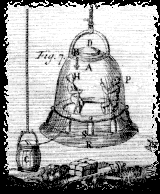
Aristotle's diving bell, 4th century BC
Charles Momsen's diving bell
I saw this one mentioned in Mary Roach's Grunt: The Curious Science of Humans at War. It's undoubtedly one of the HOLY CRAPpiest books I've ever read. The story is tense and action-packed, as everything that can go wrong does during the rescue efforts. The book finishes with the repeated attempts to raise the Squalus - not quite as thrill-a-minute, but still fraught with danger and potential disaster.
Recommended to anyone looking for a good real-life thriller that leaves you gasping.
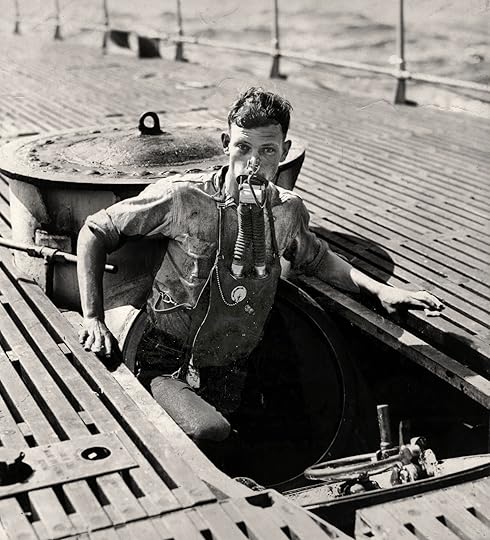
Undisputed hero, Momsen, demonstrates his "Momsen Lung" device.
It was 1939, the Second World War had yet to begin in Europe, the United States still had a few more years of peace--and America's newest submarine, the "Squalus," set out on a test dive off the coast of New Hampshire. Then something went wrong and the sub plunged to the floor of the North Atlantic. Previously when subs had gone down, the entire crew would be lost. But, this time, one man was determined to change things and save the men trapped on the ocean floor. That man was a most remarkable US Navy officer, Charles "Swede" Momsen. Momsen had spent years developing rescue devices and deep-sea diving techniques to save entombed submariners. The time had come for the moment of truth--could he save the men in the downed sub? It's a suspenseful story and author Maas gives us the blow-by-blow account of the disaster. For me, the mission to save the crew of the Squalus is the main part of the book. but after that, the effort to raise the sub was just not as interesting, although it turned out to be more difficult and dangerous for the Navy. The Squalus was salvaged, then recommissioned for service in the Pacific in WWII. We get that story as well as the story of Momsen's service during the war. Amazingly, although there was so much going on in it, this book seems rather short--at 259 pages. I wish there were some photos, illustrations, and at least one map included, but there weren't. That's where Google came in handy. Wish I had had that as a kid!
The hero of this book, Charles "Swede" Momsen, is one of the most inspiring figures I have read about in ages. Momsen's distinguished career started in the late 20s. He was a US Navy submariner and diver; unlike nearly all his colleagues, he felt that, when accidents occurred on submarines, there should be some way to rescue the trapped sailors. The prevailing wisdom was that there was nothing to be done in these cases, and one just had to accept it as an inevitable risk. Momsen had been present at two disasters where submarines had sunk in relatively shallow water, and everyone had drowned. He was distressed by what he had seen, and became increasingly sure that there must be a solution.
Operating mostly on his own, Momsen first pioneered a novel breathing device, the "Momsen lung", which allowed a crew member to leave a downed submarine and make his way to the surface. There were many technical problems; you could run out of air, be attacked by "the bends" if you came up too quickly, or be killed by the internal pressure if you held your breath and ended up with a chestful of expanding gas. Momsen tested many different designs, all of them on himself, and risked his life dozens of times as he worked out the kinks in the idea. He finally produced a version which allowed a safe ascent from a depth of 200 feet, and gave a public demonstration in the Potomac river. When it was reported in the papers, some senior Naval officials had not previously heard about his work. Far from being pleased, they were outraged by what they saw as his insubordination in not going through appropriate channels.
The "Momsen lung" was just the first of Momsen's many brilliant ideas. He was doubtful that it would be sufficient when the water was too deep, or too cold, and in parallel developed a diving bell, which could be lowered down to a stranded submarine and pick up crew members though an escape hatch. Momsen's superiors grudgingly admitted that it was a breakthrough, but thought they had a score to settle after the supposed insubordination in the earlier project; they spitefully insisted on naming the rescue bell after another member of the project, and giving him the greater part of the credit. It says a lot about Momsen's dedication that he only admitted many years later how hurt he was by this petty piece of interdepartmental politics.
Although several examples of Momsen's rescue bells were built, they had never been tested in a real situation. Then, in May 1939, a new sub, the Squalus, suddenly sank during initial testing. 33 men were trapped on board, at a depth of over 240 feet. Momsen immediately flew to the scene, mobilizing a bell and some of his best divers. He coordinated every aspect of the rescue mission, which was extremely difficult and hazardous, and got everyone up without loss of a single life; it was rather like an underwater version of Apollo 13. The Navy was not content, and wanted to know why the Squalus had sunk. Momsen then also led the salvage operation, where his men had to make over 600 dives. He successfully brought the boat up to the surface, and got it towed to a dry dock. Once again, there were innumerable problems, but not one of Momsen's divers even suffered serious injury.
As the title suggests, the book focuses on the Squalus rescue, but some of Momsen's later exploits are if anything even more impressive. During World War II, a new type of torpedo had been issued to Pacific Fleet submarines, and it rapidly became clear to everyone who used them that there was a serious design flaw. When the torpedo was fired at a target broadside-on, it would often not explode; the submariners were forced to unlearn their training and attack at an angle, where the target presented a smaller cross-section and was correspondingly harder to hit. Senior Naval officers refused to admit that the issue existed, but Momsen acquired a batch of torpedoes, and carried out tests where he fired them directly at a cliff face. Sure enough, a torpedo refused to explode, just as the submariners had said. Momsen salvaged the unexploded torpedo, which contained 600 pounds of TNT, and personally cut it open to see what had gone wrong. He was able to pinpoint the mechanical problem, and localize it to a firing pin which was a millimeter or so too long. Within a few weeks, all the remaining torpedoes had been modified by having their firing pins trimmed, and they functioned perfectly for the rest of the war.
Well. And I sometimes get annoyed because third-party software doesn't work as advertised, or my superiors are insufficiently appreciative of my efforts. Puts things in perspective, doesn't it? As I said, a truly inspiring story.
This was an interesting and at times very exciting and harrowing story. It was also quite dry at times. The beginning was so filled with names and titles that it was hard to keep track of. Once the "accident" happens, it gets much better, but was still written in a matter of fact and unemotional way. While I felt terrible for all involved, I never really got attached to them. I like non-fiction better when it reads more like fiction. Still, I'm glad I read this...I learned a lot about submarines and deep sea diving and a lot of the changes that came about due to this historic incident.
This is a tremendous story, a 5 Star tale of heroism, perseverance and innovation. “Swede” Momsen is the key figure in developing methods to save submariners trapped in a downed sub. His passion to find solutions was driven by his involvement in early submarines and proximity to other sub accidents. The main event here is the accident that causes the sub to sink and the eventual rescue. Maas keeps you on the edge of your seat throughout.
I can't imagine being in a sub. The Squalus begins its test dive. The terrifying plunge to the bottom begins with water pouring in. The diesel air inlet indicated closed but wasn’t. Men had to do their duty without hesitation, no matter the danger. Here is one hero:
Swede Momsen will be called to rescue the submariners. Momsen had experience in earlier subs:
Not only does Momsen provide two inventions that will save submariners including the Momsen lung. (and the Navy spitefully named one of the devices after someone else who only tested the device). Momsen also discovers the early problem with torpedo fuses that are malfunctioning. And later he proves that the silk bags used as packaging for gunpowder can create sparks which caused magazine explosions on ships. And later he is responsible for helping develop the most efficient design shape for subs, allowing underwater speeds only previously dreamed of and thought impossible. Maas writes a compact but riveting story.
I was surprised at how uninteresting this one was, given the good reviews here, and that I served in the Submarine Forces in the USN decades ago. What can I say? Submarine rescue is important. The author just wasn't the one to tell the story. 2.5 stars, courtesy roundup.
Four reasons to read The Terrible Hours: The Greatest Submarine Rescue in History:
1) This reconstruction of the rescue of the USS Squalus is awe-inspiring and thrilling. Even knowing the ending, I grumbled every time I was called away from this book. The suspense and tension build with every new obstacle, as does the sense of admiration owed to the people involved.
2) The author has a simple and efficient way of explaining complex things using examples and similes. I now have a working understanding of submarines, deep sea diving, and Navy bureaucracy that I didn't have before.
3) Everything in this book has been painstakingly researched. The amount of detail is incredible.
4) I enjoyed the flashbacks showing Charles "Swede" Momsen's journey and the exceptional perseverance he possessed. He deserved the recognition this book gives him.
Two drawbacks to The Terrible Hours: The Greatest Submarine Rescue in History:
1) The first chapter or two had me feeling as though English weren't my first language. I knew all of the words, but the sentences simply were not making sense. A lot of technical information is shared in a short timespan – a lot of names, too – and trying to keep track of everything was not pleasant. It got easier as I got used to it, but the inclusion of pictures and maps would have made things better.
2) The final parts of the book, those dealing with the salvage mission, are much less interesting. Although things still go wrong and the process of getting the submarine back to Portsmouth is arduous, the events are recounted in a way devoid of tension. Throughout the book, information is relayed in a dry manner. There's so little emotion in how it's written that there's no connection with the people involved, so without lives on the line, the book loses a lot of its previous energy.
Submarines may be amazing maritime vessels, but they’ve always scared me. How do you get out when something goes wrong? And history has recorded the tragedies of lives lost in submarine accidents. This book looks at the sinking of the USS Squalus in 1939 and the man who developed two new ways to rescue submerged sailors.
There had been other submarine sinkings, but for the Americans, two especially stood out for their tragic endings. In 1925, the USS S-51 sank after colliding with a steamer. Only three men were able to get off the sub before she sank (the sub had been operating on the surface at the time). Then in 1927 came the most tragic of all, when the USS S-4 was rammed by a Coast Guard gutter just as the sub was surfacing. Although the submarine sank, a rescue fleet was able to communicate with the trapped survivors via Morse Code. But the Navy did not have any way to get to them, an incident which would haunt Charles “Swede” Momsen, the specialist who would become famous for his future innovations for saving submarine sailors. When the S-4 was eventually raised, the bodies of six sailors were found with the skin of their fingers having been scraped off as they had tried desperately to open a tube to flee the sub (which hadn’t been that far submerged underwater).
With these tragedies setting the background of what the USS Squalus would endure, the book’s focus turns to Momsen. His unrelenting fight to create two new ways to help stricken subs meant he had to battle not only the elements but his own Naval elite, who did not always agree with his newfangled ways of thinking. Momsen created the Submarine Rescue Chamber, a type of diving bell that could be lowered and attached to a sub’s hatch. Trapped sailors could then climb into the chamber for the journey to the surface. Another device created by Momsen was the Momsen lung, which was a portable “lung” that used recycled air and could be attached to a submariner’s body for the ascent to the surface. It was especially unique in that it allowed the sailor to rise slowly, so as not to incur the devastating bends that could kill a human being.
When the Squalus sank, Momsen was sent to direct the dramatic rescue, and this is where the book really becomes absorbing. It’s one thing to know a submarine is somewhere on the ocean floor, but quite another to locate it and then communicate with the survivors. Stormy weather and damaging waves can delay the work done by the rescue fleet, requiring a tremendous leader (Momsen) to persevere against such obstructions.
It really is an amazing story, and Peter Maas does an excellent job in moving the reader along. From the stories of the sailors to the genius of Momsen to the rescue of the sailors to the salvage of the sub, it made for an absorbing read. One historical footnote: Just one month after the USS Squalus sinking, the HMS Thetis sank in Liverpool Bay, with just four survivors. One wonders if there could have been more survivors if the Royal Navy had Momsen’s life-saving gadgets.
I’m still not stepping on to a submarine, even if it’s comfortably docked.
More than a suspenseful tale of a rescue of a downed sub, this is a tribute to one man whose dedication to one cause -- perfecting methods to rescue submariners -- was put to the ultimate test. All the classic elements of a thriller are here, but there is also a very clear hero, if an unconventional one, in Swede Momsen, the pioneering man who invented the submarine rescue chamber. Author Maas does a good job of making the reader fully aware of the awful predicament of the sailors, contrasting it with the frustration felt by Momsen. The book is fascinating both technically and in human terms.
An inspirational story of the wonders of human ingenuity and perseverance that lead to an impossible rescue, The Terrible Hours packed a double punch.
On the surface this is the recounting of the greatest submarine rescue in history, but really this is the story of Swede Momsen, a dedicated scientist and determined visionary, whose ideas revolutionized rescue at sea, among other things.
A nice, short, and uplifting read.
Some photos/illustrations could have made this so much better. Luckily, an internet search had lots to offer.
Swede Momsen is a hero. A real, true, understated, largely unknown, American hero. Not for the flashy exploits of his Navy career. By all accounts, he wasn't a flashy guy. Swede Momsen is a hero because he spent his entire life fixing problems that a bureaucratic system didn't want to be bothered with. And because he was the spark that changed the way the Navy approached deep sea exploration & rescue.
Before GPS, cellular communication, and Sonar, what would you do if a Submarine lost control and sank to the ocean floor?
What if you went through training, were assigned to a submarine, and when you asked about what the procedure was if the submarine sank or lost control, everyone looked at you like you just violated some sort of taboo?
Unfortunately, that was the reality for submariners before Swede Momsen.
The most heroic thing about what Momsen did was that he not only dreamed up the solutions, researched and practiced and toiled and worked out the kinks of undersea rescues on his own time, but HE DID IT IN DIRECT OPPOSITION TO NAVY. Momsen tried and failed to get funding and permission to develop a rescue plan but was sidestepped and rejected. Momsen did it on his own, under the table, using volunteer divers and his own body as test subjects. His research was built on the backs of tragedies time & again with sunken submarines.
One of the more chilling and gut wrenching occurrences was a sub that sank in shallow waters--something like 100 feet below the surface--yet rescue teams could only watch helplessly from the surface as the men below died over the course of the following days. For Momsen, that was the last straw. If the Navy refused to approve the research, Momsen would do it on his own, sneaking into closed facilities after hours, using his own ingenuity and limited resources to fix the problem of deep water rescues. In time, he developed a reputation as a guy who had a particular set of expertise but it was assumed by many that he wouldn't ever be able to apply those skills in a real world situation.
Enter the sinking of the USS Squalus on May 12, 1939.
Momsen is called because no one else anywhere has ever bothered to come up with a plan. The ensuing account is one of the most thrilling true life accounts I've ever read. All of Momsen's hard work and theoretical rescue methods are finally put into play as he attempts to locate and rescue the remaining survivors of the half flooded submarine sunk in 240 deep water 9 miles off the coast. No sub had ever been rescued in anything deeper than 20 feet, so Momsen's longtime practice (usually off the record and on his own initiative) of beating the numerous pressure and communication problems involved in finding & raising men from the ocean floor are on the only hope for saving the men who still live & sit freezing inside the Squalus. The men involved in the rescue and the volunteers who worked with Momsen during his deepwater dives throughout his research put themselves at nearly an equal risk as the men inside the Squalus. It's fascinating that a problem like this wasn't solved by some research & development team funded by the military or the government... No, this problem was basically solved by one man who doggedly pressed onward against the wishes of the Navy. Money talks after all.
I LOVED this book. One of the most fascinating nonfiction accounts of real heroism I've ever read. I need more books like this. Books that illuminate the unsung heroes that truly made a difference in people's lives without seeking fame or even a pat on the back. Momsen didn't need those things. He just wanted to save the lives of sailors and knew he could solve a problem that was being ignored because of the perceived monetary cost. Excellent read.
Peter Maas is an old style reporter. He is from the school that demands creating stories from the facts at hand. This book is a history, but it does not read like one. This story moves along at a 30 knot clip and demands your attention to the details of this incredible and almost unbelievable rescue story. Maas actually developed this story from an article about Charles "Swede" Momsen he previously published in the "Saturday Evening Post" in 1968. At that time, as he explains it, the story was more or less overshadowed by many of the historical events of '68. Not to mention that a story about World War II hero was not exactly great reading during the tumultuous war-protester years of the 1960's. The last thing that people wanted to read about was a war hero from the previous generation.
The author only recently returned to his old story because he felt that people are much more responsive to the "Saving Private Ryan" and "Greatest Generation" heroism. He is correct, though I hope to God it is not a passing fad. There is so much that this generation and those to come could learn and benefit from reading about Swede Momsen and people like him. It is a great story of perserverence and never giving up on your ideas and dreams. Many of the deep-sea rescue techniques and submarine safety issues can be directly tied to Charles Momsen's efforts nearly 70 years ago.
It seems very strange to be reading about this story and the rescue of the survivors of the "Squalus" during its 1939 disaster and then reflecting on the Russian submarine, "Kursk," that just sunk in the Barents sea last month. With all the bureaucracy that Swede Momsen had to fight through just to get his diving bell built, or create a team of expert rescue-divers that could be used save the lives of sailors trapped in a steel coffin; it's understandable how the Russians and the entire Soviet bureacracy was never able to develop the forsight towards rescuing their own downed subs. Instead they relied on someone else's technology, which no doubt may have cost them valuable time. One may never know.
However this story is a great depiction that during rescue efforts, when time is essential, it is necessary to have a forward thinking individual like Swede Momsen on your side. Someone who is not afraid to try new ideas and with a lot of hard-work and pushing the right people in the right places he can make sure his ideas will become reality. His efforts and his diligence was what saved the thirty-plus survivors of the "Squalus." It was also these same efforts that would make it so future submarine accidents simply did not happen. Who knows how many future lives were saved? This is that type of story. You will be inspired and it is a great story to tell all your friends about. That sometimes one man can make all the difference.
Tells the harrowing story of an accident during a test dive of a new US submarine that happened off the coast of Rhode Island in May 1939, and was a huge story at the time. But since 1939 and subsequent years were full of big news, this accident has all but been forgotten by pretty much everyone. Certainly, this is the first I had ever heard of it, in my sixty plus years. The details of the plight of the sailors trapped 300 feet down and the long work of the naval technologist who had developed new technology to save them, is a good story, well told.
This is a fascinating rescue story and the history of the man who overhauled antiquated diving methods and invented the rescue diving bell and Momsen lung.
Such a fascinating, face-paced disaster rescue story—I could not stop reading. Rear Admiral Momsen’s contributions to the Navy’s diving program, rescue apparatuses, WWII Pacific conflict, torpedo design, submarine advancements, and on and on, are all just incredible. I really enjoyed this book.
When I found this book, I had never heard of the USS Squalus. Despite growing up in Maine and taking numerous trips across the bridge to New Hampshire that is in view of the base the submarine was built. I even have visited the USS Albacore, a submarine mentioned in the epilogue of this book.
This book is well written and researched. While not all the techniques and terms used are familiar to me, I was able to understand it. The story of the Squalus and the rescue of much of her crew is epic. How this had escaped me, I have no idea. But it is a tale that ranks up there with all the great military rescues.
In 1939, off the coast of Portsmouth, NH, a submarine and its crew submerge to do some routine testing when a malfunction causes the sub to sink to the bottom of the ocean. This book is the story of the first successful rescue out of a submarine. It tells the story of the captain and crew members, and also of Swede Momsen, who invented a rescue capsule for submarines, a diving bell that could lock on to a submarine over the escape hatch and form a seal, allowing the people inside to enter the rescue capsule from the escape hatch, all underwater. The book told of Momsen's attempts to get the Navy to take his ideas seriously. People in those days weren't afraid to risk their lives in experiments. Time and time again Momsen and his buddies narrowly escaped death trying to improve on the rescue capsule, and also trying to fix different parts of it that didn't work well. The book also told about early decompression chambers and various attempts to experiment with the right mixtures of various gasses to allow divers to spend more time underwater. Divers routinely took risks in experimenting with these new technologies. Sailors went underwater in submarines knowing that if anything went wrong, they would surely die.
This book is an actual historical account of real Navy action on and under the sea in 1939. I always wondered about the Navy Dive Tables that we used when I was SCUBA diving. In this book, you can get an idea of the sacrifice that went into creating those tables.
The rescuers of the trapped submariners aboard the Squalus were mostly healthy young men. They dove in heavy canvas suits with helmets on tight using compressed air until the advent of a helium/oxygen mix. At 250 feet these young men suffered nitrogen narcosis and struggled to do simple tasks in the few minutes they were allowed to stay at depth. There were some close calls, but in over 600 dives, no deaths. Incredible.
The development of the technology to save submarine crews came just in time for WWII. Charles "Swede" Momsen, leader and architect of the rescue system went on to distinguish himself in several different areas of naval activity. He was a man with a driving curiosity to understand how things worked and how to make them better, from dive tables to torpedoes that refused to explode, he couldn't leave a problem unsolved no matter the risk in the solution.
Peter Maas has written some engaging books, including Serpico and King of the Gypsies. In this one he turns the dry and crusty pages of Navy records and a personal diary into a gripping tale. My father used to watch episodes of Victory at Sea over and over. Peter Maas takes us back to the sea and under it and makes us feel every wave. Hold your breath!
The story of Charles "Swede" Momsen, a US Navy submariner and diver, who believed there had to be a way to rescue when a submarine sunk. He was a visionary, a scientist and in my opinion, a remarkable person in history who most do not know about.
Momsen had been experimenting and testing the tools and techniques he invented for many years. Shortly before the onset of WWII, unfortunately, he was given the opportunity to put them into action. The "Squalus," America's newest submarine sank during a routine dive before she was officially to become a part of the Navy's fleet. Something went terribly wrong and it crashed to the bottom of the cold Atlantic, not far off the coast of Maine/New Hampshire. Only 33 men survived the deadly dive, and Momsen was determined to get to them.
This was an interesting story, I admit I add to skim some as it got too technical for me. Still, worth the read about an unknown hero.
I can't remember why I put this in my Goodreads list of books I want to read, but I did. So I finally got to it this month. I think the book is well written. It is easy to understand and for the most part, the pace stays fairly fast, sometimes thrilling. The subject is a Navy person who perseveres in submarine technology advancement and leadership. The plot is mostly a submarine which had a malfunction and sunk to the bottom some 240 feet below the surface. The tale of the rescue is gripping and the salvage story is very interesting too. I think most guys would enjoy this book. To be more precise, I believe anyone who likes military history and ships would like it. However, if you have no interest in military, or boats, or history. You might find this difficult to get interested in.
I really enjoyed this short historical book. I had never previously heard of Momsen or the Squalus and I live right outside of Portsmouth, so I was stunned at how much history is right here in my own backyard. The story was engaging without becoming overdramatic. My version of the book had and afterword by the author which really shed light on the emotional state of Momsen, and delightfully, some actions that the Navy took to "make it up to him." I'm very glad I had the opportunity to read about this piece of history.
I loved the historical aspect of this book and how it was told in a way that really brought the story to life and sometimes made me had to step back and put the book down because of the intensity of it. The fact that this was a story so close to home and also because on page 232 the Harbor Master Shirley Holt shocked me because I'm a good friend of the Hold family was also very cool. Momsen seemed like such a heroic and soulful kind of guy, someone who really cared and did what it took to ensure the safety of future endeavors. The whole concept of the wives braving the threat that their husbands may die or did die was so very scary. Great read if you enjoy marine history!
I really enjoyed the first two-thirds of the book but far too much time is dedicated to salvaging the sub itself after the rescue and that lost my attention. I also was hoping for a deep technical analysis of the cause of the accident but apparently there was not one. Still recommended if you like the subject but probably not engaging enough throughout for the average reader.
What a treasure of forgotten history. I stumbled on this book at the Naval Museum in Galveston with my wife. We walked through an actual naval submarine from the same period, which enriched the reading of this book so much. Resilience. Endurance. Bravery. Resolution. Leadership. So many qualities seen by the men in this book.
I’m not sure how this book ended up in my suggested readings. I am guessing due to a book I read about another submarine that I really enjoyed. This book highlights a Naval officer and his quest to improve on several issues that faced the US Navy before WWII and after. A truly engaging book that will be over way too soon.
May 23, 1939. Television was being advertised for the first time to American consumers. Europe was on the brink of war as Hitler and Mussolini signed an alliance in Berlin. These were the days before sonar and before the discovery of nuclear power revolutionized submarine design. Dependent on battery power, submarines were actually surface ships that "occasionally dipped beneath the waves." If a sub went down, "every man on board was doomed. It was accepted that there would be no deliverance." Swede Momsen was, according to master storyteller Peter Maas, the "greatest submariner the Navy ever had," and he was determined to beat those odds. Momsen spent his career trying to save the lives of trapped submariners, despite an indifferent Navy bureaucracy that thwarted and belittled his efforts at every turn. Every way of saving a sailor entombed in a sub--"smoke bombs, telephone marker buoys, new deep-sea diving techniques, escape hatches, artificial lungs, a great pear-shaped rescue chamber--was either a direct result of Momsen's inventive derring-do, or of value only because of it." Yet on the day the Squalus sank, none of Momsen's inventions had been used in an actual submarine disaster.
In The Terrible Hours, Maas reconstructs the harrowing 39 hours between the disappearance of the submarine Squalus during a test dive off the New England coast and the eventual rescue of 33 crew members trapped in the vessel 250 feet beneath the sea. It's also the story of Momsen's triumph. Under the worst possible circumstances, Momsen led a successful mission and helped change the future of undersea lifesaving. Not only has Maas written a carefully researched and suspenseful tribute to a true hero, in the process he has salvaged a long-forgotten, riveting piece of American history.
The story of this book makes it worth reading - the rescue mission of a submarine that becomes lost during a drill run off the coast of Maine in the late 1930's on the eve of WWII. Rescue technology was severely lacking before submarines were launched in those days, and much of what was used and developed as a result of the incident involving the Squalus would change the course of submarine naval history. The central figure in this book, "Swede" Momsen, was brilliant, extraordinary, nerves of steel and had the clarity of mind to seemingly know exactly what to do at the right time. Not everything he did worked right the first time but he had an uncanny ability to problem solve through things that were not successful and always move forward. Very impressive how this gentleman handled himself under pressure and his leadership capabilities. Easy to see why he was well respected.
The disappointment of this book was the writing. Some parts of the book where technical terms are used lack explanation so that unless you are familiar with submarine technology (I am not) it becomes confusing. Drawings or a glossary would have helped considerably, or perhaps better editing. The story line did not always flow well, but the book was short enough that in a few pages it picks back up.
I'm a bit conservative on my goodreads ratings, overall I give this story a 4 but the writing a 2.5, rounded it up to a 3 for the overall rating.