A landmark book from one of the original scholars of our time: a magnificent revelation of turn-of-the-century Vienna where out of a crisis of political & social disintegration so much of modern art & thought was born.
This edition contains: Illustrations Acknowledgments Introduction Politics & the psyche: Schnitzler & Hoffmannsthal The Ringstrasse, its critics & the birth of urban modernism Politics in a new key: an Austrian trio Politics & patricide in Freud's Interpretation of dreams Gustav Klimt: painting & the crisis of the liberal ego The transformation of the garden Explosion in the garden: Kokoschka & Schoenberg Index
Carl Emil Schorske was an American cultural historian and Professor Emeritus at Princeton University. In 1981 he won the Pulitzer Prize for General Non-Fiction for his book Fin-de-Siècle Vienna: Politics and Culture (1980), which remains highly significant to modern European intellectual history. He was a recipient of the first year of MacArthur Fellows Program awards in 1981 and made an honorary cititzen of Vienna in 2012.
This reads more like a collection of topical essays than a book -- because, in fact, it was precisely that. The chapters were written as individual studies, not all at the same time, and later compiled into this book. As a result it is not always intellectually smooth, but many of the chapters are brilliant and Schorske has unusually vivid prose for an academic.
In the twentieth century Europe tried to assert independence from its past, self-defining "Modern" as the antithesis of "ancient"; in this sense modernity is characterized as a sense of one's time/history/life as different from all that has gone before. Hence, one of the tropes of this period was the search for new self-definitions. Individuals and groups alike sought for new identities and systems of belief. The weakening authority of history sped up the process of change as it liberated people to create new forms. The social and political disintegration of Vienna created a particularly fertile and ahistorical culture.
I found this book quite off-putting, and though the author is enormously learned, I feel the book is somewhat overrated. I ended up skimming vast tracts of it (hence the category: i-get-the-picture instead of 'read')... and this, after several failed attempts even at starting it.
Part of the problem is me - I know very little about this period -as fascinating as it obviously is - and have had difficulty reading the few literary works I've tried -- though that clearly is something I plan to continue working on. German is a VERY difficult language for me; literary german is incomprehensible; and to approach authors like Musil and Broch in translation is especially challenging.
But as to Schorske, he himself is neither fish nor fowl. He is not an historian or (by his own admission) an expert on Austria; he is not an art historian or literary historian or literary critic - he is a "cultural historian" and that, I'm afraid to say, means that he has only a mish-mash of a method. It is quite erudite and rotund (rhetorical, lots of adjectives - many of them signifying little or nothing) - but I never felt I came away having been given analytical insight into any of the figures I was reading about. In other words, for all the work at reading this, I got little nourishment, and effectively decided to move on.
I know that my views on this book will either strike others as foolish - or even MARK me and my limitations for all to see -- and I accept that. This IS one of the biggest gaps in my knowledge, and possibly I'd have a more favorable view of this book if I knew more about it.
I've got two more on deck - and would welcome any further suggestions.
In seven essays Carl Schorske brings Vienna through the Fin-de-Siecle to the eve of World War I. His premise is that the rise of liberal democracy in evolving Austria-Hungary brought with it the seeds of its own destruction. Once the aristocracy withdrew to reigning, not ruling, the liberal democrats found themselves yearning to be the new aristocrats (ex: the majestic pretensions of Vienna's Ringstrasse) ushering in a new age of modernism only to find themselves swarmed by socialists, Christian socialists, anti-semites, and subjugated nationalities craving their own statehood.
The key to Shorske's analysis is that this late 19th century period opened the door to what he calls the psychological man, a sea of subjectivity unto himself, as opposed to nobles, who knew their place, or the haut bourgoisie, who knew what they wished to be their place. At one and the same time revolutions erupted in demagoguery, literature, the fine arts, and music. Society ceased to cohere; structures of stability crumbled; the guiding light of morality was set aside for aesthetic and egoistic reasons; passions positive and negative were released.
These are beautifully written essays that come together quite naturally as a substantial book and peak at the end with an amazing study of Kokoschka, the artist, and Schoenberg, the composer. By their time, none of the conventional restraints pertained. Eros and death had done away with the remnants of social realism and neoclassicism. The "society" that did still exist, albeit hollowed out, was baffled and offended by having achieved, as it were, the brutal paintings of Kokoschka and the almost incomprehensible music of Schoenberg.
A brief essay on Freud, in the middle of the book, aptly sums up the proceedings, trending toward cultural and political patricide.
The fact that there isn't an essay on Robert Musil, the novelist, is disappointing but perhaps confirms the fact that no one--if not even Carl Schorske--has read The Man without Qualities to the end.
If you're like me and you have a romantic draw towards Mitteleuropa culture -- I say as I write between sips of Zubrowka -- then this is going to be a natural read for you. They're lyrical, intellectual little essays about all the people who contributed to the ferment of Vienna around the turn of the 20th Century, not all of whom I much care for (my relationship with Freud is love/hate at best, and my admiration for Klimt's skills is tempered by the degree to which people who talk like the Will Ferrell/Rachel Dratch Lovahs sketch put up Klimt prints). A wonderful jaunt of a book -- nothing earth-shattering, but a wonderful jaunt.
Appealing at first glance, but a hit-or-miss with more 'miss' than 'hit'. It's an attractive theme and idea: linking cultural instances to the liberal failure in 1900s Vienna, with the Hapsburgs on the wane. Musil loved this period and wrote effectively about it, in terms of quick decline and slide into reactionary anti-Semitic Germanism, but applying analysis to it doesn't always work, mostly because Schorske tries a little too hard at times. The liberal failure is fascinating, in part because it manifested in ways that we largely take for granted nowadays and which can be encapsulated in two themes: Freudian psychoanalysis; excellent art. The Freud bits here are the weaker of the two themes, though less far-reaching in their assumptions. Schorske seems the "turn inward" as a manifestation of socio-political shock and/or disengagement as the right-wing started to fling shit at the fan. Fine, but Schorske also uses Freud as an unnecessary lens for some of the other components of his study. The art bits fare better, though they tend to get shrill and po-motastic quickly, so duck when you read them! Fine sections on Klimt and Schoenberg and Stifter (briefly) are balanced by less interesting looks at the Ringstrasse and Kokoschka, but how you judge those might depend on how much you like architecture and Oskar.
This is the beautiful, horrific crucible of the modern world. Ponder that from the 1890s to the eve of World War I Freud, Hitler, Stalin, Trotsky, Schoenberg, Klimt, Herzl (the father of Zionism), Wittgenstein, Popper all either made their home in Vienna, capital of the Austrian-Hungarian empire and, Carl Schorske would argue, birthplace of the new and often frightening in art, music, and politics of the left and right. The very mixture of nationalities and ideologies located in one place drove some to break boundaries in painting and psychology, while others fled, particularly the future Fuhrer of Germany, in dread and still others "danced atop the volcano", knowing this city above the clouds could not last forever and found refuge in art and music. While Walter Benjamin was right calling Paris "the capital of the nineteenth century" Vienna was the capital of the twentieth century---it's just that no one knew it yet. Schorske explores not only the intellectual life of the city but also its architecture, sights and sounds, and new colors for a new world waiting to be born. A case can be made that two world wars, the holocaust, atonal music and the State of Israel were all born in Viennese cafes.
Books like these tend to fail, and fail quite badly. Fusing politics, art and history without overplaying one of the areas, superficially brushing over another or stitching together a flavorless vignette of second-rate ideas is surprisingly hard to do. And yet Schorske succeeds quite nicely and in eight related but essentially standalone essays he paints a portrait of the Austro-Hungarian empire from its optimistic classical liberal inspired beginnings to a rather inglorious decline.
As points of stability were eroded in the areas of politics, art and culture the psyche of the nation was disintegrating along with the rest of it. Ironically and perhaps intentionally Schorkse doesn’t mention the obvious impact of the Great War, and instead shows us the empire that was ultimately doomed with or without 1914 events.
Rest are notes to self:
o Reading about classic liberalism being torn apart by nationalism, socialism, anarchism, anti-Semitism and Zionism made me wonder if it is fundamentally unstable. Once you open up the democratic franchise it is difficult to impose constraints that would keep the nation well-governable. Sure, Fukuyama keeps finding examples which exhibit a balance of accountability, law and competent bureaucracy but they all seem transient. Taleb’s localism is perhaps the best hope here.
o In Vienna: the old right got expressed as christian socialism (Karl Lueger), the new left got expressed as nationalism (Georg von Schoenerer). Both brought about anti-Semitism which beget Zionism through a pretty interesting path of Theodore Herzl. Nationalists were threatening the unity of the empire through disintegration, Zionists through secession. All in conflict with paleo-liberals.
o Ringstrasse through history-preserving communitarian Otto Wagner and history-rejecting functionalist Smitte. Both left their marks on architecture early, and luckily neither one took his vision to its full fruition as most their later and more radical designs never made it past proposal state.
o Klimt and Kokoschka transitions are covered brilliantly. Klimt, the Secession – soft conflation of subject and object, passion when depicted is depersonalized. Kokoschka, and Expressionism - rejects ‘traditional’ cult of beauty in favor of truth. The ‘truth’ is a fully subjective expression of author’s emotional inner-self which has little to do with objective reality. And so Klimt is confused about reality, while Kokoschka refuses to deal with it. Of course today our world is full of Kokoschkas who are convinced that the vision of their subjective inner-self IS in fact reality.
o Essay on Freud was the weakest part of the book. The metaphor of the garden in the last 2 chapters was fine for the most part but crumbling badly at the edges. On the other hand, nice finish with Arnold Schoenberg freeing music from the oppressive hierarchy of diatonic scale by introducing democracy of tonalities. And through the absence of hierarchy at the bottom he gives us a meta, emergent order on top. Is he seeding the roots for Ludwig von Mises and Austrian economics here?
I love a decadent city on the precipice of disaster, I love Vienna secession art, I love the reading about the anxiety of modern life so this was pretty up my alley.
Klimt is basically a cliche I guess but I’m a defender! His (rejected!!) university of Vienna murals where he represents medicine philosophy and jurisprudence each in a very abstract and anxious way are rlly fantastic. Especially the jurisprudence mural where depicts the concept as the three furies sentencing a convict to be killed by a tentacled octopus monster!! Waaat??
Also it was interesting to read about anti-liberal politicians in a multi ethnic empire and the traits/ strategies of anti-liberal leaders. Adopting some trappings of liberal upper-classdom while simultaneously vilifying it (and usually Jews too) was a very popular strategy that we see a lot today too.
This is really more like seven long essays than a true book and of course some of em didn’t really interest me but ya know the ones that hit, hit! (3.5!)
Schorske unites here seven previously published or written essays, linked thematically by political and cultural developments in late 19th century Vienna: the failures of liberalism, the burgeoning of anti-Semitism, the creation of psychoanalysis, the oedipal rebellions of later artists (such as Oskar Kokoschka and Arnold Schoenberg) against the previous rebellers (Gustav Klimt, architect Otto Wagner, Hugo von Hofmannsthal) whose art had arrived at a comfortable compromise with bourgeois aesthetics. This 1981 paperback edition contains both white and white illustrations, and color plates.
Mal acreditei no meu alemão quando li sobre a juventude austríaca em "Die Welt von Gestern". Os filhos da burguesia saíam da escola falando cinco idiomas além das matérias curriculares. Treinamento musical era garantido a todos numa sociedade que literalmente idolatrava o teatro. Mas isso é só a metade pois à sala de aula preferiam os jovens os cafés: A juventude tinha uma segunda educação. Uma hierárquica e o outra democrática, uma formal outra viva, uma histórico outra presente. Numa imagem de Stephan Zweig, os alunos seguravam as peças de Schiller em frente aos professores enquanto por baixo liam Nietzsche e Rilke. Enfeitiçado por essa Atenas descobri o livro de Schorske.
Schorske é um professor liberal estado-unidense preocupado com o conceito de modernidade. Segundo ele Nietzsche foi o primeiro a perceber que com a queda das estruturas tradicionais cada indivíduo teria de se tornar um criador de si mesmo e coletar os fragmentos dispersos da sociedade, transformando-os em uma nova individualidade. Heinz Kohut chamou o fenômeno “the reshuffling of the self” e muitos o associam com o irracionalismo, subjetivismo, abstracionismo e a ansiedade da cultura pós-nitzscheana. Com as ciências, todas elas demasiado humanas, o fenômeno se apresenta como um crescimento desproporcional seguido de metástase. A sociologia, por exemplo, com Comte e Marx, adquiriu alcance inaudito: para saber o verdadeiro significado de um poema, doutrina teológica ou política monetária, muitos se voltam aos sociólogos. Por outro lado, uma ciência serva da sociologia, a linguística, passou da investigação de curiosidades à explicação holística das ações humanas. No campo da arte basta que lembremos de estetas como Oscar Wilde que absolutamente desprezam os inábeis em se representar artisticamente. Apenas lembrando uma expressão usada por Nelson Rodrigues e Paulo Francis: “Idiotas da objetividade. Assim descrito, penso que se trata não mais de modernidade mas de pós modernidade. Qualquer que seja o caso, tem que ver com a “superação da história”, o antigo não se contrapõe ao moderno, mas é ignorado.
O cenário é a Europa da decadência, termo que qualifica não apenas o estado moral mas também as esferas culturais e científica. O pós-modernismo já é uma realidade, então por que estudar a Áustria e não a França ou Inglaterra? Porque a transição ao pós-modernismo foi mais rápida que o normal e apresentou muitos frutos importantes à cultura europeia. Além do mais, Schorske está interessado nas causas políticas que levaram à remodelação da individualidade. Portanto, temos que entender um pouco da história austríaca para captar a tese do livro.
Ao contrário da França, a monarquia absoluta da Áustria não caiu porque seu povo estava insatisfeito, mas por razões externas. Aparentemente naquela época as pessoas entenderam que os nobres não cumpriram sua missão histórica. A casa dos Habsburgos foi a mais prestigiada e poderosa de toda a Europa e alcançou seu ápice na época do Sacro Império Romano Germânico, quando almejou o Império sobre toda a cristandade. O sonho foi desfeito com a guerra dos trinta anos. Incapaz de governar sobre todos os cristãos, a Áustria tentou unificar todos os reinos e condados alemães, mas fracassou perdendo a guerra para a Prússia. Quando, depois da guerra franco-prussiana, a Alemanha foi unificada sob Bismarck e Wilhelm I, a nobreza perdeu a confiança na sua capacidade de guiar seu povo a um objetivo satisfatório. Mesmo assim não houve um hiato de caos e confusão porque os políticos que substituiriam os nobres tinham outro firme ideal no qual guiar sua pátria.
Contada a história dessa forma a um observador exterior, a monarquia parlamentar constitucional pode levar a crer que a Áustria sentia resignação e algum ressentimento. Mas não. Libertar-se do peso das guerras e ambições territoriais trouxe alegria, conforto e prosperidade ao povo. Sob uma filosofia iluminista a Áustria progrediu rapidamente. A preocupação da classe média deixou de ser a política externa mas ascensão social, que na terra dos Habsburgo isso era muito mais difícil. Ter dinheiro não era o suficiente na corte em Viena, como seria em Londres, para se misturar à nobreza mas ter cultura, frequentar teatro e sustentar artistas. O efeito disso sobre Viena foi o que relatei no primeiro parágrafo: um enriquecimento cultural sem precedentes. Em qualquer outro país ter filho artista é razão de preocupação a um pai da classe média, na Viena de fin-de siècle geralmente uma honra.
Mas o sonho ruiu em uma geração. Os liberais esperavam que o povo decidiria pelo liberalismo e capitalismo mas constantemente as decisões indicavam socialismo e antissemitismo (ainda hoje para muitas pessoas judaísmo = capitalismo); eles esperavam uma guinada da sociedade para crenças “baseadas na ciência” mas a maioria se apegou ainda mais à religião; eles esperavam apoio na luta contra os nobres, mas a nobreza recebeu um apoio inesperado. Basicamente, os liberais ficaram acuados, sem aceitação da nobreza ou do povo. Lideranças verdadeiramente populares se levantaram e os liberais foram praticamente excluídos do poder. Diante desse cenário, os filhos daqueles liberais, as pessoas com o mais alto nível de educação na sociedade, perderam o poder que acharam que herdariam de seus pais e garantiriam através de sua educação. Totalmente alienados dos movimentos populares – na verdade hostilizados, a quase totalidade das personalidades esboçadas no livro ou são judeus ou os tinham no seu círculo íntimo – e desprezados pela nobreza, a geração jovem teve de criar uma nova identidade para si, ou seja, tinham atingido as condições onde o “reshuffle of the self” era uma necessidade.
O primeiro ensaio, sobre Arthur Schnitzler e Hugo von Hofmannsthal, mostra como a obra desses dois escritores seguiu de perto o movimento político que meio canhestramente tentei narrar. O período da nobreza foi retratado como a repressão sexual e formalismo da cultura enquanto que o herói, racionalista e aberto às novas experiências, como aquele que consegue se libertar experimentando com a libido. Com a predominância das forças mais populistas e antissemitas, a obra de ambos os autores (Schnitzler judeu, Hofmannsthal filho de cristão novo) passou ter a guinada interessante: as forças da libido se apresentam como destrutivas e os heróis tem de buscar um equilíbrio entre tradição e liberalismo ou morrem devorados por seus desejos.
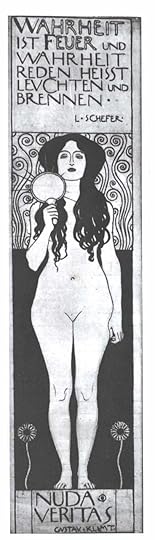
Arquitetura é o objeto do segundo ensaio, mais especificamente a Ringstrasse – a rua mais famosa de Viena. Projetada na época dos liberais, a “rua em forma de anel” é larga, em sua forma moderna e horizontal, não convergindo a nenhum ponto fixo (como nos planos barrocos) enquanto a maioria dos edifícios seguia uma tradição clássica. Os dois principais críticos da Ringstrasse escolheram lados diferentes dessa contradição. Camilo Sitte escolheria o retorno ao tradicional e Otto Wagner abraçaria o moderno. A imagem central é a ilustração de Klimt, a nuda veritas (verdade nua): uma virgem nua segurando um espelho (símbolo da arte) para o homem moderno. Mas Camilo Sitte, Otto Wagner e Klimt viam coisas diferentes no espelho.
Enfim, eu quero que mais gente leia esse livro então vou parar por aqui. Na verdade, mesmo que resumisse todo o livro, não seria o bastante para transmitir a enorme erudição de Schorske. É um oceano de conteúdo.
Venho pensando por esses dias que, a julgar as menções e traduções de escritores alemães, a literatura alemã anda muito mal representada. Ou posso estar errado e dos clássicos só sobraram os que podem ostentar algum superlativo. “O maior dramaturgo”, “O melhor poeta” etc. Enfim, é uma boa introdução à literatura austríaca e por isso recomendo essa obra.
I keep on coming back to this book as source of my fascination with the birth of Modernism. Schorske's book is a series of interconnected essays that can be read as stand alone essays, though best if read in order. The prose is a dense, though Schorske seems to cover every applicable topic - politics, art, social movements, high culture, low culture, etc. Everytime I read an essay in this book I have to get my graduate school mind back. Not for the beach.
Carl E. Schorske’s Fin-de-Siècle Vienna: Politics and Culture (1980) is widely regarded as a landmark in cultural and intellectual history. Awarded the Pulitzer Prize in 1981, the book stands at the intersection of political history, psychoanalysis, modernist art, and urban studies. Schorske’s project is ambitious: to show how the political crises of late nineteenth-century Austria, and specifically Vienna, served as a crucible for modernist culture. His central argument is that the breakdown of liberal politics in the Habsburg Empire generated a cultural shift in which artists, architects, psychoanalysts, and intellectuals sought refuge from a failed public sphere by turning inward, thus laying the foundations of modernism.
The volume is structured as a series of interrelated essays, each exploring a key figure or movement that exemplifies the tensions of fin-de-siècle Vienna. Schorske begins with a discussion of liberalism’s political collapse in Austria, noting how the impotence of the liberal bourgeoisie against conservative forces undermined confidence in parliamentary politics. He traces how this disillusionment fostered intellectual withdrawal from politics, which found expression in the arts, psychology, and philosophy. Sigmund Freud’s psychoanalysis is presented as one of the most emblematic responses: where politics failed, the exploration of the unconscious offered a new realm of meaning.
The essays on architecture and urban planning—particularly the Ringstrasse project and Otto Wagner’s architectural innovations—demonstrate how the built environment embodied both the aspirations and the contradictions of liberal culture. Similarly, Schorske’s treatment of painters such as Gustav Klimt and the Vienna Secession movement underscores the turn to aesthetic autonomy and symbolism as a rejection of liberal rationalism and bourgeois complacency. His analysis of Arthur Schnitzler’s literary works extends the argument into narrative form, showing how Viennese literature grappled with the psychological and moral ambiguities of modern urban life.
One of Schorske’s greatest achievements is his capacity to weave together cultural production and political history without reducing one to the other. His method exemplifies what might be called a “contextualist” approach to intellectual history: art, literature, and theory are not autonomous creations but responses to specific social and political predicaments. Yet, he avoids crude determinism by highlighting the creative autonomy of cultural actors. For example, Freud’s psychoanalysis is understood both as a reaction to Viennese liberalism’s demise and as a radical theoretical innovation with a global legacy.
Critics have pointed to certain limitations in Schorske’s account. Some argue that he overstates the collapse of liberal politics as the determining factor in Viennese modernism, thereby underestimating the persistence of liberal traditions and the complexity of Austria’s political culture. Others note that his focus on elite intellectual and artistic circles neglects the broader social base of cultural transformation, including the roles of popular culture, women, and non-German minorities in the Habsburg Empire. Nevertheless, even critics acknowledge the interpretive brilliance and influence of Schorske’s framework.
The legacy of Fin-de-Siècle Vienna lies in its demonstration of how cultural modernism can be illuminated by political history and vice versa. Schorske’s essays are exemplary in their interdisciplinary scope, combining art history, psychoanalysis, urban studies, and political theory. His elegant prose and interpretive insight made the book accessible to a wide readership beyond the academy, while also reshaping scholarly debates about modernism, the crisis of liberalism, and the intellectual origins of the twentieth century.
Carl Schorske’s Fin-de-Siècle Vienna is both a classic of cultural history and a touchstone for interdisciplinary research. By situating Freud, Klimt, Wagner, and Schnitzler within the political collapse of liberal Vienna, Schorske not only explained the origins of modernism in a particular historical context but also offered a model for understanding the entanglement of politics and culture more generally. For historians, literary scholars, and students of modernism, it remains an indispensable work.
I read this as part of the Literary Cityscapes course "Fin-De-Siecle Vienna" in The Basic Program at the U of C. Schorske provides a thorough overview of the culture of the Fin-de-Siecle with entries on literature, art, politics, the importance of the Ringstrasse, and the impact of Freud. The importance of culture for literature and the rest of art is brilliantly propounded in this influential book. My favorite discussion is that of the "coffeehouse culture" which was a veritable hothouse for new ideas. This book is the place to start for an understanding of the culture of this era.
Before I turned my focus towards Gauguin, I began with a survey of Gustav Klimt's artwork. Carl Schorske is most likely the ultimate scholar on fin-de-siecle Vienna and provides excellent background, intimate details regarding daily life, city buildings, and analyzes Klimts work, as well as Egon Schiele and Oscar Kokoshka in excellent intricacy.
Another re-read (though this for the third or fourth time); yet again, even better when you have time to let it ferment. I had a recurring dream motif of a waltz spinning out into infinity—or, rather, spinning as if under centripetal force while the world spins out endlessly, centrifugally, beyond and around it. And so what to do, but to pick up Schorske again, beginning, so famously, with his portrait of Ravel's 'La Valse'? To return to the world of Werkstatte hammered gold & gold enameling, of psychological forces that perne in all-consuming gyres, of populists crashing through the old order, of an emperor and a bourgeoisie that "reign but cannot rule". Alex Ross wrote in a little piece in the New Yorker some years back, about his own high-school encounter with Schorske: "'Fin-de-Siècle Vienna' was not an easy read, especially if you had to look up every other name in an encyclopedia, but its complexity was infectious: you seemed to be catching a glimpse of the inner machinery of modernity, and you may have entertained idle fantasies of writing something like it." I am glad to have Wikipedia and Spotify and Google Images to supplement the 80-some plates & figures that Vintage Books (then under Random House) managed to include; still, one feels that one is seeing this incredible world but through a glass darkly.
The psychologizing theme stood out to me on this read more than before—nearly every challenge to the old political & aesthetic regime springs out the advent of the new, modern, psychological man. So too the constantly recurring Anglophilia of the Austrian liberals. (Also: Schorske's love of, and, dare I say, overuse of, the word "adumbrate".) In the subjectivity of the instinctual and the psychological, new opposition can be mustered to the liberal-rational order. The mystical & occult re-enters not only the world of art and aesthetics, but that of government: as Hoffmannsthal writes, "Politics is magic. He who knows how to summon the forces from the deep, him will they follow."
I come out of this read with greater sympathy for the Viennese rationalist-bourgeoisie, or at least with the Social Democrats who sought to apply the social-egalitarian-rationalist ideals beyond how far the bourgeois classes were willing to allow. On the other hand, very much more set against the Kokoschkas, who, by depicting morbidity and mortality, effect it.
A classic textbook on the history of Austria and the birth of modernity. Written with the obnoxious pomp and purple prose of a 'true' art critic. It's a good book - an important one too - don't get me wrong. But so much of the information is unnecessary and draws away from unifying themes. And the author's obsession with Freud is unlikely to find many sympathetic modern readers. Plus, and this is a trouble with the whole setup of the book - it's framed using the basis of psychoanalysis. Or at the very least, every conflict is noted as being oedipal. But usually in the father-hating, and not the mother-loving kind of way. In some areas, like in architecture, this is a reasonable analogy. Anyways, here's a summary chapter by chapter:
Intro: From the 1860s until the pre-war era, Austria underwent a cultural crisis. The rapid change in regimes and social stratifications led to a series of sociocultural ruptures that set the stage for a pluralized modernity. In large part, this cultural struggle was aligned against the culture of the previously ruling Austrian aristocracy, and with disparate historical and modern influences - hence, being oedipal in a sense.
Ch1: Bourgeois Austroliberalism granted lots of political power to the growing Austrian middle class, and rose quickly to power in the 1860s. The new Austroliberalism held progress, science, reason, and utility as the highest virtues. At the same time, a more plastic worldview, which saw the universe as ever-changing, and held art as the highest virtue, became prominent in the literature of the time.
Ch2 parts 1-2: The new liberal government was prone to contradiction. Before the 1860s, the city center of Vienna was isolated by a surrounding ring known as the glacis - for military and strategic purposes. The pioneering liberals opened up the glacis to development, so that the suburbs and the traditionally more upper class city center could be connected, but ultimately backtracked by designing the city center (which came to be known as the Ringstrasse) in a wholly self-contained way, so as to isolate it from its surroundings. Now, as the government sought to develop the Ringstrasse, it had difficult choices to make. There were no historical precedents - no historical forefathers - to the exact tradition of Austrian liberalism (at least, none they were aware of or wanted to embrace). So, the task became to reflect a new historical epoch in the architectural styles of the new government's capital. Overall, the Ringstrasse was developed with a multitude of conflicting styles, and interestingly, without a central emphasis in the city. The city square had buildings of government, theatre, and education - none emphasized over another, reflecting the liberal government's idea of a democratic culture. Finally, the economic growth that came with the new regime led to the integration of the middle class with the aristocracy financially. As such, in spite of being a city center, the Ringstrasse was designed without much of a focus on businesses (since the upper class did not do much direct selling). Instead, housing was primary.
Ch2 parts 3-4: The development of the Ringstrasse also saw the beginning of architectural debates between aesthetic and utilitarian focus. Otto Wagner (Not to be confused with Richard Wagner) took up the utilitarian side, criticizing the Ringstrasse's use of ornamental historical style. Camillo Sitte denounced the decadent city center for being *too* modern, as it abandoned organic city growth for intentional design and did not center community interaction. Sitte's traditionalist-oriented complaints that the city did not follow the movement and spirit of citizens (especially for not sticking to a consistent historical style) gained initial traction, with the help of rising Austrian nationalism caused by the crash of 1873 and the other Wagner (Richard). Following Sitte's rise to popularity, Otto W took the stage by the 1890s, implementing rationalist design across Vienna, with a particular emphasis on making transportation between cities east. His work reflects some of the earliest intentional modernist techniques - he did not just emphasize practicality, he made it into an aesthetic (for example, he used materials associated with function, like steel supports, as decorative elements). He also emphasized direction, intentionality, and conformity in designing the city (he's part of the reason suburbs look like ... that). A major reason for OW's rise to fame was the anti-historicist Secession movement (more to come on these guys later). In short, rapid social change upset the normal progression of architectural styles, leading to conflict over whether to find a new tradition to follow (Sitte), or pave a new "modern" path altogether (O. Wagner).
Ch3: The gradual decline of the secular and laissez faire Austroliberal regime led to the rise of strong opposing groups. This chapter explores three of the leading figures of the opposition to the liberal government. First, Schönerer, a violent, antisemitic and anti-Slavic pan-German nationalist briefly gained some power by drawing on the support base of the Linz Program of 1882 (whose goals overwhelmingly overlapped with those of the American Populists of around the same time). For one, the movement already had underlying anti-Slavic attitudes, and second, Schönerer drew on the adherents' animosity towards the 'elite' and redirected it towards Jews (who he claimed controlled the elite). Following Schönerer's arrest due to incitement of mob violence, his successor in Reaction and the second figure of this chapter, the self-proclaimed Christian Socialist Karl Lueger took his place and became even more popular than him. Lueger drew on Catholic resentment of the secular regime and maintained Schönerer's antisemitism, while distancing himself from his pan-German Nationalism. Both of these leaders inspired Hitler. The third and final leader, and the only one in this chapter who did not play a role in the Reaction, was Theodor Herzl - founder of Zionism. He came to be viewed as a messianic figure, but beyond his Zionism, he was just another aristocratic liberal who fostered hidden antisemitic attitudes.
Ch4: This chapter is just a weird attempt at an in-depth psychoanalysis of Freud's struggle with his career choice, his father, and antisemitism. The author advocates Freud's idea that all politics is reducible to oedipal conflict. Not sure how this fits into the larger picture of the book, as this is hyper-focused on Freud's personal life.
Ch5: An in-depth exploration of Klimt's life and controversies in the context of the wider Austrian art scene. Gustav Klimt began his artistic career unimpressively, using traditional realistic styles with an emphasis on theatrical scenes. However, he soon joined the Secession movement, an artistic collective united around a rejection of classical style. Their goal was threefold - to use new forms of art as a kind of generational revolt, to use art to reveal underlying psychological truths, and to use art as a way to provide asylum from the frustrations of modern life. Klimt's early Secession work drew on themes of instinctual life and ancient aesthetics, with heavy inspiration from philosophers Schopenhauer and Nietzsche. His paintings usually involved prominent erotism and female subjects, so as to "liberate sexuality from the constraints of a moralistic culture" (224). Klimt began receiving national attention and government support when he was commissioned to make three paintings for the newly-established University of Vienna. The series was supposed to consist of three works shedding 'light onto darkness,' each with a different theme. The first, titled 'Philosophy,' depicts an indeterminate and flowing (but wholly interconnected) world of pleasure and pain. This is my favorite of the series - you can take a look here - https://www.gustav-klimt.com/Philosop.... 'Philosophy,' combined with his second work for the series, 'Medicine' (which depicted life and death as an intertwining column) sparked public outrage. His depiction of reality as nebulous and erotic pushed liberal reformers towards traditionalist censorship. Surprisingly, the government held up support. The new 1900 government aimed to unite the Austrian people by strengthening the country's culture and economy. Klimt's final work for the University, 'Jurisprudence,' was reworked after he received criticism from all corners of society. Initially depicting an uncontroversial portrait of the judiciary as a powerful woman ridding the world of evil, the final version of the work was meant to be controversial, if not disturbing. It depicted the castration of an old man in front of three sadistic enforcers (with their ironic counterparts - Truth, Justice, and Law - above). That painting lost Klimt his ever-so-vital government support. So he went on to join his Secession partners in a monument to Beethoven. His work in this project shows a transition from using erotic elements in depictions of punishment to using them as symbols of heroism and fulfillment. Finally, Klimt's late period saw him withdrawing from government commissions and philosophically-oriented works. He worked with the side of the Secession forming the art deco movement (which spread new ideas about interior design, especially well known for its emphasis on architectural geometry and simplicity), with particular influence from Byzantium. His last works were largely composed of portraiture, where he placed a unique emphasis on the environment instead of the subject of the painting.
Ch6: With the decline of Austroliberalism following the 70s and 80s, the middle class lost its instrument of political power, leading to varying emphases on the ability to shape society through other means, especially art. One author, Stifter, advocated the return of classical conservative and individualist bourgeois values, with art-based education on social ideals being the highest value. Moreover, with the middle class's attempt to reassert its influence against the aristocracy, a divided aesthetic movement superseded the fin-de-secle Secessionists. Parts of the movement advocated for art as an educational tool, the other half followed a Wildean message of hedonism and art for arts sake. But the strong messages from both sides - of self improvement or virulent indulgence - did not gain much influence among the disillusioned lower classes of Austrian society.
Ch7: The Secession's decline from artistic radicalism into art deco left an aesthetic power vacuum. But before the hedonist wing of aestheticism could take the country by storm, a more moderate set of artists put forth the doctrine of art as primarily intentional and for human purposes. Kokoschka, for example, brought extensive art education into children's education. Art became once more personal and largely decorative, against the Secession's ideology that art's main goal was to expose general (not individual) psychological tendencies. Innovation persisted nonetheless, with explorations of sadomasochism by Kokoschka, the invention of atonality by Schoenberg, and the use of free consciousness style by both. Moreover, this scene brought forth more modernist architects, like Alfred Loos, who, echoing Sitte, declared that all design should be utilitarian.
I have never read anything like this book, and I certainly was not familiar with the field of research, where politics and art studied together as parts of a whole, mutually affecting and transforming each other. I wish I could find a similar book on other periods and other corners of the planet. I always was curious about the circumstances in which some art works were created, but my curiosity didn't go far enough to do independant research.
It was a challenging reading, as I know very little about the period, but I truly enjoyed it, although some of the author's premises were not quite clear to me, it was interesting just reading his reflections, irrespective of whether they represent a "true"/widely accepted interpretation.
Schorske posits that liberal society and its values were undergoing major transformation both on political front - with more populistic movements taking over liberal ideas of rule of law, logic and equality, with creation of christian socialism (Karl Lueger), antisemitism and, in responce, zionism (Theodor Herzl); but also on cultural front, with rationality being taken over by instincts and fears (Freud, Klimt, Hoffmansthal, Schnitzler), art taking place of the religion, and cultural/sensual development being a sort of social elevator for bourgoisie to unpermiatable nobelty.
The book is also full of anecdotes (like for example explaining how Freud managed to get his promotion thanks to a Arnold Böcklin's painting), that somehow make these end-of-XIX century intellectuals appear not as distant, but very human and even relatable at times.
Since this book consists of seven more-or-less independent essays, I'll review them as I read them.
I. Politics and the Psyche: Schnitzler and Hofmannsthal
Schorske introduces the basic crisis that constitutes the decadence discussed in the other essays, namely the conflict between rational, capitalist Classical Liberalism, the ruling ideology of Viennese politics from the 1860s to the end of the century, and a more irrational, instinctual "psychological man" who would come to constitute the mass movements of the 20th century. He suggests the salience of this conflict through the works of both Arthur Schnitzler, whose works explored the consequences of replacing rational politics with instinctual politics, and Hugo von Hofmannsthal, whose works expressed his desire to harmonize irrational instinct with politics through art. Given that he's exploring turn of the century Vienna, it's almost inevitable that Schorske's analysis of the psyche relies to some extent on a Freudian interpretation of the mind, but the general concepts he presents are still valid and intriguing.
II. The Ringstrasse, Its Critics, and the Birth of Urban Modernism
The Ringstrasse was a district developed in Vienna, beginning in the 1860s, out of what were previously the city walls and surrounding earthworks. Schorske discusses the influence of Classical Liberalism on the early form of the buildings in the district, and the reactions by Camillo Sitte and Otto Wagner. Sitte had a literally pedestrian critique of the Ringstrasse; he would have preferred a district designed to resemble the ancient street grid of the city center, one more pedestrian-oriented than movement-oriented, resembling Jane Jacob's critiques of modernist planning several decades later. Unlike Jacobs, however, Sitte's critique was rooted in an artistic and historic ideology, rather than one based on personal experience with modernist planning. Wagner took the opposite view, one associated with ascendent modernism; he advocated for (and indeed built) buildings that clearly delineated commercial and residential functions, and even created plans for the infinite, rational expansion of Vienna. Schorske subtly frames the reaction to the bourgeois style of the early Ringstrasse as a conflict between rational modernism and intuitive historicism.
III. Politics in a New Key: An Austrian Trio
Schorske details the political evolution of Georg von Schönerer, Karl Lueger, and Theodore Herzl, all from the classical Liberal tradition to Pan-Germanism, Christian Socialism, and Zionism, respectively. In all three cases, presented one after the other, he identifies the reaction against rational politics as a shift away from the classical political spectrum, and towards one that reflects a mass psychology, one that paradoxically reflected the values of what Schorske calls a "pre-rationalist order."
IV. Politics and Patricide in Freud's Interpretation of Dreams
Schorske works through Freud's dreams, as detailed in his eponymous interpretation thereof, to suggest that Freud viewed politics as ultimately the conflict between father and son, and that repressed sexual force mirrors the repressed force of a revolutionary people. I take slight issue with a Freudian interpretation of politics, but the section is nonetheless an interesting read.
V. Gustav Klimt: Painting and the Crisis of the Liberal Ego
This essay is a review of the artistic evolution of Klimt in light of the conflict between rationality, as identified through a representational, Classic mode, and sensuality, shown through various levels of abstraction and identification with Freudian sexuality. Schorske begins with his murals for various Ringstrasse buildings, done in an entirely representational, Classical style, and then discusses Klimt's relationship with the Secession movement, in the context of his paintings for the University of Vienna and the political backlash they generated.
VI. The Transformation of the Garden
VII. Explosion in the Garden: Kokoschka and Schoenberg
Interesting read, each of its chapters can be read as distinct essays on a particular figure or set of figures (I believe each chapter actually appeared separately in historical journals before being published together [off the top of my head])
But because this book was what my final year special subject focused on, it ruined my life for a solid year.
I still have nightmares from that final year exam.
Recently revisiting Vienna, I reread this famous work by Carl E. Schorske, a sometimes difficult but rewarding read. A collection of essays, it focuses on some of the artists, politicians and scientists who defined fin-de-siècle Vienna, such as Otto Wagner, Gustav Klimt, Sigmund Freud, Arnold Schoenberg. The link between the essays is Schorske's view of politics and culture: generational tension and oedipal revolt, liberalism and antisemitism, beauty and destruction. The essays were written in the 1960s and 1970s and although that shows from time to time, what shows even more is Schorske's subtlety, originality and resourcefulness. His use of the metaphor of the garden, for example, on the transformation and destruction of high bourgeois Viennese culture, is masterful. Schorske doesn't strive for completeness, but still his neglect of Gustav Mahler - on whom he wrote elsewhere - and Egon Schiele - whom he never mentions - is a bit unfortunate. Unnoticed, Schorske is very much among you when in Vienna: I found the wall texts of the Leopold Museum, devoted to Vienna 1900, heavily influenced by his interpretation of this remarkable period in Europe's cultural history.
During a test for a sociology 101 class I took at Truman Community College in Chicago, I encountered a question that asked whether and how the contemporary United States was comparable to the Roman Empire as it collapsed. After reading this book, I see more similarities to the collapse of the Austro-Hungarian Empire: both composed of a multitude of ethnic groups, many of which have a history of violent conflict and with a wide economic disparity; both suffered humiliating losses in wars; both have a prominent middle class that steeps in decadence and withdrawal (the chapter on the Secession movement is an excellent account of its rapid about-face from idealism to escapism). While I confess to a fixation on Vienna, I think that anyone interested in history, art, or cities would enjoy this book, or at least part of it.
I have this thing for late 19th century Vienna, I mean who doesn't? In any case I couldn't resist this one. Parts of it are actually very interesting especially the essays on the transformation of Austrian politics from a liberal democracy to populist demagoguery at the end of the century. It sort of ruins the concept of a progression towards tolerance and enlightenment in human society that was sometimes envisioned. There's also a great essay on Gustav Klimnt and his development from a straightforward artist to the avant-garde. It does make you appreciate the explosion of artistic ideas immediately prior to World War I as the classical style burned itself out. The last few essays drag, however.
A wonderful conducted tour through the Viennese turn of the century cultural scene. Left me a little breathless at the end, and desirous of more of this high quality entertainment.