

What do you think?

Contre-Jour: A triptych after Pierre Bonnard
Gabriel Josipovici's acclaimed novel reissued in 2018.
Josipovici's novel is based on the life of Pierre Bonnard, the painter of enchanting domestic interiors and innocently unsensual nudes. A thoughtful and deeply felt piece told in three parts from the perspectives of Bonnard's wife, daughter, and the painter himself.
The publisher is currently reprinting this title, reissuing it with a new cover ahead of the Pierre Bonnard exhibition, "The Colour of Memory," scheduled at Tate Modern, London (Jan-May 2019).
Josipovici's novel is based on the life of Pierre Bonnard, the painter of enchanting domestic interiors and innocently unsensual nudes. A thoughtful and deeply felt piece told in three parts from the perspectives of Bonnard's wife, daughter, and the painter himself.
The publisher is currently reprinting this title, reissuing it with a new cover ahead of the Pierre Bonnard exhibition, "The Colour of Memory," scheduled at Tate Modern, London (Jan-May 2019).
144 pages, Paperback
First published January 1, 1986
About the author
Gabriel Josipovici
55 books76 followersGabriel Josipovici was born in Nice in 1940 of Russo-Italian, Romano-Levantine parents. He lived in Egypt from 1945 to 1956, when he came to Britain. He read English at St Edmund Hall, Oxford, graduating with a First in 1961. From 1963 to 1998 he taught at the University of Sussex. He is the author of seventeen novels, three volumes of short stories, eight critical works, and numerous stage and radio plays, and is a regular contributor to the Times Literary Supplement. His plays have been performed throughout Britain and on radio in Britain, France and Germany, and his work has been translated into the major European languages and Arabic. In 2001 he published A Life, a biographical memoir of his mother, the translator and poet Sacha Rabinovitch (London Magazine editions). His most recent works are Two Novels: 'After' and 'Making Mistakes' (Carcanet), What Ever Happened to Modernism? (Yale University Press), Heart's Wings (Carcanet, 2010) and Infinity (Carcanet, 2012).
Ratings & Reviews
Friends & Following
Create a free account to discover what your friends think of this book!
Community Reviews
Displaying 1 - 23 of 23 reviews

June 26, 2020
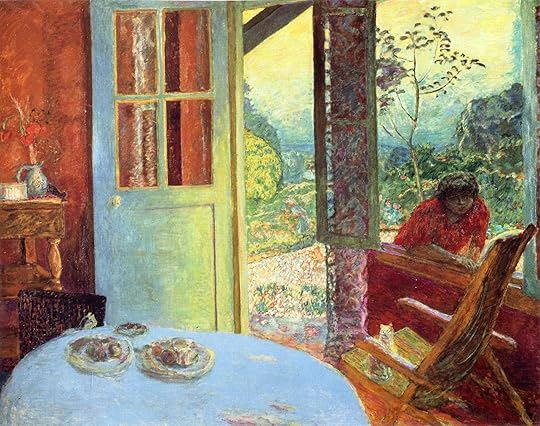
This novella is biographical fiction, inspired by aspects of Pierre Bonnard’s life and work. He painted interiors almost as if they were landscapes, often with doors and windows ajar, giving a tantalising view through and beyond the permeable boundary between man-made and natural worlds. That's also a theme at the end of Josipovici's brilliant whimsy, Only Joking (see my review HERE).
“The window was open and the french window too, and it was as if the garden were inside the room.”
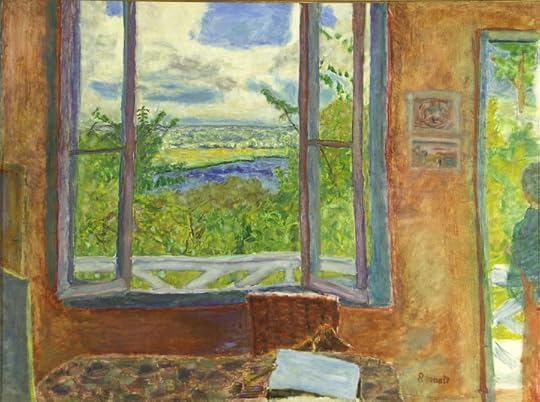
Image: Fenêtre ouverte sur la Seine (Vernon) 1911-12 (Source.)
His subjects were intimate but ordinary domestic moments and quotidian rituals, painted from memory, with frequent revisions - occasionally spanning years. Human, canine, and feline subjects are often not the subjects: they’re in corners or shadows, half truncated.
His muse and eventual wife, Marthe, often features, especially in the bath.
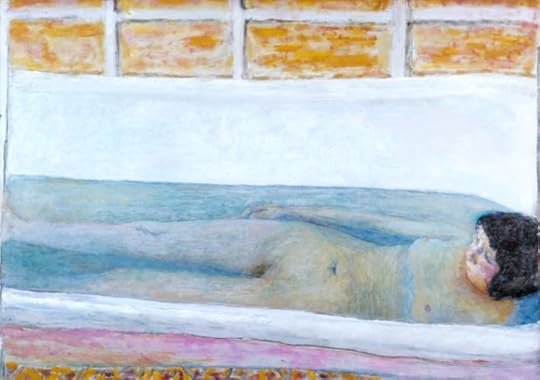
Image: The Bath 1925 (Source.)
Little lies and big truth
Bonnard himself said:
“There is a formula that perfectly fits painting: lots of little lies for the sake of one big truth.”
Josipovici does something similar. This is steeped in the themes of Bonnard’s art, transforming his visual tropes to verbal ones. But his name and Marthe’s are changed, and there’s a daughter they never had. At first that bothered me: why not either stay closer to reality or invent an artist? I was won over, but at an emotional level, because I glimpsed the wider truth.
(Also, since Josipovici wrote this, it's emerged that the mythology of Bonnard's wife's health and baths was very wrong, and arose because of legal disputes after the artist's death! See here.)
Impressions
Bonnard was a post-impressionist: not tied to natural colours, and with hints towards modernism and the abstract. The book paints an impression of Bonnard in three parts: from the perspectives of his adult daughter, wife, and finally the painter.
It’s better not to know much about Bonnard’s life, as this isn’t factual. But do have a look at some of his art.
I enjoyed the second section more than the first, where the "lies'' Josipovici incorporated into the story began to crystalise into a more complex exploration of truth, memory, and the power of what’s unsaid.
The two main narrators, each addressing the other (second person) become increasingly unreliable, as they play with memories and alternative scenarios. Gradually, the reader questions their honesty and then sanity. Instead of two sides of key moments, there are several, overlapping, shifting ones. Who rejected who, and why? Or maybe no one did. But both feel guilt and pass blame. Where lies truth?
If you were, instead, to read the mother’s section and then the daughter’s, a rather different story and interpretation might evolve.
The final few paragraphs from “Bonnard” himself add poignancy, but not clarity. They don’t need to. Their brevity exemplifies his apparently self-contained emotions.
“What excites me… is the way things are seen out of the corner of the eyes, are felt at the edges of consciousness.”
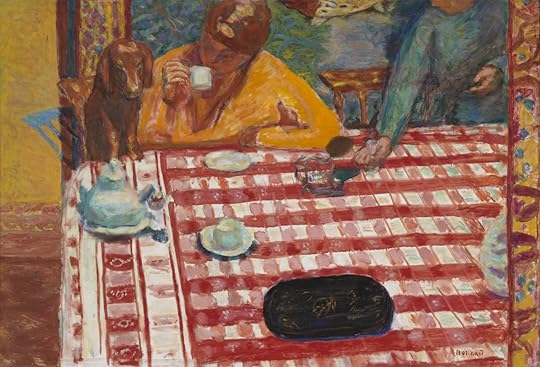
Image: Coffee 1915 (Source.)
Chosen because
I read this shortly after I’d been stunned by my first Josipovici novella, The Cemetery in Barnes (see my review HERE), and because last year I went to a Bonnard exhibition at Tate Modern (see HERE).
This book turned out to be very different from both, but was unexpectedly relatable reading in a pandemic. I sat in my sunny garden, gazing at views across the valley, longing to escape the Coronavirus lockdown.
Quotes
* “I want my people to be bathed in time as the Impressionists bathed them in light.”
* “What do we want from life that makes us so dissatisfied with whatever is given?”
* “Individual moments, unrelated to each other. A lot of separate moments and, between them, holes… Separate. Distinct. Like beads on a string.”
* “You have to find a way… which will do justice to the passing of time, to the fact that nothing stands still… And yet to give that fleeting quality a solidity without turning it into a monument.”
* “His work always includes a sense of the before and after.”
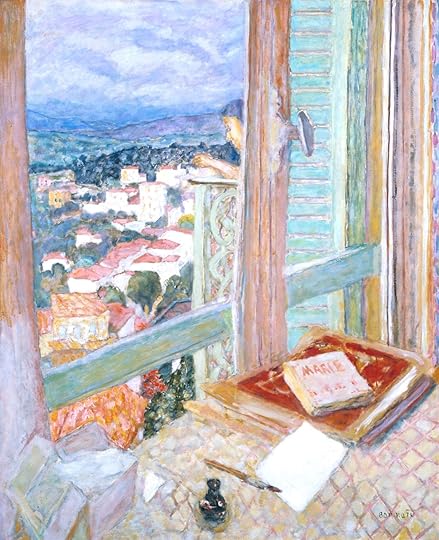
Image: The Window 1925 (Source.)
Note: There are no illustrations in the book itself. I don’t think it needs them, but it is helpful to know roughly what his paintings look like before you read it.
“The window was open and the french window too, and it was as if the garden were inside the room.”
Image: Fenêtre ouverte sur la Seine (Vernon) 1911-12 (Source.)
His subjects were intimate but ordinary domestic moments and quotidian rituals, painted from memory, with frequent revisions - occasionally spanning years. Human, canine, and feline subjects are often not the subjects: they’re in corners or shadows, half truncated.
His muse and eventual wife, Marthe, often features, especially in the bath.
Image: The Bath 1925 (Source.)
Little lies and big truth
Bonnard himself said:
“There is a formula that perfectly fits painting: lots of little lies for the sake of one big truth.”
Josipovici does something similar. This is steeped in the themes of Bonnard’s art, transforming his visual tropes to verbal ones. But his name and Marthe’s are changed, and there’s a daughter they never had. At first that bothered me: why not either stay closer to reality or invent an artist? I was won over, but at an emotional level, because I glimpsed the wider truth.
(Also, since Josipovici wrote this, it's emerged that the mythology of Bonnard's wife's health and baths was very wrong, and arose because of legal disputes after the artist's death! See here.)
Impressions
Bonnard was a post-impressionist: not tied to natural colours, and with hints towards modernism and the abstract. The book paints an impression of Bonnard in three parts: from the perspectives of his adult daughter, wife, and finally the painter.
It’s better not to know much about Bonnard’s life, as this isn’t factual. But do have a look at some of his art.
I enjoyed the second section more than the first, where the "lies'' Josipovici incorporated into the story began to crystalise into a more complex exploration of truth, memory, and the power of what’s unsaid.
The two main narrators, each addressing the other (second person) become increasingly unreliable, as they play with memories and alternative scenarios. Gradually, the reader questions their honesty and then sanity. Instead of two sides of key moments, there are several, overlapping, shifting ones. Who rejected who, and why? Or maybe no one did. But both feel guilt and pass blame. Where lies truth?
If you were, instead, to read the mother’s section and then the daughter’s, a rather different story and interpretation might evolve.
The final few paragraphs from “Bonnard” himself add poignancy, but not clarity. They don’t need to. Their brevity exemplifies his apparently self-contained emotions.
“What excites me… is the way things are seen out of the corner of the eyes, are felt at the edges of consciousness.”
Image: Coffee 1915 (Source.)
Chosen because
I read this shortly after I’d been stunned by my first Josipovici novella, The Cemetery in Barnes (see my review HERE), and because last year I went to a Bonnard exhibition at Tate Modern (see HERE).
This book turned out to be very different from both, but was unexpectedly relatable reading in a pandemic. I sat in my sunny garden, gazing at views across the valley, longing to escape the Coronavirus lockdown.
Quotes
* “I want my people to be bathed in time as the Impressionists bathed them in light.”
* “What do we want from life that makes us so dissatisfied with whatever is given?”
* “Individual moments, unrelated to each other. A lot of separate moments and, between them, holes… Separate. Distinct. Like beads on a string.”
* “You have to find a way… which will do justice to the passing of time, to the fact that nothing stands still… And yet to give that fleeting quality a solidity without turning it into a monument.”
* “His work always includes a sense of the before and after.”
Image: The Window 1925 (Source.)
Note: There are no illustrations in the book itself. I don’t think it needs them, but it is helpful to know roughly what his paintings look like before you read it.

Read
March 23, 2021Deciphering this very interesting text is a bit like trying to read underwater. Everything is distorted: time, place, relationships, but especially the narrative voice. The voice is querulous in the first part of the book, constantly demanding answers to questions that only lead to more questions. In the second part, it becomes pitiful, constantly circling the same subjects endlessly like water swirling round and round the plughole of a bath. But just as our eye is drawn towards swirling water, the reader is sucked into this narrative in spite of herself.
If I've mentioned baths and water in connection with this book, it's partly because the main character, Anna, spends a large part of each day in the bath, obsessing about her husband Charles' obsession with sketching her while she lies there thinking her thoughts and listening to the sound of his pencil scratching her outline onto the page, wondering sometimes if she exists beyond the paper.
When she's not wondering about her husband fixing her to the page, she's thinking about the central tension of her life: the daughter she may/might have had, and how that daughter ought to have a child herself so that she will be a better mother than Anna considers herself to have been. It's as if Anna is in the womb as she lies in the bathwater, as if she becomes her own daughter, and so the first half of the book reveals the thoughts of the daughter she has somehow become. The second part reads as Anna's response to the daughter's thoughts. There's a third part too, merely a page, but which allows the author to subtitle the book A Triptych after Pierre Bonnard (an early 20th century French artist who painted triptychs as well as many versions of his wife in the bath).
The main title, Contre-Jour, only adds to the effect of distortion which the narrative voice conveys. Objects or people seen 'against the light' in a painting lose their identity and can appear illformed. Anna's identity is fluid in that way. A hydra is mentioned at one point, (a two-headed creature associated with water), and the notion of a hydra conveys neatly what Gabriel Josipovici has created here: a woman who is both herself and her own daughter.
This is not an easy book. I came to it having read three other Josipovici books so I was prepared to search the narrative for a long time before I made out the themes. But that's what I like about Josipovici's books. He makes me think and think, and then think some more. And the more I thought, the more I admired what he's done here. He selected some known facts about the artist Pierre Bonnard, his artist-model wife, and his painting methods, and created an original work from them, a work that provides clues to Josipovici's own writing methods which turn out to be not unlike Bonnard's painting methods (I presumed the snippets on painting throughout the book were taken from Bonnard's theories). Art in the West has for too long been the victim of the mad idea that objects and people face you squarely, that you have all the time in the world to gaze at them. But life isn't like that. It slips by. There is light, there is movement, like the dog entering the room while I look at the mimosa. In Josipovici's other books, I'd noticed how he circles his subjects, tackling them in an oblique manner rather than straight on. And like Bonnard, who repeatedly painted his wife in the bath, Josipovici uses a lot of repetition, within each book and between the books. Many of his narrators indulge in long monologues where they circle a theme, returning to aspects of it over and over.
Another of the snippets on painting goes like this: Some people see the same thing in a thousand women. The interesting thing is to see a thousand things in the same woman.
Josipovici approaches his themes in a similar way, extracting the maximum from the minimum.
So for me, Contre-Jour is not a book about the Bonnard couple but rather an homage to Bonnard's series of paintings of the body of his wife lying underwater. If Josipovici's book were a painting, you'd have to stand back from it for a long time before you deciphered even half of what's in it. But isn't that the best kind of painting? It's definitely the best kind of book.
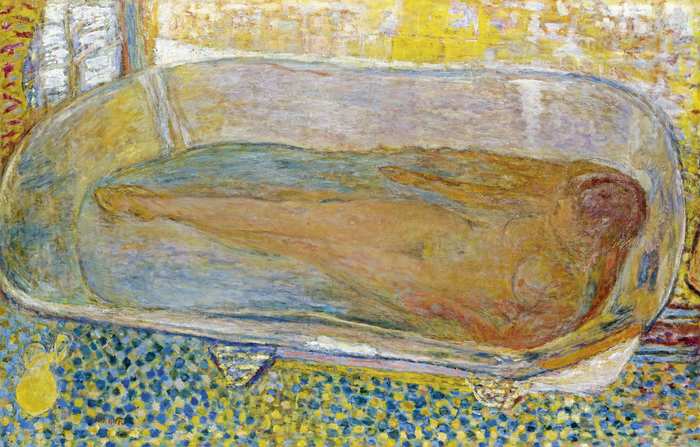
Marthe Bonnard by Pierre Bonnard
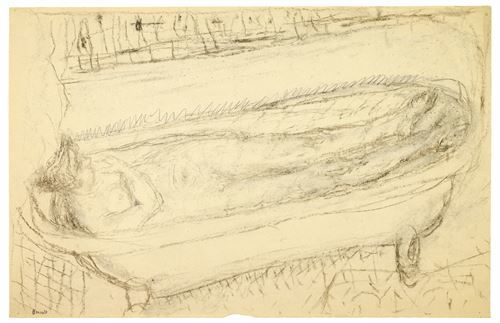
If I've mentioned baths and water in connection with this book, it's partly because the main character, Anna, spends a large part of each day in the bath, obsessing about her husband Charles' obsession with sketching her while she lies there thinking her thoughts and listening to the sound of his pencil scratching her outline onto the page, wondering sometimes if she exists beyond the paper.
When she's not wondering about her husband fixing her to the page, she's thinking about the central tension of her life: the daughter she may/might have had, and how that daughter ought to have a child herself so that she will be a better mother than Anna considers herself to have been. It's as if Anna is in the womb as she lies in the bathwater, as if she becomes her own daughter, and so the first half of the book reveals the thoughts of the daughter she has somehow become. The second part reads as Anna's response to the daughter's thoughts. There's a third part too, merely a page, but which allows the author to subtitle the book A Triptych after Pierre Bonnard (an early 20th century French artist who painted triptychs as well as many versions of his wife in the bath).
The main title, Contre-Jour, only adds to the effect of distortion which the narrative voice conveys. Objects or people seen 'against the light' in a painting lose their identity and can appear illformed. Anna's identity is fluid in that way. A hydra is mentioned at one point, (a two-headed creature associated with water), and the notion of a hydra conveys neatly what Gabriel Josipovici has created here: a woman who is both herself and her own daughter.
This is not an easy book. I came to it having read three other Josipovici books so I was prepared to search the narrative for a long time before I made out the themes. But that's what I like about Josipovici's books. He makes me think and think, and then think some more. And the more I thought, the more I admired what he's done here. He selected some known facts about the artist Pierre Bonnard, his artist-model wife, and his painting methods, and created an original work from them, a work that provides clues to Josipovici's own writing methods which turn out to be not unlike Bonnard's painting methods (I presumed the snippets on painting throughout the book were taken from Bonnard's theories). Art in the West has for too long been the victim of the mad idea that objects and people face you squarely, that you have all the time in the world to gaze at them. But life isn't like that. It slips by. There is light, there is movement, like the dog entering the room while I look at the mimosa. In Josipovici's other books, I'd noticed how he circles his subjects, tackling them in an oblique manner rather than straight on. And like Bonnard, who repeatedly painted his wife in the bath, Josipovici uses a lot of repetition, within each book and between the books. Many of his narrators indulge in long monologues where they circle a theme, returning to aspects of it over and over.
Another of the snippets on painting goes like this: Some people see the same thing in a thousand women. The interesting thing is to see a thousand things in the same woman.
Josipovici approaches his themes in a similar way, extracting the maximum from the minimum.
So for me, Contre-Jour is not a book about the Bonnard couple but rather an homage to Bonnard's series of paintings of the body of his wife lying underwater. If Josipovici's book were a painting, you'd have to stand back from it for a long time before you deciphered even half of what's in it. But isn't that the best kind of painting? It's definitely the best kind of book.
Marthe Bonnard by Pierre Bonnard

January 18, 2021

This novel offers highly perceptive comments that do indeed suit the art of Pierre Bonnard (1867-1947), or at least some of his paintings, those in which he focuses on his wife Maria Boursin (1869-1942). The reader is warned that there is an explicit connection to the French painter by the subtitle of the novel, --for a novel it is -- “A triptych after Pierre Bonnard”.
His paintings had no preconceived dimensions A writer does not know how long his book is going to be when he starts, so why should a painter be expected to know the size of his pictures and also encapsulated a certain unmeasured passage of time. So his work is never simple description, it always includes a sense of the before and after." Through the complex relationship between a sitter, who does not engage directly with the painter nor with the viewer, we are presented with the ambiguity of a framing which does not clearly delineate what is inside or deliberately included, and what is left outside or deliberately excluded. And then there is water, which dissolves presence, and which dilutes outlines and profiles.
And yet, this novel somewhat dissatisfied me. The characterization of Bonnard’s sitter, who emerges as the main narrator in this book, made me very uncomfortable and made me think of the limitations of fiction, or indeed of the moral responsibility of taking a real person and creating a distorted depiction of that person, and under a negative light. For the protagonist is an obsessive complainer and a blamer – for which I have a low tolerance level.
It does seem that Maria Boursin was a difficult character. She presented herself to Bonnard when they met, aged 26 and 24 respectively, as Marthe de Méligny. After more than thirty years together they got married, and it was then that, supposedly, Pierre found out her true identity. There is something very peculiar here that defies belief. Allegedly, they also isolated themselves later on which invited further speculation from their friends.
Wondering what basis had Josipovici had in presenting such a strongly negative, and possibly falsified, identity, I set out to google a bit around. . Finding nothing that supported his misconstruction I grew somewhat dispirited with the book. Because all that whining and accusing and bewailing, unconvincing in the fiction, and unsustainable in reality, just did not go well with me.
But may be the fact that I was combining the reading of this novel with a book on the Roman Legions may have affected my impression.
May be also, I compared it in my mind to my recent read Prohibido entrar sin pantalones, which seemed a much more successful biography of an artist, in novel form.

March 7, 2022
CRITIQUE:
A Pronounced Lack of Intimacy
For all but the last page of this novella, we don't know the names of the characters. We only know their familial relationship.
Josipovici strips them of much of their identity, apart from what they do around the house (which isn't much - it's mostly eating, talking, bathing, painting, or being painted as a subject, while in the dining room or bathroom).
In the process of writing, they become mere pronouns, in the eyes of the narrators: in the first panel or chapter, they are "I", "you", and "he". Daughter, mother/wife, and father/husband.
The pronouns that seem to be missing are "we" and "us". There is no sense of the family as a collective, a whole, or a unity. "You" doesn't include "me". The daughter never feels like she's part of the family. (In her eyes, "you" plus "me" should make "us".) Nor does she comprehend the relationship between her parents. It's possible that the father's art (like the screen in the painting below) comes between husband and wife, as well as between parents and daughter:
The novella's subtitle alerts us to the possibility that the male character, a painter, might be the artist Pierre Bonnard, that his wife might be Marthe Bonnard, and that the girl might be their daughter. So we read attentively, constantly searching for clues and evidence of identity, resemblance and influence.
Like the daughter, we try to understand her parents (and her family), by interpreting her father's paintings of her mother (there are no paintings of the daughter - Marthe was enough, and he painted her forever young).
How much can be inferred or learned from a painting? Can we read too much into a painting? Or find too little?
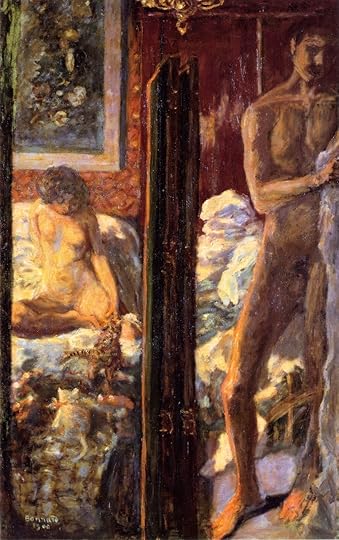
Pierre Bonnard - "Man and Woman" [with screen]
A Modelled Family
The question arises whether these characters are meant to be the Bonnards (the timeframe established in the third panel is consistent), or are they fictional inventions who are simply modelled on them (or the characters in the paintings)?
The painter's wife is his life-long muse and model, even as she deteriorates mentally and physically:
Originally, she hadn't wanted to have a child, but changed her mind for the benefit of her husband.
Soon after childbirth, she develops a form of eczema that seems to be the result of a nervous condition:
The mother blames her daughter for her skin condition (and her inability to cope with her daughter), thus transferring a false sense of fault and guilt to her daughter.
As a result, the daughter never wanted to have a child, and create a family, of her own. Instead, she becomes a doctor.
A Triptych After Pierre Bonnard
Another interpretation is that, aesthetically, the novella is simply "after" or "in the manner (or style)" of Pierre Bonnard.
It is certainly presented to us as parts of a triptych. There are three perspectives, each with their own chapter: the daughter's monologue, her mother's monologue (and correspondence), and her father's scanty one page letter, in which names are named, and fates are revealed.
Collectively, over the course of the novella, light is shone on the characters from behind (contre-jour: it's not clear whether the light is from the past, the imagined present of the novel [1941], or perhaps from the future [the time of Josipovici's writing]).
The characters become, first, silhouettes of themselves, and, then, fully illuminated or exposed beings. These are the characters in Bonnard's paintings, if not necessarily Pierre Bonnard and Marthe themselves. The totality of their portraits grows as we look or read on. We see the characters for what they are (or were), even if there is still a shadow of a doubt.
This doubt persists, because the names in the father's letter do not coincide with those of the Bonnard family. Even at the very end, Josipovici maintains one last divergence between fact and fiction. Who can guess exactly how many others there are: Bonnard's own view was that there could be many: art tells "lots of little lies for the sake of one big truth".
Arguably, Josipovici captures a truth about the Bonnards' life, by telling little lies inspired by Pierre Bonnard's paintings (which might, in turn, have been Bonnard's own little lies).
SOUNDTRACK:
A Pronounced Lack of Intimacy
For all but the last page of this novella, we don't know the names of the characters. We only know their familial relationship.
Josipovici strips them of much of their identity, apart from what they do around the house (which isn't much - it's mostly eating, talking, bathing, painting, or being painted as a subject, while in the dining room or bathroom).
In the process of writing, they become mere pronouns, in the eyes of the narrators: in the first panel or chapter, they are "I", "you", and "he". Daughter, mother/wife, and father/husband.
The pronouns that seem to be missing are "we" and "us". There is no sense of the family as a collective, a whole, or a unity. "You" doesn't include "me". The daughter never feels like she's part of the family. (In her eyes, "you" plus "me" should make "us".) Nor does she comprehend the relationship between her parents. It's possible that the father's art (like the screen in the painting below) comes between husband and wife, as well as between parents and daughter:
"I do not know what really went on between you. I do not know the first thing about you, either individually or together. Which is a strange thing for a child to confess to her parents."
The novella's subtitle alerts us to the possibility that the male character, a painter, might be the artist Pierre Bonnard, that his wife might be Marthe Bonnard, and that the girl might be their daughter. So we read attentively, constantly searching for clues and evidence of identity, resemblance and influence.
Like the daughter, we try to understand her parents (and her family), by interpreting her father's paintings of her mother (there are no paintings of the daughter - Marthe was enough, and he painted her forever young).
How much can be inferred or learned from a painting? Can we read too much into a painting? Or find too little?
Pierre Bonnard - "Man and Woman" [with screen]
A Modelled Family
The question arises whether these characters are meant to be the Bonnards (the timeframe established in the third panel is consistent), or are they fictional inventions who are simply modelled on them (or the characters in the paintings)?
The painter's wife is his life-long muse and model, even as she deteriorates mentally and physically:
"I had been so proud of my skin. One of my best features, people said. It was because of my skin that your father wished to paint me in the first place. Your creamy skin, he said."
Originally, she hadn't wanted to have a child, but changed her mind for the benefit of her husband.
Soon after childbirth, she develops a form of eczema that seems to be the result of a nervous condition:
"It was the inability to cope with you that had brought it on. The only way to get rid of it was to send you away for a while...
"...I couldn't bear the itching...Only when I lay in the warm water did the pain cease for a while...a gentle sponging was the only thing that soothed it."
The mother blames her daughter for her skin condition (and her inability to cope with her daughter), thus transferring a false sense of fault and guilt to her daughter.
As a result, the daughter never wanted to have a child, and create a family, of her own. Instead, she becomes a doctor.
A Triptych After Pierre Bonnard
Another interpretation is that, aesthetically, the novella is simply "after" or "in the manner (or style)" of Pierre Bonnard.
It is certainly presented to us as parts of a triptych. There are three perspectives, each with their own chapter: the daughter's monologue, her mother's monologue (and correspondence), and her father's scanty one page letter, in which names are named, and fates are revealed.
Collectively, over the course of the novella, light is shone on the characters from behind (contre-jour: it's not clear whether the light is from the past, the imagined present of the novel [1941], or perhaps from the future [the time of Josipovici's writing]).
The characters become, first, silhouettes of themselves, and, then, fully illuminated or exposed beings. These are the characters in Bonnard's paintings, if not necessarily Pierre Bonnard and Marthe themselves. The totality of their portraits grows as we look or read on. We see the characters for what they are (or were), even if there is still a shadow of a doubt.
This doubt persists, because the names in the father's letter do not coincide with those of the Bonnard family. Even at the very end, Josipovici maintains one last divergence between fact and fiction. Who can guess exactly how many others there are: Bonnard's own view was that there could be many: art tells "lots of little lies for the sake of one big truth".
Arguably, Josipovici captures a truth about the Bonnards' life, by telling little lies inspired by Pierre Bonnard's paintings (which might, in turn, have been Bonnard's own little lies).
SOUNDTRACK:

June 25, 2020
There is a formula that perfectly fits painting: lots of little lies for the sake of one big truth.
Pierre Bonnard
Contre-Jour: A triptych after Pierre Bonnard is the fictional story of a painter, Charles, and his wife and long term model, Anna, although explicitly based on Pierre Bonnard and Marthe de Méligny, and their time living in "Le Bosquet" in Le Cannet where, Pierre Bonnard noted:
« J’ai tous mes sujets sous la main. Je vais les voir. Je prends des notes. Et puis je rentre chez moi. Et avant de peindre, je réfléchis, je rêve. »
Josipovici has explained (https://journals.openedition.org/lisa...
Being a Josipovici novel the story is told in a more creative way than my description may imply. The first part is narrated after Anna's and subsequently Charles's deaths by their daughter, but is in the form of a monologue addressed to her deceased mother. The narrator was estranged from her parents long before their death, simply feeling excluded from their life:
And it was not from the day I went away that I began to feel my life like this, but from the day in the bathroom, the day I came in and found you there, in the bath and then turned and saw him sitting there, unconcerned, sketching, At least that's how it seems to me, looking back.
...
And do you know what that made me feel? Not just that I was not wanted, but that I did not exist, I had never existed and I would never exist
A reference to Bonnard's famous series of paintings of Marthe in the bath. As Josipovici noted in another interview (https://bookblast.com/blog/interview-...)
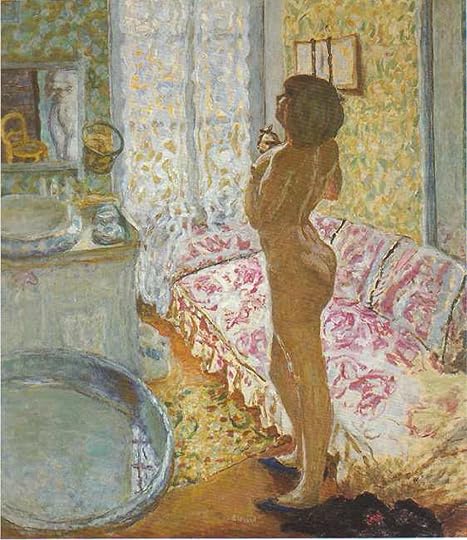
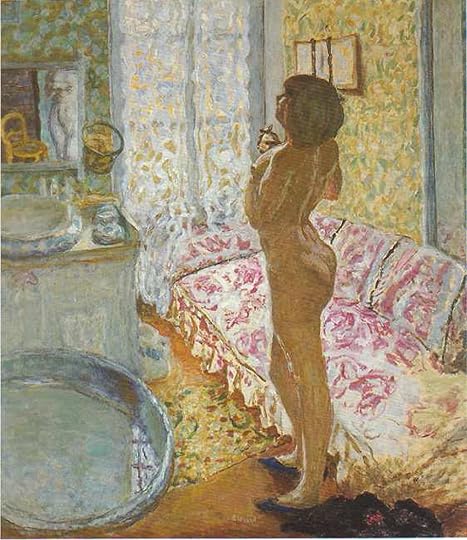
Nu à contre-jour, Pierre Bonnard (1908)
The daughter's account of her life with her parents cleverly references the domestic scenes, as well as those in the bathroom, from Bonnard's paintings, which Josipovici discussed in a 2019 TLS article https://www.the-tls.co.uk/articles/to....
The second part of the novel, also a monologue, is told from her mother, the painter's wife's perspective. Initially it has a Job-like flavour, as she asks her daughter of what sins against her she is accused, justifies her own behaviour and laments her situation. But as her lament continues it increasingly casts doubt on whether the daughter even exists (the Bonnard's in real-life were childless, leading to a protracted legal inheritance dispute after their deaths) or is merely a projection for her own frustrations with her relationship with her husband, who simply watches her and paints, and her own psychosis.
Even if things had been bad between us. It would have been different if I had had a daughter. Not this great emptiness. This great silence.
The voice in the third part of the triptych is the artist himself, but it is barely half a page long, a poignant letter to a friend announcing his wife's death, based on an actual letter sent by Bonnard to Matisse.
And as always with Josipovici he manages to tell a complex story in little over 100 pages, an example to other authors. When asked in a Bookblast interview for his motto he replied:
Perhaps not my favourite Josipovici novel - it may need a greater knowledge of Bonnard's paintings to be fully appreciated - but still recommended.
Pierre Bonnard
Contre-Jour: A triptych after Pierre Bonnard is the fictional story of a painter, Charles, and his wife and long term model, Anna, although explicitly based on Pierre Bonnard and Marthe de Méligny, and their time living in "Le Bosquet" in Le Cannet where, Pierre Bonnard noted:
« J’ai tous mes sujets sous la main. Je vais les voir. Je prends des notes. Et puis je rentre chez moi. Et avant de peindre, je réfléchis, je rêve. »
Josipovici has explained (https://journals.openedition.org/lisa...
When I wrote a novel that took off from the relations of Bonnard to his wife, I didn’t want to write ‘a novel about Bonnard’, mainly out of respect for Bonnard — I wanted to be free to use what I wanted about that relationship and about Bonnard the painter, and to shed the rest. So I called it Contre-Jour, in homage to the painter, and subtitled it ‘A Triptych after Pierre Bonnard’ — which I hope gets it about right.
Being a Josipovici novel the story is told in a more creative way than my description may imply. The first part is narrated after Anna's and subsequently Charles's deaths by their daughter, but is in the form of a monologue addressed to her deceased mother. The narrator was estranged from her parents long before their death, simply feeling excluded from their life:
And it was not from the day I went away that I began to feel my life like this, but from the day in the bathroom, the day I came in and found you there, in the bath and then turned and saw him sitting there, unconcerned, sketching, At least that's how it seems to me, looking back.
...
And do you know what that made me feel? Not just that I was not wanted, but that I did not exist, I had never existed and I would never exist
A reference to Bonnard's famous series of paintings of Marthe in the bath. As Josipovici noted in another interview (https://bookblast.com/blog/interview-...)
Contre Jour: A Triptych After Pierre Bonnard was a chance thing. I heard a talk on the radio about a Paris exhibition that featured many of his nudes in the bath. The speaker explained the one reason there were so many of them was that Bonnard’s wife was a compulsive washer. I dropped everything. I don’t know why. I went to Paris and had a look at that exhibition. I had dismissed Bonnard as being very beautiful like Renoir and a bit obvious, but I realised that he was not like that at all, but was very strange. The book came very quickly, almost as if I was copying it down and was not even writing it or inventing – it was all there.
Nu à contre-jour, Pierre Bonnard (1908)
The daughter's account of her life with her parents cleverly references the domestic scenes, as well as those in the bathroom, from Bonnard's paintings, which Josipovici discussed in a 2019 TLS article https://www.the-tls.co.uk/articles/to....
The second part of the novel, also a monologue, is told from her mother, the painter's wife's perspective. Initially it has a Job-like flavour, as she asks her daughter of what sins against her she is accused, justifies her own behaviour and laments her situation. But as her lament continues it increasingly casts doubt on whether the daughter even exists (the Bonnard's in real-life were childless, leading to a protracted legal inheritance dispute after their deaths) or is merely a projection for her own frustrations with her relationship with her husband, who simply watches her and paints, and her own psychosis.
Even if things had been bad between us. It would have been different if I had had a daughter. Not this great emptiness. This great silence.
The voice in the third part of the triptych is the artist himself, but it is barely half a page long, a poignant letter to a friend announcing his wife's death, based on an actual letter sent by Bonnard to Matisse.
And as always with Josipovici he manages to tell a complex story in little over 100 pages, an example to other authors. When asked in a Bookblast interview for his motto he replied:
John Berryman says in one of his poems, “Write as short as you can, in order, of what matters.” I like that.
Perhaps not my favourite Josipovici novel - it may need a greater knowledge of Bonnard's paintings to be fully appreciated - but still recommended.

September 14, 2020
I looked back at my TBR Excel file (yes, I keep such a file on Excel 🧐) and could not find any info on why I ordered this book. I gave this novel a high rating for me, 4 stars. And I am going to give it this superb rating even though I have a problem with the book — I do not understand it. 🤨
The first part of the triptych is narrated in the first person by the daughter supposedly of Bonnard. —The second part of the triptych is narrated by the wife of Bonnard and mother of the daughter. The mother/wife appeared to be delusional and mentally ill (e.g., she runs around outside of the house with no clothes on, she at one point slashes her husband’s painting, she leaves notes on doors inside the house for him, she takes 4 or more baths a day). Such ruminations and her behaviors cast doubt on the veracity of the first part of the triptych. Does the daughter even exist??? 😦
The only thing I have to go on to answer my question after reading the book is a painting on the front cover by Pierre Bonnard (so he exists!) and the following three blurbs on the back cover:
• Its translucence fosters an extraordinary purity of form and concept. In clear, obsessive, neurotic prose a mother and a daughter recall a painting husband and father…serious, even challenging about the conditions of artistic production, especially the domestic tax art levies on all its worthwhile practitioners.” from the Observer (UK periodical)
• Gabriel Josipovici’s new novel is based on the life of Pierre Bonnard, the painter of enchanting domestic interiors and innocently unsensual nudes…both thoughtful and deeply felt.” from the Sunday Times (UK periodical)
• “Josipovici proves himself once again to be one of the very best writers now at work in the English language. From The Guardian
So it would seem to me the story is told by the mother (2nd part of the triptych) and the daughter (first part). But I am not sure about that…and hence I am giving a 4-star rating to a novel where if you asked me on the street what the novel is about I would say “I’m not sure.” All I am sure about at this point was that it was extremely well-written and a captivating read. Maybe I will understand more after reading a bio of Bonnard and reading the reviews below.
I should mention that the third part of the triptych consists of a ten-sentence letter addressed to Robert from Charles. And I don’t have the foggiest who those two gentlemen are…supposedly the letter is from the painter and I thought that would be Pierre Bonnard….???
Oh, and by the way, ‘contre-jour’ (French for "against daylight") is a photographic technique in which the camera is pointing directly toward a source of light and an equivalent technique of painting.
Link to Pierre Bonnard’s bio from Wikipedia: https://en.wikipedia.org/wiki/Pierre_... (Note: Bonnard features heavily in the 2005 Booker prize winning novel, The Sea by John Banville. In the novel, the protagonist and art historian Max Morden is writing a book about Bonnard and discusses the painter's life and work throughout.)
Reviews:
From a blog site: https://thebookbindersdaughter.com/20...
https://www.kirkusreviews.com/book-re...
https://journals.openedition.org/lisa...
Hells Bells…no wonder I am lost….Josipovici is the author of The Cemetery in Barnes in which I had the same problem!!!! https://www.hive.co.uk/Product/Gabrie...
😲
The first part of the triptych is narrated in the first person by the daughter supposedly of Bonnard. —The second part of the triptych is narrated by the wife of Bonnard and mother of the daughter. The mother/wife appeared to be delusional and mentally ill (e.g., she runs around outside of the house with no clothes on, she at one point slashes her husband’s painting, she leaves notes on doors inside the house for him, she takes 4 or more baths a day). Such ruminations and her behaviors cast doubt on the veracity of the first part of the triptych. Does the daughter even exist??? 😦
The only thing I have to go on to answer my question after reading the book is a painting on the front cover by Pierre Bonnard (so he exists!) and the following three blurbs on the back cover:
• Its translucence fosters an extraordinary purity of form and concept. In clear, obsessive, neurotic prose a mother and a daughter recall a painting husband and father…serious, even challenging about the conditions of artistic production, especially the domestic tax art levies on all its worthwhile practitioners.” from the Observer (UK periodical)
• Gabriel Josipovici’s new novel is based on the life of Pierre Bonnard, the painter of enchanting domestic interiors and innocently unsensual nudes…both thoughtful and deeply felt.” from the Sunday Times (UK periodical)
• “Josipovici proves himself once again to be one of the very best writers now at work in the English language. From The Guardian
So it would seem to me the story is told by the mother (2nd part of the triptych) and the daughter (first part). But I am not sure about that…and hence I am giving a 4-star rating to a novel where if you asked me on the street what the novel is about I would say “I’m not sure.” All I am sure about at this point was that it was extremely well-written and a captivating read. Maybe I will understand more after reading a bio of Bonnard and reading the reviews below.
I should mention that the third part of the triptych consists of a ten-sentence letter addressed to Robert from Charles. And I don’t have the foggiest who those two gentlemen are…supposedly the letter is from the painter and I thought that would be Pierre Bonnard….???
Oh, and by the way, ‘contre-jour’ (French for "against daylight") is a photographic technique in which the camera is pointing directly toward a source of light and an equivalent technique of painting.
Link to Pierre Bonnard’s bio from Wikipedia: https://en.wikipedia.org/wiki/Pierre_... (Note: Bonnard features heavily in the 2005 Booker prize winning novel, The Sea by John Banville. In the novel, the protagonist and art historian Max Morden is writing a book about Bonnard and discusses the painter's life and work throughout.)
Reviews:
From a blog site: https://thebookbindersdaughter.com/20...
https://www.kirkusreviews.com/book-re...
https://journals.openedition.org/lisa...
Hells Bells…no wonder I am lost….Josipovici is the author of The Cemetery in Barnes in which I had the same problem!!!! https://www.hive.co.uk/Product/Gabrie...
😲

September 29, 2013
A very sneaky and dark novel making tremendous use of the (usually tired) technique of a second-person address to an unnamed listener. The speakers and addressees are unnamed apart from mother, daughter, father, and the subtitle A Triptych After Pierre Bonnard clues the reader in to the sleights-of-hand at play here. In the first part, the daughter speaks to her father and mother about extremely non-specific emotional damages, shifting the recipient of her complaints from mother to father in unsignposted twists. In the second, the mother address her absent daughter, and as she laments and complains (making the novel not particularly pleasurable to read), questions start to arise to the mental state of the speaker, and the relation between Bonnardian reality and Josipovician invention. Painter Pierre Bonnard is depicted as an extremely quiet and unresponsive character, almost monstrous, but the sneaky subtext offers more disturbing alternatives to the attentive reader. Clever and cunning.

May 20, 2015
I’m here. Can’t you see me. You never do, do you? My difference excludes me. Do you know what it is like to sit on these shelves and have you pass by as though I did not exist? Maybe you are afraid of me? This is my only way to survive, to make up crap like this as you reach for one of those other kind of writers. My spine is weakening. Frayed it is more difficult to stand straight. Withering I become less alluring each day. Yellowed. If you only understood. This is my virtue. Yeah, I said virtue. It is what I am about, excluding others, Being excluded. You know it don’t you. You’re doing the same thing to me, purposely or not, excluding me, making me invisible. Just to protect yourself. Hell, I bet you even do it to yourself. Take me off the shelf. Open my covers and read me. This is what my characters do. My characters. Ha! They’ve gone astray on their own. Even my author has left. Maybe though for different reasons, I hope. But what he left were alive people acting on their own. Pretty exciting, huh. Like actors stepping out of a television set into your living room., not knowing or caring that it is your living room or that you are there. So you sit on your sofa half petrified and half eating crap that will eventually kill you or worse leave you trying out for one of their roles. You see, all they do is busy themselves about your living room encasing themselves in an invisible protective coating where the others can’t reach them. Can’t reach themselves.
Only one tries. Who is she again? Oh yeah, that’s right, the daughter. Hasn’t seen the parents for years. Years I’m saying. So what happens? Not much. They aren’t much different if at all. The mother is still in the bath tub and the father sits on a stool in the corner of the bathroom sketching her. Sounds kinky. But with my frayed spine I’m getting too old for kinky. How about if we just call it curly? Nah, you’re right I’m more likely for him to choose me if there is some kink.
In the end who am I to say. I’m just a book. One that failed in the conventions of my time. An outcast. I didn’t lose the arc but eschewed it. I can’t find my plot. That’s reasonable since I didn’t think it relevant. But these characters. Who and what are they? Easy to say they are part of the writer’s mind. That’s the simple way out. They take me forward on their own. I watch their destination as the creation of their own habits and conventions to solidify safety of exposure and vulnerability. Difficult even for me as a book, the book, to see what is in all of us through these people’s actions. The daughter who steps in. Does she, can she make a difference? Huh. They sketch and paint, model, read, eat at the same times. Their struggles are our struggles.
No wonder you don’t want to read me. Reality sucks, right. I know what I’ll do. Hey I’ve got to do it. By increments moving to the edge of the shelf I will…leap. A suicide dive with the hope that my inevitable landing will leave me like one of those turtles on there backs, open.. You’ll pick me up, right and hopefully glance. Glancing is good. Then, there is the possibility that what you see is intriguing. The people wandering around our…your library, though not the gloss of a Hollywood screen production are interesting in a disturbing way. Disturbing is good, right.
It may be too late for me if you close my covers and reshelve me, and for you if you do not read me, kinks and all.
Only one tries. Who is she again? Oh yeah, that’s right, the daughter. Hasn’t seen the parents for years. Years I’m saying. So what happens? Not much. They aren’t much different if at all. The mother is still in the bath tub and the father sits on a stool in the corner of the bathroom sketching her. Sounds kinky. But with my frayed spine I’m getting too old for kinky. How about if we just call it curly? Nah, you’re right I’m more likely for him to choose me if there is some kink.
In the end who am I to say. I’m just a book. One that failed in the conventions of my time. An outcast. I didn’t lose the arc but eschewed it. I can’t find my plot. That’s reasonable since I didn’t think it relevant. But these characters. Who and what are they? Easy to say they are part of the writer’s mind. That’s the simple way out. They take me forward on their own. I watch their destination as the creation of their own habits and conventions to solidify safety of exposure and vulnerability. Difficult even for me as a book, the book, to see what is in all of us through these people’s actions. The daughter who steps in. Does she, can she make a difference? Huh. They sketch and paint, model, read, eat at the same times. Their struggles are our struggles.
No wonder you don’t want to read me. Reality sucks, right. I know what I’ll do. Hey I’ve got to do it. By increments moving to the edge of the shelf I will…leap. A suicide dive with the hope that my inevitable landing will leave me like one of those turtles on there backs, open.. You’ll pick me up, right and hopefully glance. Glancing is good. Then, there is the possibility that what you see is intriguing. The people wandering around our…your library, though not the gloss of a Hollywood screen production are interesting in a disturbing way. Disturbing is good, right.
It may be too late for me if you close my covers and reshelve me, and for you if you do not read me, kinks and all.

September 29, 2013
A dismal and imaginary meditation on the relationships of the painter Pierre Bonnard with his wife and a daughter. Exquisitely executed portrayals of the constraints and restraints social and parental conditioning impose, as well as the consequences of emotional betrayal and the egoism required to participate in and produce human expression.
Rendered as a triptych by virtue of three parts each representing the voices of the three protagonists, principally the daughter, wife and finally the painter himself, in free indirect discourse in the present tense, there is little here to satisfy a reader whose aesthetics demand form generating content, but much for a reader who enjoys psychological studies.
Rendered as a triptych by virtue of three parts each representing the voices of the three protagonists, principally the daughter, wife and finally the painter himself, in free indirect discourse in the present tense, there is little here to satisfy a reader whose aesthetics demand form generating content, but much for a reader who enjoys psychological studies.

May 10, 2026
Seit einer Ausstellung seiner Werke im Frankfurter „Städel“ fasziniert mich Pierre Bonnard. Besonders seine Badezimmerszenen haben es mir angetan. Fernab von Voyeurismus präsentiert er sein Modell gleich einer Madonna. So auch im vermutlich titelgebenden Gemälde „Nu à contre-jour“ (Nackte im Gegenlicht) zu. Das Bild zeigt Bonnards spätere Ehefrau Marthe, die auch für viele andere seiner Bilder Modell stand.
Um diese Kleinfamilie dreht sich der Romans. Es ist fast ein Kammerstück, da er sich fast durchgängig im abgelegenen Haus des Ehepaars im Süden Frankreichs abspielt. Der Untertitel „Ein Triptychon nach Pierre Bonnard“ evoziert die Vorstellung eines dreiflügeligen Altars mit einem zentralen Bild, das von szenenreichen Türflügeln umrahmt wird. Jedes Bild ist einer Person gewidmet. Bonnard, Marthe und ihrer Tochter. Die wahren Bonnards waren kinderlos, Josipovici nutzt die Konstellation der historischen Personen, um seine Themen durchzuspielen. Für mich sind dies die Durchdringung des Künstlers von seinem Schaffen und die damit einhergehende Vereinsamung seiner Familie.
Nu à contre-jour, 1908, Musées royaux des Beaux-Arts de Belgique
Die übersteigerte symbiotische Abhängigkeit (Marthe: Ich konnte ihn nicht verlassen, ich konnte nicht mit ihm leben.) von Vater und Mutter, Maler und Modell lässt für die Tochter keinen Platz. Sie stört und wird konsequenterweise in ein Internat abgeschoben (vertrieben). Auch später findet sie keinen Weg, um offen mit den Eltern zu reden und meidet sie. Dabei sehnt sich Marthe nach ihrer Tochter. Sie hofft, diese könnte sie von ihrem manischen Zwang zu Baden befreien. Er wurde ausgelöst durch einen traumatischen Arztbesuch. Dessen Natur bleibt im Dunkeln, ich vermute aber, dass es sich um einen Abort handelte, nach der Marthe unfruchtbar wurde. Die . Auch die historische Marthe Bonnard hat Stunden in der Wanne verbracht, vermutlich aufgrund einer Hautkrankheit. Das formal überraschende an diesem Triptychon ist das Kapitel, in dem der Maler zu Wort kommt, um den sich alles dreht. Es besteht lediglich aus einer kurzen Nachricht an einen Freund über den Tod seiner Frau. Die Tatsache, dass der Maler hier „Charles“ und seine Frau „Anne“ heißen, unterstreicht, dass das Buch sich nur an den Lebensumständen der Bonnards orientiert, sie aber nicht porträtiert.
Ich habe mich anfangs schwer getan mit dem Buch. Je mehr ich aber in Josipovicis Kompositionsweise eingestiegen bin, desto stärker fühlte ich mich angesprochen. Zudem habe viel über Bonnards Sicht- und Malweise gelernt: Es ist weniger ein schöpferischer Akt, eher als würde man ein großes Tier füttern. … In einem einzigen Zimmer, in einem einzigen Menschen liegt genug Arbeit für hundert Maler, für hundert Leben. Wenn wir nur richtig sehen könnten.
Um diese Kleinfamilie dreht sich der Romans. Es ist fast ein Kammerstück, da er sich fast durchgängig im abgelegenen Haus des Ehepaars im Süden Frankreichs abspielt. Der Untertitel „Ein Triptychon nach Pierre Bonnard“ evoziert die Vorstellung eines dreiflügeligen Altars mit einem zentralen Bild, das von szenenreichen Türflügeln umrahmt wird. Jedes Bild ist einer Person gewidmet. Bonnard, Marthe und ihrer Tochter. Die wahren Bonnards waren kinderlos, Josipovici nutzt die Konstellation der historischen Personen, um seine Themen durchzuspielen. Für mich sind dies die Durchdringung des Künstlers von seinem Schaffen und die damit einhergehende Vereinsamung seiner Familie.
Nu à contre-jour, 1908, Musées royaux des Beaux-Arts de Belgique
Die übersteigerte symbiotische Abhängigkeit (Marthe: Ich konnte ihn nicht verlassen, ich konnte nicht mit ihm leben.) von Vater und Mutter, Maler und Modell lässt für die Tochter keinen Platz. Sie stört und wird konsequenterweise in ein Internat abgeschoben (vertrieben). Auch später findet sie keinen Weg, um offen mit den Eltern zu reden und meidet sie. Dabei sehnt sich Marthe nach ihrer Tochter. Sie hofft, diese könnte sie von ihrem manischen Zwang zu Baden befreien. Er wurde ausgelöst durch einen traumatischen Arztbesuch. Dessen Natur bleibt im Dunkeln, ich vermute aber, dass es sich um einen Abort handelte, nach der Marthe unfruchtbar wurde. Die . Auch die historische Marthe Bonnard hat Stunden in der Wanne verbracht, vermutlich aufgrund einer Hautkrankheit. Das formal überraschende an diesem Triptychon ist das Kapitel, in dem der Maler zu Wort kommt, um den sich alles dreht. Es besteht lediglich aus einer kurzen Nachricht an einen Freund über den Tod seiner Frau. Die Tatsache, dass der Maler hier „Charles“ und seine Frau „Anne“ heißen, unterstreicht, dass das Buch sich nur an den Lebensumständen der Bonnards orientiert, sie aber nicht porträtiert.
Ich habe mich anfangs schwer getan mit dem Buch. Je mehr ich aber in Josipovicis Kompositionsweise eingestiegen bin, desto stärker fühlte ich mich angesprochen. Zudem habe viel über Bonnards Sicht- und Malweise gelernt: Es ist weniger ein schöpferischer Akt, eher als würde man ein großes Tier füttern. … In einem einzigen Zimmer, in einem einzigen Menschen liegt genug Arbeit für hundert Maler, für hundert Leben. Wenn wir nur richtig sehen könnten.

October 23, 2021
At first, I didn't enjoy this short novel as much as others of Josipovici's that I've read and it took me a long time to get through it. It was only as I embarked on the final stretch that the spell the writer had cast on me began to take effect, and my confusion grew in a pleasing way. Contre-Jour turns out to be fiendishly clever, as we might expect from this author.
The title is derived from Pierre Bonnard's painting Nu à contre-jour, "Nude against the Light". And exposed in the light is what the three main characters of this novel are. This painting shows Bonnard's muse spraying herself with perfume after taking a bath. The novel returns time and again to this scene as the painter in the story sketches his wife in the bathroom.
Superficially, the two halves of the book comprise a daughter talking to her absent mother and mother talking to absent daughter. The two are respectively daughter and wife to the painter around whom the novel revolves, an absence himself, forever absorbed in his work. The three of them form the triptych of the subtitle. It was only towards the end of the book that I began to suspect that the entire narrative was actually the "mother's". Since the enstrangement of daughter and mother, the latter remarks several times that for the father the former no longer exists. She also refers to the fact that she had been "barren", in which case she wouldn't have borne a daughter at all. Does the daughter actually exist, then, or is she a figment of a deeply-troubled imagination?
The major theme, presumably one close to Josipovici's heart, concerns 'real' life being sacrificed for art. The artist never stops sketching and painting, despite the apparent mental disintegration of his wife. In one memorable passage, his wife recalls that when his father died and then his brother, he didn't mourn as such. Instead, he merely stopped painting for one day before recommencing. Anyone who paints or sculpts, composes or writes seriously, will recognise the picture Josipovici paints, the conflicts and contradictions that such a life presents.
Is the painter Bonnard or not and does it really matter either way? I would say not. We have a template for such semi-fictional accounts of artists in Maugham's The Moon and Sixpence, where Charles Strickland is quite clearly a body-double for Paul Gaugin. I don't know enough about Bonnard to say whether the novel bears much relation to his life. Certainly, the life of the painter's wife shares aspects in common with that of Marthe de Mėrigny, Bonnard's wife and muse.
A further theme is lack of communication, how many of the things we ought to say to those close to us remain unspoken. The characters only talk to each other about their feelings when they're alone, when the other is absent. The painter says little. A life dedicated to the pursuit of art leaves little time for talk. The third panel of the triptych, when it comes, is just half a page long, told from the his perspective. It delivers the emotional knock-out punch.
The title is derived from Pierre Bonnard's painting Nu à contre-jour, "Nude against the Light". And exposed in the light is what the three main characters of this novel are. This painting shows Bonnard's muse spraying herself with perfume after taking a bath. The novel returns time and again to this scene as the painter in the story sketches his wife in the bathroom.
Superficially, the two halves of the book comprise a daughter talking to her absent mother and mother talking to absent daughter. The two are respectively daughter and wife to the painter around whom the novel revolves, an absence himself, forever absorbed in his work. The three of them form the triptych of the subtitle. It was only towards the end of the book that I began to suspect that the entire narrative was actually the "mother's". Since the enstrangement of daughter and mother, the latter remarks several times that for the father the former no longer exists. She also refers to the fact that she had been "barren", in which case she wouldn't have borne a daughter at all. Does the daughter actually exist, then, or is she a figment of a deeply-troubled imagination?
The major theme, presumably one close to Josipovici's heart, concerns 'real' life being sacrificed for art. The artist never stops sketching and painting, despite the apparent mental disintegration of his wife. In one memorable passage, his wife recalls that when his father died and then his brother, he didn't mourn as such. Instead, he merely stopped painting for one day before recommencing. Anyone who paints or sculpts, composes or writes seriously, will recognise the picture Josipovici paints, the conflicts and contradictions that such a life presents.
Is the painter Bonnard or not and does it really matter either way? I would say not. We have a template for such semi-fictional accounts of artists in Maugham's The Moon and Sixpence, where Charles Strickland is quite clearly a body-double for Paul Gaugin. I don't know enough about Bonnard to say whether the novel bears much relation to his life. Certainly, the life of the painter's wife shares aspects in common with that of Marthe de Mėrigny, Bonnard's wife and muse.
A further theme is lack of communication, how many of the things we ought to say to those close to us remain unspoken. The characters only talk to each other about their feelings when they're alone, when the other is absent. The painter says little. A life dedicated to the pursuit of art leaves little time for talk. The third panel of the triptych, when it comes, is just half a page long, told from the his perspective. It delivers the emotional knock-out punch.

August 30, 2020
Josipovici's fictional exploration of the life of the painter Pierre Bonnard is told via three different perspectives. Whilst this kind of literary experimentation can easily become trite in the wrong hand, Jospovici skilfully uses it to explore the relationship between Bonnard's daughter with her parents, whose fragmented, illusory and often contradictory memories develop a sense of haziness and uncertainty around their shared past. The common thread which runs through each of their narrative is one of regret; Bonnard's short epistolary passage at the end conveys regret at the loss of his wife and whilst his wife and daughter both feel Bonnard was aloof and far-removed from their emotional turmoils, the both provide different accounts for the breakdown in their relationship, with his daughter expressing her distaste for her parents austere and distant relationship with her and his wife expressing her uncertainty as to why her daughter has cut them off.
The domestic struggles which Josipovici creates reflects his own artistic obsession with the everyday, the quotidian and domestic details of our lives which he was able to transform in his impressionistic renderings of interiors. As the story goes on, the half truths begin to slowly unravel as the truth of the narratives slowly become less important against the atmosphere which Josipovici is able to create, one of half-light and shadows, of the inexpressible nature of human experience and haziness of memory and of the fleeting nature of time. 'Contre-Jour' isn't so much an exploration of Pierre Bonnard's life, but of his aesthetics and represents a truly original way of exploring the work of an artist via fiction.
The domestic struggles which Josipovici creates reflects his own artistic obsession with the everyday, the quotidian and domestic details of our lives which he was able to transform in his impressionistic renderings of interiors. As the story goes on, the half truths begin to slowly unravel as the truth of the narratives slowly become less important against the atmosphere which Josipovici is able to create, one of half-light and shadows, of the inexpressible nature of human experience and haziness of memory and of the fleeting nature of time. 'Contre-Jour' isn't so much an exploration of Pierre Bonnard's life, but of his aesthetics and represents a truly original way of exploring the work of an artist via fiction.

March 2, 2019
I hate extended second-person narratives, but Gabriel Josipovici proves that it can be done in a way that pleases even me. Josipovici is a brilliant writer, and this is a brilliant book. But I found the subtitle problematic in the sense that this is more of a musical than a visual book. The book, especially its first and better section (there is very little to the third), is a minimalist (musical rather than literary) masterpiece that moves slowly through the various aspects of blame (and, to a lesser extent, its companion, guilt). It features a triangle of mother, daughter, and father, with the mother and daughter speaking to each other, even though they’re not there for each other. In other hands, this could have been horrible, or dull.

March 18, 2021
3 1/2*

July 31, 2017
A so-so read, very good in parts, not so hot in others. No chance for any true connection emotionally to anyone. Not one of Josipovici's "best".

November 5, 2010
A fascinating and confusing book, like life itself. The author brilliantly takes us into the minds of each character but one... and we get the other side of the story. Well done

July 24, 2013
Exquisite!
February 13, 2019
Confusing. Interesting.
Read
July 17, 2025Great recommendation, feels like you entered one of Bonnard's paintings and you're staring at the characters who are stuck in the canvas and can't get out.
The dialogue between mother and daughter hit home for me, as well as the figure of the artistic genius absent father. All the "non-dits" are so frustrating and so real. And the writing was sensible and light, again like little delicate brush strokes that paint a beautiful and nostalgic image (sorry for the lame painting allegories i'll stop).
I was appreciating the ride calmly and then suddenly the story starts fucking with you about wether the daughter ever even existed or not. That was a genius addition to the story that makes it go from pleasant to full on mind-blowing. I devoured it in 2 days.
The dialogue between mother and daughter hit home for me, as well as the figure of the artistic genius absent father. All the "non-dits" are so frustrating and so real. And the writing was sensible and light, again like little delicate brush strokes that paint a beautiful and nostalgic image (sorry for the lame painting allegories i'll stop).
I was appreciating the ride calmly and then suddenly the story starts fucking with you about wether the daughter ever even existed or not. That was a genius addition to the story that makes it go from pleasant to full on mind-blowing. I devoured it in 2 days.
This entire review has been hidden because of spoilers.

April 18, 2018
Sometimes you meet a couple who are so intertwined and eccentric that it makes you wonder ... were they always like this ... did his behaviour make her like this or vice versa. What were they like before they met each other, were they less idiosyncratic when they were younger? Why do they think their behaviour is acceptable to others? Do they even care what others think? Why do they continue to drudge on in their misery, because clearly neither one appears happy, but they do coexist in some level of contentment that no-one else can fully understand.
These are the questions that seem to be addressed within this fascinating book.
I thoroughly enjoyed every aspect of this book and will be seeking out other books by this author.
Deeply thought provoking and gripping on so many levels.
These are the questions that seem to be addressed within this fascinating book.
I thoroughly enjoyed every aspect of this book and will be seeking out other books by this author.
Deeply thought provoking and gripping on so many levels.

April 26, 2020
Een jonge vrouw bezoekt na lange tijd nog eens haar ouders. Vader zit de krant te lezen en kijkt amper op. Moeder neemt haar mee naar de keuken, maar ook met haar kan ze geen zinnig gesprek voeren. Het is allemaal de schuld van die moeder, bedenkt de dochter nadien. Zij heeft nooit een kind gewild, ze kon het gewoon niet aan. Die keer, toen ze haar moeder in bad zag liggen terwijl haar vader haar schetste, besefte ze dat ze nooit deel uit zou maken van hen. Dat ze niet veel later naar een kostschool werd gestuurd, versterkte dat gevoel allen maar.
In Tegenlicht, beschrijft de Frans-Britse Gabriel Josipovici de vierkant draaiende relatie tussen een schilder en zijn vrouw. Hij baseerde zich daarbij op het leven van Pierre Bonnard en diens vrouw Marthe, die zelf kinderloos waren, maar in het boek wel degelijk een dochter hebben - of misschien ook weer niet. In drie delen laat hij zijn drie personages vanuit hun standpunt weergeven waar het allemaal fout liep, waarbij Bonnard slechts in een brief gericht aan Matisse aan bod komt, een brief waarin hij zijn verdriet omwille van de dood van Marthe beschrijft.
Marthe leed aan tuberculoze laryngitis en smetvrees en bracht daarom niet alleen een groot deel van haar leven in bad door, ze wou na verloop van tijd ook niets meer te maken hebben met Bonnards intellectuele vriendjes. De schilder vereenzaamde daardoor, en toonde hoe je de wereld in een huis kunt vatten. Je zou Bonnard de tegenhanger van Picasso kunnen noemen, die tegenover de sterke, grote en assertieve wil van deze schilder zijn eigen stille teruggetrokkenheid plaatste.
Tegenlicht is een boek vol ingehouden woede en teleurstelling, dat net als Bonnards schilderijen in dat ene huis op het platteland speelt. Maar het graaft ook pijnlijk diep in de psyche van de personages, die op zoek zijn naar de zin en de schuldigen van hun leed. Alleen zijn die er niet. Het is allemaal zinloos en niemand is schuldig, of iedereen. Er is alleen het niets dat de schilder zijn leven lang op doek wil vastleggen: ‘Er gebeurt niets, er gebeurt niets, er gebeurt niets en plotseling is er een heel leven voorbij en besef je dat dat niets eigenlijk alles was.’
In Tegenlicht, beschrijft de Frans-Britse Gabriel Josipovici de vierkant draaiende relatie tussen een schilder en zijn vrouw. Hij baseerde zich daarbij op het leven van Pierre Bonnard en diens vrouw Marthe, die zelf kinderloos waren, maar in het boek wel degelijk een dochter hebben - of misschien ook weer niet. In drie delen laat hij zijn drie personages vanuit hun standpunt weergeven waar het allemaal fout liep, waarbij Bonnard slechts in een brief gericht aan Matisse aan bod komt, een brief waarin hij zijn verdriet omwille van de dood van Marthe beschrijft.
Marthe leed aan tuberculoze laryngitis en smetvrees en bracht daarom niet alleen een groot deel van haar leven in bad door, ze wou na verloop van tijd ook niets meer te maken hebben met Bonnards intellectuele vriendjes. De schilder vereenzaamde daardoor, en toonde hoe je de wereld in een huis kunt vatten. Je zou Bonnard de tegenhanger van Picasso kunnen noemen, die tegenover de sterke, grote en assertieve wil van deze schilder zijn eigen stille teruggetrokkenheid plaatste.
Tegenlicht is een boek vol ingehouden woede en teleurstelling, dat net als Bonnards schilderijen in dat ene huis op het platteland speelt. Maar het graaft ook pijnlijk diep in de psyche van de personages, die op zoek zijn naar de zin en de schuldigen van hun leed. Alleen zijn die er niet. Het is allemaal zinloos en niemand is schuldig, of iedereen. Er is alleen het niets dat de schilder zijn leven lang op doek wil vastleggen: ‘Er gebeurt niets, er gebeurt niets, er gebeurt niets en plotseling is er een heel leven voorbij en besef je dat dat niets eigenlijk alles was.’

October 26, 2023
A Triptych after Pierre Bonnard but not Pierre Bonnard; or maybe?
The three parts of the book consist firstly of an imaginary daughter blaming her mother for not loving her enough, secondly the 'mother' blaming her 'daughter' for leaving and thirdly a brief letter from Charles to Robert (which the title page explains is based in a letter from Bonnard to Matisse) telling of the death of his wife and also clears up the mystery of who Alex, Michael and Leo are!
I had started this book on two previous occasions getting irritated and confused about who the many yous were and once distracted found myself lost; finally I have finished it. Hurrah. So, apparently Bonnard's wife Marthe was a 'difficult' woman but nevertheless his muse; they had no children and this book seems to be an exploration of a woman's sense of loss for what might have been.I'm not sure if I enjoyed it.
The three parts of the book consist firstly of an imaginary daughter blaming her mother for not loving her enough, secondly the 'mother' blaming her 'daughter' for leaving and thirdly a brief letter from Charles to Robert (which the title page explains is based in a letter from Bonnard to Matisse) telling of the death of his wife and also clears up the mystery of who Alex, Michael and Leo are!
I had started this book on two previous occasions getting irritated and confused about who the many yous were and once distracted found myself lost; finally I have finished it. Hurrah. So, apparently Bonnard's wife Marthe was a 'difficult' woman but nevertheless his muse; they had no children and this book seems to be an exploration of a woman's sense of loss for what might have been.I'm not sure if I enjoyed it.

January 18, 2021
Josipovici utgår från Bonnards tavlor, en sorts fördjupning i den verklighet de skildrar, och från detta: en anklagelseakt från ett barn paret Bonnard aldrig hade, ett försvarstal eller förklaring till samma barn. När Bonnard dog ska han ha sagt "He who sings isn't always happy"; och det kanske är det som Josipovici fastnat för, att se bakom den idyll man kan mena skildras av Bonnard. Kanske ett steg för långt i så fall eftersom Pierre och Marthes verklighet beskrivs som så otroligt sorglig, hennes sinnessjukdom så allvarlig. Välskrivet men inte direkt njutbart alltså.
Displaying 1 - 23 of 23 reviews