

What do you think?
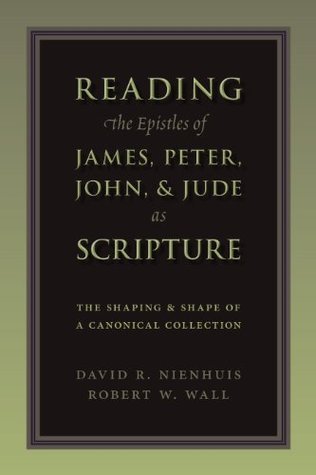
Reading the Epistles of James, Peter, John & Jude as Scripture: The Shaping and Shape of a Canonical Collection
Through a detailed examination of the historical shaping and final canonical shape of seven oft-neglected New Testament letters, Reading the Epistles of James, Peter, John, and Jude as Scripture introduces readers to the historical, literary, and theological integrity of this indispensable apostolic witness.
While most scholars today interpret biblical texts in terms of their individual historical points of composition, David Nienhuis and Robert Wall argue that a theological approach to this part of Scripture is better served by attending to these texts' historical point of canonization -- those key moments in the ancient church's life when apostolic writings were grouped together to maximize the Spirit's communication of the apostolic rule of faith to believers everywhere.
Reading the Epistles of James, Peter, John, and Jude as Scripture is the only treatment of the Catholic Epistles that approaches these seven letters as an intentionally designed and theologically coherent canonical collection.
While most scholars today interpret biblical texts in terms of their individual historical points of composition, David Nienhuis and Robert Wall argue that a theological approach to this part of Scripture is better served by attending to these texts' historical point of canonization -- those key moments in the ancient church's life when apostolic writings were grouped together to maximize the Spirit's communication of the apostolic rule of faith to believers everywhere.
Reading the Epistles of James, Peter, John, and Jude as Scripture is the only treatment of the Catholic Epistles that approaches these seven letters as an intentionally designed and theologically coherent canonical collection.
- GenresBiblical Studies
320 pages, Paperback
First published November 30, 2013
About the author
David R. Nienhuis
7 books6 followersDavid R. Nienhuis (PhD, University of Aberdeen) is Professor of New Testament studies at Seattle Pacific University.
Ratings & Reviews
Friends & Following
Create a free account to discover what your friends think of this book!
Community Reviews
Displaying 1 - 1 of 1 review

February 19, 2016
Throughout this project, Nienhius and Wall are pushing the reader to move the interpretive
focus from the composition of each epistle to the point of their collective canonization, and to
read and interpret each of the epistles in light of the entire canonical collection. Readers who are
familiar with canonical criticism will appreciate that their indebtedness to Brevard Childs’ work
does not stop Nienhuis and Wall from disagreeing with or expanding upon many of his theses.
Whether their initial thesis is granted or not, readers will find that the exegetical and theological
work done throughout Parts 2 and 3 to be trustworthy guides for those who are seeking to preach,
teach, and be nourished by the Catholic Epistles.
focus from the composition of each epistle to the point of their collective canonization, and to
read and interpret each of the epistles in light of the entire canonical collection. Readers who are
familiar with canonical criticism will appreciate that their indebtedness to Brevard Childs’ work
does not stop Nienhuis and Wall from disagreeing with or expanding upon many of his theses.
Whether their initial thesis is granted or not, readers will find that the exegetical and theological
work done throughout Parts 2 and 3 to be trustworthy guides for those who are seeking to preach,
teach, and be nourished by the Catholic Epistles.
Displaying 1 - 1 of 1 review