

What do you think?
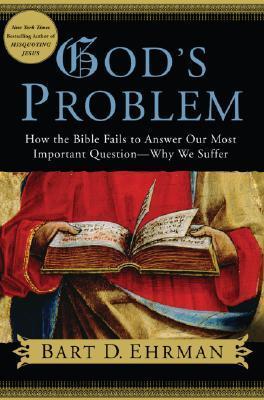
God's Problem: How the Bible Fails to Answer Our Most Important Question - Why We Suffer
In times of questioning and despair, people often quote the Bible to provide answers. Surprisingly, though, the Bible does not have one answer but many "answers" that often contradict one another. Consider these competing explanations for suffering put forth by various biblical writers:
The prophets: suffering is a punishment for sin
The book of Job, which offers two different answers: suffering is a test, and you will be rewarded later for passing it; and suffering is beyond comprehension, since we are just human beings and God, after all, is God
Ecclesiastes: suffering is the nature of things, so just accept it
All apocalyptic texts in both the Hebrew Bible and the New Testament: God will eventually make right all that is wrong with the world
For renowned Bible scholar Bart Ehrman, the question of why there is so much suffering in the world is more than a haunting thought. Ehrman's inability to reconcile the claims of faith with the facts of real life led the former pastor of the Princeton Baptist Church to reject Christianity.
In God's Problem, Ehrman discusses his personal anguish upon discovering the Bible's contradictory explanations for suffering and invites all people of faith—or no faith—to confront their deepest questions about how God engages the world and each of us.
The prophets: suffering is a punishment for sin
The book of Job, which offers two different answers: suffering is a test, and you will be rewarded later for passing it; and suffering is beyond comprehension, since we are just human beings and God, after all, is God
Ecclesiastes: suffering is the nature of things, so just accept it
All apocalyptic texts in both the Hebrew Bible and the New Testament: God will eventually make right all that is wrong with the world
For renowned Bible scholar Bart Ehrman, the question of why there is so much suffering in the world is more than a haunting thought. Ehrman's inability to reconcile the claims of faith with the facts of real life led the former pastor of the Princeton Baptist Church to reject Christianity.
In God's Problem, Ehrman discusses his personal anguish upon discovering the Bible's contradictory explanations for suffering and invites all people of faith—or no faith—to confront their deepest questions about how God engages the world and each of us.
304 pages, Hardcover
First published February 19, 2008
About the author
Bart D. Ehrman
69 books2,228 followersBart Denton Ehrman is an American New Testament scholar focusing on textual criticism of the New Testament, the historical Jesus, and the origins and development of early Christianity. He has written and edited 30 books, including three college textbooks. He has also authored six New York Times bestsellers. He is the James A. Gray Distinguished Professor of Religious Studies at the University of North Carolina at Chapel Hill.
Ratings & Reviews
Friends & Following
Create a free account to discover what your friends think of this book!
Community Reviews
Displaying 1 - 30 of 449 reviews

August 30, 2008
Read this book.
I don’t care if you are a fundamentalist Christian or a wishy-washy Christian or a lapsed Christian or a never was Christian – the discussion here in this book is so important and so well put together that I would find it hard to believe that any thinking human being would not get something worthwhile out of it.
I’ve only recently finished reading another of his books – Misquoting Jesus. I came away from that book not really knowing if the author was a Christian or not – and really not caring. What was utterly clear was that this guy knows his stuff. Having been that most rare of God’s creatures – a Fundie with a brain – he has researched and studied the Bible in more depth than most of us would ever dream of doing. His command of his subject matter is inspiring. For this alone reading this book is worthwhile – it is an article of my faith that when people write about subjects that truly concern them they almost invariably write well.
But this isn’t just a well written book. This is the story of why a man who spent years trying to become a better Christian finally had to give up on Christianity. The problem that ended his faith and the problem in the title is the problem of suffering.
Suffering is one of those things that is supposed to drag people into churches. And this isn’t something the Churches themselves try to hide – we have all heard that ‘there are no Atheists in the fox-holes”. So, this book seeks to discuss the answers presented in the Bible to explain suffering and asks whether these answers are good or bad answers.
One of the things people might find surprising is that the Bible doesn’t have one answer for why there is suffering, but many. Also that of these many some of the answers are mutually exclusive and contradictory. I’ve no real problem with that – the Bible is supposed to be a book about life and life is, if anything, contradictory and full of mutually exclusive answers.
The first major explanation for suffering in the Bible is that it is God’s punishment for us not following his laws. But this doesn’t make a lot of sense – as some of us are punished without having committed any sin. Children born with AIDS, for example.
There is an extensive discussion of the book of Job and this was utterly fascinating. I didn’t realise Job was two books that had been rather inexpertly patched together – a prose book and a poetry book. You’d think I’d have noticed such a thing. I am going to have to read this book of the Bible again at some stage. It is, beyond question, the strangest book of the Bible. Take a man without sin and make his life an utter misery – kill his kids, take away his property, give him sores – and just to see if he ever gets around to cursing God. And this all done by God so he can win a bet!
I also hadn’t realised that the Jews didn’t originally have a notion of eternal life and going to ‘heaven’. Ehrman points out that whoever wrote Ecclesiastes clearly felt this life was all there was and that we should live life in this life so as to enjoy it to the full. In fact, Ehrman says that if he is a follower of the Bible at all – then this is the book of the Bible that he follows. There is no eternal fame or anything like it – there is here and now and everything you love is set to perish – so live and love and share and engage and make the world a better place. This is all there is and welcome the joy and beauty and utter wonderfulness of it.
I’ve never quite gotten as far as Ecclesiastes in my readings of the Bible – but I definitely will have to read it now.
Also discussed are the standard religious views of suffering – that suffering is good for you as it focuses the mind on God and doesn’t make us too ‘uppity’. That suffering now is part of the way to ensure you get good stuff in the next life – for he who is last shall be first.
Ehrman rejects each of these views in turn as a basis on which to build a good or moral life.
Oh, I should have expressed the problem by now – I’ll do it immediately. The problem is: why is there suffering in the world? If God is all ‘good’ and all ‘powerful’ – then why does he allow suffering? The answers to this question have tortured people of faith throughout time. Which is why we end up with answers like, “It is God’s punishment.” Which is appalling. There is a really nice bit in the book where Ehrman explains why he doesn’t say Grace for his food. The problem being not in feeling grateful for the abundance of food he has – but because thanking God for this abundance also implies its opposite, that God is responsible for the shortage of food that confronts and that kills so many people around the world today.
I never have been religious, I find it hard to understand how anyone could be religious, so it really isn’t my place to go recommending books to the religious, I guess. Whatever you get out of ‘religion’ is forever barred to me, I suspect. All the same, if any part of the religious experience is open to rational discussion then this book should be essential reading for all Christians. I don’t mean that it will end your faith – that isn’t Ehrman’s intention – and even his wife is still a believer (and let's face it, if you can't even convert your wife - who has to put up with you all day long - you're not doing a terribly good job of converting people). What it will do is make you think about the nature of suffering and perhaps see that the message Jesus was giving wasn’t, “I want you to be rich” – but something a little different. I think I could almost put up with Christians if one of two of them where a little more Christian.
This book isn’t about converting people to atheism, nonetheless, it presents the problem of suffering in a way that ought to be a challenge to anyone’s faith. This is a problem that made the writer lose his faith. He is a compassionate, interesting, intelligent and thoughtfully close reader of Biblical texts. You may not agree with his conclusions, but you ought to read him all the same.
I don’t care if you are a fundamentalist Christian or a wishy-washy Christian or a lapsed Christian or a never was Christian – the discussion here in this book is so important and so well put together that I would find it hard to believe that any thinking human being would not get something worthwhile out of it.
I’ve only recently finished reading another of his books – Misquoting Jesus. I came away from that book not really knowing if the author was a Christian or not – and really not caring. What was utterly clear was that this guy knows his stuff. Having been that most rare of God’s creatures – a Fundie with a brain – he has researched and studied the Bible in more depth than most of us would ever dream of doing. His command of his subject matter is inspiring. For this alone reading this book is worthwhile – it is an article of my faith that when people write about subjects that truly concern them they almost invariably write well.
But this isn’t just a well written book. This is the story of why a man who spent years trying to become a better Christian finally had to give up on Christianity. The problem that ended his faith and the problem in the title is the problem of suffering.
Suffering is one of those things that is supposed to drag people into churches. And this isn’t something the Churches themselves try to hide – we have all heard that ‘there are no Atheists in the fox-holes”. So, this book seeks to discuss the answers presented in the Bible to explain suffering and asks whether these answers are good or bad answers.
One of the things people might find surprising is that the Bible doesn’t have one answer for why there is suffering, but many. Also that of these many some of the answers are mutually exclusive and contradictory. I’ve no real problem with that – the Bible is supposed to be a book about life and life is, if anything, contradictory and full of mutually exclusive answers.
The first major explanation for suffering in the Bible is that it is God’s punishment for us not following his laws. But this doesn’t make a lot of sense – as some of us are punished without having committed any sin. Children born with AIDS, for example.
There is an extensive discussion of the book of Job and this was utterly fascinating. I didn’t realise Job was two books that had been rather inexpertly patched together – a prose book and a poetry book. You’d think I’d have noticed such a thing. I am going to have to read this book of the Bible again at some stage. It is, beyond question, the strangest book of the Bible. Take a man without sin and make his life an utter misery – kill his kids, take away his property, give him sores – and just to see if he ever gets around to cursing God. And this all done by God so he can win a bet!
I also hadn’t realised that the Jews didn’t originally have a notion of eternal life and going to ‘heaven’. Ehrman points out that whoever wrote Ecclesiastes clearly felt this life was all there was and that we should live life in this life so as to enjoy it to the full. In fact, Ehrman says that if he is a follower of the Bible at all – then this is the book of the Bible that he follows. There is no eternal fame or anything like it – there is here and now and everything you love is set to perish – so live and love and share and engage and make the world a better place. This is all there is and welcome the joy and beauty and utter wonderfulness of it.
I’ve never quite gotten as far as Ecclesiastes in my readings of the Bible – but I definitely will have to read it now.
Also discussed are the standard religious views of suffering – that suffering is good for you as it focuses the mind on God and doesn’t make us too ‘uppity’. That suffering now is part of the way to ensure you get good stuff in the next life – for he who is last shall be first.
Ehrman rejects each of these views in turn as a basis on which to build a good or moral life.
Oh, I should have expressed the problem by now – I’ll do it immediately. The problem is: why is there suffering in the world? If God is all ‘good’ and all ‘powerful’ – then why does he allow suffering? The answers to this question have tortured people of faith throughout time. Which is why we end up with answers like, “It is God’s punishment.” Which is appalling. There is a really nice bit in the book where Ehrman explains why he doesn’t say Grace for his food. The problem being not in feeling grateful for the abundance of food he has – but because thanking God for this abundance also implies its opposite, that God is responsible for the shortage of food that confronts and that kills so many people around the world today.
I never have been religious, I find it hard to understand how anyone could be religious, so it really isn’t my place to go recommending books to the religious, I guess. Whatever you get out of ‘religion’ is forever barred to me, I suspect. All the same, if any part of the religious experience is open to rational discussion then this book should be essential reading for all Christians. I don’t mean that it will end your faith – that isn’t Ehrman’s intention – and even his wife is still a believer (and let's face it, if you can't even convert your wife - who has to put up with you all day long - you're not doing a terribly good job of converting people). What it will do is make you think about the nature of suffering and perhaps see that the message Jesus was giving wasn’t, “I want you to be rich” – but something a little different. I think I could almost put up with Christians if one of two of them where a little more Christian.
This book isn’t about converting people to atheism, nonetheless, it presents the problem of suffering in a way that ought to be a challenge to anyone’s faith. This is a problem that made the writer lose his faith. He is a compassionate, interesting, intelligent and thoughtfully close reader of Biblical texts. You may not agree with his conclusions, but you ought to read him all the same.

October 2, 2011
Updated with a big quotation from an essay by Ron Rosenbaum added at the bottom for those interested.
****
Disclaimer : I just reread this review and it's very disrespectful to the topic at hand and portrays complex ideas in a crude cartoonlike and smirky way. There's a celebrity death match between God and Satan, a nervous Jewish spokesman, and something called The Lone Bangster.
Shakes head.
Shrugs.
Does not get struck by lightning.
Yet!
Okay. It could be that I read this book sadistically, having cruel fun watching the poor Christians run around like rats frantically looking for the impossible way out of the trap that they themselves created, which is:
-God is omnipotent
-God loves us
-We live in an ocean of human suffering which laps and lashes at everyone's life. Just take a look at the news. God loves us? You gotta be joking, pal.
But I believe I read this book with a bit more compassion. And surprisingly, it turned out the author isn't a Christian either. He was, but he lost his faith. Because of the problem of suffering. And he's not caning Christianity in a mean-minded way, not at all. But he does say that Christianity fails to explain human suffering.
THIS JUST IN : GOD NOT OMNIPOTENT
The problem is solved if one of the statements about God is not true. So, perhaps, believers have entirely mistaken the nature of God.
O Abstract Creative Force, which art imbued in the very fabric of the material universe, in every quark and photon, hallowed be thy name.
Might it be that God was just the bang in the big bang – and that's all? Wham, BANG, thank you ma'am! Who was that masked man? Why that was the Lone Bangster. He rides into pre-time-and-space and creates a new universe and he's gone before anyone can thank him. In this version, the ancients were not wrong to state that there was an original creative and sustaining power, I mean, there was, wasn't there!, but because they couldn't conceptualise in any other way, they gave this power all these human attributes. Mistake! Because the Bang isn't compassionate and loving, the Bang is just the Bang!
Bang!
Another version in which God is not omnipotent is the
GOD VERSUS SATAN : CELEBRITY DEATH MATCH
In this version, very popular with some Christians, they SAY God is omnipotent, but then they say that here, on this earth where we live, he doesn't have power – he's in a perpetual battle with the Adversary – the Evil One, Voldemort – no, sorry, Satan. That's him. So don't blame God for all the suffering on planet Earth, it's Satan what done it, and for some reason, God can't just reach out and swat Satan like one of those fat greenbottle flies, ugh I hate them, no, he has to put up with Satan and we have to strive on earth to fend him (and his little devilettes, they're always coming round trying to seduce us, in their fetching red boots and glitzy hairdos) off, and exorcise him like in The Exorcist when he or a mean old devilkin gets stuck in our psyches (like a clog in a U-bend I suppose). Out, clog, out!
In this scenario, God is able to make commando raids on our planet from time to time, and send in some help, such as when he sent in Jesus and the disciples (the spiritual SAS of the first century) but that's all he can do. We're kind of on our own.
So this is called the Apocalyptic version. And in fact most New Testament writers believed in that, as did Jesus himself, except for the boots and the hairdos, I made that up. So all human suffering is nothing to do with God.
In this version God will be kicking down the door real soon, like a giant supernatural police raid – All right, Satan, up against the wall - YOU'RE BUSTED!
- I'm not coming quietly Godddd (pronounced with an insolent sneer) – you're gonna have to come in and get me.
- MY PLEASURE! (Whammm!)
So really, this apocalyptic version of God is a rewrite of the Greek and Roman view of The Gods, whereby the gods fight and carouse and have a wild time throughout the universe and we humans get caught in the crossfire from time to time. This is where sacrifice and prayer come in. These are two forms of pleading to the gods to a) make it rain and b) please go away and leave us in peace, we can't get any sleep when you're around. You're so scary! Meep, meep!
WHY WE SUFFER, OLD TESTAMENT STYLEE
1) because you sinned. What, I have malaria and you're saying that it's because I was sinful? Yes, deal with it.
The reasoning here is unexpectedly mechanical. Now, we think of a person's religion as being what they believe, but back then it was to do with what they did – i.e. whether they followed all the complex rules, which for the Jews was the Torah. Man, that's a lot of rules. So, you could always tell an Old Testament Jew – your leprosy is because you wore a garment made out of two different types of cloth. If you don't believe me, check it out. It's in Leviticus.
So you needed a way of saying sorry that you broke the rules, and hence sacrifice. Now exactly why burning & killing animals was so pleasing to God that he would forgive you is not clear. But that was the way you got right.
Later on the idea of the messiah evolved and became strongly associated with the idea of sacrifice, to the point where by the time the gospel writers set down the story of Jesus, they had absorbed the notion that he was in himself the perfect sacrifice for all of mankind's sins. The thinking here is quite complex, or perhaps I mean muddled. Exactly whose sins? And why couldn't God have just forgiven us without all the folderol? I mean, God sends his only begotten son so that he may be a sacrifice to God so God forgives the human race for their poor attitudes to each other and him, and he withholds the punishments they all so richly deserve. Well, this idea has been accepted by all Christians for the last 2000 years so who am I to say it sounds really loopy?
2) Redemptive Suffering
Simply put, it means that there's always a point to suffering. A silver lining. This is the idea that Dostoyevsky takes a chainsaw to in The Brothers Karamazov. A Biblical example is Joseph, who has brothers who are so mean they sell him into Egyptian slavery, and he suffers for years. But then he becomes powerful in Egypt so that when his brothers and their clans turn up requesting relief from the drought in Israel, he's able to help them. And this is shown as God allowing them to have sold him into slavery to begin with so that they can benefit from his forgiveness later, and lessons can be learned. You can see the idea of God as a puppeteer of humans here. God contrives the whole situation to prove a point. Later on, Exodus says specifically that God "hardens the heart" of Pharoah so that he doesn't listen to Moses and doesn't let the Israelites go until the final plague, in order to prove, once again, a point, i.e, that he is very powerful. What a strange way to go about things. But of course it sounds just like the authors had got the stories already and were back-reading the theology into them.
The story of God and Israel in the Old Testament is the tale of an abusive relationship. Israel betrays God and goes a-whoring after Baal, Israel end up in the Accident and Emergency Unit time and time again when God becomes violent; Israel weeps and says sorry but then the whole cycle repeats. It's all there in Kings & Chronicles and throughout the Prophets.
God: I brought you froth from bondage in Egypt.
Nervous Jewish spokesman : Froth?
God : Forth. I meant forth. (Irritably) That was a typo.
NJS: Yes, you did that, but, er, I believe you arranged for the bondage to happen in the first place.
God : No, no, that was someone else. I brought you forth.
NJS: Okay boss, whatever, you know on behalf of the whole tribe, I'd like to say, we adore you.
God: Okay then – no more Baal!
NJS : Absolutely! Baal (mimes kicking someone's behind) is right out!
God : Okay then – I'll have 50 kine, 25 – no, make that another 50 goats, and 25 sheep. Sacrifices to begin a week Friday. Okay?
NJS: Oh, oh – that many? I mean – yes, yes, great.
God : Okay, we're good then. (Disappears.)
And finally, natural disasters! Yay!
Alright - I'm glad to say that Mr Ehrman has the same attitude to earthquakes as I do. He's a very affable and readable guy, by the way, and I do recommend this book. So, many Christians like to say - and this explanation of suffering ISN'T in the Bible - that if we didn't have the FREE WILL to choose to sin, we would be robots, and it's because of sin that there's so much suffering. Mr Ehrman - you can almost hear him pulling his hair out here - says - but what about earthquakes, tsunamis, tornadoes, floods, volcanoes and mudslides? What sin caused all that human grief? His theological students tend to shuffle off gazing at their shoes when he puts that to them. Yes, you can say - at a stretch - that all the genocides were due to human sin. The Holocaust was created by the Nazis. They did it. But one million children died - so even when you accept that human sin comes from our free will you have to accept the notion of millions of completely innocent children victims. (This is what Dostoyevsky rants about.) So that - for me - scuppers the notion of God being in any way loving. Added to the natural disasters, for me that means that, sorry, and all that, but it looks like there's nobody here but us chickens.
Correction - us and the BANG!!
***
ADDENDUM
I just read a great essay by Ron Rosenbaum (author of one of my favourite ever books Explaining Hitler) which addresses in anguish and compassion our topic. It's here
http://chronicle.com/article/The-Nake...
but I will quote the last half. He was reading Bob Dylan's unreadable anti-novel "Tarantula" and came across a line which set him off thinking hard :
"hitler did not change
history. hitler WAS history ... "
Whoa. Those eight words... In the 10 years I spent writing a 500-page book called Explaining Hitler, not one of the historians, philosophers, artists, or other sages I spoke to or read ever made as white-hot an indictment of humanity as that. An indictment, implicitly, of God as well.
In those eight words it seems to me, Dylan is not saying Hitler's evil genius was unique, exceptional. He's saying Hitler represents—embodies—a distillation of all the horrors routinely perpetrated by human civilization. The truth about human nature over the centuries. Human civilization reached its true historical pinnacle—its bloody telos—in Hitler. Human nature is Hitler nature. Just as human history is Hitler history. (And please don't tell me Hitler "lost." Tell that to the six million Jews he killed. Each murder a win for him.)
Such an all-encompassing judgment obviously didn't come out of nowhere. It must have come out of long sessions of thought, ones that reach a critical mass in this lightning bolt of dreadful insight. So if this is Dylan's God problem—look upon his works, ye mighty, and sicken—it was time to turn to the second half of the title of my lecture, "Dylan's God Problem—and Ours."
It was here that I found myself growing so harsh and unrelenting in tone (I'd written it out before, but tone is everything) that I now feel the need to apologize. At least to one listener. I didn't realize the degree of anger I still carried around, not just at the Holocaust, but at those who could remain complacent and go on with their worship of God as if nothing had happened.
"Our God problem," I said, was the abject failure of post-Holocaust Jewish theodicy: The attempt to maintain a belief in a God who had
given Hitler free rein to murder. For Jewish scholars and theologians, it seemed to me, post-Holocaust theodicy should be the first, if not only, subject of their study—not a theodicy that reached back to some commentary on some commentary on some commentary on some third-century rabbinic texts rationalizing the destruction of the Second Temple by the Romans to somehow explain Jewish misfortune.
The failure of contemporary Jewish sages, scholars, and the rabbinate to come up with an adequate explanation for God's silence, God's absence, is scandalous to me, virtually an admission that there is no good explanation. But must we then reject God? It's a fairly important question to spend your academic or seminary life ignoring. It's the elephant, no, the mastodon, in the room. Something most don't want to talk about. Or claim not to be troubled by.
I've found myself troubled. I've found myself unable to say the Passover prayer anymore, the one about how God always stretches forth His mighty hand—God the superhero—to save us. This historical lie is an insult to the dead who devoted their lives to belief in God and that prayer—and were cruelly betrayed by both.
Not all rabbis and Jewish scholars are so timid. Rabbi Richard Rubenstein, a famous dissenter from the complacent rabbinic orthodoxy, wrote, "Jewish history has written the final chapter in the terrible story of the God of History" (sounding a bit like Dylan's "Hitler WAS history"). And "the pathetic hope of coming to grips with Auschwitz through the framework of traditional Judaism will never be realized."
As a cheerful note, he added: "We learned in the crisis we were totally and nakedly alone, that we could expect neither support nor succor from God. ... Therefore, the world will forever remain a place of pain, suffering, alienation, and ultimate defeat."
Other scholars, such as Irving Greenberg ("Not to confront is to repeat" Hitler's crime, he wrote in "Cloud of Smoke, Pillar of Fire," his influential essay) and the late Emil Fackenheim (whom I interviewed in Jerusalem), have wanted to preserve a belief in God but at least have had the courage to face the failure of explanation to fit the old religion into the new, evil revelation.
But I got carried away during this second half of the lecture. And I disclosed my intellectual—and emotional—distress at the rationalizations of God's role in the Holocaust. What I proceeded to do was ridicule any attempt to maintain that there was some "excuse" for God's absence and silence. The theodicy of the Shas rabbi in Israel, for example, who declared that the Holocaust was God's punishment for European Jews who'd slid away from orthodoxy to secularism. That Hitler was "the rod of God's anger" against them.
Obscene.
No less obscene than those who claimed the Holocaust was "part of God's plan," perhaps His way of hastening the establishment of a Jewish state. Then there was the argument that it was not God's fault—he just gave man free will to use for good or evil. Which prompts one to ask: Was it not in His power to create a being incapable of choosing mass murder so often? A human nature that didn't include childhood cancers, say, and the genesis of holocausts? Are we not allowed to question His creation in the smoking ruins of the death camps? Or, to alter the tone of the much-ridiculed notion: Is this—this! this hell on earth—the best of all possible worlds an all-powerful God could have created?
Then there's the last refuge of theological scoundrels: "It's all a big mystery." It sounds so profound. It's a disguise for willed avoidance.
I reserved my greatest contempt for those, including many intellectually "progressive" rabbis who try to get away with the sophistry that "God was in the camps," that God was there in every act of goodness and self-sacrifice the camp inmates showed one another. Doubly obscene. It steals from those brave souls the credit for their selfless acts and gives the credit to an absent God. Virtually robbing their graves for the sake of making God look better.
How can these rabbis and scholars justify themselves, intellectually and morally, with their ludicrously inadequate theodicies? Perhaps they have too much stake in established religious structure, in the comfy status quo of their institutions, to fear undermining it all by asking discomfiting, subversive questions. It seems to me to be intellectual cowardice.
At this point in the lecture, my anger had gotten the better of me. My condemnation of those who used that ploy spilled over to all the failed theodicies and their self-deceiving believers. But most of the audience seemed to be receptive in the sense that there were no outraged outcries.
It was only toward the end of the question period that a rather frail and aged figure—I believe I was later told he was both a rabbi and religious scholar—stood up almost shaking with rage. His rage was ostensibly at my citation of Dylan's rewrite (in "Highway 61 Revisited") of the Abraham, Isaac, and God human-sacrifice story. Dylan makes it seem like some sleazy transaction between carny hustlers. ("God said to Abraham, 'Kill me a son' / Abe says, 'Man, you must be puttin' me on.'")
The enraged rabbi raised his voice to cry out that Jews didn't take this story literally. Well, duh. (Although, of course, millions of Jews do take every word of the Bible as the word of God.) But even if it was only a metaphor about devotion and loyalty to an insecure deity who demanded the willingness to kill one's firstborn as proof of devotion, it was a particularly repellent metaphor. One can only imagine the soul-crushing effect on Abraham—even after his child-murder reprieve—of the realization that he valued an invisible delusion more than a living child.
Afterward, after the question period ended and people began to depart, the questioner approached me at the podium, and I realized that his rage, and the unspoken dissent of others in the audience, wasn't over the interpretation of the Abraham-and-Isaac story. It was (this was later confirmed to me by a colleague of his) because I had sought to strip away any possibility of a grown-up's continuing to believe in the loving and powerful God of Abraham, Isaac, and Jacob after Auschwitz.
That conclusion he could not abide, logic or no logic. He wanted his God, he wanted the consolation of a God, he needed to pray to him, and I had said doing so was robbing the graves of the dead.
I believe my feelings were as legitimate as his feeling of faithfulness, my anger as legitimate as his desire to continue a lifetime of belief and consolation. But who knows what losses he endured and how he had continued to love God?
In the months that followed, I kept thinking about our confrontation. I had ended it by saying, "We'll have to agree to disagree," but that didn't mollify him, and I kept thinking about his anger. Thinking about the tone in which I had critiqued (slashed away at) the range of theodicies.
I couldn't shake the image of that man shaking his finger at me.
My position, should you care, is that I love everything about Jews and being Jewish—except the Jewish God. (I'm the kind of agnostic who is always arguing with the God he doesn't believe in.) And it wasn't that I couldn't take criticism. But what that man was offering was not so much criticism as shame and reproof for my anger.
But I don't feel shame.
Hitler is dead, and I had nonetheless hurt the feelings of an undoubtedly good man to make a point about Hitler, God, and Bob Dylan. That wasn't my purpose, nor is my purpose here to take pride in my newly awakened empathy for my questioner. It's to register an honest evolution of feeling from an anger that was not sufficiently separated from a desire to hurt those religious figures who assumed some special authority if not holiness, and whom I felt had failed me and their followers. In a place for truth-telling—the academy—I feel remorse for my zeal to make the truth hurt.
And though he and I still may well differ, for that I apologize to him.
****
Disclaimer : I just reread this review and it's very disrespectful to the topic at hand and portrays complex ideas in a crude cartoonlike and smirky way. There's a celebrity death match between God and Satan, a nervous Jewish spokesman, and something called The Lone Bangster.
Shakes head.
Shrugs.
Does not get struck by lightning.
Yet!
Okay. It could be that I read this book sadistically, having cruel fun watching the poor Christians run around like rats frantically looking for the impossible way out of the trap that they themselves created, which is:
-God is omnipotent
-God loves us
-We live in an ocean of human suffering which laps and lashes at everyone's life. Just take a look at the news. God loves us? You gotta be joking, pal.
But I believe I read this book with a bit more compassion. And surprisingly, it turned out the author isn't a Christian either. He was, but he lost his faith. Because of the problem of suffering. And he's not caning Christianity in a mean-minded way, not at all. But he does say that Christianity fails to explain human suffering.
THIS JUST IN : GOD NOT OMNIPOTENT
The problem is solved if one of the statements about God is not true. So, perhaps, believers have entirely mistaken the nature of God.
O Abstract Creative Force, which art imbued in the very fabric of the material universe, in every quark and photon, hallowed be thy name.
Might it be that God was just the bang in the big bang – and that's all? Wham, BANG, thank you ma'am! Who was that masked man? Why that was the Lone Bangster. He rides into pre-time-and-space and creates a new universe and he's gone before anyone can thank him. In this version, the ancients were not wrong to state that there was an original creative and sustaining power, I mean, there was, wasn't there!, but because they couldn't conceptualise in any other way, they gave this power all these human attributes. Mistake! Because the Bang isn't compassionate and loving, the Bang is just the Bang!
Bang!
Another version in which God is not omnipotent is the
GOD VERSUS SATAN : CELEBRITY DEATH MATCH
In this version, very popular with some Christians, they SAY God is omnipotent, but then they say that here, on this earth where we live, he doesn't have power – he's in a perpetual battle with the Adversary – the Evil One, Voldemort – no, sorry, Satan. That's him. So don't blame God for all the suffering on planet Earth, it's Satan what done it, and for some reason, God can't just reach out and swat Satan like one of those fat greenbottle flies, ugh I hate them, no, he has to put up with Satan and we have to strive on earth to fend him (and his little devilettes, they're always coming round trying to seduce us, in their fetching red boots and glitzy hairdos) off, and exorcise him like in The Exorcist when he or a mean old devilkin gets stuck in our psyches (like a clog in a U-bend I suppose). Out, clog, out!
In this scenario, God is able to make commando raids on our planet from time to time, and send in some help, such as when he sent in Jesus and the disciples (the spiritual SAS of the first century) but that's all he can do. We're kind of on our own.
So this is called the Apocalyptic version. And in fact most New Testament writers believed in that, as did Jesus himself, except for the boots and the hairdos, I made that up. So all human suffering is nothing to do with God.
In this version God will be kicking down the door real soon, like a giant supernatural police raid – All right, Satan, up against the wall - YOU'RE BUSTED!
- I'm not coming quietly Godddd (pronounced with an insolent sneer) – you're gonna have to come in and get me.
- MY PLEASURE! (Whammm!)
So really, this apocalyptic version of God is a rewrite of the Greek and Roman view of The Gods, whereby the gods fight and carouse and have a wild time throughout the universe and we humans get caught in the crossfire from time to time. This is where sacrifice and prayer come in. These are two forms of pleading to the gods to a) make it rain and b) please go away and leave us in peace, we can't get any sleep when you're around. You're so scary! Meep, meep!
WHY WE SUFFER, OLD TESTAMENT STYLEE
1) because you sinned. What, I have malaria and you're saying that it's because I was sinful? Yes, deal with it.
The reasoning here is unexpectedly mechanical. Now, we think of a person's religion as being what they believe, but back then it was to do with what they did – i.e. whether they followed all the complex rules, which for the Jews was the Torah. Man, that's a lot of rules. So, you could always tell an Old Testament Jew – your leprosy is because you wore a garment made out of two different types of cloth. If you don't believe me, check it out. It's in Leviticus.
So you needed a way of saying sorry that you broke the rules, and hence sacrifice. Now exactly why burning & killing animals was so pleasing to God that he would forgive you is not clear. But that was the way you got right.
Later on the idea of the messiah evolved and became strongly associated with the idea of sacrifice, to the point where by the time the gospel writers set down the story of Jesus, they had absorbed the notion that he was in himself the perfect sacrifice for all of mankind's sins. The thinking here is quite complex, or perhaps I mean muddled. Exactly whose sins? And why couldn't God have just forgiven us without all the folderol? I mean, God sends his only begotten son so that he may be a sacrifice to God so God forgives the human race for their poor attitudes to each other and him, and he withholds the punishments they all so richly deserve. Well, this idea has been accepted by all Christians for the last 2000 years so who am I to say it sounds really loopy?
2) Redemptive Suffering
Simply put, it means that there's always a point to suffering. A silver lining. This is the idea that Dostoyevsky takes a chainsaw to in The Brothers Karamazov. A Biblical example is Joseph, who has brothers who are so mean they sell him into Egyptian slavery, and he suffers for years. But then he becomes powerful in Egypt so that when his brothers and their clans turn up requesting relief from the drought in Israel, he's able to help them. And this is shown as God allowing them to have sold him into slavery to begin with so that they can benefit from his forgiveness later, and lessons can be learned. You can see the idea of God as a puppeteer of humans here. God contrives the whole situation to prove a point. Later on, Exodus says specifically that God "hardens the heart" of Pharoah so that he doesn't listen to Moses and doesn't let the Israelites go until the final plague, in order to prove, once again, a point, i.e, that he is very powerful. What a strange way to go about things. But of course it sounds just like the authors had got the stories already and were back-reading the theology into them.
The story of God and Israel in the Old Testament is the tale of an abusive relationship. Israel betrays God and goes a-whoring after Baal, Israel end up in the Accident and Emergency Unit time and time again when God becomes violent; Israel weeps and says sorry but then the whole cycle repeats. It's all there in Kings & Chronicles and throughout the Prophets.
God: I brought you froth from bondage in Egypt.
Nervous Jewish spokesman : Froth?
God : Forth. I meant forth. (Irritably) That was a typo.
NJS: Yes, you did that, but, er, I believe you arranged for the bondage to happen in the first place.
God : No, no, that was someone else. I brought you forth.
NJS: Okay boss, whatever, you know on behalf of the whole tribe, I'd like to say, we adore you.
God: Okay then – no more Baal!
NJS : Absolutely! Baal (mimes kicking someone's behind) is right out!
God : Okay then – I'll have 50 kine, 25 – no, make that another 50 goats, and 25 sheep. Sacrifices to begin a week Friday. Okay?
NJS: Oh, oh – that many? I mean – yes, yes, great.
God : Okay, we're good then. (Disappears.)
And finally, natural disasters! Yay!
Alright - I'm glad to say that Mr Ehrman has the same attitude to earthquakes as I do. He's a very affable and readable guy, by the way, and I do recommend this book. So, many Christians like to say - and this explanation of suffering ISN'T in the Bible - that if we didn't have the FREE WILL to choose to sin, we would be robots, and it's because of sin that there's so much suffering. Mr Ehrman - you can almost hear him pulling his hair out here - says - but what about earthquakes, tsunamis, tornadoes, floods, volcanoes and mudslides? What sin caused all that human grief? His theological students tend to shuffle off gazing at their shoes when he puts that to them. Yes, you can say - at a stretch - that all the genocides were due to human sin. The Holocaust was created by the Nazis. They did it. But one million children died - so even when you accept that human sin comes from our free will you have to accept the notion of millions of completely innocent children victims. (This is what Dostoyevsky rants about.) So that - for me - scuppers the notion of God being in any way loving. Added to the natural disasters, for me that means that, sorry, and all that, but it looks like there's nobody here but us chickens.
Correction - us and the BANG!!
***
ADDENDUM
I just read a great essay by Ron Rosenbaum (author of one of my favourite ever books Explaining Hitler) which addresses in anguish and compassion our topic. It's here
http://chronicle.com/article/The-Nake...
but I will quote the last half. He was reading Bob Dylan's unreadable anti-novel "Tarantula" and came across a line which set him off thinking hard :
"hitler did not change
history. hitler WAS history ... "
Whoa. Those eight words... In the 10 years I spent writing a 500-page book called Explaining Hitler, not one of the historians, philosophers, artists, or other sages I spoke to or read ever made as white-hot an indictment of humanity as that. An indictment, implicitly, of God as well.
In those eight words it seems to me, Dylan is not saying Hitler's evil genius was unique, exceptional. He's saying Hitler represents—embodies—a distillation of all the horrors routinely perpetrated by human civilization. The truth about human nature over the centuries. Human civilization reached its true historical pinnacle—its bloody telos—in Hitler. Human nature is Hitler nature. Just as human history is Hitler history. (And please don't tell me Hitler "lost." Tell that to the six million Jews he killed. Each murder a win for him.)
Such an all-encompassing judgment obviously didn't come out of nowhere. It must have come out of long sessions of thought, ones that reach a critical mass in this lightning bolt of dreadful insight. So if this is Dylan's God problem—look upon his works, ye mighty, and sicken—it was time to turn to the second half of the title of my lecture, "Dylan's God Problem—and Ours."
It was here that I found myself growing so harsh and unrelenting in tone (I'd written it out before, but tone is everything) that I now feel the need to apologize. At least to one listener. I didn't realize the degree of anger I still carried around, not just at the Holocaust, but at those who could remain complacent and go on with their worship of God as if nothing had happened.
"Our God problem," I said, was the abject failure of post-Holocaust Jewish theodicy: The attempt to maintain a belief in a God who had
given Hitler free rein to murder. For Jewish scholars and theologians, it seemed to me, post-Holocaust theodicy should be the first, if not only, subject of their study—not a theodicy that reached back to some commentary on some commentary on some commentary on some third-century rabbinic texts rationalizing the destruction of the Second Temple by the Romans to somehow explain Jewish misfortune.
The failure of contemporary Jewish sages, scholars, and the rabbinate to come up with an adequate explanation for God's silence, God's absence, is scandalous to me, virtually an admission that there is no good explanation. But must we then reject God? It's a fairly important question to spend your academic or seminary life ignoring. It's the elephant, no, the mastodon, in the room. Something most don't want to talk about. Or claim not to be troubled by.
I've found myself troubled. I've found myself unable to say the Passover prayer anymore, the one about how God always stretches forth His mighty hand—God the superhero—to save us. This historical lie is an insult to the dead who devoted their lives to belief in God and that prayer—and were cruelly betrayed by both.
Not all rabbis and Jewish scholars are so timid. Rabbi Richard Rubenstein, a famous dissenter from the complacent rabbinic orthodoxy, wrote, "Jewish history has written the final chapter in the terrible story of the God of History" (sounding a bit like Dylan's "Hitler WAS history"). And "the pathetic hope of coming to grips with Auschwitz through the framework of traditional Judaism will never be realized."
As a cheerful note, he added: "We learned in the crisis we were totally and nakedly alone, that we could expect neither support nor succor from God. ... Therefore, the world will forever remain a place of pain, suffering, alienation, and ultimate defeat."
Other scholars, such as Irving Greenberg ("Not to confront is to repeat" Hitler's crime, he wrote in "Cloud of Smoke, Pillar of Fire," his influential essay) and the late Emil Fackenheim (whom I interviewed in Jerusalem), have wanted to preserve a belief in God but at least have had the courage to face the failure of explanation to fit the old religion into the new, evil revelation.
But I got carried away during this second half of the lecture. And I disclosed my intellectual—and emotional—distress at the rationalizations of God's role in the Holocaust. What I proceeded to do was ridicule any attempt to maintain that there was some "excuse" for God's absence and silence. The theodicy of the Shas rabbi in Israel, for example, who declared that the Holocaust was God's punishment for European Jews who'd slid away from orthodoxy to secularism. That Hitler was "the rod of God's anger" against them.
Obscene.
No less obscene than those who claimed the Holocaust was "part of God's plan," perhaps His way of hastening the establishment of a Jewish state. Then there was the argument that it was not God's fault—he just gave man free will to use for good or evil. Which prompts one to ask: Was it not in His power to create a being incapable of choosing mass murder so often? A human nature that didn't include childhood cancers, say, and the genesis of holocausts? Are we not allowed to question His creation in the smoking ruins of the death camps? Or, to alter the tone of the much-ridiculed notion: Is this—this! this hell on earth—the best of all possible worlds an all-powerful God could have created?
Then there's the last refuge of theological scoundrels: "It's all a big mystery." It sounds so profound. It's a disguise for willed avoidance.
I reserved my greatest contempt for those, including many intellectually "progressive" rabbis who try to get away with the sophistry that "God was in the camps," that God was there in every act of goodness and self-sacrifice the camp inmates showed one another. Doubly obscene. It steals from those brave souls the credit for their selfless acts and gives the credit to an absent God. Virtually robbing their graves for the sake of making God look better.
How can these rabbis and scholars justify themselves, intellectually and morally, with their ludicrously inadequate theodicies? Perhaps they have too much stake in established religious structure, in the comfy status quo of their institutions, to fear undermining it all by asking discomfiting, subversive questions. It seems to me to be intellectual cowardice.
At this point in the lecture, my anger had gotten the better of me. My condemnation of those who used that ploy spilled over to all the failed theodicies and their self-deceiving believers. But most of the audience seemed to be receptive in the sense that there were no outraged outcries.
It was only toward the end of the question period that a rather frail and aged figure—I believe I was later told he was both a rabbi and religious scholar—stood up almost shaking with rage. His rage was ostensibly at my citation of Dylan's rewrite (in "Highway 61 Revisited") of the Abraham, Isaac, and God human-sacrifice story. Dylan makes it seem like some sleazy transaction between carny hustlers. ("God said to Abraham, 'Kill me a son' / Abe says, 'Man, you must be puttin' me on.'")
The enraged rabbi raised his voice to cry out that Jews didn't take this story literally. Well, duh. (Although, of course, millions of Jews do take every word of the Bible as the word of God.) But even if it was only a metaphor about devotion and loyalty to an insecure deity who demanded the willingness to kill one's firstborn as proof of devotion, it was a particularly repellent metaphor. One can only imagine the soul-crushing effect on Abraham—even after his child-murder reprieve—of the realization that he valued an invisible delusion more than a living child.
Afterward, after the question period ended and people began to depart, the questioner approached me at the podium, and I realized that his rage, and the unspoken dissent of others in the audience, wasn't over the interpretation of the Abraham-and-Isaac story. It was (this was later confirmed to me by a colleague of his) because I had sought to strip away any possibility of a grown-up's continuing to believe in the loving and powerful God of Abraham, Isaac, and Jacob after Auschwitz.
That conclusion he could not abide, logic or no logic. He wanted his God, he wanted the consolation of a God, he needed to pray to him, and I had said doing so was robbing the graves of the dead.
I believe my feelings were as legitimate as his feeling of faithfulness, my anger as legitimate as his desire to continue a lifetime of belief and consolation. But who knows what losses he endured and how he had continued to love God?
In the months that followed, I kept thinking about our confrontation. I had ended it by saying, "We'll have to agree to disagree," but that didn't mollify him, and I kept thinking about his anger. Thinking about the tone in which I had critiqued (slashed away at) the range of theodicies.
I couldn't shake the image of that man shaking his finger at me.
My position, should you care, is that I love everything about Jews and being Jewish—except the Jewish God. (I'm the kind of agnostic who is always arguing with the God he doesn't believe in.) And it wasn't that I couldn't take criticism. But what that man was offering was not so much criticism as shame and reproof for my anger.
But I don't feel shame.
Hitler is dead, and I had nonetheless hurt the feelings of an undoubtedly good man to make a point about Hitler, God, and Bob Dylan. That wasn't my purpose, nor is my purpose here to take pride in my newly awakened empathy for my questioner. It's to register an honest evolution of feeling from an anger that was not sufficiently separated from a desire to hurt those religious figures who assumed some special authority if not holiness, and whom I felt had failed me and their followers. In a place for truth-telling—the academy—I feel remorse for my zeal to make the truth hurt.
And though he and I still may well differ, for that I apologize to him.

January 17, 2024
God's Problem. <--is it, though?
I didn't read this to see if Ehrman could answer the question as to whether or not God allows suffering for a purpose, what that purpose is, and whether or not that means God actually exists.
That's one of those unanswerable things. A choose your own adventure story that can be tailored to fit each individual's expectations and understanding.

My reason for grabbing this is more along the lines that I've read tons of Ehrman's books, and he has mentioned multiple times that it was not the lack of divinity in the Bible, but his inability to reconcile the suffering he sees in the world that eventually made him unable to believe in the Christian God.
I really don't understand that myself. For me, it was realizing that the Bible had been written by humans, put together by humans, edited by humans, and had a lot of human contradiction and error in it that made me an agnostic/atheist/whatever.
So I was more or less interested in what would make a person cling to their religious views after realizing that. Was there more to it than just wanting to believe in God?

The short answer is no.
Why in the world would you even bother to try to figure out the inner workings of a fictional character is beyond me.
There is suffering because there is suffering. It's a lightning strike, it's bad luck, it's the wrong place and the wrong time, it's a genetic fuck up, it's a roll of the dice.
Of course good things can come out of bad things. But people have to actively try to make that happen. And there are certain types of personalities that tend to make lemonade out of lemons.
Doesn't mean God allowed a child to die so that their sibling would start a camp for sick kids. But people certainly like to think that.
And if that makes them feel better, what do I care?

To be honest, I'm always kind of baffled by arguments for God. But the older I get, the more I see this need for religion that I don't understand - it's just not part of the way my brain works. It was apparently part of how Ehrman's brain worked.
He needed some kind of valid philosophical reason to "lose his faith".
And that's what this book was about, Ehrman using Biblical arguments to finally pull the trigger on agnosticism.
For me, this sounded a lot like when I hear comic book fans get into arguments over whether or not Lois Lane could "actually" carry Superman's child.
Clark has alien DNA - they won't mix!
If he came inside her, his super-spooge might knock her through the wall!
The baby would kick a hole in her womb!
Yeah. Ok. Cool, cool, cool.

I don't mean to sound like I think people who believe in God are silly or stupid, it's just that I can't imagine unfairness being a legitimate reason to lose your faith.
Whether you believe in God or gods, it's one of those in-for-a-penny, in-for-a-pound kind of deals. You've already made the leap to mystic, don't be trying to bring logic into it now.
I didn't get anything out of this other than my curiosity over Ehrman's reasoning satisfied, but if you are interested in one man's argument against God being real due to the nature of suffering?
This is one of them.
I didn't read this to see if Ehrman could answer the question as to whether or not God allows suffering for a purpose, what that purpose is, and whether or not that means God actually exists.
That's one of those unanswerable things. A choose your own adventure story that can be tailored to fit each individual's expectations and understanding.
My reason for grabbing this is more along the lines that I've read tons of Ehrman's books, and he has mentioned multiple times that it was not the lack of divinity in the Bible, but his inability to reconcile the suffering he sees in the world that eventually made him unable to believe in the Christian God.
I really don't understand that myself. For me, it was realizing that the Bible had been written by humans, put together by humans, edited by humans, and had a lot of human contradiction and error in it that made me an agnostic/atheist/whatever.
So I was more or less interested in what would make a person cling to their religious views after realizing that. Was there more to it than just wanting to believe in God?
The short answer is no.
Why in the world would you even bother to try to figure out the inner workings of a fictional character is beyond me.
There is suffering because there is suffering. It's a lightning strike, it's bad luck, it's the wrong place and the wrong time, it's a genetic fuck up, it's a roll of the dice.
Of course good things can come out of bad things. But people have to actively try to make that happen. And there are certain types of personalities that tend to make lemonade out of lemons.
Doesn't mean God allowed a child to die so that their sibling would start a camp for sick kids. But people certainly like to think that.
And if that makes them feel better, what do I care?
To be honest, I'm always kind of baffled by arguments for God. But the older I get, the more I see this need for religion that I don't understand - it's just not part of the way my brain works. It was apparently part of how Ehrman's brain worked.
He needed some kind of valid philosophical reason to "lose his faith".
And that's what this book was about, Ehrman using Biblical arguments to finally pull the trigger on agnosticism.
For me, this sounded a lot like when I hear comic book fans get into arguments over whether or not Lois Lane could "actually" carry Superman's child.
Clark has alien DNA - they won't mix!
If he came inside her, his super-spooge might knock her through the wall!
The baby would kick a hole in her womb!
Yeah. Ok. Cool, cool, cool.
I don't mean to sound like I think people who believe in God are silly or stupid, it's just that I can't imagine unfairness being a legitimate reason to lose your faith.
Whether you believe in God or gods, it's one of those in-for-a-penny, in-for-a-pound kind of deals. You've already made the leap to mystic, don't be trying to bring logic into it now.
I didn't get anything out of this other than my curiosity over Ehrman's reasoning satisfied, but if you are interested in one man's argument against God being real due to the nature of suffering?
This is one of them.

November 10, 2019
Well, as an atheist, it was a foregone conclusion that I would agree with the author that suffering cannot be explained away in religious terms. (For me, there is no explanation needed also, as I consider the whole universe guided by random chance.) The question was whether I would like the book - and I like it a lot. Ehrman writes simple prose, explaining his viewpoints logically, and he is never polemical. He is a person who, after years of being faithful to the religion of his birth, has moved on to agnosticism - because his faith could not satisfy his doubts. So he brings the same rationality to his arguments. Unlike Richard Dawkins in The God Delusion, he is not out to prove a point which the world must accept. He is only setting forth his viewpoint. And being a Biblical scholar does help.
Suffering has been the permanent bugbear of almost all religions. Hindus cleverly posit karma spread over multiple births, to explain away innocents suffering apparently without reason. Those who wrote the Upanishads posited human existence itself as "maya" (illusion), so suffering was due to one's immersion in this illusory world: once one was one with the Brahman (the cosmic soul), the suffering would vanish. The Buddha took it even one more step ahead and said that existence was of course maya, but there was no Brahman out there to realise - no individual soul either. The solution is to understand the illusory nature of existence, and identify the root cause of suffering - attachment. So the solution is to reject attachment and practice compassion as the only worthy emotion.
For the Abrahamic religions, having a personal God who sits "up there", who is omnipotent, and who can always interfere in human affairs, and who is also the wellhead of love and compassion, this kind of metaphysical jugglery won't work. So they have to find an answer to the knotty problem why there is so much suffering in a world created by a loving being. And in this book, Ehrman tells you how they have tried to do so in the Bible - not once, but many times, in many different ways.
The reasons for suffering as enumerated in the Bible - and why they fail (according to the author, as well as me):
1. God is punishing people for transgressing his laws. This works well for a tribal God who works with whims and fancies: but not for an omnipotent one who is in charge of all creation. Why doesn't God make all people compliant so that there is no chance of law-breaking?
2. Suffering is caused by people because they have been given the "free will" to disobey God. A good argument on the surface, but on detailed analysis this also does not make sense: why give people the freedom to think for themselves, and sin, and hurt others, and then punish them to bring them to the correct path? And anyway, it does not explain innocents affected by earthquakes, volcanoes, tsunamis and other such "acts of God".
3. Suffering is redemptive: it ultimately brings good. There can be something redemptive in suffering - but all suffering is not redemptive: for example, babies in Ethiopia dying of malnutrition, or the innocent kids caught up in a school shooting.
4. Suffering is a test of faith. This is most famously explained in the Book of Job (Indian mythology also uses this trope, in the tale of Raja Harishchandra). God puts the screws on y0u to see whether you will curse him, just to win a bet with Satan. I won't waste my time dwelling on the utter stupidity of this concept.
5. Suffering is caused by forces opposed to God. The so-called Apocalyptic view, where the gentleman with the horns, forked tail and the trident and his minions cause the suffering: and God and His forces are in constant battle with him. They will win out at the End of Days, of course. This view at least acknowledges evil as a force. But the concept of a mythological battle at the Armageddon (which is always just around the corner) points to this being more of a panacea than a solution.
6. Suffering is mystery. A logical view - but the Biblical insistence that we should not question God (who works in mysterious ways, apparently) makes no sense. Since God has made us, our sense of right and wrong apparently comes from Him - and we have every right to call out a wrong.
While analysing these, Ehrman gives us some fascinating insights also about the Bible - such as how the Hebrews had no concept of afterlife, how the Devil only made his entrance only very late, and how many of the parts which are thought to be about Jesus and future is actually about the historical Israel in the past. The book comes across as a fascinating account of the history and mythology of a people, collated over a period of centuries. Enchanting, but most definitely not divine.
At the end, the author says:
I would like to quote a popular Hindi song of yore before I sign off.
Kisi ki muskurahaton pe ho nisaar,
Kisi ka dard mil sake to le udhaar;
Kisi ke vaaste hai tere dil mein pyaar-
Jeena isi ka naam hai!
(Bring a smile to someone's face,
If possible, take away some pain;
Have love for someone in your heart-
This is called living!)
Suffering has been the permanent bugbear of almost all religions. Hindus cleverly posit karma spread over multiple births, to explain away innocents suffering apparently without reason. Those who wrote the Upanishads posited human existence itself as "maya" (illusion), so suffering was due to one's immersion in this illusory world: once one was one with the Brahman (the cosmic soul), the suffering would vanish. The Buddha took it even one more step ahead and said that existence was of course maya, but there was no Brahman out there to realise - no individual soul either. The solution is to understand the illusory nature of existence, and identify the root cause of suffering - attachment. So the solution is to reject attachment and practice compassion as the only worthy emotion.
For the Abrahamic religions, having a personal God who sits "up there", who is omnipotent, and who can always interfere in human affairs, and who is also the wellhead of love and compassion, this kind of metaphysical jugglery won't work. So they have to find an answer to the knotty problem why there is so much suffering in a world created by a loving being. And in this book, Ehrman tells you how they have tried to do so in the Bible - not once, but many times, in many different ways.
The reasons for suffering as enumerated in the Bible - and why they fail (according to the author, as well as me):
1. God is punishing people for transgressing his laws. This works well for a tribal God who works with whims and fancies: but not for an omnipotent one who is in charge of all creation. Why doesn't God make all people compliant so that there is no chance of law-breaking?
2. Suffering is caused by people because they have been given the "free will" to disobey God. A good argument on the surface, but on detailed analysis this also does not make sense: why give people the freedom to think for themselves, and sin, and hurt others, and then punish them to bring them to the correct path? And anyway, it does not explain innocents affected by earthquakes, volcanoes, tsunamis and other such "acts of God".
3. Suffering is redemptive: it ultimately brings good. There can be something redemptive in suffering - but all suffering is not redemptive: for example, babies in Ethiopia dying of malnutrition, or the innocent kids caught up in a school shooting.
4. Suffering is a test of faith. This is most famously explained in the Book of Job (Indian mythology also uses this trope, in the tale of Raja Harishchandra). God puts the screws on y0u to see whether you will curse him, just to win a bet with Satan. I won't waste my time dwelling on the utter stupidity of this concept.
5. Suffering is caused by forces opposed to God. The so-called Apocalyptic view, where the gentleman with the horns, forked tail and the trident and his minions cause the suffering: and God and His forces are in constant battle with him. They will win out at the End of Days, of course. This view at least acknowledges evil as a force. But the concept of a mythological battle at the Armageddon (which is always just around the corner) points to this being more of a panacea than a solution.
6. Suffering is mystery. A logical view - but the Biblical insistence that we should not question God (who works in mysterious ways, apparently) makes no sense. Since God has made us, our sense of right and wrong apparently comes from Him - and we have every right to call out a wrong.
While analysing these, Ehrman gives us some fascinating insights also about the Bible - such as how the Hebrews had no concept of afterlife, how the Devil only made his entrance only very late, and how many of the parts which are thought to be about Jesus and future is actually about the historical Israel in the past. The book comes across as a fascinating account of the history and mythology of a people, collated over a period of centuries. Enchanting, but most definitely not divine.
At the end, the author says:
In the end, we may not have ultimate solutions to life’s problems. We may not know the why’s and wherefore’s. But just because we don’t have an answer to suffering does not mean that we cannot have a response to it. Our response should be to work to alleviate suffering wherever possible and to live life as well as we can.I wholeheartedly agree.
I would like to quote a popular Hindi song of yore before I sign off.
Kisi ki muskurahaton pe ho nisaar,
Kisi ka dard mil sake to le udhaar;
Kisi ke vaaste hai tere dil mein pyaar-
Jeena isi ka naam hai!
(Bring a smile to someone's face,
If possible, take away some pain;
Have love for someone in your heart-
This is called living!)
September 3, 2008
This book is well written, no doubt there. Ehrman has a knack for writing to the “man on the street.” As such this book reads fast and smooth, much like his Misquoting Jesus. Thus, my low ranking is due to the content of the book, the cogency of the argumentation. This book is so chalk full of errors that the measly 10,000 characters goodreads gives isn’t enough. I could use 100,000 characters.
God's problem is that suffering exists and the Bible can't explain it. Ehrman tries to show this by noting myriad biblical explanations for suffering and then showing how these answers are “contradictory” (19) with each other. I count roughly 7 explanations for suffering: punishment for sin (Ch.2 & 3); sinners cause it (Ch.4); greater good (Ch.5); no reason (Ch.6); apocalyptic view (Ch.7 & 8); God isn’t all powerful to stop it (Ch. 9); Christ’s suffering is God’s answer (Ch. 9).
Ehrman fails to show how these are contradictory, though. Not sure he knows what a contradiction is. For example, the first view Ehrman admits wasn’t meant to be applied universally: “I should stress that the prophets themselves never state this as a universal principle, a way of explaining every instance of suffering” (53). But he later acts as if this view is “at odds” with some instances of suffering: “The classical view of suffering just didn’t work, for me, as an explanation for what actually happened in the world” (96). That may be true. But, it’s hardly coherent to claim a view as contradictory which you admit has exceptions and qualifications! Ehrman repeats this blunder several times in the book (47, 53-55, 90, 96, 120, 203, 214). Moreover, many of his critiques beg the question. If this is punishment for crimes, why complain? I don’t see him complaining that child molesters are made to “suffer” in jail for their crimes. How dare we punish criminals.
Ehrman also creates straw men. He pretends that many of the answers don’t work because if God helped his people in the past he should help them now: “If God intervened before to help us, why doesn’t he help us now?” (89, also cf.16). Not only does this ignore the fact that God frequently did not intervene to help his people, it ignores the uniqueness of theocratic Israel. Ehrman seems to read the Bible as if there weren’t hundreds and hundreds of years between events. As if miracles and God delivering his people were every day occurrences back then. This is how a 5 yr. old reads the Bible, folks. He also seems to make rather large non-sequiturs that if God did x then, he should do x now. Bart can therefore disbelieve the Bible every time he comes face to face with a bush that is not burning and God not commissioning him to go deliver his people and take them to a bit of physical land in the middle east. Another straw man is the idea that we aren't supposed to suffer given Christianity.
Ehrman also puts himself up as the standard of rationality and what is acceptable for an explanation. Frequently, at crucial points in the argument, he simply dismisses views because he doesn’t think they work. “I could no longer reconcile,” “I simply could not believe,” “I could not explain,” “I don’t think so,” “an answer I could understand,” “I refuse to think,” “I just don’t see,” “I refuse to believe,” etc., etc., etc! He also shows his presuppositions when he claims, “Suffering is not only senseless, it is also random [and] capricious” (61). And he says that there are “those who suffer for no reason and to no end” (p.157). But of course this begs the very question at hand! If suffering really is random, capricious, happening for no reason whatsoever, then of course there can be no explanation! If you think something is random and happens without reason, you don’t go looking for an “explanation.” He also just inserts gratuitous suffering right into the argument, but this is what needs to be debated. His only argument, though, for gratuitous suffering is that he “doesn’t see” a reason, therefore (?), there is none? But thinkers like Bergman and Howard-Snyder have effectively rebutted the poor inference from “noseeum” to “thereisnun.” So rather than cogent argumentation, we get stuff like the above, or emotion laden, question begging epithets: “atrocious,” “egocentric,” “cold-hearted,” “self-centered,” “raving,” “hasn’t matured,” etc! When your argument is paper thin, resort to rhetoric.
Ehrman also applies double standards. In his continued demonstration of his inability to either put forth a cogent argument, or interact with any, he on the one hand claims that the answers put forth by “intellectual theologians or philosophers” seek to give “intellectually satisfying answers” but are “repugnant” because they are “removed from the actual pain and suffering” in the world, only worried about giving answers that are intellectually satisfying (18), but on the other hand complains that the answers he looks at (from the non-scholar) are not “intellectually satisfying” (274)! He also somewhat sympathizes with Ivan from Brother’s Karamazov who says that even if God gave him an answer for all the suffering, one that showed that it was necessary and for a greater good, Ivan would reject it. But it is irrational to reject the truth. So Ehrman avoids full endorsement of Ivan. His “more rational” position is to admit that he would accept God’s explanation, but only if it made sense to him and he could understand it. But this too is irrational. If God says x is the case, then x is true. To argue or disbelieve would be to argue or disbelieve the truth. So if God said that there was a good reason for suffering, and that we could not understand the reason, then that would be true. To hold out seems to me like what a 5 yr. old might do when he can’t understand something his parent says, “Nuh-uh, the moon is really following our car, I can see it!”
Ehrman critiques the apocalyptic view by claiming that it presents a utopia, “utopia is that perfect place that ... does not exist” (89). But when presenting his own view of what the world would look like if he had his way, it looks like a utopia. He offers such clichés and platitudes as: “We should love and be loved. Make money and spend money. The more the better. Enjoy food and drink. Make love, have babies, and raise families. Travel and read books and go to museums and look at art and listen to music. We should love life. Say 'Never Again' to holocausts, murder, crimes, and meanness. Alleviate suffering and bring hope to a world devoid of hope. No poverty. Redistributed wealth. No people sleeping on streets, and no children dying of malaria. No more starvation, no loneliness either” (pp.276-277). Ah, the humanistic Messiah preaches the gospel of a humanistic heaven. No more crying or curse. Notice, too, that the way to live life is the way of the Western intellectual elite. Drink wine, eat cheese, go to art museums and listen to Mozart. I bet a billion Chinese have a different idea. Who is Bart to tell us how to live? Of course his ethic of qualitative hedonism seen above (cf. x, 195) suffers from numerous problems Ehrman is either ignorant of, or too self-serving to mention.
Another critique of the apocalyptic, a view Ehrman says provides the best answers, is that it is false and based on mythology. This is based on a rather odd interpretation of Scripture. Ehrman expects the writers of Scripture to speak in scientifically precise terms. I rebut that view here .
Ehrman seems ignorant of Israel's theocratic uniqueness, the role the covenant of works plays, the concept of federal headship, the nature of the new covenant, the already/not yet view of prophecy, various eschatological hermeneutics that would undermine his minimalism and reductionism, and offers horrible exegesis of Job and Ecclesiastes. For example, he takes a disputed passage in Job as claiming there is no after life. Not only is this uttered by a man undergoing an extreme time of crisis, Old Testament scholars (Ehrman is a NT scholar) like Daniel Block have demonstrated Job meant quite the opposite (see Block's Hell in the Old Testament in Hell Under Fire). And Ehrman seems to operate under the hermeneutic that whatever was reported in the Bible was endorsed in the Bible.
His critique of the greater good theodicy was incompetent. Essentially it runs like this: I can't see the greater good, therefore there isn't one. That's how my 11 month old reasoned when he was getting vaccination shots!
He is completely sophomoric in his comments on sovereignty and free will. Shows he's not trained in this field, or ethics for that matter.
He frequently critiques Christians rather than the Bible. But the subtitle of the book is how the Bible can't answer the question.
Of course Ehrman puts forth no explanation of how his naturalistic and evolutionary worldview can make sense of the existence of good and evil. He just assumes they are features of the world. But given his worldview, this is far from obvious. In fact, I’d argue doesn’t have the metaphysical resources to do the heavy lifting an argument for his presuppositions would require. Ehrman borrows from something like a Christian theistic worldview in order to undermine it.
He also offers no argument for why we should live the way he tells us to. If we only go around once, why not grab for all you can get?
And in the end, Ehrman admits that there is no explanation for suffering. It just happens by chance. No reason for it. So when your friend tells you her daughter has died, if you remove the Ehrman platitudes, the answer is: Shit happens.
I wish I had more key strokes...
God's problem is that suffering exists and the Bible can't explain it. Ehrman tries to show this by noting myriad biblical explanations for suffering and then showing how these answers are “contradictory” (19) with each other. I count roughly 7 explanations for suffering: punishment for sin (Ch.2 & 3); sinners cause it (Ch.4); greater good (Ch.5); no reason (Ch.6); apocalyptic view (Ch.7 & 8); God isn’t all powerful to stop it (Ch. 9); Christ’s suffering is God’s answer (Ch. 9).
Ehrman fails to show how these are contradictory, though. Not sure he knows what a contradiction is. For example, the first view Ehrman admits wasn’t meant to be applied universally: “I should stress that the prophets themselves never state this as a universal principle, a way of explaining every instance of suffering” (53). But he later acts as if this view is “at odds” with some instances of suffering: “The classical view of suffering just didn’t work, for me, as an explanation for what actually happened in the world” (96). That may be true. But, it’s hardly coherent to claim a view as contradictory which you admit has exceptions and qualifications! Ehrman repeats this blunder several times in the book (47, 53-55, 90, 96, 120, 203, 214). Moreover, many of his critiques beg the question. If this is punishment for crimes, why complain? I don’t see him complaining that child molesters are made to “suffer” in jail for their crimes. How dare we punish criminals.
Ehrman also creates straw men. He pretends that many of the answers don’t work because if God helped his people in the past he should help them now: “If God intervened before to help us, why doesn’t he help us now?” (89, also cf.16). Not only does this ignore the fact that God frequently did not intervene to help his people, it ignores the uniqueness of theocratic Israel. Ehrman seems to read the Bible as if there weren’t hundreds and hundreds of years between events. As if miracles and God delivering his people were every day occurrences back then. This is how a 5 yr. old reads the Bible, folks. He also seems to make rather large non-sequiturs that if God did x then, he should do x now. Bart can therefore disbelieve the Bible every time he comes face to face with a bush that is not burning and God not commissioning him to go deliver his people and take them to a bit of physical land in the middle east. Another straw man is the idea that we aren't supposed to suffer given Christianity.
Ehrman also puts himself up as the standard of rationality and what is acceptable for an explanation. Frequently, at crucial points in the argument, he simply dismisses views because he doesn’t think they work. “I could no longer reconcile,” “I simply could not believe,” “I could not explain,” “I don’t think so,” “an answer I could understand,” “I refuse to think,” “I just don’t see,” “I refuse to believe,” etc., etc., etc! He also shows his presuppositions when he claims, “Suffering is not only senseless, it is also random [and] capricious” (61). And he says that there are “those who suffer for no reason and to no end” (p.157). But of course this begs the very question at hand! If suffering really is random, capricious, happening for no reason whatsoever, then of course there can be no explanation! If you think something is random and happens without reason, you don’t go looking for an “explanation.” He also just inserts gratuitous suffering right into the argument, but this is what needs to be debated. His only argument, though, for gratuitous suffering is that he “doesn’t see” a reason, therefore (?), there is none? But thinkers like Bergman and Howard-Snyder have effectively rebutted the poor inference from “noseeum” to “thereisnun.” So rather than cogent argumentation, we get stuff like the above, or emotion laden, question begging epithets: “atrocious,” “egocentric,” “cold-hearted,” “self-centered,” “raving,” “hasn’t matured,” etc! When your argument is paper thin, resort to rhetoric.
Ehrman also applies double standards. In his continued demonstration of his inability to either put forth a cogent argument, or interact with any, he on the one hand claims that the answers put forth by “intellectual theologians or philosophers” seek to give “intellectually satisfying answers” but are “repugnant” because they are “removed from the actual pain and suffering” in the world, only worried about giving answers that are intellectually satisfying (18), but on the other hand complains that the answers he looks at (from the non-scholar) are not “intellectually satisfying” (274)! He also somewhat sympathizes with Ivan from Brother’s Karamazov who says that even if God gave him an answer for all the suffering, one that showed that it was necessary and for a greater good, Ivan would reject it. But it is irrational to reject the truth. So Ehrman avoids full endorsement of Ivan. His “more rational” position is to admit that he would accept God’s explanation, but only if it made sense to him and he could understand it. But this too is irrational. If God says x is the case, then x is true. To argue or disbelieve would be to argue or disbelieve the truth. So if God said that there was a good reason for suffering, and that we could not understand the reason, then that would be true. To hold out seems to me like what a 5 yr. old might do when he can’t understand something his parent says, “Nuh-uh, the moon is really following our car, I can see it!”
Ehrman critiques the apocalyptic view by claiming that it presents a utopia, “utopia is that perfect place that ... does not exist” (89). But when presenting his own view of what the world would look like if he had his way, it looks like a utopia. He offers such clichés and platitudes as: “We should love and be loved. Make money and spend money. The more the better. Enjoy food and drink. Make love, have babies, and raise families. Travel and read books and go to museums and look at art and listen to music. We should love life. Say 'Never Again' to holocausts, murder, crimes, and meanness. Alleviate suffering and bring hope to a world devoid of hope. No poverty. Redistributed wealth. No people sleeping on streets, and no children dying of malaria. No more starvation, no loneliness either” (pp.276-277). Ah, the humanistic Messiah preaches the gospel of a humanistic heaven. No more crying or curse. Notice, too, that the way to live life is the way of the Western intellectual elite. Drink wine, eat cheese, go to art museums and listen to Mozart. I bet a billion Chinese have a different idea. Who is Bart to tell us how to live? Of course his ethic of qualitative hedonism seen above (cf. x, 195) suffers from numerous problems Ehrman is either ignorant of, or too self-serving to mention.
Another critique of the apocalyptic, a view Ehrman says provides the best answers, is that it is false and based on mythology. This is based on a rather odd interpretation of Scripture. Ehrman expects the writers of Scripture to speak in scientifically precise terms. I rebut that view here .
Ehrman seems ignorant of Israel's theocratic uniqueness, the role the covenant of works plays, the concept of federal headship, the nature of the new covenant, the already/not yet view of prophecy, various eschatological hermeneutics that would undermine his minimalism and reductionism, and offers horrible exegesis of Job and Ecclesiastes. For example, he takes a disputed passage in Job as claiming there is no after life. Not only is this uttered by a man undergoing an extreme time of crisis, Old Testament scholars (Ehrman is a NT scholar) like Daniel Block have demonstrated Job meant quite the opposite (see Block's Hell in the Old Testament in Hell Under Fire). And Ehrman seems to operate under the hermeneutic that whatever was reported in the Bible was endorsed in the Bible.
His critique of the greater good theodicy was incompetent. Essentially it runs like this: I can't see the greater good, therefore there isn't one. That's how my 11 month old reasoned when he was getting vaccination shots!
He is completely sophomoric in his comments on sovereignty and free will. Shows he's not trained in this field, or ethics for that matter.
He frequently critiques Christians rather than the Bible. But the subtitle of the book is how the Bible can't answer the question.
Of course Ehrman puts forth no explanation of how his naturalistic and evolutionary worldview can make sense of the existence of good and evil. He just assumes they are features of the world. But given his worldview, this is far from obvious. In fact, I’d argue doesn’t have the metaphysical resources to do the heavy lifting an argument for his presuppositions would require. Ehrman borrows from something like a Christian theistic worldview in order to undermine it.
He also offers no argument for why we should live the way he tells us to. If we only go around once, why not grab for all you can get?
And in the end, Ehrman admits that there is no explanation for suffering. It just happens by chance. No reason for it. So when your friend tells you her daughter has died, if you remove the Ehrman platitudes, the answer is: Shit happens.
I wish I had more key strokes...

June 24, 2011
I don't like the title of this book. I think it should have been called Our Problem. And I don't mean Our Problem as is "reconciling human suffering with a loving creator-god is a problem, or puzzle, to be worked through." Likewise I don't mean Our Problem as in "we're the ones with a problem here, not God, because we're the small-minded creatures who can't understand the Creator's good plans for us all." No, I mean
Our Problem
as in "human suffering is a real problem in the world, and it's our responsibility to solve it, not God's."
I'm not the only one who doesn't like the book's title. Some say, pithily, that it should have been called "Bart's Problem" because we all know the Bible provides all the answers if only you look and have faith, and it's Bart's problem that he can't see them. Everybody knows how to reconcile the existence of human suffering with a loving Creator, right? I mean, come on, it's easy! Our loving God allows bad things to happen in the world because … (insert your favorite Christian platitude here).
But platitudes are just that; they say very little and explain even less. And each of Christianity's attempts to reconcile human suffering with a loving God turn out to be little more than platitudes when they are subjected to a bit of critical thinking. Indeed, in my opinion, it is not difficult to refute Christianity's standard answers to the question of why a loving creator-God allows so much human suffering. That human suffering and a loving creator-God are irreconcilable is, at this point in my theological/philosophical evolution, a given.
Now, I don't want to start listing all the answers to the question of why God allows so much suffering and then shoot them down in turn. That's what the book is for. (That's not all the book is for, incidentally; Bart Ehrman has much more to say in God's Problem than simply "Christians can't explain suffering.") But feel free to fire off your favorite answer in the comments to this review and I'll explain why it's just a platitude, cliché, or tautology.
So, no, shooting down the answers isn't what's important to me. In fact the answers themselves aren't important to me, and thus neither is arguing about them (though I do enjoy the argument). My faith certainly isn't what it used to be, but if you want to hold on to the "standard" Christian views that's your business. I can think you're misguided and you can think I'm misguided but there's something we can, something we should agree upon: our response to suffering. Oh, we'll have different responses to philosophical quandaries about god and suffering and good and evil, but I'm talking about action. We need an active response to actual human suffering going on today in the world around us. It's our responsibility, as Jews, Christians, Hindus, agnostics—as whatever we are—to do something about it.
The world is full of people less fortunate than us. People experiencing real suffering even as you read this. People dying from lack of clean drinking water. Little children dying of AIDS and starvation. Women being raped and murdered. People the world over being ravaged by cancer. Men, women, and children dying of malnutrition. That's all real; it's all happening. And it's up to us to make the world a better place, through charitable giving, through volunteerism, and through the voting booth. This we can—we must—agree on. For if we don't do something about it, who will?
I'm not the only one who doesn't like the book's title. Some say, pithily, that it should have been called "Bart's Problem" because we all know the Bible provides all the answers if only you look and have faith, and it's Bart's problem that he can't see them. Everybody knows how to reconcile the existence of human suffering with a loving Creator, right? I mean, come on, it's easy! Our loving God allows bad things to happen in the world because … (insert your favorite Christian platitude here).
But platitudes are just that; they say very little and explain even less. And each of Christianity's attempts to reconcile human suffering with a loving God turn out to be little more than platitudes when they are subjected to a bit of critical thinking. Indeed, in my opinion, it is not difficult to refute Christianity's standard answers to the question of why a loving creator-God allows so much human suffering. That human suffering and a loving creator-God are irreconcilable is, at this point in my theological/philosophical evolution, a given.
Now, I don't want to start listing all the answers to the question of why God allows so much suffering and then shoot them down in turn. That's what the book is for. (That's not all the book is for, incidentally; Bart Ehrman has much more to say in God's Problem than simply "Christians can't explain suffering.") But feel free to fire off your favorite answer in the comments to this review and I'll explain why it's just a platitude, cliché, or tautology.
So, no, shooting down the answers isn't what's important to me. In fact the answers themselves aren't important to me, and thus neither is arguing about them (though I do enjoy the argument). My faith certainly isn't what it used to be, but if you want to hold on to the "standard" Christian views that's your business. I can think you're misguided and you can think I'm misguided but there's something we can, something we should agree upon: our response to suffering. Oh, we'll have different responses to philosophical quandaries about god and suffering and good and evil, but I'm talking about action. We need an active response to actual human suffering going on today in the world around us. It's our responsibility, as Jews, Christians, Hindus, agnostics—as whatever we are—to do something about it.
The world is full of people less fortunate than us. People experiencing real suffering even as you read this. People dying from lack of clean drinking water. Little children dying of AIDS and starvation. Women being raped and murdered. People the world over being ravaged by cancer. Men, women, and children dying of malnutrition. That's all real; it's all happening. And it's up to us to make the world a better place, through charitable giving, through volunteerism, and through the voting booth. This we can—we must—agree on. For if we don't do something about it, who will?

August 18, 2021
God's Problem: How the Bible Fails to Answer Our Most Important Question - Why We Suffer - By Bart D. Ehrman.
I read this as a paperback prior to joining Goodreads in 2011. (When this matter arises, I use my birthday in 2011 as my "Read" date.) I remember being very impressed with Bart Ehrman's writing and his arguments overall.
The question "Why We Suffer?" remains unanswered, as do all theodicies, but my mind, ten years or more later, needs to be jogged, as my specific memories of this book appear to have changed, or have been changed by subsequent reading and other influences, or dimmed by old age, so I will listen to it as an audiobook this time and see what I think about this book ten years later.
I own a copy of the audiobook and I have added this to my "Currently Reading" shelf for 2021.
I read this as a paperback prior to joining Goodreads in 2011. (When this matter arises, I use my birthday in 2011 as my "Read" date.) I remember being very impressed with Bart Ehrman's writing and his arguments overall.
The question "Why We Suffer?" remains unanswered, as do all theodicies, but my mind, ten years or more later, needs to be jogged, as my specific memories of this book appear to have changed, or have been changed by subsequent reading and other influences, or dimmed by old age, so I will listen to it as an audiobook this time and see what I think about this book ten years later.
I own a copy of the audiobook and I have added this to my "Currently Reading" shelf for 2021.

December 1, 2010
Ever since reading Misquoting Jesus, I have been a fan of Bart Ehrman's. His books have the refreshing quality of being both informative and unpretentious. He doesn't bother with constructing academic or flowery prose, but is instead content to let simplicity carry the day. I believe his reward is a considerably larger audience than most authors in his field enjoy.
The thesis of this book is that the bible provides us with a number of views on suffering, and some of them are contradictory. You don't need to read much further than that before we run into a problem. What is the bible? As most reasonably aware people already know, the bible isn't a book. It's a collection of books, fables, poems, wisdom literature, apocalypses, borrowed myths, pseudepigrapha, historical and pseudo-historical narrative. To call the views within it 'contradictory' is only a point if your active assumption is that sixty-six books authored by different people––and sometimes a single book is the product of several sources––are all conspiring to make a cogent point about why we suffer. You might as well accuse your local newspaper being self-contradictory.
Even so, God's Problem is not so easily dismissed. More apparent than the so-called contradictions is the individual stupidity and absurdity of the different views. Take the Classical view, which is that people suffer as a result of their sins, and the righteous do not suffer, but rather are rewarded. What an insane and stupid concept. A man I work with has a son with leukemia. The child is three. I could bore you with the details, but to meet a child who is suffering from the effects of this alleged 'Intelligent Design' is enough to put this disgusting idea to rest.
My personal favorite part of the book was Ehrman's ballistic deconstruction of the book of Job. Job is a book I have long considered to be one of the most immoral and repugnant stories about suffering ever crafted by human hands, or as it happens, a couple pairs of human hands. One of the most basic techniques you learn about in the study of literature is dramatic irony. It is essentially what happens when a viewer knows more than the character does in a given scene. If you have just read that an axe murderer is hiding in a closet and that the protagonist is about to open the door for his coat, viola, dramatic irony.
The book of Job is only profound insofar that you forget the beginning and ignore the end. There once was a rich man who came upon a sudden tragedy. An evil supernatural force conspired to have his flocks and herds destroyed, his ten children murdered, and his body stricken with sores and boils. His friends come to console him and to reason with him as to the cause of his suffering. Perhaps he sinned? Perhaps he did it without knowing? Eventually God himself makes an appearance in what has to be one of the more underwhelming Deus ex machina scenes in history. According to God, the reason Job suffers is that God does not owe him a damn explanation for anything. He's God. You don't like it? You're SOL. Job says, "Oh yeah, you're right," and God rewards him by giving him ten new children, kind of like how you'd get your girlfriend a new puppy if the old one died.
What the deranged sadist of an author seemed to forget was that the audience had already been given the explanation for Job's suffering on page one. God, having nothing worthwhile to do, is approached by 'The Adversary' who places a friendly celestial wager. The only reason that Job loves God, he says, is that God gives him everything. Take that away, and he'd tell you to f&^k off. So the God character, who already foreknows the outcome of the wager, who can not be bettered one iota by winning it or deprived of anything by losing it, driven by psychotic disregard for the wellbeing of an innocent man, allows unspeakable misery and cruelty to fall on Job. The reader is perfectly aware of this throughout the entire narrative, making it both overlong and the ending a complete failure at every level.
If there is a highlight to biblical musings on suffering, it is Ecclesiastes, the most human, poetic, and beautiful book in the bible. I won't go into a soliloquy on it, but I will recommend that every literate person find a way to read it at least once.
I appreciated this book, which is a habit of mine when it comes to Ehrman's work. He brings the expertise of a scholar as well as an understanding of his audience and an unapologetic openness. There is no answer from Ehrman on why we suffer. Which is good, because there is no answer in the bible, either. There are plenty of hypotheses to go around, and maybe one day there will be a final reckoning, but the importance is what we do to stop it. With our science, our money, our time, our economy––what we humans do to better our world. As the saying goes...
"A single pair of hands at work is worth more than a million clasped in prayer."
The thesis of this book is that the bible provides us with a number of views on suffering, and some of them are contradictory. You don't need to read much further than that before we run into a problem. What is the bible? As most reasonably aware people already know, the bible isn't a book. It's a collection of books, fables, poems, wisdom literature, apocalypses, borrowed myths, pseudepigrapha, historical and pseudo-historical narrative. To call the views within it 'contradictory' is only a point if your active assumption is that sixty-six books authored by different people––and sometimes a single book is the product of several sources––are all conspiring to make a cogent point about why we suffer. You might as well accuse your local newspaper being self-contradictory.
Even so, God's Problem is not so easily dismissed. More apparent than the so-called contradictions is the individual stupidity and absurdity of the different views. Take the Classical view, which is that people suffer as a result of their sins, and the righteous do not suffer, but rather are rewarded. What an insane and stupid concept. A man I work with has a son with leukemia. The child is three. I could bore you with the details, but to meet a child who is suffering from the effects of this alleged 'Intelligent Design' is enough to put this disgusting idea to rest.
My personal favorite part of the book was Ehrman's ballistic deconstruction of the book of Job. Job is a book I have long considered to be one of the most immoral and repugnant stories about suffering ever crafted by human hands, or as it happens, a couple pairs of human hands. One of the most basic techniques you learn about in the study of literature is dramatic irony. It is essentially what happens when a viewer knows more than the character does in a given scene. If you have just read that an axe murderer is hiding in a closet and that the protagonist is about to open the door for his coat, viola, dramatic irony.
The book of Job is only profound insofar that you forget the beginning and ignore the end. There once was a rich man who came upon a sudden tragedy. An evil supernatural force conspired to have his flocks and herds destroyed, his ten children murdered, and his body stricken with sores and boils. His friends come to console him and to reason with him as to the cause of his suffering. Perhaps he sinned? Perhaps he did it without knowing? Eventually God himself makes an appearance in what has to be one of the more underwhelming Deus ex machina scenes in history. According to God, the reason Job suffers is that God does not owe him a damn explanation for anything. He's God. You don't like it? You're SOL. Job says, "Oh yeah, you're right," and God rewards him by giving him ten new children, kind of like how you'd get your girlfriend a new puppy if the old one died.
What the deranged sadist of an author seemed to forget was that the audience had already been given the explanation for Job's suffering on page one. God, having nothing worthwhile to do, is approached by 'The Adversary' who places a friendly celestial wager. The only reason that Job loves God, he says, is that God gives him everything. Take that away, and he'd tell you to f&^k off. So the God character, who already foreknows the outcome of the wager, who can not be bettered one iota by winning it or deprived of anything by losing it, driven by psychotic disregard for the wellbeing of an innocent man, allows unspeakable misery and cruelty to fall on Job. The reader is perfectly aware of this throughout the entire narrative, making it both overlong and the ending a complete failure at every level.
If there is a highlight to biblical musings on suffering, it is Ecclesiastes, the most human, poetic, and beautiful book in the bible. I won't go into a soliloquy on it, but I will recommend that every literate person find a way to read it at least once.
I appreciated this book, which is a habit of mine when it comes to Ehrman's work. He brings the expertise of a scholar as well as an understanding of his audience and an unapologetic openness. There is no answer from Ehrman on why we suffer. Which is good, because there is no answer in the bible, either. There are plenty of hypotheses to go around, and maybe one day there will be a final reckoning, but the importance is what we do to stop it. With our science, our money, our time, our economy––what we humans do to better our world. As the saying goes...
"A single pair of hands at work is worth more than a million clasped in prayer."

August 31, 2020
To me, this seems like the most productive critique of the Bible I've seen -- a survey of all that the Bible says on the meaning of suffering. Ehrman examines the various different explanations offered in the Bible texts: that suffering happens as a punishment for sin (Deuteronomy, the prophets); that it's caused by evil spirits harming the innocent (Exodus, the Gospels), that God can do whatever he likes and we have no right to question it (Job), that God brings redemptive good out of suffering (Genesis, the Gospels), that suffering is a test of faith (Job, Acts), or that we can never know the reason for suffering, and can only enjoy what pleasures we can (Ecclesiastes).
Then Ehrman examines the apocalyptic explanations, which arose because enemy powers had conquered Israel, and it's people were persecuted -- not for violating, but for upholding their religious laws. In that case, growing numbers of religious leaders claimed that the whole earth had fallen under control of evil forces, and only a great apocalypse could destroy those powers and establish a kingdom of God (Daniel, Revelation). Ehrman gives a remarkably lucid discussion of how apocalyptic understandings shaped the Gospels and Paul's message concerning sacrifice, the Judgement Day, and the transformation mortal bodies into immortal bodies. Ehrman's clear, objective discussions of these "answers to suffering" made me think like no other review of the Bible has ever made me do.
In the end, however, Ehrman finds all these explanations of suffering inadequate, except perhaps the answer given in Ecclesiastes. He feels that all the other discussions of suffering and its solution basically amount to a claim that a supernatural being will come and take our problems away. His conclusion is this: "Just because we don't have an answer to suffering does not mean that we cannot have a response to it. Our response should be to work to alleviate suffering wherever possible and live life as well as we can." And this, to my mind, is actually where the book should have began, instead of where it ended. Instead if asking WHY suffering exists, we should focus on finding HOW to heal or alleviate it. We should ask what helps to overcome suffering in its various forms -- psychological, physical, social, and environmental. Instead of asking what external forces make us suffer, we should consider how we make ourselves suffer, and how we can change that.
Then Ehrman examines the apocalyptic explanations, which arose because enemy powers had conquered Israel, and it's people were persecuted -- not for violating, but for upholding their religious laws. In that case, growing numbers of religious leaders claimed that the whole earth had fallen under control of evil forces, and only a great apocalypse could destroy those powers and establish a kingdom of God (Daniel, Revelation). Ehrman gives a remarkably lucid discussion of how apocalyptic understandings shaped the Gospels and Paul's message concerning sacrifice, the Judgement Day, and the transformation mortal bodies into immortal bodies. Ehrman's clear, objective discussions of these "answers to suffering" made me think like no other review of the Bible has ever made me do.
In the end, however, Ehrman finds all these explanations of suffering inadequate, except perhaps the answer given in Ecclesiastes. He feels that all the other discussions of suffering and its solution basically amount to a claim that a supernatural being will come and take our problems away. His conclusion is this: "Just because we don't have an answer to suffering does not mean that we cannot have a response to it. Our response should be to work to alleviate suffering wherever possible and live life as well as we can." And this, to my mind, is actually where the book should have began, instead of where it ended. Instead if asking WHY suffering exists, we should focus on finding HOW to heal or alleviate it. We should ask what helps to overcome suffering in its various forms -- psychological, physical, social, and environmental. Instead of asking what external forces make us suffer, we should consider how we make ourselves suffer, and how we can change that.

Read
August 14, 2018If you were creating a universe, would you create it without suffering?
If you did, people would need neither intelligence nor compassion. And we wouldn't develop it. People for whom everything always goes their way tend to become insensitive and entitled. The most recent Supreme Court appointee is a case in point. Commonly, people who have suffered are kind and generous.
(With nothing to strive for or avoid, life likely could never have developed.)
Also, if everything were perfect all the time, we wouldn't know it.
As Mark Twain noticed, happiness isn't a thing in itself, merely a contrast with something unpleasant.
We have the concept of health because there's disease. Ditto justice/injustice, and so on.
Twain shows that it's because we suffer that we know joy:
If you suffer enough that the title question doesn't sound inane to you, the Bible does speak to it:
Job 38–42's answer is, God is all. You, and your complaints, are small. You can trust God, or, you can despair. biblegateway.com/passage/?search=Job+...
The Bible answers the question. Just not the answer you may want.
The author is from an Evangelical tradition that thinks, “God’s our pal. We have all the answers.” He’s starting to see the cracks, but still wants it to be true.
If you did, people would need neither intelligence nor compassion. And we wouldn't develop it. People for whom everything always goes their way tend to become insensitive and entitled. The most recent Supreme Court appointee is a case in point. Commonly, people who have suffered are kind and generous.
(With nothing to strive for or avoid, life likely could never have developed.)
Also, if everything were perfect all the time, we wouldn't know it.
As Mark Twain noticed, happiness isn't a thing in itself, merely a contrast with something unpleasant.
We have the concept of health because there's disease. Ditto justice/injustice, and so on.
Twain shows that it's because we suffer that we know joy:
If you suffer enough that the title question doesn't sound inane to you, the Bible does speak to it:
Job 38–42's answer is, God is all. You, and your complaints, are small. You can trust God, or, you can despair. biblegateway.com/passage/?search=Job+...
The Bible answers the question. Just not the answer you may want.
The author is from an Evangelical tradition that thinks, “God’s our pal. We have all the answers.” He’s starting to see the cracks, but still wants it to be true.

March 19, 2018
"...came to realize that I could no longer believe in the God of my tradition, and acknowledged that I was an agnostic: I don’t “know” if there is a God; but I think that if there is one, he certainly isn’t the one proclaimed by the Judeo-Christian tradition, the one who is actively and powerfully involved in this world." p. 4
Ehrman claims to be open to some god other than the Judeo-Christian one, but later he says;
"But there is no God up there, just above the sky, waiting to come “down” here or to take us “up” there." p. 259
He later says there is no God waiting to come down, excluding any other kind of God.
"God knows how many Iraqis have died..." p. 262
Finally, he thinks that only God knows how many Iraqis died during the war. This indicates that during the process of writing Ehrman went from agnostic to full atheist, but by the time he finished the book he had regained his faith. Is this a fair assessment? No, but it is typical of the way a historical-critical interpreter, like Ehrman, analyzes a text, or at least that's the way it appears to me. For instance;
"...in many respects their views stand at odds with Paul’s: Matthew, for example, appears to teach that followers of Jesus do need to keep the Law (see Matt. 5:17–20); and there is a real question of whether the Gospel of Luke teaches a doctrine of atonement." p. 142
For Ehrman, there is no harmonizing of the scriptures. Omissions or minor differences are seen as contradictions. Paul spoke against this type of literal interpretation (2 Co 3:6). The writers of the NT didn't interpret the OT that way (John 5:39, Luke 24:44-47). The historical-critical interpretation wasn't developed until after the Enlightenment, so why would the biblical authors write in a way that could only be understood by that method?
People do evil things to other people. Natural catastrophes cause evil things. People get old, suffer and die. Ehrman doesn’t believe there can be a loving God in heaven because of these things. Sometimes he speaks like he is the only one to ever think about it. He says that he lives a great life, but apparently, the fact that many people have good lives is no reason for thinking there might be a God. It’s all about what God can do for me. Since God is presumed to have made the rules for creatures, he has to abide by them.
So how convincing are Ehrman's arguments? He admits his wife is an intelligent Christian that doesn't share his views.
“The Christian notions of heaven and hell reflect a development of this notion of a resurrection, but it is a notion that has been transformed—transformed because of the failed apocalyptic expectations of Jesus and his earliest followers.” p.258
Christian beliefs shifted sometime during the writing of the NT, according to Ehrman. It changed from expectations of an earthly kingdom to spiritual ideas of heaven and hell.
“...the majority of critical scholars in the English-speaking (and German-speaking) world have understood Jesus for more than a century, since the publication of Albert Schweitzer’s classic study, The Quest of the Historical Jesus…”
Scholars had to wait until the 20th century to understand the apocalyptic teachings of Jesus.
“And so we should enjoy life to the fullest, as much as we can, as long as we can. That’s what the author of Ecclesiastes thinks, and I agree.” p. 276
Erdman says eat, drink, and be merry, that’s the teaching of Ecclesiastes. He stops his examination in the ninth chapter of that book and never reaches its final conclusion.
Ecc 12:13 Let us hear the conclusion of the whole matter: Fear God, and keep his commandments: for this is the whole duty of man.
Ecc 12:14 For God shall bring every work into judgment, with every secret thing, whether it be good, or whether it be evil.
Ehrman claims to be open to some god other than the Judeo-Christian one, but later he says;
"But there is no God up there, just above the sky, waiting to come “down” here or to take us “up” there." p. 259
He later says there is no God waiting to come down, excluding any other kind of God.
"God knows how many Iraqis have died..." p. 262
Finally, he thinks that only God knows how many Iraqis died during the war. This indicates that during the process of writing Ehrman went from agnostic to full atheist, but by the time he finished the book he had regained his faith. Is this a fair assessment? No, but it is typical of the way a historical-critical interpreter, like Ehrman, analyzes a text, or at least that's the way it appears to me. For instance;
"...in many respects their views stand at odds with Paul’s: Matthew, for example, appears to teach that followers of Jesus do need to keep the Law (see Matt. 5:17–20); and there is a real question of whether the Gospel of Luke teaches a doctrine of atonement." p. 142
For Ehrman, there is no harmonizing of the scriptures. Omissions or minor differences are seen as contradictions. Paul spoke against this type of literal interpretation (2 Co 3:6). The writers of the NT didn't interpret the OT that way (John 5:39, Luke 24:44-47). The historical-critical interpretation wasn't developed until after the Enlightenment, so why would the biblical authors write in a way that could only be understood by that method?
People do evil things to other people. Natural catastrophes cause evil things. People get old, suffer and die. Ehrman doesn’t believe there can be a loving God in heaven because of these things. Sometimes he speaks like he is the only one to ever think about it. He says that he lives a great life, but apparently, the fact that many people have good lives is no reason for thinking there might be a God. It’s all about what God can do for me. Since God is presumed to have made the rules for creatures, he has to abide by them.
So how convincing are Ehrman's arguments? He admits his wife is an intelligent Christian that doesn't share his views.
“The Christian notions of heaven and hell reflect a development of this notion of a resurrection, but it is a notion that has been transformed—transformed because of the failed apocalyptic expectations of Jesus and his earliest followers.” p.258
Christian beliefs shifted sometime during the writing of the NT, according to Ehrman. It changed from expectations of an earthly kingdom to spiritual ideas of heaven and hell.
“...the majority of critical scholars in the English-speaking (and German-speaking) world have understood Jesus for more than a century, since the publication of Albert Schweitzer’s classic study, The Quest of the Historical Jesus…”
Scholars had to wait until the 20th century to understand the apocalyptic teachings of Jesus.
“And so we should enjoy life to the fullest, as much as we can, as long as we can. That’s what the author of Ecclesiastes thinks, and I agree.” p. 276
Erdman says eat, drink, and be merry, that’s the teaching of Ecclesiastes. He stops his examination in the ninth chapter of that book and never reaches its final conclusion.
Ecc 12:13 Let us hear the conclusion of the whole matter: Fear God, and keep his commandments: for this is the whole duty of man.
Ecc 12:14 For God shall bring every work into judgment, with every secret thing, whether it be good, or whether it be evil.

April 28, 2008
I heard Bart Ehrman speak on the radio. He teaches in Chapel Hill. He was speaking about how there is nothing redemptive in the suffering of parents who lost a child in an auto accident. He said this on the radio just as I was driving by the house where a friend of my son lived--he was an only child killed in a car accident a few years ago. I had to buy the book. I was also struck by his openness and understanding about faith--he is not writing from a position of antagonism.
As I read the book, I kept wishing I could talk to the author. He seems to really care so much about this subject--it makes me wonder why, if he has already rejected the idea of God and Christianity. Why would it be so important to write a book about it? I think the fact that he cares means that he has not really rejected faith--he is still open to it.
Meanwhile, in the book, he discusses every singe troublesome passage in scripture--all of the ones that make us cringe--psalm about baby bashing, the binding of Issac (the rabbis have worked on that for eons), the angry God stories, etc. I kept thinking, what about the other scripture passages, about the God of love, who is slow to anger? Why just pick out the hard ones? Why not look at the whole picture?
He found no intellectual answers for suffering. I would say the reason is that there are no answers. But somehow, we keep going. There are faithful people who have terrible suffering. The intellectual answers fly in the face of human experience. Theology devoid of experience is vapid. He needs to write another book to explain Goodness.
As I read the book, I kept wishing I could talk to the author. He seems to really care so much about this subject--it makes me wonder why, if he has already rejected the idea of God and Christianity. Why would it be so important to write a book about it? I think the fact that he cares means that he has not really rejected faith--he is still open to it.
Meanwhile, in the book, he discusses every singe troublesome passage in scripture--all of the ones that make us cringe--psalm about baby bashing, the binding of Issac (the rabbis have worked on that for eons), the angry God stories, etc. I kept thinking, what about the other scripture passages, about the God of love, who is slow to anger? Why just pick out the hard ones? Why not look at the whole picture?
He found no intellectual answers for suffering. I would say the reason is that there are no answers. But somehow, we keep going. There are faithful people who have terrible suffering. The intellectual answers fly in the face of human experience. Theology devoid of experience is vapid. He needs to write another book to explain Goodness.

March 19, 2008
Discusses the various, sometimes contradictory, ways in which the Bible explains the existence and meaning of suffering. The author, no longer a believer, explores the reasons behind these explanations being formulated in their own time and evaluates their (in)adequacies generally and for thinking people today. His material on apocalyptic explanations and figures, including Jesus and Paul, was especially interesting to me.

September 1, 2009
Ehrman is a very talented writer. In this book he tackles difficult topics in a way that should be easily understood by the average reader. Each chapter begins with real-life illustrations of sufferings. Some of these are from Ehrman's life, he gets very personal discussing his father's experiences in World War II, while some are from the news, such as hurricanes, tsunamis and mudslides. These illustrations then lead into a discussion of the biblical data, with each chapter looking at a different way the Bible explains suffering. Ehrman shows that sometimes the Bible speaks of suffering as punishment from God, sometimes as a result of human sin (i.e., humans cause suffering), sometimes suffering is redemptive (for the greater good), sometimes suffering has no explanation, sometimes suffering is caused by evil spiritual forces who will be dealt with by God (apocalypticism).
A major premise of the book is that the various answers the Bible does give for suffering are contradictory. What is missing is an explanation of how those who put this Bible together, as well as those who have read it over the centuries, accept the various answers the Bible gives as contributing to the complex issue of suffering. Maybe if individual prophets such as Isaiah or Amos give two different explanations of suffering at two different times they are not contradicting themselves, but rather each part of a complete answer. If these answers were all accepted in the same Bible (or simply, in the same book of Isaiah or Amos), maybe they do work together somehow?
Furthermore, should we expect the problem of suffering to have an easy answer? If the Bible only had one simplistic answer we would accuse it of not taking suffering seriously. The Bible seems to fit our experiences: sometimes suffering may be punishment, sometimes it may be to teach us, sometimes it is because of free will, etc.
Basically, Ehrman is giving us an autobiography. He found the problem of suffering unsolvable and left his childhood faith. But if he interacted with theologians and philosophers, why not show us more of his own journey? It is not like he is the first person to notice suffering. And many people still have faith through the suffering. Why doesn't Ehrman at least offer a bibliography (or more extensive footnotes) that shows the depth and breadth of his journey? He definitely has interacted with many other authors, why not show us who? Why not go deeper into why he finds those answers and interpretations wanting? Or put them in the bibliography so those interested can find them? He gives a little bit of this, but more is needed.
Finally, Ehrman's last couple pages end up illustrating the problem he is now in, and may not even realize. He states that this life is all there is. Later, in the same paragraph, he asserts that because this life is all there is we should try to make the world a better place for ourselves and for others in it. But why does that conclusion (we should try to make the world better) follow from the premise (this world is all there is)? Where does this "should" come from?
He talks about how the wealth could be redistributed so the poor have enough. But if this life is all there is, why should the wealthy give up their wealth? For no apparent reason they ended up wealthy. If they choose to enjoy life and not help anyone is there any reason, in Ehrman's view that this life is all there is, that we can say they are wrong? In these final pages he uses the word "should" a lot. He speaks of how we should visit soup kitchens, give to charities, work to help others. I agree we should do these things. But in Ehrman's view that this life is all there is, why should we do them? Can he really go up to someone who is enjoying their own life and tell them they should spend the only life they have at a soup kitchen? He has no reason for such a request. If we believe that there is a God who created us in His image and humans have worth and that we are called to make this world a better place in preparation for the better future that God is bringing, then we have a reason to help. Ehrman quotes Dostoyevsky's The Brother's Karamazov a lot, but fails to quote the statement made in it, "If there is no God, all things are permissible." The fact is, if there is no God, if this world is all there is, there is no way to get from what IS to what OUGHT TO BE. So Ehrman has no basis to say to others what they ought to do.
So it is not as simple as rejecting the Bible's answers to suffering and then getting on with life by working to alleviate suffering. If God is removed, everything changes. If God is removed, where does human worth come from? Why should I care about those who happen to live on the other side of the world and are suffering? The problem of suffering is HUGE for Christians, but it is equally problematic for agnostics/atheists. This is something Ehrman must take into consideration.
Overall, Ehrman offers a good summary of the answers to suffering given in the Bible. He pulls no punches, taking suffering very seriously. He finds the Biblical answers wanting and contradictory. I think finding them contradictory is off the mark, instead they are complementary answers to horrible questions. I think the Biblical answer is much more appealing than the answer Ehrman gives, for ultimately his answer puts us on a road to nihilism.
A major premise of the book is that the various answers the Bible does give for suffering are contradictory. What is missing is an explanation of how those who put this Bible together, as well as those who have read it over the centuries, accept the various answers the Bible gives as contributing to the complex issue of suffering. Maybe if individual prophets such as Isaiah or Amos give two different explanations of suffering at two different times they are not contradicting themselves, but rather each part of a complete answer. If these answers were all accepted in the same Bible (or simply, in the same book of Isaiah or Amos), maybe they do work together somehow?
Furthermore, should we expect the problem of suffering to have an easy answer? If the Bible only had one simplistic answer we would accuse it of not taking suffering seriously. The Bible seems to fit our experiences: sometimes suffering may be punishment, sometimes it may be to teach us, sometimes it is because of free will, etc.
Basically, Ehrman is giving us an autobiography. He found the problem of suffering unsolvable and left his childhood faith. But if he interacted with theologians and philosophers, why not show us more of his own journey? It is not like he is the first person to notice suffering. And many people still have faith through the suffering. Why doesn't Ehrman at least offer a bibliography (or more extensive footnotes) that shows the depth and breadth of his journey? He definitely has interacted with many other authors, why not show us who? Why not go deeper into why he finds those answers and interpretations wanting? Or put them in the bibliography so those interested can find them? He gives a little bit of this, but more is needed.
Finally, Ehrman's last couple pages end up illustrating the problem he is now in, and may not even realize. He states that this life is all there is. Later, in the same paragraph, he asserts that because this life is all there is we should try to make the world a better place for ourselves and for others in it. But why does that conclusion (we should try to make the world better) follow from the premise (this world is all there is)? Where does this "should" come from?
He talks about how the wealth could be redistributed so the poor have enough. But if this life is all there is, why should the wealthy give up their wealth? For no apparent reason they ended up wealthy. If they choose to enjoy life and not help anyone is there any reason, in Ehrman's view that this life is all there is, that we can say they are wrong? In these final pages he uses the word "should" a lot. He speaks of how we should visit soup kitchens, give to charities, work to help others. I agree we should do these things. But in Ehrman's view that this life is all there is, why should we do them? Can he really go up to someone who is enjoying their own life and tell them they should spend the only life they have at a soup kitchen? He has no reason for such a request. If we believe that there is a God who created us in His image and humans have worth and that we are called to make this world a better place in preparation for the better future that God is bringing, then we have a reason to help. Ehrman quotes Dostoyevsky's The Brother's Karamazov a lot, but fails to quote the statement made in it, "If there is no God, all things are permissible." The fact is, if there is no God, if this world is all there is, there is no way to get from what IS to what OUGHT TO BE. So Ehrman has no basis to say to others what they ought to do.
So it is not as simple as rejecting the Bible's answers to suffering and then getting on with life by working to alleviate suffering. If God is removed, everything changes. If God is removed, where does human worth come from? Why should I care about those who happen to live on the other side of the world and are suffering? The problem of suffering is HUGE for Christians, but it is equally problematic for agnostics/atheists. This is something Ehrman must take into consideration.
Overall, Ehrman offers a good summary of the answers to suffering given in the Bible. He pulls no punches, taking suffering very seriously. He finds the Biblical answers wanting and contradictory. I think finding them contradictory is off the mark, instead they are complementary answers to horrible questions. I think the Biblical answer is much more appealing than the answer Ehrman gives, for ultimately his answer puts us on a road to nihilism.

November 14, 2008
I have found all of Ehrman's books (and lectures published by the Teaching Company) to be readable, thought-provoking, fascinating, and a welcome antidote to the mindless religio-babble coming from many so-called Christians, especially of the television variety.
February 23, 2025
3.5-Stars ^ 4-Stars "I liked it - a Lot"
God's Problem: How the Bible Fails to Answer Our Most Important Question -Why We Suffer (2009)
After my 2nd 'read', this is from the book's blurb: "Ehrman's inability to reconcile the claims of faith with the facts of real life led the former pastor...to reject Christianity". Why am I not surprised?
This quite an excellent book by Dr Bart D Ehrman, the 21st from his published list of at least 40 books. I was already an agnostic atheist before first reading "God's Problem", but it certainly confirmed the decision I had made some years earlier. It is excellent because this highly educated, experienced and widely acclaimed biblical scholar presents the problem of suffering, not to convert anybody to atheism, but in such a way that it ought to challenge the faith of any Christian, Muslim or Jew.
I was disappointed with the narration of God's Problem" by L J Ganser. He claims to have narrated 400, (or 600) audiobooks, so he has the experience, but to me his reading appeared to lack both interpretation and empathy. He was narrating a serious book, on a serious subject, and his voice sounded so... disinterested. Overall, his voice was simply annoying😧!
In my audiobook collection I have five other books written by Ehrman, all published after he rejected his Christian faith. These books include "Did Jesus Exist - The Historical Argument for Jesus of Nazareth" (2013) which I have selected as my next "listen" to Bart Ehrman.
Extracts from My Listening Progress:
Jan 09, 2025 @ 00%: "Previously read as a paperback prior to joining GR in 2011, I had decided to listen to the audiobook in 2021, but didn't🤔. A recent 'like' on my original review prompted me to do it now!"
Jan 11, 2025 @ 12%: "God's Problem" was my first Bart Ehrman book and it was an eye-opener for me, a relatively recent agnostic-atheist at the time. Regrettably, the narrator has a most annoying voice!"
Jan 12, 2025 @ 20%: "I first read the paperback in 2009, but the audio is showing how much I have forgotten since then. The recording may be 17+ years old, but the choice of LJ Ganser as the narrator remains the irritating factor!"
Jan 14, 2025 @ 51%: "As my memories of this book return after having read the paperback in 2009, there is no doubt that "God's Problem" represents a metamorphosis for Bart Ehrman and his Christianity."
Feb 12, 2025 @ 79%: "I am enjoying listening to "God's Problem", I just wish the narrator showed more interest in the narrative..."
Feb 22, 2025 @ 99%: "After this, my 2nd 'read', : "Ehrman's inability to reconcile the claims of faith with the facts of real life led the former pastor...to reject Christianity". Why am I not surprised?"
God's Problem: How the Bible Fails to Answer Our Most Important Question -Why We Suffer (2009)
After my 2nd 'read', this is from the book's blurb: "Ehrman's inability to reconcile the claims of faith with the facts of real life led the former pastor...to reject Christianity". Why am I not surprised?
This quite an excellent book by Dr Bart D Ehrman, the 21st from his published list of at least 40 books. I was already an agnostic atheist before first reading "God's Problem", but it certainly confirmed the decision I had made some years earlier. It is excellent because this highly educated, experienced and widely acclaimed biblical scholar presents the problem of suffering, not to convert anybody to atheism, but in such a way that it ought to challenge the faith of any Christian, Muslim or Jew.
I was disappointed with the narration of God's Problem" by L J Ganser. He claims to have narrated 400, (or 600) audiobooks, so he has the experience, but to me his reading appeared to lack both interpretation and empathy. He was narrating a serious book, on a serious subject, and his voice sounded so... disinterested. Overall, his voice was simply annoying😧!
In my audiobook collection I have five other books written by Ehrman, all published after he rejected his Christian faith. These books include "Did Jesus Exist - The Historical Argument for Jesus of Nazareth" (2013) which I have selected as my next "listen" to Bart Ehrman.
Extracts from My Listening Progress:
Jan 09, 2025 @ 00%: "Previously read as a paperback prior to joining GR in 2011, I had decided to listen to the audiobook in 2021, but didn't🤔. A recent 'like' on my original review prompted me to do it now!"
Jan 11, 2025 @ 12%: "God's Problem" was my first Bart Ehrman book and it was an eye-opener for me, a relatively recent agnostic-atheist at the time. Regrettably, the narrator has a most annoying voice!"
Jan 12, 2025 @ 20%: "I first read the paperback in 2009, but the audio is showing how much I have forgotten since then. The recording may be 17+ years old, but the choice of LJ Ganser as the narrator remains the irritating factor!"
Jan 14, 2025 @ 51%: "As my memories of this book return after having read the paperback in 2009, there is no doubt that "God's Problem" represents a metamorphosis for Bart Ehrman and his Christianity."
Feb 12, 2025 @ 79%: "I am enjoying listening to "God's Problem", I just wish the narrator showed more interest in the narrative..."
Feb 22, 2025 @ 99%: "After this, my 2nd 'read', : "Ehrman's inability to reconcile the claims of faith with the facts of real life led the former pastor...to reject Christianity". Why am I not surprised?"

June 25, 2011
God's Problem by Bart D. Ehrman
God's Problem is a fantastic book of how the Bible fails to answer the question of why we suffer. Accomplished author and biblical critic, Bart D. Erhman takes us through a realistic biblical ride on the four main justifications of suffering: suffering caused by sin, suffering caused by sins committed by others, redemptive suffering, and finally suffering as a test of faith. This excellent 304 page-book is composed of the following nine chapters: 1. Suffering and a Crisis of Faith, 2. Sinners in the Hands of an Angry God: The Classical View of Suffering, 3. More Sin and More Wrath: The Dominance of the Classical View of Suffering, 4. The Consequences of Sin, 5. The Mystery of the Greater Good: Redemptive Suffering, 6. Does Suffering Make Sense? The Book of Job and Ecclesiastes, 7. God Has the Last Word: Jewish-Christian Apocalypticism, 8. More Apocalytpic Views: God's Ultimate Triumph over Evil and 9. Suffering: The Conclusion.
Positives:
1. Well written, thought-provoking book by one of the best authors of this genre.
2. Very few authors know the Bible as well as Mr. Ehrman and even fewer are able to convey the meaning of it as well and as clear as he does.
3. Even-handed, respectful tone throughout.
4. Mr. Ehrman's track record is sound, you can trust him.
5. Theodicy explained.
6. The immoralities and mixed messages of the Bible.
7. Great sound historical references throughout this book.
8. The aforementioned four types of suffering illustrated in the Bible with a luxury of details.
9. So many great, practical examples from the Bible. Mr. Ehrman masters his craft.
10. The evolution of the Bible. Fascinating...
11. The central messages of the Old and New Testaments.
12. The impact of Paul on Christianity. Great insight.
13. Jesus as a first-century apocalyptic Jew.
14. The problem of evil.
15. Great thought-provoking thoughts abound.
16. I always learn something new from Mr. Ehrman.
17. I will never see the book of Job the same way ever again.
18. The wisdom of Ecclesiastes.
19. The current suffering of humanity.
20. Why does Paul call Jesus the "first fruits" of the resurrection? This explanation alone is with the price of the book.
21. Was the book of "Revelation "written with us in mind?? Find out.
22. So what happens to apocalyptic worldview when the expected apocalypse never comes?
23. The doctrine of heaven and hell.
24. Ends this book with an uplifting bang! Excellent.
25. Enlightening book from beginning to end.
26. Great notes.
Negatives:
1. Links did not work.
2. A little repetitive.
3. Illustrations never hurt.
In summary, I thoroughly enjoyed this book. It's one of the main reasons I enjoy reading so much. I read, I learn and I live. Kudos Mr. Ehrman for a wonderful book on such an important and thought-provoking topic. Highly recommended for all.
Further suggestions: "Misquoting Jesus" by the same author, "Man Made God" by Barbara G. Walker, "Sense and Goodness without God" by Richard Carrier, "God and His Demons" by Michael Parenti, "Christian No More..." by Jeffrey Mark, and "Why I Became an Atheist..." by John Loftus.
God's Problem is a fantastic book of how the Bible fails to answer the question of why we suffer. Accomplished author and biblical critic, Bart D. Erhman takes us through a realistic biblical ride on the four main justifications of suffering: suffering caused by sin, suffering caused by sins committed by others, redemptive suffering, and finally suffering as a test of faith. This excellent 304 page-book is composed of the following nine chapters: 1. Suffering and a Crisis of Faith, 2. Sinners in the Hands of an Angry God: The Classical View of Suffering, 3. More Sin and More Wrath: The Dominance of the Classical View of Suffering, 4. The Consequences of Sin, 5. The Mystery of the Greater Good: Redemptive Suffering, 6. Does Suffering Make Sense? The Book of Job and Ecclesiastes, 7. God Has the Last Word: Jewish-Christian Apocalypticism, 8. More Apocalytpic Views: God's Ultimate Triumph over Evil and 9. Suffering: The Conclusion.
Positives:
1. Well written, thought-provoking book by one of the best authors of this genre.
2. Very few authors know the Bible as well as Mr. Ehrman and even fewer are able to convey the meaning of it as well and as clear as he does.
3. Even-handed, respectful tone throughout.
4. Mr. Ehrman's track record is sound, you can trust him.
5. Theodicy explained.
6. The immoralities and mixed messages of the Bible.
7. Great sound historical references throughout this book.
8. The aforementioned four types of suffering illustrated in the Bible with a luxury of details.
9. So many great, practical examples from the Bible. Mr. Ehrman masters his craft.
10. The evolution of the Bible. Fascinating...
11. The central messages of the Old and New Testaments.
12. The impact of Paul on Christianity. Great insight.
13. Jesus as a first-century apocalyptic Jew.
14. The problem of evil.
15. Great thought-provoking thoughts abound.
16. I always learn something new from Mr. Ehrman.
17. I will never see the book of Job the same way ever again.
18. The wisdom of Ecclesiastes.
19. The current suffering of humanity.
20. Why does Paul call Jesus the "first fruits" of the resurrection? This explanation alone is with the price of the book.
21. Was the book of "Revelation "written with us in mind?? Find out.
22. So what happens to apocalyptic worldview when the expected apocalypse never comes?
23. The doctrine of heaven and hell.
24. Ends this book with an uplifting bang! Excellent.
25. Enlightening book from beginning to end.
26. Great notes.
Negatives:
1. Links did not work.
2. A little repetitive.
3. Illustrations never hurt.
In summary, I thoroughly enjoyed this book. It's one of the main reasons I enjoy reading so much. I read, I learn and I live. Kudos Mr. Ehrman for a wonderful book on such an important and thought-provoking topic. Highly recommended for all.
Further suggestions: "Misquoting Jesus" by the same author, "Man Made God" by Barbara G. Walker, "Sense and Goodness without God" by Richard Carrier, "God and His Demons" by Michael Parenti, "Christian No More..." by Jeffrey Mark, and "Why I Became an Atheist..." by John Loftus.

April 11, 2015
I have long been a fan of Bart Ehrman and have read (and for the most part greatly enjoyed) almost every book he has published, so along with this brief review I offer a sincere apology to the author for its relative unkindness.
The title is a misnomer: it states that the Bible fails to answer the question of why we suffer. But Ehrman devotes significant portions of the book to doing exactly that by explaining the different ways the Bible does answer the question of why we suffer: 1) Suffering is inflicted by God as punishment for sin; 2) it comes from human beings as a consequence of sin; 3) it comes from God in order to be redemptive. I would argue that our most important question is not why we suffer, but how do we alleviate suffering and more importantly, even if impossible to do, is how do we go about putting an end to it? Although Ehrman begins to address these issues toward the end of the book, what he has to say about it amounts to little more than generalized platitudes rather than concrete recommendations.
From the preface on, Ehrman offers frequent autobiographical anecdotes to explain how & why this particular issue is so important to him and how his thinking about the issue of why we suffer has changed over time. In many of his other books, he recounts in lesser detail some of the same personal stories he shares here but rarely in anything approaching as much detail and insight. God’s Problem is one of Ehrman’s most personal books to date, and that is the book’s greatest strength. As a result, the tone of the book is less scholarly than his others, although it does still include plenty of endnotes and bibliographical references to other relevant works. There are several instances in the book in which Ehrman presents as settled fact information that is still hotly contested and debated by some scholars, presumably because he assumes readers will be familiar with the standard assertion he makes in his other works that “the majority of modern critical scholars agree” those issues are settled.
Despite my 2-star rating, God’s Problem really isn’t a bad book. If you’re a fan of Ehrman’s, it’s a good place to read about which events and emotions in his life led him to think & believe the way he does today. If you have never given much thought to why humans suffer, it’s a great source for studying about how various Biblical authors and editors thought about and tried to present the issue to their respective ancient audiences. As much as I like Ehrman’s body of work, this one just wasn’t for me.
The title is a misnomer: it states that the Bible fails to answer the question of why we suffer. But Ehrman devotes significant portions of the book to doing exactly that by explaining the different ways the Bible does answer the question of why we suffer: 1) Suffering is inflicted by God as punishment for sin; 2) it comes from human beings as a consequence of sin; 3) it comes from God in order to be redemptive. I would argue that our most important question is not why we suffer, but how do we alleviate suffering and more importantly, even if impossible to do, is how do we go about putting an end to it? Although Ehrman begins to address these issues toward the end of the book, what he has to say about it amounts to little more than generalized platitudes rather than concrete recommendations.
From the preface on, Ehrman offers frequent autobiographical anecdotes to explain how & why this particular issue is so important to him and how his thinking about the issue of why we suffer has changed over time. In many of his other books, he recounts in lesser detail some of the same personal stories he shares here but rarely in anything approaching as much detail and insight. God’s Problem is one of Ehrman’s most personal books to date, and that is the book’s greatest strength. As a result, the tone of the book is less scholarly than his others, although it does still include plenty of endnotes and bibliographical references to other relevant works. There are several instances in the book in which Ehrman presents as settled fact information that is still hotly contested and debated by some scholars, presumably because he assumes readers will be familiar with the standard assertion he makes in his other works that “the majority of modern critical scholars agree” those issues are settled.
Despite my 2-star rating, God’s Problem really isn’t a bad book. If you’re a fan of Ehrman’s, it’s a good place to read about which events and emotions in his life led him to think & believe the way he does today. If you have never given much thought to why humans suffer, it’s a great source for studying about how various Biblical authors and editors thought about and tried to present the issue to their respective ancient audiences. As much as I like Ehrman’s body of work, this one just wasn’t for me.

April 7, 2008
I enjoyed this book. The author looks at a question none of us enjoys thinking of - why is there such overwhelming suffering in the world? Suffering comes in many forms, crimes, thuggery, personal oppression, wars, mudslides, tsunamis, mob mentality and genocide.
The 21st Century American mind finds it hard to comprehend the scope of suffering in the world and in history. Outside of personal tragedies involving disease and accidents, much of our exposure to suffering comes from television, newspapers and history books. An example of how difficult it is for Americans to get their heads around the scope of present-day suffering, a recent interview on Charlie Rose with the former United Nations Undersecretary-General for Humanitarian Affairs revealed the following - one thousand million (1 billion) people daily go to bed hungry, without clean water to drink, earning less than 1 dollar a day, living daily in fear for their continued existence.
So back to the question. The author seems as though he would be OK with the answer - "bad things just plain happen". In fact, breathtakingly staggering bad things happen and they happen on a daily basis (for example - 40,000 humans die every day from complications arising from unclean drinking water). The real question presented by the book is "what does the Bible tell us about suffering?"
Bart Ehrman, the author, is a professor of biblical studies at the University of North Carolina and he takes this question seriously. We learn how the Bible wrestles with the question of suffering throughout the Old Testament and into the New Testament. In short, what we find is not satisfying - which is probably why most people don't bring up the Bible when the question of suffering comes up - they bring up modern notions of "free will" - itself an unsatisfying explanation when examined closely (for longer than the 15 seconds its proponents typically give it).
Ehrman's writing is engaging and readable. The author shows clarity of thought and intellectual rigor. In short, his answer to the question of suffering is not just "bad things just plain happen" - it's also that "we must try to be aware of human suffering and to alleviate it where we can" (e.g. the Gates' Foundation's work on malaria). Bravo.
The 21st Century American mind finds it hard to comprehend the scope of suffering in the world and in history. Outside of personal tragedies involving disease and accidents, much of our exposure to suffering comes from television, newspapers and history books. An example of how difficult it is for Americans to get their heads around the scope of present-day suffering, a recent interview on Charlie Rose with the former United Nations Undersecretary-General for Humanitarian Affairs revealed the following - one thousand million (1 billion) people daily go to bed hungry, without clean water to drink, earning less than 1 dollar a day, living daily in fear for their continued existence.
So back to the question. The author seems as though he would be OK with the answer - "bad things just plain happen". In fact, breathtakingly staggering bad things happen and they happen on a daily basis (for example - 40,000 humans die every day from complications arising from unclean drinking water). The real question presented by the book is "what does the Bible tell us about suffering?"
Bart Ehrman, the author, is a professor of biblical studies at the University of North Carolina and he takes this question seriously. We learn how the Bible wrestles with the question of suffering throughout the Old Testament and into the New Testament. In short, what we find is not satisfying - which is probably why most people don't bring up the Bible when the question of suffering comes up - they bring up modern notions of "free will" - itself an unsatisfying explanation when examined closely (for longer than the 15 seconds its proponents typically give it).
Ehrman's writing is engaging and readable. The author shows clarity of thought and intellectual rigor. In short, his answer to the question of suffering is not just "bad things just plain happen" - it's also that "we must try to be aware of human suffering and to alleviate it where we can" (e.g. the Gates' Foundation's work on malaria). Bravo.

July 21, 2017
Ehrman grew up a conservative Christian, breaking with the faith as a result, he says, of serious biblical study and of the theodicy problem. Not having had such a background, I look at the matter as an outsider, trying to understand how many Christians, Moslems, Jews and Zoroastrians attempt to reconcile human suffering with their notions of a Creator. As ever, Ehrman is a pleasure to read, his exposition of biblical theodicies both sensitive and clear. I do think, however, that he leaves out two important considerations.
First, there is the matter of agency. On the human side of the equation, Ehrman presupposes individualism, that the ethical (and suffering) actors are individual human organisms. This, it seems to me, is hardly adequate in approaching the texts of the bible, particularly the older ones. Therein agency is often seen as collective, most notably as regards the Hebrew people, many texts apostrophizing 'Israel' as a whole. Within that social context, there was no concern with personal perdurance after death, no heavenly reward; the reward was having successful successors. Within that social context, an individual of one group might injure an individual of another and adequate restitution might be that a third individual of the offending group be punished. Within that social context, the replacement of Job's deceased children with another set of children apparently seemed an unremarkable case of divine justice.
Second, there is the matter of god's nature. Here I can't fault Ehrman for neglecting aspects of the biblical text. This is more a matter of fully representing an approach to the theodicy problem arising from the Judeo-Christian tradition, an approach best represented by Reconstructuralist Judaism. Here, understanding the god concept as the collective ideal of a community and recognizing its evolutionary development in the Hebrew canon, Reconstructuralists are able to give an account for how, on the one hand, we can find god recommending infanticide and genocide in some (older) texts while, on the other hand, recommending mercy and charity in other (newer) texts. Obviously, this approach eschews the metaphysical conceits of revealed religion, of 'special' revelations of the divine nature.
First, there is the matter of agency. On the human side of the equation, Ehrman presupposes individualism, that the ethical (and suffering) actors are individual human organisms. This, it seems to me, is hardly adequate in approaching the texts of the bible, particularly the older ones. Therein agency is often seen as collective, most notably as regards the Hebrew people, many texts apostrophizing 'Israel' as a whole. Within that social context, there was no concern with personal perdurance after death, no heavenly reward; the reward was having successful successors. Within that social context, an individual of one group might injure an individual of another and adequate restitution might be that a third individual of the offending group be punished. Within that social context, the replacement of Job's deceased children with another set of children apparently seemed an unremarkable case of divine justice.
Second, there is the matter of god's nature. Here I can't fault Ehrman for neglecting aspects of the biblical text. This is more a matter of fully representing an approach to the theodicy problem arising from the Judeo-Christian tradition, an approach best represented by Reconstructuralist Judaism. Here, understanding the god concept as the collective ideal of a community and recognizing its evolutionary development in the Hebrew canon, Reconstructuralists are able to give an account for how, on the one hand, we can find god recommending infanticide and genocide in some (older) texts while, on the other hand, recommending mercy and charity in other (newer) texts. Obviously, this approach eschews the metaphysical conceits of revealed religion, of 'special' revelations of the divine nature.

July 1, 2011
There's much to say about this book, but let me try to be brief.
First, what's refreshing about dealing with Ehrman as opposed to some of the related writings of the new atheists, is that Ehrman knows the Bible and Christianity well. And while he is given to overstatement and conflation, he does get a number of things right. In this book, for example, the basic categories he lays out in terms of the biblical response to theodicy (the problem of evil) are pretty spot on. The Bible does have a number of ways of dealing with the problem of evil and it often appears difficult to reconcile them. Because of this understanding Ehrman can rightly dismiss someone like Kushner (272) and his perspective of theodicy as not fitting with the biblical witness.
Second, Ehrman seems to lack an interpreter's imagination at many points. It's hard to tell whether this is intentional (Ehrman being the devil's advocate and exaggerating the differences in the text) or really a lack of ability to do constructive biblical theology that requires the ability to prioritize and integrate. Despite everything else, this is probably my biggest issue with the book. Ehrman often acts as though there is no way the various perspectives on theodicy can be possibly reconciled or integrated when even a someone educated Christian could come up with a reasonable explanation for how this could take place.
In the final chapter Ehrman comes pretty clean, though. Despite his tendency to emphasize the lack of "fit" on the biblical witness in regards to suffering, he seems to show his cards (264, 273) in a) recognizing there can be a framework that makes sense of this, and b) he is uncomfortable with the kind of God he believes this would mean exists (a God whose ways seem capricious and whose ends (in Ehrman's mind) can't justify the means).
The pull of Ehrman and those like him is strong. I think there are impulses of honesty in Ehrman -- if he was able strengthen these impulses I think the debate would be greatly strengthened.
First, what's refreshing about dealing with Ehrman as opposed to some of the related writings of the new atheists, is that Ehrman knows the Bible and Christianity well. And while he is given to overstatement and conflation, he does get a number of things right. In this book, for example, the basic categories he lays out in terms of the biblical response to theodicy (the problem of evil) are pretty spot on. The Bible does have a number of ways of dealing with the problem of evil and it often appears difficult to reconcile them. Because of this understanding Ehrman can rightly dismiss someone like Kushner (272) and his perspective of theodicy as not fitting with the biblical witness.
Second, Ehrman seems to lack an interpreter's imagination at many points. It's hard to tell whether this is intentional (Ehrman being the devil's advocate and exaggerating the differences in the text) or really a lack of ability to do constructive biblical theology that requires the ability to prioritize and integrate. Despite everything else, this is probably my biggest issue with the book. Ehrman often acts as though there is no way the various perspectives on theodicy can be possibly reconciled or integrated when even a someone educated Christian could come up with a reasonable explanation for how this could take place.
In the final chapter Ehrman comes pretty clean, though. Despite his tendency to emphasize the lack of "fit" on the biblical witness in regards to suffering, he seems to show his cards (264, 273) in a) recognizing there can be a framework that makes sense of this, and b) he is uncomfortable with the kind of God he believes this would mean exists (a God whose ways seem capricious and whose ends (in Ehrman's mind) can't justify the means).
The pull of Ehrman and those like him is strong. I think there are impulses of honesty in Ehrman -- if he was able strengthen these impulses I think the debate would be greatly strengthened.

November 28, 2017
Theologically, this book is blasphemous and will send those who believe it to eternal suffering in hell.
However, it is a helpful book in a couple of ways:
1. It gives a pretty good summary of how critical "scholars" view the composition and content of the Scriptures.
2. It is an honest description of Ehrman's path from evangelicalism to atheism.
3. It gives a glimpse into how theodicy is viewed by unbelievers.
Other than the fact that Ehrman is an unbeliever, he has one primary weakness in his understanding of what the Scriptures say regarding suffering, and that is that he doesn't think the Scriptures say anything about suffering.
Instead, Ehrman believes that individual biblical books say things about suffering, these things are contradictory, and the whole biblical corpus has no unified view. Because his reading of Scripture is completely atomized, he misses the point.
He believes that there can be no unified biblical view because he denies that the Scriptures have any internal consistency (even though he acknowledges the influence that older views can have on later ones).
Toward the end of the book he references "Suffering: A Test of Theological Method" by McGill, and if he describes it's position accurately, it sounds like it is the orthodox Christian position on suffering. I may try to get a copy of the book.
However, it is a helpful book in a couple of ways:
1. It gives a pretty good summary of how critical "scholars" view the composition and content of the Scriptures.
2. It is an honest description of Ehrman's path from evangelicalism to atheism.
3. It gives a glimpse into how theodicy is viewed by unbelievers.
Other than the fact that Ehrman is an unbeliever, he has one primary weakness in his understanding of what the Scriptures say regarding suffering, and that is that he doesn't think the Scriptures say anything about suffering.
Instead, Ehrman believes that individual biblical books say things about suffering, these things are contradictory, and the whole biblical corpus has no unified view. Because his reading of Scripture is completely atomized, he misses the point.
He believes that there can be no unified biblical view because he denies that the Scriptures have any internal consistency (even though he acknowledges the influence that older views can have on later ones).
Toward the end of the book he references "Suffering: A Test of Theological Method" by McGill, and if he describes it's position accurately, it sounds like it is the orthodox Christian position on suffering. I may try to get a copy of the book.

May 19, 2008
This book is part personal spiritual memoir and part biblical analysis. It comes across as a rambling lecture by a bible professor who likes to tell stores about himself and expound on world history in addition to discussing the biblical subject at hand. The combination kept my interest while providing an educational experience.
Mr. Ehrman provides a thorough review of Biblical views of evil and suffering that includes both the Old Testament (Hebrew Bible) and the New Testament. He uses easy to understand language, and when academic and theological terms are used they are clearly defined. His analysis of the book of Job I found to be particularly well done. Mr. Ehrman can now evaluate the book of Job without trying to defend God's actions, now that he has publicly announced that he's an agnostic.
Yes it's true! He states early in the book that he now considers himself to be an agnostic. And that is after starting out as an evangelical fundamentalist and attending the conservative bastions of Moody Bible Institute and Wheaton College. Wow, what a roller coaster ride that must have been!
I am sympathetic with his spiritual journey except that the beginning and ending points are less extreme in my own case. However, I wish Mr. Ehrman had mentioned some of the alternative concepts of God that he apparently passed over on his journey from being fundamentalist to becoming agnostic. Ehrman is sufficiently well informed to know that there are images of God that don't require God to be a divine and cosmic baby sitter. Ehrman has concluded that since there is suffering in the world, God can't possibly be anything that is humanly imaginable. Does this include a God who simply doesn't intervene in the physical universe? Does that include a God who is the "ground of being?" Perhaps Ehrman didn't want to hurt his book sales by trying to discuss difficult to understand concepts of God. He wanted to make sure he got his share of the "No-God" genre by staking out a position somewhere between Richard Dawkins and Billy Graham.
Mr. Ehrman provides a thorough review of Biblical views of evil and suffering that includes both the Old Testament (Hebrew Bible) and the New Testament. He uses easy to understand language, and when academic and theological terms are used they are clearly defined. His analysis of the book of Job I found to be particularly well done. Mr. Ehrman can now evaluate the book of Job without trying to defend God's actions, now that he has publicly announced that he's an agnostic.
Yes it's true! He states early in the book that he now considers himself to be an agnostic. And that is after starting out as an evangelical fundamentalist and attending the conservative bastions of Moody Bible Institute and Wheaton College. Wow, what a roller coaster ride that must have been!
I am sympathetic with his spiritual journey except that the beginning and ending points are less extreme in my own case. However, I wish Mr. Ehrman had mentioned some of the alternative concepts of God that he apparently passed over on his journey from being fundamentalist to becoming agnostic. Ehrman is sufficiently well informed to know that there are images of God that don't require God to be a divine and cosmic baby sitter. Ehrman has concluded that since there is suffering in the world, God can't possibly be anything that is humanly imaginable. Does this include a God who simply doesn't intervene in the physical universe? Does that include a God who is the "ground of being?" Perhaps Ehrman didn't want to hurt his book sales by trying to discuss difficult to understand concepts of God. He wanted to make sure he got his share of the "No-God" genre by staking out a position somewhere between Richard Dawkins and Billy Graham.

February 20, 2020
I'm not religious, but I've been interested in Biblical archeology and history for a while (I even took a semester in college where I got to translate passages from the New Testament from Greek into English, which was fun). I'd previously read Ehrman's Lost Christianities and thought it was great, so I finally got around to another book by him.
God's Problem is a lot more personal a book than I was expecting from the author, as it details some of the reasoning behind his loss of faith (he had previously been an evangelical Christian, but is now agnostic). As a whole, though, this book goes into the concept of theodicy (why does God allow evil?) and looks at the Bible (both Old and New Testaments) to see how the ancient Biblical writers tackled the question of suffering. He also mentions some of the modern answers to suffering (such as the free-will defense) and how they don't stack up either.
Even though I knew some of the elements of which Ehrman discussed, I really appreciated the in-depth look at the text, especially for things I hadn't read too much analysis of before (such as the Book of Job and the Book of Revelations). I also came away with the feeling that the God as described in the Bible is completely heartless (using the Job example: killing Job's wife and children, and then at the end, "rewarding" him by giving him a new wife and new children... tough luck to the wife and kids that were killed for no reason but to test Job: The Ultimate Fridging).
I really do like this kind of writing and analysis with regard to religion; I can't stand to read about Biblical archeology that presumptuously assumes textual accuracy and then tries to find evidence to back it up (I'm also not convinced that the Trojan War happened as told in the Iliad and the Odyssey, either, but good luck telling someone like Michael Wood that).
God's Problem is a lot more personal a book than I was expecting from the author, as it details some of the reasoning behind his loss of faith (he had previously been an evangelical Christian, but is now agnostic). As a whole, though, this book goes into the concept of theodicy (why does God allow evil?) and looks at the Bible (both Old and New Testaments) to see how the ancient Biblical writers tackled the question of suffering. He also mentions some of the modern answers to suffering (such as the free-will defense) and how they don't stack up either.
Even though I knew some of the elements of which Ehrman discussed, I really appreciated the in-depth look at the text, especially for things I hadn't read too much analysis of before (such as the Book of Job and the Book of Revelations). I also came away with the feeling that the God as described in the Bible is completely heartless (using the Job example: killing Job's wife and children, and then at the end, "rewarding" him by giving him a new wife and new children... tough luck to the wife and kids that were killed for no reason but to test Job: The Ultimate Fridging).
I really do like this kind of writing and analysis with regard to religion; I can't stand to read about Biblical archeology that presumptuously assumes textual accuracy and then tries to find evidence to back it up (I'm also not convinced that the Trojan War happened as told in the Iliad and the Odyssey, either, but good luck telling someone like Michael Wood that).

April 25, 2008
Why we suffer? This is a question that I continue to ask of my Christian faith. I was excited when this book was recommended to me because I hoped to get some insight into this question although once I checked it out from the library I kept putting it to the side and reading other things. Perhaps I didn't want to find out the answer to the question. I was forced to finally start the book this week as it is coming due, and I am so glad that I took the time to read it. The author examines the various explanations for suffering: punishment for sin, suffering is a test, suffering is beyond comprehension, suffering is the nature of things, and the apocalyptic view that there are evil forces in the world and God will eventually right all that is wrong with the world. The author provides many familiar examples from the Bible along with modern day examples to support each explanation. This book was definitely well worth my time.

June 22, 2018
As Gertrude Stein said, “There ain't no answer. There ain't gonna be any answer. There never has been an answer. That's the answer.” And so, after examining the Bible’s explanations for suffering in this world, and finding them logically, morally, or intellectually insufficent (or indefensible), Ehrman is led back to the position of Ecclesiastes, which is that there is no explanation for suffering, there is no why. We are left with the inexplicable physical fact of brief lives accumulating pain in larger or smaller amounts, and then we die. It is grim, but better an honest answer than a comforting lie. No one is going to rescue us from pain, and death is certain, but we can at least recognize the dignity in the lives of others and try our best to help where we can.

July 25, 2011
Ehrman has written a string of highly readable and engaging books in the popular mode which present the state of current biblical scholarship, or rather critical biblical scholarship as it exists outside evangelical or traditional circles. He as done so again but with the twist that it is through the lens of what philosophers call “the problem of evil,” namely how can it be that a morally perfect and almighty being should allow evil and suffering. Ehrman has precious little patience for the nuances of philosophical responses and rejoinders. To an extent, this is all well and good. As Ehrman points out, holy writ does not include anything that vaguely resembles Plantinga's God, Freedom and Evil or Leibniz's Theodicy. On the other hand, he takes the nuances of such arguments to be inherently evil and so comes off a bit less than cogent when explaining why he no longer believes in God.
Ehrman breaks God's Problem down by the various traditions found in the Bible (Yes there is something called Tradition Criticism, though Ehrman never explicitly states that this is what he in engaging in). These would include the Deuteronomic (“the sins of the fathers are visited upon their children and their children's children”), Prophetic (“you have not heeded the word of the Lord”), Wisdom (“in a perfectly good world, one gets what one deserves,” or “its a mystery,” or “God knows,”) and Apocalyptic(“God is testing the righteous to make them worthy”) Traditions, along with some of their variants. There is actually very little here that a college or seminary student would not have learned twenty-five or thirty years ago. That is to say, there are no bombshells or revelations. What is valuable is how each of these traditions dealt with the issue of suffering.
On this level Ehrman is brilliant. Where Ehrman fails is to establish his assumption that the question of why we suffer actually drives both the biblical writers or the direction that the various traditions within scripture weave in and out. Is the question of suffering really our most important question and was it really the most important question for the biblical writers? Even if the former is true for us, I see no reason for the latter. If not, then there may well be a good reason why scripture does not give a definitive answer, any more than one would find an argument for the existence of God.
What gives God's Problem pathos, however is Ehrman personal introduction to each chapter, which is interspersed with horrors he has either encountered or has some direct knowledge or acquaintance. These serve to show his transformation from an conservative Evangelical Christian to a reflective and liberal agnostic. Each chapter ends with a personal reflection. At times it seemed these were working on two levels, one as an apology for his current relationship toward Christianity and the other as a personal expression of the biblical material. If so, the former is more effective than the latter.
Grave suffering has often been enough to make one loose one's faith, and Ehrman is in good company. However, given his background and predilections in biblical scholarship, that the Bible doesn't give a direct answer to his question is not sufficient. His own method presents at least two alternatives (should he have been so inclined). On the one hand he as presented the biblical writers as as shifting their positions as to the relationship that exists between God and the world and so came up with different answers to the question of suffering. Unless Ehrman believes that the writers have exhausted the possibilities (and given the state of theology, I would say not), it would seem that he has sufficient warrant to do some shifting himself, or he could attempt to do what theologians have done for centuries, synthesize the various strains of the biblical witness into a larger whole. Perhaps, though, Ehrman is not so much arguing as confessing.
Ehrman breaks God's Problem down by the various traditions found in the Bible (Yes there is something called Tradition Criticism, though Ehrman never explicitly states that this is what he in engaging in). These would include the Deuteronomic (“the sins of the fathers are visited upon their children and their children's children”), Prophetic (“you have not heeded the word of the Lord”), Wisdom (“in a perfectly good world, one gets what one deserves,” or “its a mystery,” or “God knows,”) and Apocalyptic(“God is testing the righteous to make them worthy”) Traditions, along with some of their variants. There is actually very little here that a college or seminary student would not have learned twenty-five or thirty years ago. That is to say, there are no bombshells or revelations. What is valuable is how each of these traditions dealt with the issue of suffering.
On this level Ehrman is brilliant. Where Ehrman fails is to establish his assumption that the question of why we suffer actually drives both the biblical writers or the direction that the various traditions within scripture weave in and out. Is the question of suffering really our most important question and was it really the most important question for the biblical writers? Even if the former is true for us, I see no reason for the latter. If not, then there may well be a good reason why scripture does not give a definitive answer, any more than one would find an argument for the existence of God.
What gives God's Problem pathos, however is Ehrman personal introduction to each chapter, which is interspersed with horrors he has either encountered or has some direct knowledge or acquaintance. These serve to show his transformation from an conservative Evangelical Christian to a reflective and liberal agnostic. Each chapter ends with a personal reflection. At times it seemed these were working on two levels, one as an apology for his current relationship toward Christianity and the other as a personal expression of the biblical material. If so, the former is more effective than the latter.
Grave suffering has often been enough to make one loose one's faith, and Ehrman is in good company. However, given his background and predilections in biblical scholarship, that the Bible doesn't give a direct answer to his question is not sufficient. His own method presents at least two alternatives (should he have been so inclined). On the one hand he as presented the biblical writers as as shifting their positions as to the relationship that exists between God and the world and so came up with different answers to the question of suffering. Unless Ehrman believes that the writers have exhausted the possibilities (and given the state of theology, I would say not), it would seem that he has sufficient warrant to do some shifting himself, or he could attempt to do what theologians have done for centuries, synthesize the various strains of the biblical witness into a larger whole. Perhaps, though, Ehrman is not so much arguing as confessing.

July 16, 2008
Now that I have finished reading God's Problem, I see that the entire work serves as an apology for why Bart Ehrman can no longer believe in the Christian faith. Ehrman, a fundamentalist born-again Christian, feels hurt and betrayed that the Bible is contradictory. Instead of seeing scripture as a collection of different people's attempts to make sense of God, (which is how I like to look at it), he points out its failure to present a cohesive answer to the question of why suffering exists. He refuses to believe in a God who doesn't directly intervene in human affairs. He now self-identifies as an agnostic: "If there is a God, he is not the kind of being I believed in as an evangelical" (p. 125).
Since the problem is complex and there are many attempts by Biblical authors to address the question, it is not surprising that Ehrman's attempt fails. He has presented three main interpretations to the problem of theodicy and discussed each separately, pointing out the difficulties with each.
I appreciate his efforts to make this subject understandable to the general reader. But in doing so, he has greatly oversimplified what philosophers have been grappling with for centuries. Perhaps there is more than one reason why God allows pain and evil to exist. I felt that it was unfortunate that Ehrman did not address some of the more cogent arguments by theologians to explain the problem of evil and suffering. Instead, he creates a straw man and argues against the fundamentalist view, while ignoring more nuanced ones.
I realize it was hard for him to give up the fundamentalist God that was so important to him, but as a theologian and Biblical scholar, I don't think I'm out of line to expect him to be able to consider some other perceptions of Deity. I know that the book was meant to be accessible, but it was quite obvious that he left out or only gave glancing mention of the more convincing arguments.
I also had issues with Ehrman's interpretation of the Bible. He jumps back and forth between what he presents (and ridicules) as the "Christian" view, and a more secular interpretation. Neither, in my opinion, is doctrinally correct. Just one example is his refusal to see a Messianic figure in any of the Old Testament writings, though the New Testament authors clearly present Jesus as the fulfillment of prophecy. A review of this book at Time magazine opines:
"...his biblical expertise is a help and a hindrance, since his conceit is to
examine only explanations of suffering that appear in Scripture."
I would add that his conceit is to examine only his interpretation of what scripture has to say about the subject, ignoring those explanations presented by other theologians which he considers "pat," "simplistic," or "flawed." Having read Ehrman's Misquoting Jesus, which I felt was very thoughtful and enlightening, I was disappointed in this book.
Since the problem is complex and there are many attempts by Biblical authors to address the question, it is not surprising that Ehrman's attempt fails. He has presented three main interpretations to the problem of theodicy and discussed each separately, pointing out the difficulties with each.
I appreciate his efforts to make this subject understandable to the general reader. But in doing so, he has greatly oversimplified what philosophers have been grappling with for centuries. Perhaps there is more than one reason why God allows pain and evil to exist. I felt that it was unfortunate that Ehrman did not address some of the more cogent arguments by theologians to explain the problem of evil and suffering. Instead, he creates a straw man and argues against the fundamentalist view, while ignoring more nuanced ones.
I realize it was hard for him to give up the fundamentalist God that was so important to him, but as a theologian and Biblical scholar, I don't think I'm out of line to expect him to be able to consider some other perceptions of Deity. I know that the book was meant to be accessible, but it was quite obvious that he left out or only gave glancing mention of the more convincing arguments.
I also had issues with Ehrman's interpretation of the Bible. He jumps back and forth between what he presents (and ridicules) as the "Christian" view, and a more secular interpretation. Neither, in my opinion, is doctrinally correct. Just one example is his refusal to see a Messianic figure in any of the Old Testament writings, though the New Testament authors clearly present Jesus as the fulfillment of prophecy. A review of this book at Time magazine opines:
"...his biblical expertise is a help and a hindrance, since his conceit is to
examine only explanations of suffering that appear in Scripture."
I would add that his conceit is to examine only his interpretation of what scripture has to say about the subject, ignoring those explanations presented by other theologians which he considers "pat," "simplistic," or "flawed." Having read Ehrman's Misquoting Jesus, which I felt was very thoughtful and enlightening, I was disappointed in this book.

April 29, 2009
I believe I have given a written review to all of my 5 star rated books so I believe it would be out of place if I didn't give one here as well.
First, I have read Misquoting Jesus by Ehrman and I did like it, didn't love it, but really liked it. I do like Ehrman's writing style and his ability to keep his incredible intelligence from confusing the common dude (ie. me). I listened to a radio interview with Bart Ehrman where he was asked about this particular book and why he wrote it. He stated that this book was going to be of a personal nature rather than a regualr scholarly book related to his knowledge of the Bible. This book was going to be focused on the major cause of his loss of faith to the Catholic church. So naturally, I gave it a shot.
This book was difficult to read in certain areas and I found myself not agreeing with some of Ehrman's opinions relating to interpreting scripture, but he is a smart dude and shouldn't be dismissed. This book is filled with Ehrman's personal opinion, but his main point is a very good point and deserves thoughtful consideration. That point is, why do people suffer if God is as actively involved in humanity like the Bible claims? As Ehrman points out in the book, the Bible has blatant contradictions in trying to answer that question and he does a good job making his case.
The main reason I loved this book is because I found myself realizing that I find that question really troublesome as well. It is a very difficult question most people have, but most simply ignore it or give it the quick answers discussed in the book: God works in mysterious ways, Free Agency of man, or we simply won't know in this life. The last is the best answer, but it still leaves the question unanswerable.
First, I have read Misquoting Jesus by Ehrman and I did like it, didn't love it, but really liked it. I do like Ehrman's writing style and his ability to keep his incredible intelligence from confusing the common dude (ie. me). I listened to a radio interview with Bart Ehrman where he was asked about this particular book and why he wrote it. He stated that this book was going to be of a personal nature rather than a regualr scholarly book related to his knowledge of the Bible. This book was going to be focused on the major cause of his loss of faith to the Catholic church. So naturally, I gave it a shot.
This book was difficult to read in certain areas and I found myself not agreeing with some of Ehrman's opinions relating to interpreting scripture, but he is a smart dude and shouldn't be dismissed. This book is filled with Ehrman's personal opinion, but his main point is a very good point and deserves thoughtful consideration. That point is, why do people suffer if God is as actively involved in humanity like the Bible claims? As Ehrman points out in the book, the Bible has blatant contradictions in trying to answer that question and he does a good job making his case.
The main reason I loved this book is because I found myself realizing that I find that question really troublesome as well. It is a very difficult question most people have, but most simply ignore it or give it the quick answers discussed in the book: God works in mysterious ways, Free Agency of man, or we simply won't know in this life. The last is the best answer, but it still leaves the question unanswerable.

December 27, 2012
Every five seconds, a child starves to death.
Ehrman uses this and other facts to argue that suffering is a huge problem. He then goes on to describe suffering as God's problem, in that the many explanations that the Bible uses to address the problem of suffering fall short, and/or are contradictory.
Every five seconds a child starves to death. Every five seconds.
I found my reaction to this book very similar to my reaction to theodicy arguments, though I did appreciate that this was very well grounded in the Bible. But finally, just as Job didn't find comfort in his friends explanations for his suffering, I don't find meaning in what feels like Job's friends arguing with themselves.
Every five seconds a child starves to death.
Oh, and for one who keeps up with the news and frequently reads analyses of war, poverty, hunger, and other kinds of suffering (and it's draining to do so, because there but for fortune [or the grace of God?] go I), I found the repetition of the suffering facts from the first chapter throughout the book depressingly distracting. I already know life is suffering; being reminded every few pages of the same things didn't help me.
Oh, and did you know that every five seconds a child starves to death?
Ehrman uses this and other facts to argue that suffering is a huge problem. He then goes on to describe suffering as God's problem, in that the many explanations that the Bible uses to address the problem of suffering fall short, and/or are contradictory.
Every five seconds a child starves to death. Every five seconds.
I found my reaction to this book very similar to my reaction to theodicy arguments, though I did appreciate that this was very well grounded in the Bible. But finally, just as Job didn't find comfort in his friends explanations for his suffering, I don't find meaning in what feels like Job's friends arguing with themselves.
Every five seconds a child starves to death.
Oh, and for one who keeps up with the news and frequently reads analyses of war, poverty, hunger, and other kinds of suffering (and it's draining to do so, because there but for fortune [or the grace of God?] go I), I found the repetition of the suffering facts from the first chapter throughout the book depressingly distracting. I already know life is suffering; being reminded every few pages of the same things didn't help me.
Oh, and did you know that every five seconds a child starves to death?
Displaying 1 - 30 of 449 reviews