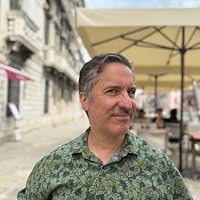
Carl Phillips is the highly acclaimed author of 10 collections of poetry.
He was born in 1959 to an Air Force family, who moved regularly throughout his childhood, until finally settling in his high-school years at Cape Cod, Massachusetts. He holds degrees from Harvard University, the University of Massachusetts-Amherst, and Boston University and taught high-school Latin for eight years.
His first book, In the Blood, won the 1992 Samuel French Morse Poetry Prize and was heralded as the work of an outstanding newcomer in the field of contemporary poetry. His other books are Cortège (1995), a finalist for both the National Book Critics Circle Award and the Lambda Literary Award in Poetry; From the Devotions (1998), a finalist for the National Book Award in poetry; Pastoral (2000), winner of the Lambda Literary Award; The Tether, (2001), winner of the prestigious Kingsley Tufts Poetry Award; Rock Harbor (2002); The Rest of Love: Poems, a 2004 National Book Award finalist, for which Phillips also won the Theodore Roethke Memorial Foundation Poetry Prize and the Thom Gunn Award for Gay Male Poetry; Riding Westward (2006); Quiver of Arrows: Selected Poems, 1986-2006 (2007); and Speak Low (2009), a 2009 National Book Award finalist. Two additional titles were published in the 2003-04 academic year: a translation of Sophocles' Philoctetes came out in September 2003, and a book of essays, Coin of the Realm: Essays on the Life and Art of Poetry, was published in May 2004. Phillips is the recipient of, among others, a literature award from the American Academy of Arts and Letters, a Guggenheim Fellowship, the Witter Bynner Foundation Fellowship from the Library of Congress, the Academy of American Poets Fellowship, two Pushcart Prizes, and the Academy of American Poets Prize. His poems, essays, and translations have appeared in such publications as The New Yorker, The Paris Review, and The Yale Review, as well as in anthologies, including eight times in the Best American Poetry series, The Best of the Best American Poetry 1988-1997, and The New Bread Loaf Anthology of Contemporary American Poets. He was inducted into the American Academy of Arts and Sciences in 2004 and elected a chancellor of the Academy of American Poets in 2006. He is a Professor of English and of African and Afro-American Studies at Washington University in St. Louis, where he also teaches in the Creative Writing Program.
Thank you NetGalley and FSG for the Advanced Reader's Copy!
Available May 2026.
Carl Phillips's In the Blood is like watching a maestro at work. Each line is restrained to its core element and the result is sparse, tense poems that highlight queer love and loss and self-discovery. It was especially illuminating to hear Phillips' ruminate on the origins of his first collection of poetry, the circumstances that inspired him to write, and his thoughts on the journey the book has taken.
I was immediately interested to read this new edition of In the Blood by Carl Phillips featuring a new afterword by the author because he won the 2023 Pulitzer Prize for Poetry. I enjoyed these poems! This was his debut collection originally published in 1992 and they offer his inner self. Arranged in five parts these poems explore his sexuality, the body and spirit. My fave poem is Birdland which is mentioned in the afterword as one of the earliest-written poems in the book. Actually my fave part of this book is the afterword as the author looks back after 30 years and offers significant insights to these poems and their meanings. I loved that added context. I loved how he explains why he still writes in 2025. I am very curious to read his other poetry now!
Thank you to FSG Books via NetGalley for the free review copy!
From the afterword: “The poems arose from a mix of fear and desire, and a mostly subconscious impulse to live rather than succumb to a competing impulse to destroy what seemed monstrous in me, by destroying myself. I’ve written from necessity, rather than occasion, ever since. Each poem is a fumbling forward, toward a glimpse of clarity through a thicket of quandary, before everything blurs again back to the everyday business of living a life that mostly doesn’t include a lot of self-reflection; we might see more than we should, or wanted to.”
His first collection, and my first time reading earlier work of his. A bit more emphasis on story but still very clearly his voice. Also more explicitly sexual, it seems. The "I" of these poems somewhat less attractive as a figure, somehow, more selfish. (Because younger?) Interesting, and I will return to them.
Thank you NetGalley and Farrar, Straus and Giroux for the review copy of "In the Blood" by Carl Phillips.
I am not familiar with Carl Phillips' work, which is an embarrassing admission to have to make as he is a Pulitzer Prize winner and the recipient of several other literary awards. "In the Blood" was first released in 1992; this edition includes an afterword by Phillips himself, which I found to be equally as fascinating as the poems. This was his debut collection, and it clearly shows his gift for poetry even early in his career. He writes with raw honesty; there is an earnestness to his voice as he opens himself to his readers. He writes as though the page gives his voice the freedom to soar. This is what I wish my poetry to become.
poetry wise it is not for me, however there are a few banger poems in here (the first and the last, ofc), and I think it is also significant to discuss the impact that carl phillips has on the poetry community
What a remarkable book, an even more remarkable first book of poems. These poems were full of longing and haunting detail as well as restraint. There is such a tension between desire and how the speaker talks about it. I'm still thinking about the last poem.
I'm not the least bit surprised Carl Phillips' debut collection is a stunner, an entrancing presentation of desire as a drug that leaves you unexpectedly edgy. It's like one ache is followed by another of a different sort even as you're searching to repeat the first. A standout poem is "The man we're looking for" which may be Phillips at his most youthfully comic. Delicious!
Phillips fuses the erotic with the daily and the reverent in this collection which explores the nature of desire. He expresses the individual as mythic yet ordinary, and I enjoy the allusions to characters of Greek and sometimes Christian mythology brought to human scale, when God becomes the lover. His mood is generally on the melancholic side, perhaps because the nature of desire, as he depicts it, becomes a loss once realized. Where it occurs, humor gives his work another edge. I enjoy the aging Cupid as biker in "Eros." The metaphor of birding in "Birdland" makes this birdwatcher smile.
Two sections particularly stand out for me: the third one speaks to the theme of conversion as transformation. Anyone who has ever rowed a boat can relate to the sense of wings and more working in "Fra Lippo Lippi and the Vision of Henley." Ending this section, the poem, "Death of the Sibyl" offers an ironic hope to one for whom "the hours / drift and pick at the air." Perhaps the most compelling section is the fourth one, in which a soft sadness is made all the more poignant in poem by poem by either a dash of bitterness or something very cold in our nature. "In the Jury Box," we vividly confront this latter sense in "the distraction of flesh / rendered still and useless," but you have to read the whole poem to get the full impact.
A few of the poems in here went over my head -- he's very allusive -- but a few of the other ones were absolutely amazing, and the ones that are left err on the side of being good, so... well worth the investment!
(This is his first collection -- I went on amazon and bought up the next six, since they had only one copy of a few of them left!)
** SECOND READING REVIEW **
Basically the same thing here! Some of the poems are downright beautiful; others are downright disturbing (I'm looking at you, "In the Jury Box.") Most of the poems are about love, about sexuality -- as such, they're right up my alley. The poems are written in such a way that they feel very autobiographical -- it's hard to talk about a speaker rather than just Carl Phillips. As I said before, well worth the investment!