

What do you think?
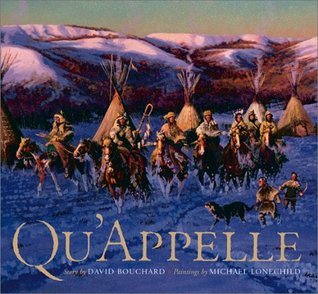
Qu'Appelle
For generations, the Native people of the Northern Plains have told the legend of Qu'Appelle. In this famous love story, a young brave must leave his betrothed to lead a war party against the Blackfoot. Heartbroken by his absence, she falls sick, calls out for her love, and dies. Cree elders say that if you go out onto the prairies and listen, you can still hear the brave searching for his lost love, calling out "Qu'Appelle" -- who is calling?
32 pages, Hardcover
First published June 24, 2002
About the author
David Bouchard
78 books39 followersCanadian Métis author and literacy advocate David Bouchard has produced more than fifty books for readers of all ages, including two guides on reading for parents and educators.
An erstwhile teacher and school principal, he is particularly concerned with Aboriginal-related issues and is a sought-after speaker for conference keynotes and school presentations and on topics of reading, literacy and aboriginal well-being.
David Bouchard's books have won numerous awards, including a Special Mention for Non-Fiction in the 2010 Bologna Ragazzi Awards for The Drum Calls Softly, a Gold Medal in the 2008 Moonbeam Award for I am Raven, the 2004 Governor General's Award for The Song Within My Heart, the 1999 Red Cedar Award for The Great Race and the 1997 Lee Bennett Hopkins Poetry Award for Voices from the Wild. An Aboriginal Carol was included in the 2008 White Ravens Catalogue.
In April 2009, Bouchard was named as a Member of the Order of Canada "for his contributions as an author of children’s books and an advocate who has championed the cause of reading and writing, and who has shared his pride as a member of the Métis community through his stories."
David lives in Victoria, British Columbia, with his wife Vicki and their daughter Victoria.
-taken from the author's website
An erstwhile teacher and school principal, he is particularly concerned with Aboriginal-related issues and is a sought-after speaker for conference keynotes and school presentations and on topics of reading, literacy and aboriginal well-being.
David Bouchard's books have won numerous awards, including a Special Mention for Non-Fiction in the 2010 Bologna Ragazzi Awards for The Drum Calls Softly, a Gold Medal in the 2008 Moonbeam Award for I am Raven, the 2004 Governor General's Award for The Song Within My Heart, the 1999 Red Cedar Award for The Great Race and the 1997 Lee Bennett Hopkins Poetry Award for Voices from the Wild. An Aboriginal Carol was included in the 2008 White Ravens Catalogue.
In April 2009, Bouchard was named as a Member of the Order of Canada "for his contributions as an author of children’s books and an advocate who has championed the cause of reading and writing, and who has shared his pride as a member of the Métis community through his stories."
David lives in Victoria, British Columbia, with his wife Vicki and their daughter Victoria.
-taken from the author's website
Ratings & Reviews
Friends & Following
Create a free account to discover what your friends think of this book!
Community Reviews
Displaying 1 - 8 of 8 reviews

July 5, 2010
If I could give this superb picture book, if I could give David Bouchard's retelling of the Cree folktale of Qu'Appelle more than five stars, I would. A famous First Nations love story, a young warrior must leave his betrothed to go to war, and heartbroken by his absence, she dies, calling out his name. And according to Cree elders, if you go out on the Saskatchewan prairies, you can still hear the young warrior searching for his lost love, calling out "Qui appelle" (who is calling) in response having heard his name.
Alhough the text of Qu'Appelle is emotional and obviously of course sad, even rather tragic by mere thematic necessity, David Bouchard has created (actually, has retold) a truly tender and beautifully poetic story of love, loss and remembrance so melodic, so sweetly rhythmic that it also simply begs to be read aloud, or to be put into song. And yes indeed, while I have read other retellings of this particular legend before, none of them come even remotely close to the beauty, pathos and sheer loveliness of Bouchard's rendition. Furthermore, the evocative accompanying illustrations (actually, they are prints of paintings) by renowned Cree artist Michael Lonechild do in my humble opinion make Qu'Appelle an absolute treat (both narrationally and visually), and one to be shared not only with children, but really with anyone interested in First Nations/Native Canadian/Native American folklore. David Bouchard supposedly first heard this legend of the Qu'Appelle Valley (Saskatchewan) as a boy, and I am so very glad that he and Michael Lonechild have collaborated on this absolutely lovely, evocative project, that they have shared the legend. Most highly recommended in every way!
Alhough the text of Qu'Appelle is emotional and obviously of course sad, even rather tragic by mere thematic necessity, David Bouchard has created (actually, has retold) a truly tender and beautifully poetic story of love, loss and remembrance so melodic, so sweetly rhythmic that it also simply begs to be read aloud, or to be put into song. And yes indeed, while I have read other retellings of this particular legend before, none of them come even remotely close to the beauty, pathos and sheer loveliness of Bouchard's rendition. Furthermore, the evocative accompanying illustrations (actually, they are prints of paintings) by renowned Cree artist Michael Lonechild do in my humble opinion make Qu'Appelle an absolute treat (both narrationally and visually), and one to be shared not only with children, but really with anyone interested in First Nations/Native Canadian/Native American folklore. David Bouchard supposedly first heard this legend of the Qu'Appelle Valley (Saskatchewan) as a boy, and I am so very glad that he and Michael Lonechild have collaborated on this absolutely lovely, evocative project, that they have shared the legend. Most highly recommended in every way!

August 11, 2010
Thank you, Gundula for alerting me to this book!
I wasn’t in the mood for either a love story or a war story, and this is both, but I’d just returned from an evening at the opera so it seemed fitting to read this, and I’m trying to finish my at home library borrowed picture books before I pick up my copy of Mockingjay Tuesday morning. Another book with love & war elements, actually.
The illustrations are absolutely stunning. Many of the pictures would be welcomed as paintings on my walls. They’re by a Cree artist and this story comes from a Cree legend.
The story is quite sad. And it reminds me of how much I hate all but truly necessary wars. But I felt a connection with the story, and with the plains of Canada from where it comes.
This is one of those tales I think might be appreciated even more by adults than by children. I’m not sure whether I’d have become as engaged by the love story when I was a young child, though the friendship would have tugged at my heartstrings, and I do think children will be enchanted by the pictures and by the cadence and rhythm of the story, and might very well have their imaginations stirred when thinking about the call “Qui Appelle.”
There is a author’s note in the back I really appreciated: “The Valley, the People, and the Legend: a note from the poet…” It explains some of the history of the legend and informs that this variation of the story is not the only version.
I wasn’t in the mood for either a love story or a war story, and this is both, but I’d just returned from an evening at the opera so it seemed fitting to read this, and I’m trying to finish my at home library borrowed picture books before I pick up my copy of Mockingjay Tuesday morning. Another book with love & war elements, actually.
The illustrations are absolutely stunning. Many of the pictures would be welcomed as paintings on my walls. They’re by a Cree artist and this story comes from a Cree legend.
The story is quite sad. And it reminds me of how much I hate all but truly necessary wars. But I felt a connection with the story, and with the plains of Canada from where it comes.
This is one of those tales I think might be appreciated even more by adults than by children. I’m not sure whether I’d have become as engaged by the love story when I was a young child, though the friendship would have tugged at my heartstrings, and I do think children will be enchanted by the pictures and by the cadence and rhythm of the story, and might very well have their imaginations stirred when thinking about the call “Qui Appelle.”
There is a author’s note in the back I really appreciated: “The Valley, the People, and the Legend: a note from the poet…” It explains some of the history of the legend and informs that this variation of the story is not the only version.

April 26, 2019
Métis children's author David Bouchard, whose many picture-books with First Nations content include such outstanding titles as
The Secret of Your Name: Proud to Be Métis
, and
Long Powwow Nights
, here relates a Cree legend from Saskatchewan's Qu'Appelle Valley. Told in verse, it is the tragic love story of Ikciv and Witonia, friends from childhood and sweethearts from the time they first start to think romantically. When Ikciv is called away, with all of the other young men, to go to war, Witonia is inconsolable, eventually dying from her grief. Ikciv, in the meantime, fights like a demon, and returns home to find her dead. Refusing to accept this state of affairs, he sets out to find her, continually crying "Qui Appelle?" (meaning "Who Calls?") in response her still echoing cry for him, on her deathbed.
Although the folklorist in me is glad to learn of this Cree legend (thanks for bringing it to my attention, Gundula!), which has apparently rarely been written down, somehow the poetic narrative here didn't really impress me as much as I'd been expecting. I loved the illustrations by Cree artist Michael Lonechild, and am fascinated by the fact that there are still accounts, to this day, of people in Saskatchewan hearing an eerie cry, "Qui Appelle?" But the story itself left me wanting more... I couldn't quite understand the extremity of Witonia's grief, as Ikciv, although certainly in danger, might still have returned to her. I expect it reveals a decidedly unromantic sensibility on my part, but the idea that being deprived of a loved one's company for a week or two could be so traumatic that it resulted in illness and death, seems rather ridiculous to me. There has to be more to the story, right?
In any case, regardless of one's feelings about the romantic aspects of the tale, it is still an example of a fascinating local folk legend, and is recommended to young readers with an interest in folklore, or Cree culture.
Although the folklorist in me is glad to learn of this Cree legend (thanks for bringing it to my attention, Gundula!), which has apparently rarely been written down, somehow the poetic narrative here didn't really impress me as much as I'd been expecting. I loved the illustrations by Cree artist Michael Lonechild, and am fascinated by the fact that there are still accounts, to this day, of people in Saskatchewan hearing an eerie cry, "Qui Appelle?" But the story itself left me wanting more... I couldn't quite understand the extremity of Witonia's grief, as Ikciv, although certainly in danger, might still have returned to her. I expect it reveals a decidedly unromantic sensibility on my part, but the idea that being deprived of a loved one's company for a week or two could be so traumatic that it resulted in illness and death, seems rather ridiculous to me. There has to be more to the story, right?
In any case, regardless of one's feelings about the romantic aspects of the tale, it is still an example of a fascinating local folk legend, and is recommended to young readers with an interest in folklore, or Cree culture.

October 14, 2015
Childhood friends growing up in the same Cree home become so close that when they are young adults and Ikvic leaves for war against other Indians, Witonia is so lonely and desolated that she cannot bear their separation. She gives up and dies while her love is rushing to be at her side. Alas he arrives too late. But on his journey he hears her call his name and replies, "Qui appelle?" (Who is calling?). And travelers who walk through the Qu'Appelle Valley in Manitoba and Saskatchewan can sometimes hear the haunting call, "Qu'appelle?"
This Cree legend is beautifully told and stunningly illustrated by Michael Lonechild. The book doesn't give the media: my guess is watercolor and acrylic. I hope the book continues to find an audience, as it is too beautiful to miss. However the sad story might be off-putting to young children who are most often the consumers of picture books.
This Cree legend is beautifully told and stunningly illustrated by Michael Lonechild. The book doesn't give the media: my guess is watercolor and acrylic. I hope the book continues to find an audience, as it is too beautiful to miss. However the sad story might be off-putting to young children who are most often the consumers of picture books.

October 18, 2011
A young warrior must leave his wife for war. But she loves him so much that she cannot live without him. Upon returning home, the young warrior discovers his wife passed away while calling out his name.
This is a retelling of a Cree folktale. David Bouchard tells this beautifully sad tale with poetry and he does it quite well. It is a tale of love, loss and rememberance.
I recommend this book to those who like poetry, folktales and Native American/First Nations stories.
This is a retelling of a Cree folktale. David Bouchard tells this beautifully sad tale with poetry and he does it quite well. It is a tale of love, loss and rememberance.
I recommend this book to those who like poetry, folktales and Native American/First Nations stories.

January 11, 2023
Si vous marchez dans la prairie
Quand le soleil à l'ouest pãlit
Quand un vent léger vous caresse
Ne vous croyez pas tout seul
Si vous marchez dans la prairie
Quand le soleil à l'ouest pâlit
Si par hasard vous entendez une voix
Une voix qui semble appeler
Soyez calme et attentif
Arrêtez vous et sans répondre
Tendez l'oreille et vous entendrez
Une voix murmure: 'Qui appelle'
Quand le soleil à l'ouest pãlit
Quand un vent léger vous caresse
Ne vous croyez pas tout seul
Si vous marchez dans la prairie
Quand le soleil à l'ouest pâlit
Si par hasard vous entendez une voix
Une voix qui semble appeler
Soyez calme et attentif
Arrêtez vous et sans répondre
Tendez l'oreille et vous entendrez
Une voix murmure: 'Qui appelle'

July 6, 2011
Beautiful rendering of a Cree Indian legend. It is almost too sad for me, though.

October 22, 2018
Incredible paintings but until the controversy (Oct 2018) is cleared up over Bouchard’s Metis heritage, I consider this cultural appropriation and it breaks my heart to say so. Bouchard is so beloved but this could potentially be another Joseph Boyden situation. If it’s cleared up I will revise my review in fairness.
Displaying 1 - 8 of 8 reviews