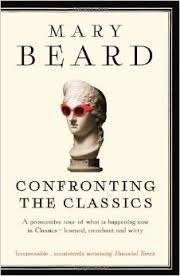
Mary Beard is one of the world's best-known classicists - a brilliant academic, with a rare gift for communicating with a wide audience both though her TV presenting and her books.
In a series of sparkling essays, she explores our rich classical heritage - from Greek drama to Roman jokes, introducing some larger-than-life characters of classical history, such as Alexander the Great, Nero and Boudicca. She invites you into the places where Greeks and Romans lived and died, from the palace at Knossos to Cleopatra's Alexandria - and reveals the often hidden world of slaves. She takes a fresh look at both scholarly controversies and popular interpretations of the ancient world, from The Golden Bough to Asterix.
The fruit of over thirty years in the world of classical scholarship, Confronting the Classics captures the world of antiquity and its modern significance with wit, verve and scholarly expertise.
Winifred Mary Beard (born 1 January 1955) is Professor of Classics at the University of Cambridge and is a fellow of Newnham College. She is the Classics editor of the Times Literary Supplement, and author of the blog "A Don's Life", which appears on The Times as a regular column. Her frequent media appearances and sometimes controversial public statements have led to her being described as "Britain's best-known classicist".
Mary Beard, an only child, was born on 1 January 1955 in Much Wenlock, Shropshire. Her father, Roy Whitbread Beard, worked as an architect in Shrewsbury. She recalled him as "a raffish public-schoolboy type and a complete wastrel, but very engaging". Her mother Joyce Emily Beard was a headmistress and an enthusiastic reader.
Mary Beard attended an all-female direct grant school. During the summer she participated in archaeological excavations; this was initially to earn money for recreational spending, but she began to find the study of antiquity unexpectedly interesting. But it was not all that interested the young Beard. She had friends in many age groups, and a number of trangressions: "Playing around with other people's husbands when you were 17 was bad news. Yes, I was a very naughty girl."
At the age of 18 she was interviewed for a place at Newnham College, Cambridge and sat the then compulsory entrance exam. She had thought of going to King's, but rejected it when she discovered the college did not offer scholarships to women. Although studying at a single-sex college, she found in her first year that some men in the University held dismissive attitudes towards women's academic potential, and this strengthened her determination to succeed. She also developed feminist views that remained "hugely important" in her later life, although she later described "modern orthodox feminism" as partly "cant". Beard received an MA at Newnham and remained in Cambridge for her PhD.
From 1979 to 1983 she lectured in Classics at King's College London. She returned to Cambridge in 1984 as a fellow of Newnham College and the only female lecturer in the Classics faculty. Rome in the Late Republic, which she co-wrote with the Cambridge ancient historian Michael Crawford, was published the same year. In 1985 Beard married Robin Sinclair Cormack. She had a daughter in 1985 and a son in 1987. Beard became Classics editor of the Times Literary Supplement in 1992.
Shortly after the 11 September 2001 attacks on the World Trade Center, Beard was one of several authors invited to contribute articles on the topic to the London Review of Books. She opined that many people, once "the shock had faded", thought "the United States had it coming", and that "[w]orld bullies, even if their heart is in the right place, will in the end pay the price".[4] In a November 2007 interview, she stated that the hostility these comments provoked had still not subsided, although she believed it had become a standard viewpoint that terrorism was associated with American foreign policy.[1]
In 2004, Beard became the Professor of Classics at Cambridge.[3] She is also the Visiting Sather Professor of Classical Literature for 2008–2009 at the University of California, Berkeley, where she has delivered a series of lectures on "Roman Laughter".[5]
This is the perfect Goodreads book - a collection of old book reviews. Taken from the Times literary Supplement, the London Review of Books and the New York Review of Books, slightly reworked,starting from the 1990s but mostly from this century.
They are lively and witty pieces, all of the books reviewed are from the field of Classics, Mary Beard being Mary Beard only three (if my count be true) of the books get an unambiguous thumbs up, this is possibly a spoiler, so if you don't want to know look away now - Asterix and the Actress, Bilingualism and the Latin Language, and another one which I have forgotten, as you can tell I wasn't taking notes.
The others are weighed in the balance, and if not exactly always found wanting, at least probed and questioned. Some of the books that she enjoys too, are far from perfect, she finds T.P. Wiseman's Remus: A roman Myth quite inspired even if she is plainly not entirely convinced by his belief that various Roman myths were created and fixed in the Roman imagination by a series of plays (none of which unfortunately have survived, and for none of which is there any evidence that they ever had existed in the first place) she chews up a few biographies of Emperors (Augustus and Hadrian) like a lion gnawing on an antelope so that I was eventually impressed by the boldness of writers in dumping four hundred pages plus of mostly speculation on the reading public that entirely avoids the substantive political issues of their reigns. The problem it emerges is not a shortage of source material, it is not even biographies themselves as a concept, the problem is the desire to write cradle to grave biographies of the sort you can buy about our contemporaries.
In one passage she is discusses the (baleful) influence of Robert Graves' I Claudius on academic assumptions about Augustus and his wife Livia, mentioning how low budget it was and how it was tarted up and made to look classier for USA audiences for example by cutting the scene in which Caligua tells Claudius that he has carried out a caesarian on his sister and eaten their baby (he was the father), and then digresses to Robert Graves attending an opening night party for the actors for an earlier stage version. At the party Graves insisted that Jesus lived until he was eighty and after the end of his public career devoted his time to inventing spaghetti (not the best use of his time as the fork was not in common use in the region for centuries to come), Graves gave a magic stone to the cast to ensure the success of the show - it was a flop.
This is a book that probably requires you to know a bit of ancient history, but I found her discussions of Thucydides (his Greek is so obscure that scholars are still in the process of working out what he might have been saying - none of which has stopped Donald Kagan from using him to advance his theories on how he believes the Cold war should have been fought), Cicero, the removal and restoration of plundered Art (which curiously enough never goes back to where it was taken from).
Anyway as it was one of those days when I had to go on a journey and in this case spend the best part of four hours on buses having a new topic to read about every eight or so pages was just about perfect, I didn't even notice going past the "Pig and Butcher" pub.
Ideal as well as a Goodreads book, she closes with a mini-manifesto for reviewing:reviews are a crucial part of the ongoing debate that makes a book worth writing and publishing; and they are a way of opening up the conversation that it provokes to a much wider audience (p.284).
I always feel like there's something wrong with me when I have an allergic reaction to a book that is so popular and successful, written by an author as universally loved and respected as Beard.
But this book gave me a rash, for two reasons:
1.) It's a collection of wonderful essays that are fascinating and illuminating explorations of a range of aspects of the classical world, including underserved areas like laughter, and the lives of freed slaves.
BUT
Every single chapter is 50% what I've just described, and 50% Beard attacking previous scholarship on the topic, often with a kind of condescending insouciance that I'm more used to with sealioning Twitter trolls. Confronting the Classics isn't a book of history, it's a book of Beard's reviews, and who the heck wants to read that? Not me.
The final chapters aren't even discussion of classics at all, but of the academics (like Beard) who interpret them for us. It's self-licking ice cream cone territory, an exercise in ego rather than scholarship.
2.) I really got off the bus when Beard nostalgically gives a pass to the groping of history students in her chapter on Eduard Fraenkel. She acknowledges that it's sexual harassment, but she also waxes eloquently on the link between pedagogy and eroticism, which, frankly, turned my stomach. If this is a thing to be nostalgic about, then clearly I'm missing the point. I'm surprised that Beard hasn't been more seriously taken to task for her casual treatment of what I regard as a very serious crime.
"I do not want to belong to any club that would have me as a member," said Groucho Marx in his most frequently quoted line - one that I thought of several times while reading Confronting the Classics. Good grief, Mary Beard is doing just what I've done! She's taken a bunch of reviews, tidied them up a bit, stuck on some linking text, and called it a book! I mean, come on. I've tried her formula, and I know all the drawbacks. No doubt the individual reviews are quite good, but the construction is choppy and fragmented. It has no coherence. And she's never really addressing the reader. A lot of the time, it's painfully obvious that she's invited me into her text and then, in an elementary faux pas that no society hostess would dream of committing, she's blatantly ignoring me while she talks to the author instead. What kind of behavior is that?
Embarrassingly, though, Professor Beard is able to muster one point in her defense: her method appears to work. Despite doing three years of Latin at school, I have never felt very interested in classical studies. I passed my Latin O-level with difficulty and have never learned any Greek. I am extremely vague on classical history. But having read a few dozen of her reviews, I discover that I am rather better informed about the subject than I was before. Book reviewing, as everyone on this site knows, is an enjoyable spectator sport. I found myself paying close attention as she rapped one author over the knuckles for analyzing Latin dramas that possibly never existed, or spent half a page discussing why another didn't bother to mention in his biography of a certain famous classicist that the gentleman in question had a habit of sexually harassing his female students. She made the subject exciting. It becomes apparent than many of the so-called experts in this field are perilously close to the boundary which separates speculative research from out-and-out fraud. The facts are hard to obtain, and the temptation to extrapolate and add more or less fictitious details is enormous. She can spot them cheating when I'd gullibly swallow their stories, and it's fun to watch. And while you do that, in a manner that's familiar to anyone who hangs out on this site, you find yourself learning. After all, if you don't familiarize yourself with the background you can't follow the match.
Well... I don't know. It's hard to argue with results; maybe this isn't such a bad format after all. In fact, I almost wonder if I shouldn't try it again myself...
Mary Beard’s Confronting the Classics is an uneven jumble of essays and book reviews previously published in the Times Literary Supplement, the New York Review of Books and the London Review of Books. It has generated many favorable reviews in various media and been roundly praised by dozens of GR members. It struck me as lackluster and uninteresting. The back flap mentions a New York Times description of Beard as “the closest thing, if it exists, to a celebrity classics professor.” That, in fact, may be the problem. It barely passed my threshold into Three Star territory.
If I had a central criticism of Confronting the Classics, it would be that I've written "Historiography" already about as many times as it appears in the book. So what is Beard is deliberately and unambiguously writing about?
Historiography.
History is a set of stories told to us. Historiography is a study of how those stories came about.
Enjoying that tidbit of Thucydidean thought in some sonorously written contemporary political opinion? Well, interjects historiography, did that author unscramble Thucydides' notoriously impenetrable Greek, or did they rely on a translator with their own slant/wonderfully fertile imagination? It is a lot easier for the ancient writers to be universally applicable when you keep changing what they said.
What a revealing collection of stories about Emperor Hadrian this biographer found, you muse to yourself. They really gives insight into his greatness. Historiography leans in and whispers in your ear: Just how contemporary are these stories? Is the source someone from a less prosperous age, slipping in boilerplate anecdotes to fit a narrative as to what makes someone great?
Wasn't it interesting how Cleopatra gave birth to Caesarion you (somewhat weirdly) ponder. Hold up, historiography butts in. Would you want your doctor to rely on a cobbled together set of unrelated medical texts hundreds of years apart? Because that's what you just read.
This book is exceptional at providing examples of how to critically read not just Classics, but History as a whole. It also draws our attention to (a) perceptions of events and things changed over time, even down to how to pose a statute and (b) that there is value in those perceptions themselves. Bernini might have invented the mattress for Sleeping Hermaphroditus, but it is still hell of a thing to look at. Historiography says it’s ok take a peek.
While convenient for Beard to just collate existing articles, I actually agree with this approach for this particular case. A book advancing a unified theory is probably impossible and would almost certainly be unreadable. Short, wide ranging, examples are prompters. What it teaches you is not to believe the last book you read, even if its views line up with you own.
However… …there are a couple of issues to note. One is she doesn’t tie the stories well enough to advance the thesis of historiography. Her linking passages tease at her point but end up being a bit… …flaccid. The other is that she occasionally advances a theory that is unsupported by the evidence available within the review. Her view that the characteristics of Alexander the Great are a Roman invention? Interesting, tell me more… …oh, now for a chapter on Greek laughter. The book is not set up for own theories, so when they slip in as asides, it ends up being frustrating.
One issue I don’t consider valid is tone. Because Confronting the Classics is a collection of reviews of history writing (pop historiography), Beard makes a lot of criticisms of that writing. Which is right, because that’s the point of historiography, even when I might disagree on particular reviews. The barbs are hardly pointed and rarely directed at the actual authors, except over serial groping habits. Beard’s almost wistful recollection on the latter has been criticised, rightfully so, but in comparison of decades of silence from male colleagues, we should perhaps view her statements in context (without excusing them), i.e. use some historiographical thinking.
The book is good, and it sneaks to four stars because we need more explanations of historiography. It would be even better if she shouted that a bit louder.
The thing about a good bookshop is that it encourages speculation. This was another book I picked up in Daunt Books on Marylebone High St. Mary Beard will be familiar in particular to the British, but I'm guessing to a lot of other English speakers, as a high profile academic, with a public presence I imagine is unusual for somebody in this discipline. She is the Classics editor of the TLS and it is a hodge podge collection of book reviews she has written over quite a long period of time, linked together by various themes, that form the basis for this book. The units are small, I found myself looking forward to a tale and a cuppa for a week or two.
I hadn't done any Classics since school and this was a bit of an eye-opener for me. I hadn't realised just how much surmising has come from so little evidence. How many careers, books - an entire academic industry, not to mention a popular one too - has been extracted in a manner that one could rather precisely say 'literally' brings to mind blood from a stone. The big theme of this book is explaining how our view of this ancient period is dictated by interpretation in a way that makes me, as a historian of more modern times, aghast. It's all made up! Almost. The characters, the stories, the very palaces we visit to pay homage to our ideas of how things were.
I exaggerate a little, of course: it isn't ALL made up.
I enjoyed Mary Beard’s book on Pompeii, and I think I’ve read a couple of others, or at least seen her work cited. She’s always struck me as pretty level headed, unlikely to get carried away with conjectures, so I wasn’t really surprised by the fairly sceptical tone of most of these reviews (though I did begin to wonder if anyone, anywhere, could produce work she’d give the green light). It’s a little odd reading a book of essays that are adapted (I’m not sure how much they’ve been changed) from reviews of particular books: some of them seemed very disconnected from the books they purportedly reviewed, which worked fine in this context, but seemed a bit odd when she did start discussing the books.
It’s not just criticism of other people’s theories, although there’s a lot of it there: there’s a general survey of the literature, some discussion of issues that the study of the classics faces in general, some windows into little bits of history.
Mostly, though… it is a book about other books; a rather disparate collection, however much I might want more. The essays are fine, and I did enjoy reading it, but I didn’t feel like I really learned anything new. Just what not to believe!
Never has a book dropped so quickly from a decent 3.5 star read to a 2 star nope. I enjoyed the first 28 chapters, and I didn’t really mind that it turned out to be a book of book reviews. I subscribe to the LRB, I think Mary is an engaging writer, and I enjoyed finding out a little about a wide range of topics. It was strange that it wasn’t made clear anywhere on the covers that this was a tour of Mary’s previous writing in literary magazines, but oh well.
The chapter on R. G. Collingwood, Oxford philosopher and receiver of a ‘Classic Greats’ education (which Mary clearly admires) was a little baffling, but the next chapter was where I stopped dead. Eduard Fraenkel, renown classical scholar, is casually described as ‘pawing’ his female students, although as this is described as ‘kisses and increasingly constant fumblings with... (my) underclothes’ we would certainly call this sexual assault. Mary seems to minimise this description, and admits nostalgia for these kinds of ‘exploits’ as at least she learnt a lot about classics while dodging various professors. Considering how little the chapters about various classicists add to the book, I’m left wondering why she decided to republish this particular review. Maybe I’m just too sensitive and Mary is tougher and ‘no nonsense’, but this attitude towards the casual, repetitive sexual assault and harassment of young women by men in positions of power feels extremely regressive.
Mary Beard(瑪莉‧畢爾德 or 比爾德)的作品在海峽兩岸也是如雨後春筍般不斷地引進,作為個人最喜歡的古典學作者,其作品只要不是偏離感興趣的主題太多,幾乎都是必買。可能是個人買了之後放置太久才開始閱讀,看完這本《古典學還有未來嗎》,才赫然發現,它其實是一本書評集。本書原名《Confronting the Classics》,內容只有一篇文章與中文書名直接聯繫,編輯則自陳畢爾德收錄的各個書評的中心思想是在討論古典學與歐美文明的相關性,是否如此,見仁見智了。
Mary Beard’s writing is accessible, but not condescending to the general reader. She keeps academic score settling to a minimum. You may be already well versed in the classics or a person trying to figure the people, customs and events both great and small from 20 centuries ago out for the first time or, more likely, between those poles. Maybe you have been to Italy, marveled at the Coliseum, the aqueducts and the Pantheon, made a trip to the foot of Mount Vesuvius and wondered about the people of Pompeii and Herculaneum going about their business one minute, being engulfed in boiling lava and ash the next. Or you studied Plato, Aristotle and the rest of the great minds of fifth century BCE and remained interested in them or saw the amphitheaters where “Antigone” and “Electra” were first performed. No matter, just about anyone not in grad school in Classics will learn something new or find a new way to look at familiar topics.
Beard discusses the boredom and gloom of Roman soldiers stationed in cold, rainy Britain, unlike the sun kissed plains of Umbria as can be. Regarding slavery in Rome, she makes the point that for many slavery was a temporary condition and not a life sentence and that many (perhaps even a majority) of the free population were ex-slaves or closely related to them must have made a difference in how former slaves were treated by the ordinary man or woman. Her vey cogent chapter on the Roman military makes the point that while Rome, both the Republic and then the Empire, was a militarized state constantly at war at the margins of its settled territory, armed soldiers weren’t allowed into the capital itself. There was an emphatic split between the demilitarized center and the zone of military activity, a split reflected by the standard Latin for “at home and abroad”, domi militiaeque.
Beard shows how we construct versions of the classical world to suit ourselves. Alexander the Great’s reputation is an obvious example. For many he has remained a positive example of a great general heroically leading his army to victory in battles increasingly distant from Greece. Dante had him in the seventh circle of hell, screaming in pain in a river of boiling blood, surrounded by such monsters as Attila the Hun and Dionysus the tyrant of Sicily. A contemporary historian summarized his career: “He spent much of his time killing and directing killing and, arguably killing is what he did best.”
In addition to Alexander, fifth century B.C. Athens is viewed through a contemporary and anachronistic lens. We have chosen to invest the fifth-century Athenians with the status of 'inventors of democracy'; and have projected our desire for an origin onto them. While our word 'democracy' derives from the Greek Beard says that “As far as we know, no ancient Greek ever said so and anyway democracy isn't something that is 'invented' like a piston engine. This is an excellent book for anyone interested in the classical world and those who study it.
This is not a book for the layman, nor does it pretend to be. Therefore the views of this layman - who acquired it partly by chance and partly from having enjoyed the lighter side of Professor Beard's writing -should be taken for what they are worth.
Confronting the Classics is a collection of book reviews contributed to various publications over a number of years, together with an Introduction and an Afterword. The Introduction is the equivalent of an angler tossing bait into the water to entice the quarry. Here are hints of many juicy bits to follow, and sure enough they do, surrounded by a great deal of erudite observation on the way of life and thought in ancient Greece and Rome.
Not all of this could be expected to wow the lay reader, but plenty does - for example, the suggestion that the Palace at Knossos (which this lay reader has visited) are a case of "rebuilding ruins"; or the details of daily life for a squaddie stationed at Hadrian's Wall; and much more. Made readable by an author who can invoke the Carry On Films and make them relevant, or who can offer a comprehensive guide to the Asterix books both in the original French and thier English translations.
The fact that these are reviews of books by other academics of course offers ample scope for points scoring in a notoriously competitive field. They are not resisted but are invariably fair and balanced. In any case, the clever professor makes that very point in her Afterword. Or that's how it seemed to this lay reader.
One would not expect a collection of book reviews by a Classics professor at a prominent university in Britain to make for a pleasurable read. Typically, book reviews—especially those written by classicists and published in heady academic journals—fail to capture a sense of wonder or excitement. Somehow, Mary Beard pulls this off with her brilliantly witty and subversive Confronting the Classics, a compendium of thirty-one reviews written by her for the London Review of Books, the New York Review of Books, and the Times Literary Supplement and adapted for the sake of this remarkable volume. Let the record show, Confronting the Classics is a collection of reviews, many of which are not necessarily related to each other than the fact that they all deal with some aspect of the classical world. Beard makes this very clear in her Preface, so that none should be surprised at the book’s content or composition. And, in any event, book reviews are fun to read, as they often do much more than merely summarize what an author has to say about her particular subject. As Beard notes early on, “reviews have long been one of the most important places where classical debates take place” (x). At the end of the book, Beard explains how reviews “have a vital job to do as a basic quality-control mechanism . . . If the Latin is all wrong, or the mythology and dates all mixed up, then someone has got to say so” (284). True to her word, Beard never shies away from dismantling a fellow classicist’s dubious claims, even if she knows the author herself. “I never put something in a review that I would not be prepared to say to the author’s face,” she says. One has to admire her critical eye and principled skepticism. Both make for an extraordinarily enjoyable read.
Beard’s reviews cover many different aspects of the ancient world, from the political theory found in Thucydides’ History of the Peloponnesian War, to the machinations of the imperial Roman court, to the daily lives of Roman freedmen. The final section, titled “Arts & Culture; Tourists & Scholars,” deals with the post-classical history of Classics itself, with a excellent chapter on what has made (and still makes) the adventures of Astérix and his Gallic compatriots so popular for millions of Europeans. Nearly all of Beard’s essays tackle important questions in Classics, save for a few less than stellar chapters that discuss the lives of British academics and antiquarians. Her best include “Which Thucydides Can You Trust?” (Pericles’ plan in the Peloponnesian War, “far from being a stroke of cautious genius, as Thucydides thought . . . was leading Athens to almost certain defeat”), “Alexander: How Great?” (Alexander is as much a product of Roman invention as of accounts of “what really happened” between 334 and 323 BCE), “Roman Art Thieves” (“Repatriation never restores the status quo ante: it is always another stage in the moving history of the art object”), “Bit-part Emperors” (“Expecting a student with two or three years’ Latin to take on the Annals is in some ways like offering Finnegans Wake to a non-Anglophone equipped only with a Basic Proficiency Certificate in English”), and “Fortune-telling, Bad Breath and Stress” (“It is almost impossible to identify clearly divergent strands of elite and popular taste,” as “cultural and aesthetic choices at Rome were broadly the same right across the spectrum of wealth and privilege”).
Throughout the book, Beard also makes her disdain for modern biographies of prominent ancient characters known and consequently takes aim at classical historiography itself. “Historians start their books with a ritual lament about ‘the sources’ and their inadequacy,” she explains. “But that is part of the ancient historical game: first pick your question, then demonstrate the appalling difficulty of finding an answer given the paucity of the evidence, finally triumph over that difficulty by scholarly ‘skill.’ Prestige in this business goes to those who outwit their sources . . . and who play the clever detective against an apparent conspiracy of ancient silence” (173). What are we to take from all this? As a reader, tread with caution. When an author starts to talk about what an ancient character “would have” seen or experienced, note that this is probably the stuff of sheer fantasy.
While Confronting the Classics is not aimed at specialists, it nevertheless upends many conclusions drawn by some of the most prominent experts in Classics. I therefore suspect that even the most committed students of antiquity will find pleasure in this book. Perhaps most importantly, Beard’s reviews call attention to a number of hotly debated issues in the field today, many of which remain unsolved. Most of the books she critiques are well worth any classicist’s time, especially if one wants to decide whether Beard is correct in her appraisals. In fact, I plan to pick up a copy of T. P. Wiseman’s Remus: A Roman Myth—discussed in Beard’s chapter titled “Who Wanted Remus Dead?”—to see for myself if his conclusions are as conjectural as Beard claims. In the end, Confronting the Classics was one of the most fun books I have ever read about the ancient Mediterranean world. That Classics can boast a celebrity professor of Beard’s acumen should be a source of pride for those in the field. It certainly is for me.
The fastest way to learn about Classics is to read reviews of their own literature about Classics. Piecemeal and random the selection necessarily will be, Mary Beard nonetheless accelerates her readers into understanding the latest theories not just among classicists but also historians, literary criticism and philosophy in the West at least. Armed with her partial perspective, the field of classical studies suddenly appears much more worthwhile and exciting. For that feat, four stars.
I have to admit that I disliked classics as a field coming into this book, since to me it seems like a problematically named field (why do Greece and Rome get to be “classical” while Chinese, Indian, and Persian civilizations do not?) while also promoting a thoroughly debunked Eurocentric narrative that Anglo-American culture can be traced back straight from Greece to Rome to Renaissance Europe. I hoped this book would change my mind and was sorely disappointed. The main problem is this book’s wild inconsistency, mostly from the format. Beard’s book is not a book, but rather a collection of various reviews of other works of scholarship. It is not the “guided tour of antiquity” we are promised, but rather brief blurbs about different parts of the ancient Mediterranean world that as soon as they show promise, transition to Beard mercilessly punching down at other books. There are some interesting points to be made about historiography, but it is far from what one is led to expect, and without a unifying throughline I was left hard-pressed to find why I should care. Again, because of the format, there is inconsistency, and while some of the later chapters on Rome (Beard’s area of expertise) show promise, she destroys it when she describes being “nostalgic” for a time when male academics could freely grope their students.
I loved this book because it made me think. Mary Beard did a fantastic BBC television series called 'Meet the Romans' where she brought alive everyday life in Rome. She was passionate about the subject matter and that really came across strongly. This book is a collection of reviews of other people's books which have already been published elsewhere but for me it does work as a book in its own right. The topics are very wide ranging and Mary Beard is particularly good at pointing out what the right questions to ask might be and how the topics have been treated in the past, and in other media such as drama or cartoons. For me the book made me think about the ways in which how things are understood change with time and place. The chapters are short, beautifully written and are a way of evoking the current situation of classics, particularly in Britain.
This is another one of those books where it is not at all what I thought it would be. I have enjoyed Mary Beard’s works in the past, and was looking forward to a humorous yet incisive popular overview of key classical authors and areas of interest in the field of classics. Well, the text is a nice easy read, marked by Beard’s characteristic witty style, but it’s really a series of her book reviews compiled into a book, and often doesn’t review the classics themselves (what I was hoping for), but the books written about the classics. So, in the end not what I wanted to read at all, but interesting enough that I don’t regret the read.
Since I'm reading so much about the Roman Empire right now, it's cool to have Mary Beard explain basically where we are in our understanding of the Ancient World. I really like her voice and her perspective, so it was a joy to read.
Confronting the Classics by Mary Beard is a good secondary book for those interested in ancient history. It is a collection of book reviews on subjects related to studying the classics. It opens with an essay by Mary Beard where she argues that studying the classics means studying both the information gleaned from the ancients and the work of those studying that information, i.e., the classicists.
The book reviews are organized to trace out the various periods of classical history, Greece, Republican Rome, and Imperial Rome. The last section has to do with cultural aspects and is a little more hodge-podge (and to me less interesting, except for the chapter on Asterix!). The closing word comes from Mary Beard and wraps up the volume well.
I say this is a good secondary book because you have to be familiar to some extent with the history for this book to make much sense to you. For that, I would recommend Mary Beard's own S.P.Q.R., a history of Rome, as well as Will Durant's The Life of Greece and Caesar and Christ. Also, numerous books by Michael Grant. There are more of course, but books like these will give a sense of the period.
The strength of this book is in raising questions about the conclusions classicists make as they discuss the history. All of them are working (basically) from the same data, the remains of the Roman and Greek writers. Those ancient writers are limited because only portions of their writings survive. Consequently, classicists fill in the gaps with their surmises and projections based on thin references in these sources, or on archaeology, or some other such pieces of esoteric data.
I recommend this book as an aide to helping the study of the ancient era as a bit of a check on the exuberance of our conclusions as we read!
Insightful collection of reviews from a variety of books featuring Classics. Some were more interesting than others (I failed to see why the Golden Bough part was added (unless in an attempt to bulk out the Classical reception section), as it didn't seem particularly Classical related. However, remarkable that James Frazer was so popular, but now I he is not a well-known character at all.
This book gave bite-sized chunks of a variety of Classics with all forms of bases covered. Nothing particularly mind-blowing but nice to read and to have that jump around the Classics. Plus also insightful way in HOW to review.
Was a weird point about senior male lecturers abusing their power to grope female students: "If I'm honest, it is also hard to repress a bit of wistful nostalgia for that academic era... when the erotic dimension of pedagogy was firmly stamped out"... UM yes Mary it is frowned upon because it is a severe breach of power imbalance!!??! Very odd comment.
An interesting read about (recent) studies about the Classics. The chapters are in general a nice length and many of them are reviews of (recently) published books/articles about the classics (so be warned, if that's not for you, you might want to put this book down again!).
I thought it was quite ironic that Beard complains a few times about writers who don't publish pictures of things described in their book or accuses others of being difficult to understand if the reader wouldn't have a certain background, because Beard herself was sometimes guilty of this fault herself.
Anyway, I'd recommend this book to anyone who's interested in Classics/classical scholarship and wants to read a varied, not too difficult, book about it!
I’ve heard of Mary Beard for quite a few years, and have always intended to read her books, but as you know, my TBR list is long and I haven’t quite gotten around to all of them. But when I saw a copy of Confronting the Classics at an extremely reasonable price, I decided that I had procrastinated long enough and promptly got myself a copy of read.
And wow, have I been missing out.
Confronting the Classics is a fun and engaging read that takes the reader through various issues in the study of classics, from the humour of the Greeks to the appeal of Asterix. Each chapter is adapted from a book review that Beard has written, but you definitely do not have to have had read a library’s worth of books to appreciate this. Beard’s reviews put the book in context and introduce the relevant background information before discussing its merits and demerits, which means that you can read the review and come away learning something new (instead of needing to know, for instance, the basics of Greek humour in order to read the review). All the essays are accessible to the average reader and do a great job of showing that classic scholarship is an ongoing conversation.
The only thing I wish the book had was a slightly more globalised outlook. While I understand that the classic studies refers mostly to Greek and Latin studies, it seems like the book is written mostly for a Western audience. What benefit would someone in Singapore, China, Japan, Vietnam, etc have if they read up about the classics? There is a brief mention of how Asterix has performed across the world, but by and large the issue of whether classical studies has global worth (as opposed to being for an audience with a Western heritage) is not discussed. The most we get is about how Britain related to the classics and Greece as a country (other European thinkers, especially Eastern European ones, aren’t even mentioned that much, come to think of it).
Plus, I checked and the era of the Roman empire lasted till the fifth century, which means that it overlaps with the Qin and Han dynasties. If Wikipedia can have a page on Sino-Roman relations, surely there could have been a book about the issue which was reviewed?
Of course, this is me being picky. Confronting the Classics does a fantastic job of showing that the study of the classics is a worthwhile pursuit – me asking for the argument to be extended past the Western literary frontier may be pushing it; although another part of me wonders why, in our globalised world, can’t the study of classics adapt and take a slightly more globalised outlook. After all, this book shows that the study of the Classics is still ongoing and being debated about. Perhaps this is an issue that could be studied as well.
The last chapter of this book is about reviewing books and I found Beard’s discussion on book reviews to be fascinating. It’s not a personal reaction to the book (as most of my reviews are) but a way of performing basic quality control and “a crucial part of the ongoing debate that makes a book worth writing and publishing; and they are a way of opening up the conversation that it provokes to a much wider audience.” It does make me think if I should be relooking my reviews, particularly my nonfiction reviews.
Das Buch war leider ein Reinfall. Es besteht aus über Jahren gesammelten, aufgefrischten Rezensionen von Büchern anderer Altertumswissenschaftler. Also besteht sein Inhalt zu 40% aus Rezensionen dem Laien vollkommen unbekannter Bücher, zu 40% aus Diskussionen innerhalb der Altertumswissenschaften über alle möglichen Thesen und Behauptungen und vielleicht nur zu 20% aus informativen Teilen, die auch für den Laien interessant sein können. Am Schluss habe ich versucht nur diese Teile noch in den Texten zu finden. Literarisch wertvoll sind alle drei Teile nicht. Was auch stört ist die Anmaßung der Autorin, allen anderen Noten zu geben, weil sie selbst es besser weiß oder tiefer reflektiert. Schade, habe mir mehr davon versprochen. Es gibt einen Kapitel über Pompeji. Wenigstens dazu passt meine nächste Lektüre: Gabriel Zuchtriegel:vom Zauber des Untergangs - was Pompeji über uns erzählt
This was a brilliant book to read if you want to dip your toe into the wider classical world. Beard reviews many authors argumentd and theories on a variety of subjects but doesnt make her essays so long that you lose interest. Its a very well written book (not surprisingly!) and its given me a few topics of interest i want to read into further!!! Really recommend this one.
Good bullshit antidote. Beard has a gift for taking the cherry from everyone's pie. My favorite part went something like "if you are reading a biography of an ancient individual and it is more than a couple hundred pages, you can be guaranteed it is mostly fiction."
The fact that this writer tries to force a heteronormative narrative onto the lives of Alexander the Great and Hadrian makes me doubt everything this book has to say.
It's less a work in it's own right and more just a commentary on what other people have said already.