

What do you think?
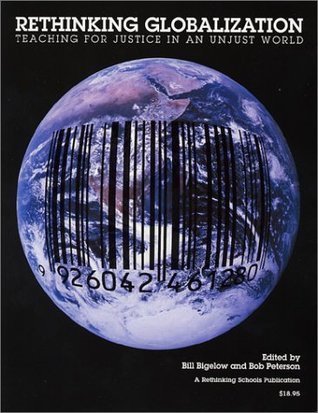
Rethinking Globalization: Teaching for Justice in an Unjust World
Rethinking Globalization is the best single-volume source for teaching strategies that will help students make sense of an increasingly complicated and scary world. The book alerts readers to the challenges we face--from child labor to sweatshops, from global warming to destruction of the rain forests--and also spotlights the enormous courage and creativity of people working to set things right. This essential resource includes role plays, interviews, poetry, stories, background readings, and hands-on teaching tools. A winner of the World Hunger Year Media Award.
402 pages, Paperback
First published March 1, 2002
Ratings & Reviews
Friends & Following
Create a free account to discover what your friends think of this book!
Community Reviews
Displaying 1 - 12 of 12 reviews
July 16, 2017
Teacher's Resources: Social Justice: Colonialism
September 29, 2008
This is a text book for teachers but I found it while an undergrad and picked it up although it was not assigned for any of my classes. It gave me the power to unravel the lies of the the public school. Yet, a few public schools are using it since the authors both teach at public schools! yeah.
The lies are in what is left out of our current education system and for the last say, 30 years! Of course there are exceptions but it is amazing to me what I learned in my third and fourth years of college and why these ideas are not presented in middle school.
Rethinking Schools magazine is great too. In addition to their website I would recommend Teaching Tolerance publications and their website.
The lies are in what is left out of our current education system and for the last say, 30 years! Of course there are exceptions but it is amazing to me what I learned in my third and fourth years of college and why these ideas are not presented in middle school.
Rethinking Schools magazine is great too. In addition to their website I would recommend Teaching Tolerance publications and their website.

January 17, 2009
If you are teaching Social Studies and have an interest in providing your students with innovative, away-from-the-textbook material, I would highly recommend this book (and furthermore, the entire "Rethinking Teaching"/"Rethinking Education" series). It is filled with interesting social justice articles and ideas for the classroom, including simulations and role plays. Very good, very relevant and I think the students will engage the material!

November 21, 2007
Excellent reference book/curricular materials for anyone teaching classes dealing with Global Issues. Focused by themes: Human Rights, Conflict, the Environment, etc. I used it in a senior elective class called "World Issues"- but it could easily be used 7-12.

July 22, 2009
Great resource for high school teaching.

September 2, 2011
A huge resource for passing along justice to the next generation.
February 5, 2012
Excellent resource for teaching social justice in the classroom.

July 24, 2008
This book provides resources and lessons plans for teaching about unjust global economy. It is arranged into several sections: Colonial Roots, The Global Economy, Global Sweatshops, Child Labor in the Global Economy, Just Food? and Culture, consumptions and the Environment. Each section contains activities, articles, cartoons, and poetry that a teacher could utilize.
THE BOY WITH ONE SHOE
A person overseas reported seeing a boy with one shoe. When asked how he lost his other shoe the boy responded: "I didn't. I found this one."
THE LOW ROAD by Marge Piercy
What can they do
to you? Whatever they want.
They can set you up, they can
bust you, they can break
your fingers, they can
burn your bring with electricity,
blur you with drugs till you
can't walk, can't remember, they can
take your child, wall up
your lover. They can do anything
you can't stop them
from doing. How can you stop
them? Alone, you can fight,
you can refuse, you can
take what revenge you can
but they roll over you.
But two people fighting
back to back can cut through
a mob, a snake-dancing file
can break a cordon, an army
can meet an army.
Two people can keep each other
sane, can give support, conviction,
love, massage, hope, sex.
Three people are a delegation,
a committee, a wedge. With four
you can play bridge and start
an organization. With six
you can rent a whole house,
eat pie for dinner with no
seconds, and hold a fundraising party.
A dozen make a demonstration.
A hundred fill a hall.
A thousand have solidarity and your
own newsletter;
ten thousand, power and your own
paper;
a hundred thousand, your own media;
ten million, your own country.
It goes on one at a time,
it starts when you care
to act, it starts when you do
it again after they said no,
it starts when you say We
and know who you mean, and each
day you mean one more.
THE BOY WITH ONE SHOE
A person overseas reported seeing a boy with one shoe. When asked how he lost his other shoe the boy responded: "I didn't. I found this one."
THE LOW ROAD by Marge Piercy
What can they do
to you? Whatever they want.
They can set you up, they can
bust you, they can break
your fingers, they can
burn your bring with electricity,
blur you with drugs till you
can't walk, can't remember, they can
take your child, wall up
your lover. They can do anything
you can't stop them
from doing. How can you stop
them? Alone, you can fight,
you can refuse, you can
take what revenge you can
but they roll over you.
But two people fighting
back to back can cut through
a mob, a snake-dancing file
can break a cordon, an army
can meet an army.
Two people can keep each other
sane, can give support, conviction,
love, massage, hope, sex.
Three people are a delegation,
a committee, a wedge. With four
you can play bridge and start
an organization. With six
you can rent a whole house,
eat pie for dinner with no
seconds, and hold a fundraising party.
A dozen make a demonstration.
A hundred fill a hall.
A thousand have solidarity and your
own newsletter;
ten thousand, power and your own
paper;
a hundred thousand, your own media;
ten million, your own country.
It goes on one at a time,
it starts when you care
to act, it starts when you do
it again after they said no,
it starts when you say We
and know who you mean, and each
day you mean one more.

December 29, 2008
This book is a bad joke. The authors use every dirty trick you would accuse ethnocentric-European historians of using (unfair caricatures, patronizing views of non-Europeans, douchebagary) in the name of eco-justice. The cause would be better served by honesty and treating readers like adults.

January 9, 2009
A great compendium of strategies to address the nebulous topic of globalization. A great resource for thinking about social justice in the classroom.

February 17, 2009
A book full of activities to illustrate the effects of globalism on the weakest members of society. The book is a little preachy, but has some great stuff.

August 8, 2011
Great book with tons of workshop/teaching ideas, handouts and resources. Covering issues of poverty, inequity of resources, Free Trade Agreements, migrant labor, sustainable development, etc.
Displaying 1 - 12 of 12 reviews