

What do you think?
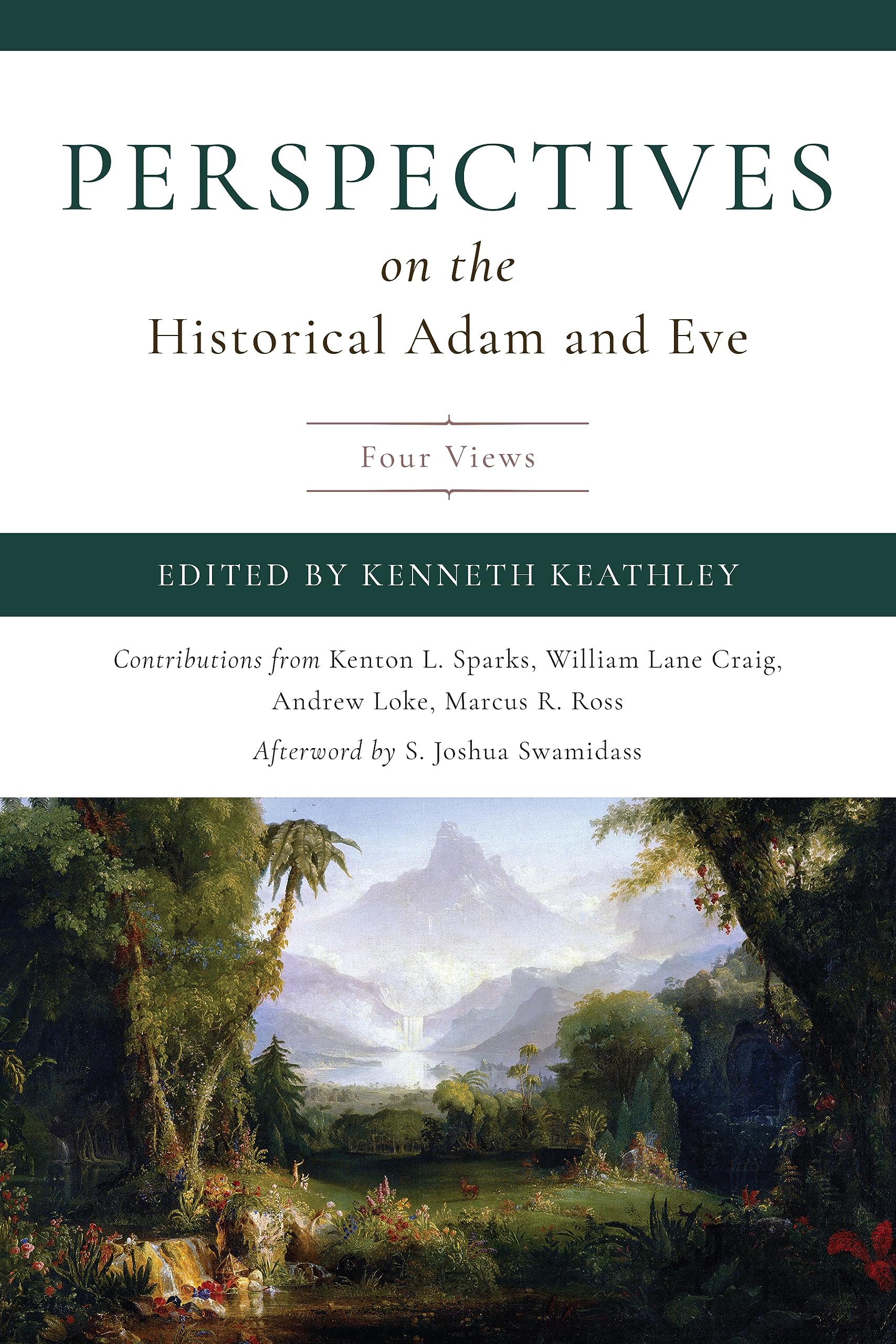
Perspectives on the Historical Adam and Eve: Four Views
The question of the historicity of the biblical Adam and Eve remains a crucial issue for contemporary Christians. The range of Christian beliefs regarding the origin of humanity impacts their understanding of human identity, human uniqueness, and the human condition. Theologically, the historicity of Adam and Eve speaks to original sin, redemption, and God’s plan and purpose for humanity.
Perspectives on the Historical Adam and Eve delves into the anthropological and theological dimensions that shape our understanding of humanity. In an essay-and-response model, four leading evangelical scholars examine the biblical teachings, scientific evidence, and theological and practical implications of each view.
As part of the Perspectives series, this volume presents four distinct positions in dialogue, moderated by volume editor Kenneth Keathley and with an afterword by S. Joshua The essays and responses engage with contemporary research into the genealogical Adam and Eve and well as the advancing biblical studies of the Genesis narratives of Adam and Eve as part of the primeval history of Genesis 1–11. Professors, students, pastors, and interested lay readers are invited to join an ongoing and important conversation that has the power to shape their beliefs about human identity, redemption, and God's divine plan.
The Perspectives series brings together scholars with multiple viewpoints on contested topics in biblical studies, theology, and ministry, allowing them to engage with each other’s ideas and arguments in a point-counterpoint discussion. From their different perspectives, the scholars address a myriad of questions surrounding complex issues, providing the reader with a broader and deeper understanding of the subject.
Perspectives on the Historical Adam and Eve delves into the anthropological and theological dimensions that shape our understanding of humanity. In an essay-and-response model, four leading evangelical scholars examine the biblical teachings, scientific evidence, and theological and practical implications of each view.
As part of the Perspectives series, this volume presents four distinct positions in dialogue, moderated by volume editor Kenneth Keathley and with an afterword by S. Joshua The essays and responses engage with contemporary research into the genealogical Adam and Eve and well as the advancing biblical studies of the Genesis narratives of Adam and Eve as part of the primeval history of Genesis 1–11. Professors, students, pastors, and interested lay readers are invited to join an ongoing and important conversation that has the power to shape their beliefs about human identity, redemption, and God's divine plan.
The Perspectives series brings together scholars with multiple viewpoints on contested topics in biblical studies, theology, and ministry, allowing them to engage with each other’s ideas and arguments in a point-counterpoint discussion. From their different perspectives, the scholars address a myriad of questions surrounding complex issues, providing the reader with a broader and deeper understanding of the subject.
240 pages, Paperback
Published August 15, 2024
Ratings & Reviews
Friends & Following
Create a free account to discover what your friends think of this book!
Community Reviews
Displaying 1 - 8 of 8 reviews

September 7, 2024
Absolutely fascinating overview of the topic, my copy of the book is full of annotations.
December 19, 2024
There is huge merit in books like this, and I hope the conversation on this topic is inspired and challenged by these 4 contributions. I think the choices for contributors were pretty good, though I wish the GAE view had been defended by someone more theologically and hermeneutically astute, like John Garvey. But I love the format of having an essay, followed by responses from the other 3 contributors, followed by a rejoinder. I hope future volumes on discussions like this follow a similar structure.
I disagree with some of what Swamidass says in the final chapter, but one thing I really like is his challenge to pick a "second best" option and discuss, defend, dig into that one. This is a very good idea for opening our minds and advancing the discussion.
I recommend this book to anyone who wants a decent (though incomplete) survey of the best current live options on this very important topic. And, with the plethora of references each author gives, it will surely be a springboard to discovering variants on these views in the papers and books of other important thinkers.
I disagree with some of what Swamidass says in the final chapter, but one thing I really like is his challenge to pick a "second best" option and discuss, defend, dig into that one. This is a very good idea for opening our minds and advancing the discussion.
I recommend this book to anyone who wants a decent (though incomplete) survey of the best current live options on this very important topic. And, with the plethora of references each author gives, it will surely be a springboard to discovering variants on these views in the papers and books of other important thinkers.

August 28, 2024
In this book, four different views are represented. You have a no-historical Adam approach, advocated by Kenton Sparks; a mytho-historical approach by William Lane Craig; a genealogical Adam and Eve view by Andrew Loke; and the Young Earth Creationist view by Marcus Ross. This format was different than the other four-view books. In this volume, they gave the essayist a chance to give a short reply to the critiques. I liked this format, it allowed the essayist to clear any misconceptions and strawmen that were in the critique.
The first view by Sparks lays out the fundamental difference between himself and the others, in that he is not an inerrantist. In fact, inerrancy, in his view, has led to many beliefs that are not supported by modern-day science. He agrees with Ross (the YEC) that the Biblical authors thought the earth was no older than 10,000 years but in light of all the evidence we know this not to be true. Thus, he opts for Genesis 1-11 being some kind of theological fiction.
The second view advocated by Bill Craig was the mytho-historical view. In this view, Genesis 1-11 shares many similarities with ANE myths of its day, but due to the genealogies and NT evidence it seems to be more than just a myth. In fact, Paul in Romans 5 seems to imply that Adam was historical as well as his fall. So these events and persons are real but coated within the genre of myth, hence mytho-history.
The third view advocated for a genealogical Adam and Eve, which was made popular by Swamidass' recent book. Loke's contention is that the Bible does not place its emphasis on genetics but rather on genealogy. With the hints that there were other people outside the garden, Adam and Eve's offspring would have cohabitated with them, thus we are all related to Adam and Eve genealogically.
The last view is advocated by Marcus Ross, who just holds to the YEC view. He argues for a type of wooden literalism, while not really arguing for this position until he gets to passages in the NT (2 Pet. 3). He asserts that the earth is only about 10,000 years old and that Adam and Eve were recent.
In conclusion, this book was a wonderful survey of differing views. I myself do not really hold to any of these views presented in this book but found this to be really helpful. Everyone communicated with Christian charity which was refreshing to see. If I had to rank who did the best, I would say William Lane Craig presented the best case, followed by Loke, then it's a toss-up between Sparks and Ross. My bias I suppose is that I am a theistic-evolutionist.
The first view by Sparks lays out the fundamental difference between himself and the others, in that he is not an inerrantist. In fact, inerrancy, in his view, has led to many beliefs that are not supported by modern-day science. He agrees with Ross (the YEC) that the Biblical authors thought the earth was no older than 10,000 years but in light of all the evidence we know this not to be true. Thus, he opts for Genesis 1-11 being some kind of theological fiction.
The second view advocated by Bill Craig was the mytho-historical view. In this view, Genesis 1-11 shares many similarities with ANE myths of its day, but due to the genealogies and NT evidence it seems to be more than just a myth. In fact, Paul in Romans 5 seems to imply that Adam was historical as well as his fall. So these events and persons are real but coated within the genre of myth, hence mytho-history.
The third view advocated for a genealogical Adam and Eve, which was made popular by Swamidass' recent book. Loke's contention is that the Bible does not place its emphasis on genetics but rather on genealogy. With the hints that there were other people outside the garden, Adam and Eve's offspring would have cohabitated with them, thus we are all related to Adam and Eve genealogically.
The last view is advocated by Marcus Ross, who just holds to the YEC view. He argues for a type of wooden literalism, while not really arguing for this position until he gets to passages in the NT (2 Pet. 3). He asserts that the earth is only about 10,000 years old and that Adam and Eve were recent.
In conclusion, this book was a wonderful survey of differing views. I myself do not really hold to any of these views presented in this book but found this to be really helpful. Everyone communicated with Christian charity which was refreshing to see. If I had to rank who did the best, I would say William Lane Craig presented the best case, followed by Loke, then it's a toss-up between Sparks and Ross. My bias I suppose is that I am a theistic-evolutionist.

January 10, 2025
I read my first 4 views (on the Millennium) back in the early 80s when this was a novel concept. These days there are a plethora of these books - and with series from different publishers even duplication. Given recent genetic and genealogical research, I though that this recent work looking at 4 views on the Historical Adam would be a worthwhile read.
Given different views and the topic, I should point out my bias. I was a devout Young Earth Creationist in my youth but have been far more attracted to old Earth models for several decades. I would say that I like the work that C. John Collins has done on Genesis. While I do have a Science degree and a Teaching degree, my areas of expertise are Mathematics and Computer Science - I have read heavily in Physics - and I did study Microbiology and Organic Chemistry at University. I am also a pastor ;-)
First let me say that all 4 views are well written and reasonably easy to read.
The Non-Historical Adam was the hardest for me to consider as the author and I have significantly different views on Scripture - and his view on Scripture is essential for his argument. I did agree with him on some of his critiques of the articles from the other authors.
The Mytho-Historical Adam was the only view written by an author I was familiar with - William Lane Craig. While I appreciated his consideration of genre, this came across more as a philosophical solution rather than one that cames to grips with the New Testament side of the hermeneutics involved.
The Genealogical Adam did a better job at presenting a more consistent hermeneutics - but needs more work justifying the ethical side of “non-image humans”. If I had to pick one of the 4 I would probably pick this one - though there is many concerns that it introduces.
The Recent Adam is a Young Earth Creationist approach. I was very pleasantly suprised at how much I enjoyed this author. I didn’t agree with him - but his graciousness and gentleness is to be applauded. My break with YEC was motivated by the lack of kindness in so many of the authors. (I have also struggled with this in those from other camps). He probably does the best theological argument of the 4.
It seems that when it comes to the Biological side of things, and especially those the revolve around Evolution - it is an all or nothing situation. Where I seem to be free to question various aspects of Quantum Mechanics - this does not seem to be “allowed” when it comes to Evolution. With these views I seem to be being forces into an all or nothing when it comes to genetic modelling - and I did find that a bit disappointing. Would’ve been nice in the Afterword (which was quite good) to perhaps note some of the strengths and weaknesses of the scientific area that is causing this debate ;-)
Given different views and the topic, I should point out my bias. I was a devout Young Earth Creationist in my youth but have been far more attracted to old Earth models for several decades. I would say that I like the work that C. John Collins has done on Genesis. While I do have a Science degree and a Teaching degree, my areas of expertise are Mathematics and Computer Science - I have read heavily in Physics - and I did study Microbiology and Organic Chemistry at University. I am also a pastor ;-)
First let me say that all 4 views are well written and reasonably easy to read.
The Non-Historical Adam was the hardest for me to consider as the author and I have significantly different views on Scripture - and his view on Scripture is essential for his argument. I did agree with him on some of his critiques of the articles from the other authors.
The Mytho-Historical Adam was the only view written by an author I was familiar with - William Lane Craig. While I appreciated his consideration of genre, this came across more as a philosophical solution rather than one that cames to grips with the New Testament side of the hermeneutics involved.
The Genealogical Adam did a better job at presenting a more consistent hermeneutics - but needs more work justifying the ethical side of “non-image humans”. If I had to pick one of the 4 I would probably pick this one - though there is many concerns that it introduces.
The Recent Adam is a Young Earth Creationist approach. I was very pleasantly suprised at how much I enjoyed this author. I didn’t agree with him - but his graciousness and gentleness is to be applauded. My break with YEC was motivated by the lack of kindness in so many of the authors. (I have also struggled with this in those from other camps). He probably does the best theological argument of the 4.
It seems that when it comes to the Biological side of things, and especially those the revolve around Evolution - it is an all or nothing situation. Where I seem to be free to question various aspects of Quantum Mechanics - this does not seem to be “allowed” when it comes to Evolution. With these views I seem to be being forces into an all or nothing when it comes to genetic modelling - and I did find that a bit disappointing. Would’ve been nice in the Afterword (which was quite good) to perhaps note some of the strengths and weaknesses of the scientific area that is causing this debate ;-)

April 4, 2025
This is the first four-views book I have read and it won’t be the last. The format is extremely valuable in understanding multiple points of view. It is a thrill to open your mind up to new ideas.
I think the YEC model requires too much science to be ad hoc; the non-historical view is self-defeating in a way as it seemingly argues that it's silly to make an argument, toeing the line between there is no truth and the truth can't be known; the GAE model makes more of a possibility argument vs a feasibility argument, the issue is too big to pin to a mere possibility without arguing for a strong likelihood, and the mytho-historical argument argues persuasively, but requires granting too many premises which can certainly be argued against.
While it is certainly critical for Christians to make sense of Genesis 1-11 in light of modern scientific theory, I fear that in toiling over evidence and historicity, we may actually overlook what the story is about. The creation account is replete with meaning and tells us many vital truths: how the world functions as multiplicity coming together into unity, what is good and evil, what humanity’s identity/purpose is within the world, etc. All of these truths and meanings can be revealed regardless of Adam’s literal historicity, the Earth’s age, the locality of the great flood, or a theological and scientific reconciliation with modern evolutionary biology. I fear that these four views argue to defend a belief system about Genesis 1-12 but fail to tell the story of Genesis 1-11 in a way that cherishes the rich meaning of the text. Why is the creation account ordered as it is? Why was Adam made of dust and breath and why was Eve made from his rib? Why a talking serpent or a magic apple? I believe that it is far more useful for most believers to answer these questions than it is for them to decide between a mytho-historical, GAE, or YEC view.
I think the YEC model requires too much science to be ad hoc; the non-historical view is self-defeating in a way as it seemingly argues that it's silly to make an argument, toeing the line between there is no truth and the truth can't be known; the GAE model makes more of a possibility argument vs a feasibility argument, the issue is too big to pin to a mere possibility without arguing for a strong likelihood, and the mytho-historical argument argues persuasively, but requires granting too many premises which can certainly be argued against.
While it is certainly critical for Christians to make sense of Genesis 1-11 in light of modern scientific theory, I fear that in toiling over evidence and historicity, we may actually overlook what the story is about. The creation account is replete with meaning and tells us many vital truths: how the world functions as multiplicity coming together into unity, what is good and evil, what humanity’s identity/purpose is within the world, etc. All of these truths and meanings can be revealed regardless of Adam’s literal historicity, the Earth’s age, the locality of the great flood, or a theological and scientific reconciliation with modern evolutionary biology. I fear that these four views argue to defend a belief system about Genesis 1-12 but fail to tell the story of Genesis 1-11 in a way that cherishes the rich meaning of the text. Why is the creation account ordered as it is? Why was Adam made of dust and breath and why was Eve made from his rib? Why a talking serpent or a magic apple? I believe that it is far more useful for most believers to answer these questions than it is for them to decide between a mytho-historical, GAE, or YEC view.
November 19, 2025
I loved this exchange of ideas and positions on the historical Adam. I thought the discussion was inclusive of all of the best views out there today and the participants were well chosen. I found Dr. Craig’s mytho-history position the most plausible and his case was the strongest, but all the contributors provide ample food for thought. Highly recommended.

September 16, 2024
Wise
Refreshing dialogue between people who are experts in their fields and care about intelligent discourse. This conversation is important, and this book does a good job of moving the conversation forward.
Refreshing dialogue between people who are experts in their fields and care about intelligent discourse. This conversation is important, and this book does a good job of moving the conversation forward.

January 14, 2025
It appeared to me that while reading this book that the author could have done a little better job with the editing or assisting the contributors in helping to assure uniformity in their parts. Keathley laid out the general design of the work, including questions which were posed to the contributors to answer. Whether he provided some fencing, besides some type of word count, around the opening essays remains unclear or that the authors didn't follow it. Some of the essays were more of a survey of the position (Ross), others argued for a possible position (Sparks), one was demonstrating compatibility (Loke), and the last as strong defense to warrant their position (Craig). Due to the variety of opening essays for each position the discussion didn't much go toe-to-toe with each other; and I see this as the responsibility of the editor.
HOWEVER, overall this was a very good survey of the various views concerning the historical Adam and Eve and it was enjoyable to see for the most part how each contributor defended or arrived at their position. What may be best is the amount of citations provided in this book often with each contributor providing references to their own work where one can dig into the topic and point further. It was obvious at times that the contributors had difficulty condensing much of their own written work into their essays.
I also very much appreciated the concluding contribution by Joshua Swamidass. He gave some valuable insight and recommendations for considering a work like this and I believe that he correctly lays out a path forward not just in the dialog surrounding this but in our own hearts about how we engage (with others) in viewpoints which we disagree with.
I definitely recommend this book to better understand the various viewpoints of Adam and Eve.
HOWEVER, overall this was a very good survey of the various views concerning the historical Adam and Eve and it was enjoyable to see for the most part how each contributor defended or arrived at their position. What may be best is the amount of citations provided in this book often with each contributor providing references to their own work where one can dig into the topic and point further. It was obvious at times that the contributors had difficulty condensing much of their own written work into their essays.
I also very much appreciated the concluding contribution by Joshua Swamidass. He gave some valuable insight and recommendations for considering a work like this and I believe that he correctly lays out a path forward not just in the dialog surrounding this but in our own hearts about how we engage (with others) in viewpoints which we disagree with.
I definitely recommend this book to better understand the various viewpoints of Adam and Eve.
Displaying 1 - 8 of 8 reviews