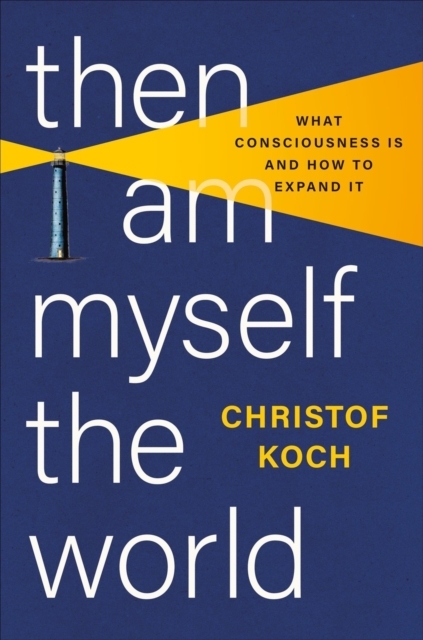
The world’s leading investigator of consciousness argues that by understanding what consciousness does—cause change in the world—we can understand its origins and its future
In Then I Am Myself the World , Christof Koch explores the only thing we directly consciousness. At the book’s heart is integrated-information theory, the idea that the essence of consciousness is the ability to exert causal power over itself, to be an agent of change. Koch investigates the physical origins of consciousness in the brain and how this knowledge can be used to measure consciousness in natural and artificial systems.
Enabled by such tools, Koch reveals when and where consciousness exists, and uses that knowledge to confront major social and scientific When does a fetus first become self-aware? Can psychedelic and mystical experiences transform lives? What happens to consciousness in near-death experiences? Why will generative AI ultimately be able to do the very thing we can do, yet never feel any of it? And do our experiences reveal a single, objective reality?
This is an essential book for anyone who seeks to understand ourselves and the future we are creating.
is an American neuroscientist best known for his work on the neural bases of consciousness. He is the President and Chief Scientific Officer of the Allen Institute for Brain Science in Seattle. From 1986 until 2013, he was a professor at the California Institute of Technology.
Koch is a fantastic thinker, and he jumps here from explaining consciousness, using Giulio Tononi’s excellent model, to proclaiming that conscious entities must have free will. That, to me, is a bridge too far. I also do not see how engineered objects such as computers differ fundamentally from evolved objects such as humans. The difference is one of degree, not of substance. Koch himself even implies this - even as he seems to deny it. I still find his/Tononi’s integrated information theory of consciousness to be most compelling. I just don’t see how it necessarily contradicts the possibility of engineered, conscious, determined entities. I would love to see him discuss this with Sam Harris. Perhaps he already has?
Koch is a leading neuropsychologist who was based for much of his career at the California Institute of Technology and has pioneered the uses of neurobiology to investigate consciousness. I have read several of his books and was keen to see how his work and strong adherence to Integrated Information Theory have held up to recent developments in neural imaging. So I was disconcerted, to say the least, when Then I Am Myself The World starts with a "note"in which Kock tells us we are about to read about transforming experiences, followed by what is clearly several paragraphs written by his lawyers telling us he is definitely, absolutely, not advocating we take hallocinogenics in this book. My suspicions were rapidly confirmed: Turns out, Koch spent his pandemic tripping. And now he really, really wants to talk about it. How people feel about this book is going to be largely still determined by how they view IIT, which studies consciousness as an emergent phenomenon from systems that integrate information in specific ways. There is much about IIT that makes sense to me. IIT has elements of panpsychism but is assertively grounded in a materialist view of brain function - and the view that consciousness can studied by understanding brain function as a tractable problem. It proposes ways to resolve the combination issue around how we can feel something singular from a multiplicity of processes, and centers the experience/qualia as the uniquely concious marker, the thing that these processes produce which is irreducible. I do not find the vehemence of IIT's adherents - or their enthusiasm for how perfect their theory is - appealing at all. And unfortunately, there is a lot of this here, and there didn't feel to me to be a great deal here which was new enough to justify a full book. The first half recaps IIT, which is better done in either Koch's other books or by Guilio Tononi's Phi. The second half looks more at hallucinogens, and it would be fair to say that Koch is a fan (although clearly his lawyers would very much like him not to). He briefly recaps the growing popularity of these drugs in medical circles, the potential they show to treat addiction and how they are differentiated from opiods and amphetamines in not having the same dependency issues. The book is mercifully light on actual accounts of trips, although there is some non-specific enthusing in many spots which is frustrating. Koch is a big fan of Michael Pollen's books, and, in the section of the book that did make me glad I read it, he does in fact do what Pollen did not (I savaged that book in my review, it does from distance a little unfairly) which is to cover, and reference, what we understand of how LSD and psilocybin work. Which crudely, is a) we don't know much b) some of the effect is increased neuroplasticity which may well be about molecular releases caused by the chemicals and c) when the brain gets quieter, we have a less present sense of self (this bit comes from neuroimaging of master meditators, actually). Koch clearly, however, wants to believe - wants us to believe - that the experience of tripping is part of the therapeutic benefit. You can see he can see the current research leading to sythesised drugs which increase plasticity without the experience and how little he thinks that will be the best way forward. It was also interesting that many of the references - most to studies on rodents - are from 2022 and 2023 - clearly there is significant work rolling out here now. Lastly, he covers speculation on AI. While a decade ago, Koch and Tononi speculated that the internet could develop conciousness, in the right conditions, if the complexity and integration thresholds were met, Koch's views now on AI are quite different. Partly, he correctly identifies what is being viewed as AI as the capacity to predict and enact patterns, which is a different kind of thing entirely. But interestingly, he also implies here that experiences - interactions of the senses - are needed to provide the kind of complexity of inputs that can lead to something. IIT is often accused/described as being panpsychism, but it is clear that Koch is focused here on suggesting brains, certainly more than human brains, but still, brains are the only way we know that consciousness emerges. Overall, the book is a bit chaotic, scarce, and often has big ideas that are not detailed enough to really understand what Koch is getting at. Most worryingly, he also refers twice to his new employer, the (unrelated) Elizabeth Koch, in jarringly glowing terms (the 'visionary'). E Koch is a polarising figure who has been accused of trying to clean her image, and the weird references to her and her institute don't dispel that at all. With all that, IIT remains an interesting idea, and I remain interested in the quest to investigate consciousness with something more practical than philosophy. The information on hallucinogenic processes was great—and very hard to find elsewhere. I just wish it was all a little more, well, robust.
This book is a patchwork: a lovely, if uneven, attempt to convey a deeply personal experience wrapped in a factual package.
It opens with several highly accessible chapters that introduce the mysteries of consciousness in a swift and basic (perhaps sometimes a little too basic) manner. Then it all spirals into a few—for me, quite unintelligible—chapters on the Integrated Information Theory, which would have really benefited from a slower, more structured explanation. Koch also utters some bold statements (such as that the idea of not having free will is incompatible with human experience?) which he drops like a firecracker and then moonwalks away.
That being said, I thought that the chapter on the birth of consciousness in human babies was spectacular. I also enjoyed his discussion of how different people experience the world in surprisingly different ways: for example, how some women have tetrachromatic vision and perceive unique shades of red and green (which cannot be tested using regular trichromatic computer screens), or how the ability to recognise human faces exists on a broad spectrum which made me aware that I probably fall near the bottom of that spectrum because I absolutely suck at remembering faces (which also made me wonder if I have a brain tumour, but so far, so good).
Beyond that, I was generally touched by the book’s overarching message. It seems to me that the Western school of thought is going through a beautiful transformation in which it is beginning to recognise its hypertrophied sense of self-importance and is slowly deconstructing the rigid anthropocentrism that has existed for centuries. And this book is a lovely contribution to that shift. Because there are so many perfect ways to experience the world: whether that is through the touch of a soft, leathery palm, or by feeling the flow of water over one’s scales.
For it is only in compassion with all life that we can redeem ourselves.
First of all I want to say that this is just a great book. Through a clear and pleasant writing, it covers so many subjects with a general unbiased approach (alternative views are always reported, and the opinion of the author clearly stated). The concept of integrated information theory and causal power is fascinating and getting to new unexplored frontiers, even its axioms and postulates feels a lot like a self sustaining thought. More work to be done! This is the first book I read from Prof. Koch, but certainly not the last!
The author makes a lot of bold claims about consciousness. According to him, it seems like we have a theory of what consciousness is in principle and how to define it. The theory is called integrated information theory. This theory can apparently make some meaningful predictions. For example, according to the author, as long as software is run on computers with the modern architecture, a computer program can never become conscious. He claims that for a computer program to be conscious it will have to be run on either a quantum computer or a neuromorphic computer (don’t know what that is). He also claims that humans have free will. This is interesting timing for a book to make that claim because earlier this year another book by a neuroscientist had come out that said free will obviously did not exist.
The thing that utterly disappointed me though was how the author did not provide any detail at all about this amazing theory or consciousness. He has one small chapter where he rushes through some technical details but that chapter is quite incomprehensible.
Christof Koch’s latest book gives a good overview of his work in neuroscience spanning several decades. Koch always likes a bet, and talks about settling his 25 year wager with David Chalmers: in June 2023 he handed over a case of fine Madeira wine for failing to have identified the neural correlates of consciousness in the preceding 25 years. He thinks he is closer in the elusive search for the seat of consciousness, with the hunt narrowing towards the back of the neocortex, and reckons the next 25 years or so should see it pinned down further. In terms of ‘how’ consciousness works, he is now a fervent advocate of the ambitious Integrated Information Theory (IIT) of Giuilio Tononi, a theory that more than 100 consciouness researchers have branded pseudoscience.
The chapter on IIT is, unsurprisingly, the most dense. The rest of the book is an engaging read. Christof Koch is an elegant writer, and this book starts with a very open description about one of his experiments with Psilocybin to engage the deeper parts of his conscious experiments. His later discussions on the use of this psychedelic substance provide a fascinating glance into how altered states of consciousness can offer insights into the brain’s mechanisms and the nature of subjective experience.
Koch sets out his lifelong journey of discovery. He is a materialist and reductionist, but as a supporter of IIT his views contrast with philosophers like Daniel Dennett, who were skeptical of many of the qualia of conscious experience and dismiss them as mere illusion.
Given his many decades of work in the field he is well placed to stand at the crossroads of where rigorous scientific inquiry meets deeply personal reflection. Koch navigates the complexities of how consciousness emerges from the brain, offering readers an accessible yet intellectually rich exploration.
In addition to his scientific rigor, Koch opens up on his personal journey—from Catholic altar boy, to agnostic materialist, to someone who accepts the world in all its glorious qualia. This infuses the narrative with a sense of intellectual humility and openness. Koch’s ability to weave complex theories with philosophical musings and personal insights makes Then I Am Myself the World a standout contribution. The book is not just a scientific treatise but also a meditation on the profound mysteries of existence.
I have read several of his books, and rate him highly as a scientist and thinker. He appears to have much more humility than many of his contemporaries in the field, and although I don’t agree with all his conclusions, he is certainly someone I would love to spend an evening drinking beer with. This book is highly recommended for anyone seeking a deeper understanding of consciousness.
I found 'Then I Am Myself the World' to be eloquent and comprehensive. I particularly enjoyed the latter sections, such as 'The End of Consciousness,' where Koch delves into the debated issues surrounding what defines death. The book also contains numerous references to other works, many of which I love!
A short, concise look at the integrated information theory of consciousness vis-a-vis the global workspace theory of consciousness. I guess you could also call it intrinsic causal power vs. computational functionalism. It is a compelling argument and Koch does a great job of starting at the beginning and building the argument throughout the book. It's an age old question: are humans special? Is there 'something' that makes us different than any other living creature, even ones that are very close to us in the evolutionary tree? We don't know what it's 'like' to be a rat, monkey, dog, or any other animal we have done experiments on and we generally can't perform the same experiments on humans due to ethical concerns so we don't know what it's 'like' to be someone else. We truly only know ourselves. And, even then, we can manipulate our own consciousness a variety of ways (psychedelics are fun!). In his opinion, global workspace theory cannot account for the subjective experience or free will mainly because it's just functional computation, but integrated information theory can because of causal powers. As such, that means AI will never be able to be conscious or sentient because it lacks the causal powers that are intrinsic in consciousness. Imitation is not consciousness. Koch uses an analogy using a computer simulator. If it simulates a black hole, the computer does not get sucked into it...because it's a simulation, just like AI. It can act like it has emotions and logic but it's just simulating it, there's no consciousness or sentience. That's a pretty solid analogy. I have one reservation that I would need to flush out but it seems like Koch is saying there has to be an action of some sort for there to be a causal power. What types of actions count? What happens when AI is integrated with a humanoid quadbot? It could then take lots of actions which potenially could have causal power. Would it be sentient then? Could it evolve and reach a tipping point where sentience arises? It still feels like we're talking about a ghost in the machine. As AI advances, it will be fascinating to see where the science of consciousness ends up landing. Meanwhile, back to the 'shrooms :)
I really enjoyed this book. This is one of the better books on consciousness in that it doesn’t get bogged down in the history of philosophy of mind, and the arguments over time, though he does provide some history and throws in quotes from various sources. So many books on consciousness spend way too much time over past arguments.
This book defines consciousness really well as awareness with content, and how it differs from intelligence. Integrated Information theory depends on a substrate, in this case a brain, and feedback loops that give us that feeling of “being” within a body. Even animals have a feeling of being a dog, cat, or bat, etc. This makes sense. Koch also describes what area of the brain is likely responsible for consciousness and the complex networks of synapses that reflect these feedback loops.
He also goes into how drugs and near death experiences interfere with the brain communicating with itself to create altered reality experiences. He experimented with drugs so could also speak to these firsthand rather than just through speaking with others.
The last chapters focused on AI and computers, and how these differ from consciousness. Intelligence is the accumulation of knowledge(data, bits) and how that information is presented, which AI is acquiring at an exponential rate. Consciousness, however, depends on the substrate. Perhaps quantum computers could one day get there, but even that may be unlikely.
Some reviewers felt Koch contradicts himself and that the theory suggests computers could be conscious, but I didn’t get that impression.
This book is well written, enjoyable to follow, and fascinating. It also falls in line with what I had believed to be true concerning consciousness and my own insights via meditation, etc, which of course made me biased to enjoy the book all the more:-) We love it when scientific theories fall in line with our own so I am aware of my natural leaning here.
This is a very good overview of the current trends/schools of thought about consciousness. It takes the reader from the philosophy of consciousness to neurobiology to mystical experiences to psychedelics to death to artificial intelligence -- all in a couple hundred pages. Koch has a definite point of view, but he gives competing views a fair airing.
Koch does a solid job of avoiding jargon and didn't lose me (an engaged layman) -- except for Chapter 5's explanation of Integrated Information Theory (IIT) where my eyes pretty much completely glazed over. Though, in fairness, Koch kinda apologizes for it, saying in the second-to-the-last sentence of the chapter "Congratulations on making it through the conceptually densest chapter in the book." I think his close involvement fleshing out IIT with its creator Giulio Tononi prevented him from gaining the distance he needed to write a less dense explanation.
The final chapters on the possibilities of digitally replicating our consciousness in a computer and of generative AI systems achieving AGI (artificial general intelligence) and therefore sentience or consciousness are in some ways the best. They are a good counter to some of the more hysterical AI doom merchants getting air time nowadays.
I quite enjoyed this discussion on consciousness and some of the implications from how we conceive of how consciousness relates to the mind, to the body, to the physical world. Koch emphasizes and expounds on Integrated Information Theory (with some helpful synoptical looks at competing theories) which is based on the correlate of "maximal integrated information" to conscious experience, implying that "only what has causal power exists". The "phi-structure" relates a particular state (experience) with associated probabilities to the amount of causal power wielded. The IIT accounts for conscious experience within 5 components: intrinsically, the experience exists for itself; information, it feels a particular way; integration, single holistic experience; exclusion, definite experience (albeit subjective); and composition, experience structured into components. Here, intelligence does not equate to consciousness.
Later Koch explores what consciousness means in the age of AI, AGI, and other dystopian technologies that are encroaching on our near present reality. I also liked the thoughts on psychedelic experiences / altered states of consciousness / near death experiences and how those relate to one another and the feeling of existing for oneself as a human being.
After stomaching a lame legal disclaimer about psychedelics, I thought this book was quite enjoyable for the first four chapters. Then I increasingly found myself skipping to the next section or chapter. Chapter five about integrated information theory and the neural correlates of consciousness is totally unintelligible to me. It feels like an excited friend trying to breathlessly summarize a movie for me, but he starts at act three and I'm totally lost.
True, I did not read every word of the book. I'm still not sure how it could deliver on the claim of the subtitle, "and how to expand [consciousness]." Basically the options are to have a mystical/spiritual experience, and the author admits only a fraction of us have those. The other is a near death experience. I've been in some close-enough calls, but no thanks to that. So up comes thoughtful use of psychedelics, which my government and the book's own disclaimer says not to do. I'm not feeling expanded.
I'm not sure this book will age well. The author makes some apt mentions about the Covid-19 pandemic, Ukraine, and the latest (as of late 2023) situation in AI. It goes down speculative routes about technology and computing that were not compelling or interesting to me.
Great discussions regarding theories of consciousness (such as IIT - integrated information theory and GNWT - global neuronal workspace theory) that lay bare inadequacies of both. The author is beyond competent, but leaves the conscientious reader unenlightened.
'Siddhartha' is NOT the story of Gautama Buddha as Christof Koch writes in this work. It IS a story set in the time of The Buddha. Rather jarring to come across such a reference.
"The Dress" (that is actually blue with dark stripes, but appears to be white with gold stripes due to explained and illustrated optical effects) isn't any indicator of how perception makes the reality experienced by any individual consciousness. That rather unsupportable contention by the author paints many of his thoughts as meant to impress rather than enlighten. Such explanations do not do him or his work credit.
Overall, an interesting read suitable for diligent researchers into 'consciousness.'
The book seems mainly an overview of the author’s thoughts on consciousness, something he has obviously spent a lot of time thinking about. With the exception of chapter 5, which the author admits is the most conceptually dense chapter in the book, the book is very readable and for the most part clearly written. The subtitle is “what consciousness is and how to expand it,” but the “how” isn’t something the author spends much time on, other than to catalog the three ways in which he believes consciousness is transformed: through spiritual means, via psychedelic drugs, and through near death experiences. The only “how” that most people can opt for is the second, which the author makes a compelling case for (despite the fact that mind altering drugs are still illegal in the US).
First of all, I would like to say that this is a good book, treating to explain something that, today, it can't be explained: consciousness. Then, I would say that this is a good shot, but mistaked. The author put a very big emfasi in the integrated information theory of consciousness, but under my opinion it fails, because it can't be proved. There is a gap between the immaterial reality of the consciousness and the materiality of our brain, and no theory, even quantum mechanics, can fill this gap. Nevertheless, it's worth to read the book. Thanks for your effort, Mr. Koch!
Our self-image often reflects the technology of the age we live in. In the age of Fulton we talk of letting off steam. In the age of Edison when a idea comes to us a light bulb goes on in our head. Now in the Information Age we see our minds as software running on the hardware of our brain and dream of living beyond brain death by transferring our software. Koch argues against this view of mind. Often fascinating and insightful, the book is also sometimes a difficult read and the readers can feel we are moving very fast over big topics.
Thought provoking book that combines consciousness, current AI developments, and psychedelics - do not threaten me with a good time. It can be quite dry at points but totally worth the read.
One of the parts that seated with me, is (paraphrasing) “the same way you cannot expect a black hole to form from your laptop when you are simulating gravity, you cannot expect consciousness from simulating the brain and its processes” to me this encapsulates, at least for now, the fundamental nature of consciousness.
Originally I thought this book might appeal to those who like the mystical; where big words that say nothing sounds exciting. But later on, he won me over. Although this seemed like two books in one. The first was a personal discourse on the benefits and effects of psychedelics. The other book was a primer on Integrated Information Theory (a theory of consciousness). I enjoyed learning about ITT and consciousness. Also his thoughts on whether AI can become conscious. Definitely worth the price of admission.
Did you know he worked with Francis Crick? Bogged down in the middle and I started skimming. I like the beginning and his points on why our definition of consciousness matters, especially in both beginning of life and end of life ethics. Spent a lot of time talking about psychedelics. In general, I like how he weaves in humor, current events and personal experience but he’s not a great writer like Junger - was nice to read these back to back.
nice general write up, found some interesting papers to read, esp at the psychedelics part! but the argument of “if believing in causal power —> consciousness” then AIs r not conscious because they lack the physical power is very weak; “consciousness” to me doesn’t need to be in the real physical world, and AIs CAN HAVE causal power in the simulated digital world… also completely disagree with the free will part
Engagingly written, and three stars for several book and further reading recommendations that look interesting. Ultimately, pretty unsatisfying.
The IIT overview was pretty helpful, and there is a whole book to go to on that for more detail, but otherwise it’s a lot of “hmmm… we don’t really know” superficially touching on various different consciousness-adjacent topics. Expected more, perhaps silly of me given the state of the science.
A provocative take on consciousness as the basis of reality. I didn't agree with some of the conclusions, like how the causal power of the brain's structure must mean we have free will, and I think physicalism was misrepresented at times, but I still find Koch's ideas compelling. Integrated Information Theory sounds like an intriguing model of consciousness and I will surely be reading more on that topic.
Easy to read and absorb! I still have a long way to read and research before I comment on what’s right or wrong about this book but overall it gave me a good starting point on trying to unpack consciousness and what makes a conscious being or if ‘free will’ exists in a deterministic system. At parts it can be a bit complex with the terminologies used but I found it useful as a beginner on understanding the mystery of human brain.
I’m not really sure what the main point of the book was; it’s not very coherent as well. In a nutshell: after years of searching for the neural correlates of consciousness, Koch pivoted to Tononi’s theory after his experiences with psychedelics. The first part is just an overview of philosophical concepts, followed by an explanation of Tononi’s theory, and then he ends with a bit of a ramble about drugs, death, and phenomenal consciousness. I was really hoping for something new.
This entire review has been hidden because of spoilers.
Super basic introduction to a variety of issues related to consciousness. There's a chapter on near death experiences, a chapter on psychedelics, etc. I've read entire books on topics Koch covers in a single chapter, so to me this felt like a waste of time. But someone who wants an introduction might find this very satisfying.
Koch writes as an expert on the brain, but his writing is not fully accessible to non-experts. His self-described “meatiest” chapter is unapologetically challenging - and was largely beyond this engineer. Lots of good stuff, though; especially if a reader is interested in mind-expanding chemicals and how they might work.
An interesting, although very general, introduction into the study of consciousness and Kochs impact therein. A recommendation for everyone looking to start in that direction! Especially his appeal to destigmatize the use of substances such as dmt or psilocybin with regard to psychology, psychiatry and research really resonated with me.
Pretty deep…but thoroughly enjoyed it. Definitely a thinking book…I liked how it made me consider the fact that everything is matter and void until experienced by a sentient (conscious) mind. Also, great reminder how each of us make our own meanings in life. No two people experience the world the same!
a fitting capstone to Koch’s project as he moves from neuroscience to a metaphysical claim that consciousness is being, not mere computation, with psychedelics and ego-dissolution giving the book its most vivid personal edge. AI can be brilliant, but intelligence ≠ experience; the book forces you to ask whether machines can ever truly be rather than just act smart.