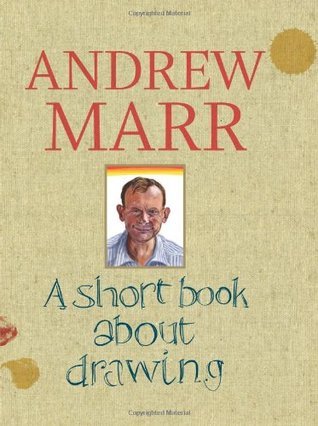
Like millions of others, Andrew Marr draws. He hasn't had lessons, yet since childhood, the journalist and TV presenter has been at his happiest with a pen or brush in his hand. One way or another he draws most days, even if it's just a doodle on the edge of a newspaper. But why does he do it? Does it have a point? And in what way, if any, does this activity of his relate to what we think of as 'art'? In this intriguing new book, Andrew Marr explores the subject of drawing and painting through his own experience. He considers the mechanics of the process - the act of making and its importance for a happy life - alongside the ways in which good drawing or painting can make us think harder and see the world differently. He discusses what a bad drawing is, and the nature of failure as well as success. The book, lavishly illustrated with over 50 of the author's own pictures, was written during the winter of 2012 and completed weeks before Andrew suffered the major stroke from which he is currently recovering - and finding himself drawing again. Written in his signature fresh, engaging and evocative style, A Short Book About Drawing is Andrew Marr's unique take on this absorbing subject.
Andrew Marr is a Scottish journalist. He is a graduate of Cambridge University and has had a long career in political journalism, working for the Scotsman, The Independent, The Economist, the Express and the Observer. From 2000 to 2005 he was the BBC's Political Editor. His broadcasting includes series on contemporary thinkers for BBC 2 and Radio 4, political documentaries for Channel 4 and BBC Panorama, and Radio 4's Start The Week'.
Description: Exploring the subject of drawing and painting through experience. The author considers the mechanics of the drawing process - the act of making and its importance of a happy life - along with the ways in which good drawing or painting can make us think harder and see the world differently.
3* A History of Modern Britain 3* A Short Book about Drawing
Reading this book was a pleasure. I thoroughly enjoyed it – it made me happy and it encouraged me to carry on with my drawing. It’s not an instruction book, but it’s full of insight into what happens when you draw and it’s dotted throughout with personal information, such as how Marr began drawing, like most of us at school, what he drew, and how he lingered over drawings and paintings, going to exhibitions such as those at the Royal Scottish Academy.
He refers to artists and their paintings without including illustrations – the only paintings/drawings are his own! He writes that ‘there isn’t a single drawing here I would regard as a real work of art, but I think most of them will encourage people to try for themselves.’
He draws most days. This book was written not long before Marr suffered a stroke and it was only after he found himself drawing again - on his iPad – that he began to feel himself again. I would have liked more details about his drawings, about the medium he used – some are obviously digital, and others are pencil sketches, but others are less obvious, maybe pen and wash?
It is a short book – just 144 pages – but there is a lot packed into those pages.
A Short Book About Drawing is a special book. I thoroughly recommend it.
This short book contains a wealth of ideas on the subject of drawing. Andrew Marr not only talks about what drawing has done for him, but encourages everyone to take whatever tools they have to hand and have a really good look at things and have a go at drawing it ourselves. By looking back at the history of drawing and contemplating what it means to be interested in recording "life", whether it be through learning the technical aspects of the skill or just sketching what we see and have experienced ourselves, we come to understand the importance of this small (or very big) act through the lens of our own experience. The book is full of Andrew's own drawings which are an inspiration themselves.
I enjoyed this as a bedside occasional dipper. A gentle, readable and unstuffy account of the history of making art, interspersed with Marr’s own experiences and enjoyable artwork. His enthusiasm and encouragement of others to try out drawing and painting shines through. The later chapters read well as mini-essays. I particularly enjoyed the account of the explosion of amateur art in 19th century, when “normal” people started to pick up art as a hobby and a way of documenting, preserving and processing their life experiences. It’s easy to see parallels with 21st century booms in photography and life-logging. The tools might differ but the desires and motivations persist.
Political journalist Andrew Marr writes with passion about the joy drawing brings him. By his own admission, he's not a great artist, but choosing to illustrate the book with his own imperfect art works is inspiring to anyone that it's ok to make art just for the sheer enjoyment of the activity. He's very knowledgeable and passionate about his subject matter. A book to return to time and time again.
This was a case of the right book at the right time. I found the book this year when clearing my parent’s house. It’s signed and dated by the author in 2014. Both parents enjoyed the book and I found sketch books by my dad of landscapes, trees and birds. I have always drawn and spent last summer sketching outdoors. I like drawing and what looking carefully and sitting quietly does. But recently I got to thinking what’s the point, I don’t sell any pictures, I should be doing more important stuff, no-one notices what I do or appreciates me, art is a waste of time etc etc… Andrew Marr’s book reminded me why people have always drawn and what it means to him to draw. It is about valuing the importance of doing the drawing - as opposed to producing a finished piece.
From childhood, Andrew Marr, the BBC political broadcaster, has been an impulsive drawer. He keeps sketchbooks of drawings as a graphic diary, recording sights that have attracted him throughout his life, as a far-travelled, professional correspondent and as an ordinary family man. More recently, he uses an iPad with the app "Brushes". On rare days, he might even get out the oil paints. He says he is untutored and doesn't go to classes but, judging from the numerous examples in this book, this is hard to believe, not because they are good - they are variable - but the good ones show clues of competent techniques which are more likely learned than arrived at by nature.
Nevertheless, this is, as Marr says, a book about what makes him happy. I relate to this, it makes me happy too. Though it's a reasonably broad analysis, chapter by chapter, of what drawing is - in Marr's view at least -it's light on depth and criticism. The few quotes and ideas he borrows are from friends and acquaintances, such as David Hockney and Anthony Gormley. He includes no illustrations other than his own sketches, excusing this on grounds of copyright and freedom to criticise his own efforts with impunity, the latter comes across more as modest self-deprecation than useful insight. He also says it is the most enjoyable thing he has written. I'm guessing that it didn't take him too long and wasn't at all difficult.
I don't wish to sound too negative, it is a pleasant read and I enjoyed it. But I think this was because I'm a chronic, impulsive, amateur sketcher too, and he confirmed my views rather than challenged them. It was, as promised, a short book, and fortunately, at the moment of purchase, much reduced in price. A difficult one for me to rate.
I loved Andrew Marr's book about the UK journalism industry, "My Trade" when I read it a while back. It was so thorough owing to Marr's industry experience as editor of The Independent newspaper. Recently, Marr suffered a setback from his journalistic career as he suffered a stroke and this book is about his passion of drawing, its influence in his life and how it helped him recover during his period of convalescence.
Andrew Marr's writing style is clear, unpretentious and often humorous, and he communicates his passion enthusiastically. I wanted to read this after supervising a MyChoice activity at Colegio Roosevelt, where students taught me (reminded me) of the communicative and meditative power of illustration. Marr is a serious artist though, and has excelled in the company of some of the UK's best artists for decades. So, this work did not really inspire me to pick up a pencil and start sketching, as much as make me think how futile it would be to start, unless real time and dedication were applied. For now, I think I will stick to reading about the craft through accessible companions such as this one!
This is an eye-opening and inspiring book. It is not just about art, it is about looking at life and our surroundings in a deep and meaningful way. Whether you are an aspiring artist, someone who dabbles in art or someone who just likes to look at art, I believe this book will speak to you and at some level and enhance your artistic experience. I got to the end and wanted to go straight back to the beginning and read it all over again. I also wanted to investigate some of the artists Andrew Marr mentions whom I know little about. It was also reassuring to see pictures of some of his artistic efforts which he describes as 'bad' as well as those which he is pleased with. The only reason I have given it four stars instead of five is because the ending was too abrupt for me. I wanted one more chapter, a summing up. Maybe he could add that to another edition but apart from that I would highly recommend this book. In a rushed world where we tend to skim rather than delve it is a reminder to pause, savour, honour what is in front of us, whatever that may be.
Andrew Marr writes short chapters that explore various aspects of drawing, interwoven with historical notes and insights. There are little observations that are delightful and significant, for example on the importance of 'making', the historical rise of drawing as a popular hobby in the 1700s, and the sad mid-20th century decline in the rigorous teaching of drawing in art schools (overtaken by conceptual art). The text is accompanied by Marr's own sketches; as he explains, and I've also found, reproducing others' art works is expensive due to copyright. I loved Marr's pencil sketches but was less impressed with his ipad drawings, a mode that was necessitated by his physical disabilities. "Drawing will make you a better person - not morally, necessarily, but it makes you think." (p.90) "In the end, my pictures are my unsaleable 'artobiography'". (p.142).
This is a wonderful book, both in terms of the physical object and in terms of its contents. It contains plentiful images in a high-quality finish, and the text comprises short, pithy chapters that muse on the nature of art, of beauty, of seeing, etc. It's witty, incisive, charming and often beautiful.
The only negative is that Marr often talks about others' images, making you want to look at them, and yet none are included. However, he candidly states that this is because of the cost involved, and if the book had cost me any more than £15 I wouldn't have torn open my wallet, so I shan't complain any further.
I'm tempted to reread this short book immediately.
Andrew Marr is of course one of the BBCs best known news correspondents, reporting and commanding interviews with insight, making difficult and complex situations digestible to the viewer. And he is famously fighting his way back from a life changing stroke. But all his life he has sketched and in this book he reflects on what drives him and millions like him, not necessarily (but sometimes) world famous artists, often ordinary people, to draw. He speaks of what drawing asks of in the viewer and what it does for the creator. It is generously illustrated with his own sketches and paintings, some paper and canvas, many created on his iPad. Inspiring and insightful.
A very well written and informative book about drawing. There are references to the works of other artists but thankfully the book only contains images of Andrew Marr's drawings. Trying to include images of other people's artwork (no matter how good) would in my opinion have spoiled this book. Mr Marr is a talented artist - though he disputes the moniker - and I will return to this book many times to look at his work.
I was expecting to read more about how he draws, how he has developed his style and what his techniques are. This is much more of an introspective reflection of himself and what drawing brings. An interesting book, but I would have loved to read more about the mechanics of his work, but then I would love to draw and I can't so I was really hoping to see how his relaxed style was developed.
I saw this book reviewed in the Daily Mail. It was very good and I loved his enthusiasm for his love of drawing. It has made me want to pick up my sketchbook again after years of thinking about it. I bought a copy of it for my Dad for Christmas. He has recently taken up painting again after years. I'm sure he'll like it!
Very interesting. Well worth seeking if you have an interest in drawing. Marr is a great enthusiast and it was good to learn of his approach to the subject, and what drawing means to him.
Marr starts off saying he nearly died from a stroke and how he felt robbed of his own autonomy during his recovery, which is a shockingly frank way to begin a book about drawing. Marr goes through his life and his relationship to drawing with the same openness of his own limitations, and often refers to his own drawings/paintings in the book in a humorous self-deprecating fashion. For what it’s worth, I thought some of the art that he presented in the book are pretty for a self-taught amateur.
As he goes throughout the events of his life, Marr also relates them to the broader society and artistic history. For Marr, drawing isn’t just about having fun but a way of entering a state of bliss, a desire to control one’s self and exert a will unto the environment and the whole process of art is not unremoved from the sociology-political-economic processes within which the artist is immersed in. This broader awareness of himself and to the world makes this breezy book an interesting read.