

What do you think?

Twilight at Monticello: The Final Years of Thomas Jefferson
Much has been written about Thomas Jefferson, with good reason: His life was a great American drama–one of the greatest–played out in compelling acts. He was the architect of our democracy, a visionary chief executive who expanded this nation’s physical boundaries to unimagined lengths. But Twilight at Monticello is something entirely new: an unprecedented and engrossing personal look at the intimate Jefferson in his final years that will change the way readers think about this true American icon. It was during these years–from his return to Monticello in 1809 after two terms as president until his death in 1826–that Jefferson’s idealism would be most severely, and heartbreakingly, tested.
Based on new research and documents culled from the Library of Congress, the Virginia Historical Society, and other special collections, including hitherto unexamined letters from family, friends, and Monticello neighbors, Alan Pell Crawford paints an authoritative and deeply moving portrait of Thomas Jefferson as private citizen–the first original depiction of the man in more than a generation.
Here, told with grace and masterly detail, is Jefferson with his family at Monticello, dealing with illness and the indignities wrought by early-nineteenth-century medicine; coping with massive debt and the immense costs associated with running a grand residence; navigating public disputes and mediating family squabbles; receiving dignitaries and corresponding
with close friends, including John Adams, the Marquis de Lafayette, and other heroes from the Revolution. Enmeshed as he was in these affairs during his final years, Jefferson was still a viable political force, advising his son-in-law Thomas Randolph during his terms as Virginia governor, helping the administration of his good friend President James Madison during the “internal improvements” controversy, and establishing the first wholly secular American institution of higher learning, the University of Virginia at Charlottesville. We also see Jefferson’s views on slavery evolve, along with his awareness of the costs to civil harmony exacted by the Founding Fathers’ failure to effectively reconcile slaveholding within a republic dedicated to liberty.
Right up until his death on the fiftieth anniversary of America’s founding, Thomas Jefferson remained an indispensable man, albeit a supremely human one. And it is precisely that figure Alan Pell Crawford introduces to us in the revelatory Twilight at Monticello.
'Crawford (Thunder on the Right) offers his own equally compelling look, in this case at Jefferson's life, post-presidency, from 1809 until his death in 1826. Then a private citizen, Jefferson was burdened by financial and personal and political struggles within his extended family. His beloved estate, Monticello, was costly to maintain and Jefferson was in debt. Newly studying primary sources, Crawford thoroughly conveys the pathos of Jefferson's last years, even as he successfully established the University of Virginia (America's first wholly secular university) and maintained contact with James Madison, John Adams, and other luminaries. He personally struggled with political, moral, and religious issues; Crawford shows us a complex, self-contradictory, idealistic, yet tragic figure, helpless to stabilize his family and finances. Historians and informed readers alike will find much to relish in both of these distinctive works of original scholarship. Both are recommended for academic and large public libraries.
–Library Journal
“In "Twilight at Monticello," Alan Pell Crawford treats his subject with grace and sympathetic understanding, and with keen penetration as well, showing the great man's contradictions (and hypocrisies) for what they were.”
–Wall Street Journal
“Like all people, famous or almost unknown, Jefferson was a mass of contradictions. Crawford explores them masterfully, thus indeed presenting a new Jefferson for a new generation.”
–Houston Chronicle
“…a worthy addition to the already enormous body of Thomas Jefferson scholarship. Crawford did his homework well, using literally dozens of sources to give us an unvarnished picture of the human side of one of America’s greatest leaders in an entertaining, fast-moving narrative. You might never loom at Monticello in quite the same way again after reading this book.”
–The Fredericksburg (Va.) Free-Lance Star
Based on new research and documents culled from the Library of Congress, the Virginia Historical Society, and other special collections, including hitherto unexamined letters from family, friends, and Monticello neighbors, Alan Pell Crawford paints an authoritative and deeply moving portrait of Thomas Jefferson as private citizen–the first original depiction of the man in more than a generation.
Here, told with grace and masterly detail, is Jefferson with his family at Monticello, dealing with illness and the indignities wrought by early-nineteenth-century medicine; coping with massive debt and the immense costs associated with running a grand residence; navigating public disputes and mediating family squabbles; receiving dignitaries and corresponding
with close friends, including John Adams, the Marquis de Lafayette, and other heroes from the Revolution. Enmeshed as he was in these affairs during his final years, Jefferson was still a viable political force, advising his son-in-law Thomas Randolph during his terms as Virginia governor, helping the administration of his good friend President James Madison during the “internal improvements” controversy, and establishing the first wholly secular American institution of higher learning, the University of Virginia at Charlottesville. We also see Jefferson’s views on slavery evolve, along with his awareness of the costs to civil harmony exacted by the Founding Fathers’ failure to effectively reconcile slaveholding within a republic dedicated to liberty.
Right up until his death on the fiftieth anniversary of America’s founding, Thomas Jefferson remained an indispensable man, albeit a supremely human one. And it is precisely that figure Alan Pell Crawford introduces to us in the revelatory Twilight at Monticello.
'Crawford (Thunder on the Right) offers his own equally compelling look, in this case at Jefferson's life, post-presidency, from 1809 until his death in 1826. Then a private citizen, Jefferson was burdened by financial and personal and political struggles within his extended family. His beloved estate, Monticello, was costly to maintain and Jefferson was in debt. Newly studying primary sources, Crawford thoroughly conveys the pathos of Jefferson's last years, even as he successfully established the University of Virginia (America's first wholly secular university) and maintained contact with James Madison, John Adams, and other luminaries. He personally struggled with political, moral, and religious issues; Crawford shows us a complex, self-contradictory, idealistic, yet tragic figure, helpless to stabilize his family and finances. Historians and informed readers alike will find much to relish in both of these distinctive works of original scholarship. Both are recommended for academic and large public libraries.
–Library Journal
“In "Twilight at Monticello," Alan Pell Crawford treats his subject with grace and sympathetic understanding, and with keen penetration as well, showing the great man's contradictions (and hypocrisies) for what they were.”
–Wall Street Journal
“Like all people, famous or almost unknown, Jefferson was a mass of contradictions. Crawford explores them masterfully, thus indeed presenting a new Jefferson for a new generation.”
–Houston Chronicle
“…a worthy addition to the already enormous body of Thomas Jefferson scholarship. Crawford did his homework well, using literally dozens of sources to give us an unvarnished picture of the human side of one of America’s greatest leaders in an entertaining, fast-moving narrative. You might never loom at Monticello in quite the same way again after reading this book.”
–The Fredericksburg (Va.) Free-Lance Star
352 pages, Hardcover
First published January 8, 2008
About the author
Alan Pell Crawford
6 books21 followersAlan Pell Crawford is the author of "Unwise Passions: A True Story of a Remarkable Woman - and the First Great Scandal of Eighteenth Century America" and "Twilight at Monticello". His writings have appeared in "American History", "The Washington Post", and "The New York Times". He is a regualr book reviewer for "The Wall Street Journal". Crawford has had a residential fellowship at the International Center for Jefferson Studies at Monticello. A former resident of Washington, DC, he lives in Richmond, Virginia, with his wife Sally Curran, the editor of My VMFA, the quarterly magazine of the Virginia Museum of Fine Arts. They are the parents of two sons, Ned and Tim.
Ratings & Reviews
Friends & Following
Create a free account to discover what your friends think of this book!
Community Reviews
Displaying 1 - 30 of 143 reviews

October 9, 2014
”Jefferson ‘alluded to the probability of his death--as a man would to the prospect of being caught in a shower--as an event not to be desired, but not to be feared.’”
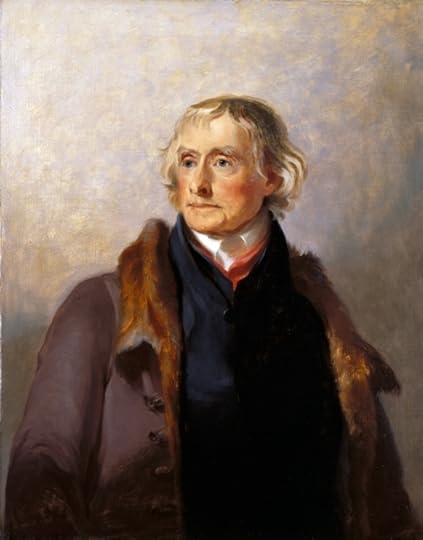
Portrait by Thomas Sully of Thomas Jefferson in 1821. Jefferson died on July 4th, 1826 at age 83.
One would think that the man who was the principal author of the Declaration of Independence, who was elected the 2nd governor of Virginia, who was the founder of the University of Virginia, and who was elected President of the United States...twice...would be able to retire without financial worries.
This was simply not the case with the tall, redhead from Virginia.
Thomas Jefferson was certainly cursed with some bad luck. We all experience our share of that, but Jefferson certainly made things worse with his all consuming curiosity about all things. These desires for achieving an understanding of the innovations of the day made him the fascinating man that he was, but curiosity, as I can attest to myself, is expensive.
”A remarkable disciplined scholar, Jefferson spent money on books the way less purposeful young men spent it on whiskey and women...within three and a half years, Jefferson had purchased 1,256 volumes to replace those lost. During this period, he bought books at a rate of roughly one a day, at a time when books were costly items.”
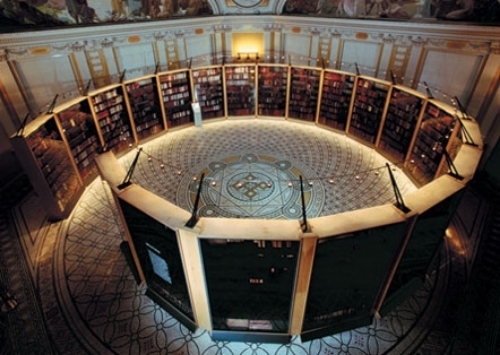
The Thomas Jefferson library at the Library of Congress. In 1814 when the British burned the Library of Congress along with the White House, Jefferson offered to sell his library to the government to use as a basis for building a new collection. This temporarily eased some financial burdens for Jefferson.
He’d amassed 1,200 volumes previously, but his childhood home at Shadwell had burned down taking all the books with it. He replaced them all in less than four years. Luckily book collecting is a “gentle madness” though it can be exasperating to those that live with the book collector.
We can’t really condemn him for buying too many books, that would be ridiculous.
He was not, unfortunately, a very good farmer, many of his experiments did not prove fruitful though he did seem to be a better gardener. His gardens, still in operation at Monticello, are beautiful. A few years ago I had the opportunity to stroll those gardens and also to take a tour of the house. He also suffered some untimely droughts (part of that bad luck) that forced him to buy grain, that normally would have come from his own lands, to feed his extensive family and slaves.

A small part of the massive gardens at Monticello.
Monticello is pleasing to the eye, an architectural marvel that was designed by Jefferson. Unfortunately what is beautiful is not always practical and efficient heating was not one of the attributes of this house. The lovely skylights are amazing, until it rains, and they leak. The upkeep of Monticello was very expensive and as hard cash became more difficult for Jefferson to obtain the less that was spent on his much loved house.
Jefferson obsessed with new architectural ideas and in the midst of his ongoing economic crises he decided to build another house on another property he owned called Poplar Forest. Simply madness or simply a man too consumed by his passions to be practical. He did want to keep his family close to him so by building another house just down the road he had another place to entice his burgeoning extending family to stay. It leaked like a rusty bucket as well, but that just adds a bit of charm.
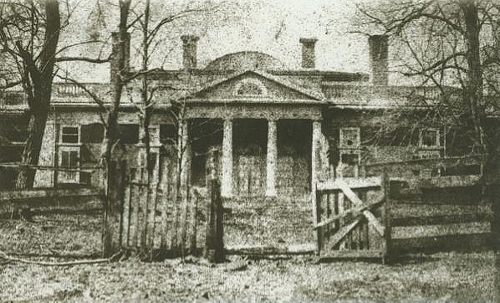
Monticello experienced some dilapidation before being restored.
He made poor investments, rarely could refuse himself anything that furthered his enjoyment and understanding of the universe, he indulges his grandchildren with gold watches, silk dresses, and horse riding equipment, and he cosigned notes for friends when he was barely able to find credit for himself.
He wasn’t the only one suffering in Virginia during this time, families that felt they should be doing really well were struggling. Alan Pell Crawford outlines some very real reasons for this downturn in Virginia’s wealth.
”Intellectual life was almost nonexistent. Virginians published few newspapers or books. Almost all literary works came from the North. The well-to-do refused to be taxed to pay for the education of their poorer neighbors, and the great majority of young people, white and black, received no formal schooling. A result was the almost complete absence of an educated middle class. There were only land-rich, cash-poor gentleman planters at the top, a somewhat larger group of lawyers, doctors, and merchants just below them, and the poor whites and free blacks at the bottom, followed by great numbers of slaves. Costly in itself, the presence of slaves discouraged the immigration of white laborers, denying Virginia much needed skills and enterprise.”
With every new generation there is an opportunity to make social changes. There were men trying to find ways to escape this calcified and doomed perception of a way of life. Jefferson was approached as a man who on paper had all the qualifications to carry the banner for emancipation. He’d even favored the process of gradual emancipation. He’d attempted to abolish the slave trade in an early draft of the Declaration of Independence (struck out because of the strong objections of South Carolina and Georgia).
He...was...not interested.
This is the biggest sticking point of all apologists for Jefferson. Out of all the Southern patriots he is the first name that one would put their finger on to lead the charge to abolish slavery. It is hard not to believe that the real reason that Jefferson did not do what he could do to end slavery was because he benefited from the system. He was caught in the thinking that slavery was the only option to maintaining his way of life. We could say that he was a man of his time, but he was not a man of his time. He was a man out of his time, beyond his time. He was a visionary. It was as if that one shot he took, when he was writing the Declaration of Independence, was his one and only serious attempt to be a man capable of escaping the narrow vision of his class.
I want to touch briefly on the Sally Hemings affair. I am looking forward to reading The Hemingses of Monticello and feel that my understanding of the situation will be greatly enhanced after reading that book. Sally Hemings was the daughter of John Wayles and his slave Betty Hemings; and therefore, the half sister of Martha Wayles Skelton. Martha married Thomas Jefferson. Sally was light complected, not surprising since she was of three-quarters European descent. She was petite and said to be very pretty. Martha died in 1781 and on her death bed asked that Jefferson never remarry. He swore he would not and kept that promise. Two years later he left for France with his daughter Patsy and with her was the fourteen year old Sally Hemings.
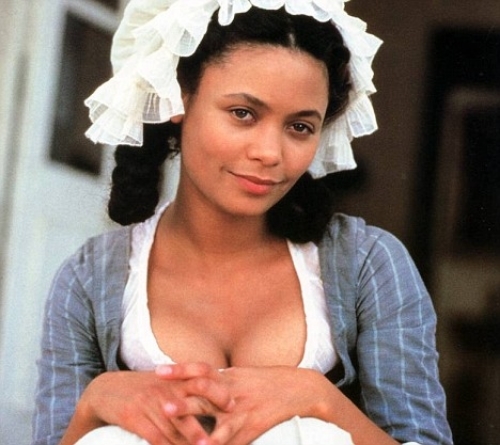
The lovely actress Thandie Newton played the role of Sarah “Sally” Hemings in the film Jefferson in Paris.
Scholars believe that his relationship with Sally started in France or shortly after their return. Her quarters at Monticello were beneath his own and he had a staircase built that would allow her unrestricted private access to his chambers. This reminded me of many similar staircases built by European kings for safe passage of mistresses to their beds. She had six children, four of which made it to adulthood. It is fascinating to think of this relationship. To some it further tarnishes his image. In his political campaigns it was certainly used against him in the form of bawdy poems and songs, revealing that it was not a well kept secret. Jefferson never bothered to deny the assertions which in retrospect was probably very good politics.
In a time when men routinely married the sister of a deceased wife, this is somewhat odd to our sensibilities today, but not considered so then, I do wonder if when he looked at Sally did he see much of his wife in her movements, and in her features? Was she a way of still keeping his beloved wife in his life? DNA evidence has proven that Sally’s children were descended from a Jefferson male, not conclusively to Jefferson, but certainly to the family.
Crawford does focus on the rather stressful final years of Jefferson’s life, but he does give the reader a thumbnail sketch in several tightly written chapters of the president’s early life. Crawford sprinkles in some enlightening anecdotes that brings the older and younger Jefferson alive. I especially enjoyed the one regarding how he hurt his wrist that gave him so much pain later in life (there was a woman involved). I also find it curious that little is known about Jefferson’s parents mainly because he so rarely wrote about them. He had other health issues besides a painful wrist. He frequently suffered from rheumatism and a rash of boils would assault his back and buttocks from time to time probably somewhat induced by stress.
I can’t help but smile about some of the financial difficulties he found himself in mainly because he was “living large”, but also because of his insatiable curiosity that had him buying innovations that he could ill afford. He was a man who did much. We wish he would have done more; and yet, he remains one of the most respected and beloved presidents.
If you wish to see more of my most recent book and movie reviews, visit http://www.jeffreykeeten.com
I also have a Facebook blogger page at:https://www.facebook.com/JeffreyKeeten

Portrait by Thomas Sully of Thomas Jefferson in 1821. Jefferson died on July 4th, 1826 at age 83.
One would think that the man who was the principal author of the Declaration of Independence, who was elected the 2nd governor of Virginia, who was the founder of the University of Virginia, and who was elected President of the United States...twice...would be able to retire without financial worries.
This was simply not the case with the tall, redhead from Virginia.
Thomas Jefferson was certainly cursed with some bad luck. We all experience our share of that, but Jefferson certainly made things worse with his all consuming curiosity about all things. These desires for achieving an understanding of the innovations of the day made him the fascinating man that he was, but curiosity, as I can attest to myself, is expensive.
”A remarkable disciplined scholar, Jefferson spent money on books the way less purposeful young men spent it on whiskey and women...within three and a half years, Jefferson had purchased 1,256 volumes to replace those lost. During this period, he bought books at a rate of roughly one a day, at a time when books were costly items.”

The Thomas Jefferson library at the Library of Congress. In 1814 when the British burned the Library of Congress along with the White House, Jefferson offered to sell his library to the government to use as a basis for building a new collection. This temporarily eased some financial burdens for Jefferson.
He’d amassed 1,200 volumes previously, but his childhood home at Shadwell had burned down taking all the books with it. He replaced them all in less than four years. Luckily book collecting is a “gentle madness” though it can be exasperating to those that live with the book collector.
We can’t really condemn him for buying too many books, that would be ridiculous.
He was not, unfortunately, a very good farmer, many of his experiments did not prove fruitful though he did seem to be a better gardener. His gardens, still in operation at Monticello, are beautiful. A few years ago I had the opportunity to stroll those gardens and also to take a tour of the house. He also suffered some untimely droughts (part of that bad luck) that forced him to buy grain, that normally would have come from his own lands, to feed his extensive family and slaves.

A small part of the massive gardens at Monticello.
Monticello is pleasing to the eye, an architectural marvel that was designed by Jefferson. Unfortunately what is beautiful is not always practical and efficient heating was not one of the attributes of this house. The lovely skylights are amazing, until it rains, and they leak. The upkeep of Monticello was very expensive and as hard cash became more difficult for Jefferson to obtain the less that was spent on his much loved house.
Jefferson obsessed with new architectural ideas and in the midst of his ongoing economic crises he decided to build another house on another property he owned called Poplar Forest. Simply madness or simply a man too consumed by his passions to be practical. He did want to keep his family close to him so by building another house just down the road he had another place to entice his burgeoning extending family to stay. It leaked like a rusty bucket as well, but that just adds a bit of charm.

Monticello experienced some dilapidation before being restored.
He made poor investments, rarely could refuse himself anything that furthered his enjoyment and understanding of the universe, he indulges his grandchildren with gold watches, silk dresses, and horse riding equipment, and he cosigned notes for friends when he was barely able to find credit for himself.
He wasn’t the only one suffering in Virginia during this time, families that felt they should be doing really well were struggling. Alan Pell Crawford outlines some very real reasons for this downturn in Virginia’s wealth.
”Intellectual life was almost nonexistent. Virginians published few newspapers or books. Almost all literary works came from the North. The well-to-do refused to be taxed to pay for the education of their poorer neighbors, and the great majority of young people, white and black, received no formal schooling. A result was the almost complete absence of an educated middle class. There were only land-rich, cash-poor gentleman planters at the top, a somewhat larger group of lawyers, doctors, and merchants just below them, and the poor whites and free blacks at the bottom, followed by great numbers of slaves. Costly in itself, the presence of slaves discouraged the immigration of white laborers, denying Virginia much needed skills and enterprise.”
With every new generation there is an opportunity to make social changes. There were men trying to find ways to escape this calcified and doomed perception of a way of life. Jefferson was approached as a man who on paper had all the qualifications to carry the banner for emancipation. He’d even favored the process of gradual emancipation. He’d attempted to abolish the slave trade in an early draft of the Declaration of Independence (struck out because of the strong objections of South Carolina and Georgia).
He...was...not interested.
This is the biggest sticking point of all apologists for Jefferson. Out of all the Southern patriots he is the first name that one would put their finger on to lead the charge to abolish slavery. It is hard not to believe that the real reason that Jefferson did not do what he could do to end slavery was because he benefited from the system. He was caught in the thinking that slavery was the only option to maintaining his way of life. We could say that he was a man of his time, but he was not a man of his time. He was a man out of his time, beyond his time. He was a visionary. It was as if that one shot he took, when he was writing the Declaration of Independence, was his one and only serious attempt to be a man capable of escaping the narrow vision of his class.
I want to touch briefly on the Sally Hemings affair. I am looking forward to reading The Hemingses of Monticello and feel that my understanding of the situation will be greatly enhanced after reading that book. Sally Hemings was the daughter of John Wayles and his slave Betty Hemings; and therefore, the half sister of Martha Wayles Skelton. Martha married Thomas Jefferson. Sally was light complected, not surprising since she was of three-quarters European descent. She was petite and said to be very pretty. Martha died in 1781 and on her death bed asked that Jefferson never remarry. He swore he would not and kept that promise. Two years later he left for France with his daughter Patsy and with her was the fourteen year old Sally Hemings.

The lovely actress Thandie Newton played the role of Sarah “Sally” Hemings in the film Jefferson in Paris.
Scholars believe that his relationship with Sally started in France or shortly after their return. Her quarters at Monticello were beneath his own and he had a staircase built that would allow her unrestricted private access to his chambers. This reminded me of many similar staircases built by European kings for safe passage of mistresses to their beds. She had six children, four of which made it to adulthood. It is fascinating to think of this relationship. To some it further tarnishes his image. In his political campaigns it was certainly used against him in the form of bawdy poems and songs, revealing that it was not a well kept secret. Jefferson never bothered to deny the assertions which in retrospect was probably very good politics.
In a time when men routinely married the sister of a deceased wife, this is somewhat odd to our sensibilities today, but not considered so then, I do wonder if when he looked at Sally did he see much of his wife in her movements, and in her features? Was she a way of still keeping his beloved wife in his life? DNA evidence has proven that Sally’s children were descended from a Jefferson male, not conclusively to Jefferson, but certainly to the family.
Crawford does focus on the rather stressful final years of Jefferson’s life, but he does give the reader a thumbnail sketch in several tightly written chapters of the president’s early life. Crawford sprinkles in some enlightening anecdotes that brings the older and younger Jefferson alive. I especially enjoyed the one regarding how he hurt his wrist that gave him so much pain later in life (there was a woman involved). I also find it curious that little is known about Jefferson’s parents mainly because he so rarely wrote about them. He had other health issues besides a painful wrist. He frequently suffered from rheumatism and a rash of boils would assault his back and buttocks from time to time probably somewhat induced by stress.
I can’t help but smile about some of the financial difficulties he found himself in mainly because he was “living large”, but also because of his insatiable curiosity that had him buying innovations that he could ill afford. He was a man who did much. We wish he would have done more; and yet, he remains one of the most respected and beloved presidents.
If you wish to see more of my most recent book and movie reviews, visit http://www.jeffreykeeten.com
I also have a Facebook blogger page at:https://www.facebook.com/JeffreyKeeten

December 5, 2012
Excellent book about the man I have come to consider our first sleazy president. While TJ was no doubt brilliant, talented, and inventive he was also politically short sighted, paternalistic, and self-centered. This book lays out the nature of the man behind the curtain and how he managed to avoid spending all his time in court being sued by people he cheated is a miracle.

May 10, 2018
Approximately forty-two years ago (1976) I read a series of books about famous Americans. They were published in the 1950s and aimed at young readers. They were a product of their time (Cold War, Red Scare, Eisenhower Era). Designed to give a patriotic history lesson to young Americans they weren't a "warts and all" biography. Of course I was too young to realize that I was reading what was basically propaganda. One of my favorites was The Story of Thomas Jefferson by Earl Schenck Miers. I believe I read that one several times over the course of my year in 3rd Grade (1976-1977). It made such an impression that I still remember the book and it has had much to do with my ideas of the third president of the United States.
"Twilight at Monticello" ,on the other hand, is like dunking myself into a tub of ice water. Of course I've known about the possible relationship between Jefferson and his slave ,Sally Hemings, for many years and the many contradictions that made up the man are also not unknown to me. However ,what I was unfamiliar with, was Jefferson's life after he left the White House; the last seventeen years of his long life. I had no idea that he ,and his family, was always living on the edge of financial ruin. I also knew precious little about his many descendants. Alan Crawford's excellent biography has helped to educate me - which is always a good thing.
Books covering the final years of famous individuals can be tough reads. People who accomplish great things are often very complex and not always very nice. Their final years are often hard as their peak years are behind them and they no longer enjoy the prestige and power they once possessed. The final years often seem comprised of disappointment and pathos. There is that in Jefferson's final years as well.
Mr. Crawford's book alternates between examining the public and academic pursuits of Jefferson in his final years and his personal life. Jefferson wasn't good at managing money and his single minded determination to pursue an enlightened and rational life caused him to often ignore the more unpleasant aspects of Humanity - to include his own progeny and the people they married (violence, alcoholism, bankruptcy, etc.). Crawford writes in an easy style and it moves along at a rapid pace. Rather then an highly detailed academic treatise Mr. Crawford has produced an informative biography intended for the non-specialist.
Mr. Crawford has not written an assassination piece. He shows that Jefferson was all too Human - as are we all. Jefferson was a true Renaissance Man with an incredible mind. There was much about Jefferson that was admirable and not so admirable, such as his stance both practical and intellectually regarding slavery. The effect is making Jefferson a more interesting and deeper person that the one that I was introduced to in 1976. He doesn't take the easy and simple minded task of portraying Jefferson as some type of secular saint or just a lecherous hypocrite. Such a balancing act is not an easy thing to do and I ,for one, am impressed by Mr. Crawford's work.
Appropriately enough I purchased this book at the gift shop located at Monticello. It was a good purchase. Though a fast read I recommend it. It's a good book.
"Twilight at Monticello" ,on the other hand, is like dunking myself into a tub of ice water. Of course I've known about the possible relationship between Jefferson and his slave ,Sally Hemings, for many years and the many contradictions that made up the man are also not unknown to me. However ,what I was unfamiliar with, was Jefferson's life after he left the White House; the last seventeen years of his long life. I had no idea that he ,and his family, was always living on the edge of financial ruin. I also knew precious little about his many descendants. Alan Crawford's excellent biography has helped to educate me - which is always a good thing.
Books covering the final years of famous individuals can be tough reads. People who accomplish great things are often very complex and not always very nice. Their final years are often hard as their peak years are behind them and they no longer enjoy the prestige and power they once possessed. The final years often seem comprised of disappointment and pathos. There is that in Jefferson's final years as well.
Mr. Crawford's book alternates between examining the public and academic pursuits of Jefferson in his final years and his personal life. Jefferson wasn't good at managing money and his single minded determination to pursue an enlightened and rational life caused him to often ignore the more unpleasant aspects of Humanity - to include his own progeny and the people they married (violence, alcoholism, bankruptcy, etc.). Crawford writes in an easy style and it moves along at a rapid pace. Rather then an highly detailed academic treatise Mr. Crawford has produced an informative biography intended for the non-specialist.
Mr. Crawford has not written an assassination piece. He shows that Jefferson was all too Human - as are we all. Jefferson was a true Renaissance Man with an incredible mind. There was much about Jefferson that was admirable and not so admirable, such as his stance both practical and intellectually regarding slavery. The effect is making Jefferson a more interesting and deeper person that the one that I was introduced to in 1976. He doesn't take the easy and simple minded task of portraying Jefferson as some type of secular saint or just a lecherous hypocrite. Such a balancing act is not an easy thing to do and I ,for one, am impressed by Mr. Crawford's work.
Appropriately enough I purchased this book at the gift shop located at Monticello. It was a good purchase. Though a fast read I recommend it. It's a good book.

May 2, 2021
After reading this book I came up with three things Thomas Jefferson would love to have in his life from the 21st century. He would have loved Home Depot. “Putting up and pulling down, one of my favorite amusements,” Jefferson said about the building of Monticello. It took him more than 40 years to complete the house's 33 rooms on four floors. Secondly, he loved books, Jefferson owned between 9,000 and 10,000 books in his lifetime on a wide range of subjects. I think he would have loved Goodreads! Lastly, Jefferson never escaped mounting debt. He died with debts of $107,000, which is roughly $2 million today. Do you think he would have loved Mastercard?
Alan Crawford explores these themes along with many more stories of Thomas Jefferson in retirement. Crawford breaks from tradition of most Jefferson biographies and spends the bulk of his energy not on Jefferson's time in public office, but on his seventeen years in retirement. He shows an old man who is out of the spotlight, mourning his children, madly in love with his grandchildren, and making amends with old friends. We get Jefferson's thoughts on the institution of slavery but unable to let go of his own slaves. He was not without faults and most of his problems were of his own. He struggled with many of life's common challenges and temptations. It will perhaps be comforting to know that he was human just like all of us. As Jefferson aged Crawford has given us a real person who suffered from boils, warts, rheumatism and in doing so shows us a founding father who still shines brightly. As my father once said, "Age is simply the number of years the world has been enjoying you! "Life is to be lived and not question." I think Jefferson could say he did that.
Alan Crawford explores these themes along with many more stories of Thomas Jefferson in retirement. Crawford breaks from tradition of most Jefferson biographies and spends the bulk of his energy not on Jefferson's time in public office, but on his seventeen years in retirement. He shows an old man who is out of the spotlight, mourning his children, madly in love with his grandchildren, and making amends with old friends. We get Jefferson's thoughts on the institution of slavery but unable to let go of his own slaves. He was not without faults and most of his problems were of his own. He struggled with many of life's common challenges and temptations. It will perhaps be comforting to know that he was human just like all of us. As Jefferson aged Crawford has given us a real person who suffered from boils, warts, rheumatism and in doing so shows us a founding father who still shines brightly. As my father once said, "Age is simply the number of years the world has been enjoying you! "Life is to be lived and not question." I think Jefferson could say he did that.

May 7, 2013
http://bestpresidentialbios.com/2013/...
“Twilight at Monticello: The Final Years of Thomas Jefferson” is Alan Pell Crawford’s third and most recent book, published in 2008. Breaking away from the tradition of most Jefferson-focused biographies, Crawford’s work spends the bulk of its energy not on Jefferson’s time in public office, but on his seventeen-year retirement.
At first blush, it might seem strange that anyone would set out to describe in two-hundred or so pages the same period that Dumas Malone spent five-hundred pages chronicling in his sixth and final volume on Jefferson written thirty-five years ago. What eventually becomes clear, however, is that Crawford’s book is no ordinary accounting of the last years of one of our most revered presidents.
“Twilight at Monticello” begins with a prologue which takes the reader to a day in 1819 when one of Jefferson’s grandsons is seriously injured in a fight with his brother-in-law. Much of this section seems to fall into the category of historical fiction, describing what Jefferson ”may” have eaten for breakfast that morning and what he ”perhaps” did the rest of that day before learning of the altercation. It seems intended to set a dramatic tone for the remainder of the book, but is unnecessary.
Crawford then takes the reader on a fifty-page whirlwind tour through Jefferson’s youth, his time as a lawyer, legislator, governor, diplomat, secretary of state and his two terms as president. This brief reference to Jefferson’s upbringing and public life is too superficial and rushed to serve as a meaningful introduction to the man, but does provide a quick reminder of how Jefferson spent his time prior to retirement.
The author then takes a more leisurely-paced and wonderfully detailed stroll through Jefferson’s post-presidential years. But rather than providing what might reasonably be described as an impartial, if critical, look at Jefferson’s last years of life, Crawford crafts a story of persistent heartbreak, misery, scandal and intrigue. There are few moments of homage to a man of great deeds, love for friends and family (particularly his daughter Martha), and fervent in his desire to establish the University of Virginia.
Most of all, we are reminded (constantly) of the almost unending misery borne by Jefferson and his family in his last decades of life: of the death of friends and family, alcoholism and domestic abuse within his extended circle, mental illness among his siblings, of achingly persistent financial woes and of his own ill health. The author seems to take special delight in highlighting Jefferson’s pervasive pangs. The Old Testament’s “Job” almost seems to have been fortunate by comparison.
Far from sympathizing with Jefferson’s misfortune and (often) self-inflicted woes, Crawford describes an impractical, self-focused and often delusional dreamer – a profligate shopper unable to control his spending, whose life and family is wracked by so much dysfunction and so many contradictions that it is a wonder his likeness is carved into Mount Rushmore.
The anguish and pain, the incomprehensible personal contradictions and Jefferson’s crushing financial debts are well-described and Crawford provides remarkable and penetrating insight into these darkest of shadows. He also describes the Jefferson/Hemings controversy in a comprehensive and balanced manner, repeating the conclusion of many (based on DNA studies) that Jefferson almost certainly fathered at least one of Sally Heming’s children.
One of the book’s missed opportunities, however, was the chance to more fully describe the renewed friendship between Jefferson and John Adams during their respective retirements. Their prolific correspondence, terminating only with their nearly simultaneous deaths, provides history with rich insight into these two unique men. And although his book might have served to complete the psychological profile provided by Joseph Ellis’s “American Sphinx,” Crawford stopped short of fully exploring how Jefferson’s lifelong pain (and fear) of loss shaped his character.
“Twilight at Monticello” does not end with Jefferson’s death, but goes on to tell the sorry tale of the years that followed, with Monticello virtually abandoned, Jefferson’s estate largely liquidated to repay old debts, and his family scattered geographically while attempting to recover from the shock of almost complete-ruin. Nowhere else have I seen such a fulsome and candid description of the fallout which followed Jefferson’s death.
Crawford’s book is far from perfect and it seems clear that his “angle” was to focus on the most miserable and contradictory aspects to an otherwise impressive (if enigmatic) life. What is left unconfessed is that many of these challenges, and contradictions, are present in almost every family. But most of us don’t author a Declaration or serve as president, or profess the evils of slavery while owning slaves. And in his fame, Jefferson seems to invite special attention.
“Twilight at Monticello” is an unconventional look at an already complex and mysterious former president. It is a skillfully written, entertaining and well-researched book focusing on the less transparent aspects of Jefferson’s last years. That the book seems imbued with a tabloid patina may be inevitable given the focus of the book, but in any respect it also seems somewhat unbalanced. For the reader with a robust existing knowledge of Jefferson’s life, “Twilight at Monticello” will likely provide greater color and some new insight to his final years. For others, the book will seem a strange jolt, inconsistent with fading memories of Jefferson acquired in a history class years ago.
Overall Rating: 4 stars
“Twilight at Monticello: The Final Years of Thomas Jefferson” is Alan Pell Crawford’s third and most recent book, published in 2008. Breaking away from the tradition of most Jefferson-focused biographies, Crawford’s work spends the bulk of its energy not on Jefferson’s time in public office, but on his seventeen-year retirement.
At first blush, it might seem strange that anyone would set out to describe in two-hundred or so pages the same period that Dumas Malone spent five-hundred pages chronicling in his sixth and final volume on Jefferson written thirty-five years ago. What eventually becomes clear, however, is that Crawford’s book is no ordinary accounting of the last years of one of our most revered presidents.
“Twilight at Monticello” begins with a prologue which takes the reader to a day in 1819 when one of Jefferson’s grandsons is seriously injured in a fight with his brother-in-law. Much of this section seems to fall into the category of historical fiction, describing what Jefferson ”may” have eaten for breakfast that morning and what he ”perhaps” did the rest of that day before learning of the altercation. It seems intended to set a dramatic tone for the remainder of the book, but is unnecessary.
Crawford then takes the reader on a fifty-page whirlwind tour through Jefferson’s youth, his time as a lawyer, legislator, governor, diplomat, secretary of state and his two terms as president. This brief reference to Jefferson’s upbringing and public life is too superficial and rushed to serve as a meaningful introduction to the man, but does provide a quick reminder of how Jefferson spent his time prior to retirement.
The author then takes a more leisurely-paced and wonderfully detailed stroll through Jefferson’s post-presidential years. But rather than providing what might reasonably be described as an impartial, if critical, look at Jefferson’s last years of life, Crawford crafts a story of persistent heartbreak, misery, scandal and intrigue. There are few moments of homage to a man of great deeds, love for friends and family (particularly his daughter Martha), and fervent in his desire to establish the University of Virginia.
Most of all, we are reminded (constantly) of the almost unending misery borne by Jefferson and his family in his last decades of life: of the death of friends and family, alcoholism and domestic abuse within his extended circle, mental illness among his siblings, of achingly persistent financial woes and of his own ill health. The author seems to take special delight in highlighting Jefferson’s pervasive pangs. The Old Testament’s “Job” almost seems to have been fortunate by comparison.
Far from sympathizing with Jefferson’s misfortune and (often) self-inflicted woes, Crawford describes an impractical, self-focused and often delusional dreamer – a profligate shopper unable to control his spending, whose life and family is wracked by so much dysfunction and so many contradictions that it is a wonder his likeness is carved into Mount Rushmore.
The anguish and pain, the incomprehensible personal contradictions and Jefferson’s crushing financial debts are well-described and Crawford provides remarkable and penetrating insight into these darkest of shadows. He also describes the Jefferson/Hemings controversy in a comprehensive and balanced manner, repeating the conclusion of many (based on DNA studies) that Jefferson almost certainly fathered at least one of Sally Heming’s children.
One of the book’s missed opportunities, however, was the chance to more fully describe the renewed friendship between Jefferson and John Adams during their respective retirements. Their prolific correspondence, terminating only with their nearly simultaneous deaths, provides history with rich insight into these two unique men. And although his book might have served to complete the psychological profile provided by Joseph Ellis’s “American Sphinx,” Crawford stopped short of fully exploring how Jefferson’s lifelong pain (and fear) of loss shaped his character.
“Twilight at Monticello” does not end with Jefferson’s death, but goes on to tell the sorry tale of the years that followed, with Monticello virtually abandoned, Jefferson’s estate largely liquidated to repay old debts, and his family scattered geographically while attempting to recover from the shock of almost complete-ruin. Nowhere else have I seen such a fulsome and candid description of the fallout which followed Jefferson’s death.
Crawford’s book is far from perfect and it seems clear that his “angle” was to focus on the most miserable and contradictory aspects to an otherwise impressive (if enigmatic) life. What is left unconfessed is that many of these challenges, and contradictions, are present in almost every family. But most of us don’t author a Declaration or serve as president, or profess the evils of slavery while owning slaves. And in his fame, Jefferson seems to invite special attention.
“Twilight at Monticello” is an unconventional look at an already complex and mysterious former president. It is a skillfully written, entertaining and well-researched book focusing on the less transparent aspects of Jefferson’s last years. That the book seems imbued with a tabloid patina may be inevitable given the focus of the book, but in any respect it also seems somewhat unbalanced. For the reader with a robust existing knowledge of Jefferson’s life, “Twilight at Monticello” will likely provide greater color and some new insight to his final years. For others, the book will seem a strange jolt, inconsistent with fading memories of Jefferson acquired in a history class years ago.
Overall Rating: 4 stars


February 27, 2020
I really liked this book. The first one third was Jefferson's life all the way through the end of his presidency. It was a well done summary. The last two thirds of the book covered just the years after his presidency: the founding of the University of Virginia, slavery, family drama (lots!), debt, etc. I found it all very fascinating.

December 14, 2021
Provided an in-depth look at Jefferson’s retirement and all the relatives he supported. It also highlighted, for me, how terrible TJ was with finances and his expenses. To read and see a picture of how decrepit Monticello became was so depressing.

July 10, 2018
Thomas Jefferson was a true genius and Renaissance man who, in his last years, dealt with crippling migraines, painful boils on his ass, an alway-present risk of complete financial ruin, and death. Lots and lots of death – including his wife, five of their children, two of their grandchildren, five siblings, and many close friends. The man suffered a lot, but also gave us a lot. Namely, a country.
I really enjoyed this book, especially how the author showed us the real Jefferson, warts and all. Jefferson was no doubt a brilliant man, but was also a real flesh-and-blood human, and the author dos an admirable job blending the "perfect" side of what we think of Jefferson with the "imperfect" reality of the man in the twilight of his life. Well researched and well done.
I really enjoyed this book, especially how the author showed us the real Jefferson, warts and all. Jefferson was no doubt a brilliant man, but was also a real flesh-and-blood human, and the author dos an admirable job blending the "perfect" side of what we think of Jefferson with the "imperfect" reality of the man in the twilight of his life. Well researched and well done.

Read
May 23, 2016Added 5/22/16.
I never realized that Jefferson had been so ill or that he went through such hard times.
I forgot to post a review right after I listened to the audio version of this book. So I don't remember much of what I heard on the CD. I listened to the CD around April, 2016.
However, I did copy down one quote:
"[Thomas Jefferson] made elaborate geographical calculations. ... This was the kind of abstract comtemplation that he found so soothing. ... such mental exercise kept worrisome realities at a managable distance for only so long however."
I never realized that Jefferson had been so ill or that he went through such hard times.
I forgot to post a review right after I listened to the audio version of this book. So I don't remember much of what I heard on the CD. I listened to the CD around April, 2016.
However, I did copy down one quote:
"[Thomas Jefferson] made elaborate geographical calculations. ... This was the kind of abstract comtemplation that he found so soothing. ... such mental exercise kept worrisome realities at a managable distance for only so long however."

August 17, 2019
On a journey of reading presidential biographies, I am fascinated by Thomas Jefferson. A man that advocated for human freedom, but kept slaves. A man that advocated for national austerity, chipping away at the national deficit while president, yet plunging his family into debt and poverty. Advocating racial purity, yet having children with his slave.
This book was recommended on the website, bestpresidentialbios.com, and the recommendations I've found fro this site are very good! I've yet to be disappointed. As its title alludes, this biography really focuses on Thomas Jefferson's years after his presidency.
On the issue of slavery, the author writes about Jefferson, "This seems a surprisingly constricted view of the moral universe, especially from the author of the Declaration of Independence, with its soaring sense of human possibility. It is nonetheless the one by which Jefferson lived, even if he seems never to have been completely comfortable with it. He could always insist, as he did throughout his life, that the time to end slavery had not arrived...the possibility of a race war had haunted Jefferson at least since 1781, when he wrote in Notes on The State of Virginia:
I tremble for my country when I reflect that God is just:that his justice cannot
sleep forever:...The Almighty has no attribute which can take side with us in
such a contest."
Chapter 29: A Philosophe's Faith, is a fascinating study of Jefferson's faith, in today's terminology he would be considered a humanist. Thomas Jefferson did in fact advocate for the separation of church and state. His writing of a "Correct" version of the gospels is well documented and controversial. He denied the deity of Jesus Christ and reduced him to a great man.
Over all, a great read, also reflecting on what happened to the family fortunes after his death.
This book was recommended on the website, bestpresidentialbios.com, and the recommendations I've found fro this site are very good! I've yet to be disappointed. As its title alludes, this biography really focuses on Thomas Jefferson's years after his presidency.
On the issue of slavery, the author writes about Jefferson, "This seems a surprisingly constricted view of the moral universe, especially from the author of the Declaration of Independence, with its soaring sense of human possibility. It is nonetheless the one by which Jefferson lived, even if he seems never to have been completely comfortable with it. He could always insist, as he did throughout his life, that the time to end slavery had not arrived...the possibility of a race war had haunted Jefferson at least since 1781, when he wrote in Notes on The State of Virginia:
I tremble for my country when I reflect that God is just:that his justice cannot
sleep forever:...The Almighty has no attribute which can take side with us in
such a contest."
Chapter 29: A Philosophe's Faith, is a fascinating study of Jefferson's faith, in today's terminology he would be considered a humanist. Thomas Jefferson did in fact advocate for the separation of church and state. His writing of a "Correct" version of the gospels is well documented and controversial. He denied the deity of Jesus Christ and reduced him to a great man.
Over all, a great read, also reflecting on what happened to the family fortunes after his death.
February 22, 2008
Great look at the final years of this American genius. Also great insights into his family. Excellent retelling of the mending of the rift with John Adams. He quotes the following letter to Adams: "A letter from you carries me back to the times when, beset with difficulties and dangers, we were fellow laborers in the same cause, struggling with what is most valuable to man, his right of self-government. Laboring always at the same oar, with some wave ever ahead threatening to overwhelm us and yet passing under our bark, we knew not how, we rode through the storm with heart and hand, and made a happy port. Crawford writes, "With this exchange of pleasantries began one of the most learned and provocative correspondences--literary, philosophical, political, and scientific--in the history of the American republic. I love Jefferson's quote about the virtues of farming: "Corruption of morals in the mass of cultivators is a phenomenon of which no age nor nation has furnished an example." Compares very closely with Tolstoy's views on the issue. I was unaware of the sad financial state Jefferson found himself in towards the end of his life. All in all, an excellent read.

March 19, 2009
I have always admired Thomas Jefferson for his grand ideas and how they helped form our government and country. I also knew he was an architect and have always wanted to visit his home, Monticello. This book focuses on Jefferson's life after he is president. It made me a little sad to see that all his scholarly ideas didn't help him with normal, everyday life. He was a poor manager of his farms and was even worse at handling his financial affairs. He built Monticello, but it was not a practical house to live in. Still, he loved it so much his family stayed there until he died. He got himself in deep financial trouble and hoped that his country would help him out of the appreciation Jefferson believed they felt for him. His family life didn't go much better with his wife and children all passing away very young except for one daughter, who loved Jefferson more than her own husband. The author is sympathetic to Jefferson and I found myself still admiring, but also pitying, our Founding Father.

February 9, 2008
Listened to the audio download from [www.audible.com].
Narrated by: James Boles
If I read this book rather than listened to it, I would have given it 4 stars. This is the first time I've ever penalized a book for the reading.
Having just finished John Adams and watched the HBO miniseries, this book was an excellent accompaniment. Full disclosure, I am not a big Jefferson fan due his treatment of Hamilton and Adams, and as a result, could not feel sorry for him in his final years as he suffered financially for the extravagant ways of his early years nor for the painful boils on his butt.
Still, I think him a wise man not necessarily a nice man.
Narrated by: James Boles
If I read this book rather than listened to it, I would have given it 4 stars. This is the first time I've ever penalized a book for the reading.
Having just finished John Adams and watched the HBO miniseries, this book was an excellent accompaniment. Full disclosure, I am not a big Jefferson fan due his treatment of Hamilton and Adams, and as a result, could not feel sorry for him in his final years as he suffered financially for the extravagant ways of his early years nor for the painful boils on his butt.
Still, I think him a wise man not necessarily a nice man.

February 14, 2015
This book chronicles the tragic, increasingly sad and impoverished last days of Thomas Jefferson. I found this work to be a fascinating, instructive look at the end of a life governed almost solely by philosophic rationalism and cherished ideals, but at the same time lacking what the author calls the "moral imagination" to extricate himself from the culture and practice of slave-holding. This failure, along with Jefferson's abject failure as a farmer/plantation owner--led to the spiritual and moral impoverishment that marked his last days, and the experience of the family members that survived him.
This work is a wonderful study of how the beliefs, values, and faults of a leader bear fruit in the lives of those he/she loves, and leaves behind. A sobering read.
This work is a wonderful study of how the beliefs, values, and faults of a leader bear fruit in the lives of those he/she loves, and leaves behind. A sobering read.

May 29, 2022
It was only not so long after visiting the house museum curated by the education-oriented Thomas Jefferson foundation that I picked up this book. I visited as a sort of errant pilgrimage, as I was traveling north on the east coast. This book was a sort of supplement for me - after my travels and therefore, I am likely to abound with my personal projections. Please keep that in mind.
I visited the ‘American Sphinx’s’ home to see if perhaps on my exploration, I could come to some more insight as to this man of a most contradictory character. On one hand, Jefferson spearheaded the crafting of a foundational document of human rights, on the other, he was a slave owner. This peculiarity famously expressed itself in this slave owner's claim in an early unpublished draft of the declaration that slavery was an “Abominable crime”.
As I read Crawford’s book- which primarily centered on the last act of Jefferson’s life- I would frequently return in my memory to the sights of the Monticello. I remember briefly gazing over titles in his library at books such as D’Holbach’s system of nature in the original French, and of the various classical writings, all in his study at the peak of a small mountain his Italian:“mont-cello” (“mountain little” ), and thinking to myself, something along the lines of, “holy shit this is creepy I am on a freaking plantation why are these books here”.
The answer of course is quite simple. The man, regardless of how ‘lettered’ he may have been, was simply a slave owner. Yes. That's it. But with a modification from that of some of the many poorly educated slave owners, we knew in the past. He was instead, a natural philosopher slave owner (pre-scientist) who, as Crawford stresses studied the breeding of plants, and the correlation of the weather, and was curious about the natural world from its fossils to its physiography. He was a frontiersman, pressed up against the western frontier, and he was clearly a man of the late enlightenment. Did you see what I wrote there? He was still a slave owner. Perhaps of course, as the book stresses, he was at times much more humane to his slaves than some, but he nonetheless was merciful in as much as he saw them as commodities he must be kind to. Crawford pulls no punches, as he discusses the occasional flogging Jefferson would put his slaves through if they were misbehaving to his caprice. He also mentions the time when Jefferson banished one of his slaves that he saw as misbehaving to a plantation where they would be worked to death.
This book articulates the frailties, plights, pains, reminiscences, and contextualizations of the aging statesman at the end of his life. And in no way seems to imply that Jefferson’s philosophical musings on freedom and liberty are vindication for the sheer brutality, and inhuman treatment of human beings based on mere prejudice. Nothing excuses it. Nothing should.
The book talks much about his place as a patriarch in his family. How he structured his household. How he served as a model for his children and grandchildren. How he took the many travelers from across the lands to learn of the political state of the world after his retirement from the presidency. And overall, how he lived out his retirement as the slave-owning slave sage on Monticello. He was in some ways, nothing more than the average very wealthy southern aristocrat - with a sharp eye for political understanding. As this book expresses, he was, in this last segment of his mortal coil, a curious statesman, a philosopher and safe for those who traveled, and a man who saw past the morals of the myopia of the late 18th and early 19th century. He was still, among all else an individual, who harmed others. He saw some humans as capital, even if he understood the plight of such an institution.
Crawford's focus, which I must articulate was not on dealing with the riddles, of this man's morals, rather it was quite simply as expressed earlier, on how the former statesman, and president lived out his later years. We are taught many interesting aspects of his life, from how he became wealthy, to how many people traveled to inquire if he indeed was the thinker whose impassionate words had become so attached to the notion of individual rights and general liberalism, and how he helped construct the University of Virginia, as its large dome was peered at with his telescope from high on his mountain top, and much more which helps conclude the life of this figure. I must profess, that the weighting I personally gave to the topic of slavery was not shared by that of Crawford. The book is much more dispersed in its reconstructions of his late life and seeks nothing akin to a sort of character assassination as some books may. My focus on the topic of slavery outweighs that of the book, as it was one of the primary topics I was searching for within its text.
Overall, as a biography of Jefferson, I saw this book as superb. It is quite valuable to peer at the life of an individual from the vantage point of how they lived out their remaining years in its vicissitudes and rheumatisms, and recollections. I believe that this book should supplement the library of those studying Jefferson. I do not think it will be as valuable as a book if it is the first you are hearing of the man. I would rather start with one of the more general biographies.
After many years of my interest in this man who represented one of the last generations where one could have a command over much of the knowledge circulating in the west, I now see more clearly, thanks to this book and this trip, that Jefferson was no statue.
He was simply a person.
I am happy that this book helped me solidify my thoughts on the matter.
I visited the ‘American Sphinx’s’ home to see if perhaps on my exploration, I could come to some more insight as to this man of a most contradictory character. On one hand, Jefferson spearheaded the crafting of a foundational document of human rights, on the other, he was a slave owner. This peculiarity famously expressed itself in this slave owner's claim in an early unpublished draft of the declaration that slavery was an “Abominable crime”.
As I read Crawford’s book- which primarily centered on the last act of Jefferson’s life- I would frequently return in my memory to the sights of the Monticello. I remember briefly gazing over titles in his library at books such as D’Holbach’s system of nature in the original French, and of the various classical writings, all in his study at the peak of a small mountain his Italian:“mont-cello” (“mountain little” ), and thinking to myself, something along the lines of, “holy shit this is creepy I am on a freaking plantation why are these books here”.
The answer of course is quite simple. The man, regardless of how ‘lettered’ he may have been, was simply a slave owner. Yes. That's it. But with a modification from that of some of the many poorly educated slave owners, we knew in the past. He was instead, a natural philosopher slave owner (pre-scientist) who, as Crawford stresses studied the breeding of plants, and the correlation of the weather, and was curious about the natural world from its fossils to its physiography. He was a frontiersman, pressed up against the western frontier, and he was clearly a man of the late enlightenment. Did you see what I wrote there? He was still a slave owner. Perhaps of course, as the book stresses, he was at times much more humane to his slaves than some, but he nonetheless was merciful in as much as he saw them as commodities he must be kind to. Crawford pulls no punches, as he discusses the occasional flogging Jefferson would put his slaves through if they were misbehaving to his caprice. He also mentions the time when Jefferson banished one of his slaves that he saw as misbehaving to a plantation where they would be worked to death.
This book articulates the frailties, plights, pains, reminiscences, and contextualizations of the aging statesman at the end of his life. And in no way seems to imply that Jefferson’s philosophical musings on freedom and liberty are vindication for the sheer brutality, and inhuman treatment of human beings based on mere prejudice. Nothing excuses it. Nothing should.
The book talks much about his place as a patriarch in his family. How he structured his household. How he served as a model for his children and grandchildren. How he took the many travelers from across the lands to learn of the political state of the world after his retirement from the presidency. And overall, how he lived out his retirement as the slave-owning slave sage on Monticello. He was in some ways, nothing more than the average very wealthy southern aristocrat - with a sharp eye for political understanding. As this book expresses, he was, in this last segment of his mortal coil, a curious statesman, a philosopher and safe for those who traveled, and a man who saw past the morals of the myopia of the late 18th and early 19th century. He was still, among all else an individual, who harmed others. He saw some humans as capital, even if he understood the plight of such an institution.
Crawford's focus, which I must articulate was not on dealing with the riddles, of this man's morals, rather it was quite simply as expressed earlier, on how the former statesman, and president lived out his later years. We are taught many interesting aspects of his life, from how he became wealthy, to how many people traveled to inquire if he indeed was the thinker whose impassionate words had become so attached to the notion of individual rights and general liberalism, and how he helped construct the University of Virginia, as its large dome was peered at with his telescope from high on his mountain top, and much more which helps conclude the life of this figure. I must profess, that the weighting I personally gave to the topic of slavery was not shared by that of Crawford. The book is much more dispersed in its reconstructions of his late life and seeks nothing akin to a sort of character assassination as some books may. My focus on the topic of slavery outweighs that of the book, as it was one of the primary topics I was searching for within its text.
Overall, as a biography of Jefferson, I saw this book as superb. It is quite valuable to peer at the life of an individual from the vantage point of how they lived out their remaining years in its vicissitudes and rheumatisms, and recollections. I believe that this book should supplement the library of those studying Jefferson. I do not think it will be as valuable as a book if it is the first you are hearing of the man. I would rather start with one of the more general biographies.
After many years of my interest in this man who represented one of the last generations where one could have a command over much of the knowledge circulating in the west, I now see more clearly, thanks to this book and this trip, that Jefferson was no statue.
He was simply a person.
I am happy that this book helped me solidify my thoughts on the matter.

August 4, 2008
Like Lincoln, the books on Thomas Jefferson would fell a large forest in the Pacific northwest. Most probably aren't worth your time, however, this is one that definitely deserves a spot on your shelf.
Jefferson's post presidential life, which this book covers, was an exercise in a futile attempt at remaining solvent. Like many Virginia planters, Jefferson was land rich but cash poor. His sons-in-law, daughters and grandchildren were constant sources of worry and consternation. His estate, Monticello, was a burden on him in terms of upkeep and maintenance.
Crawford's book is an interesting and informative account of our most enigmatic founding fathers.
Jefferson's post presidential life, which this book covers, was an exercise in a futile attempt at remaining solvent. Like many Virginia planters, Jefferson was land rich but cash poor. His sons-in-law, daughters and grandchildren were constant sources of worry and consternation. His estate, Monticello, was a burden on him in terms of upkeep and maintenance.
Crawford's book is an interesting and informative account of our most enigmatic founding fathers.

February 18, 2009
I love learning about Thomas Jefferson. I thought his life after the presidency was very interesting but also depressing. Such an active interesting man that I was saddened to read that he and his family ended up in poverty. However, he had such a full life that I think that it just goes to prove that anyone can have money problems! I really reccommend this book! Did you know that he used the Koran when he was sworn in as President?

June 11, 2008
I enjoyed this book. It was interesting to know about Jefferson after the Presidency. Life at Monticello was at times difficult. I would really like to visit there now that I have read this book. What a fascinating man!

September 28, 2025
While not exactly highly critical of Jefferson the Founding Father, this left me with a further-reduced impression of Jefferson as a human being. One of the things I find remarkable is how one of his grandsons worked for twenty years to pay off all the debts that Jefferson left. These debts included, no doubt, the expense of providing gold watches to a tranche of granddaughters, as he stipulated in his will. Gold watches for everyone! Just one of the many, many purchases that seem basically frivolous, certainly in a financial context where basic insolvency would seem to call for serious restraint.
Prefiguring this theme of frittering, Crawford had listed a fairly lengthy list of items purchased by Jefferson in his last days in the President’s House (now White House). These things included a set of black-lacquered cane-back chairs, an 18-piece dessert service, and quite a few other things, including a whole series of bespoke clothing items he had deemed necessary for his grandson’s wardrobe.
We know these things because Jefferson kept a lifelong ledger, or more accurately, a lifelong list of purchases. While he was knowledgeable about accounting principles, he quickly had given up on the concept of balancing debits and credits.
At the time of his exiting the presidency, he was claiming preoccupation with controlling expenses, but at the same time fully embarked on an expensive building project – Poplar Forest. This, when the mere completion and maintenance of Monticello would have legitimately soaked up all his agricultural income. I have more respect for the worthy folks who have collaborated to restore and maintain Poplar Forest as an architectural treasure, than I do for Jefferson the architect. The great architect didn’t like stairs, and didn’t like chimneys either, and his infatuation with form often came at the expense of function.
The Sally Hemings saga is hard to un-remember when thinking of Jefferson. Crawford makes it clear how the most plausible father for Sally’s children is Thomas Jefferson, but it was also interesting to know that the DNA case for this has not been comprehensively made, notwithstanding popular perception of the 1998 DNA study, which merely established a strong likelihood of his paternity of one of Sally’s children. Even here, there are other possible candidates in the Jefferson paternal line, who had access to Sally. So this topic remains partially speculative. You have to work hard to overcome the circumstantial evidence of his paternity, but you can do it. Typically, Jefferson made no mention of Sally in his will.
The book doesn’t deal heavily with Jefferson’s political thought, but the glancing impressions I am left with are analogous to his architecture: aesthetically pleasing, but maddeningly impractical. He would certainly consider the practical administrative state we live in today as being close to absolute tyranny. He was never wholly a fan of our US Constitution, seeing its fatal flaw as allowing ordinary citizens to participate only through their representatives. He thought a ward-based system would allow people to directly participate in their own governance, in contrast to how we do it now, whereby we only participate by voting. Jefferson’s vision here is starkly at odds with how he conducted himself as President, and seems about as practical as an octagonal three-story house without stairs.
Overall: a very humanizing portrait of Jefferson as a luminary man of his times.
Prefiguring this theme of frittering, Crawford had listed a fairly lengthy list of items purchased by Jefferson in his last days in the President’s House (now White House). These things included a set of black-lacquered cane-back chairs, an 18-piece dessert service, and quite a few other things, including a whole series of bespoke clothing items he had deemed necessary for his grandson’s wardrobe.
We know these things because Jefferson kept a lifelong ledger, or more accurately, a lifelong list of purchases. While he was knowledgeable about accounting principles, he quickly had given up on the concept of balancing debits and credits.
At the time of his exiting the presidency, he was claiming preoccupation with controlling expenses, but at the same time fully embarked on an expensive building project – Poplar Forest. This, when the mere completion and maintenance of Monticello would have legitimately soaked up all his agricultural income. I have more respect for the worthy folks who have collaborated to restore and maintain Poplar Forest as an architectural treasure, than I do for Jefferson the architect. The great architect didn’t like stairs, and didn’t like chimneys either, and his infatuation with form often came at the expense of function.
The Sally Hemings saga is hard to un-remember when thinking of Jefferson. Crawford makes it clear how the most plausible father for Sally’s children is Thomas Jefferson, but it was also interesting to know that the DNA case for this has not been comprehensively made, notwithstanding popular perception of the 1998 DNA study, which merely established a strong likelihood of his paternity of one of Sally’s children. Even here, there are other possible candidates in the Jefferson paternal line, who had access to Sally. So this topic remains partially speculative. You have to work hard to overcome the circumstantial evidence of his paternity, but you can do it. Typically, Jefferson made no mention of Sally in his will.
The book doesn’t deal heavily with Jefferson’s political thought, but the glancing impressions I am left with are analogous to his architecture: aesthetically pleasing, but maddeningly impractical. He would certainly consider the practical administrative state we live in today as being close to absolute tyranny. He was never wholly a fan of our US Constitution, seeing its fatal flaw as allowing ordinary citizens to participate only through their representatives. He thought a ward-based system would allow people to directly participate in their own governance, in contrast to how we do it now, whereby we only participate by voting. Jefferson’s vision here is starkly at odds with how he conducted himself as President, and seems about as practical as an octagonal three-story house without stairs.
Overall: a very humanizing portrait of Jefferson as a luminary man of his times.

March 18, 2011
Till now I've never talked about binding and paper, but this is one of a handful of paperbacks that are a delight to hold (another good example being The Art of Racing in the Rain. To my surprise, book designers and printers I've talked to can only guess at what makes it this way, although they're in agreement. Since no printer samples I've been given match this effect, my own book (going to print this week) will have to take an ordinary glossy cover.
In terms of content, this book helped me to see Jefferson as a flesh-and-blood mortal, as opposed to the icon he'd always been, at least in my family. I lived many years in Charlottesville, went to his University (The University, as it's called in those parts), toured Monticello innumerable times, and had a father who not only studied the man's biographies but shared some of his traits (the delight in tinkering and the incessant counting and measuring of observable phenomena).
The book skims rather quickly over Jefferson's early years and public life, but this high-level view makes it easy to see both his brilliant moves (such as seizing the "fugitive" opportunity to buy 828,000 square miles of North American territory from France) and those that were incredibly wrong-headed (esp imposing a punitive trade embargo against England and France that hurt only Americans). It also puts today's poisonous political climate in perspective, since opposing parties were at each other's throats in Jefferson's day as well--and over essentially the same basic issue, i.e., how much authority the federal government should be allowed to assume.
Jefferson's opposition to an all-powerful central government derived from his belief that Americans were and needed to be a "self-governing" people. That is what had motivated him in writing the Declaration of Independence, but in later years he perceived that
America was fast becoming a republic in name only, where power may have been derived from the people, but where they possessed it 'only on the days of their elections. After that it is the property of their rulers.' The steady transfer of power from the local governments to the states and from the states to the federal government threatened to turn all the challenges of self-government--of what later generations could call democracy--into problems of administration. Self-government required the active participation of well-informed citizens. Problems of administration relied, instead, on a professional class of increasingly unaccountable government agents.
Jefferson's opinion was often sought during his retirement, and his writings in that time period show a startling degree of perception regarding the crises ahead for his country, all the way up to the present day. Crawford mentions modern historians who belittle this Jefferson as a "crabbed and distrustful old man with little faith" in government, but he argues convincingly that Jefferson's views on this matter were consistent throughout his life. In other words, objecting to his later writings is tantamount to objecting to the rationale for the American Revolution.
Rulers derive their just powers from the consent of the governed, and the friends of self-government must remind their rulers of this fact whenever they forget it, as they always do. Jefferson reiterated these principles throughout his life, and it is surely evidence of their radicalism--and of Jefferson's timeless relevance--that they retain their power to offend even now.
Aside from that, however, the book shows a man who did have his share of contradictions. Although a keen observer of literally everything and a deep thinker, he lived far beyond his means and instead of dealing with his problems objectively, took refuge in impractical projects like experimental gardening (realizing only very late in life that he should have delegated critical matters such as management of his farms to someone else). Although he disapproved of gambling in general and state lotteries in particular, he eagerly sought approval by the state government for a raffle that he hoped would enable him to get out of debt. Most importantly, although he hated the institution of slavery and early in his career was a solitary voice urging its abolition, he kept slaves of his own, including one with whom he probably had conjugal relations.
One other important factor of his later years was strife in the family. Both his daughter Martha and his granddaughter Ann married poorly, with unions that subjected everyone to a great deal of recurring misery. Against the sage wisdom of Jefferson, the propriety of Martha, and the long-suffering decency of his grandson Jeff Randolph was the alcoholism and mental instability of others that would have made for soap-opera material had they lived in our era of media intrusiveness.
Having read this, I feel that I understand Jefferson far better than ever before. What I see is a man who didn't especially want to be in public life but who rose to the occasion far more capably than do most career politicians. I see an affable, generally cheery fellow who trusted people perhaps more than was wise but who remained relatively serene despite severe personal disappointments. I wouldn't call him a paragon, but my admiration for him has been enhanced, and to it has been added a kind of affection.
In terms of content, this book helped me to see Jefferson as a flesh-and-blood mortal, as opposed to the icon he'd always been, at least in my family. I lived many years in Charlottesville, went to his University (The University, as it's called in those parts), toured Monticello innumerable times, and had a father who not only studied the man's biographies but shared some of his traits (the delight in tinkering and the incessant counting and measuring of observable phenomena).
The book skims rather quickly over Jefferson's early years and public life, but this high-level view makes it easy to see both his brilliant moves (such as seizing the "fugitive" opportunity to buy 828,000 square miles of North American territory from France) and those that were incredibly wrong-headed (esp imposing a punitive trade embargo against England and France that hurt only Americans). It also puts today's poisonous political climate in perspective, since opposing parties were at each other's throats in Jefferson's day as well--and over essentially the same basic issue, i.e., how much authority the federal government should be allowed to assume.
Jefferson's opposition to an all-powerful central government derived from his belief that Americans were and needed to be a "self-governing" people. That is what had motivated him in writing the Declaration of Independence, but in later years he perceived that
America was fast becoming a republic in name only, where power may have been derived from the people, but where they possessed it 'only on the days of their elections. After that it is the property of their rulers.' The steady transfer of power from the local governments to the states and from the states to the federal government threatened to turn all the challenges of self-government--of what later generations could call democracy--into problems of administration. Self-government required the active participation of well-informed citizens. Problems of administration relied, instead, on a professional class of increasingly unaccountable government agents.
Jefferson's opinion was often sought during his retirement, and his writings in that time period show a startling degree of perception regarding the crises ahead for his country, all the way up to the present day. Crawford mentions modern historians who belittle this Jefferson as a "crabbed and distrustful old man with little faith" in government, but he argues convincingly that Jefferson's views on this matter were consistent throughout his life. In other words, objecting to his later writings is tantamount to objecting to the rationale for the American Revolution.
Rulers derive their just powers from the consent of the governed, and the friends of self-government must remind their rulers of this fact whenever they forget it, as they always do. Jefferson reiterated these principles throughout his life, and it is surely evidence of their radicalism--and of Jefferson's timeless relevance--that they retain their power to offend even now.
Aside from that, however, the book shows a man who did have his share of contradictions. Although a keen observer of literally everything and a deep thinker, he lived far beyond his means and instead of dealing with his problems objectively, took refuge in impractical projects like experimental gardening (realizing only very late in life that he should have delegated critical matters such as management of his farms to someone else). Although he disapproved of gambling in general and state lotteries in particular, he eagerly sought approval by the state government for a raffle that he hoped would enable him to get out of debt. Most importantly, although he hated the institution of slavery and early in his career was a solitary voice urging its abolition, he kept slaves of his own, including one with whom he probably had conjugal relations.
One other important factor of his later years was strife in the family. Both his daughter Martha and his granddaughter Ann married poorly, with unions that subjected everyone to a great deal of recurring misery. Against the sage wisdom of Jefferson, the propriety of Martha, and the long-suffering decency of his grandson Jeff Randolph was the alcoholism and mental instability of others that would have made for soap-opera material had they lived in our era of media intrusiveness.
Having read this, I feel that I understand Jefferson far better than ever before. What I see is a man who didn't especially want to be in public life but who rose to the occasion far more capably than do most career politicians. I see an affable, generally cheery fellow who trusted people perhaps more than was wise but who remained relatively serene despite severe personal disappointments. I wouldn't call him a paragon, but my admiration for him has been enhanced, and to it has been added a kind of affection.
May 9, 2024
This was excellent book on the last years of Thomas Jefferson. It was sad to see such a great man end up in massive debt and his beloved monticello sold. I was disappointed that such a brilliant man did not believe in god and did not believe that jesus died and rose again.
This entire review has been hidden because of spoilers.
February 17, 2024
Audiobook Interesting to hear about Jefferson as more of a person than a legend. Obviously brilliant, but you see the human side of him and like all of us, not always the best side. But well loved and respected by all who knew all sides of him.

June 21, 2017
As someone whose views of Thomas Jefferson are somewhat complicated [1], I found it rather noteworthy that this author too had a complicated view of Thomas Jefferson. This is not a straightforward book, and the author shows a high degree of ambivalence about his subject. It should be noted that my views of the subject are not identical with those of the author--they are particularly far apart when it comes to questions of religion and education--but the author finds himself faced with the difficulty of seeking to be honest while also praising and appropriating what he views to be particularly relevant aspects of the character and behavior of Jefferson. This is a particularly difficult task as the author's attempts at giving Jefferson a charitable view are hindered by the author's own ideological commitments. The author, in a position of wanting to praise and honor Jefferson while viewing his troubled later years as being symbolic for the overall decline of Virginia and the slave south, is forced into a great many difficult places that he finds himself unable to fully overcome, try as he might, making him rather like Jefferson in his attempts to get out of debt while maintaining an unreasonably optimistic view of the future.
In terms of its structure and organization, this particular volume is mostly but not entirely chronological. A substantial amount of space is given to Jefferson's youth and family background and his ambivalent view towards his parents. There is also a fair bit of space given to the ruinous decline of Monticello after Jefferson's death when it took decades for his grandson Jeff Randolph to put the family's situation aright again before the disaster of the Civil War. In between we see a lot of Jefferson's idealism, his utter lack of practical focus, the yawning gap between the world of his imagination and self-deception and the real world, his inability to properly understand whole dimensions of human life, such as faith, and his letters. Jefferson comes off in this book as being ineffectual in defending the well-being of his slaves and relatives, of being inconsistent with his own views of honor with regards to Sally Hemmings as well as his opaque and shady financial dealings, and of being someone who was unable to live up to his high-minded pronouncements and a poor example for how our nation or any nation should address religious faith. He also shows himself entirely too attached to the culture of Virginia for his own good, and unable to make real steps at either moral or financial retrenchment in the face of difficulties. The author may be generally sympathetic to Jefferson, but the facts he uncovers makes it hard for an honest reader or listener to be as charitable.
In reading this book one gets an autumnal sense of melancholy, seeing Jefferson's ambition for high office and love of books and abstraction get in the way of a practical life. We see a man who had a hard time denying himself anything and so he behaved in such a way as to make life difficult on those who loved him the most. In particular, reading this book gives one a strong sense of sympathy for Jefferson's son-in-law and grandson, who suffered the most from his debt, his divisive family politics, and from his behavior. The author covers all of the expected, and some unexpected, angles of Jefferson's life, from his freethinking ways to his refusal to spend political capital to defend the well-being of slaves and free blacks, to his struggles with alcoholism and debt within his close family circle, as well as his frequent and expensive architectural alterations, some of which made it particularly easy for him to engage in a lengthy if clandestine relationship with his slave mistress while the menfolk of his family circle engaged in their own similar behavior. At the end, this book shows that Jefferson's behavior made him feel unable to be the sort of moral guide to his family that he wished to be, and to seek escape through the life of the mind. Even for all of his flaws, it is hard not to have some sympathy for Jefferson and his difficulties, and to wonder if we would have done better ourselves.
[1] See, for example:
https://edgeinducedcohesion.blog/2017...
https://edgeinducedcohesion.blog/2016...
https://edgeinducedcohesion.blog/2016...
https://edgeinducedcohesion.blog/2015...
https://edgeinducedcohesion.blog/2015...
https://edgeinducedcohesion.blog/2014...
In terms of its structure and organization, this particular volume is mostly but not entirely chronological. A substantial amount of space is given to Jefferson's youth and family background and his ambivalent view towards his parents. There is also a fair bit of space given to the ruinous decline of Monticello after Jefferson's death when it took decades for his grandson Jeff Randolph to put the family's situation aright again before the disaster of the Civil War. In between we see a lot of Jefferson's idealism, his utter lack of practical focus, the yawning gap between the world of his imagination and self-deception and the real world, his inability to properly understand whole dimensions of human life, such as faith, and his letters. Jefferson comes off in this book as being ineffectual in defending the well-being of his slaves and relatives, of being inconsistent with his own views of honor with regards to Sally Hemmings as well as his opaque and shady financial dealings, and of being someone who was unable to live up to his high-minded pronouncements and a poor example for how our nation or any nation should address religious faith. He also shows himself entirely too attached to the culture of Virginia for his own good, and unable to make real steps at either moral or financial retrenchment in the face of difficulties. The author may be generally sympathetic to Jefferson, but the facts he uncovers makes it hard for an honest reader or listener to be as charitable.
In reading this book one gets an autumnal sense of melancholy, seeing Jefferson's ambition for high office and love of books and abstraction get in the way of a practical life. We see a man who had a hard time denying himself anything and so he behaved in such a way as to make life difficult on those who loved him the most. In particular, reading this book gives one a strong sense of sympathy for Jefferson's son-in-law and grandson, who suffered the most from his debt, his divisive family politics, and from his behavior. The author covers all of the expected, and some unexpected, angles of Jefferson's life, from his freethinking ways to his refusal to spend political capital to defend the well-being of slaves and free blacks, to his struggles with alcoholism and debt within his close family circle, as well as his frequent and expensive architectural alterations, some of which made it particularly easy for him to engage in a lengthy if clandestine relationship with his slave mistress while the menfolk of his family circle engaged in their own similar behavior. At the end, this book shows that Jefferson's behavior made him feel unable to be the sort of moral guide to his family that he wished to be, and to seek escape through the life of the mind. Even for all of his flaws, it is hard not to have some sympathy for Jefferson and his difficulties, and to wonder if we would have done better ourselves.
[1] See, for example:
https://edgeinducedcohesion.blog/2017...
https://edgeinducedcohesion.blog/2016...
https://edgeinducedcohesion.blog/2016...
https://edgeinducedcohesion.blog/2015...
https://edgeinducedcohesion.blog/2015...
https://edgeinducedcohesion.blog/2014...

November 1, 2025
This history of Thomas Jefferson takes an entirely different approach than others. It covers his life and activities after his political life when he had retired to Monticello. His energy persisted as he designed and supervised the building of the University of Virginia, among other things. It also covers the events after his death, including the sale of Monticello, which blessedly had been restored now and is open to the public. Fascinating book !

August 7, 2020
Book number 11 on my journey of the Presidents, I backtracked slightly to read this one. I thought this would round off my study of Jefferson nicely. Even though his later years were described in more full biographies I read of him, there was still information to be gleaned from this one. The big three that stick out to me are his founding of the University of Virginia, his family drama, and the legacy of his family. I knew hints of those things before, but this went into more depth. In fact, the book ended with the death of his grandson Thomas Jefferson "Jeff" Randolph. Jefferson was a complicated man who was torn between his knowledge that slavery was immoral with his need for it to continue to prevent financial ruin. He freed some slaves upon his death, but not all. He also foresaw it's end, but knew it was a ways off. The flow of the book was easy, and began with a quick overview of Jefferson's life until the end of his second term as President. While definitely not a cradle to grave biography, this is a good supplement to one. Worth the read!

November 17, 2024
I began reading this book before the election but set it aside because I was finding it to be a dry read. After the election, I returned to the book to gain insight into how much our country has changed since the days of Thomas Jefferson.
The narrative begins when he is 62 years old and facing significant challenges. His personal finances are in disarray, and he is deeply concerned about the future of America, especially as the economy struggles to recover from the War of 1812. He worries about the country's ability to govern itself effectively and questions the viability of a National Bank, as proposed by Alexander Hamilton. Additionally, his thoughts are frequently preoccupied with the future of slavery.
Thomas Jefferson served as the second governor of Virginia, the first Secretary of State, the second Vice President, and the third President of the United States at the age of 44. Reading that made me feel a bit jealous, especially since we just elected the oldest person ever to become President in this country.
The book continues with a description of Monticello, highlighting its symmetry, gardens, and design. It then goes back to the beginning of Jefferson's story, starting with his childhood. I often envision Jefferson as a fully developed individual, so it was helpful for me as a reader to be reminded that he was once a child who had to grow up. He was born into a wealthy family of enslavers and received a good education. He attended William and Mary College, where he was exposed to radical ideas from the Enlightenment, including John Locke's assertion of the natural rights of man—that all are equal and independent and that "no one ought to harm another in his life." Today, we are so far removed from the Enlightenment that its ideas no longer influence us.
The key to understanding Jefferson lies in his optimism about human nature and his belief that reason could liberate mankind from the constraints of oppressive superstition. He also believed in the possibility, if not the inevitability, of human progress. Jefferson wrote the Declaration of Independence himself; America was his vision. It often makes me laugh how today's "originalists" completely misinterpret his intentions.
By the time he was 29, he owned 187 slaves, which he acquired through marriage and inheritance. In his original draft of the Declaration of Independence, he suggested imposing a tax on the slave trade in an effort to raise enough money to eventually abolish slavery within three generations. However, the other signers removed that passage, citing it as "needlessly inflammatory" or providing other excuses. Surprisingly, his "Bill for Establishing Religious Freedom" passed, and Jefferson claimed it was his greatest accomplishment in public life.
A significant portion of the book details Thomas Jefferson's presidency and family life, both of which were marked by conflict. During his time in office, he enacted the Embargo Act of 1807 in an attempt to prevent American ships from trading in foreign ports while the two major European powers were at war. However, this act ultimately devastated the American economy.
Jefferson's extended family was known for their tendency to drink and accumulate debt. Jefferson himself was also perpetually in debt and always risked losing Monticello, which, by the way, was a very impractical building prone to leaking.
Throughout the book, slavery lurks in the backdrop. There's absolutely no doubt that he impregnated the slave girl Sally Hemmings multiple times, the first time being when she was 16 years old. Sally herself was a product of a master and slave relationship. Visitors who stayed overnight in Monticello also took sexual advantage of the enslaved women. These were facts I found infuriating to imagine.
Over time, Jefferson's generation of like-minded individuals passed away, and their idealism failed to resonate with the succeeding generations. He feared that "the virtues developed by participation in government would atrophy until Americans were no longer fit to govern themselves." Jefferson lived long enough to witness the direction the country was heading, and I feel we today are experiencing the fulfillment of his prophecy. He also predicted that slavery would be the reason why this country would inevitably tear itself apart. Additionally, he expressed concern about allowing states to wield too much power. The struggle between federal and state rights has been evident since the founding of the country, largely due to the issue of slavery. I honestly believe that if slavery was never an issue in our founding days, this country wouldn't have any states at all but would be one unified whole with consistent laws.
Toward the end of his life, he sought to publish a study of Jesus that focused on his humanity, excluding any divine aspects. However, his contemporaries strongly rejected this approach. There was little interest in an enlightened, rationalist, and pragmatic interpretation of Jesus; instead, America preferred to maintain a sacred image of him.
The book's final chapters focus on Jefferson's later years, which were marked by health issues and financial difficulties. After his death, his family faced significant losses, and Monticello began to deteriorate almost as quickly as it was built.
Subsequent generations inherited the problems that Jefferson foresaw for his country. The divide between the North and South widened, with the North becoming wealthier and more educated while the South experienceed a decline. Jefferson's idealism is currently overshadowed by rampant capitalism, where property protection takes precedence over citizens' well-being.
He was America's last hope for a rational thinker. So much time has passed now that no one is left to support many of his views.
My only critique is that the author could have elaborated on specific topics with just a sentence or two more. I often found myself putting the book down and using the internet to find additional information.
The narrative begins when he is 62 years old and facing significant challenges. His personal finances are in disarray, and he is deeply concerned about the future of America, especially as the economy struggles to recover from the War of 1812. He worries about the country's ability to govern itself effectively and questions the viability of a National Bank, as proposed by Alexander Hamilton. Additionally, his thoughts are frequently preoccupied with the future of slavery.
Thomas Jefferson served as the second governor of Virginia, the first Secretary of State, the second Vice President, and the third President of the United States at the age of 44. Reading that made me feel a bit jealous, especially since we just elected the oldest person ever to become President in this country.
The book continues with a description of Monticello, highlighting its symmetry, gardens, and design. It then goes back to the beginning of Jefferson's story, starting with his childhood. I often envision Jefferson as a fully developed individual, so it was helpful for me as a reader to be reminded that he was once a child who had to grow up. He was born into a wealthy family of enslavers and received a good education. He attended William and Mary College, where he was exposed to radical ideas from the Enlightenment, including John Locke's assertion of the natural rights of man—that all are equal and independent and that "no one ought to harm another in his life." Today, we are so far removed from the Enlightenment that its ideas no longer influence us.
The key to understanding Jefferson lies in his optimism about human nature and his belief that reason could liberate mankind from the constraints of oppressive superstition. He also believed in the possibility, if not the inevitability, of human progress. Jefferson wrote the Declaration of Independence himself; America was his vision. It often makes me laugh how today's "originalists" completely misinterpret his intentions.
By the time he was 29, he owned 187 slaves, which he acquired through marriage and inheritance. In his original draft of the Declaration of Independence, he suggested imposing a tax on the slave trade in an effort to raise enough money to eventually abolish slavery within three generations. However, the other signers removed that passage, citing it as "needlessly inflammatory" or providing other excuses. Surprisingly, his "Bill for Establishing Religious Freedom" passed, and Jefferson claimed it was his greatest accomplishment in public life.
A significant portion of the book details Thomas Jefferson's presidency and family life, both of which were marked by conflict. During his time in office, he enacted the Embargo Act of 1807 in an attempt to prevent American ships from trading in foreign ports while the two major European powers were at war. However, this act ultimately devastated the American economy.
Jefferson's extended family was known for their tendency to drink and accumulate debt. Jefferson himself was also perpetually in debt and always risked losing Monticello, which, by the way, was a very impractical building prone to leaking.
Throughout the book, slavery lurks in the backdrop. There's absolutely no doubt that he impregnated the slave girl Sally Hemmings multiple times, the first time being when she was 16 years old. Sally herself was a product of a master and slave relationship. Visitors who stayed overnight in Monticello also took sexual advantage of the enslaved women. These were facts I found infuriating to imagine.
Over time, Jefferson's generation of like-minded individuals passed away, and their idealism failed to resonate with the succeeding generations. He feared that "the virtues developed by participation in government would atrophy until Americans were no longer fit to govern themselves." Jefferson lived long enough to witness the direction the country was heading, and I feel we today are experiencing the fulfillment of his prophecy. He also predicted that slavery would be the reason why this country would inevitably tear itself apart. Additionally, he expressed concern about allowing states to wield too much power. The struggle between federal and state rights has been evident since the founding of the country, largely due to the issue of slavery. I honestly believe that if slavery was never an issue in our founding days, this country wouldn't have any states at all but would be one unified whole with consistent laws.
Toward the end of his life, he sought to publish a study of Jesus that focused on his humanity, excluding any divine aspects. However, his contemporaries strongly rejected this approach. There was little interest in an enlightened, rationalist, and pragmatic interpretation of Jesus; instead, America preferred to maintain a sacred image of him.
The book's final chapters focus on Jefferson's later years, which were marked by health issues and financial difficulties. After his death, his family faced significant losses, and Monticello began to deteriorate almost as quickly as it was built.
Subsequent generations inherited the problems that Jefferson foresaw for his country. The divide between the North and South widened, with the North becoming wealthier and more educated while the South experienceed a decline. Jefferson's idealism is currently overshadowed by rampant capitalism, where property protection takes precedence over citizens' well-being.
He was America's last hope for a rational thinker. So much time has passed now that no one is left to support many of his views.
My only critique is that the author could have elaborated on specific topics with just a sentence or two more. I often found myself putting the book down and using the internet to find additional information.
May 29, 2018
Twilight At Monticello didn't involve vampires, or vampire slayers, but it did give a nitty gritty portrayal of Thomas Jefferson's later life, his creation of the University of Virginia, and the overall decline of the state of Virginia. The politics of slavery, drunken son-in-laws, and the day-to-day matters of running a plantation are covered in just enough detail to make it interesting, and not too much to create boredom.
If you tire of fake Super Heroes, then read about a true Super Hero, a founder of the USA, and a noble gentlemen, not perfect by any judgement, but a man of substance and the kind the world needs now more than ever. But how can substance, knowledge, experience, and wisdom compete with tights, abs, biceps, tweets, and salaciousness? Let's hope that virtues return to popularity soon.
If you tire of fake Super Heroes, then read about a true Super Hero, a founder of the USA, and a noble gentlemen, not perfect by any judgement, but a man of substance and the kind the world needs now more than ever. But how can substance, knowledge, experience, and wisdom compete with tights, abs, biceps, tweets, and salaciousness? Let's hope that virtues return to popularity soon.

April 3, 2018
I read this book about a year after reading "America's First Daughter" and combined it with a visit to Monticello. I liked having read "America's First Daughter" first, as it helped me appreciate "Twilight at Monticello" more fully. Alan Pell Crawford did a fantastic job of organizing the facts and weaving quotes and pictures into the narrative of Thomas Jefferson's post presidency life. I'm glad to have a better understanding of the beliefs and struggles of this Founding Father. It's unfortunate that many of the same struggles continue today, for example, the division over public education and its funding.

May 22, 2018
This is almost a duel biography of Jefferson and his Monticello plantation focused of the years following his presidency. Crawford is the most honest biographies of Jefferson I’ve encountered. He also explicitly imputes Jefferson’s well-known struggle to confront reality to deism. Jefferson’s maimed understanding of human ontology cost his family dearly. To call the third president’s final years tragic is not an overstatement. A beautiful book, that will be enjoyed by historians and laypeople alike.
Displaying 1 - 30 of 143 reviews