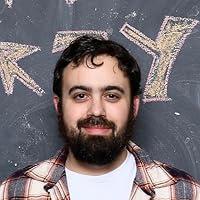
Gow grew up in rural Pennsylvania and lives in Allentown Pennsylvania with their two pugs, Eddie and Gertie and their queer family. He works at Bradbury-Sullivan LGBT Community Center coordinating supportive services for the local LGBTQIA+ community.
Awarded the Jerry Cain and Scott James Creative Writing Fellow, Gow earned their MFA in Creative Writing from Adelphi University where they also taught writing courses as an adjunct professor.
Gow runs the trans & queer reading series Gender Reveal Party and co-edits the new magazine The Comments Section.
Robin is the author of the chapbook Honeysuckle by Finishing Line Press and the collection Our Lady of Perpetual Degeneracy by Tolsun Books.
Their first YA novel in verse, A Million Quiet Revolutions, is forthcoming March 2022 with FSG Books for Young readers and their first essay collection, Blue Blood, is forthcoming with Nasiona Publishing House.
They is a managing editor The Nasiona and the assistant editor at large at Doubleback Books. They served for four years as the production editor of the Lantern literary magazine and are Social Media Coordinator for Oyster River Pages. They has also worked to help produce several zines and taught creative writing workshops in a variety of community spaces, including online forms.
They are an out and proud autistic bisexual genderqueer man passionate about LGBTQIAA+ issues.
Makes parallels to lanternflies just wanting to exist and humans just wanting to exist. Not being comfortable in your own skin. Feeling targeted for simply being. I see how it can benefit others, but was not really for me.
Read the conversation with the author at the end of the book. "In a sense this book is a love letter and a break up pain with my hometown". Knowing where the author is from, I understood this sentiment completely.
Robin Gow uses the unwanted, invasive lanternfly as a mirror for the experiences of queer people and feelings of otherness. The resulting poems, many of which incorporate language from instructions on how to eradicate lantern flies, are beautiful, sometimes funny or ironic, haunting, and insightful.
As one trying to exist as they are, sometimes in places they are not welcomed, Gow’s poetry is both a magnifying glass and a ransom note: both looking for the lanternfly. Loved the graphical and experimental pieces.
A fascinating and poignant meditation on what it means to be valued, alive, allowed to be—by oneself even if not by others. Gow uses the concept of “invasive species” to trouble ideas of belonging and value in the natural and human worlds. In poems that experiment with a variety of forms and imagery, Gow asserts, “I must be stopped and yet / here I am with a whole / cluster of hymns.”