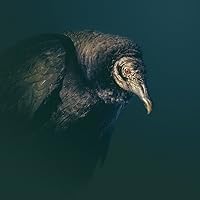
John James Audobon (1785-1851) is now best known for the birdwatching and conservation society which bears his name. He was at one time, however, best known for this book (or rather, the one which this is an abridged and smaller version). Audobon painted the birds of North America in detail, in their natural habitat and in lifelike poses, and was also apparently enough of a salesman to sell many copies of his work. Apparently the original was made with each bird reproduced at life size, so that the largest waterbirds were on large foldouts.
This reproduction, from 1950, shrinks them all down to a more normal 8.5" by 5.5" book, and declines to reproduce those which later generations have found questionable in accuracy. Audobon was accurate and meticulous for his day, but much was done in the century between his death and the publication of this book, to put the knowledge of what bird was what in North America on a firmer footing.
I notice that, in 1950, even as conservation-minded a volume as this one was willing to mention the (not inconsiderable in number) species whose status had improved in recent decades. More recently, any admission that anything might have gotten better in any respect is usually elided, or at the very least followed up quickly by statements to the effect that any gains are tenuous at best and much else is being lost. Which is no doubt true, but a lot of the reason for the erosion of popular support for conservationism in recent decades is that it is associated with relentless gloom, which is dispiriting and therefore enervating. If you don't want to admit to your successes, you will have more difficulty rallying people to attempt to secure more of them.
But the other thing sapping support for conservation, of course, is that most people no longer spend much time outdoors. In 1950, though, it was still the case that many people used Audobon's guide (and the many imitators that came afterwards) to help identify the birds they were seeing when they went on hikes, canoe trips, fishing expeditions, and so on. When they saw a picture of, say, a Great White Heron ("hybridizes with the Great Blue"), they could see that it was not precisely the same as the Snowy Egret, with which they may also have been familiar from real life.
Whether or not we will ever persuade people to venture forth from their climate-controlled, electrified, music-filled, and otherwise comfortable indoors where excitement and entertainment arrives without need of effort on their part, it is to our benefit that we have still records of what North America looked like in Audobon's time. I hope that a latter-day Audobon may someday find a way to persuade us to go out in numbers to see these birds in person.