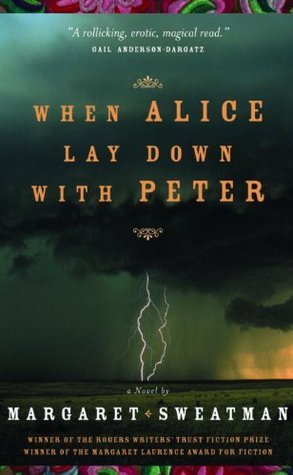
When Alice Lay Down with Peter is a sweeping, magical novel that follows four generations of the McCormack family through more than a century of Canadian history, as it unfolds on the flood plains of southern Manitoba. The story of Alice and Peter McCormack and their progeny is a glorious, witty, and intimate epic that truly reminds us that life stories not only include the details of the past, but also expand into the present and future, encompassing much more than the statistics of life and death would seem to admit. Narrated by Blondie McCormack--Alice and Peter’s daughter, who has just died at the age of 109--When Alice Lay Down with Peter is a novel that rejoices in the inevitability of change, and in the hauntings that reward our choosing to remember our own history.Just as When Alice Lay Down with Peter is a story of a family, it is a story of a particular place over time. Margaret Sweatman’s characters are never separate from the story of the land itself, or from the natural and political events that work away at its edges. The history of the McCormacks is a history of life on the of bountiful crops and devastating floods, the renewal of spring and the death that marks each fall. It is in the connection between the place and its inhabitants that we find the deceptively simple meaning of “home.” And it is to this conjoining of histories that Sweatman brings the lightning spark of her imagination, and out of which this wonderful novel has been born.
Margaret Sweatman is a novelist, playwright, and lyricist. She teaches literature and creative writing and performs with the Broken Songs Band. Her three previous novels garnered Sweatman the McNally Robinson Prize for the Manitoba Book of the Year, the John Hirsch Award for the most promising Manitoba writer, the Rogers Writers' Trust Fiction Prize, the Margaret Laurence Award for Fiction, the Sunburst Award for Canadian Literature of the Fantastic, and the Carol Shields Winnipeg Award. She has also won a Genie for the song "When Wintertime" which she co-wrote with her husband Glenn Buhr for the film, Seven Times Lucky. She was born in Winnipeg where now makes her home.
A great story following four generations of women in a family, as told by Blondie, the second generation matriarch. Set primarily in southern Manitoba, the author does a fabulous job of guiding us through the trials and tribulations of one family from the execution of Thomas Scott through time to the 1960's. Joined now and then with spirits from their past, this story reflects survival and empowerment while enduring multiple hardships, all the while revolving around the role women have in society, yet working to break the stereotypes.
This was another one that I found I didn't really know what I was reading about. Little bit of history interspersed with a couple generations of a family dynamic, in the wilderness then not of Manitoba.
Covering four generations of a settler family in Canada, this novel roams both history and territory with a sense of awe and magic. It is rich with growth and destruction, and real in its displays of survival, compromise, and discovery.
Could have been an epic Canadian story of one family but got bogged down on the weirdness of the main characters. Not so much a family but a lunatic asylum. Became ponderous.
This is a story of four generations of women in a Manitoba family told by a narrator of the second generation. The women of the family are involved with, or somehow connected and deeply affected by pretty much every portentous event from the first Riel Rebellion up to the 1960s, including the Boer War, the sinking of the Titanic, the First World War, the suffrage movement, and the Second World War, often as active participants. The book is firmly grounded in the Canadian Prairie genre, exhibiting a strong connection to the land, the soil and the often difficult existence settlers had. The book also has a dreamlike, ethereal quality. While this quality takes some time to get used to, it gives the novel an interesting sense of time and place, as if what is being told is perhaps not quite real or not quite as remembered, which given that the narrator is more than 100 years old may be a legitimate and deliberate device. My biggest critique is that while I acknowledge the need to suspend disbelief when reading novels, it still seemed a bit of a stretch to believe that this one family could be so intimately involved in every historic event during the period. I enjoyed the book and would recommend it to anybody that enjoys Can-lit.
"My mother's laughter, those nine months, came from the place where happiness and a nearly intolerable ache live together."
"[The newborn] is infinitely familiar. And infinitely new."
Some incredibly beautiful descriptive writing in this woman-centred (re)telling of (western) Canadian history, c. 1869-1979. The theme throughout is change, inconsistency, upheaval. People, ideas, values come and go, radicals always fighting at the margins and men leading wars in the middle. The scope is epic and while it flows from the narration of one woman about her lifetime, womb to centenarianhood, it is not really her story but that of the times, a lesson in history, nationhood and the natures of human things.
Interesting book. The scope of the tale is vast, as it's being told by the 96 year old Blondie and spans from before her birth. Her parents emigrated to Canada from Scotland (that's a story in itself) and settled near the Red River in Manitoba. Blondie tells of their lives, their involvement with Louis Riel, early homesteading, her birth, times of war and depression, marriages, births. All interesting and a few bizarre twists like a series of cross dressing women, ghosts that return to help and hinder, and a lot of ballsy women.
This is a fantastic story. Historical fiction woven with a fairy tale wonder for the world. The characters are complex, the descriptions of nature are lyrical and there is humour thrown in too. It is predictable near the end but not in a bad way, in an I can't wait for this to happen way.
Read it if you like mystical stories that are just a bit too perfect to be real life but have a grounded feeling and a less literal way of explaining the human condition.
Strange in a Canadian novel sort of way. I read it to the end, but probably if I’d had something better to read I wouldn’t have. Chronicles the life of four generations of a family living in Manitoba and (of all things) lays on the history of Manitoba quite heavily. This fact, plus the fact the characters are all eccentric, really made this a strange read.
Wow. What a surprising book. I was skeptical from the beginning - some of the first few words are "coupled loins," opening on a *really* dramatic sex scene - but Sweatman's vivid detailing soon won me over and I was entranced with the awesome women characters and the overlapping of history and present.
Margaret Sweatman is far too often overlooked, even in her own country . . . crowded out by the likes of Ms. Atwood -- a daunting form in Canadian lit.
"Why is a woman's love supposed to be expressed by patience? Such an unpredictable expression of strength."
I found this beautifully written, but strange...I loved knowing the areas written about, but really, all those women running off to all the different wars? In the end, it made me feel a bit stupid. I just didn't "get" a lot of it.