Jump to ratings and reviews
Rate this book

David Smiley #1

Albanian Assignment

Rate this book
Albanian Assignment is one of the finest special forces memoirs to come out of the Second World War. Readers of Damien Lewis, Ben Macintyre and Patrick Leigh Fermor will be enthralled by this book.In 1940 Winston Churchill established the Special Operations Executive to “set Europe ablaze.”Three years later David Smiley and Billy McLean were parachuted into northern Greece and crossed the border into Albania to do just that.For the next eight months Smiley mediated between the competing resistance factions and organised them to conduct ambushes and acts of sabotage on fascist armies and infrastructure.His actions were rewarded with an immediate Military Cross, yet his work in Albania was not done. Soon after he had left the country tensions between the Albanian resistance movements had deteriorated into open conflict meaning that Smiley and McLean were once again forced to parachute into the country to reconcile the guerrilla forces whilst continuing the fight against the Nazi forces.Smiley’s account of his time in Albania is a remarkable book that uncovers the operations and its difficulties of an SOE agent in one of the forgotten fronts of World War Two.“David Smiley, a regular officer of the Blues, was an early arrival in the country. His memoir of the time he spent there deserves to become one of the classics of special operations literature” John Keegan, The Sunday Times“wartime memoirs are often exaggerated and boastful, and sometimes the authors’ roles can safely be halved. But the writer here is an extremely modest man and the opposite precaution will be a help.” Patrick Leigh Fermor“This engrossing memoir recounts British intelligence agent Smiley’s two missions in 1943 and 1944 to Albanian resistance fighters.” Library Journal“David Smiley's tale of his war-time escapades in the SOE in Albania should have a broad appeal with its racy, comic and serious political aspects” Financial Times

192 pages, Paperback

First published January 1, 1985

337 people are currently reading
278 people want to read

About the author

David Smiley

20 books2 followers
Colonel David de Crespigny Smiley, LVO, OBE, MC & Bar (1916 - 2009) was a British special forces and intelligence officer. He fought in the Second World War in Palestine, Iraq, Persia, Syria, Western Desert and with Special Operations Executive (SOE) in Albania and Thailand.

He was Commander of the Sultan of Muscat and Oman's Armed Forces between 1958 and 1961.

Ratings & Reviews

What do you think?
Rate this book

Friends & Following

Create a free account to discover what your friends think of this book!

Community Reviews

5 stars
142 (28%)
4 stars
208 (41%)
3 stars
116 (23%)
2 stars
28 (5%)
1 star
5 (1%)
Displaying 1 - 30 of 38 reviews
Profile Image for Poppy.
74 reviews45 followers
August 5, 2025
An engrossing read and certainly informative. I need to read more of the Balkans. Colonel Smiley was there to bring factions together and smooth over any long held distrusts: united we stand....

Once into this, I wondered more than just the once if somewhere down the line David Smiley had any role in the naked belle and the MGB outside the offices of the SIS during the late hours.
Profile Image for Jamie Smith.
521 reviews112 followers
August 11, 2021
The value of partisan and irregular forces is not in their military capabilities. Poorly led, often poorly equipped, and almost entirely untrained, they do not perform well against real soldiers, presuming they will fight at all. The Albanian forces in this book were noted for melting away, not at the first signs of combat, but at the first rumors that there might be enemy forces in the area.

Others were no more than bandits, preying on the unprotected civilians and focused on settling scores with rival criminal gangs, and the groups supporting different political objectives preferred to fight each other rather than the enemy. They could occasionally perform militarily useful operations, such as ambushes or demolition, but their main value lay in the ability to tie down enemy troops. The Germans kept half a million men in the Balkans, soldiers who were not available to reinforce other theaters.

David Smiley’s book does a fine job conveying the frustrations of waging war in a such an ad hoc fashion. The Albanian forces were divided into three main groups, the communists, who were the best disciplined but focused primarily on eliminating their rivals rather than fighting the enemy, and two nationalist groups, one supporting former King Zog, and the other wanting to establish a representative government. The enemies were first the Italians and later the Germans, but even that was confusing. When Italy surrendered, some of their troops in Albania wanted to keep fighting with the Germans, some joined the resistance to fight against the Germans, and most just wanted to go home. The confused situation was exemplified by a group of several hundred “Turkmen” from central Asia, a mixed group from Turkmenistan, Kazakhstan, Tajikistan, and Kyrgyzstan. After being drafted into the Soviet army, they mutinied and killed their officers at Kharkov in 1942 and defected to the Germans, who assigned them to garrison duty in the Balkans. In 1944 they killed their German officers and offered themselves to the resistance, joining a group with Albanians, Italians, Yugoslavs, and the occasional German deserter.

The British, and later the Americans, provided arms, equipment, and money via air drops. The British did a better job of it, since the Americans made their runs from too high an altitude and scattered supplies over several miles. This was not just an inconvenience, since the theft of supplies was a constant problem, with both villagers and allied fighters stealing anything they could lay their hands on. In the case of the American drops, one-third of the total often went missing. Partisan leaders would seek out the British liaison officers after the drops to beg for supplies. A constant refrain was that they were eager to fight, but they just needed more arms, no matter how much they had already received.

The British military mission to Albania had started with just one major and three or four others, including Smiley, but eventually grew so large a brigadier with a full staff was assigned. This was not a good idea, because the general wanted to run things along conventional military lines, and insisted on normal army procedures and discipline. His large staff could not be relocated in a hurry when the enemy approached, and sure enough, his headquarters was attacked, his staff scattered, and he himself was wounded and spent the rest of the war as a POW.

Among the communist partisan forces, no military objective was as important as eliminating their internal rivals. In what would become a familiar refrain, they would claim to have launched a major attack resulting in hundreds of enemy casualties and the destruction of large numbers of vehicles and armaments, but somehow they could never produce identifying unit information from the enemy dead, and in the cases when Smiley investigated their claims, he found that they exaggerated their success by a hundredfold. At one point an 800-man communist battalion marched out to attack an enemy position but retreated without firing a shot when confronted by a twenty-man garrison.

Relations with the communist leaders continued to deteriorate and by late 1944 the country was in open civil war, with the Germans almost forgotten. British liaison officers embedded with the communist forces reported that the nationalist groups were collaborating with the Germans, and should get no more support, and they were believed. Smiley has a strong, and probably well-founded, suspicion that the communists were aided and abetted by fellow-travelers at British headquarters. They ignored assessments made on the ground, suppressed requests for higher level intervention, and even ordered Smiley and his group to surrender to the communists and be escorted out of the country, though they knew that the partisan groups searching for them had orders to kill them on sight. Smiley believes that Albania had a chance for a democratic post-war government, but those hopes were sabotaged by British communists in the foreign office and operational headquarters.

Much of the actual damage done to the Germans was by Smiley and his little group themselves. They were experts at bridge demolition, dropping a number of important spans, and conducted ambushes whenever targets of opportunity arose. They would mine a road, wait for a German vehicle to pass over it, then open fire on the occupants. One of their mines was a small piece of explosive that looked like a piece of manure, but was powerful enough to destroy a tire and bring the vehicle to a halt.

On two occasions Smiley was conducting reconnaissance with members of one of the irregular groups, and was dressed as a gendarme. The Germans were familiar with the gendarmes and ignored them. The groups he was with flagged down German trucks and rode to their destination in the back, alongside German troops who paid them no attention.

The book was published in 1985 and yet contains very detailed descriptions of what Smiley did between 1943 and 1945. He mentions that he kept a diary, which he knew was against orders, so this must be where he got the information for the book. However, if that is so the diary was not just a violation of the rules, it was a very serious breach of operational security, in that he kept detailed records of daily events which would have been a goldmine of information if it had fallen into enemy hands. At one point he listed all the local partisan groups in the area, including how large they were, where they were based, and what machine guns or mortars they possessed.

After the war Smiley was posted to a top secret operation on Malta that trained Albanian patriots to re-enter their country to try to fight the communists. However, their plans were betrayed and many of them were captured and killed as soon as they returned. It later turned out that the likely source was none other than Kim Philby, the most highly placed Soviet spy in the British government, who was responsible for untold damage to American and British intelligence efforts.

The book is well written, and captures the sense of what it was like to be on the ground behind enemy lines. Smiley describes the people, the tactics, and the operational procedures, and delights in the mayhem he created. As he says of himself, he just wanted to blow things up. It was a dangerous mission, and many of his fellow operatives were killed; he was often hungry and freezing, and suffered recurring bouts of malaria. He did a fine job under extremely difficult circumstances, but in the end his efforts came to little: the partisans wanted to fight each other more than the Germans, and sympathizers in the British government helped ensure Albania would have a communist post-war government.
Profile Image for Paul Alkazraji.
Author 5 books225 followers
May 12, 2023
Smiley 3
Smiley and McLean: Lives of derring-do.

When Smiley and McLean drop into the Epirus Mountains, avoiding the common mistake of breaking their noses on the other side of the Halifax’s hatch, their Albanian adventure begins. Smiley thuds onto the bed of a rocky stream to be hugged by a big, bearded, bandolier-wearing Greek, and they set off on their mission to organise the local resistance and harassment of the occupying WW2 German forces.

Smiley was friends with Patrick Leigh Fermor, who famously stole a German general on Crete and took him to Cairo in ‘Ill Met by Moonlight’. It was through Smiley’s book that I learnt of film actor Anthony Quayle’s presence in Albania, looking as sick as he did on a stretcher in ‘The Guns of Navarone’, and wrote a fictional scene around it in my own novel ‘The Silencer’.

For me this book has added local interest as much of the action takes place in the mountains I can see from my window, in the villages of Vithkuq, Shtylle and Voskopojë. His map makes it possible to walk in the footsteps of, through spectacular mountain scenery, without, that is, blowing up bridges with the ҫetas - as Smiley did. Furthermore, a friend of mine met him once, half a century later, when he returned.

He was unimpressed with Hoxha’s ‘shtab’ and the Partisans, who sought British weapons, exaggerated the successes of their operations against the Germans, sabotaged Zogist operations in process, and eventually sought to capture and execute him and McLean as they readied themselves for the post-war power grab of Albania.

Smiley’s band of Zogists, downed pilots and deserters became the last stand of forces that might have turned Albania in an entirely different direction for the next half-century, away from what Albanians subsequently had to endure.

Though it may have started with a purer idealism, of human effort striving to create a workers’ paradise, it produced a workers’ prison camp. It factored out the defects in human nature, taking no account of sin. So many of those in the 1st Partisan Brigade fought for a cause that later purged or executed them, until the friendless Enver Hoxha was the last man standing.

Not as thorough as Julian Amery’s ‘Sons of The Eagle’, ‘Albanian Assignment’ is, nevertheless, a good jumping off point from which to parachute into the world of SOE memoirs in the country.

Enver
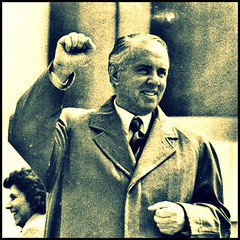
Enver Hoxha: 'Last man standing'.

David Smiley’s obituary in The Guardian.
https://www.theguardian.com/world/200...


By this reviewer:
Christ and the Kalashnikov by Paul Alkazraji The Silencer by Paul Alkazraji The Migrant by Paul Alkazraji
Profile Image for Mary.
85 reviews38 followers
April 25, 2022
I knew nothing of the Balkans prior to joining Goodreads; if you had asked me to point it out on a map I would have failed.
A hotbed of spies, ethnic hatreds, religious rivalry and political power struggles; and part of Nazi Germany's 'soft underbelly' where those charged with 'setting Europe ablaze' might, by use of a little 'ungentlemanly warfare', do significant harm and cause re-direction of Axis forces from other fronts.
And with that, the then Captain David Smiley was 'dropped' into Greece and given the task of sneaking into Albania.
This is his account of the brave men and women he worked with, the diplomacy that they struggled with, the continual juggling they faced and the hardships suffered.
It is such an informative thriller; reading of the lives of those he became friends with was a joy and realising the despair the entire region suffered was saddening.
It is wonderfully written and worth every minute of my time. I feel privileged to know of the sacrifice these people made: the vast majority wanting nothing but a peaceful existence.
In the preface, Colonel Smiley states:
"TO MY ALBANIAN FRIENDS, ALIVE AND DEAD."
I will read this again: I can but say, "Thank you," to them all.
Profile Image for Mike.
800 reviews26 followers
September 29, 2024
This book is a memoir of the author's account of his time serving with the SOE in Albania during WWII. The writing is typical of first-hand memoirs and is somewhat understated. The subject on the other hand is a something that I have seen very little information on. The author details his efforts in Albania and describes how he was thwarted and nearly betrayed by those working in comfy offices. It describes activities related to the country becoming part of the Soviet sphere of influence after the war.

If you are interested in special operations, the Eastern Front, or events that shaped the Cold War, this is a good book to read.
Profile Image for Jenny.
28 reviews17 followers
May 18, 2025
Another of those most humble, gracious, witful and, when necessary, very deadly men. A great read and it brings me hope when I discover these types. Thanks again Goodreads.
Profile Image for Sam.
170 reviews
January 21, 2018
Overall a good read. What comes across most is the frustration of wanting to do so much to help, and yet accomplishing relatively little due to a number of factors.

The author is very anti-communist which he makes no bones about in the book. I did find it strange that the first sentence of Chapter 8 on page 102 starts with: "In the previous chapters on Albania I have avoided politics.." since there was ample discussion of politics up to that point; he was shunted between pro-Zogist and communist partisan groups that were for the most part more interested in fighting each other than attacking the occupying Italians and Germans.

To me, the politics at play behind the scenes which helped shape postwar Albania into the hard-line communist state rather than a pro-western democracy was one of the most interesting parts of the story.
Profile Image for Chaplain Stanley Chapin.
1,978 reviews22 followers
February 28, 2021
A history lessson

I found it every interesting at times and extremely boring at other times. The descriptions of the land and some of the participants was excellent, while some of the other unneeded.
Profile Image for Dottie (I'm not dotty).
26 reviews13 followers
April 1, 2025
An amazing account of the authors time in Albania. To me it feels incredulous the life both the men and women of SOE lived.
I sleep outdoors, from choice, most nights of the year: it is fantastic. To think how these people lived and survived.
Mr Smiley was indeed a first-rate, front-line, manager of a fearsome bunch.
Profile Image for Millie Nevelos.
455 reviews3 followers
October 20, 2022
It's an interesting story I just don't think I really liked him. Very privileged viewpoint and also just a confusing timeline too.
Profile Image for Martin Turner.
25 reviews11 followers
July 13, 2024
At times this reads like contact report, many of which I'm sure the author has written in his time.

Still, a most engaging tale of a good deal of brave people.
286 reviews2 followers
April 5, 2023

I am a voracious reader of post-WWII Albanian history, yet almost all of my reading on the subject was done years before I started to keep a blog of book reviews in 2010. In the past thirteen years I see that I have only read two other books on the country. I bought Albanian Assignment by David Smiley around thirty years ago at a pop-up remainders bookstore. Three decades later and it’s time to finally read it.

During World War II Smiley was working on a British Special Operations assignment with the mission to infiltrate Albania to organize local resistance against the occupying Germans and Italians. His memoir–brief at only 168 pages–was a speedy read as a mixture of military strategy with uproarious observations. It isn’t often that one laughs out loud during a wartime memoir, but these passages continue to do so, even after multiple rereads:

“Enver Hoxha was an entirely different character–a big man with too much flesh and a flabby handshake.”

“Gerry Field had dropped out of the same aircraft as Tilman, actually managing to be sick as he was coming down in his parachute, which sounded very messy as he came down faster than his vomit.”

“Once they were formed up, there began a series of the longest and most boring speeches it has ever been my fate to listen to. Only the intermittent shouts of ‘Death to Fascism’ and ‘Liberty to the People’ kept me from falling asleep. McLean’s speech was by far the best, for it was the shortest. I secretly hoped that an Italian aeroplane would fly over and bring the proceedings to an end, but no such luck.”

“I was with a small partisan çeta at the time, and the leader suggested that as it led to the fortifications it might be worth blowing up. I heartily agreed, for I liked blowing things up.”

“I was getting pretty fed up at the thought of further inactivity. I can’t have been much good at hiding my feelings, for I overheard McLean remark to Amery, ‘David seems to be getting restless again; we must find him something to blow up.'”

“My shouted whispers had to be contained for half an hour while a German staff car was tiresome enough to have a puncture on the bridge and the occupants changed a wheel; some of us were actually under it at the time, not daring to move back for more explosives, for fear of being seen. One German reminded us of his presence by urinating over the side, but luckily he did not score a direct hit on any of us.”

Smiley painted a picture of himself as a modern-day Superman, which he no doubt was, parachuting into Albania and living undercover in forests among warring factions, surviving on the meagrest of rations. With scant resources to communicate and navigate, he was never captured by the enemy and although he wasn’t shot or maimed he did suffer recurring bouts of malaria.

The mission was in vain as Smiley was battling not only Germans and Italians but Albanians themselves who were on the brink of civil war. As one of the citations above shows (as well as the photos section), Smiley had encounters with Enver Hoxha who would later become the President of the People’s Socialist Republic of Albania, and who turned the country into a xenophobic isolated state of terror for over forty years.

1,213 reviews165 followers
January 6, 2025
Behind the Lines in the Balkans in WW II

The Italians occupied Albania in 1939 without much trouble. They had already dominated it economically before that. The King and his part-American queen fled the country, taking their two-day old son with them. World War II in Europe began officially about five months later, a vast whirlpool of death and destruction that is probably at least partly familiar to everyone. Albania didn’t loom large in the scheme of things, there were no big battles involving thousands of troops, no heavy bombing campaigns or tank battles. However, that small Balkan country also saw its share of action. As in neighboring Yugoslavia, a variety of anti-Axis forces sprang up. By 1943 they were engaging in sporadic fighting with the superior Italian forces. The British decided to help these guerrilla forces to tie down as many Italian troops as possible. That’s why they parachuted in a few brave officers to meet the partisan groups, encourage them to attack the invaders and supply them with arms, food, tents, gold, and other materials necessary to maintain an ongoing struggle. As this process unfolded, Italy was knocked out of the war and the Germans took over.
That’s the picture when David Smiley walked into Albania with a couple of others after being parachuted into northern Greece. These men had only a sketchy idea of the situation inside Albania. They successfully contacted a group of guerrillas who turned out to be Communists under the leadership of Enver Hoxha, who eventually became El Supremo of postwar Albania, remaining in charge till his death in 1985. Relations were never very warm, but the Communists, unlike the several other resistance groups, actually fought the Italians, then the Germans. Unfortunately, they also fought the Nationalist and Royalist groups as well. But, the orders were to get the Albanians to attack the Axis forces and the Communists did. Hence, supplies of all kinds were parachuted to them at night at predetermined spots arranged by the British team, who also had a good supply of gold coins to buy local supplies and allegiance.

ALBANIAN ASSIGNMENT is the story of two such efforts, for at last the Communists turned away from the British, even threatening them with captivity or worse. Smiley and the group were evacuated. The second effort was after being parachuted directly into north-central Albania and linking up with the non-Communist partisans. Ultimately, the British mission failed, the Communist attacks plus the falling fortunes of the Germans all over, led to the Nazi evacuation of Albania and the Communist takeover. The non-Communist forces wound up too close to the Germans, which prevented the supply of weapons etc. from the British, which in turn doomed their efforts.
Smiley writes in a very personal, direct style with few political or cultural observations. He liked blowing up bridges and had a few spectacular successes, but in general the British team was not there to fight, but to encourage the guerrillas. He and the group had to climb countless mountains, walking for many hours, go without much food or rest, living off the assistance of isolated villagers, and even disguise themselves as Albanians and venture into towns for reconnaissance. We meet some of the other British and many Albanians who helped them or worked for them.
It’s a short, readable account of a part of World War II which is certainly not well known.


Profile Image for Virginia O'Malley.
Author 10 books22 followers
August 19, 2020
Albanian Assignment: The Memoir of an SOE Agent in World War Two
Author: David Smiley
Publisher: Sapere Books, London
Years: Published August 2nd, 2020 (first published January 1st, 1985)

This book is the memoir of Colonel David de Crespigny Smiley who gives an insight into the life behind the scenes during World War Two. David Smiley (Mr. English Captain) and his companion Billy McLean are parachuted into northern Greece and crossed the border into Albania.

This book shows a fly on the wall look behind the scenes of the hardships faced, the sights they endured, the companions they met. The message communications they sent between one another, knowing their letters would be opened; they had their own way of getting around that.

There are some interesting parts where the author says that beards in Albania were customarily worn by priests and outlaw. Most of the men described in the book had facial hair or grand moustache which were the style at that time. Sovereigns were important and carried to get supplies or any assistance on the journey towards survival.

There was a section where the men had to “Stand to” which meant they had to be ready fully dressed in uniform and weapons for an attack at whatever time was agreed which was sometimes as early as 5 am in the morning, considering the times they usually retired for bed would be very late at night.

I found the local customs and living areas most interesting and the hospitality of the Albanians. I think this section makes a most interesting read about the housing, cooking, household, and hospitality and taking of the weapons at the door.

Some parts are terribly sad especially when people are ridden with hunger and forced to eat the mules, they have been using to transport them. When they had no water to drink but that collected in the puddles from rain shows considerable strength to survive. The boat filling with water, containing the film, briefcase, and maps of important documents. What do you do when faced with this situation?

This is an interesting read regardless of your political views. You must bear in mind that this is the past and the information must be preserved and the memoir of these brave men is a must-read. The cover of the book is a lovely photo probably of the men featured in this book or some of their companions.

Colonel David de Crespigny Smiley, LVO, OBE, MC & Bar (1916 - 2009) was a British special forces and intelligence officer. He fought in the Second World War in Palestine, Iraq, Persia, Syria, Western Desert and with Special Operations Executive (SOE) in Albania and Thailand. He was Commander of the Sultan of Muscat and Oman's Armed Forces between 1958 and 1961.
Profile Image for Mark Allen.
79 reviews11 followers
September 24, 2020
This was given freely for review by Sapere Books.

It's hard to imagine that lives like this are real. David Smiley was a young man who was an army regular at the outbreak of war. After service in East Africa he used his family influences (he was of noted stock) to join a commando corps and started his most extraordinary adventures. After missions in Abyssinia, Syria and Palestine he joined the Special Operations Executive and was parachuted into Albania to work with the locals against Italian and then German occupation.
What is most fascinating about these times is the underlying politics. Albania wasn't (isn't) a country of similar people. There are different ethnicities, tribes and religions with some being Muslim and some orthodox. Sadly, these differences in that region never seem to have settled and in my lifetime there have been tragic events in Kosovo against ethnic Albanians.
At this time communist forces are also trying to establish power in the region. The British government plays games behind the scenes trying to not only win the war but also influence the outcomes. Will we ever learn that arming groups with British weapons so often works against us? As we now know Albania entered Soviet influence and King Zog was exiled - it could so easily have been a similar story in Greece where civil war was also unfolding at the same time.
Back to Smiley - he is at the forefront of these events. He discusses with all parties in the field in an attempt to drive out the Italian and German forces. He moves around using false identities or disguises and at one point even has a lift in a car with a German soldier. All this despite speaking little Albanian and conducting many conversations in French. The sheer front of the man (and others alongside him) is phenomenal.
A strange and disconcerting aspect of the book, to me at least, is the cold bloodedness of war. While Smiley clearly describes with fondness certain dishes he ate, houses he stayed in and girls that served him the truly exciting events are tossed aside in the manner of "we laid a mine to disable a troop lorry and killed about 20 men as they jumped off". Simple as that, and yet the affection he had for a horse was enough that he showed real emotion at parting. I guess that's how soldiers are trained.
I really enjoyed these memoirs - the politics really drew me in, especially being of an age that remembers the Cold War of the 80s, the fall of the Iron Curtain and the Balkan wars of the 90s. This is where it all started and it's not pretty reading for fans of British influence. Our soldiers are as incredible as ever, our politicians as inept. Greece avoided communism despite British aid, not because of it according to this book.
A great read for fans of politics and war history as well as those who want a true story of incredible heroism, this is a recommended read.
24 reviews
June 11, 2021
Because he was too busy living, soldiering and adventuring, it was not until the 1980s that Lt-Col David Smiley published his three excellent memoirs, of which Albanian Assignment is the first. It deals with two SOE sabotage missions during WW2, the first against the Italians and the second, after a wild period of Rest and Recreation, against the Germans and, arguably, against some very nasty partisans once he figured out who they were. By the 80s many fellow cloak-and-dagger military friends had written of their own experiences there, but this is arguably the best. This may be because the passage of time allowed maturity of perspective and assessment. Shortly after publication Albania would awaken from the long spell of a particularly deadening Communism under Hoxha which he and his forces failed to divert.
All military staff are taught to ‘read and write’, by which is meant to create clear, concise, comprehensive, complete and accurate reports fit for use in future strategic planning. To these Smiley could add detailed and reflective personal diaries, and support from surviving contacts both from among former SOE companions and from Albanians and their families. That these friendships survived tells a great deal about the man. His writing in the memoirs is far from clinical as he brings a compassion and shrewdness of judgment, curiously laced with a maverick’s ingenuity. I first read this book when it was published in 1984; rereading it three and a half decades later I find it as fresh, informative and moving as I did then. What happened in the Balkan wars still influences today’s events, and Smiley’s descriptions of the descent into chaos and distrust is a vivid warning for today’s readers and politicians.
14 reviews
Read
September 2, 2020
This is a very interesting first-hand account of a British officer sent into Albania to organize resistance against the Italians and Germans during World War II.
It containes stories of hair-raising escapes, battles, dangerous journeys and local diplomatic efforts. The writer has a poor opinion of many of the partisans he was trying to help, as the British had food and supplies stolen, yet he also has great respect for individuals he came to know.
You can tell this account was written by a professional soldier as all these adventures are recounted in a straight-forward manner, with little embellishment. He refers to his own heroics, such as laying mines and blowing up bridges as matters of fact, of duty, not heroism.
He was also in n a delicate position, having to maneuver among the different factions in Albania who disliked each other and wanted to run the country after the war. Actually, a civil war did ensue and several of the leaders he dealt with did later rise to Influential positions in the Balkans.
This is a book well worth reading for those interested in covert operations in World War II. There should be a movie!
Profile Image for Marie.
284 reviews3 followers
Read
June 18, 2021
Talk About Complicated!

This very readable book, clearly described what must have been one of the most complicated war theatres to be involved in- on the local scene civil war was pending as power & politics became ascendant, ignoring the World War on its' borders! Communists, loyalists, racial groups and democratic fighters were all in the mix. The Germans were invading, Italians were joining any group who would arm and feed them, Russian defaulters were innumerable, Greeks were escaping the Germans and the local peasants were confused and able to be bought. To try and work a war resistance group by a few British agents in the midst of this chaos, was some tall order!
The story moves quickly, is at times harrowing and tense but at others is witty and even funny. However frustrations run high with traitors and spies and people motivated by greed and personal gain.
Very readable and certainly informative!
22 reviews1 follower
September 2, 2020

Wow, what book!! What a life!! I don't normally read this type of book, but it intrigued me!! So brave, and it reminded me of my dad, as he was in the Far East, in the 'Buffs' and he would never tell me everything that happened fighting the Japanese, so took it to his grave!!!!! Some stories I know, and they were horrifying enough!!
Not only was David Smiley trying to do his job of fighting and his reconnaissance of the Germans, he was also having to deal with the 'Partisans' & the idiots at 'Bari' (and now we know why!! How frustrating) aswell!!!!
Honestly, you would think that this was Fiction, I had to keep reminding myself that this was real, it actually happened!!!!!
Such bravery, it made me cry a little for all of them, and felt very proud to know there was such bravery from the British, Albanians, and some poor Italians who 'saw the light'!!
177 reviews3 followers
August 30, 2020
This is a very interesting and thought provoking book. The story of David Smiley and his fellow agents’ time in Albania during WWII is not an easy or quick read, primarily due to the amount of information that you need to absorb to appreciate the book. The narrative is very matter of fact and, in some ways, seems to downplay the dangers they faced from several sides. The air drops they received frequently included arms and gold sovereigns, dangerous things to possess when you’re in the middle of a war.

This book is well worth reading, amongst other things, for its insight into partisan activities during the war and its effect on post war Albanian politics.

Thanks to Sapere Books for a review copy
149 reviews1 follower
June 14, 2022
A big fan of the works and life of Patrick Leigh Fermor, I was lead to this book through a reference in a book about Fermor. Not a very long read, Smiley's book details his assignments as a British agent in Albania during WW II. Not as captivating a writer as Fermor, Smiley is short on details in many places, but the story is fascinating nonetheless. Admittedly, it was often a tough read due to my unfamiliarity with Albania and its history. In my view, a map with the locations discussed would have been very helpful, as almost none of the geographic references are familiar. Additionally, the many names of the many Albanians involved is his narrative are hard to keep straight, and the book is without an index, so his "Postscript" is not easy to follow.
Profile Image for Thomas Shears.
22 reviews1 follower
September 9, 2020
A very enjoyable read about David Smiley's exploits in Albania during World War II. Mr. Smiley's team had an almost impossible task of trying to get the Albanians to fight the German occupiers while wrestling with the political problems of the Albanians. The Communist partisans were fighting for control against nationalist Zogists and Ballists, and all they wanted to do was fight each other with British help. The Alabanian terrain is a major player in the story as well. A very enlightening and interesting story of SOE operations in Albania.
Profile Image for John.
137 reviews38 followers
February 27, 2021
A riveting story. To read, first hand, how the SOE managed from day-to-day, at times brought a shiver. On several occasions, having read a passage, I had to sit and think about the determination and the endurance it must have taken to achieve an aim. These people were certainly tough - as old leather. The author, himself, and also at times amazingly lucky, to escape injury/death. The politics of that era was as fraught as the combat SOE undertook. I enjoyed this and tip my hat to all involved in the 'daring-do' [derring-do].
Profile Image for Gazmend Kryeziu.
3 reviews30 followers
August 26, 2022
An incredible account of a brave and intelligent SOE agent helping Albania and the Albanians in the most difficult times.This is a true account,very different from the stories that we were taught in school during Enver Hoxha’s dictatorship.I admire and I am greatful for the sacrifices that Mr Smiley and my three cousins Said Kryeziu,Hasan Kryeziu and Gani Kryeziu fought for a free Albania.Hasan Kryeziu was executed by Tito and Gani Kryeziu was sentenced to five years hard labour.Said Kryeziu is a banker in New York USA.
147 reviews1 follower
June 29, 2024
Happened to find this book after reading about the Durrells in Corfu and then wondering if there are still any countries like Corfu at that time and then I somehow wandered into Albania in my research. Later I read the first Mrs. Pollifax book which actually takes place in Albania so I felt pretty prepared for this nonfiction diary of a Secret Service person towards the end of World War II. Compelling narration also made it an enjoyable audiobook. It seemed to me the author, David Smiley, was part of the inspiration for the John le Carre books which I will look into next.
27 reviews
October 21, 2020
Interesting story, but I found it almost too complex in determining who were their allies and who were their enemies, since they changed with time and situation. Unsure of the level of success due to the lack of coordinated support from their superiors. Full of strange names and strange places that I found it difficult to relate to and to remember. All these point aside, it was an interesting tale.
8 reviews6 followers
September 23, 2024
Another terrific read: two in a row.
SOE/MI6/Military Intelligence/David Smiley: a man with what it takes to pull conflicting resistance groups together and set about disrupting the enemies operations. This tells what SOE - at the coal face - was all about.
I could not have enjoyed this more: books like this need to be held up high. There are hundreds of reason why we overcame the Nazi regime, people like David Smiley are part of that.
118 reviews1 follower
August 20, 2021
Good view of Albania in WW2 and a view into the Cold War

Balkan politics - good god. British officers from the right regiments in rough conditions. Getting a good map might have helped; I didn’t even try. The reader can see why Soviets and national communists were so distrusted.

Profile Image for Val.
10 reviews12 followers
July 23, 2025
'The Extraordinary Life' is not an understatement. Is it the tragic event (WW2) that brings these people to the fore or are they always destined for a place in our history. That question struck me when I read of Fitzroy Maclean.

Another breathtaking account of a man who put his duty to the crown before all else.
7 reviews
March 23, 2021
Very brave men

A magnificent history of agents in Albania during World War 2. It is hard imagine what these brave men went through. Real eye opener and should be compulsory reading schools.
Displaying 1 - 30 of 38 reviews

Can't find what you're looking for?

Get help and learn more about the design.