Jump to ratings and reviews
Rate this book

The Cossacks and Other Stories: Stories of Sevastopol, the Cossacks, Hadji Murat

Rate this book
In 1851, at the age of twenty-two, Tolstoy joined the Russian army and travelled to the Caucasus as a soldier. The four years that followed were among the most significant in his life, and deeply influenced the stories collected here. Begun in 1852 but unfinished for a decade, The Cossacks describes the experiences of Olenin, a young cultured Russian who comes to despise civilization after spending time with the wild Cossack people. Sevastopol Sketches, based on Tolstoy's own experiences of the siege of Sevastopol in 1854-55, is a compelling consideration of the nature of war, while Hadji Murat, written towards the end of his life, returns to the Caucasus of Tolstoy's youth to explore the life of a great leader torn apart by a conflict of loyalties. Written at the end of the nineteenth century, it is amongst the last and greatest of Tolstoy's shorter works.

532 pages, Kindle Edition

First published January 1, 1863

99 people are currently reading
1205 people want to read

About the author

Leo Tolstoy

7,960 books28.5k followers
Lev Nikolayevich Tolstoy (Russian: Лев Николаевич Толстой; most appropriately used Liev Tolstoy; commonly Leo Tolstoy in Anglophone countries) was a Russian writer who primarily wrote novels and short stories. Later in life, he also wrote plays and essays. His two most famous works, the novels War and Peace and Anna Karenina, are acknowledged as two of the greatest novels of all time and a pinnacle of realist fiction. Many consider Tolstoy to have been one of the world's greatest novelists. Tolstoy is equally known for his complicated and paradoxical persona and for his extreme moralistic and ascetic views, which he adopted after a moral crisis and spiritual awakening in the 1870s, after which he also became noted as a moral thinker and social reformer.

His literal interpretation of the ethical teachings of Jesus, centering on the Sermon on the Mount, caused him in later life to become a fervent Christian anarchist and anarcho-pacifist. His ideas on nonviolent resistance, expressed in such works as The Kingdom of God Is Within You, were to have a profound impact on such pivotal twentieth-century figures as Mohandas Gandhi and Martin Luther King, Jr.

Ratings & Reviews

What do you think?
Rate this book

Friends & Following

Create a free account to discover what your friends think of this book!

Community Reviews

5 stars
284 (32%)
4 stars
359 (40%)
3 stars
191 (21%)
2 stars
36 (4%)
1 star
13 (1%)
Displaying 1 - 30 of 75 reviews
Profile Image for Carolyn Marie.
415 reviews9,608 followers
February 5, 2022
Finished The Sevastopol Stories for the first month of Dickens vs. Tolstoy 2022!

Can’t wait to read the other stories in this collection!
Profile Image for Lee Klein .
910 reviews1,058 followers
February 5, 2019
Not sure if this is the best translation of "The Cossacks,” seems semi-wonky and less active than the others I’ve looked at (Maude, eg), will read other translations when I re-read, and this short novel (~150 pages) is worth re-reading as proto-Tolstoy. Early on there's a fantastic scene: shooting a man floating down a river not quite hidden enough by a tree stump, followed by a love triangle between a wealthy Moscovite soldier of sorts (Tolstoy's authorial stand-in, Olenin) looking for truth, beauty, a sense of what's real in life; an authentic young Cossack named Luka, who shot the enemy in the river; and Maryana, the triangle's enticing pinnacle, in blue shirt that reveals her beautiful, strong-armed, sturdy form (not like those fancy ladies up north with their thin arms) when backlit in a way that jumps off the page, most likely regardless of translation.

Character names are "exotic" and difficult to remember a few days after finishing -- there's an older man, very friendly to Olenin, who like Platon in W&P embodies the sort of perfect authenticity that for Tolstoy seems to be the ideal way of being, the sort that his stand-ins like Pierre or Olenin in this case admire with total sincerity, envying only in an aspirational or instructive way, not with anything like jealousy.

Felt like it really lagged midway through but that may also have had something to do with multiple sittings reading only a few pages -- again, the translation felt wonky and I often zoned-out in a way that usually signals that I've hit a passage that didn't quite make sense and sent me into a state of "blind reading" for a while. POV often switches mid-paragraph which can be tricky too. Omniscient third-person POV in general not nearly as steady as in W&P and AK. A great festival with everyone out on the streets in sparkly clothes (reminded me of the Mummers in Philly on New Year's Day) as the sun drops behind the mountains. The setting really comes through throughout.

Here's a quotation that suggests the representative passage in W&P involving Pierre's dream of the globe made of little globs surging and replacing one another that represents God and life, also with some KOK resonance:
"The Caucasus appeared quite different from what he had imagined it to be. Here he had found nothing that resembled his dreams, or the descriptions of the Caucasus he had heard and read. 'Here there are no burkas, rapids, Amalat-Beks, heroes or villains,' he thought. 'People live as nature lives: they die, are born, copulate, are born again, fight , drink, eat, rejoice and die again, and with no restrictions but those unalterable ones that nature has placed on the sun, the grass, the animal and the tree. They have no other laws but those . . . '"

A little expedition the next day that ends in an extraordinarily active and rivetingly clear half-page of violence. Didn't see the ending coming (expected a duel) and therefore loved it. Recommended for a taste of proto-Tolstoy. Will re-read the Maude translation most likely, already downloaded it from Kindle for like 99 cents although it's also available at Project Gutenberg and elsewhere for free.

"The Sevastopol Sketches" reminds me of Prince Andrei's roving tour on horseback among the soldiers before the battle of Austerlitz, I think, but without really much characterization. All war, no peace, with only suggestions of characters. I kept reading and fight off the temptation to quit it for lines about the word "aristocrat" and mention of Vanity Fair (Thackery apparently influenced W&P) and other glimpses of what the young author unleashes fully formed once matured.

This question seems like Tolstoy's challenge to himself -- and why he ultimately writes a novel featuring a slew of aristocrats faced with the challenges of war: "Why did authors such as Homer and Shakespeare write of love, glory, and suffering, while the literature of our own age is merely an endless sequel to The Book of Snobs and Vanity Fair?" (Should probably read Vanity Fair, not sure about The Book of Snobs.)

"Sevastopol in May" -- as in The Cossacks, another totally riveting scene of violence, this time with a shell whistling down, falling, not detonating right away, and then Tolstoy demonstrates what goes through the minds of two men nearby, one whose chest is blown open and the other who's only hit in the head with a rock. The prose completely clarifies and the two pages fly by as the absolute climax of "May." And then at the very end the author pretty much reveals the moral of the story, which directly relates to what I'd sensed about the roving perspective and insufficient characterization, the last bit of which is often quoted in Tolstoy bios and essays:
"Where in this narrative is there any illustration of evil that is to be avoided? Where is there any illustration of good that is to be emulated? Who is the villain of the piece, and who its hero? All the characters are equally blameless and equally wicked.

Neither Kalugin with his gentleman's gallantry . . . and personal vanity -- the motive force of all his actions -- not Praskukin who, in spite of the fact that he falls in battle for 'Church, Tsar and Fatherland', is really nothing more than a shallow, harmless individual, not Mikhailov with his cowardice and blinkered view of life, nor Pest -- a child with no steadfast convictions or principles -- are capable of being either the villains or heroes of my story.

No, the hero of my story, whom I love with all my heart and soul, whom I have attempted to portray in all his beauty and who has always been, is now and will always be supremely magnificent, is truth."

(Just now checking out "Vanity Fair," I see that its subtitle in some editions is "A Novel Without a Hero.")

"August" was more of the same. I finished it over the weekend and can't really remember how it ended. Again something about vanity, dying for the fatherland?

I read Hadji Murad in the Maude translation eleven years ago and didn't think much of it on first read, not sure why it's lauded as a masterpiece. Maybe once I've read and re-read and re-re-re-read the two biggies from Tolstoy's prime, I'll read some criticism about it before trying again. Sort of feel like I've already spent too long in the Caucasus . . .

The "four star" rating therefore is really only for "The Cossacks" -- "Sevastopol Sketches" includes a handful of active pages toward the end of each section and a few scattered insights where the prose clarifies and satisfies but otherwise seemed undermined by thin characterization and not particularly exciting dramatization throughout -- and "Hadji Murad" just doesn't seem to engage my interest/imagination, maybe thanks to the translations or most likely something about the original text. But again, "The Cossacks" is worth checking out if you've read W&P and AK.
Profile Image for Roger Brunyate.
946 reviews744 followers
September 5, 2017
Sevastopol Sketches: War and no Peace

A friend asked why there is so little literature about the Crimean War (1854–56).* I am not yet in a position to answer that, but I though I'd start with an eyewitness account, Tolstoy's Sevastopol Sketches (1856), available free on Gutenberg in a translation by Isabel Hapgood. But her first sentences gave me pause:
The flush of morning has but just begun to tinge the sky above Sapun Mountain; the dark blue surface of the sea has already cast aside the shades of night and awaits the first ray to begin a play of merry gleams; cold and mist are wafted from the bay.
So I turned to the more modern translation by David McDuff in the Penguin collection:
The light of daybreak is just beginning to tint the sky about the Sapun-gora. The dark surface of the sea has already thrown off the night's gloom and is waiting for the first ray of sunlight to begin its cheerful sparkling. From the bay comes a steady drift of cold and mist.
Actually, reading on, I saw that both translations were more or less equally flowery, but in different ways. It is clear that, already the ironist, Tolstoy exploited the radiance of nature as contrast to the scenes of death and battle. So I stuck with the Penguin, which also has the advantage of notes, maps, a glossary, and an excellent introduction by Paul Foote. For now, I am confining myself to the Sevastopol Sketches; if I go back to read the Cossack Stories and Hadji Murat, also included here, I shall write a separate review.
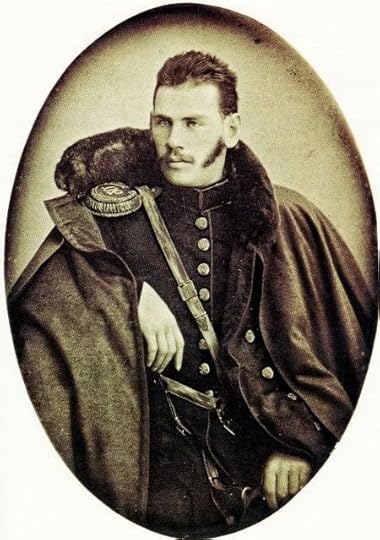

Tolstoy as a volunteer cadet

After a wild youth, Tolstoy joined the Russian army in the Caucasus in 1851 as a cadet volunteer; he was 22. By 1854, when the Crimean War broke out, he was now a regular officer. At his own request, he was posted to Sevastopol, then near the start of its eleven-month siege by French and British forces. Much of the Sevastopol Sketches, which launched his literary fame, is thinly-disguised reportage of what he himself experienced. It is this that would give him the authenticity to write War and Peace a decade later, although this earlier book is a much grimmer, more compact work: war, with no peace whatsoever. It may well (as another reader has pointed out) be the first eye-witness account of warfare written with an anti-war theme.

The stories form an interesting progression: in length, In date, in narrative technique, and above all in attitude. Each of the three stories is twice as long as its predecessor, at roughly 25, 50, and 100 pages respectively. In date, they cover the final nine months of the siege; they are labeled December 1854, May 1855, and August 1855; as these dates are old style, the final story ends with the surrender of Sevastopol, which took place on September 9, 1855, in the Western calendar.


British artillery firing on Sevastopol

Narratively, they begin with the eye of a reporter and end with the sensibility of a novelist. The December story is written entirely in the second person, as though the writer were showing you around. The effect is much like a newsreel, where the narrator tours the scene with a portable camera as he moves unflinching from the harbor to the fetid horrors of the hospital, into this barracks or that guardroom, and finally to the most notorious of the gun emplacements, the 4th bastion, amid an almost constant barrage of cannonballs and mortar shells. In the May section, Tolstoy introduces named characters, from a young prince and other aristocrats treating the war as a kind of social adventure, to hardworking regular officers and men with no such claims to privilege. But in his second-to-last paragraph he dismisses the lot of them, saying that nobody is capable of being either the villains or the heroes of his story.

The third and longest tale may not have heroes either, but it does have fully-realized characters. It begins with two brothers meeting up by accident on the road to Sevastopol. The elder has been wounded earlier in the siege, and sent away to convalesce before returning to his regiment. The younger is a volunteer, like Tolstoy originally was himself, and will be seeing battle for the first time. Their fond reunion tapers off into one of those human comments that could only be Tolstoy (if not Thackeray or Trollope):
When they had talked all they wanted to, and had finally begun to feel the way close relatives often do—namely, that although each is very fond of the other, they neither of them have terribly much in common—the brothers fell silent for quite a long time.
Subsequent chapters will shift between the two of them, gaining much from the contrast between the innocent and experienced views, and full of fascinating vignettes of their fellow soldiers—in the end showing that no man is immune to fear, but that there is a spark of heroism in all of us. The climax, seen interestingly through a telescope from a distant lookout, shows the capture of the vital Malakoff Hill by the French, which led to the Russian evacuation of the city the next day.
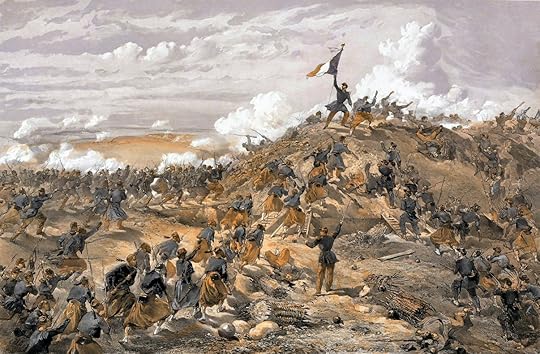

The capture of the Malakoff

As for the progression from patriotic fervor to numb despair in Tolstoy's increasingly disillusioned attitude to war, I can do no better than to quote brief excerpts from all three stories:
You will suddenly have a clear and vivid awareness that those men you have just seen are the very same heroes who in those difficult days did not allow their spirits to sink but rather felt them rise as they joyfully prepared to die, not for the town but for their native land. Long will Russia bear the imposing traces of this epic of Sevastopol, the hero of which was the Russian people. [December, 1854]

But the dispute which the diplomats have failed to settle is proving to be even less amenable to settlement by means of gunpowder and human blood. […] One of two things appears to be true: either war is madness, or, if men perpetrate this madness, they thereby demonstrate that they are far from being the rational creatures we for some reason commonly suppose them to be. [May, 1855]

Each man, on arriving at the other side of the bridge, took off his cap and crossed himself. But this feeling contained another—draining, agonizing, and infinitely more profound: a sense of something that was a blend of remorse, shame, and violent hatred. Nearly every man, as he looked across from the North Side at abandoned Sevastopol, sighed with a bitterness that could find no words, and shook his fist at the enemy forces. [August, 1855]
======

*I have since read and reviewed Beryl Bainbridge's rather odd novel Master Georgie and Cecil Woodham-Smith's classic history, The Reason Why. I know a lot more about the Crimean War as a result, but am none the wiser as to why it was not a more fruitful subject for fiction.
Profile Image for Adrian.
23 reviews15 followers
October 30, 2012
The Cossacks is a coming of age story based on Tolstoy's experience of the Caucasus and the cossack way of life when he was there as a young soldier. It's gripping enough and has beautiful passages, especially those where the landscape of the plains, rivers and mountains are described. You feel as though you are there - no-one can do that like Tolstoy. It's the work of a youngish writer though, with characters that feel a bit like archetypes, not always completely convincingly created.

Well at least not when compared with the last work in this book: Hadji Murad, which Harold Bloom has described as the finest story ever written. It's Tolstoy's final work, and one of absolute mastery. When reading it I couldn't help but feel its relevance, it has so much to offer to us in the era we live in.

People who have read it have probably been thinking the same thing about Hadji Murad since it was published one hundred years ago.
Profile Image for E. G..
1,175 reviews796 followers
December 24, 2016
Chronology
Introduction
A Note on the Texts
Maps


--The Cossacks

The Sevastopol Stories
--Sevastopol in December
--Sevastopol in May
--Sevastopol in August (1855)

--Hadji Murat

Notes
Glossary

14 reviews2 followers
December 7, 2007
Tolstoy, when you don't feel like committing to a thousand pages. It's great.
Profile Image for Amy.
771 reviews43 followers
March 10, 2024
I don’t think this is the best translation of these Tolstoy classics but regardless the writing touched me deeply. A few sittings included deep appreciation of Tolstoy’s ability to get to the raw nerve of human existence and proves to me once again, he is one of the greatest storytellers in history. Olenin’s transformation in The Cossacks and Ilyich’s introspection in The Death of Ivan Ilyich are pretty profound character studies and Tolstoy delivers transcendental experiences with his writing.
Profile Image for Fionnuala.
887 reviews
Read
December 5, 2019
It was one of those special evenings that occur only in the Caucasus. The sun had gone behind the mountains, but it was still light. The sunset had taken over a third of the sky, and the lustreless white masses of the mountains stood out sharply against it. The air was thin, motionless and resonant. A long shadow, extending for several versts, was being cast on the steppe by the mountains. Everywhere–on the steppe, beyond the river, along the roads–is deserted. If at the rarest of intervals men on horseback appeared, the Cossacks watched them from the cordon, as did the Chechens from the aul, with surprise and curiosity, trying to guess who these ill-intentioned people might be. As soon as it is evening, people slink off to their dwellings out of fear of one another, and only the beasts and the birds, not fearing man, freely roam in that wilderness. Before the sun goes down, the Cossack women finish tying up the vines and hurry from the vineyards, cheerfully talking. The vineyards, too, become deserted, like all the rest of the environs; but at this time of the evening the settlement grows particularly lively. From all sides, on foot, on horseback, or driving in creaking carts, people move towards the settlement. Girls in tucked-up shirts, holding switches, run to the gates, chatting cheerfully, to meet the cattle that are jostling together in a cloud of dust and gnats, which they have brought from the steppe. Well-fed cows and buffalo cows straggle about the streets, and the Cossack women in coloured beshmets scurry among them. One can hear their shrill talk, merry laughter and shrieks, interspersed with the bellowing of the cattle. There a Cossack, armed, on horseback, having requested leave from the cordon, rides up to a hut and, leaning over to the window, knocks on it: in response to the knock the pretty young head of a Cossack girl appears, and smiling, affectionate conversation is heard. There a ragged, high-cheekboned Nogay labourer who has arrived with reeds from the steppe turns his creaking cart around in the Cossack captain's clean broad courtyard, lifts the yoke from the oxen that are tossing their heads, and exchanges shouted conversation with the master.
This entire passage reads like the description of a painting.
26 reviews
March 26, 2020
The genius of Tolstoy is his ability to write complex characters and situations while still being easy to read. The simplest of the writing is in The Cossacks but still Tolstoy's eye for nuance is apparent. You feel as if you are living in close quarters with all the characters. The disillusioned Russian fleeing an empty upper class existence in Moscow to riding horseback, hunting pheasants and sitting around smoky campfires with the Cossacks.
Sevastopol stories I found fascinating. Perhaps biased by my current corona virus lockdown the stories of the town being under siege by the French and British during the Crimean wars were spellbinding. I gulped them all down in one sitting. No one writes war and people in war like Tolstoy and for anyone with even the slightest interest in this conflict these stories are a must read.
Hadji Murat is the story with the most complex writing in this book but still easy to read. Detailing the story of the mountain warrior Hadji Murat who defects to the Russians but lives with divided loyalties. Once again Tolstoy puts you smack dab in the life of all the characters. You are deep in the mind of Murat as he sorts out all his internal conflicts. You live with him and understand his culture his decisions and his motivations. Likewise you live shoulder to shoulder with the Russians at their fancy dinners, on their military exercises or swilling vodka and singing their hearts out in dusty tents on the frontier.
I love to read authors whose voice is loud and clear inside of me as I read and Tolstoy is one of the best at this. An unvarnished look at mid 19th century warfare in the Crimea and all the characters and cultures involved. Highly recommended.
Profile Image for Dary.
311 reviews17 followers
October 4, 2023
'Tis not easy, brother mine,
In a foreign land to live.


i thoroughly enjoyed reading all three of these (my edition contains "The Cossacks", "Happy Ever After", and "The Death of Ivan Ilyich")
766 reviews4 followers
October 17, 2018
The audio version has the narrator reading in British English, which for some reason was a little disconcerting. I found the description of the Cossack life interesting, but otherwise did not particularly connect with the story.
Profile Image for Kyle.
466 reviews16 followers
November 26, 2013
Mountain men on the edge of the Russian empire. Wonder if any of the djigits left the motherland for Canada, part of the Tolstoy-funded Doukhobors exodus?
Profile Image for Lindsey.
Author 6 books51 followers
February 28, 2023
I truly wish that I could give The Cossacks more than one star, as I greatly value Tolstoy's work -- not only his remarkable propensity for language, but his exploration of religion, philosophy, war, and the human condition. For these reasons, I loved Anna Karenina; it was simply the subject matter of this early work of his, I think, that failed to hold me captive.

The Cossacks and Other Stories contains the following "short stories" (in reality, they're novella-length):

1) The Cossacks;
2) The Sevastopol Stories;
3) Hadji Murat.

Of all of these, "The Cossacks" was probably my favorite. Though all are set against a backdrop of war in far eastern Russia, "The Cossacks" contained the most relatable characters who felt well-developed, and whose interests I genuinely cared about by the end. I knew how I felt about each, and could identify one from the next -- not something I could easily do in Tolstoy's other two stories.

Furthermore, "The Cossacks" presented more varied themes than just war; it is also a love story, which drew me in and made me more invested in the outcome. "Sevastopol Stories" and "Hadji Murat" were both too heavily focused on the battlefield for my liking, and I found my eyes glazing over at several points where there was simply too much repetitive action (there are numerous mentions of cannonballs, rifles, daggers, swords, etc.). To me, this action isn't a true story. Though Tolstoy certainly incorporated some salient (no pun intended) and thought-provoking gems in each story, there simply wasn't enough outside of the general theme of war to hold my interest.

One other note: I once tried to read War and Peace , but stopped when the sheer number of characters became too overwhelming for me. After listening to some literary podcasts/reading some book reviews, I now realize that it's not just me -- other readers are put off by the endless rotation of characters, as well. "Sevastopol" and "Hadji Murat" are a bit like that. Though I'm not suggesting that there were nearly as many characters in these works as there are in War and Peace, these stories did give me similar vibes. For me, the most effective literature introduces a handful of characters, who become irreplaceable and thoroughly memorable by the ending of the book.

...Then again, I read and loved Les Miserables and The Count of Monte Cristo, both of which are replete with characters, so maybe I just really don't care for the technique when it comes to Tolstoy.

1/5 stars. Would recommend reading "The Cossacks" as a standalone story, rather than this collection.
Profile Image for madeline.
111 reviews
Read
December 31, 2024
finally finished my last book of 2024!

happy to report that i have read my first publication from tolstoy! i've been meaning to get into his work (and russian literature in general) for quite a few years at this point. i know this collection of stories is kind of an odd choice to start with, but it was what i had on my shelf and i'm trying to focus on reading the books i already own. plus, because this is 3 stories (and not one very long novel), i figured it would be easier to digest. i really liked the first story, which i thought was both interesting from historical and literary standpoints. i even discovered a new favorite quote! however, i found the other two to be quite boring and couldn't help wishing they would end so that i could move onto something new. i don't normally push myself to finish stories if i'm not truly invested, but i wanted to understand how tolstoy orchestrates his tales. while i wasn't obsessed with this anthology, i am very excited to read more of tolstoy's work in the future :)
Profile Image for Lewis Woolston.
Author 3 books66 followers
September 3, 2021
I avoided the classic Russians for a long time because i was under the impression that they all wrote brick size books that were completely impenetrable and full of misery and doom.
Then i discovered Chekhov.
I loved his short stories with a passion and thought to myself that maybe i should try some other Russian short stories and then maybe work my way up to attempting War and Peace.
So this is the first Tolstoy i've read. I don't these short stories are in the same league as Chekhov but they're still pretty good. Not sure if i'm ready to tackle War and Peace just yet. I think i'll find some more short stories by Russian writers first.
Profile Image for Karan U.
27 reviews
May 15, 2024
I enjoyed reading both ‘The Cossacks’ and ‘Hadji Murat’ a lot. Both excellent novellas that I would recommend to anyone interested in shorter Russian literature. ‘Sevastopol Stories’ on the other hand didn’t do as much for me but nevertheless I’m very glad to have revisited Tolstoy’s work, I hadn’t read too much from him before but I am looking forward to reading more.
Profile Image for carla.
95 reviews1 follower
December 28, 2025
mha agradat molt la seva manera d’escriure, sento que no he començat pel llibre idoni per llegirme Tolstoy pro bno, tinc ganes de donar-li alguna altra oportunitat. quant al llibre està bé però és això el que més mha agradat és la seva manera descriure i el seu humor, podriem dir.
Profile Image for Haghia lubis.
23 reviews4 followers
February 3, 2018
A very good description of the facts surrounding every war,particularlu the factions and events surrounding that era-which are still relevant with current issues particularly with the rise of Islam.
Profile Image for Juri.
208 reviews
June 5, 2025
Ein junger Soldat findet eine neue naturnahe Heimat fernab vom Großstadtrummel. Ihm wird der dortige Lebensstil näher gebracht.. und seine Lebenseinstellung verändert sich.
Ein schöner kurzer Roman von Tolstoy! Es findet sich auch teilweise Andeutungen für seine späteren Werke.
This entire review has been hidden because of spoilers.
13 reviews
March 1, 2008
After spending almost three weeks in the Caucasus in the summer of 2007, Tolstoy's "The Cossacks" was familiar territory, even though I'd never read the book. Not much has changed since then - Russians are still fighting Chechens, Chechens view Russians with mistrust, and the Caucasus is a wild, untamed, and even mysterious place.

Set in what is likely now North Ossetia and Chechnya in Russia, "The Cossacks" is the story of the region in a microcosm: a Russian soldier, born of nobility, falls in love with a Cossack girl, and has to compete for her affections with a Cossack soldier. This tests his relationship with the Cossacks, and the friendship that our protagonist thought he forged with his fellow Cossacks ends up being not quite as deep as he thought it was. For this reason, the story ends on a rather poignant note. Tolstoy himself was stationed in the Caucasus during his stint in the Russian Army - but the extent to which this story is drawn from his real-life experiences is, to me, unclear at best. (I certainly hope he wasn't spurned like the story's protagonist was!)

"Sebastopol Stories", another short story in this collection, is drawn from Tolstoy's real-life experiences, this time in the Crimean War. It is a rather vivid and brutal portrayal of a city under siege, and one can see why Tolstoy ended his life as a pacifist.

Tolstoy's books brim with the eagerness of life and those who live it. The problem is that the translations of his works have often been lacking cultural context and sensitivity. For example, it is quite jarring to read references to "Mass" in Tolstoy's works, for this word refers to the Catholic rite and not the Orthodox Christian Divine Liturgy to which Tolstoy was most assuredly referring. Fortunately, the works of Tolstoy and other great Russian authors are being newly translated by the amazing husband-and-wife duo of Larissa Volokhonsky and Richard Pevear, who have breathed new life into these works by restoring not only the Russian cultural context but also Tolstoy's unique writing style. This Penguin Classics translation, unfortunately, is by David McDuff and Paul Foote, but a Volokhonsky translation won't be long in coming, I suspect.
This entire review has been hidden because of spoilers.
Profile Image for Pixie.
259 reviews24 followers
January 25, 2020
I usually really enjoy 19th century Russian authors but struggled a little with this Tolstoy novel, finding it a bit heavy going despite its enormous detail about a world & lifetime that no longer exists. I will keep on reading & hope for some progress. Finally finished, the stories got a little more interesting as I persisted with this book but would only recommend it for real aficionados of russian literature.
Profile Image for Todd Hogan.
Author 7 books6 followers
January 9, 2019
A masterful recreation of a Cossack village in the midst of a war-torn area by a master of detail. The village comes alive, the characters become real, and the dangers are ever-present although the villagers keep on with their daily lives. It's interesting to see the role Chechens and Muslim terrorists play in this short novel more than a hundred years ago. The deaths described in the novel occur with brutality, as in war they would, but are treated as an inevitable event. On the other hand, the love triangle that opens up in the story could only be doomed from the start.

A great piece of historical fiction by a master storyteller.
200 reviews
March 18, 2019
From a historical point of view, great. Paints a picture of 1850's Russia in both internal wars against Chechnya as well as the siege of Sevastopol in the Crimean war. These biographical events follow a picture painted of life amongst the Cossacks. Not a story to sit and read, but one to study and consider.
Profile Image for Emma.
61 reviews5 followers
April 17, 2015
happy ever after - 3.5/5
ivan ilyich - 4/5
cossacks - 3/5
Profile Image for Suzy R.
32 reviews
September 10, 2023
"Our garden and woods and fields which I had known so long, became suddenly new and beautiful to me. He was right in saying that the only certain happiness in life is to live for others." --family happiness


" But at each step the magic wall closed up again behind us and in front, and I ceased to believe in the possibility of advancing farther-I ceased to believe in the reality of it all.

'Oh, there's a frog!' cried Katya.

Who said that? and why?' I thought. But then I realized it was Katya, and that she was afraid of frogs. Then I looked at the ground and saw a little frog which gave a jump and then stood still in front of me, while its tiny shadow was reflected on the shining

clay of the path. 'You're not afraid of frogs, are you?' he asked.

I turned and looked at him. Just where we were there was a gap of one tree in the lime avenue, and I could see his face clearly-it was so handsome and so happy!

Though he had spoken of my fear of frogs, I knew that he meant to say, 'I love you, my dear one!' 'I love you, I love you' was repeated by his look, by his arm; the light, the shadow, and the air all repeated the same words." - family happiness

--------------


No, I said to myself involuntarily, 'you have no right to pity him and to be indignant at the lord's well-being. Who has weighed the inner happiness to be found in the soul of each of them? He is now sitting somewhere on a dirty door-step, gazing at the gleaming moonlit sky and gaily singing in the calm of the fragrant night; in his heart there is no reproach, or malice, or regret. And who knows what is now going on in the souls of all the people within these palatial walls? Who can tell whether among them all there is as much carefree benign joy in life and harmony with the world as lives in the soul of that little man? Endless is the mercy and wisdom of Him who has allowed and ordained that all these contradictions should exist. Only to you, significant worm, who rashly and wrongly try to penetrate His laws and His intentions-only to you do they seem contradictions, He looks down benignly from His bright immeasurable height and rejoices in the infinite harmony into which all your endless contradictory movements resolve themselves. In your pride you thought you could separate yourself from the universal law. But you, too, with your mean and petty indignation the waiters, have been playing your necessary part in the eternal and infinite harmony
--- Lucerne


--------------


Formerly, solitude and the absence of anyone who might have attracted her attention had caused the power of love, which Providence has given impartially to each of us, to rest intact and tranquil in her bosom, and now she had lived too long in the melancholy happiness of feeling within her the presence of this something, and of now and again opening the secret chalice of her heart to contemplate its riches, to be able to lavish its contents thoughtlessly on anyone. God grant she may enjoy to her grave this chary bliss! Who knows whether it be not the best and strongest, and whether it is not the only true and possible happiness?

O Lord my God,' she thought, 'can it be that I have lost my youth and happiness in vain and that it will never be. ...never be? Can that be true?' And she looked into the depths of the sky lit up by the moon and covered by light fleecy clouds that, veiling the stars, crept nearer to the moon. 'If that highest white cloudlet touches the moon it will be a sign that it is true,' thought she. The mist-like smoky strip ran across the bottom half of the bright disk and little by little the light on the grass, on the tops of the limes, and on the pond, grew dimmer and the black shadows of the trees grew less distinct. As if to harmonize with the gloomy shadows that spread over the world outside, a light wind ran through the leaves and brought to the window the odour of dewy leaves, of moist earth, and of blooming lilacs.

'But it is not true,' she consoled herself. "There now, if the nightingale sings tonight it will be a sign that what I'm thinking is all nonsense, and that I need not despair,' thought she. And she sat a long while in silence waiting for something, while again all became bright and full of life and again and again the cloudlets ran across the moon making everything dim. She was beginning to fall asleep as she sat by the window, when the quivering trills of a nightingale came ringing from below across the pond and awoke her. The country maiden opened her eyes. And once more her soul was renewed with fresh joy by its mysterious union with Nature which spread out so calmly and brightly before her.
-two hussars
This entire review has been hidden because of spoilers.
Profile Image for Lenny Husen.
1,115 reviews23 followers
August 10, 2018
If I could give a book greater than 5 stars... Alas, 5 out of 5 will have to do.
This was amazing. Tolstoi is my favorite author and has been for many years. These stories were unforgettable. Some I liked better than others; all were very moving and rang true. My copy of the book was published in 1899 and the stories were all written in the 1850's.
The Cossacks, which takes place in the Caucasus, was about romanticizing a culture alien from one's own, seeking simplicity and acceptance in a simpler life. I identified with the Yunker, Olyenin, who wanted so badly to fit in and failed miserably.
Sevastopol (three stories/essays) was historical on the theme of the horror and pointlessness of war, the Crimean War to be precise.
"The Invaders" is about the dreadful Caucacus conflict, a different spin than "The Cossacks" and a very depressing story. But it contains this:
"Nature breathed peacefully in beauty and power.
Is it possible that people find no room to live together in this beautiful world, under this boundless stary heaven? Is it possible that, amid this bewitching Nature, the soul of man can harbor the sentiments of hatred and revenge or the passion for inflicting destruction on his kind? All ugly feelings in the heart of man, ought, it would seem, to vanish away in this intercourse with Nature---with this immediate expression of beauty and goodness!"
"The Wood-Cutting Expedition" is notable for the description of the Three Types (with many subdivisions) of Soldiers.
"An Old Acquaintance" is notable for the narrator wanting to help someone who is beyond help, and yet the narrator's compassion makes the story.
"The Snowstorm" is great because no one dies. Whew!
"Polikushka" is about a Serf who commits suicide, and the lives touching that life.
"Kholstomer" is the story of a great and beautiful swift Horse, one of the best characters ever. I keep thinking about this story--it haunts me, is terribly sad and yet somehow gives me more hope than I have possessed in over 2 years.
Profile Image for Zulfiqar.
105 reviews4 followers
February 12, 2018
A semi biographical account mixed with historical realism witnessed firsthand by Tolstoy. The setting takes place in the mountainous Russian Caucasus countryside bordering several Kazakh, Tartar and Chechen territories surrounded by indigenous tribesmen known as Cossacks. These areas are currently under Imperial Russian Occupation having annexed in a series of wars during the expansion of Czar Ivan the Terrible. A young army officer from Moscow, Tolstoy becomes fascinated with the social norms and customs of the Cossacks, a lawless militia of frontiersmen horse riding, fur garment, excessive drunken escapades and dance, begins to write a novel. The main protagonist Olenin, a Russian solider and citizen is sent to serve the Empire along it's border only to embrace their customs and beings to have caring feelings with a Cossack girl.
574 reviews6 followers
November 26, 2018
I read this book during my years of 'discovery '. The time I was reading everything that fell into my hands, or recommended to me. I didn't know then that 19th century literature is so dull and heavy on the chest (if I may say in my very humble opinion ). This book had a different and lighter mood. It was more pleasant and colorful than most of what I read during that era. I'm not expert enough to decide whether that was due to the fact that this was a Tolstoy or whether it was due to the Russian taste of literature of that time.
Displaying 1 - 30 of 75 reviews

Can't find what you're looking for?

Get help and learn more about the design.