Jump to ratings and reviews
Rate this book

Star Trek: Logs #3

Star Trek: Log Three

Rate this book
More lively adaptations from television's most popular science-fiction series!

—Complete in this volume—

Once Upon a Planet: The crew lands on a planet for rest and recreation, a planet programmed to play out each person's favorite fantasies. Suddenly, the system runs amok, and the crew is chased by fantastic creations of their own imaginings.

Mudd's Passion: That reprobate trader Harry Mudd smuggles a love potion aboard the Enterprise. The first two people affected are Nurse Chapel and—would you believe—Mr. Spock.

The Magicks of Megas-Tu: Captain Kirk and company meet a strange goat-man named Lucien on a mysterious planet. But why does he look so familiar?

215 pages, Mass Market Paperback

First published January 1, 1975

2 people are currently reading
367 people want to read

About the author

Alan Dean Foster

498 books2,033 followers
Bestselling science fiction writer Alan Dean Foster was born in New York City in 1946, but raised mainly in California. He received a B.A. in Political Science from UCLA in 1968, and a M.F.A. in 1969. Foster lives in Arizona with his wife, but he enjoys traveling because it gives him opportunities to meet new people and explore new places and cultures. This interest is carried over to his writing, but with a twist: the new places encountered in his books are likely to be on another planet, and the people may belong to an alien race.

Foster began his career as an author when a letter he sent to Arkham Collection was purchased by the editor and published in the magazine in 1968. His first novel, The Tar-Aiym Krang, introduced the Humanx Commonwealth, a galactic alliance between humans and an insectlike race called Thranx. Several other novels, including the Icerigger trilogy, are also set in the world of the Commonwealth. The Tar-Aiym Krang also marked the first appearance of Flinx, a young man with paranormal abilities, who reappears in other books, including Orphan Star, For Love of Mother-Not, and Flinx in Flux.

Foster has also written The Damned series and the Spellsinger series, which includes The Hour of the Gate, The Moment of the Magician, The Paths of the Perambulator, and Son of Spellsinger, among others. Other books include novelizations of science fiction movies and television shows such as Star Trek, The Black Hole, Starman, Star Wars, and the Alien movies. Splinter of the Mind's Eye, a bestselling novel based on the Star Wars movies, received the Galaxy Award in 1979. The book Cyber Way won the Southwest Book Award for Fiction in 1990. His novel Our Lady of the Machine won him the UPC Award (Spain) in 1993. He also won the Ignotus Award (Spain) in 1994 and the Stannik Award (Russia) in 2000.

Ratings & Reviews

What do you think?
Rate this book

Friends & Following

Create a free account to discover what your friends think of this book!

Community Reviews

5 stars
116 (18%)
4 stars
231 (35%)
3 stars
242 (37%)
2 stars
50 (7%)
1 star
3 (<1%)
Displaying 1 - 26 of 26 reviews
203 reviews6 followers
Read
September 11, 2017
Continuing, after quite some delay, my series of reviews of Treklit, we come to Alan Dean Foster’s Star Trek Log Three , another in his series of novelizations of Star Trek: The Animated Series. This volume contains adaptations of “Once Upon a Planet”, “Mudd’s Passion”, and “The Magicks of Megas-Tu”.


Once Upon a Planet

This story is a sequel to the TOS episode “Shore Leave”, in which the Enterprise happens upon a ‘shore leave planet’ that is designed just to satisfy, as Kirk noted, the need of complex minds for the simplicity of play.

The Enterprise has been overtaxed, lately (the stories in these novelizations are written as taking place in sequence), so Kirk asks for something special in the way of reward for the crew, and he gets it: approval for shore leave on the Shore Leave Planet, in the Omicron region.

Upon arriving, Uhura, Sulu, and McCoy beam down together and note that everything seems to be as it was when last they saw the planet, down to the appearance of Alice and the White Rabbit. They go their separate ways in order to enjoy their own–private–fantasies, but McCoy has scarcely come into view of the Southern mansion he dreamed up when he is set upon by armed playing cards, straight out of Alice, who attack him in deadly earnest. He manages to call for an emergency beam-up just in time to escape them.

Shore leave is canceled as the crew of the Enterprise strive to determine why the planet is attacking, why the Keeper didn’t intervene, and what has happened to Uhura, who has vanished without a trace.

This story is pretty good, and translated well by Foster.

Mudd’s Passion

Cutting shore leave somewhat short, the Enterprise is ordered to investigate the activity of an old ‘friend’, Harry Mudd, who we last saw in “I, Mudd”. He is up to his old tricks, swindling people far and wide. This time, he’s selling a love potion.

This story is very thin and no better for Foster’s efforts.

The Magicks of Megas-Tu

The Enterprise is sent to investigate the unusual phenomena at the center of the galaxy, including a ‘negative black hole’ busily ejecting matter, which they presume to be the source of all matter in the galaxy, drawing its energy from a multitude of other universes. Then they begin to be drawn into a cone-shaped vortex which is drawing in–and destroying–matter, from which the Enterprise cannot escape. They gamble that it may be safer in the center of the vortex, and, passing through it, they find themselves in another place, strange to them, operating by no known laws.

The delicate equipment of the Enterprise does not take kindly to this lawlessness, and begins to fail. The crew, dependent on this equipment, begin to fail as well. When the situation has grown most desperate, the Enterprise is suddenly saved by a strange alien–half man, half goat–who appears on the bridge. He restores their environment with what appears to be magic, then introduces himself:

“Who am I? Oh, you want a name! Call me Baal.” He paused thoughtfully. “Or Lucien. Yes, Lucien. But above all, call me friend.” One finger fluttered skyward as he declaimed, “Never could I abandon those who have come so far to frolic with me . . . for such purpose you must have been sent.”


Lucien introduces the to the planet Megas-Tu, where the physical laws correspond to what the humans would call magic. His people had ventured out of their own universe before and encountered Earth, but their welcome had not been so warm. When others of Lucien’s people discover the humans, they quickly put them on trial for the crimes of their species, as exemplified by the Salem witch trials, in which, weakened by the distance from their own world, the Megans were persecuted and even burned.

Kirk argues that if humans were once so savage, they have changed, and continue to strive to change, to be better and more noble. The Megans accept that this may be so, but declare that Lucien still must be punished for bringing the humans to Megas-Tu. Kirk defends him, as well, accusing the Megans of being as cruel as they accused the humans of being. In so doing, he passes a secret test, proving by his concern for Lucien, known also as Lucifer, that humans truly have changed. Should humans again visit Megas-Tu, they would find a warmer welcome.

Where to begin with this one? The adaptation is good–superior to the original. It spends too long on the setup and not enough on the resolution, but it’s still well done. As for the story, it was obvious to anyone just who a goat man named Lucien would turn out to be, but it was satisfying, all the same. Kirk and McCoy question whether Lucien was really the Lucifer of myth, and McCoy concedes that it doesn’t really matter, except:

“It’s just that–if he was, Jim–this would be the second time he was on the verge of being cast out. But thanks to you, this is the first time he was saved.”
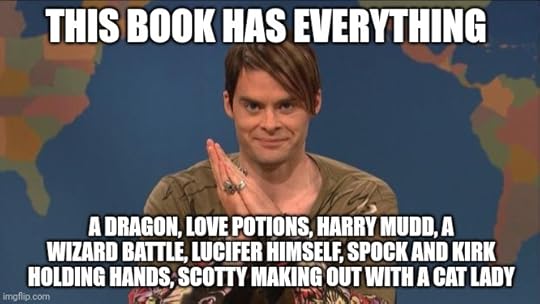

The author of this episode, Larry Brody, indicated that originally, the Enterprise was to meet God out in space, but that idea was nixed by the censors. But meeting the Devil in space was fine, and so the episode was born. This episode must have been influential, indeed. In the first episode of Star Trek: The Next Generation, “Encounter at Farpoint”, Q puts the crew of the Enterprise on trial for the crimes of humanity, and Picard, too, argues that Q should consider whether humanity is presently as savage as in times past. Then in “Where No One Has Gone Before”, the Enterprise is taken to the edge of the universe, and find it a strange place where reality is impacted by thought. Then, in Star Trek V: The Final Frontier, the Enterprise (under Kirk’s command, this time) visits the center of the galaxy, where they find a godlike being who turns out to be evil.

In summary

The first and last stories in this are quite good, though the middle one is forgettable. That’s a pretty good ratio for novelizations of television episodes. “Once Upon a Planet” is perfectly like any Trek episode you’ve ever seen, and “Mudd’s Passion” is like most of the bad ones. “The Magicks of Megas-Tu” isn’t a top-tier story, but it’s pleasant enough, and interesting in how it presages later Trek. If you’re a Trek fan looking for a little light reading, this book isn’t bad.
Profile Image for Rafeeq O..
Author 11 books10 followers
April 6, 2025
Alan Dean Foster's 1975 Star Trek Log Three contains 3 stories adapted by Foster from the screenplays of the early 1970s animated cartoon television series that had been spun off from the original acted series of half a dozen years earlier.

Never having seen the animated series, I can make no comparison between the original episodes and Foster's adaptations, in the way I occasionally have with James Blish's adaptations of the original series. I can comment, though, that the cartoon series evinces some differences from the acted series. Here, for example, we have a handy piece of technology called a "life-support belt," which creates a very thin but tough force field, meaning that characters can stomp around in vacuum or poisonous atmospheres as if in a spacesuit. And of course another product of the animated nature of the show is that we have a few alien crew members--three-legged and three-armed, cat-like, or winged, for example--who would have been too expensive to produce every week via elaborate costuming, along with other odd aliens occasionally encountered. These differences are commonsensical, at least in science fiction, and they do not draw attention to themselves unduly.

"Once Upon a Planet," whose original script was by Len Janson and Chuck Menville, takes us back to the pleasure planet of the Omicron system first visited in "Shore Leave" by Ted Sturgeon in the acted series, a planet "programmed long ago by some unknown but highly advanced alien race," with "extensive mind-reading devices and attendant manufacturing machinery capable of materializing any fantasy they can pick up" (1979 Del Rey paperback). Here, already on approach to the planet, "normal ship efficiency is down twenty-two percent from the standard level" due to "ship's personnel [being] so involved in plotting out the elaborate fantasies they hoped to enjoy that only automatic instrumentation kept the Enterprise in working order" (page 9). Still, it's all fun and games...until the central computer no longer seems to be protecting the revelers from danger.

"Mudd's Passion," whose original script was by Stephen Kandel, brings back roguish interstellar conman Harry Mudd, this time wanted for "[f]raud, illegal drug manufacturing, swindling...for openers" (page 97). Accompanied by a "delicate yet voluptuous" girl with a "low and throaty" voice who "gaze[s] up at him with an expression of rapturous adoration, the kind classical painters usually reserved for angels adoring the Magi" (page 95), Mudd is selling a love potion. But is it truly as bogus as the Venus drug of "Mudd's Women" from the original series...?

In "The Magicks of Megas-Tu," whose original script was by Larry Brody, we journey to the center of the galaxy, where the Enterprise is to examine "the rarest single structure in the known universe: a negative black hole--one that ejects, rather than attracts matter" (page 163). That is, here we might prove the hypothesis that "all matter in our universe has been drawn from other universes" "and that our black holes may each well be the galactic center of other star clusters" of other universes (page 163). But the title also refers to magic, does it not? Thus of course we will take a wild ride through the chaos to another dangerous planet where yet again Humanity Must Be Judged...

All stories are good. In terms of minor annoyances, a punctuational problem in the previous two books in the series--unevenness of correct use of quotation marks when quoted speech continues without break from one paragraph to another--fortunately is absent here. There were, however, a few noticeable instances of the possessive its, as in something like, say, "The split rock showed its interior," being given as the mistaken it's instead, which is quite odd, so...hmm. Still, I think it likely that the error is not Foster's but that of some random dingus down in Copyediting.

In any event, Alan Dean Foster's Star Trek Log Three may begin with stories originally from a cartoon show, yet the adaptations are well done and aimed at an adult audience, and for any fan of the starship Enterprise and its historic five-year mission, the book will be a swift and enjoyable 5-star read.
Profile Image for Rex Libris.
1,335 reviews3 followers
March 1, 2020
Of all of the series I have read so far, this has fallen into the most outright hackery and unoriginal thinking. Two of the stories rely on recycled plots from the original series: The Alice in Wonderland planet and a Harry Mudd adventure. The third is a very tired and old trope, a Salem Witch Trial riff.
Profile Image for SciFiOne.
2,021 reviews39 followers
December 10, 2017
I own and have read all ten but have them them grouped in one record in my listing. I started reading them again in 2014.

1976 average grade B
2014 average grade B-

Animated Trek, three stories per book.
B+/A-, B, B-
Profile Image for Wayne.
13 reviews
October 27, 2019
More awesome adventures with the crew of the USS Enterprise.
Profile Image for Fredric Rice.
137 reviews6 followers
May 24, 2022
Pretty much cookie-cutter short story series roughly based on the Star Trek original series. Nothing special, really, and rather silly these days.
223 reviews
August 7, 2022
Took longer than watching an episode of ToS, but even more enjoyable. :)
This entire review has been hidden because of spoilers.
Profile Image for Kevin.
487 reviews2 followers
June 29, 2011
I really enjoy reading the original series novels and yet, sadly I was disappointed with this book. The first and third stories were okay but I really hate Harry Mudd so I just tried to get through the middle story as fast as I could. Unfortunately the two that were just okay were merely that. Okay. I wasn't blown away by them and I felt that the Magiks of Mesa-tu was just a little bit too tongue in cheek although it was slightly enjoyable. I know I sound like I am contradicting myself but that's how I feel about this short book. I always enjoy reading about the star trek crew but these were not the best stories I have read.
Profile Image for Rich Meyer.
Author 50 books57 followers
November 26, 2014
The third Star Trek Log again has Alan Dean Foster doing a trio of adaptations from scripts of the animated Star Trek series. This volume features two sequels to TOS episodes ("Once Upon a Planet," a sequel to "Shore Leave" and "Mudd's Passion," using Roger C. Carmel's inimitable rogue), and an original on ("The Magicks of Megas-Tu"). For once, all three are relatively entertaining. One has to wonder how much better the stories might have been had Foster actually watched the show instead of just using the shooting scripts. "Mudd's Passion" has Spock considerably out of character, even being under the influence of a "love potion," but it is still a fun read.
Profile Image for Leo Knight.
127 reviews2 followers
May 27, 2014
Another thrift store find, I had great fun reading these three tales based on episodes of the animated series. I vaguely recall seeing a few of the animated episodes from my childhood. Alan Dean Foster did a great job of bringing the familiar characters to life, and fleshing out what were probably fairly sparse half hour scripts into readable stories. I especially enjoyed "Mudd's Passion", as it brought back one of my favorite characters, that incorrigible rogue, Harry Mudd. I took great joy imagining actor Roger C. Carmel's delivery as I read his dialogue.
Profile Image for Joseph.
36 reviews
April 29, 2016
An excellent read. Foster has a gift for imagery seldom found in literature of any kind. The only problem, and a minor one at that, is some scene transitions aren't clearly indicated, so the story will occasionally jump settings without the reader being initially aware. A small price to pay for such vivid descriptions, though.
280 reviews9 followers
September 7, 2007
(I have read this book at least three times.)

Though this book drags a little, the final story--"The Magicks of Megas-Tu"--is well-treated. Overall, it's an enjoyable and well-executed novelization. Perhaps I enjoyed it so much because it may be "comfort reading" ;-)
Profile Image for Zachary.
Author 18 books27 followers
January 4, 2017
They're quick, easy reads. It's interesting how in my head the characters sort of shift between the original cast, the reboot cast, and the animated cast (the Logs are novelizations of Animated series episodes, usually three to a log).
Profile Image for Baal Of.
1,243 reviews82 followers
March 12, 2015
Enjoyable fun for a fan, but not the greatest volume. A lot of revisiting of themes that had already been done in the original series.
Profile Image for Vincent Darlage.
Author 25 books64 followers
November 1, 2014
A fun collection of stories. They have a real sense of menace to the characters despite the problem of knowing they'll survive. Imaginative and fun.
Profile Image for Tim Ristow.
67 reviews
April 19, 2017
Another of Foster's adaptations of Star Trek The Animated Series (TAS) episodes. This volume features the episodes "Once Upon a Planet", "Mudd's Passion" and "The Magicks of Megas Tu". The first two are sequels to original series episodes "Shore Leave and "I Mudd", respectively.

I've read some of the later volumes in the "Log" series and Foster's writing seemed to get better as the series went along. I did find his "Log One" to be a good first volume to launch the series. But this third volume is definitely lacking. Each of these stories contained here are very similar to their animated counterparts, with minimal additions and little expanded dialogue. However, having watched each of the animated episodes on which these are based, I have to say that these stories do tend to play much better in written form than on screen, especially "The Magicks of Megas Tu".

Nothing really special here but worth it for Trek fans looking for a quick weekend read.
Displaying 1 - 26 of 26 reviews

Can't find what you're looking for?

Get help and learn more about the design.