First edition. Written and illustrated by Valenti Angelo. The story of his childhood in Tuscany, Italy and his immigration to America when he was eight. This is the first book authored by Angelo. 85. Many illustrations. Presentation from Angelo to Charles B. Barrett on the free endpaper. Endpapers yellowed; spine slightly faded. 244 pages. cloth, dust jacket.. 8vo..
What a sweetly poetic story Valenti Angelo's Nino has (and surprisingly) proven to be! Informative, gentle, and Nino's artistically visual nature is certainly and glowingly presented, often in direct contrast to the more standard (but equally endearing) nature of his best friend Julio, who seems to always be hungry, is more mischievous than Nino, but is also very musical. And I do very much love the gentle and supportive family and neighbourhood atmosphere of Nino and how early 20th century rural Italian life is so lovingly and descriptively depicted, albeit also perhaps just a trifle overly nostalgically and too positively at times.
Now right at the end of the novel, right at the end of Nino, a letter comes from the father (who does not appear as a character in the novel, as he had immigrated to the United States a few years previously), and it looks as though the mother, Nino and even the grandfather will now be joining him in the USA. But really (and this is the only part of Nino with which I personally have had a bit of an issue) no reason is ever in my opinion truly given (within the scope of the narrative) as to why the father ended up immigrating to the States in the first place, and I continue to be left with a sad and frustrated, even somewhat annoyed feeling that Nino, his mother and grandfather are giving up a type of rural Italian paradise (and one where even art and famous artists, where culture and cultural achievements are honoured and feted) for an at best rather uncertain future in America.
And finally, as much as I have enjoyed and even treasured Nino (and think I would have equally enjoyed it as a child), I do wonder a bit whether modern children (who seem to have been raised on novels with much more excitement, adventure and "issue based" themes) would appreciate and be able to equally savour and appreciate the descriptive and at times slow cadences of Nino. And yes, I also do rather wish that the author (that Valenti Angelo) had provided a map of the region, especially since the area, the villages etc. really do actually exist (I did some research on Wikipedia to verify this, but it sure would have been easier, had Nino contained even a rudimentary map).
Young Nino is growing up on a farm in the village of Massarosa in the province of Lucca in 1905 Italy. He lives with his mother and grandfather, his father having gone to America. The reader sees Nino grow to the age of 9 and reads about that one important year of his life. Nino experiences an idyllic childhood with farm chores, art, church and playtime with his mischievous best friend Julio.
Thank you to my friend Manybooks for bringing this story to my attention. I really enjoyed it and it reminded me very much of my own family's story. My great-grandmother was educated by nuns and ran the family farm and raised the children while her husband was in America. Like Nino, my Nonnie grew up on a farm on the outskirts of the village with no modern amenities. She played outside and waited for letters from her father she had never met.
Unlike my grandmother's childhood, Nino's life is idyllic. Everyone he knows is kind and caring and he hardly has any work to do. His mother and grandfather are loving and patient with him and encourage Nino's interest in art. I found Nino just a bit too good for me. I enjoyed his best friend Julio much more. Julio is mischievous, naughty and spoiled. His parents indulge him. Even the priest is jovial and doesn't lecture. What ruined the book for me was Nino's mother's snide comment about not having animals in her house, that's what they do in Naples but not HERE. In Naples they kept the animals in the barn in the basement of the house, not IN the house proper. There were other comments about other locales but the one about Naples bothered me because of the north vs. south prejudice that affected my family for generations.
The setting is beautiful and will make you want to visit Tuscany.
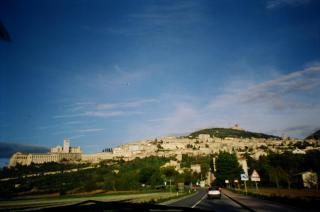
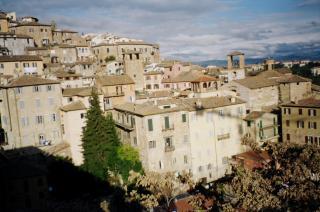
My family photos of village in the Tuscan hills
Despite the idyllic lifestyle on the surface of the novel, adult readers will pick up on adult concerns such as the weather: what happens if it rains too much or if there's a draught? The men also half worry about the encroaching Industrial Revolution. In America everything is made in factories! What would happen to the farmers if factories came to Italy? Factory work provided steady wages and possibly more opportunities to get ahead.
The simple illustrations are lovely and really evoke the time and place but they would be better in color. I do not think this book will appeal to a modern audience of children used to being bombarded by multimedia. It's just too slow and too simple. This story reminded me of Farmer Boy by Laura Ingalls Wilder. I highly recommend this to children and grandchildren of Italian immigrants who made their way from what now looks like an idyllic paradise to American cities and towns. I wish I had discovered this book as a child so I could have read it with my Nonnie and seen what memories it prompted.
I finally got a chance to read this Newbery Honor book and I did enjoy it. It reminded me much of Dobry, a quiet story of a happy boyhood in the Old Country. But of course Valenti Angelo's book is autobiographical: http://www.catholicauthors.com/angelo....
But, no, I cannot guess why the father went to America. I find no evidence he would have been an activist escaping persecution or anything like that, as there was no revolution or civil war at the time. The family was one of the more comfortable in the village, Nino makes clear in the chapter about harvest and the gleaners. There's no evidence of local scandal. It's just odd.
For heaven's sake, why would you leave a prosperous farm to live in, surely, a tenement in New York City? I know I idealize (and idolize) an Italian peasant existence, but damn, not without reason.
The book mentions Viareggio, putting the farm near the coast in the north. They grow corn and olives, eat risotto and polenta, goat's cheese and lamb, chestnuts and wine. Bliss. But off they go to America: another bit of propaganda.
Of course, as a children's book it glosses over political and economic repression and other such adult motivations. The male protagonist, born around the 1900, is the perfect age to die in WWI, but moving to the United States will only postpone his being drafted.
2.5+ stars. Here's another pleasant book from the 1930s, this one written by Valenti Angelo (illustrator of 1937 Newbery Award winner Ruth Sawyer's "Roller Skates") and idyllically fictionalizing his childhood in turn of the century Italy. The child Nino (literally "boy") is the son of a man who immigrated to the US - either shortly after birth or during the wife's pregnancy. The mother, grandfather, and Nino live comfortably on a farm with enough money and food evidenced in one chapter about a harvest when Nino is pitying the poorer residents who are gleaning in the fields after his family's harvest. The story follows Nino from swaddled babe carried into the fields while his mother works until he's in the 6-10 year old range. Some of the highlights are a trip to the larger town when he's 4 to get a family picture taken to send to his father, a description of a fair, and one towards the end of the book of Christmas in the village. Other readers have noted that it's a mystery why the father left the village. There doesn't seem to be an economic or political reason, and certainly not a legal reason given the respect of the other villagers, but then that's not the point of the book. I read this for my 2018 Reading Challenge and my Newbery Challenge (Honor Book 1939).
A charming book full of the ordinary realities of Italian village life. The inclusion of the village's Catholic activities are welcome, showing how religion was entwined with all aspects of life. I learned that Angelo himself was an altar boy, so the detailed descriptions of the Mass are accurate.
The illustrations are lovely - Angelo was an artist, first and foremost. We have May Massee of Viking to thank for his writing, which is simple and straightforward, communicating well. I look forward to reading the sequel (and other books by Angelo).
I was surprised to see mention of a gypsy bear in this book - hadn't I just read another book that included this oddity? Yes, Dobry. I guess this was more common than I would have supposed. That's not the only similarity: like Dobry, this is a book about a European kid in a small village who is growing up to be an artist. We get lots of food, music, celebrations, etc. There's a little bit of character development, but not a great deal. It's mostly about the neighbors and friends and the joy of the everyday.
This is a story about a young boy, Nino, his mother, his grandfather, and their close friends/neighbors the Ditto family. In this book we get a glimpse of the life of well-to-do peasants from a small village in the hills somewhere in Italy around 1910-ish. The father lives and works in America. The book mostly covers important cultural events - the Spring fair, Easter, Christmas, and the like. It was okay, but I really liked the last chapter. Tied everything together with the culture here in America. A little slow at times, but it's worth it to get to the end. :-)
I loved Angelo's illustrations of village life in Italy. Life in 1900 Italy is undoubtedly idealized, but I don't hold anything against the book because of that. It's a beautiful book that, for me, calls to mind Laura Ingalls Wilder in its portrayal of the simple pleasures of rural life. Angelo's nostalgic feeling for a time now past in Italy comes through strongly. I recommend this book, but only for a certain type of reader with special interests. I can't think of many children off-hand in my elementary school who would be interested in it.
This book was written in 1938 and is a good book but I wouldn't say it was excellent. The book is about the life of Nino in Italy whose father is in America. Nino has little adventures, we learn about the life of a small town community and the fun things that children did. The chapters cold stand on their own, they are loosely linked but there's no really "problem" or "problems" that would encourage a young reader to continue to read this book. I forced myself to finish this book just because I have committed to reading Catholic Children's Literature and want to get a good idea of the various literature available to children. This book brings in some Catholic themes but doesn't really focus on faith as much as it could have. So in the end, I don't think a young child would want to read this book, unfortunately.
A young Italian boy spends his days in the fields with his mother and at home with his grandfather, thinking of his father, who has traveled to America. Inventive neither in its story or its writing, this one. Another Newbery Honor Book that hasn't aged particularly well, I think. *shrug*
This book was fine. It is very descriptive of life in this Italian small town in this time period. The plot is episodic, and some chapters are more interesting than others.
I love Nino's character. Throughout the book he finds beauty in everything, and the author does an amazing job of painting the world through his eyes with the text. I loved reading about Nino's adventures with Julio, a boy very different from himself in personality. The characters and chapters were so fun to read.
This book was cute and had potential. It did a good job of describing Italian Culture during the 1900's. However, the book moved slowly and did not keep my interest very long. Even though I eventually finished it, I kept putting the book down in favor of other books. As I am far removed from the target audience, it may be of interest to younger readers.
Interesting look at life in Italy - family life as little Nino grows up. His father is off working in the U.S. This is still a timely and interesting story.